中国戈壁针茅草原的分布、群落特征和分类
- 1 内蒙古大学生态与环境学院, 呼和浩特 010021
2 中国林业科学研究院荒漠化研究所, 北京 100091
3 中国科学院植物研究所植被与环境变化国家重点实验室, 北京 100093
4 中国科学院大学, 北京 100049
网络出版日期: 2018-06-01
基金资助
国家科技基础性工作专项重点专项(2015FY210200);国家自然科学基金(31670532)
Distribution, community characteristics and classification of Stipa tianschanica var. gobica steppe in China
- 1 College of Ecology and Environment, Inner Mongolia University, Hohhot 010021, China
2 Institution of Desertification Studies, Chinese Academy of Forestry, Beijing 100091, China
3 State Key Laboratory of Vegetation and Environmental Change, Institute of Botany, Chinese Academy of Sciences, Beijing 100093, China
4 University of Chinese Academy of Sciences, Beijing 100049, China
Online published: 2018-06-01
Supported by
Supported by the National Special Program on Basic Works for Science and Technology of China(2015FY210200);the National Natural Science Foundation of China(31670532)
摘要
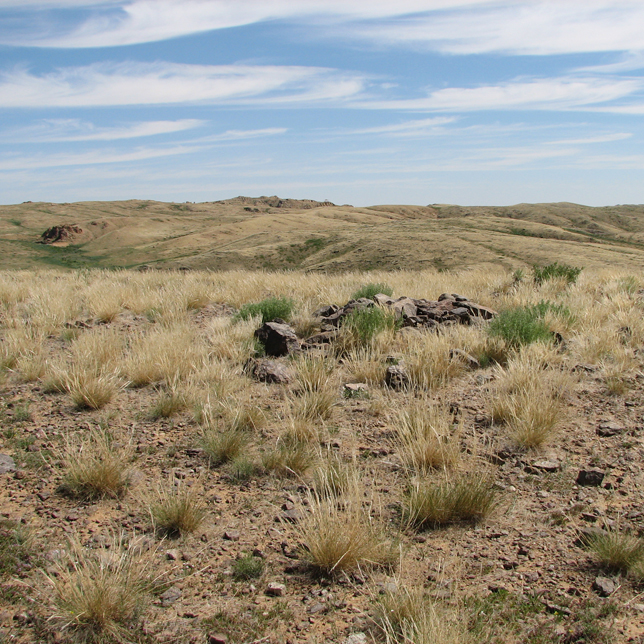
戈壁针茅(Stipa tianschanica var. gobica)草原主要分布于荒漠草原区的石质丘陵或石质山坡, 向东可以分布在典型草原区的石质丘陵或山地, 向西也可以分布在荒漠区的石质山坡上。该研究调查了中国戈壁针茅草原的主要植被类型, 通过对115个样地的样方数据分析, 量化描述了这一草原类型的主要植物群落特征。结果表明, 中国戈壁针茅草原共有维管植物272种, 隶属于38科127属; 其中裸子植物3种, 隶属于1科1属; 被子植物269种, 隶属于37科126属, 物种数大于等于10种的科为: 菊科、禾本科、豆科、蔷薇科、百合科、藜科、石竹科; 戈壁针茅草原植物区系的生活型谱以地面芽植物为主, 共178种植物, 占总种数的65.44%; 水分生态类型以旱生植物为主, 共120种, 占总种数的44.12%; 植物区系地理成分上以东古北极分布种和亚洲中部分布种(含其变型)最多, 分别为82种和80种, 占总种数的30.14%和29.41%; 盖度等级划分上以0.1%-1.0%的盖度最多, 共174种, 占总种数的63.97%; 恒有度等级划分上以I级(0-20%)的物种数最多, 共258种植物, 占所有植物种数的94.85%。基于群落调查数据, 按照群落-外貌分类原则, 将戈壁针茅群系划分为8个群丛组106个群丛。
本文引用格式
朱媛君, 乔鲜果, 郭柯, 旭日, 赵利清 . 中国戈壁针茅草原的分布、群落特征和分类[J]. 植物生态学报, 2018 , 42(7) : 785 -792 . DOI: 10.17521/cjpe.2017.0314
Abstract
Aims Stipa tianschanicavar. gobica steppe is mainly distributed on the rocky slopes or rocky hills of desert steppe region, and can also be found in rocky hills or mountains of the typical steppe area eastwardly and some rocky slopes of the desert region westwardly. The main vegetation types of S. tianschanicavar. gobica steppe in China were investigated in this paper, and based on the 115 plot samples, the characteristics of the main desert steppe plant communities from the main vegetation types were quantitatively described. And the results showed that: according to the quadrat data, 272 seed plants belonging to 38 families and 127 genera (including the subspecies, varieties and forms) were recorded in the S. tianschanicavar. gobica steppe of China, among which there were 3 gymnosperm species belonging to 1 families and 1 genera, and 269 angiosperm species belonging to 37 families and 126 genera. The families having more than 10 species were Compositae, Poaceae, Leguminosae, Rosaceae, Liliaceae, Chenopodiaceae and Caryophyllaceae respectively. Hemicryptophyte, with a total of 178 species is the dominant life form in S. tianschanicavar. gobica steppe, which accounted for 65.44% of the total species. As for the ecological type of water, xerophytes was the dominant plants, with a total of 120 species, accounting for 44.12% of all species. East Palaeo-North element areal-type (including 82 species) and Middle Asia element (included the variants) areal-type (including 80 species) were the major floristic elements, containing 30.14% and 29.41% of the total species. The coverage of 0.1%-1% was the dominant level in the cover class distribution of the species, including 63.97% of the total species. The constancy degree of I (0-20%) was the dominant level in the constancy degree distribution of the species in S. tianschanicavar. gobica steppe, containing 94.85% of all the species. In accordance with the classification principle of community-appearance, Form. S. tianschanicavar. gobica was divided into 8 S. tianschanicavar. gobica steppe association groups, and 106 associations were divided from these 8 association groups based on community survey data.
参考文献
| [1] | Chen LZ, Sun H, Guo K (2014). Floristic and Vegetation Geography of China. Science Press, Beijing. 469-500. |
| [1] | [ 陈灵芝, 孙航, 郭柯 (2014). 中国植物区系和植被地理. 科学出版社,北京. 469-500.] |
| [2] | Editorial Board of the Flora of Nei Mongol ( 1998). Flora of Nei Mongol (Tomus 1). 2nd edn. Nei Mongol People’s Publishing House, Huhhot. 78-81. |
| [2] | [ 内蒙古植物志编辑委员会 ( 1998). 内蒙古植物志(第一卷). 第二版. 内蒙古人民出版社, 呼和浩特. 78-81.] |
| [3] | Comprehensive Expedition in Nei Mongol, Ningxia, Chinese Academy of Sciences ( 1985). Nei Mongol Vegetation.Science Press, Beijing. |
| [3] | [ 中国科学院内蒙古宁夏综合考察队 ( 1985). 内蒙古植被. 科学出版社, 北京.] |
| [4] | Editorial Board of the Vegetation of China ( 1980). Vegetation of China. Science Press, Beijing. |
| [4] | [ 中国植被编辑委员会 ( 1980). 中国植被. 科学出版社, 北京.] |
| [5] | Fang JY, Wang XP, Shen ZH, Tang ZY, He JS, Yu D, Jiang Y, Wang ZH, Zheng CY, Zhu JL, Guo ZD ( 2009). Methods and protocols for plant community inventory. Biodiversity Science, 17, 533-548. |
| [5] | [ 方精云, 王襄平, 沈泽昊, 唐志尧, 贺金生, 于丹, 江源, 王志恒, 郑成洋, 朱江玲, 郭兆迪 ( 2009). 植物群落清查的主要内容、方法和技术规范. 生物多样性, 17, 533-548.] |
| [6] | Li B ( 1962). The basic types of the zonal vegetation in Inner Mongolia and its ecological geographic rule. Journal of Inner Mongolia University (Natural Sciences Edition), 4, 41-71. |
| [6] | [ 李博 ( 1962). 内蒙古地带性植被的基本类型及其生态地理规律. 内蒙古大学学报(自然科学版), 4, 41-71.] |
| [7] | Nobis M ( 2014). Taxonomic revision of the central Asian Stipa tianschanica complex (poaceae) with particular reference to the epidermal micromorphology of the lemma. Folia Geobot, 49, 283-308. |
| [8] | Qiao XG, Guo K, Zhao LQ, Liu CC, Zhao HW, Hou DJ, Gao CG ( 2017). Distribution, community characteristics and classification of Stipa tianschanicaklemenzii steppe in China. Chinese Journal of Plant Ecology, 41, 231-237. |
| [8] | [ 乔鲜果, 郭柯, 赵利清, 刘长成, 赵海卫, 侯东杰, 高趁光 ( 2017). 中国石生针茅草原的分布、群落特征和分类. 植物生态学报, 41, 231-237.] |
| [9] | The Editorial Committee of Vegetation Map of China, Chinese Academy of Sciences ( 2007). Vegetation Map of the People’s Republic of China 1: 1000000. Geological Publishing House, Beijing. |
| [9] | [ 中国科学院中国植被图编辑委员会 ( 2007). 中华人民共和国植被图1: 1000000. 地质出版社, 北京.] |
| [10] | Wu ZY, Raven PH, Hong DY ( 2006). Flora of China.Tomus 22. Science Press, Beijing; Missouri Botanical Garden, St. Louis. |
| [11] | Yang Y, Guo K, Zhao LQ, Zhao HW, Qiao XG, Liu HM, Liu CC ( 2014). Community characteristics of Stipa roborowskyi steppe in Xizang. Chinese Journal of Plant Ecology, 38, 635-639. |
| [11] | [ 杨瑶, 郭柯, 赵利清, 赵海卫, 乔鲜果, 刘慧明, 刘长成 ( 2014). 西藏昆仑针茅草原的基本特征. 植物生态学报, 38, 635-639.] |
| [12] | Zhang JT (2011). Quantitative Ecology. Science Press, Beijing. |
| [12] | [ 张金屯 (2011). 数量生态学. 科学出版社, 北京.] |
| [13] | Zhang WK, Li H, Wang GH ( 2013). Community characteristics of main vegetation types along two altitudinal transects on mountains of northwestern Beijing, China. Chinese Journal of Plant Ecology, 37, 566-570. |
| [13] | [ 张维康, 李贺, 王国宏 ( 2013). 北京西北部山地两个垂直样带内主要植被类型的群落特征. 植物生态学报, 37, 566-570.] |
| [14] | Zhao YZ (2012). Classification and Its Floristic Ecological Geographic Distributions of Vascular Plants in Inner Mongolia. Inner Mongolia University Press, Huhhot. 1-856. |
| [14] | [ 赵一之 (2012).内蒙古维管植物分类及其区系生态地理分布. 内蒙古大学出版社, 呼和浩特. 1-856.] |