中国北方干旱半干旱区草原生态系统能量平衡闭合的季节和年际变异
- 中国科学院植物研究所植被与环境变化国家重点实验室, 北京 100093
中国科学院大学, 北京 100049
收稿日期: 2021-11-22
录用日期: 2022-04-22
网络出版日期: 2022-05-16
基金资助
国家重点研发计划(2017YFA0604801);国家自然科学基金(32071565);国家自然科学基金(41773084)
Seasonal and interannual variations in energy balance closure over arid and semi-arid grasslands in northern China
- State Key Laboratory of Vegetation and Environmental Change, Institute of Botany, Chinese Academy of Sciences, Beijing 100093, China
University of Chinese Academy of Sciences, Beijing 100049, China
Received date: 2021-11-22
Accepted date: 2022-04-22
Online published: 2022-05-16
Supported by
National Key R&D Program of China(2017YFA0604801);National Natural Science Foundation of China(32071565);National Natural Science Foundation of China(41773084)
摘要
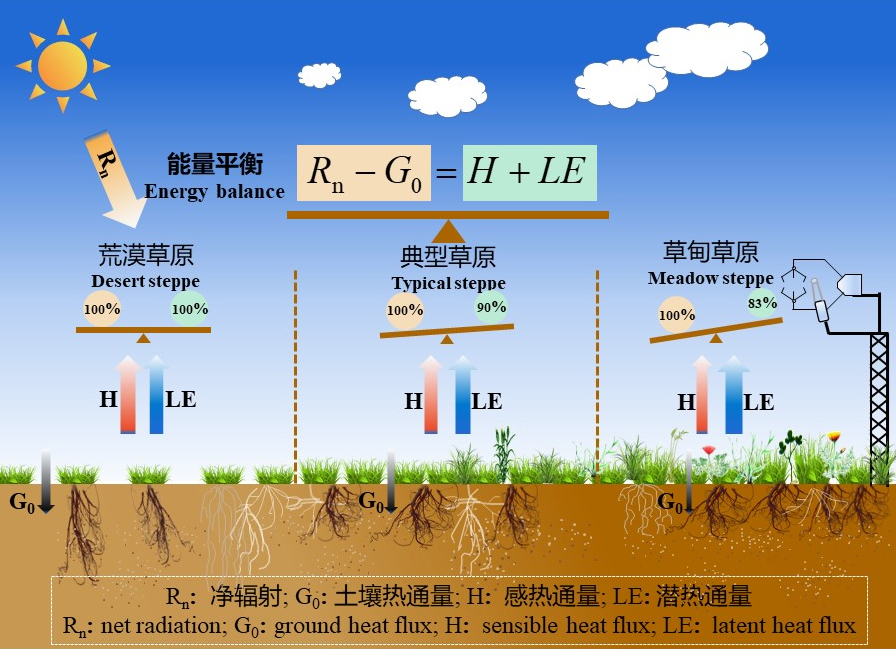
能量平衡闭合状况是评估通量观测数据质量的重要参考指标, 为客观评价中国北方干旱半干旱涡度观测数据的质量, 确定数据分析方法和改进策略, 加深对能量闭合度与环境因子之间关系的理解, 该研究基于内蒙古3种不同草原类型(荒漠草原、典型草原和草甸草原) 6个涡度相关通量观测站点(四子王旗站、锡林浩特割草站、锡林浩特围封站、西乌珠穆沁旗站、多伦站和额尔古纳站)的56个站年的能量通量和气象因子测定数据集, 利用能量平衡比率(EBR)和最小二乘法线性回归(OLS)这两种常用的方法, 分析了北方干旱半干旱区不同站点和草原类型能量闭合的状况、季节和年际变异及主要影响因素。主要结果表明: 1) 6个站点多年EBR均值为0.89 ± 0.11, OLS斜率均值为0.96 ± 0.04, 能量闭合程度明显高于国际通量网和中国通量网站点的能量闭合状况。2)不同站点和草原类型间EBR存在明显差异, 表现为荒漠草原(1.01 ± 0.09)和典型草原(0.90 ± 0.11)都高于草甸草原(0.83 ± 0.05), 各站点EBR均存在明显的季节变异, 生长季基本都在1附近并且相对稳定, 非生长季低于1并且变化较大, 主要受气温(Ta)、饱和水汽压差(VPD)、土壤含水量(SWC)和反照率(Albedo)的影响, 其中较低的Ta和较高的Albedo是导致非生长季EBR较低的主要原因。3)不同站点和草原类型EBR存在显著年际变异, 主要受潜热分配(潜热通量/净辐射比值, LE/Rn)、年平均气温(MAT)和生长季Albedo显著影响, 其中LE/Rn的年际波动对EBR年际变异起主要的调控作用, 可解释EBR年际变异的44%。此外, 各站点EBR均表现出随年份逐渐降低的趋势, 植被盖度显著增大后引起Albedo降低可能是造成EBR下降的主要原因。综上所述, 为更加全面地评估能量闭合状况, EBR和OLS斜率两种方法建议结合起来使用。
本文引用格式
王彦兵, 游翠海, 谭星儒, 陈波宇, 许梦真, 陈世苹 . 中国北方干旱半干旱区草原生态系统能量平衡闭合的季节和年际变异[J]. 植物生态学报, 2022 , 46(12) : 1448 -1460 . DOI: 10.17521/cjpe.2021.0428
Abstract
Aims Eddy covariance (EC) systems are widely used for measuring the fluxes of carbon, water, and energy, as well as meteorological factors. As one important reference of independently evaluating scalar flux by EC technique, energy balance closure is widely used for evaluating data quality of carbon, water, and energy fluxes.
Methods Using the data of energy fluxes and meteorological variables retrieved from 56 site-year, the energy balance closure of six sites across three ecosystems (i.e. desert steppe, typical steppe, and meadow steppe) was analyzed by two widely used methods: linear regression from the ordinary least squares (OLS) and the energy balance ratio (EBR). The overall evaluation of energy balance closure, the seasonal and interannual variations and the related influencing factors were investigated.
Important findings The results show that: 1) the multiple-year EBR and OLS slope over the six sites had a mean value of 0.89 ± 0.11 and 0.96 ± 0.04, respectively, which are better than the results of the FLUXNET and ChinaFLUX. 2) There were significant differences over different sites and grassland types, with EBR of desert steppe (1.01 ± 0.09) and typical steppe (0.90 ± 0.11) both higher than meadow steppe (0.83 ± 0.05). There were seasonal variations of EBR over the six studied sites, and with better and stable results in growing season than non-growing season. The air temperature (Ta), vapor pressure deficit (VPD), soil moisture (SWC), and Albedo regulated the seasonal variation of EBR, with the low Ta and high Albedo remarkably reducing EBR during the non-growing season. 3) There were significant interannual variations of EBR across different sites and grassland types. The latent heat fraction (the ratio of latent heat flux to net radiation, LE/Rn), mean annual air temperature (MAT) and growing season Albedo significantly influenced interannual variation of EBR. The LE/Rn showed the strongest impact and explained 44% of the interannual variation of EBR. The significantly increasing in leaf area index (LAI) strongly regulated the upward of the available energy (net radiation minus ground heat flux, Rn- G0), which contributes to the significant downward of EBR during observed years. It should be noted that EBR and OLS slope should be combined to better evaluate the energy balance closure. In conclusion, this study help improve our understanding of the potential linkage between energy balance closure and environmental factors, evaluate the quality of scalar flux estimates from EC technique, as well as improve the data processing protocol of flux data in the semi-arid and arid grassland region.
参考文献
| [1] | Aubinet M, Grelle A, Ibrom A, Rannik ü, Moncrieff J, Foken T, Kowalski AS, Martin PH, Berbigier P, Bernhofer Ch, Clement R, Elbers J, Granier A, Grünwald T, Morgenstern K, et al. (2000). Estimates of the annual net carbon and water exchange of European forests: the EUROFLUX methodology. Advances in Ecological Research, 30, 114-175. |
| [2] | Blanken PD, Black TA, Neumann HH, Den Hartog G, Yang PC, Nesic Z, Staebler R, Chen W, Novak MD (1998). Turbulent flux measurements above and below the overstory of a boreal aspen forest. Boundary-Layer Meteorology, 89, 109-140. |
| [3] | Blonquist JM Jr, Tanner BD, Bugbee B (2009). Evaluation of measurement accuracy and comparison of two new and three traditional net radiometers. Agricultural and Forest Meteorology, 149, 1709-1721. |
| [4] | Burnham KP, Anderson DR (2002). Model Selection Multimodel Inference: a Practical Information-Theoretic Approach. 2nd ed. Springer, New York. |
| [5] | Chen SP, Chen JQ, Lin GH, Zhang WL, Miao HX, Wei L, Huang JH, Han XG (2009). Energy balance and partition in Inner Mongolia steppe ecosystems with different land use types. Agricultural and Forest Meteorology, 149, 1800-1809. |
| [6] | Chen SP, You CH, Hu ZM, Chen Z, Zhang LM, Wang QF (2020). Eddy covariance technique and its applications in flux observations of terrestrial ecosystems. Chinese Journal of Plant Ecology, 44, 291-304. |
| [6] | [ 陈世苹, 游翠海, 胡中民, 陈智, 张雷明, 王秋凤 (2020). 涡度相关技术及其在陆地生态系统通量研究中的应用. 植物生态学报, 44, 291-304.] |
| [7] | Cheng Y, Sayde C, Li Q, Basara J, Selker J, Tanner E, Gentine P (2017). Failure of Taylor’s hypothesis in the atmospheric surface layer and its correction for eddy-covariance measurements. Geophysical Research Letters, 44, 4287-4295. |
| [8] | Cui WH, Chui TFM (2017). Subsurface lateral heat flux within the heterogeneous surface of a subtropical wetland and its potential contribution to energy imbalance. Journal of Hydrometeorology, 18, 3125-3144. |
| [9] | Cui WH, Chui TFM (2019). Temporal and spatial variations of energy balance closure across FLUXNET research sites. Agricultural and Forest Meteorology, 271, 12-21. |
| [10] | Duveiller G, Hooker J, Cescatti A (2018). The mark of vegetation change on Earth’s surface energy balance. Nature Communications, 9, 679. DOI: 10.1038/s41467-017-02810-8. |
| [11] | Falge E, Baldocchi D, Olson R, Anthoni P, Aubinet M, Bernhofer C, Burba G, Ceulemans R, Clement R, Dolman H, Granier A, Gross P, Grünwald T, Hollinger D, Jensen NO, et al. (2001). Gap filling strategies for defensible annual sums of net ecosystem exchange. Agricultural and Forest Meteorology, 107, 43-69. |
| [12] | Foken T (2008). The energy balance closure problem: an overview. Ecological Applications, 18, 1351-1367. |
| [13] | Foken T, Aubinet M, Finnigan JJ, Leclerc MY, Mauder M, Paw UKT (2011). Results of a panel discussion about the energy balance closure correction for trace gases. Bulletin of the American Meteorological Society, 92, ES13-ES18. |
| [14] | Franssen HJH, Stockli R, Lehner I, Rotenberg E, Seneviratne SI (2010). Energy balance closure of eddy-covariance data: A multisite analysis for European FLUXNET stations. Agricultural and Forest Meteorology, 150, 1553-1567. |
| [15] | Hasi M, Zhang XY, Niu GX, Wang YL, Geng QQ, Quan Q, Chen SP, Han XG, Huang JH (2021). Soil moisture, temperature and nitrogen availability interactively regulate carbon exchange in a meadow steppe ecosystem. Agricultural and Forest Meteorology, 304-305, 108389. DOI: 10.1016/j.agrformet.2021.108389. |
| [16] | Kochendorfer J, Paw UKT (2011). Field estimates of scalar advection across a canopy edge. Agricultural and Forest Meteorology, 151, 585-594. |
| [17] | Leuning R, van Gorsel E, Massman WJ, Isaac PR (2012). Reflections on the surface energy imbalance problem. Agricultural and Forest Meteorology, 156, 65-74. |
| [18] | < XF, Zhang LM, Ren CY, Fu YL (2005). Energy balance closure at ChinaFLUX sites. Science in China Series D: Earth Sciences, 48(Supp. I),51-62. |
| [19] | Liu B, Cui YL, Luo YF, Shi YZ, Liu M, Liu FP (2019). Energy partitioning and evapotranspiration over a rotated paddy field in Southern China. Agricultural and Forest Meteorology, 276-277, 107626. DOI: 10.1016/j.agrformet.2019.107626. |
| [20] | Majozi NP, Mannaerts CM, Ramoelo A, Mathieu R, Nickless A, Verhoef W (2017). Analysing surface energy balance closure and partitioning over a semi-arid savanna FLUXNET site in Skukuza, Kruger National Park, South Africa. Hydrology and Earth System Sciences, 21, 3401-3415. |
| [21] | McGloin R, ?igut L, Havránková K, Du?ek J, Pavelka M, Sedlák P (2018). Energy balance closure at a variety of ecosystems in Central Europe with contrasting topographies. Agricultural and Forest Meteorology, 248, 418-431. |
| [22] | Michel D, Philipona R, Ruckstuhl C, Vogt R, Vuilleumier L (2008). Performance and uncertainty of CNR1 net radiometers during a one-year field comparison. Journal of Atmospheric and Oceanic Technology, 25, 442-451. |
| [23] | Oliphant AJ, Grimmond CSB, Zutter HN, Schmid HP, Su HB, Scott SL, Offerle B, Randolph JC, Ehman J (2004). Heat storage and energy balance fluxes for a temperate deciduous forest. Agricultural and Forest Meteorology, 126, 185-201. |
| [24] | Oncley SP, Foken T, Vogt R, Kohsiek W, Debruin HAR, Bernhofer C, Christen A, van Gorsel E, Grantz D, Feigenwinter C, Lehner I, Liebethal C, Liu H, Mauder M, Pitacco A, Ribeiro L, Weidinger T (2007). The Energy Balance Experiment EBEX-2000. Part I: overview and energy balance. Boundary-Layer Meteorology, 123, 1-28. |
| [25] | Reichstein M, Falge E, Baldocchi D, Papale D, Aubinet M, Berbigier P, Bernhofer C, Buchmann N, Gilmanov T, Granier A, Grünwald T, Havránková K, Ilvesniemi H, Janous D, Knohl A, et al. (2005). On the separation of net ecosystem exchange into assimilation and ecosystem respiration: review and improved algorithm. Global Change Biology, 11, 1424-1439. |
| [26] | Shao CL, Chen JQ, Li LH, Xu WT, Chen SP, Gwen T, Xu JY, Zhang WL (2008). Spatial variability in soil heat flux at three Inner Mongolia steppe ecosystems. Agricultural and Forest Meteorology, 148, 1433-1443. |
| [27] | Stoy PC, Mauder M, Foken T, Marcolla B, Boegh E, Ibrom A, Arain MA, Arneth A, Aurela M, Bernhofer C, Cescatti A, Dellwik E, Duce P, Gianelle D, van Gorsel E, et al. (2013). A data-driven analysis of energy balance closure across FLUXNET research sites: the role of landscape scale heterogeneity. Agricultural and Forest Meteorology, 171-172, 137-152. |
| [28] | Teng DX, He XM, Qin L, Lv GH (2021). Energy balance closure in the Tugai forest in Ebinur Lake basin, northwest China. Forests, 12, 243. DOI: 10.3390/f1202043. |
| [29] | Webb EK, Pearman GI, Leuning R (1980). Correction of flux measurements for density effects due to heat and water- vapour transfer. Quarterly Journal of the Royal Meteorological Society, 106, 85-100. |
| [30] | Wilson K, Goldstein A, Falge E, Aubinet M, Baldocchi D, Berbigier P, Bernhofer C, Ceulemans R, Dolman H, Field C, Grelle A, Ibrom A, Law BE, Kowalski A, Meyers T, et al. (2002). Energy balance closure at FLUXNET sites. Agricultural and Forest Meteorology, 113, 223-243. |
| [31] | Wu ZT, Dijkstra P, Koch GW, Pe?uelas J, Hungate BA (2011). Responses of terrestrial ecosystems to temperature and precipitation change: a meta-analysis of experimental manipulation. Global Change Biology, 17, 927-942. |
| [32] | Yue P, Zhang Q, Zhang L, Li HY, Yang Y, Zeng J, Wang S (2019). Long-term variations in energy partitioning and evapotranspiration in a semiarid grassland in the Loess Plateau of China. Agricultural and Forest Meteorology, 278, 107671. DOI: 10.1016/j.agrformet.2019.107671. |
| [33] | Yu GR, Sun XM (2017). Principles of Flux Measurement in Terrestrial Ecosystems. 2nd ed. Higher Education Press, Beijing. |
| [33] | [ 于贵瑞, 孙晓敏 (2017). 陆地生态系统通量观测的原理与方法. 2版. 高等教育出版社, 北京.] |
| [34] | Zhang LM, Luo YW, Liu M, Chen Z, Su W, He HL, Zhu ZL, Sun XM, Wang YF, Zhou GY, Zhao XQ, Han SJ, Ouyang Z, Zhang XZ, Zhang YP, et al. (2019). Carbon and water fluxes observed by the Chinese Flux Observation and Research Network (2003-2005). China Scientific Data, 4, 18-34. |
| [34] | [ 张雷明, 罗艺伟, 刘敏, 陈智, 苏文, 何洪林, 朱治林, 孙晓敏, 王艳芬, 周国逸, 赵新全, 韩士杰, 欧阳竹, 张宪洲, 张一平, 等 (2019). 2003-2005年中国通量观测研究联盟(China FLUX)碳水通量观测数据集. 中国科学数据, 4, 18-34.] |
| [35] | Zhang Y, Peng CH, Li WZ, Tian LX, Zhu QA, Chen H, Fang XQ, Zhang GL, Liu GB, Mu XM, Li ZB, Li SQ, Yang YZ, Wang J, Xiao XM (2016). Multiple afforestation programs accelerate the greenness in the “Three North” region of China from 1982 to 2013. Ecological Indicators, 61, 404-412. |
| [36] | Zhang YS, Kadota T, Ohata T, Oyunbaatar D (2007). Environmental controls on evapotranspiration from sparse grassland in Mongolia. Hydrological Processes, 21, 2016-2027. |
| [37] | Zuo JQ, Wang JM, Huang JP, Li WJ, Wang GY, Ren HL (2010). Estimation of ground heat flux for a semi-arid grassland and its impacts on the surface energy budget. Plateau Meteorology, 29, 840-848. |
| [37] | [ 左金清, 王介民, 黄建平, 李维京, 王国印, 任宏利 (2010). 半干旱草地地表土壤热通量的计算及其对能量平衡的影响. 高原气象, 29, 840-848.] |
