Chinese Journal of Plant Ecology >
Effects of Spartina alterniflora invasion on soil organic carbon composition of mangrove wetland in Zhangjiang River Estuary
- 1 Co-Innovation Center of Sustainable Forestry in Southern China, Key Laboratory of Soil and Water Conservation and Ecological Restoration in Jiangsu Province, Nanjing Forestry University, Nanjing 210037, China
2 Nanjing Forest Police College, Nanjing 210023, China
Online published: 2018-09-26
Supported by
Supported by the National Natural Science Foundation of China(41701225);the Natural Science Foundation of Jiangsu Province (BK20170920), and the Postgraduate Research & Practice Innovation Program of Jiangsu Province(KYCX17_0854)
Abstract
Aims The composition of soil organic carbon has been changed significantly in mangrove ecosystems due to the invasion of Spartina alterniflora in recent years. However, few studies were reported on functional groups of soil organic carbon in the two communities. The object of this study was to understand the differences in soil carbon pool and organic carbon functional group characteristics in mangrove community and S. alterniflora community of Zhangjiang Mangrove Nature Reserve in Fujian Province.
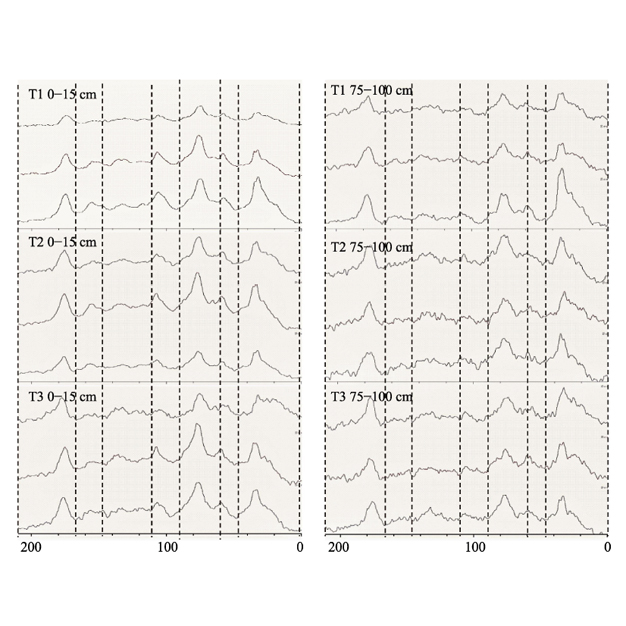
Methods We used the method of “space for time” to study the changes of soil carbon composition following the invasion of S. alterniflora. Three transects were selected from landward to seaward in the wetland of Zhangjiang Mangrove Nature Reserve in Fujian Province, with three sampling sites in each transect: mangrove community (MC), transitional community (TC), and S. alterniflora community (SC). We sampled three plots in each site for replicates. Soil samples from five soil layers at 0-100 cm were collected to analyze the characteristics of total organic carbon (TOC), particulate organic carbon (POC) and dissolve organic carbon (DOC). Nuclear magnetic resonance (NMR) spectroscopy was used to analyze the functional group characteristics for surface (0-15 cm) and deep layers (75-100 cm).
Important findings We found that: (1) soil organic carbon decreased from MC to SC, with TOC and POC following the pattern of MC > TC > SC. However, the DOC did not show a clear trend. (2) The functional groups of soil organic carbon in all vegetation types were mainly alkyl carbon and alkoxy carbon, followed by aromatic carbon and carbonyl carbon. In the surface soil 0-15 cm, the alkyl carbon and alkoxy carbon showed an increasing trend from MC to SC. The aromatic carbon and phenolic carbon decreased from MC to SC. In the deep layer of 75-100 cm soil, however, soil organic carbon composition showed no significant difference among the three communities. (3) In the surface 0-15 cm soil, alkyl carbon/alkoxy carbon showed the following pattern: SC > MC > TC; SC has the least aromaticity; hydrophobic carbon/hydrophilic carbon showed no significant difference; aliphatic carbon/aromatic carbon showed larger values in SC than in MC and TC. At the depth of 75-100 cm, there were no significant differences for all the ratios. In summary, the carbon storage of MC was higher than that of SC. The decomposition rate of soil organic carbon of SC in surface soil layer was higher than that of MC, indicating more complex organic carbon in MC. The deep layer carbon pool was more stable and less affected by vegetation type. The results indicated that S. alterniflora would reduce soil carbon storage after invading mangroves, as well as changing the composition of soil organic carbon functional groups. The molecular structure of soil organic carbon in SC was simpler than MC, and the degree of decomposition was greater in SC than MC.
Cite this article
SUN Hui-Min, JIANG Jiang, CUI Li-Na, ZHANG Shui-Feng, ZHANG Jin-Chi . Effects of Spartina alterniflora invasion on soil organic carbon composition of mangrove wetland in Zhangjiang River Estuary[J]. Chinese Journal of Plant Ecology, 2018 , 42(7) : 774 -784 . DOI: 10.17521/cjpe.2018.0104
References
| [1] | Albaladejo J, Ortiz R, Garcia-Franco N, Navarro AR, Almagro M, Pintado JG ( 2013). Land use and climate change impacts on soil organic carbon stocks in semi-arid Spain. Journal of Soils and Sediments, 13, 265-277. |
| [2] | Alongi DM ( 2014). Carbon cycling and storage in mangrove forests. Annual Review of Marine Science, 6, 195-219. |
| [3] | Bai J, Yan JY, He DJ, Cai JB, Wang R, You WB, Xiao SH, Hou DL, Li WW ( 2017). Effects of Spartina alterniflora invasion in eastern Fujian coastal wetland on the physicochemical properties and enzyme activities of mangrove soil. Journal of Beijing Forestry University, 39(1), 70-77. |
| [3] | [ 白静, 严锦钰, 何东进, 蔡金标, 王韧, 游巍斌, 肖石红, 侯栋梁, 李威威 ( 2017). 互花米草入侵对闽东滨海湿地红树林土壤理化性质和酶活性的影响. 北京林业大学学报, 39(1), 70-77.] |
| [4] | Biederbeck VO, Janzen HH, Campbell CA, Zentner RP ( 1994). Labile soil organic matter as influenced by cropping practices in an arid environment. Soil Biology & Biochemistry, 26, 1647-1656. |
| [5] | Bouillon S, Borges AV, Casta?eda-Moya E, Diele K, Dittmar T, Duke NC ( 2008). Mangrove production and carbon sinks: A revision of global budget estimates. Global Biogeochemical Cycles, 22(2), 1-12. |
| [6] | Cai WJ ( 2011). Estuarine and coastal ocean carbon paradox: CO2 sinks or sites of terrestrial carbon incineration? Annual Review of Marine Science, 3(3), 123-145. |
| [7] | Chen C ( 2004). Soil carbon pools in adjacent natural and plantation forests of subtropical Australia. Soil Science Society of America Journal, 68, 282-291. |
| [8] | Chen GX, Gao DZ, Chen G, Zeng CS, Wang WQ ( 2017). Effects of Spartina alterniflora invasion on soil carbon fractions in mangrove wetlands of China. Journal of Soil and Water Conservation, 31(6), 249-256. |
| [8] | [ 陈桂香, 高灯州, 陈刚, 曾从盛, 王维奇 ( 2017). 互花米草入侵对我国红树林湿地土壤碳组分的影响. 水土保持学报, 31(6), 249-256.] |
| [9] | Chen ZJ, Han SJ, Zhang JH ( 2016). Effects of land use change on soil organic carbon fractions in mangrove wetland of Zhangjiangkou. Chinese Journal of Ecology, 35, 2379-2385. |
| [9] | [ 陈志杰, 韩士杰, 张军辉 ( 2016). 土地利用变化对漳江口红树林土壤有机碳组分的影响. 生态学杂志, 35, 2379-2385.] |
| [10] | Coleman DC, Callaham MA, Crossley Jr DA ( 2017). Fundamentals of soil ecology. The Quarterly Review of Biology, 161, 321. |
| [11] | Dou S, Zhang JJ, Li K ( 2008). Effect of organic matter applications on 13C-NMR spectra of humic acids of soil. European Journal of Soil Science, 59, 532-539. |
| [12] | Doughty CL, Langley JA, Walker WS, Feller IC, Schaub R, Chapman SK ( 2016). Mangrove range expansion rapidly increases coastal wetland carbon storage. Estuaries and Coasts, 39, 1-12. |
| [13] | Ehrenfeld JG ( 2010). Ecosystem consequences of biological invasions. Annual Review of Ecology, Evolution, and Systematics, 41, 59-80. |
| [14] | Fontaine S, Barot S, Barré P, Bdioui N, Mary B, Rumpel C ( 2007). Stability of organic carbon in deep soil layers controlled by fresh carbon supply. Nature, 450, 277-280. |
| [15] | Gregorich EG, Voroney RP, Kachanoski RG ( 1991). Turnover of carbon through the microbial biomass in soils with different texture. Soil Biology & Biochemistry, 23, 799-805. |
| [16] | Hang ZQ ( 2013). Soil Organic Carbon Composition, Source and Structural Characteristics of Spartina alterniflora. Master degree dissertation, Nanjing Normal University, Nanjing. |
| [16] | [ 杭子清 ( 2013). 互花米草(Spartina alterniflora)盐沼土壤有机碳组分、来源及结构特征研究. 硕士学位论文, 南京师范大学, 南京.] |
| [17] | Hang ZQ, Wang GX, Liu JE, Wang G, Wang H ( 2014). Characterization of soil organic carbon fractions at Spartina alterniflora saltmarsh in North Jiangsu. Acta Ecologica Sinica, 34, 4175-4182. |
| [17] | [ 杭子清, 王国祥, 刘金娥, 王刚, 王会 ( 2014). 互花米草盐沼土壤有机碳库组分及结构特征. 生态学报, 34, 4175-4182.] |
| [18] | Kelleway JJ, Saintilan N, Macreadie PI, Skilbeck CG, Zawadzki A, Ralph PJ ( 2015). Seventy years of continuous encroachment substantially increases “blue carbon” capacity as mangroves replace intertidal salt marshes. Global Change Biology, 22, 1097-1109. |
| [19] | Li GD, Liu GQ, Zhuang SY, Gui RY ( 2010). Changes of organic matter in soils planted lei bamboo with different years. Chinese Journal of Soil Science, 41, 845-849. |
| [19] | [ 李国栋, 刘国群, 庄舜尧, 桂仁意 ( 2010). 不同种植年限下雷竹林土壤的有机质转化. 土壤通报, 41, 845-849.] |
| [20] | Li SF, Yu YC, He S ( 2002). Summary of research on dissolved organic carbon (DOC). Soil and Environmental Sciences, 11, 422-429. |
| [20] | [ 李淑芬, 俞元春, 何晟 ( 2002). 土壤溶解有机碳的研究进展. 土壤与环境, 11, 422-429.] |
| [21] | Li T, Zhao SW, Zhang Y, Ma S, Li XX ( 2011). Effect of revegetation on functional groups of soil organic carbon on the Loess Plateau. Acta Ecologica Sinica, 31, 5199-5206. |
| [21] | [ 李婷, 赵世伟, 张扬, 马帅, 李晓晓 ( 2011). 黄土区次生植被恢复对土壤有机碳官能团的影响. 生态学报, 31, 5199-5206.] |
| [22] | Li Z, Zhao B, Wang Q, Cao X, Zhang J ( 2015). Differences in chemical composition of soil organic carbon resulting from long-term fertilization strategies. PLOS ONE, 10, e0124359. DOI: 10.1371/journal.pone.0124359. |
| [23] | Liao BW, Zhang QM ( 2014). Area, distribution and species composition of mangroves in China. Wetland Science, 12, 435-440. |
| [23] | [ 廖宝文, 张乔民 ( 2014). 中国红树林的分布、面积和树种组成. 湿地科学, 12, 435-440.] |
| [24] | Linn DM, Doran JW ( 1984). Aerobic and anaerobic microbial populations in no-till and plowed soils. Soil Science Society of America Journal, 48, 794-799. |
| [25] | Liu MQ, Hu F, Chen XY ( 2007). A review on mechanisms of soil organic carbon stabilization. Acta Ecologica Sinica, 27, 2642-2650. |
| [25] | [ 刘满强, 胡锋, 陈小云 ( 2007). 土壤有机碳稳定机制研究进展. 生态学报, 27, 2642-2650.] |
| [26] | Mathers NJ, Xu Z ( 2003). Solid-state 13C NMR spectroscopy: Characterization of soil organic matter under two contrasting residue management regimes in a 2-year-old pine plantation of subtropical Australia . Geoderma, 114, 19-31. |
| [27] | Mathers NJ, Xu Z, Bernersprice SJ, Perera MCS, Saffigna PG ( 2002). Hydrofluoric acid pre-treatment for improving 13C CPMAS NMR spectral quality of forest soils in south-east Queensland, Australia . Soil Research, 40, 665-674. |
| [28] | Mcleod E, Chmura GL, Bouillon S, Salm R, Bj?rk M, Duarte CM ( 2011). A blueprint for blue carbon: Toward an improved understanding of the role of vegetated coastal habitats in sequestering CO2. Frontiers in Ecology and the Environment, 9, 552-560. |
| [29] | Mikutta R, Kleber M, Torn MS, Jahn R ( 2006). Stabilization of soil organic matter: Association with minerals or chemical recalcitrance? Biogeochemistry, 77, 25-56. |
| [30] | Ouyang X, Lee SY, Connolly RM ( 2016). Structural equation modelling reveals factors regulating surface sediment organic carbon content and CO2 efflux in a subtropical mangrove. Science of the Total Environment, 578, 513-522. |
| [31] | Rumpel C, K?gel-Knabner I ( 2011). Deep soil organic matter— A key but poorly understood component of terrestrial C cycle. Plant and Soil, 338, 143-158. |
| [32] | Schmidt MW, Torn MS, Abiven S, Dittmar T, Guggenberger G, Janssens IA ( 2011). Persistence of soil organic matter as an ecosystem property. Nature, 478, 49-56. |
| [33] | Sollins P, Homann P, Caldwell BA ( 1996). Stabilization and destabilization of soil organic matter: Mechanisms and controls. Geoderma, 74(1-2), 65-105. |
| [34] | Spaccini R, Mbagwu JSC, Conte P, Piccolo A ( 2006). Changes of humic substances characteristics from forested to cultivated soils in Ethiopia. Geoderma, 132, 9-19. |
| [35] | Tiessen H, Stewart JWB ( 1983). Particle-size fractions and their use in studies of soil organic Matter: II. Cultivation effects on organic matter composition in size fractions. Soil Science Society of America Journal, 47, 509-514. |
| [36] | Ussiri DAN, Johnson CE ( 2003). Characterization of organic matter in a northern hardwood forest soil by 13C NMR spectroscopy and chemical methods . Geoderma, 111, 123-149. |
| [37] | Wang G, Yang WB, Wang GX, Liu JE, Hang ZQ ( 2013). The effects of Spartina alterniflora seaward invasion on soil organic carbon fractions, sources and distribution. Acta Ecologica Sinica, 33, 2474-2483. |
| [37] | [ 王刚, 杨文斌, 王国祥, 刘金娥, 杭子清 ( 2013). 互花米草海向入侵对土壤有机碳组分、来源和分布的影响. 生态学报, 33, 2474-2483.] |
| [38] | Wang JM, Ouyang J, Shang Q, Deng ZW ( 2008). Application of the NMR techniques in studies on organic matters in soil. Chinese Journal of Magnetic Resonance, 25, 287-295. |
| [38] | [ 王俊美, 欧阳捷, 尚倩, 邓志威 ( 2008). 土壤有机质研究中的核磁共振技术. 波谱学杂志, 25, 287-295.] |
| [39] | Wang S, Mei H, Shao X, Mickler RA, Li K, Ji J ( 2004). Vertical distribution of soil organic carbon in China. Environmental Management, 33, S200-S209. |
| [40] | Wei D, Dai WH, Tang J ( 2011). Study of soils dissolved organic carbon in different landuse. Chinese Agricultural Science Bulletin, 27(18), 121-124. |
| [40] | [ 卫东, 戴万宏, 汤佳 ( 2011). 不同利用方式下土壤溶解性有机碳含量研究. 中国农学通报, 27(18), 121-124.] |
| [41] | Wu YP ( 2015). In situ Decomposition of Organic Carbon in Litter of Spartina alterniflora. Master degree dissertation, Nanjing Normal University,Nanjing. |
| [41] | [ 吴亚萍 ( 2015). 互花米草(Spartina alterniflora)凋落物有机碳原位分解动态. 硕士学位论文, 南京师范大学, 南京.] |
| [42] | Wynn JG, Bird MI, Vellen L, Grand-Clement E, Carter J, Berry SL ( 2006). Continental-scale measurement of the soil organic carbon pool with climatic, edaphic, and biotic controls. Global Biogeochemical Cycles, 20, GB1007. DOI: 10.1029/2005GB002576. |
| [43] | Xue JF, Gao YM, Wang JK, Fu SF, Zhu FC ( 2007). Microbial biomass carbon and nitrogen as an indicator for evaluation of soil fertility. Chinese Journal of Soil Science, 38, 247-250. |
| [43] | [ 薛菁芳, 高艳梅, 汪景宽, 付时丰, 祝凤春 ( 2007). 土壤微生物量碳氮作为土壤肥力指标的探讨. 土壤通报, 38, 247-250.] |
| [44] | Yang W, Zhao H, Chen X, Yin S, Cheng X, An S ( 2013). Consequences of short-term C4 plant Spartina alterniflora, invasions for soil organic carbon dynamics in a coastal wetland of eastern China. Ecological Engineering, 61(12), 50-57. |
| [45] | Yang WQ, Deng RJ, Zhang J ( 2007). Forest litter decomposition and its responses to global climate change. Chinese Journal of Applied Ecology, 18, 2889-2895. |
| [45] | [ 杨万勤, 邓仁菊, 张健 ( 2007). 森林凋落物分解及其对全球气候变化的响应. 应用生态学报, 18, 2889-2895.] |
| [46] | Zhang L, Guo ZH, Li ZY ( 2013). Carbon storage and carbon sink of mangrove wetland: Research progress. Chinese Journal of Applied Ecology, 24, 1153-1159. |
| [46] | [ 张莉, 郭志华, 李志勇 ( 2013). 红树林湿地碳储量及碳汇研究进展. 应用生态学报, 24, 1153-1159.] |
| [47] | Zhang XH, Li DY, Pan GX, Li LQ, Lin F, Xu XW ( 2008). Conservation of wetland soil C stock and climate change of China. Advances in Climate Change Research, 4, 202-208. |
| [47] | [ 张旭辉, 李典友, 潘根兴, 李恋卿, 林凡, 许信旺 ( 2008). 中国湿地土壤碳库保护与气候变化问题. 气候变化研究进展, 4, 202-208.] |
| [48] | Zhang YH, Zhang FC, Zhou XD, Xie XJ, Wang XW, Li Q ( 2011). Effects of plant invasion along a Spartina alterniflora chronosequence on organic carbon dynamics in coastal wetland in north Jiangsu. China Environmental Science, 31, 271-276. |
| [48] | [ 张耀鸿, 张富存, 周晓冬, 谢晓金, 王小巍, 李强 ( 2011). 互花米草对苏北滨海湿地表土有机碳更新的影响. 中国环境科学, 31, 271-276.] |
| [49] | Zhou CH, Mao TY, Xu X, Fang CM, Luo YM, Li B ( 2016). Preliminary analysis of C sequestration potential of blue carbon ecosystems on Chinese coastal zone. Scientia Sinica: Vitae, 46, 475-486. |
| [49] | [ 周晨昊, 毛覃愉, 徐晓, 方长明, 骆永明, 李博 ( 2016). 中国海岸带蓝碳生态系统碳汇潜力的初步分析. 中国科学: 生命科学, 46, 475-486.] |