Chinese Journal of Plant Ecology >
Spatial variations of community functional traits at different successional stages in temperate forests of Changbai Mountains, Northeast China
- Research Center of Forest Management Engineering of State Forestry and Grassland Administration, Beijing Forestry University, Beijing 10083, China
Received date: 2018-11-28
Revised date: 2019-03-05
Online published: 2019-05-30
Supported by
Supported by the National Key R&D Program of China(2017YFC0504005);The National Natural Science Foundation of China(31670643)
Abstract
Aims The community assembly mechanisms are among the focal topics in ecological studies. In Changbai Mountains Nature Reserve, there is an intact primary broadleaved-Korean pine forest ecosystem. With increasing loss of species diversity in recent years, study that explores the community assembly mechanisms in this region is particularly important.
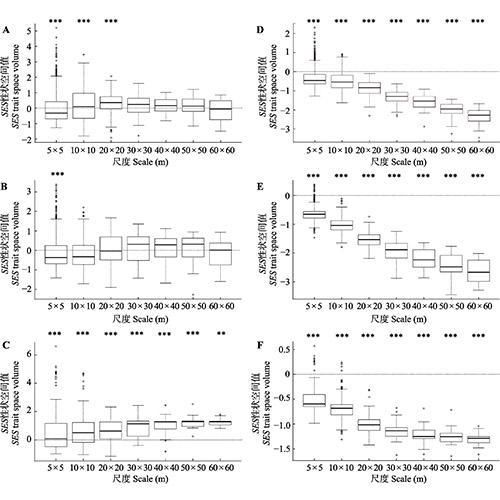
Methods This study was conducted in three large permanent plots, each of the size 5.2 hm 2, along suessional stages (secondary poplar and birch mixed forest, PBF; secondary mixed conifer and broad-leaved forest, CBF; and primary Tilia amurensis-Pinus koraiensis mixed forest, TKF) in Changbai Mountains. Six functional traits of major tree species were measured, including leaf area, specific leaf area, leaf thickness, leaf nitrogen content, leaf phosphorus content, and maximum tree height. Changes in the spatial values of community traints were analyzed at different spatial scales (5 m × 5 m, 10 m × 10 m, 20 m × 20 m, 30 m × 30 m, 40 m × 40 m, 50 m × 50 m and 60 m × 60 m). By comparing the observed values with expected values of null models, the community assembly mechanisms in temperate forests of Changbai Mountains were explored.
Important findings Results show that the size of species pool has an important impact on the outcome; in a larger species pool, the environmental filtration has a significant impact. At the plot level and for early and intermediate stages of succession, the observed spatial values of community traits do not significantly differ from the expected values. At the late successional stage, the observed spatial values of community traits were greater than the expected values. The analysis of multiple community functional diversity indices shows that the combined processes of habitat filtring and competitive exclusion are the main determinants of the species composition of the climax community in this region. In the early successional stage, large numbers of species are immigrated, and there are strong resource competitions among the species within a community. With progressing succession, some species are excluded, species maintained in the community show significant niche differentiations, and competition is the main mechanism species coexistence.
Key words: community assembly; functional trait; trait space; spatial scale
Cite this article
HAO Shu-Jun, LI Xiao-Yu, HOU Man-Man, ZHAO Xiu-Hai . Spatial variations of community functional traits at different successional stages in temperate forests of Changbai Mountains, Northeast China[J]. Chinese Journal of Plant Ecology, 2019 , 43(3) : 208 -216 . DOI: 10.17521/cjpe.2018.0295
References
| [1] | Baraloto C, Hardy OJ, Paine CT, Dexter KG, Cruaud C, Dunning LT, Chave J ( 2012). Using functional traits and phylogenetic trees to examine the assembly of tropical tree communities. Journal of Ecology, 100, 690-701. |
| [2] | Cornelissen JHC, Lavorel S, Garnier E, Díaz S, Buchmann N, Gurvich DE ( 2003). A handbook of protocols for standardised and easy measurement of plant functional traits worldwide. Australian Journal of Botany, 51, 335-380. |
| [3] | Cornwell WK, Schwilk DW, Ackerly DD ( 2006). A trait-based test for habitat filtering: Convex hull volume. Ecology, 87, 1465-1471. |
| [4] | Diamond JM ( 1975). Assembly of species communities. In: Cody ML, Diamond JM eds. Ecology & Evolution of Communities. Harvard University Press, Cambridge, USA. |
| [5] | Díaz S, Quétier F, Cáceres DM, Trainor SF, Pérez-?Harguindeguy N, Bret-Harte MS, Finegan B, Pe?a-Claros M, Poorter L ( 2011). Linking functional diversity and social actor strategies in a framework for interdisciplinary analysis of nature’s benefits to society. Proceedings of the National Academy of Sciences of the United States of America, 108, 895-902. |
| [6] | Eviner VT, Chapin III FS ( 2003). Functional matrix: A conceptual framework for predicting multiple plant effects on ecosystem processes. Annual Review of Ecology, Evolution, and Systematics, 34, 455-485. |
| [7] | Fang S, Yuan ZQ, Lin F, Ye J, Hao ZQ, Wang XG ( 2014). Functional and phylogenetic structures of woody plants in broad-leaved Korean pine mixed forest in Changbai Mountains, Jilin, China. Chinese Science Bulletin, 59, 2342-2348. |
| [7] | [ 房帅, 原作强, 蔺菲, 叶吉, 郝占庆, 王绪高 ( 2014). 长白山阔叶红松林木本植物系统发育与功能性状结构. 科学通报, 59, 2342-2348.] |
| [8] | Grime JP ( 2006). Trait convergence and trait divergence in herbaceous plant communities: Mechanisms and consequences. Journal of Vegetation Science, 17, 255-260. |
| [9] | Herben T, Goldberg DE ( 2014). Community assembly by limiting similarity vs. competitive hierarchies: Testing the consequences of dispersion of individual traits. Journal of Ecology, 102, 156-166. |
| [10] | Hou MM, Li XY, Wang JW, Liu S, Zhao XH ( 2017). Phylogenetic development and functional structures during successional stages of conifer and broad-leaved mixed forest communities in Changbai Mountains, China. Acta Ecologica Sinica, 37, 7503-7513. |
| [10] | [ 侯嫚嫚, 李晓宇, 王均伟, 刘帅, 赵秀海 ( 2017). 长白山针阔混交林不同演替阶段群落系统发育和功能性状结构. 生态学报, 37, 7503-7513.] |
| [11] | Hutchinson GE ( 1957). Concluding remarks. Cold Spring Harbor Symposiaon Quantitative Biology, 22, 415-427. |
| [12] | Hutchinson GE ( 1978). An Introduction to Population Ecology. Yale University Press, New Haven. |
| [13] | Kraft N, Ackerly DD ( 2014). The assembly of plant communities. In: Monson RK ed. The Plant Sciences—Ecology and the Environment. Springer, Berlin. 67-88. |
| [14] | Kraft NJ, Valencia R, Ackerly DD ( 2008). Functional traits and niche-based tree community assembly in an Amazonian forest. Science, 322, 580-582. |
| [15] | Laliberté E, Legendre P ( 2010). A distance-based framework for measuring functional diversity from multiple traits. Ecology, 91, 299-305. |
| [16] | Lavorel S, Grigulis K, McIntyre S, Williams NS, Garden D, Dorrough J, Berman S, Quétier F, Thébault A, Bonis A ( 2008). Assessing functional diversity in the field-?methodology matters! Functional Ecology, 22, 134-147. |
| [17] | Lessard JP, Belmaker J, Myers JA, Chase JM, Rahbek C ( 2012 a). Inferring local ecological processes amid species pool influences. Trends in Ecology & Evolution, 27, 600-607. |
| [18] | Lessard JP, Borregaard MK, Fordyce JA, Rahbek C, Weiser MD, Dunn RR, Sanders NJ ( 2012 b). Strong influence of regional species pools on continent-wide structuring of local communities. Proceedings Biological Sciences, 279, 266-274. |
| [19] | Li XY, Liao JX, Hou MM, Fan XH ( 2016). Multi-scale analysis on community phylogenetic structure of secondary Populus davidiana-Betula platyphylla forest in Changbai Mountains, northeastern China. Journal of Beijing Forestry University, 38(12), 14-20. |
| [19] | [ 李晓宇, 廖嘉星, 侯嫚嫚, 范秀华 ( 2016). 不同尺度下长白山次生杨桦林群落系统发育结构研究. 北京林业大学报, 38(12), 14-20.] |
| [20] | Li Y, Shipley B, Price JN, Dantas VDL, Tamme R, Westoby M, Laughlin DC ( 2017). Habitat filtering determines the functional niche occupancy of plant communities worldwide. Journal of Ecology, 106, 1001-1009. |
| [21] | Litvak MK, Hansell RI ( 1990). A community perspective on the multi-dimensional niche. Journal of Animal Ecology, 59, 931-940. |
| [22] | Lohbeck M, Poorter L, Martínez-Ramos M, Bongers F ( 2015). Biomass is the main driver of changes in ecosystem process rates during tropical forest succession. Ecology, 96, 1242-1252. |
| [23] | Mason NW, de Bello F, Dole?al J, Lep? J ( 2011). Niche overlap reveals the effects of competition, disturbance and contrasting assembly processes in experimental grassland communities. Journal of Ecology, 99, 788-796. |
| [24] | Mason NW, Mouillot D, Lee WG, Wilson JB ( 2005). Functional richness, functional evenness and functional divergence: The primary components of functional diversity. Oikos, 111, 112-118. |
| [25] | McGill BJ, Enquist BJ, Weiher E, Westoby M ( 2006). Rebuilding community ecology from functional traits. Trends in Ecology & Evolution, 21, 178-185. |
| [26] | Mouchet MA, Villéger S, Mason NW, Mouillot D ( 2010). Functional diversity measures: An overview of their redundancy and their ability to discriminate community assembly rules. Functional Ecology, 24, 867-876. |
| [27] | Mouillot D, Stubbs W, Faure M, Dumay O, Tomasini JA, Wilson JB, Do Chi T ( 2005). Niche overlap estimates based on quantitative functional traits: A new family of non-parametric indices. Oecologia, 145, 345-353. |
| [28] | Ostertag R, Warman L, Cordell S, Vitousek PM ( 2015). Using plant functional traits to restore Hawaiian rainforest. Journal of Applied Ecology, 52, 805-809. |
| [29] | Rosenfeld JS ( 2002). Functional redundancy in ecology and conservation. Oikos, 98, 156-162 |
| [30] | Satdichanh M, Millet J, Heinimann A, Nanthavong K, Harrison RD ( 2015). Using plant functional traits and phylogenies to understand patterns of plant community assembly in a seasonal tropical forest in Lao PDR. PLOS ONE, 10, e0130151. DOI: 10.1371/journal.pone.0130151. |
| [31] | Song YT, Wang P, Zhou DW ( 2011). Methods of measuring plant community functional diversity. Chinese Journal of Ecology, 30, 2053-2059. |
| [31] | [ 宋彦涛, 王平, 周道玮 ( 2011). 植物群落功能多样性计算方法, 生态学杂志, 30, 2053-2059.] |
| [32] | Stubbs WJ, Wilson JB ( 2004). Evidence for limiting similarity in a sand dune community. Journal of Ecology, 92, 557-567. |
| [33] | Suterine M, Edwards PJ ( 2013). Convergent succession of plant communities is linked to species’ functional traits. Perspectives in Plant Ecology,Evolution and Systematics, 15, 217-225. |
| [34] | Swenson NG ( 2013). The assembly of tropical tree communities—The advances and shortcomings of phylogenetic and functional trait analyses. Ecography, 36, 264-276. |
| [35] | Swenson NG, Weiser MD ( 2014). On the packing and filling of functional space in eastern North American tree assemblages. Ecography, 37, 1056-1062. |
| [36] | Villéger S, Mason NW, Mouillot D ( 2008). New multidimensional functional diversity indices for a multifaceted framework in functional ecology. Ecology, 89, 2290-2301. |
| [37] | Wang SP, Tang ZY, Qiao XJ, Shen ZH, Wang XP, Zheng CY, Fang JY ( 2013). The influence of species pools and local processes on the community structure: A test case with woody plant communities in China’s mountains. Ecography, 35, 1168-1175. |
| [38] | Webb CO, Ackerly DD, McPeek MA, Donoghue MJ ( 2002). Phylogenies and community ecology. Annual Review of Ecology and Systematics, 33, 475-505. |
| [39] | Weiher E, Clarke GP, Keddy PA ( 1998). Community assembly rules, morphological dispersion, and the coexistence of plant species. Oikos, 81, 309-322. |
| [40] | Weiher E, Freund D, Bunton T, Stefanski A, Lee T, Bentivenga S ( 2011). Advances, challenges and a developing synthesis of ecological community assembly theory. Philosophical Transactions of the Royal Society of London B: Biological Sciences, 366, 2403-2413. |
| [41] | Zhou XG, Lu WK, Ye D, Wen YG ( 2014). Assembly mechanism forest community based on phylogeny and functional traits. Guangxi Science, 21, 525-533. |
| [41] | [ 周晓果, 卢文科, 叶铎, 温远光 ( 2014). 基于系统发育和功能性状的森林群落构建机制. 广西科学, 21, 525-533.] |