Chinese Journal of Plant Ecology >
Estimation of grassland aboveground biomass using digital photograph and canopy structure measurements
- 1State Key Laboratory of Vegetation and Environmental Change, Institute of Botany, Chinese Academy of Sciences, Beijing 100093, China
2University of Chinese Academy of Sciences, Beijing 100049, China
Received date: 2022-06-06
Accepted date: 2022-08-16
Online published: 2022-08-28
Supported by
Strategic Priority Research Program of Chinese Academy of Sciences(XDA23080301)
Abstract
Aims Aboveground biomass (AGB) is one of the most important factors affecting grassland ecosystem function and is commonly measured in grassland research. AGB is often measured using the harvest method, which can cause great disturbance to plant communities, especially for those long-term monitoring plots. A non-destructive method for AGB estimation is thus needed.
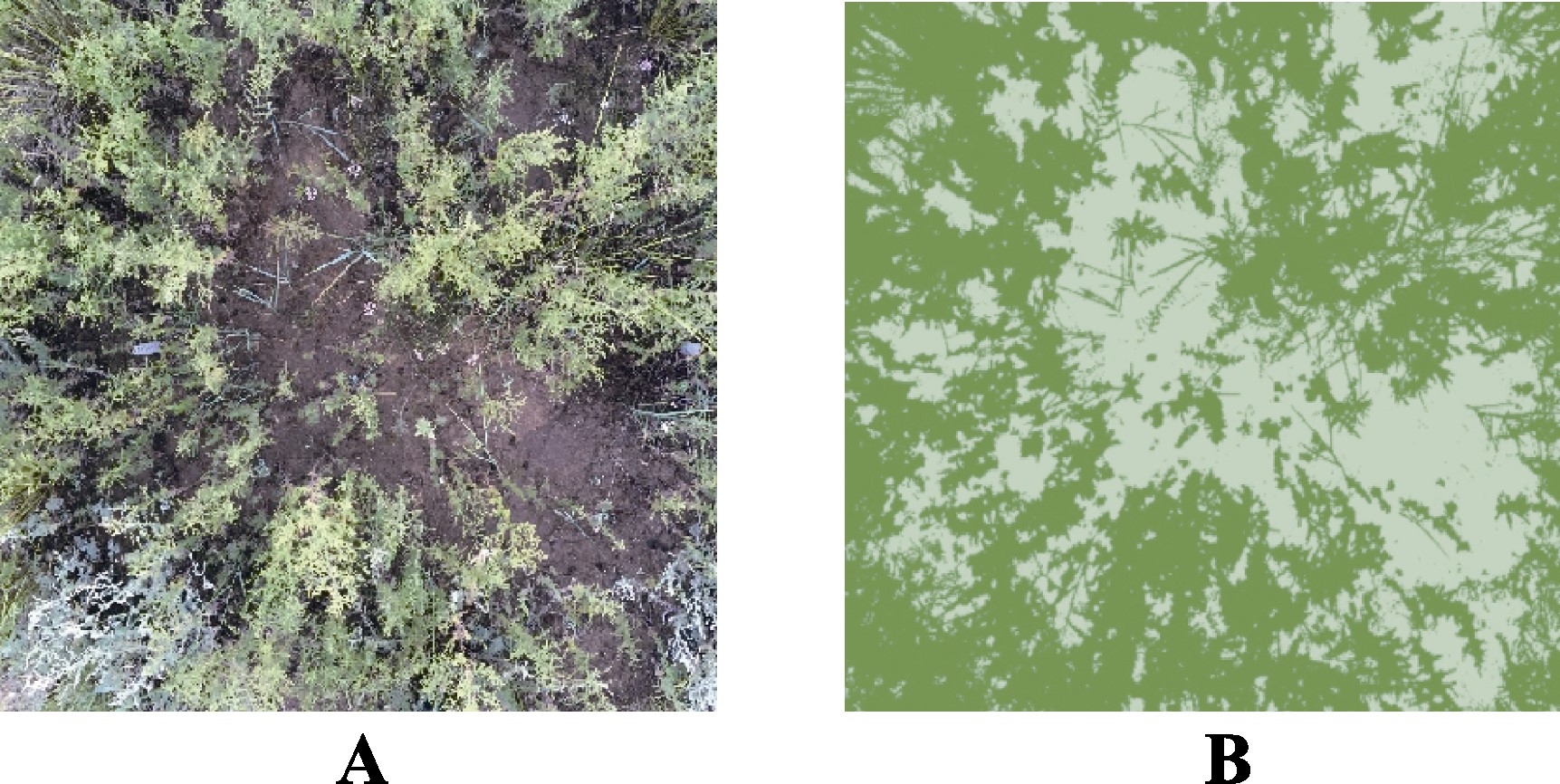
Methods Here, we conducted field measurements at a land-use manipulation experiment in a typical steppe in Nei Mongol, China. We obtained the fractional vegetation cover (FVC) using digital photographs. We also measured leaf area index (LAI), vegetation height, and plant species richness. Three different models were used to estimate AGB: univariate regression model, stepwise regression model, and random forest model.
Important findings We found that FVC, LAI, mean vegetation height, maximum vegetation height and richness were highly correlated with AGB variation. AGB can be accurately predicted by a stepwise regression model developed based on the local plant community. The determination coefficient (R2) and root-mean-square error (RMSE) of the stepwise regression model can reach 0.91 and 35.60 g·m-2, respectively. Overall, our study provides a rapid and non-destructive method for AGB measurement that can be used as an alternative to the traditional harvest method.
Cite this article
LIU Chao, LI Ping, WU Yun-Tao, PAN Sheng-Nan, JIA Zhou, LIU Ling-Li . Estimation of grassland aboveground biomass using digital photograph and canopy structure measurements[J]. Chinese Journal of Plant Ecology, 2022 , 46(10) : 1280 -1288 . DOI: 10.17521/cjpe.2022.0235
References
| [1] | Abrougui K, Gabsi K, Mercatoris B, Khemis C, Amami R, Chehaibi S. (2019). Prediction of organic potato yield using tillage systems and soil properties by artificial neural network (ANN) and multiple linear regressions (MLR). Soil and Tillage Research, 190, 202-208. |
| [2] | Bai YF, Zhao YJ, Wang Y, Zhou KL. (2020). Assessment of ecosystem services and ecological regionalization of grasslands support establishment of ecological security barriers in Northern China. Bulletin of Chinese Academy of Sciences, 35, 675-689. |
| [2] | [白永飞, 赵玉金, 王扬, 周楷玲 (2020). 中国北方草地生态系统服务评估和功能区划助力生态安全屏障建设. 中国科学院院刊, 35, 675-689.] |
| [3] | Breiman L. (2001). Random forests. Machine Learning, 45, 5-32. |
| [4] | Catchpole WR, Wheeler CJ. (1992). Estimating plant biomass: a review of techniques. Australian Journal of Ecology, 17, 121-131. |
| [5] | Chen DM, Xing W, Lan ZC, Saleem M, Wu Y, Hu SJ, Bai YF. (2019). Direct and indirect effects of nitrogen enrichment on soil organisms and carbon and nitrogen mineralization in a semi-arid grassland. Functional Ecology, 33, 175-187. |
| [6] | Chen JM, Black TA. (1992). Defining leaf area index for non-flat leaves. Plant, Cell & Environment, 15, 421-429. |
| [7] | Cooper S, Roy D, Schaaf C, Paynter I. (2017). Examination of the potential of terrestrial laser scanning and structure- from-motion photogrammetry for rapid nondestructive field measurement of grass biomass. Remote Sensing, 9, 531. DOI: 10.3390/rs9060531. |
| [8] | Cutler DR, Edwards TC, Beard KH, Cutler A, Hess KT, Gibson J, Lawler JJ. (2007). Random forests for classification in ecology. Ecology, 88, 2783-2792. |
| [9] | Dusseux P, Hubert-Moy L, Corpetti T, Vertès F. (2015). Evaluation of SPOT imagery for the estimation of grassland biomass. International Journal of Applied Earth Observation and Geoinformation, 38, 72-77. |
| [10] | Fang HL, Frederic B, Plummer S, Schaepman-Strub G. (2019). An overview of global leaf area index (LAI): methods, products, validation, and applications. Reviews of Geophysics, 57, 739-799. |
| [11] | Fang HL, Li SJ, Zhang YH, Wei SS, Wang Y. (2021). New insights of global vegetation structural properties through an analysis of canopy clumping index, fractional vegetation cover, and leaf area index. Science of Remote Sensing, 4, 100027. DOI: 10.1016/j.srs.2021.100027. |
| [12] | Fang JY, Yang YH, Ma WH, Mohammat A, Shen HH. (2010). Ecosystem carbon stocks and their changes in China’s grasslands. Science China Life Sciences, 53, 757-765. |
| [13] | Friedl MA, Schimel DS, Michaelsen J, Davis FW, Walker H. (1994). Estimating grassland biomass and leaf area index using ground and satellite data. International Journal of Remote Sensing, 15, 1401-1420. |
| [14] | Gao XX, Dong SK, Li S, Xu YD, Liu SL, Zhao HD, Yeomans J, Li Y, Shen H, Wu SN, Zhi YL. (2020). Using the random forest model and validated MODIS with the field spectrometer measurement promote the accuracy of estimating aboveground biomass and coverage of alpine grasslands on the Qinghai-Tibetan Plateau. Ecological Indicators, 112, 106114. DOI: 10.1016/j.ecolind.2020.106114. |
| [15] | Ge J, Meng BP, Yang SX, Gao JL, Feng QS, Liang TG, Huang XD, Gao XH, Li WL, Zhang RP, Wang YL. (2017). Dynamic monitoring of alpine grassland coverage based on UAV technology and MODIS remote sensing data—A case study in the headwaters of the Yellow River. Acta Prataculturae Sinica, 26(3), 1-12. |
| [15] | [葛静, 孟宝平, 杨淑霞, 高金龙, 冯琦胜, 梁天刚, 黄晓东, 高新华, 李文龙, 张仁平, 王云龙 (2017). 基于UAV技术和MODIS遥感数据的高寒草地盖度动态变化监测研究——以黄河源东部地区为例. 草业学报, 26(3), 1-12.] |
| [16] | Genuer R, Poggi JM, Tuleau-Malot C. (2010). Variable selection using random forests. Pattern Recognition Letters, 31, 2225-2236. |
| [17] | Gitelson AA, Kaufman YJ, Stark R, Rundquist D. (2002). Novel algorithms for remote estimation of vegetation fraction. Remote Sensing of Environment, 80, 76-87. |
| [18] | Hu JB, Zhang L, Huang W, Wu SH, Liu CB. (2011). Quickly determining grassland cover using the digital image. Pratacultural Science, 28, 1661-1665. |
| [18] | [胡健波, 张璐, 黄伟, 吴世红, 刘长兵 (2011). 基于数码照片的草地植被覆盖度快速提取方法. 草业科学, 28, 1661-1665.] |
| [19] | Jacquemoud S, Verhoef W, Baret F, Bacour C, Zarco-Tejada PJ, Asner GP, Fran?ois C, Ustin SL. (2009). PROSPECT+ SAIL models: a review of use for vegetation characterization. Remote Sensing of Environment, 113, S56-S66. |
| [20] | Jia Z, Li P, Wu YT, Yang S, Wang CZ, Wang B, Yang L, Wang X, Li J, Peng ZY, Guo LL, Liu WX, Liu LL. (2021). Deepened snow cover alters biotic and abiotic controls on nitrogen loss during non-growing season in temperate grasslands. Biology and Fertility of Soils, 57, 165-177. |
| [21] | Jin C, Song G., Shen M., Tang Y., Matsushita B. (2009). Estimating aboveground biomass of grassland having a high canopy cover: an exploratory analysis of in situ hyperspectral data. International Journal of Remote Sensing, 30, 6497-6517. |
| [22] | Khatami R, Mountrakis G, Stehman SV. (2016). A meta-analysis of remote sensing research on supervised pixel-based land-cover image classification processes: general guidelines for practitioners and future research. Remote Sensing of Environment, 177, 89-100. |
| [23] | Li P, Sayer EJ, Jia Z, Wu YT, Deng MF, Wang X, Liu C, Wang B, Wang Y, Bai YF, Liu LL. (2021). Deepened snow cover mitigates soil carbon loss from intensive land-use in a semi-arid temperate grassland. Functional Ecology, 36, 635-645. |
| [24] | Li XH. (2013). Using “random forest” for classification and regression. Chinese Journal of Applied Entomology, 50, 1190-1197. |
| [24] | [李欣海 (2013). 随机森林模型在分类与回归分析中的应用. 应用昆虫学报, 50, 1190-1197.] |
| [25] | Li XH. (2019). Random forest is a specific algorithm, not omnipotent for all datasets. Chinese Journal of Applied Entomology, 56, 170-179. |
| [25] | [李欣海 (2019). 随机森林是特点鲜明的模型, 不是万能的模型. 应用昆虫学报, 56, 170-179.] |
| [26] | Liang TG, Yang SX, Feng QS, Liu BK, Zhang RP, Huang XD, Xie HJ. (2016). Multi-factor modeling of above-ground biomass in alpine grassland: a case study in the Three- River Headwaters Region, China. Remote Sensing of Environment, 186, 164-172. |
| [27] | Ma WH, Fang JY, Yang YH, Mohammat A. (2010). Biomass carbon stocks and their changes in northern China’s grasslands during 1982-2006. Science China Life Sciences, 53, 841-850. |
| [28] | Piao SL, Fang JY, He JS, Xiao Y. (2004). Spatial distribution of grassland biomass in China. Acta Phytoecologica Sinica, 28, 491-498. |
| [28] | [朴世龙, 方精云, 贺金生, 肖玉 (2004). 中国草地植被生物量及其空间分布格局. 植物生态学报, 28, 491-498.] |
| [29] | Sanaei A, Ali A, Ahmadaali K, Jahantab E. (2019). Generalized and species-specific prediction models for aboveground biomass in semi-steppe rangelands. Journal of Plant Ecology, 12, 428-437. |
| [30] | Shen HH, Zhu YK, Zhao X, Geng XQ, Gao SQ, Fang JY. (2016). Analysis of current grassland resources in China. Chinese Science Bulletin, 61, 139-154. |
| [30] | [沈海花, 朱言坤, 赵霞, 耿晓庆, 高树琴, 方精云 (2016). 中国草地资源的现状分析. 科学通报, 61, 139-154.] |
| [31] | Spehn EM, Joshi J, Schmid B, Diemer M, K?rner C. (2000). Above-ground resource use increases with plant species richness in experimental grassland ecosystems. Functional Ecology, 14, 326-337. |
| [32] | Stone M. (1977). An asymptotic equivalence of choice of model by cross-validation and Akaike’s criterion. Journal of the Royal Statistical Society: Series B, 39, 44-47. |
| [33] | Strahler AH. (1980). The use of prior probabilities in maximum likelihood classification of remotely sensed data. Remote Sensing of Environment, 10, 135-163. |
| [34] | Tappeiner U, Cernusca A. (1989). Canopy structure and light climate of different alpine plant communities: analysis by means of a model. Theoretical and Applied Climatology, 40, 81-92. |
| [35] | Wang DL, Xin XP, Shao QQ, Brolly M, Zhu ZL, Chen J. (2017). Modeling aboveground biomass in Hulunber grassland ecosystem by using unmanned aerial vehicle discrete lidar. Sensors (Basel), 17, 180. DOI: 10.3390/s17010180. |
| [36] | Wang J, Xiao XM, Bajgain R, Starks P, Steiner J, Doughty RB, Chang Q. (2019). Estimating leaf area index and aboveground biomass of grazing pastures using Sentinel-1, Sentinel-2 and Landsat images. Journal of Photogrammetry and Remote Sensing, 154, 189-201. |
| [37] | Wei XF. (2010). Biomass estimation: a remote sensing approach. Geography Compass, 4, 1635-1647. |
| [38] | Xu DW, Wang C, Chen J, Shen MG, Shen BB, Yan RR, Li ZW, Karnieli A, Chen JQ, Yan YC, Wang X, Chen BR, Yin DM, Xin XP. (2021). The superiority of the normalized difference phenology index (NDPI) for estimating grassland aboveground fresh biomass. Remote Sensing of Environment, 264, 112578. DOI: 10.1016/j.rse.2021.112578. |
| [39] | Xu KX, Su YJ, Liu J, Hu TY, Jin SC, Ma Q, Zhai QP, Wang R, Zhang J, Li YM, Liu HY, Guo QH. (2020). Estimation of degraded grassland aboveground biomass using machine learning methods from terrestrial laser scanning data. Ecological Indicators, 108, 105747. DOI: 10.1016/j.ecolind.2019.105747. |
| [40] | Yang SX, Feng QS, Liang TG, Liu BK, Zhang WJ, Xie HJ. (2018). Modeling grassland above-ground biomass based on artificial neural network and remote sensing in the Three-River Headwaters Region. Remote Sensing of Environment, 204, 448-455. |
| [41] | Zhang WB, Fu SH, Liu BY. (2001). Error assessment of visual estimation plant coverage. Journal of Beijing Normal University (Natural Science), 37, 402-408. |
| [41] | [章文波, 符素华, 刘宝元 (2001). 目估法测量植被覆盖度的精度分析. 北京师范大学学报(自然科学版), 37, 402-408.] |
| [42] | Zhang YX, Li XB, Chen YH. (2003). Overview of field and multi-scale remote sensing measurement approaches to grassland vegetation coverage. Advance in Earth Sciences, 18, 85-90. |
| [42] | [张云霞, 李晓兵, 陈云浩 (2003). 草地植被盖度的多尺度遥感与实地测量方法综述. 地球科学进展, 18, 85-90.] |