Chinese Journal of Plant Ecology >
Construction and application of the indicator system for ecosystem monitoring network in the protected areas on a national scale
- 1Key Laboratory of Ecosystem Network Observation and Modelling, Institute of Geographic Sciences and Resources Research, Chinese Academy of Sciences, Beijing 100101, China
2State Key Laboratory of Vegetation and Environmental Change, Institute of Botany, Chinese Academy of Sciences, Beijing 100093, China
3Key Laboratory of Vegetation Restoration and Management of Degraded Ecosystems, South China Botanical Garden, Chinese Academy of Sciences, Guangzhou 510650, China
4Key Laboratory of Forest Ecology and Management, Institute of Applied Ecology, Chinese Academy of Sciences, Shenyang 110016, China
5Key Laboratory of Terrestrial Ecosystem Carbon Neutrality, Liaoning Province, Shenyang 110016, China
Received date: 2022-06-21
Accepted date: 2022-10-10
Online published: 2022-10-25
Supported by
Strategic Priority Research Program of Chinese Academy of Sciences(XDA23080302);Youth Innovation Promotion Association CAS(2021050)
Abstract
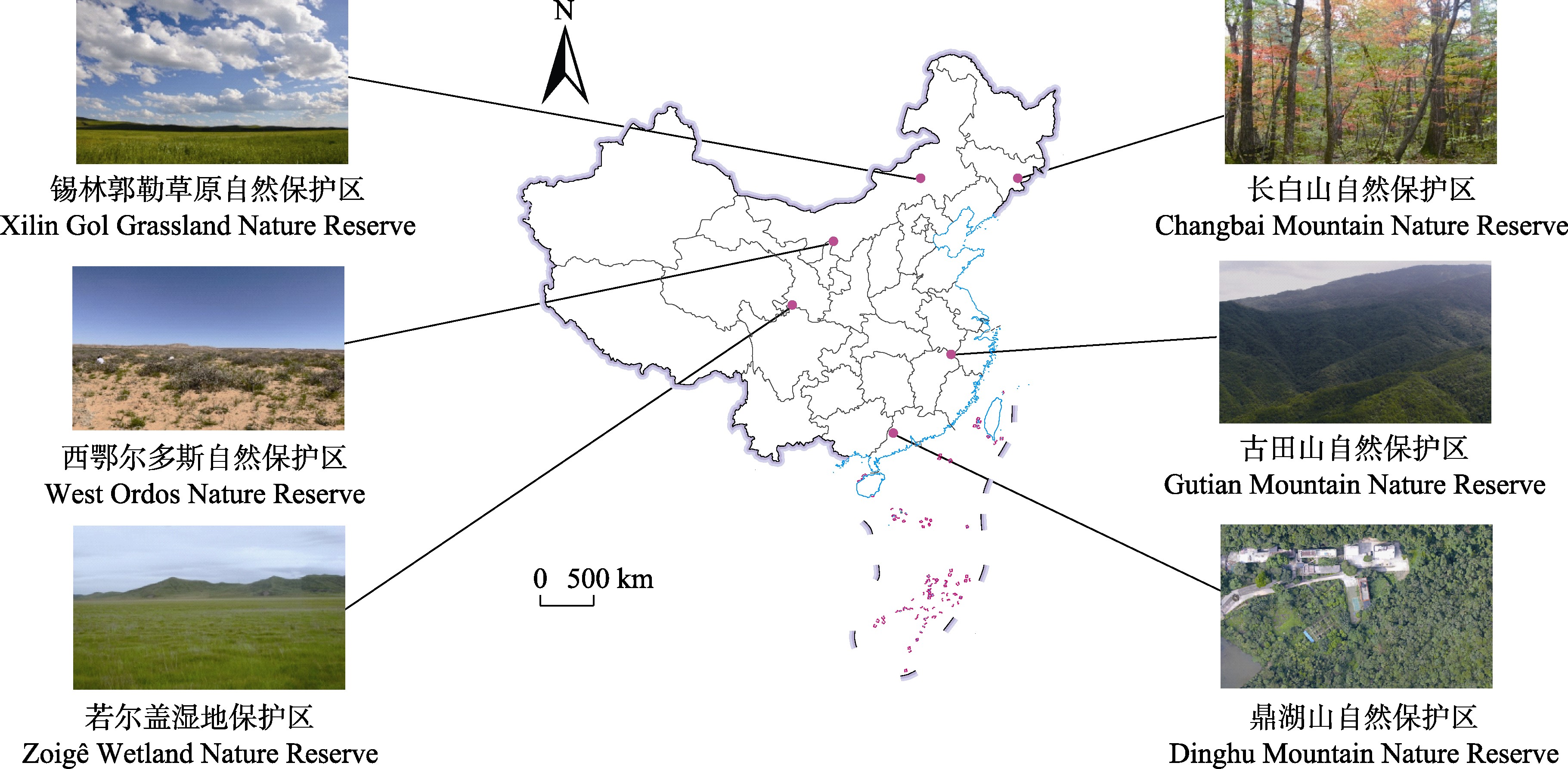
The protected areas are crucial to the maintenance of national ecological security and improvement of biodiversity conservation. Application of real-time, high-frequency and multi-scale ecological monitoring in the protected areas serves an effective means for identifying the dynamics of ecosystem, which is key to the implement of ecosystem health management in the protected areas. However, due to the lack of a unified ecosystem monitoring and research network and the corresponding indicator system of the protected areas in China, the composition and dynamics of ecosystem in many protected areas remains unclear, which can dimmish the ability to cope with emerging issues of biodiversity conservation. Lack of the data obtained from the ecological monitoring network can also hamper the evaluation of ecosystem health status and conservation effectiveness of the protected areas on a national scale. As such, it is necessary to construct a national scale monitoring and research network for the composition and dynamics of ecosystem in the protected areas, as well as a scientific, systematic and normative indicator system for this monitoring network. By addressing the aims and objectives of biodiversity and ecosystem monitoring in the protected areas and with reference to the indicator systems of existing ecological monitoring networks both in China and abroad, this study summarized the basic principles of establishing the indicator system and the selection of indicators. Accordingly, an indicator system for the ecosystem monitoring network of the protected areas was established and applied to 6 national nature reserves for demonstration. The established indicator system consists of 30 indicators to comprehensively monitor changes in the 6 key elements that compose an ecosystem, which is habitat, biota, meteorology, soil, atmospheric and water environment, and landscape. The indicator system was effectively applied to monitor the long-term and dynamic changes in the status and evolution of ecosystem components and structures in different ecosystem types of protected areas including forest, grassland, wetland and desert. The normalized and standardized data achieved from the established monitoring network can further be used for the evaluation of conservation effectiveness and healthy management of the protected areas.
Cite this article
XU Meng, TIAN Da-Shuan, WANG Yi-Heng, HE Yi-Cheng, CUI Qing-Guo, LI Yue-Lin, SHEN Xiao-Li, YUAN Zuo-Qiang, WANG Yang . Construction and application of the indicator system for ecosystem monitoring network in the protected areas on a national scale[J]. Chinese Journal of Plant Ecology, 2022 , 46(10) : 1219 -1233 . DOI: 10.17521/cjpe.2022.0259
References
| [1] | Chen LD, Liu Y, Lv YH, Feng XM, Fu BJ. (2008). Landscape pattern analysis in landscape ecology: current, challenges and future. Acta Ecologica Sinica, 28, 5521-5531. |
| [1] | [陈利顶, 刘洋, 吕一河, 冯晓明, 傅伯杰 (2008). 景观生态学中的格局分析: 现状、困境与未来. 生态学报, 28, 5521-5531.] |
| [2] | Chen SR, Dong GH, Yu Y, Liu HJ, Wen QQ, Lu SJ, Luo HJ. (2020). The framework of ecological quality monitoring network for ecological supervision. Environmental Monitoring in China, 36, 1-7. |
| [2] | [陈善荣, 董贵华, 于洋, 刘海江, 温倩倩, 陆泗进, 罗海江 (2020). 面向生态监管的国家生态质量监测网络构建框架. 中国环境监测, 36, 1-7.] |
| [3] | Cui GF. (2004). Special research fields and hot spots in science of nature reserves. Journal of Beijing Forestry University, 26(6), 102-105. |
| [3] | [崔国发 (2004). 自然保护区学当前应该解决的几个科学问题. 北京林业大学学报, 26(6), 102-105.] |
| [4] | Dudley N(Translated by Zhu CQ, Ouyang ZY)(2016). Guidelines for Applying Protected Area Management Categories. China Forestry Publishing House, Beijing. (in Chinese) |
| [4] | [朱春全, 欧阳志云 (译) (2016). IUCN自然保护地管理分类应用指南. 中国林业出版社, 北京.] |
| [5] | Fancy SG, Gross JE, Carter SL. (2009). Monitoring the condition of natural resources in US national parks. Environmental Monitoring and Assessment, 151, 161-174. |
| [6] | Feng XJ, Mi XC, Xiao ZS, Cao L, Wu H, Ma KP. (2019). Overview of Chinese Biodiversity Observation Network (Sino BON). Bulletin of Chinese Academy of Sciences, 34, 1389-1398. |
| [6] | [冯晓娟, 米湘成, 肖治术, 曹垒, 吴慧, 马克平 (2019). 中国生物多样性监测与研究网络建设及进展. 中国科学院院刊, 34, 1389-1398.] |
| [7] | Galloway JN, Townsend AR, Erisman JW, Bekunda M, Cai Z, Freney JR, Martinelli LA, Seitzinger SP, Sutton MA. (2008). Transformation of the nitrogen cycle: recent trends, questions, and potential solutions. Science, 320, 889-892. |
| [8] | Guo QH, Hu TY, Ma Q, Xu KX, Yang QL, Sun QH, Li YM, Su YJ. (2020). Advances for the new remote sensing technology in ecosystem ecology research. Chinese Journal of Plant Ecology, 44, 418-435. |
| [8] | [郭庆华, 胡天宇, 马勤, 徐可心, 杨秋丽, 孙千惠, 李玉美, 苏艳军 (2020). 新一代遥感技术助力生态系统生态学研究. 植物生态学报, 44, 418-435.] |
| [9] | Han JL, Wu SH, Luan XF, Zhao GL. (2012). Research on adaptive management of natural reserves. Journal of Shanxi Agricultural Sciences, 40, 284-287. |
| [9] | [韩俊丽, 武曙红, 栾晓峰, 赵光亮 (2012). 自然保护区适应性管理研究. 山西农业科学, 40, 284-287.] |
| [10] | He XY, Ren CY, Chen L, Wang ZM, Zheng HF. (2018). The progress of forest ecosystems monitoring with remote sensing techniques. Scientia Geographica Sinica, 38, 997-1011. |
| [10] | [何兴元, 任春颖, 陈琳, 王宗明, 郑海峰 (2018). 森林生态系统遥感监测技术研究进展. 地理科学, 38, 997-1011.] |
| [11] | Isbell F, Craven D, Connolly J, Loreau M, Schmid B, Beierkuhnlein C, Bezemer TM, Bonin C, Bruelheide H, de Luca E, Ebeling A, Griffin JN, Guo Q, Hautier Y, Hector A, et al. (2015). Biodiversity increases the resistance of ecosystem productivity to climate extremes. Nature, 526, 574-577. |
| [12] | Jackson RB, Lajtha K, Crow SE, Hugelius G, Kramer MG, Pi?eiro G. (2017). The ecology of soil carbon: pools, vulnerabilities, and biotic and abiotic controls. Annual Review of Ecology, Evolution, and Systematics, 48, 419-445. |
| [13] | Kao RH, Gibson CM, Gallery RE, Meier CL, Barnett DT, Docherty KM, Blevins KK, Travers PD, Azuaje E, Springer YP, Thibault KM, McKenzie VJ, Keller M, Alves LF, Hinckley ELS, et al. (2012). NEON terrestrial field observations: designing continental-scale, standardized sampling. Ecosphere, 3, art115. DOI: 10.1890/es12-00196.1. |
| [14] | Kulmala M. (2018). Build a global earth observatory. Nature, 553, 21-23. |
| [15] | Li MM, Xia WC, Wang M, Luan XF. (2020). A bibliometric review of natural protected areas monitoring in China. Acta Ecologica Sinica, 40, 2158-2165. |
| [15] | [李苗苗, 夏万才, 王猛, 栾晓峰 (2020). 基于文献计量的中国自然保护地监测研究. 生态学报, 40, 2158-2165.] |
| [16] | Li S, Wang DJ, Xiao ZS, Li XH, Wang TM, Feng LM, Wang Y. (2014). Camera-trapping in wildlife research and conservation in China: review and outlook. Biodiversity Science, 22, 685-695. |
| [16] | [李晟, 王大军, 肖治术, 李欣海, 王天明, 冯利民, 王云 (2014). 红外相机技术在我国野生动物研究与保护中的应用与前景. 生物多样性, 22, 685-695.] |
| [17] | Li SG, Yu GR, Yu XB, He HL, Guo XB. (2015). A brief introduction to Chinese Ecosystem Research Network (CERN). Journal of Resources and Ecology, 6, 192-196. |
| [18] | Ma KP. (2015). Biodiversity monitoring in China: from CForBio to Sino BON. Biodiversity Science, 23, 1-2. |
| [18] | [马克平 (2015). 中国生物多样性监测网络建设: 从CForBio到Sino BON. 生物多样性, 23, 1-2.] |
| [19] | Ma KP. (2016). On key issues and possible solutions related to nature reserve management in China. Biodiversity Science, 24, 249-251. |
| [19] | [马克平 (2016). 当前我国自然保护区管理中存在的问题与对策思考. 生物多样性, 24, 249-251.] |
| [20] | Mirtl M, Borer ET, Djukic I, Forsius M, Haubold H, Hugo W, Jourdan J, Lindenmayer D, McDowell WH, Muraoka H, Orenstein DE, Pauw JC, Peterseil J, Shibata H, Wohner C, et al. (2018). Genesis, goals and achievements of Long-Term Ecological Research at the global scale: a critical review of ILTER and future directions. Science of the Total Environment, 626, 1439-1462. |
| [21] | Moore CT, Lonsdorf EV, Knutson MG, Laskowski HP, Lor SK. (2011). Adaptive management in the U.S. National Wildlife Refuge System: science-management partnerships for conservation delivery. Journal of Environmental Management, 92, 1395-1402. |
| [22] | Myers N, Mittermeier RA, Mittermeier CG, da Fonseca GAB, Kent J. (2000). Biodiversity hotspots for conservation priorities. Nature, 403, 853-858. |
| [23] | Niu D, Huang TQ, Yang P, Yu GR. (2006). Chinese Ecosystem Research Network (CERN): construction experiences, future challenge and development strategy. Bulletin of Chinese Academy of Sciences, 6, 466-471. |
| [23] | [牛栋, 黄铁青, 杨萍, 于贵瑞 (2006). 中国生态系统研究网络(CERN)的建设与思考. 中国科学院院刊, 6, 466-471.] |
| [24] | Niu SL, Wang S, Wang JS, Xia JY, Yu GR. (2020). Integrative ecology in the era of big data—From observation to prediction. Science China Earth Sciences, 63, 1429-1442. |
| [25] | Ouyang ZY, Du A, Xu WH. (2020). Research on China’s protected area system classification. Acta Ecologica Sinica, 40, 7207-7215. |
| [25] | [欧阳志云, 杜傲, 徐卫华 (2020). 中国自然保护地体系分类研究. 生态学报, 40, 7207-7215.] |
| [26] | Paganini M, Leidner AK, Geller G, Turner W, Wegmann M. (2016). The role of space agencies in remotely sensed essential biodiversity variables. Remote Sensing in Ecology and Conservation, 2, 132-140. |
| [27] | Parrish JD, Braun DP, Unnasch RS. (2003). Are we conserving what we say we are? Measuring ecological integrity within protected areas. BioScience, 53, 851-860. |
| [28] | Schmeller DS, Julliard R, Bellingham PJ, Bo?hm M, Brummitt N, Chiarucci A, Couvet D, Elmendorf S, Forsyth DM, Moreno JG, Gregory RD, Magnusson WE, Martin LJ, McGeoch MA, Mihoub JB, et al. (2015). Towards a global terrestrial species monitoring program. Journal for Nature Conservation, 25, 51-57. |
| [29] | Scholes RJ, Mace GM, Turner W, Geller GN, Ju?rgens N, Larigauderie A, Muchoney D, Walther BA, Mooney HA. (2008). Toward a global biodiversity observing system. Science, 321, 1044-1045. |
| [30] | Skidmore AK, Pettorelli N, Coops NC, Geller GN, Hansen M, Lucas R, Mu?cher CA, O?Connor B, Paganini M, Pereira HM, Schaepman ME, Turner W, Wang TJ, Wegmann M. (2015). Environmental science: agree on biodiversity metrics to track from space. Nature, 523, 403-405. |
| [31] | Sykes JM, Lane AMJ. (1996). The United Kingdom Environmental Change Network: Protocols for Standard Measurements at Terrestrial Sites. Stationery Office, London. 5-32. |
| [32] | Sykes JM, Lane AMJ, George DG. (1999). The United Kingdom Environmental Change Network: Protocols for Standard Measurements at Freshwater Sites. Centre for Ecology & Hydrology, London. 7-42. |
| [33] | Théau J, Trottier S, Graillon P. (2018). Optimization of an ecological integrity monitoring program for protected areas: case study for a network of national parks. PLOS ONE, 13, e0202902. DOI: 10.1371/journal.pone.0202902. |
| [34] | Tilman D. (1999). The ecological consequences of changes in biodiversity: a search for general principles. Ecology, 80, 1455-1474. |
| [35] | Tilman D, Reich PB, Knops JMH. (2006). Biodiversity and ecosystem stability in a decade-long grassland experiment. Nature, 441, 629-632. |
| [36] | Uychiaoco AJ, Arceo HO, Green SJ, De La Cruz MT, Gaite PA, Ali?o PM. (2005). Monitoring and evaluation of reef protected areas by local fishers in the Philippines: tightening the adaptive management cycle. Biodiversity & Conservation, 14, 2775-2794. |
| [37] | Vihervaara P, D?Amato D, Forsius M, Angelstam P, Baessler C, Balvanera P, Boldgiv B, Bourgeron P, Dick J, Kanka R, Klotz S, Maass M, Melecis V, Pet?ík P, Shibata H, et al. (2013). Using long-term ecosystem service and biodiversity data to study the impacts and adaptation options in response to climate change: insights from the global ILTER sites network. Current Opinion in Environmental Sustainability, 5, 53-66. |
| [38] | Wang W, Xin LJ, Du JH, Chen B, Liu FZ, Zhang LB, Li JS. (2016). Evaluating conservation effectiveness of protected areas: advances and new perspectives. Biodiversity Science, 24, 1177-1188. |
| [38] | [王伟, 辛利娟, 杜金鸿, 陈冰, 刘方正, 张立博, 李俊生 (2016). 自然保护地保护成效评估: 进展与展望. 生物多样性, 24, 1177-1188.] |
| [39] | Watson JEM, Dudley N, Segan DB, Hockings M. (2014). The performance and potential of protected areas. Nature, 515, 67-73. |
| [40] | Wu DX, Zhang L, Song CY, Zhang SM. (2019). Protocols for Standard Biological Observation and Measurement in Terrestrial Ecosystems. China Environment Publishing Group, Beijing. |
| [40] | [吴冬秀, 张琳, 宋创业, 张淑敏 (2019). 陆地生态系统生物观测指标与规范. 中国环境出版社集团, 北京.] |
| [41] | Yang L, Chen MR, Yang SY, Hu WJ, Cheng JX, Ye GQ, Ji YN, Bao SS. (2014). Adaptive management of aquatic germplasm reserves. Marine Environmental Science, 33, 122-129. |
| [41] | [杨璐, 陈明茹, 杨圣云, 胡文佳, 程建新, 叶观琼, 纪雅宁, 鲍姗姗 (2014). 水产种质资源保护区适应性管理研究. 海洋环境科学, 33, 122-129.] |
| [42] | Yang RJ, Fu BJ, Liu GH, Ma KM. (2004). Principles and methods of sustainable management of ecosystem. Chinese Journal of Ecology, 23, 103-108. |
| [42] | [杨荣金, 傅伯杰, 刘国华, 马克明 (2004). 生态系统可持续管理的原理和方法. 生态学杂志, 23, 103-108.] |
| [43] | Yao SC, Min QW, Jiao WJ, He SY, Liu MC, Liu XY, Zhang BT, Li WH. (2019). Establishment and application of an ecological monitoring indicator system in national parks oriented to management objectives. Acta Ecologica Sinica, 39, 8221-8231. |
| [43] | [姚帅臣, 闵庆文, 焦雯珺, 何思源, 刘某承, 刘显洋, 张碧天, 李文华 (2019). 面向管理目标的国家公园生态监测指标体系构建与应用. 生态学报, 39, 8221-8231.] |
| [44] | Yu GR, He HL, Zhou YK. (2018). Ecosystem observation and research under background of big data. Bulletin of Chinese Academy of Sciences, 33, 832-837. |
| [44] | [于贵瑞, 何洪林, 周玉科 (2018). 大数据背景下的生态系统观测与研究. 中国科学院院刊, 33, 832-837.] |
| [45] | Yu GR, Zhang LM, Zhang YJ, Yang M. (2021). A coordinated three-dimensional network for observing large-scale terrestrial ecosystem status changes and the consequences on resources and environment. Chinese Journal of Applied Ecology, 32, 1903-1918. |
| [45] | [于贵瑞, 张雷明, 张扬建, 杨萌 (2021). 大尺度陆地生态系统状态变化及其资源环境效应的立体化协同联网观测. 应用生态学报, 32, 1903-1918.] |
| [46] | Zhao SD. (2005). United States National Ecological Observatory Network—With special references to its concepts, design and progress. Advances in Earth Sciences, 20, 578-583. |
| [46] | [赵士洞 (2005). 美国国家生态观测站网络(NEON)——概念、设计和进展. 地球科学进展, 20, 578-583.] |
| [47] | Zhu SY, Duan F, Li S. (2017). Promoting diversity inventory and monitoring of birds through the camera-trapping network in China: status, challenges and future outlook. Biodiversity Science, 25, 1114-1122. |
| [47] | [朱淑怡, 段菲, 李晟 (2017). 基于红外相机网络促进我国鸟类多样性监测: 现状、问题与前景. 生物多样性, 25, 1114-1122.] |