Chinese Journal of Plant Ecology >
Response and resilience of net primary productivity of the Hai River Basin ecosystems under meteorological droughts
- 1Key Laboratory of Water Cycle and Related Land Surface Processes, Institute of Geographic Sciences and Natural Resources Research, Chinese Academy of Sciences, Beijing 100101, China
2College of Resources and Environment, University of Chinese Academy of Sciences, Beijing 100049, China
3Sino-Danish College, University of Chinese Academy of Sciences, Beijing 100049, China
Received date: 2023-03-16
Accepted date: 2024-01-16
Online published: 2024-01-16
Supported by
National Key R&D Programme of China(2022YFF0801804)
Abstract
Aims The increases in drought intensity and frequency severely threaten structure and functioning of terrestrial ecosystems. To ensure the normal functioning of ecosystems under such scenarios, it is critically needed to understand the spatial-temporal characteristics of ecosystem productivity response and resilience under meteorological droughts.
Methods The intensity and frequency of meteorological droughts were quantified by standardized precipitation evapotranspiration index (SPEI) of the Hai River Basin (HRB). Net primary productivity (NPP) of natural ecosystems was estimated based on Carnegie-Ames-Stanford Approach (CASA). We quantitatively analyzed the relationship between NPP and SPEI, evaluated the drought risk of natural vegetation and the resilience of vegetation after drought.
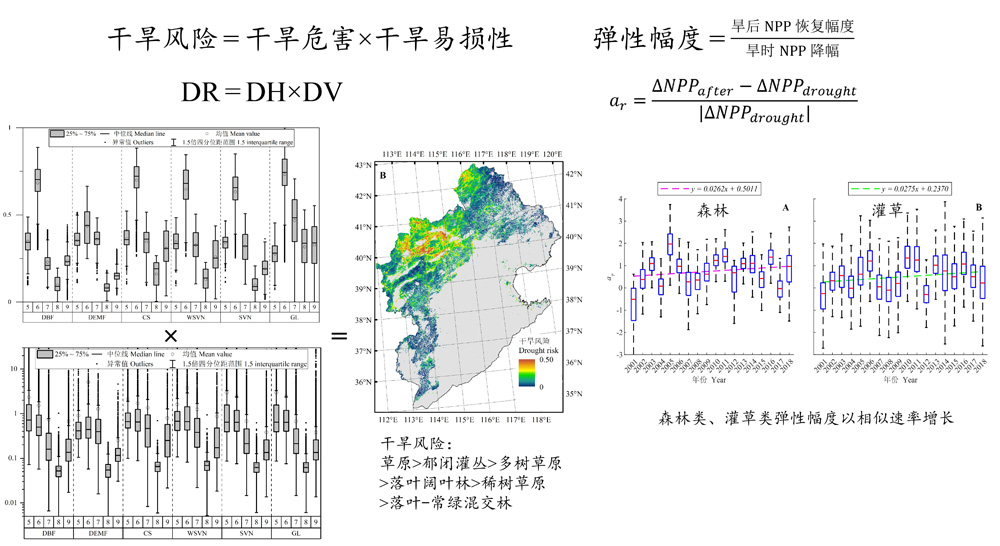
Important findings (1) Both NPP and normalized differential vegetation index (NDVI) in the HRB showed significantly increasing trend. (2) The lagging time of NPP response to droughts follow an order of grassland and savanna < deciduous broadleaf forest and woody savanna < deciduous-evergreen mixed forest and closed shrubland. (3) Drought risk followed an order of grassland > closed shrubland > woody savanna > deciduous broadleaf forest > savanna > deciduous-evergreen mixed forest. (4) More than 75% of the vegetation in the HRB showed no continuous distinctly low NPP status one month after the droughts, indicating relatively strong resilience. The resilience of forests was stronger than shrub or herbaceous vegetation, which showed opposite temporal pattern within each growing season but shared similar increasing trend interannually. Response and resilience characteristics of NPP varied with vegetation types and drought intensity. Ecosystem stability of the HRB could be improved by adjusting the afforestation and grass restoration measures based on vegetation drought risk and resilience, optimizing vegetation structure, and enhancing species diversity.
Cite this article
HUANG Li-Cheng , MO Xing-Guo . Response and resilience of net primary productivity of the Hai River Basin ecosystems under meteorological droughts[J]. Chinese Journal of Plant Ecology, 2024 , 48(10) : 1256 -1273 . DOI: 10.17521/cjpe.2023.0076
References
| [1] | Allen CD, Macalady AK, Chenchouni H, Bachelet D, McDowell N, Vennetier M, Kitzberger T, Rigling A, Breshears DD, Hogg EH, Gonzalez P, Fensham R, Zhang Z, Castro J, Demidova N, et al. (2010). A global overview of drought and heat-induced tree mortality reveals emerging climate change risks for forests. Forest Ecology and Management, 259, 660-684. |
| [2] | Anderegg WRL, Konings AG, Trugman AT, Yu K, Bowling DR, Gabbitas R, Karp DS, Pacala S, Sperry JS, Sulman BN, Zenes N (2018). Hydraulic diversity of forests regulates ecosystem resilience during drought. Nature, 561, 538-541. |
| [3] | Anderegg WRL, Trugman AT, Badgley G, Konings AG, Shaw J (2020). Divergent forest sensitivity to repeated extreme droughts. Nature Climate Change, 10, 1091-1095. |
| [4] | Ayantobo OO, Li Y, Song S, Yao N (2017). Spatial comparability of drought characteristics and related return periods in mainland China over 1961-2013. Journal of Hydrology, 550, 549-567. |
| [5] | Constenla-Villoslada S, Liu Y, Wen J, Sun Y, Chonabayashi S (2022). Large-scale land restoration improved drought resilience in Ethiopia?s degraded watersheds. Nature Sustainability, 5, 488-497. |
| [6] | Crausbay SD, Ramirez AR, Carter SL, Cross MS, Hall KR, Bathke DJ, Betancourt JL, Colt S, Cravens AE, Dalton MS, Dunham JB, Hay LE, Hayes MJ, McEvoy J, McNutt CA, et al. (2017). Defining ecological drought for the twenty-first century. Bulletin of the American Meteorological Society, 98, 2543-2550. |
| [7] | Deng SS, Liu SX, Mo XG (2021a). Assessment and attribution of China’s droughts using an integrated drought index derived from GRACE and GRACE-FO data. Journal of Hydrology, 603, 127170. DOI: 10.1016/j.jhydrol.2021.127170. |
| [8] | Deng Y, Wang X, Wang K, Ciais P, Tang S, Jin L, Li L, Piao S (2021b). Responses of vegetation greenness and carbon cycle to extreme droughts in China. Agricultural and Forest Meteorology, 298-299, 108307. DOI: 10.1016/j.agrformet.2020.108307. |
| [9] | Doughty CE, Metcalfe DB, Girardin CAJ, Amezquita FF, Cabrera DG, Huasco WH, Silva-Espejo JE, Araujo-Murakami A, da Costa MC, Rocha W, Feldpausch TR, Mendoza ALM, da Costa ACL, Meir P, Phillips OL, Malhi Y (2015). Drought impact on forest carbon dynamics and fluxes in Amazonia. Nature, 519, 78-82. |
| [10] | Field CB, Behrenfeld MJ, Randerson JT, Falkowski P (1998). Primary production of the biosphere: integrating terrestrial and oceanic components. Science, 281, 237-240. |
| [11] | Field CB, Randerson JT, Malmstr?m CM (1995). Global net primary production: combining ecology and remote sensing. Remote Sensing of Environment, 51, 74-88. |
| [12] | Gampe D, Zscheischler J, Reichstein M, O?Sullivan M, Smith WK, Sitch S, Buermann W (2021). Increasing impact of warm droughts on northern ecosystem productivity over recent decades. Nature Climate Change, 11, 772-779. |
| [13] | Gao Q, Zhao P, Zeng X, Cai X, Shen W (2002). A model of stomatal conductance to quantify the relationship between leaf transpiration, microclimate and soil water stress. Plant, Cell & Environment, 25, 1373-1381. |
| [14] | He J, Yang K, Tang WJ, Lu H, Qin J, Chen YY, Li X (2020). The first high-resolution meteorological forcing dataset for land process studies over China. Scientific Data, 7, 25. DOI: 10.1038/s41597-020-0369-y. |
| [15] | Hu S, Mo XG, Lin ZH (2015). Projections of spatial-temporal variation of drought in North China. Arid Land Geography, 38, 239-248. |
| [ 胡实, 莫兴国, 林忠辉 (2015). 未来气候情景下我国北方地区干旱时空变化趋势. 干旱区地理, 38, 239-248.] | |
| [16] | IPCC (Intergovernmental Panel on Climate Change) (2007). Climate change 2007:impacts, adaptation and vulnerability// Working Group II Contribution to the IPCC Fourth Assessment Report of the IPCC. Cambridge University Press, Cambridge. |
| [17] | IPCC (Intergovernmental Panel on Climate Change) (2014). Climate change 2014: impacts, adaptation, and vulnerability: part B:regional aspects// Working Group II Contribution to the IPCC Fifth Assessment Report of the IPCC. Cambridge University Press, Cambridge. |
| [18] | IPCC (Intergovernmental Panel on Climate Change) (2021). Climate change 2021:the physical science basis// Working Group II Contribution to the IPCC Sixth Assessment Report of the IPCC. Cambridge University Press, Cambridge. |
| [19] | Jayanthi H, Husak GJ, Funk C, Magadzire T, Chavula A, Verdin JP (2013). Modeling rain-fed maize vulnerability to droughts using the standardized precipitation index from satellite estimated rainfall—Southern Malawi case study. International Journal of Disaster Risk Reduction, 4, 71-81. |
| [20] | Jiang B, Ouyang ZY, Miao H, Zheng H, Bai Y, Zhuang CW, Fang Y (2011). Ecosystem services valuation of the Haihe River Basin wetlands. Acta Ecologica Sinica, 31, 2236-2244. |
| [ 江波, 欧阳志云, 苗鸿, 郑华, 白杨, 庄长伟, 方瑜 (2011). 海河流域湿地生态系统服务功能价值评价. 生态学报, 31, 2236-2244.] | |
| [21] | Jiang DB, Wang XX (2021). A brief interpretation of drought change from IPCC Sixth Assessment Report. Transactions of Atmospheric Sciences, 44, 650-653. |
| [ 姜大膀, 王晓欣 (2021). 对IPCC第六次评估报告中有关干旱变化的解读. 大气科学学报, 44, 650-653.] | |
| [22] | Jump AS, Ruiz-Benito P, Greenwood S, Allen CD, Kitzberger T, Fensham R, Martínez-Vilalta J, Lloret F (2017). Structural overshoot of tree growth with climate variability and the global spectrum of drought-induced forest dieback. Global Change Biology, 23, 3742-3757. |
| [23] | Keyantash J, Dracup JA (2002). The quantification of drought: an evaluation of drought indices. Bulletin of the American Meteorological Society, 83, 1167-1180. |
| [24] | Khoury S, Coomes DA (2020). Resilience of Spanish forests to recent droughts and climate change. Global Change Biology, 26, 7079-7098. |
| [25] | Li KW, Tong ZJ, Liu XP, Zhang JQ, Tong SQ (2020a). Quantitative assessment and driving force analysis of vegetation drought risk to climate change: methodology and application in Northeast China. Agricultural and Forest Meteorology, 282-283, 107865. DOI: 10.1016/j.agrformet.2019.107865. |
| [26] | Li X, Piao S, Wang K, Wang X, Wang T, Ciais P, Chen AP, Lian X, Peng S, Pe?uelas J (2020b). Temporal trade-off between gymnosperm resistance and resilience increases forest sensitivity to extreme drought. Nature Ecology & Evolution, 4, 1075-1083. |
| [27] | Liu D, Wang T, Pe?uelas J, Piao S (2022). Drought resistance enhanced by tree species diversity in global forests. Nature Geoscience, 15, 800-804. |
| [28] | Los SO, Justice CO, Tucker CJ (1994). A global 1° by 1° NDVI data set for climate studies derived from the GIMMS continental NDVI data. International Journal of Remote Sensing, 15, 3493-3518. |
| [29] | Lv Y, He HL, Ren XL, Zhang L, Qin KY, Wu XJ, Niu ZE, Feng LL, Xu Q, Zhang MY (2022). High resistance of deciduous forests and high recovery rate of evergreen forests under moderate droughts in China. Ecological Indicators, 144, 109469. DOI: 10.1016/j.ecolind.2022.109469. |
| [30] | Mishra AK, Singh VP (2010). A review of drought concepts. Journal of Hydrology, 391, 202-216. |
| [31] | Mo XG, Lin ZH, Liu SX (2000). An improvement of the dual-source model based on Penman-Monteith formula. Journal of Hydraulic Engineering, 31(5), 6-11. |
| [ 莫兴国, 林忠辉, 刘苏峡 (2000). 基于Penman-Monteith公式的双源模型的改进. 水利学报, 31(5), 6-11.] | |
| [32] | Mo XG, Liu SX, Hu S (2022). Co-evolution of climate-vegetation-hydrology and its mechanisms in the source region of Yellow River. Acta Geographica Sinica, 77, 1730-1744. |
| [ 莫兴国, 刘苏峡, 胡实 (2022). 黄河源区气候-植被-水文协同演变及成因辨析. 地理学报, 77, 1730-1744.] | |
| [33] | Mo XG, Liu SX, Lin ZH, Zhao WM (2004). Simulating temporal and spatial variation of evapotranspiration over the Lushi basin. Journal of Hydrology, 285, 125-142. |
| [34] | Mo XG, Xue L, Lin ZH (2005). Spatio-temporal distribution of crop evapotranspiration from 1981-2001 over the North China Plain. Journal of Natural Resources, 20, 181-187. |
| [ 莫兴国, 薛玲, 林忠辉 (2005). 华北平原1981-2001年作物蒸散量的时空分异特征. 自然资源学报, 20, 181-187.] | |
| [35] | Potter C, Randerson J, Field C, Matson P, Vitousek P, Mooney H, Klooster S (1993). Terrestrial ecosystem production: a process model based on global satellite and surface data. Global Biogeochemical Cycles, 7, 811-841. |
| [36] | Ruimy A, Saugier B, Dedieu G (1994). Methodology for the estimation of terrestrial net primary production from remotely sensed data. Journal of Geophysical Research: Atmospheres, 99, 5263-5283. |
| [37] | Sharma A, Goyal MK (2018). Assessment of ecosystem resilience to hydroclimatic disturbances in India. Global Change Biology, 24, e432-e441. |
| [38] | Singh VP, Guo H, Yu FX (1993). Parameter estimation for 3-parameter log-logistic distribution (LLD3) by Pome. Stochastic Hydrology and Hydraulics, 7, 163-177. |
| [39] | Smith T, Traxl D, Boers N (2022). Empirical evidence for recent global shifts in vegetation resilience. Nature Climate Change, 12, 477-484. |
| [40] | Song LS, Li Y, Ren YH, Wu XC, Guo B, Tang XG, Shi WY, Ma MG, Han XJ, Zhao L (2019). Divergent vegetation responses to extreme spring and summer droughts in Southwestern China. Agricultural and Forest Meteorology, 279, 107703. DOI: 10.1016/j.agrformet.2019.107703. |
| [41] | Towfiqul Islam ARM, Shen S, Hu Z, Atiqu Rahman M (2017). Drought hazard evaluation in boro paddy cultivated areas of western Bangladesh at current and future climate change conditions. Advances in Meteorology, 2017, 3514381. DOI: 10.1155/2017/3514381. |
| [42] | Vicente-Serrano SM, Beguería S, López-Moreno JI (2010). A multiscalar drought index sensitive to global warming: the standardized precipitation evapotranspiration index. Journal of Climate, 23, 1696-1718. |
| [43] | Wang Y, Zhang CS, Liu CL, Zhen L (2019). Research on the pattern and change of forest water conservation in Three-North Shelterbelt Forest Program region, China. Acta Ecologica Sinica, 39, 5847-5856. |
| [ 王耀, 张昌顺, 刘春兰, 甄霖 (2019). 三北防护林体系建设工程区森林水源涵养格局变化研究. 生态学报, 39, 5847-5856.] | |
| [44] | Wang YF, Mo XG, Hao YB, Guo RP, Huang XZ, Wang YF (2008). Simulating seasonal and interannual variations of ecosystem evapotranspiration and its components in Inner Mongolia steppe with VIP model. Journal of Plant Ecology (Chinese Version), 32, 1052-1060. |
| [ 王永芬, 莫兴国, 郝彦宾, 郭瑞萍, 黄祥忠, 王艳芬 (2008). 基于VIP模型对内蒙古草原蒸散季节和年际变化的模拟. 植物生态学报, 32, 1052-1060.] | |
| [45] | Wang YL, Ding Y, Hu Y, Chen J, Fan WW (2019). The study of shrubland drought dynamics in China and its impacts on vegetation growth. Acta Ecologica Sinica, 39, 2054-2062. |
| [ 王亚林, 丁忆, 胡艳, 陈静, 范文武 (2019). 中国灌木生态系统的干旱化趋势及其对植被生长的影响. 生态学报, 39, 2054-2062.] | |
| [46] | Wang ZL, Li J, Lai CG, Zeng ZY, Zhong RD, Chen XH, Zhou XW, Wang MY (2017). Does drought in China show a significant decreasing trend from 1961 to 2009? Science of the Total Environment, 579, 314-324. |
| [47] | Wu Y, Zeng Y, Zhao Y, Wu BF, Wu WB (2010). Monitoring and dynamic analysis of fractional vegetation cover in the Hai River Basin based on MODIS data. Resources Science, 32, 1417-1424. |
| [ 吴云, 曾源, 赵炎, 吴炳方, 武文波 (2010). 基于MODIS数据的海河流域植被覆盖度估算及动态变化分析. 资源科学, 32, 1417-1424.] | |
| [48] | Xie SD, Mo XG, Hu S, Liu SX (2020). Contributions of climate change, elevated atmospheric CO2 and human activities to ET and GPP trends in the Three-North Region of China. Agricultural and Forest Meteorology, 295, 108183. DOI: 10.1016/j.agrformet.2020.108183. |
| [49] | Xu HJ, Wang XP, Zhao CY, Yang XM (2018). Diverse responses of vegetation growth to meteorological drought across climate zones and land biomes in northern China from 1981 to 2014. Agricultural and Forest Meteorology, 262, 1-13. |
| [50] | Yan DH, Wu D, Huang R, Wang LN, Yang GY (2013). Drought evolution characteristics and precipitation intensity changes during alternating dry-wet changes in the Huang-Huai-Hai River basin. Hydrology and Earth System Sciences, 17, 2859-2871. |
| [51] | Yao TT, Liu SX, Hu S, Mo XG (2022). Response of vegetation ecosystems to flash drought with solar-induced chlorophyll fluorescence over the Hai River Basin, China during 2001-2019. Journal of Environmental Management, 313, 114947. DOI: 10.1016/j.jenvman.2022.114947. |
| [52] | Zhang L, Chu QQ, Jiang YL, Chen F, Lei YD (2021a). Impacts of climate change on drought risk of winter wheat in the North China Plain. Journal of Integrative Agriculture, 20, 2601-2612. |
| [53] | Zhang Q, Zhang JQ, Wang CY (2017). Risk assessment of drought disaster in typical area of corn cultivation in China. Theoretical and Applied Climatology, 128, 533-540. |
| [54] | Zhang Y, Keenan TF, Zhou S (2021b). Exacerbated drought impacts on global ecosystems due to structural overshoot. Nature Ecology & Evolution, 5, 1490-1498. |
| [55] | Zhang YC, Jiang HB, Zhang CW, Shen YJ (2020). Daily fluxes dataset of the typical irrigated agro-ecosystem in the North China Plain: a case study of Luancheng Station (2007-2013). China Scientific Data, 5(2), 36-46. |
| [ 张玉翠, 姜寒冰, 张传伟, 沈彦俊 (2020). 2007-2013年华北平原典型灌溉农田生态系统日通量数据集——以栾城站为例. 中国科学数据, 5(2), 36-46.] | |
| [56] | Zhao AZ, Zhang AB, Cao S, Liu XF, Liu JH, Cheng DY (2018). Responses of vegetation productivity to multi-scale drought in Loess Plateau, China. Catena, 163, 165-171. |
| [57] | Zhu WQ, Pan YZ, Zhang JS (2007). Estimation of net primary productivity of Chinese terrestrial vegetation based on remote sensing. Journal of Plant Ecology (Chinese Version), 31, 413-424. |
| [ 朱文泉, 潘耀忠, 张锦水 (2007). 中国陆地植被净初级生产力遥感估算. 植物生态学报, 31, 413-424.] |