
Chinese Journal of Plant Ecology >
Axial variations in vessel structure of bamboos Phyllostachys violascens ‘Prevernalis’ and Bambusa textilis
Received date: 2023-04-11
Accepted date: 2023-12-21
Online published: 2024-01-22
Supported by
National Natural Science Foundation of China(31770647)
Aims As a plant gets taller, the distance of water flow becomes longer and hydraulic resistance becomes bigger. Dicotyledons have evolved special xylem structure to compensate for the increase of hydraulic resistance to water transport with height growth by widening conduits downwards. However, monocots have no secondary growth and thus will limit the maintenance of xylem hydraulic efficiency during ontogeny. Therefore, it is important to figure out the axial changes of the hydraulic architecture of monocots, and investigate the maintenance mechanism of water transport efficiency of these plants and the reason for their wide distribution in nature.
Methods The vessel lumen size, vessel number, stem diameter, hydraulically weighted mean vessel diameter (Dh), mean vessel area, vessel density, vessel area/vessel density parameters at different heights along the stem of two arborescent bamboos, Phyllostachys violascens ‘Prevernalis’ and Bambusa textilis from Jinhua, Zhejiang Province were studied. Standardized major axis estimation (SMA) was used to analyze the changes of traits along the axis of stem, and the covariant relationship among the traits.
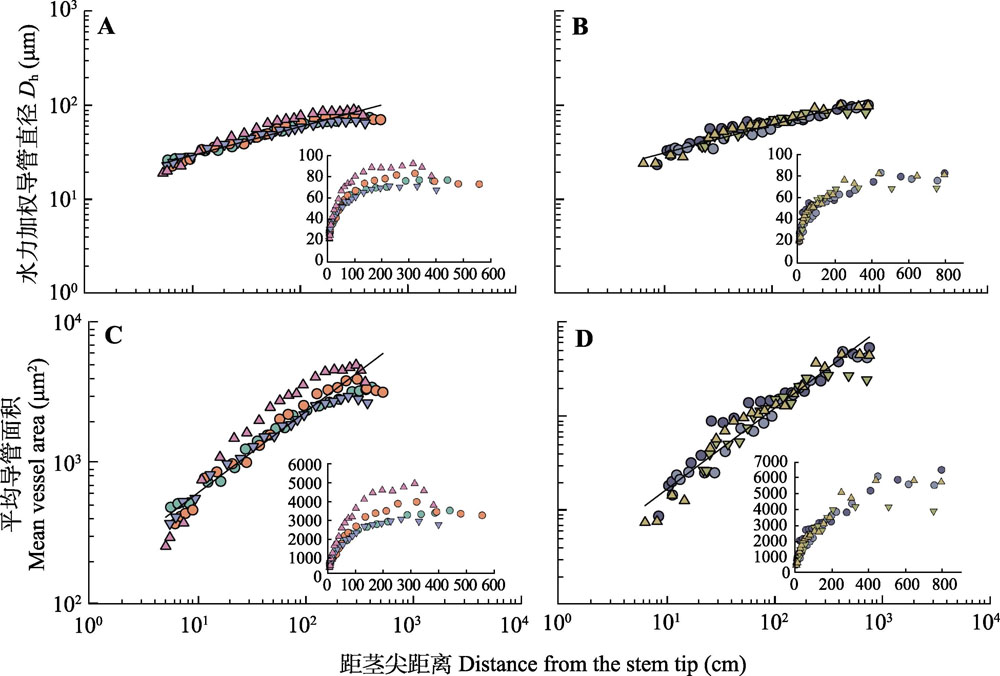
Important findings In both species, hydraulic diameter increased, vessel density decreased, and the ratio of vessel area to vessel density increased accordingly from the stem apex to the base. There was a significantly negative correlation between vessel density and vessel size. These results indicated that the size of vessels in bamboo gradually widens from the stem apex to the base, and the number of vessels in the unit cross sectional area of xylem gradually decreases. It is characterized by trade-off between changes in the size and number of vessels within stem. The results show insight on the growth adaptation strategies of monocotyledonous plants.
Key words: hydraulic limitation; axial variation; bamboo; vessel size; vessel density; trade-off
WANG Xiao-Lin , ZHOU Wei , ZHAO Mei , DING Yu-Tong , YANG Dong-Mei , ZHANG Yin-Shuang , YIN Meng-Qi , ZHUANG Yue , PENG Guo-Quan . Axial variations in vessel structure of bamboos Phyllostachys violascens ‘Prevernalis’ and Bambusa textilis[J]. Chinese Journal of Plant Ecology, 2024 , 48(7) : 915 -929 . DOI: 10.17521/cjpe.2023.0100
| [1] | Aloni R (1987). Differentiation of vascular tissues. Annual Review of Plant Physiology, 38, 179-204. |
| [2] | Aloni R, Zimmermann MH (1983). The control of vessel size and density along the plant axis: a new hypothesis. Differentiation, 24, 203-208. |
| [3] | Anfodillo T, Carraro V, Carrer M, Fior C, Rossi S (2006). Convergent tapering of xylem conduits in different woody species. New Phytologist, 169, 279-290. |
| [4] | Anfodillo T, Deslauriers A, Menardi R, Tedoldi L, Petit G, Rossi S (2012). Widening of xylem conduits in a conifer tree depends on the longer time of cell expansion downwards along the stem. Journal of Experimental Botany, 63, 837-845. |
| [5] | Aparecido LMT, dos Santos J, Higuchi N, Kunert N (2015). Ecological applications of differences in the hydraulic efficiency of palms and broad-leaved trees. Trees, 29, 1431-1445. |
| [6] | Baas P, Ewers FW, Davis SD, Wheeler EA (2004). Evolution of xylem physiology//Hemsley AR, Poole I. The Evolution of Plant Physiology. Academic Press, London. |
| [7] | Becker P, Gribben RJ (2001). Estimation of conduit taper for the hydraulic resistance model of West et al. Tree Physiology, 21, 697-700. |
| [8] | Becker P, Gribben RJ, Lim CM (2000). Tapered conduits can buffer hydraulic conductance from path-length effects. Tree Physiology, 20, 965-967. |
| [9] | Bettiati D, Petit G, Anfodillo T (2012). Testing the equi- resistance principle of the xylem transport system in a small ash tree: empirical support from anatomical analyses. Tree Physiology, 32, 171-177. |
| [10] | Bond BJ, Ryan MG (2000). Comment on ‘Hydraulic limitation of tree height: a critique’ by Becker, Meinzer and Wullschleger. Functional Ecology, 14, 137-140. |
| [11] | Brodribb TJ, Bowman DJMS, Nichols S, Delzon S, Burlett R (2010). Xylem function and growth rate interact to determine recovery rates after exposure to extreme water deficit. New Phytologist, 188, 533-542. |
| [12] | Brodribb TJ, Holbrook NM, Gutiérrez MV (2002). Hydraulic and photosynthetic co-ordination in seasonally dry tropical forest trees. Plant, Cell & Environment, 25, 1435-1444. |
| [13] | Carlquist S, Hoekman DA (1985). Ecological wood anatomy of the woody southern Californian flora. IAWA Journal, 6, 319-347. |
| [14] | Christensen-Dalsgaard KK, Fournier M, Ennos AR, Barfod AS (2007). Changes in vessel anatomy in response to mechanical loading in six species of tropical trees. New Phytologist, 176, 610-622. |
| [15] | Comstock JP, Sperry JS (2000). Tansley review No. 119 theoretical considerations of optimal conduit length for water transport in vascular plants. New Phytologist, 148, 195-218. |
| [16] | Coomes DA, Jenkins KL, Cole LES (2007). Scaling of tree vascular transport systems along gradients of nutrient supply and altitude. Biology Letters, 3, 86-89. |
| [17] | Domec JC, Gartner BL (2002). Age- and position-related changes in hydraulic versus mechanical dysfunction of xylem: inferring the design criteria for Douglas-fir wood structure. Tree Physiology, 22, 91-104. |
| [18] | Dong H, He XF, Wang L (2020). Water-transport tissue characteristics of xylem in different parts of jujube tree. Journal of Shanxi Agricultural Sciences, 48(2), 181-185. |
| [东昊, 贺晓芳, 王林 (2020). 枣树不同部位的木质部水分输导组织特征. 山西农业科学, 48(2), 181-185.] | |
| [19] | Echeverría A, Anfodillo T, Soriano D, Rosell JA, Olson ME (2019). Constant theoretical conductance via changes in vessel diameter and number with height growth in Moringa oleifera. Journal of Experimental Botany, 70, 5765-5772. |
| [20] | Enquist BJ (2002). Universal scaling in tree and vascular plant allometry: toward a general quantitative theory linking plant form and function from cells to ecosystems. Tree Physiology, 22, 1045-1064. |
| [21] | Enquist BJ, West GB, Brown JH (2000). Quarter-power allometric scaling in vascular plants: functional basis and ecological consequences//Brown JH, West GB. Scaling in Biology. Oxford University Press, Oxford. |
| [22] | Ewers FW, Ewers JM, Jacobsen AL, López-Portillo J (2007). Vessel redundancy: modeling safety in numbers. IAWA Journal, 28, 373-388. |
| [23] | Fajardo A, Martínez-Pérez C, Cervantes-Alcayde MA, Olson ME (2020). Stem length, not climate, controls vessel diameter in two trees species across a sharp precipitation gradient. New Phytologist, 225, 2347-2355. |
| [24] | Fan ZX, Cao KF, Becker P (2009). Axial and radial variations in xylem anatomy of angiosperm and conifer trees in Yunnan, China. IAWA Journal, 30, 1-13. |
| [25] | Fan ZX, Cao KF, Zou SQ (2005). Axial and radial changes in xylem anatomical characteristics in six evergreen broadleaved tree species in ailao mountain, Yunnan. Acta Phytoecologica Sinica, 29, 968-975. |
| [范泽鑫, 曹坤芳, 邹寿青 (2005). 云南哀牢山6种常绿阔叶树木质部解剖特征的轴向和径向变化. 植物生态学报, 29, 968-975.] | |
| [26] | Hacke UG, Sperry JS (2001). Functional and ecological xylem anatomy. Perspectives in Plant Ecology, Evolution and Systematics, 4, 97-115. |
| [27] | Hacke UG, Sperry JS, Pockman WT, Davis SD, McCulloh KA (2001). Trends in wood density and structure are linked to prevention of xylem implosion by negative pressure. Oecologia, 126, 457-461. |
| [28] | Hacke UG, Sperry JS, Wheeler JK, Castro L (2006). Scaling of angiosperm xylem structure with safety and efficiency. Tree Physiology, 26, 689-701. |
| [29] | Harvey PH, Pagel MD (1991). The Comparative Method in Evolutionary Biology (Vol. 239). Oxford University Press, Oxford. |
| [30] | Holbrook NM, Zwieniecki MA (2005). Integration of long distance transport in plants: perspectives and prospects for future research//Holbrook NM, Zwieniecki MA. Vascular Transport in Plants. Elsevier Academic Press, Burlington. 537-545. |
| [31] | Hubbard RM, Ryan MG, Stiller V, Sperry JS (2001). Stomatal conductance and photosynthesis vary linearly with plant hydraulic conductance in ponderosa pine. Plant, Cell & Environment, 24, 113-121. |
| [32] | Jacobsen AL, Ewers FW, Pratt RB, Paddock WA 3rd, Davis SD (2005). Do xylem fibers affect vessel cavitation resistance? Plant Physiology, 139, 546-556. |
| [33] | Jacobsen AL, Pratt RB, Venturas MD, Hacke UG (2019). Large volume vessels are vulnerable to water-stress-induced embolism in stems of poplar. IAWA Journal, 40, 4-22. DOI: 10.1163/22941932-40190233. |
| [34] | Jansen S, Gortan E, Lens F, Lo Gullo MA, Salleo S, Scholz A, Stein A, Trifilò P, Nardini A (2011). Do quantitative vessel and pit characters account for ion-mediated changes in the hydraulic conductance of angiosperm xylem? New Phytologist, 189, 218-228. |
| [35] | Ji YL, Guo Y, Chen JH, Liu P, Fang F, Ye D (2016). Resources and overall evaluation of medicinal plants in Zhejiang Normal University. Journal of Zhejiang Normal University (Natural Sciences), 39, 443-448. |
| [冀艳利, 郭印, 陈建华, 刘鹏, 方芳, 叶铎 (2016). 浙江师范大学校园药用植物资源及综合评价. 浙江师范大学学报(自然科学版), 39, 443-448.] | |
| [36] | Lazzarin M, Crivellaro A, Williams C, Dawson T, Mozzi G, Anfodillo T (2016). Tracheid and pit anatomy vary in tandem in a tall Sequoiadendron giganteum tree. IAWA Journal, 37, 172-185. |
| [37] | Li X, Li S, Deng LP, Li R, Yin YF, Zheng JM (2020). Axial variation of characteristics of water conducting tissue in xylem of Catalpa bungei. Journal of Beijing Forestry University, 42(1), 27-34. |
| [李昕, 李姗, 邓丽萍, 李仁, 殷亚方, 郑景明 (2020). 楸树木质部水分输导组织构造特征的轴向变化. 北京林业大学学报, 42(1), 27-34.] | |
| [38] | Liang Z, Wei KL, Yang DM, Peng GQ (2020). Effect of soak stems overnight with deionized water on measuring maximum hydraulic conductivity in xylem of stem segments of Robinia pseudoacacia L. and age-relate difference. Bulletin of Botanical Research, 40, 706-717. |
| [梁昭, 魏凯璐, 杨冬梅, 彭国全 (2020). 水分浸泡过夜对刺槐枝条最大水分导度测定的影响及年龄差异. 植物研究, 40, 706-717.] | |
| [39] | Liese W (1998). The Anatomy of Bamboo Culms. Technical Report 18. International Network for Bamboo and Rattan, Beijing. |
| [40] | Liese W, Weiner G (1996). Ageing of bamboo culms. A review. Wood Science and Technology, 30, 77-89. |
| [41] | Lintunen A, Kalliokoski T, Niinemets ü (2010). The effect of tree architecture on conduit diameter and frequency from small distal roots to branch tips in Betula pendula, Picea abies and Pinus sylvestris. Tree Physiology, 30, 1433-1447. |
| [42] | Liu H, Gleason SM, Hao GY, Hua L, He PC, Goldstein G, Ye Q (2019). Hydraulic traits are coordinated with maximum plant height at the global scale. Science Advances, 5, eaav1332. DOI: 10.1126/sciadv.aav1332. |
| [43] | Martínez-Cabrera HI, Jones CS, Espino S, Schenk HJ (2009). Wood anatomy and wood density in shrubs: responses to varying aridity along transcontinental transects. American Journal of Botany, 96, 1388-1398. |
| [44] | McCulloh K, Sperry JS, Lachenbruch B, Meinzer FC, Reich PB, Voelker S (2010). Moving water well: comparing hydraulic efficiency in twigs and trunks of coniferous, ring-porous, and diffuse-porous saplings from temperate and tropical forests. New Phytologist, 186, 439-450. |
| [45] | Mencuccini M, H?ltt? T, Petit G, Magnani F (2007a). Sanio’s laws revisited. Size-dependent changes in the xylem architecture of trees. Ecology Letters, 10, 1084-1093. |
| [46] | Mencuccini M, Martínez-Vilalta J, Hamid HA, Korakaki E, Vanderklein D (2007b). Evidence for age- and size-mediated controls of tree growth from grafting studies. Tree Physiology, 27, 463-473. |
| [47] | Midgley JJ (2003). Is bigger better in plants? The hydraulic costs of increasing size in trees. Trends in Ecology & Evolution, 18, 5-6. |
| [48] | Niklas KJ (1994). Predicting the height of fossil plant remains: an allometric approach to an old problem. American Journal of Botany, 81, 1235-1242. |
| [49] | Olson ME, Anfodillo T, Gleason SM, McCulloh KA (2021). Tip-to-base xylem conduit widening as an adaptation: causes, consequences, and empirical priorities. New Phytologist, 229, 1877-1893. |
| [50] | Olson ME, Anfodillo T, Rosell JA, Petit G, Crivellaro A, Isnard S, León-Gómez C, Alvarado-Cárdenas LO, Castorena M (2014). Universal hydraulics of the flowering plants: vessel diameter scales with stem length across angiosperm lineages, habits and climates. Ecology Letters, 17, 988-997. |
| [51] | Olson ME, Rosell JA (2013). Vessel diameter-stem diameter scaling across woody angiosperms and the ecological causes of xylem vessel diameter variation. New Phytologist, 197, 1204-1213. |
| [52] | Petit G, Anfodillo T (2009). Plant physiology in theory and practice: an analysis of the WBE model for vascular plants. Journal of Theoretical Biology, 259, 1-4. |
| [53] | Petit G, Anfodillo T, Carraro V, Grani F, Carrer M (2011). Hydraulic constraints limit height growth in trees at high altitude. New Phytologist, 189, 241-252. |
| [54] | Petit G, Anfodillo T, De Zan C (2009). Degree of tapering of xylem conduits in stems and roots of small Pinus cembra and Larix decidua trees. Botany, 87, 501-508. |
| [55] | Petit G, Anfodillo T, Mencuccini M (2008). Tapering of xylem conduits and hydraulic limitations in sycamore (Acer pseudoplatanus) trees. New Phytologist, 177, 653-664. |
| [56] | Petit G, DeClerck FAJ, Carrer M, Anfodillo T (2014). Axial vessel widening in arborescent monocots. Tree Physiology, 34, 137-145. |
| [57] | Petit G, Pfautsch S, Anfodillo T, Adams MA (2010). The challenge of tree height in Eucalyptus regnans: When xylem tapering overcomes hydraulic resistance. New Phytologist, 187, 1146-1153. |
| [58] | Pitman EJG (1939). A note on normal correlation. Biometrika, 31, 9-12. |
| [59] | Pittermann J, Sperry JS, Wheeler JK, Hacke UG, Sikkema EH (2006). Mechanical reinforcement of tracheids compromises the hydraulic efficiency of conifer xylem. Plant, Cell & Environment, 29, 1618-1628. |
| [60] | Poorter L, McDonald I, Alarcón A, Fichtler E, Licona JC, Pe?a-Claros M, Sterck F, Villegas Z, Sass-Klaassen U (2010). The importance of wood traits and hydraulic conductance for the performance and life history strategies of 42 rainforest tree species. New Phytologist, 185, 481-492. |
| [61] | Pothier D, Margolis HA, Waring RH (1989). Patterns of change of saturated sapwood permeability and sapwood conductance with stand development. Canadian Journal of Forest Research, 19, 432-439. |
| [62] | Preston KA, Cornwell WK, Denoyer JL (2006). Wood density and vessel traits as distinct correlates of ecological strategy in 51 California coast range angiosperms. New Phytologist, 170, 807-818. |
| [63] | Renninger HJ, McCulloh KA, Phillips N (2013). A comparison of the hydraulic efficiency of a palm species (Iriartea deltoidea) with other wood types. Tree Physiology, 33, 152-160. |
| [64] | Rich PM (1987). Developmental anatomy of the stem of welfia georgii, iriartea gigantea, and other arborescent palms: implications for mechanical support. American Journal of Botany, 74, 792-802. |
| [65] | Rosell JA, Olson ME, Anfodillo T (2017). Scaling of xylem vessel diameter with plant size: causes, predictions, and outstanding questions. Current Forestry Reports, 3, 46-59. |
| [66] | Rosner S, Světlík J, Andreassen K, B?rja I, Dalsgaard L, Evans R, Luss S, Tveito OE, Solberg S (2016). Novel hydraulic vulnerability proxies for a boreal conifer species reveal that opportunists may have lower survival prospects under extreme climatic events. Frontiers in Plant Science, 7, 831. DOI: 10.3389/fpls.2016.00831. |
| [67] | Ryan MG, Yoder BJ (1997). Hydraulic limits to tree height and tree growth. BioScience, 47, 235-242. |
| [68] | Savage VM, Bentley LP, Enquist BJ, Sperry JS, Smith DD, Reich PB, von Allmen EI (2010). Hydraulic trade-offs and space filling enable better predictions of vascular structure and function in plants. Proceedings of the National Academy of Sciences of the United States of America, 107, 22722-22727. |
| [69] | Schenk HJ, Espino S, Goedhart CM, Nordenstahl M, Cabrera HIM, Jones CS (2008). Hydraulic integration and shrub growth form linked across continental aridity gradients. Proceedings of the National Academy of Sciences of the United States of America, 105, 11248-11253. |
| [70] | Schuldt B, Leuschner C, Brock N, Horna V (2013). Changes in wood density, wood anatomy and hydraulic properties of the xylem along the root-to-shoot flow path in tropical rainforest trees. Tree Physiology, 33, 161-174. |
| [71] | Scoffoni C, Chatelet DS, Pasquet-kok J, Rawls M, Donoghue MJ, Edwards EJ, Sack L (2016). Hydraulic basis for the evolution of photosynthetic productivity. Nature Plants, 2, 16072. DOI: 10.1038/NPLANTS.2016.72. |
| [72] | Shi JM, Mao SY, Wang LF, Ye XH, Wu JA, Wang GR, Chen FS, Yang QP (2021). Clonal integration driven by source- sink relationships is constrained by rhizome branching architecture in a running bamboo species (Phyllostachys glauca): a 15N assessment in the field. Forest Ecology and Management, 481, 118754. DOI: 10.1016/j.foreco.2020. 118754. |
| [73] | Shinozaki T, Yoda K, Hozumi K, Kira T (1964a). A quantitative analysis of plantform: the pipe model theory. I. Basic analyses. Japanese Journal of Ecology, 14, 97-105. |
| [74] | Shinozaki T, Yoda K, Hozumi K, Kira T (1964b). A quantitative analysis of plantform: the pipe model theory. II. Further evidence of the theory and itsimplications in forest ecology. Japanese Journal of Ecology, 14, 133-139. |
| [75] | Soriano D, Echeverría A, Anfodillo T, Rosell JA, Olson ME (2020). Hydraulic traits vary as the result of tip-to-base conduit widening in vascular plants. Journal of Experimental Botany, 71, 4232-4242. |
| [76] | Sperry JS (2000). Hydraulic constraints on plant gas exchange. Agricultural and Forest Meteorology, 104, 13-23. |
| [77] | Sperry JS (2003). Evolution of water transport and xylem structure. International Journal of Plant Sciences, 164, S115-S127. |
| [78] | Sperry JS, Meinzer FC, McCulloh KA (2008). Safety and efficiency conflicts in hydraulic architecture: scaling from tissues to trees. Plant, Cell & Environment, 31, 632-645. |
| [79] | Taneda H, Tateno M (2004). The criteria for biomass partitioning of the current shoot: water transport versus mechanical support. American Journal of Botany, 91, 1949-1959. |
| [80] | Tyree MT (2007). Water relations and hydraulic architecture// Pugnaire F, Valladares F. Functional Plant Ecology. CRC Press, Boca Raton.175-212. |
| [81] | Tyree MT, Davis SD, Cochard H (1994). Biophysical perspectives of xylem evolution: Is there a tradeoff of hydraulic efficiency for vulnerability to dysfunction? IAWA Journal, 15, 335-360. |
| [82] | Tyree MT, Ewers FW (1991). Tansley review No. 34. the hydraulic architecture of trees and other woody plants. New Phytologist, 119, 345-360. |
| [83] | Tyree MT, Ewers FW (1996). Hydraulic architecture of woody tropical plants//Mulkey SS, Chazdon RL, Smith AP. Tropical Forest Plant Ecophysiology. Springer, New York. 217-243. |
| [84] | Tyree MT, Zimmermann MH (2002). The cohension-tension theory of sap ascent//Tyree M, Zimmermann MH. Xylem Structure and the Ascent of Sap. 2nd ed. Springer-Verlag, Berlin. |
| [85] | Warton DI, Wright IJ, Falster DS, Westoby M (2006). Bivariate line-fitting methods for allometry. Biological Reviews of the Cambridge Philosophical Society, 81, 259-291. |
| [86] | Wei ZQ (2011). Characteristics and cultivation techniques of Phyllostachys praecox. Shanghai Vegetables, (6), 26-27. |
| [魏子清 (2011). 雷竹特征特性及栽培技术. 上海蔬菜, (6), 26-27.] | |
| [87] | Weitz JS, Ogle K, Horn HS (2006). Ontogenetically stable hydraulic design in woody plants. Functional Ecology, 20, 191-199. |
| [88] | West GB, Brown JH, Enquist BJ (1999). A general model for the structure and allometry of plant vascular systems. Nature, 400, 664-667. |
| [89] | Wheeler EA, Baas P, Rodgers S (2007). Variations in dieot wood anatomy: a global analysis based on the insidewood database. IAWA Journal, 28, 229-258. |
| [90] | Wiemann MC, Wheeler EA, Manchester SR, Portier KM (1998). Dicotyledonous wood anatomical characters as predictors of climate. Palaeogeography, Palaeoclimatology, Palaeoecology, 139, 83-100. |
| [91] | Williams CB, Anfodillo T, Crivellaro A, Lazzarin M, Dawson TE, Koch GW (2019). Axial variation of xylem conduits in the Earth’s tallest trees. Trees, 33, 1299-1311. |
| [92] | Yang DM, Zhang YS, Zhou D, Zhang YJ, Peng GQ, Tyree MT (2021). The hydraulic architecture of an arborescent monocot: ontogeny-related adjustments in vessel size and leaf area compensate for increased resistance. New Phytologist, 231, 273-284. |
| [93] | Yang SD, Tyree MT (1993). Hydraulic resistance in Acer saccharum shoots and its influence on leaf water potential and transpiration. Tree Physiology, 12, 231-242. |
| [94] | Yang SM, Jiang ZH, Ren HQ (2007). Advances in the study of Bambusa textiles. Journal of Bamboo Research, 26(1), 15-19. |
| [杨淑敏, 江泽慧, 任海青 (2007). 青皮竹研究进展及展望. 竹子研究汇刊, 26(1), 15-19.] | |
| [95] | Yoder BJ, Ryan MG, Waring RH, Schoettle AW, Kaufmann MR (1994). Evidence of reduced photosynthetic rates in old trees. Forest Science, 40, 513-527. |
| [96] | Zaehle S (2005). Effect of height on tree hydraulic conductance incompletely compensated by xylem tapering. Functional Ecology, 19, 359-364. |
| [97] | Zanne AE, Westoby M, Falster DS, Ackerly DD, Loarie SR, Arnold SEJ, Coomes DA (2010). Angiosperm wood structure: global patterns in vessel anatomy and their relation to wood density and potential conductivity. American Journal of Botany, 97, 207-215. |
| [98] | Zimmermann MH (1982). Functional xylem anatomy of angiosperm trees//Baas P. New Perspectives in Wood Anatomy. Springer, Dordrecht. 59-70. |
/
| 〈 |
|
〉 |
Copyright © 2026 Chinese Journal of Plant Ecology
Tel: 010-62836134, 62836138, E-mail: apes@ibcas.ac.cn, cjpe@ibcas.ac.cn

