Chinese Journal of Plant Ecology >
Impact of drought on carbon and water fluxes and their coupling in a Quercus variabilis plantation
- 1School of Ecology and Nature Conservation, Beijing Forestry University, Beijing 100083, China
2Research Institute of Forestry, Chinese Academy of Forestry, Beijing 100091, China
3Henan Xiaolangdi Forest Ecosystem National Observation and Research Station, Jiyuan, Henan 454650, China
4Key Laboratory of Water Cycle and Related Land Surface Processes, Institute of Geographical Sciences and Natural Resources Research, Chinese Academy of Sciences, Beijing 100101, China
Accepted date: 2023-11-29
Online published: 2024-05-10
Supported by
National Natural Science Foundation of China(32271875);National Natural Science Foundation of China(31872703);National Key R&D Program of China(2020YFA0608101)
Abstract
Aims Water use efficiency (WUE) is an important indicator for understanding the carbon and water cycles and coupling mechanisms in terrestrial ecosystems. Inherent water use efficiency (IWUE) is a more suitable indicator than WUE for analyzing the carbon-water coupling mechanism of ecosystems on a daily scale. Here, we aimed to investigate the mechanism of water and carbon fluxes and their responses to drought in a planted forest ecosystem.
Methods We carried out an in-situobservation on the water and carbon fluxes and environmental factors in a Quercus variabilisplantation using eddy covariance techniques and the micrometeorological observation system. The effects of biophysical factors on the gross primary productivity (GPP), evapotranspiration (ET), and IWUE during 2021-2022 were analyzed.
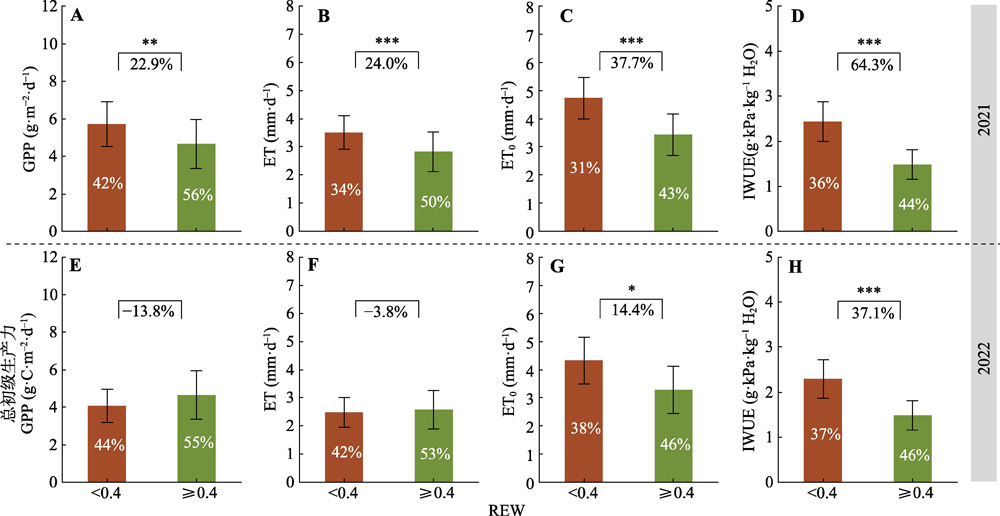
Important findings GPP, ET, and IWUE showed obvious seasonal variations. GPP and ET in the wet year were 7.9% and 21.0% higher than those in the normal year, respectively, whereas IWUE in the wet year was 21.4% lower than that in the normal year. Vapor pressure deficit (VPD) was the main factor affecting GPP in the normal year, and net radiation (Rn) was the primarily factor limiting GPP in the wet year. ET was mainly determined by Rn in both normal and wet years. Relative extractable soil water (REW) was the main factor regulating IWUE in the normal year, whereas leaf area index (LAI) was the main factor controlling IWUE in the wet year. Environmental factors regulated carbon and water fluxes by affecting canopy conductance, and consequently impacting IWUE. The occurrence of soil drought significantly increased IWUE. The response of GPP and ET to REW showed a time lag of 1 month, while the response of IWUE to REW had no lag.
Cite this article
WANG Yin , TONG Xiao-Juan , ZHANG Jin-Song , LI Jun , MENG Ping , LIU Pei-Rong , ZHANG Jing-Ru . Impact of drought on carbon and water fluxes and their coupling in a Quercus variabilis plantation[J]. Chinese Journal of Plant Ecology, 2024 , 48(9) : 1157 -1171 . DOI: 10.17521/cjpe.2023.0354
References
| [1] | Bai Y, Li XY, Zhou S, Yang XF, Yu KL, Wang MJ, Liu SM, Wang P, Wu XC, Wang XC, Zhang CC, Shi FZ, Wang Y, Wu YN (2019). Quantifying plant transpiration and canopy conductance using eddy flux data: an underlying water use efficiency method. Agricultural and Forest Meteorology, 271, 375-384. |
| [2] | Beer C, Ciais P, Reichstein M, Baldocchi D, Law BE, Papale D, Soussana JF, Ammann C, Buchmann N, Frank D, Gianelle D, Janssens IA, Knohl A, K?stner B, Moors E, et al.(2009). Temporal and among-site variability of inherent water use efficiency at the ecosystem level. Global Biogeochemical Cycles, 23, GB2018. DOI: 10.1029/2008GB003233. |
| [3] | Boyer JS (1982). Plant productivity and environment. Science, 218, 443-448. |
| [4] | Burnett MW, Quetin GR, Konings AG (2020). Data-driven estimates of evapotranspiration and its controls in the Congo Basin. Hydrology and Earth System Sciences, 24, 4189-4211. |
| [5] | Chen T, de Jeu RAM, Liu YY, van der Werf GR, Dolman AJ (2014). Using satellite based soil moisture to quantify the water driven variability in NDVI: a case study over mainland Australia. Remote Sensing of Environment, 140, 330-338. |
| [6] | Chen Y, Wang AH (2023). Effects of spring soil moisture on compound events of high temperature, low humidity, and rainfall in South China. Transactions of Atmospheric Sciences, 46, 332-344. |
| [陈玥, 王爱慧 (2023). 中国南方春季土壤湿度对夏季干热少雨复合事件的影响. 大气科学学报, 46, 332-344.] | |
| [7] | Chen YM, Xue YJ, Hu YM (2018). How multiple factors control evapotranspiration in North America evergreen needleleaf forests. Science of the Total Environment, 622-623, 1217-1224. |
| [8] | Ciais P, Reichstein M, Viovy N, Granier A, Ogée J, Allard V, Aubinet M, Buchmann N, Bernhofer C, Carrara A, Chevallier F, de Noblet N, Friend AD, Friedlingstein P, Grünwald T, et al.(2005). Europe-wide reduction in primary productivity caused by the heat and drought in 2003. Nature, 437, 529-533. |
| [9] | Ding YX, Li Z, Peng SZ (2020). Global analysis of time-lag and -accumulation effects of climate on vegetation growth. International Journal of Applied Earth Observation and Geoinformation, 92, 102179. DOI: 10.1016/j.jag.2020.102179. |
| [10] | Fisher RA, Williams M, Da Costa AL, Malhi Y, Da Costa RF, Almeida S, Meir P (2007). The response of an Eastern Amazonian rain forest to drought stress: results and modelling analyses from a throughfall exclusion experiment. Global Change Biology, 13, 2361-2378. |
| [11] | Flach M, Brenning A, Gans F, Reichstein M, Sippel S, Mahecha MD (2021). Vegetation modulates the impact of climate extremes on gross primary production. Biogeosciences, 18, 39-53. |
| [12] | Fu Y, Zheng Z, Yu G, Hu Z, Sun X, Shi P, Wang Y, Zhao X (2009). Environmental influences on carbon dioxide fluxes over three grassland ecosystems in China. Biogeosciences, 6, 2879-2893. |
| [13] | García AG, Di Bella CM, Houspanossian J, Magliano PN, Jobbágy EG, Posse G, Fernández RJ, Nosetto MD (2017). Patterns and controls of carbon dioxide and water vapor fluxes in a dry forest of central Argentina. Agricultural and Forest Meteorology, 247, 520-532. |
| [14] | Guo LM, Sun FB, Liu WB, Zhang YG, Wang H, Cui HJ, Wang HQ, Zhang J, Du BX (2019). Response of ecosystem water use efficiency to drought over China during 1982-2015: spatiotemporal variability and resilience. Forests, 10, 598-612. |
| [15] | Hao Y, Zhang H, Biederman JA, Li L, Cui X, Xue K, Du J, Wang Y (2018). Seasonal timing regulates extreme drought impacts on CO2 and H2O exchanges over semiarid steppes in Inner Mongolia, China. Agriculture, Ecosystems & Environment, 266, 153-166. |
| [16] | Hartmann H (2011). Will a 385 million year-struggle for light become a struggle for water and for carbon? How trees may cope with more frequent climate change-type drought events. Global Change Biology, 17, 642-655. |
| [17] | Heilman KA, Trouet VM, Belmecheri S, Pederson N, Berke MA, McLachlan JS (2021). Increased water use efficiency leads to decreased precipitation sensitivity of tree growth, but is offset by high temperatures. Oecologia, 197, 1095-1110. |
| [18] | Howell TA, Dusek DA (1995). Comparison of vapor-pressure- deficit calculation methods—Southern high plains. Journal of Irrigation and Drainage Engineering, 121, 191-198. |
| [19] | Hu ZM, Yu GR, Wang QF, Zhao FH (2009). Ecosystem level water use efficiency: a review. Acta Ecologica Sinica, 29, 1498-1507. |
| [胡中民, 于贵瑞, 王秋凤, 赵风华 (2009). 生态系统水分利用效率研究进展. 生态学报, 29, 1498-1507.] | |
| [20] | Huang H, Zheng CL, Meng P, Zhang JS, Tong XJ, Cheng XF (2023). Relationship between leaf area index and climate factors in a Quercus variabilis plantation at the southern foot of Taihang Mountain from 2001 to 2019. Acta Ecologica Sinica, 43, 1646-1654. |
| [黄辉, 郑昌玲, 孟平, 张劲松, 同小娟, 程向芬 (2023). 2001-2019年太行山南麓栓皮栎人工林叶面积指数与气候因子的关系. 生态学报, 43, 1646-1654.] | |
| [21] | Huang WH, Wang HL (2021). Drought and intensified agriculture enhanced vegetation growth in the central Pearl River Basin of China. Agricultural Water Management, 256, 107077. DOI: 10.1016/j.agwat.2021.107077. |
| [22] | IPCC (Intergovernmental Panel on Climate Change) (2021). Climate Change 2021: the Physical Science Basis. Contribution of Working Group I to the Sixth Assessment Report of the Intergovernmental Panel on Climate Change.. Cambridge University Press, Cambridge, UK. |
| [23] | Ishida A, Diloksumpun S, Ladpala P, Staporn D, Panuthai S, Gamo M, Yazaki K, Ishizuka M, Puangchit L (2006). Contrasting seasonal leaf habits of canopy trees between tropical dry-deciduous and evergreen forests in Thailand. Tree Physiology, 26, 643-656. |
| [24] | Ji Y, Li Y, Yao N, Biswas A, Zou Y, Meng Q, Liu F (2021). The lagged effect and impact of soil moisture drought on terrestrial ecosystem water use efficiency. Ecological Indicators, 133, 108349. DOI: 10.1016/j.ecolind.2021.108349. |
| [25] | Jia X, Zha T, Gong J, Wang B, Zhang Y, Wu B, Qin S, Peltola H (2016). Carbon and water exchange over a temperate semi-arid shrubland during three years of contrasting precipitation and soil moisture patterns. Agricultural and Forest Meteorology, 228, 120-129. |
| [26] | Jiang P, Wang YX, Yang Y, Gu XC, Huang Y, Liu L, Liu L (2023). Spatiotemporal features and time-lagged effects of drought on terrestrial ecosystem in southwest China. Forests, 14, 781. DOI: 10.3390/f14040781. |
| [27] | Kanniah KD, Beringer J, North P, Hutley L (2012). Control of atmospheric particles on diffuse radiation and terrestrial plant productivity: a review. Progress in Physical Geography: Earth and Environment, 36, 209-237. |
| [28] | Kato T, Tang Y, Gu S, Hirota M, Du M, Li Y, Zhao X (2006). Temperature and biomass influences on interannual changes in CO2 exchange in an alpine meadow on the Qinghai-Tibetan Plateau. Global Change Biology, 12, 1285-1298. |
| [29] | Konings AG, Gentine P (2017). Global variations in ecosystem- scale isohydricity. Global Change Biology, 23, 891-905. |
| [30] | Krishnan P, Black TA, Grant NJ, Barr AG, Hogg EH, Jassal RS, Morgenstern K (2006). Impact of changing soil moisture distribution on net ecosystem productivity of a boreal aspen forest during and following drought. Agricultural and Forest Meteorology, 139, 208-223. |
| [31] | Kwon H, Law BE, Thomas CK, Johnson BG (2018). The influence of hydrological variability on inherent water use efficiency in forests of contrasting composition, age, and precipitation regimes in the Pacific Northwest. Agricultural and Forest Meteorology, 249, 488-500. |
| [32] | Lei HM, Gong TT, Zhang YC, Yang DW (2018). Biological factors dominate the interannual variability of evapotranspiration in an irrigated cropland in the North China Plain. Agricultural and Forest Meteorology, 250, 262-276. |
| [33] | Li HQ, Zhu JB, Zhang FW, He HD, Yang YS, Li YN, Cao GM, Zhou HK (2019). Growth stage-dependant variability in water vapor and CO2 exchanges over a humid alpine shrubland on the northeastern Qinghai-Tibetan Plateau. Agricultural and Forest Meteorology, 268, 55-62. |
| [34] | Liu X, Qi C, Yan YL, Yuan GF (2017). Revised algorithm of ecosystem water use efficiency for semi-arid steppe in the Loess Plateau of China. Chinese Journal of Plant Ecology, 41, 497-505. |
| [刘晓, 戚超, 闫艺兰, 袁国富 (2017). 不同生态系统水分利用效率指标在黄土高原半干旱草地应用的适宜性评价. 植物生态学报, 41, 497-505.] | |
| [35] | Liu ZQ, Ji XF, Ye LM, Jiang J (2022). Inherent water-use efficiency of different forest ecosystems and its relations to climatic variables. Forests, 13, 775. DOI: 10.3390/f13050775. |
| [36] | Ma J, Jia X, Zha T, Bourque CPA, Tian Y, Bai Y, Liu P, Yang R, Li C, Li CY Xie J, Yu H, Zhang F, Zhou C (2019). Ecosystem water use efficiency in a young plantation in northern China and its relationship to drought. Agricultural and Forest Meteorology, 275, 1-10. |
| [37] | McCree KJ, Fernandez CJ (1989). Simulation model for studying physiological water stress responses of whole plants. Crop Science, 29, 353-360. |
| [38] | Monteith JL (1965). Evaporation and environment. Symposia of the Society for Experimental Biology, 19, 205-234. |
| [39] | Monteith JL, Unsworth MH (1990). Principles of Environmental Physics. 2nd ed. Chapman and Hall, New York. |
| [40] | Novick KA, Ficklin DL, Stoy PC, Williams CA, Bohrer G, Oishi AC, Papuga SA, Blanken PD, Noormets A, Sulman BN, Scott RL, Wang LX, Phillips RP (2016). The increasing importance of atmospheric demand for ecosystem water and carbon fluxes. Nature Climate Change, 6, 1023-1027. |
| [41] | Pei TT, Hou QQ, Chen Y, Ji ZX, Wu HW, Xie BP, Qi PX, Zhang JX (2022). Vegetation in arid areas of the Loess Plateau showed more sensitivity of water-use efficiency to seasonal drought. Forests, 13, 634. DOI: 10.3390/f13050634. |
| [42] | Peng J, Wu CY, Zhang XY, Wang XY, Gonsamo A (2019). Satellite detection of cumulative and lagged effects of drought on autumn leaf senescence over the Northern Hemisphere. Global Change Biology, 25, 2174-2188. |
| [43] | Saugier B, Granier A, Pontailler JY, Dufrêne E, Baldocchi DD (1997). Transpiration of a boreal pine forest measured by branch bag, sap flow and micrometeorological methods. Tree Physiology, 17, 511-519. |
| [44] | Schwalm CR, Williams CA, Schaefer K, Baldocchi D, Black TA, Goldstein AH, Law BE, Oechel WC, Paw U KT, Scott RL (2012). Reduction in carbon uptake during turn of the century drought in western North America. Nature Geoscience, 5, 551-556. |
| [45] | Tang X, Li H, Desai AR, Nagy Z, Luo J, Kolb TE, Olioso A, Xu X, Yao L, Kutsch W, Pilegaard K, K?stner B, Ammann C (2014). How is water-use efficiency of terrestrial ecosystems distributed and changing on Earth. Scientific Reports, 4, 7483. DOI: 10.1038/srep07483. |
| [46] | Thom AS (1972). Momentum, mass and heat exchange of vegetation. Quarterly Journal of the Royal Meteorological Society, 98, 124-134. |
| [47] | Thomas DS, Eamus D, Shanahan S (2000). Influence of season, drought and xylem ABA on stomatal responses to leaf- to-air vapour pressure difference of trees of the Australian wet-dry tropics. Australian Journal of Botany, 48, 143-151. |
| [48] | van der Molen MK, Dolman AJ, Ciais P, Eglin T, Gobron N, Law BE, Meir P, Peters W, Phillips OL, Reichstein M, Chen T, Dekker SC, Doubková M, Friedl MA, Jung M, et al.(2011). Drought and ecosystem carbon cycling. Agricultural and Forest Meteorology, 151, 765-773. |
| [49] | Vickers D, Thomas CK, Pettijohn C, Martin JG, Law BE (2012). Five years of carbon fluxes and inherent water-use efficiency at two semi-arid pine forests with different disturbance histories. Tellus B: Chemical and Physical Meteorology, 64, 17159. DOI: 10.3402/tellusb.v64i0.17159. |
| [50] | von Buttlar J, Zscheischler J, Rammig A, Sippel S, Reichstein M, Knohl A, Jung M, Menzer O, Arain MA, Buchmann N, Cescatti A, Gianelle D, Kiely G, Law BE, Magliulo V, et al.(2018). Impacts of droughts and extreme-temperature events on gross primary production and ecosystem respiration: a systematic assessment across ecosystems and climate zones. Biogeosciences, 15, 1293-1318. |
| [51] | Wagner FH, Hérault B, Bonal D, Stahl C, Anderson LO, Baker TR, Becker GS, Beeckman H, Boanerges Souza D, Botosso PC, Bowman DMJS, Br?uning A, Brede B, Brown FI, Camarero JJ, et al.(2016). Climate seasonality limits leaf carbon assimilation and wood productivity in tropical forests. Biogeosciences, 13, 2537-2562. |
| [52] | Wang J, Yan R, Wu GX, Liu YM, Wang MR, Zeng N, Jiang F, Wang HM, He W, Wu MS, Ju WM, Chen JM (2023). Unprecedented decline in photosynthesis caused by summer 2022 record-breaking compound drought-heatwave over Yangtze River Basin. Science Bulletin, 68, 2160-2163. |
| [53] | Wang L, Good SP, Caylor KK (2014). Global synthesis of vegetation control on evapotranspiration partitioning. Geophysical Research Letters, 41, 6753-6757. |
| [54] | Wang LS, Tong XJ, Meng P, Zhang JS, Liu PR, Li J, Zhang JR, Zhou Y (2022). Energy flux and evapotranspiration of two typical plantations in semi-arid area of western Liaoning, China. Chinese Journal of Plant Ecology, 46, 1508-1522. |
| [王俐爽, 同小娟, 孟平, 张劲松, 刘沛荣, 李俊, 张静茹, 周宇 (2022). 辽西半干旱地区两种典型人工林生态系统能量通量及蒸散特征. 植物生态学报, 46, 1508-1522.] | |
| [55] | Wang MJ, Chen YH, Wu XC, Bai Y (2018a). Forest-type- dependent water use efficiency trends across the Northern Hemisphere. Geophysical Research Letters, 45, 8283-8293. |
| [56] | Wang TX, Tang XG, Zheng C, Gu Q, Wei J, Ma MG (2018b). Differences in ecosystem water-use efficiency among the typical croplands. Agricultural Water Management, 209, 142-150. |
| [57] | Wang Y, Zhou L, Jia QY, Yu WY (2017). Water use efficiency of a rice paddy field in Liaohe Delta, Northeast China. Agricultural Water Management, 187, 222-231. |
| [58] | Wang Y, Zhou L, Ping XY, Jia QY, Li RP (2018c). Ten-year variability and environmental controls of ecosystem water use efficiency in a rainfed maize cropland in Northeast China. Field Crops Research, 226, 48-55. |
| [59] | Wang YY, Ma YM, Li HX, Yuan L (2020). Carbon and water fluxes and their coupling in an alpine meadow ecosystem on the northeastern Tibetan Plateau. Theoretical and Applied Climatology, 142, 1-18. |
| [60] | Wei XN, He W, Zhou YL, Ju WM, Xiao JF, Li X, Liu YB, Xu SH, Bi WJ, Zhang XY, Cheng N (2022). Global assessment of lagged and cumulative effects of drought on grassland gross primary production. Ecological Indicators, 136, 108646. DOI: 10.1016/j.ecolind.2022.108646. |
| [61] | Wen YY, Liu XP, Pei FS, Li X, Du GM (2018). Non-uniform time-lag effects of terrestrial vegetation responses to asymmetric warming. Agricultural and Forest Meteorology, 252, 130-143. |
| [62] | Wu DH, Zhao X, Liang SL, Zhou T, Huang KC, Tang BJ, Zhao WQ (2015). Time-lag effects of global vegetation responses to climate change. Global Change Biology, 21, 3520-3531. |
| [63] | Wu JB, Jing YL, Guan DX, Yang H, Niu LH, Wang AZ, Yuan FH, Jin CJ (2013). Controls of evapotranspiration during the short dry season in a temperate mixed forest in Northeast China. Ecohydrology, 6, 775-782. |
| [64] | Wu X, Liu H, Li X, Ciais P, Babst F, Guo W, Zhang C, Magliulo V, Pavelka M, Liu S, Huang Y, Wang P, Shi C, Ma Y (2018). Differentiating drought legacy effects on vegetation growth over the temperate Northern Hemisphere. Global Change Biology, 24, 504-516. |
| [65] | Xie J, Zha TS, Zhou CX, Jia X, Yu HQ, Yang B, Chen JQ, Zhang F, Wang B, Bourque CPA, Sun G, Ma H, Liu H, Peltola H (2016). Seasonal variation in ecosystem water use efficiency in an urban-forest reserve affected by periodic drought. Agricultural and Forest Meteorology, 221, 142-151. |
| [66] | Xu C, McDowell NG, Fisher RA, Wei L, Sevanto S, Christoffersen BO, Weng E, Middleton RS (2019). Increasing impacts of extreme droughts on vegetation productivity under climate change. Nature Climate Change, 9, 948-953. |
| [67] | Xue LQ, Fu FB, Chen XF, Liu YH, Han Q, Liao SM, Wei Q (2021). Analysis on water use efficiency of Populus euphratica forest ecosystem in arid area. Theoretical and Applied Climatology, 145, 717-730. |
| [68] | Yang Y, Guan H, Batelaan O, McVicar TR, Long D, Piao S, Liang W, Liu B, Jin Z, Simmons CT (2016). Contrasting responses of water use efficiency to drought across global terrestrial ecosystems. Scientific Reports, 6, 23284. DOI: 10.1038/srep23284. |
| [69] | Yu X, Orth R, Reichstein M, Bahn M, Klosterhalfen A, Knohl A, Koebsch F, Migliavacca M, Mund M, Nelson JA, Stocker BD, Walther S, Bastos A (2022). Contrasting drought legacy effects on gross primary productivity in a mixed versus pure beech forest. Biogeosciences, 19, 4315-4329. |
| [70] | Zhang BZ, Xu D, Liu Y, Li FS, Cai JB, Du LJ (2016a). Multi-scale evapotranspiration of summer maize and the controlling meteorological factors in north China. Agricultural and Forest Meteorology, 216, 1-12. |
| [71] | Zhang L, Xiao JF, Li J, Wang K, Lei LP, Guo HD (2012). The 2010 spring drought reduced primary productivity in southwestern China. Environmental Research Letters, 7, 045706. DOI: 10.1088/1748-9326/7/4/045706. |
| [72] | Zhang SY, Li XY, Zhao GQ, Huang YM (2016b). Surface energy fluxes and controls of evapotranspiration in three alpine ecosystems of Qinghai Lake watershed, NE Qinghai-Tibet Plateau. Ecohydrology, 9, 267-279. |
| [73] | Zhang SZ, Zhu XF, Liu TT, Xu K, Guo R (2022). Response of gross primary production to drought under climate change in different vegetation regions of China. Acta Ecologica Sinica, 42, 3429-3440. |
| [张世喆, 朱秀芳, 刘婷婷, 徐昆, 郭锐 (2022). 气候变化下中国不同植被区总初级生产力对干旱的响应. 生态学报, 42, 3429-3440.] | |
| [74] | Zhang T, Zhang YJ, Xu MJ, Zhu JT, Chen N, Jiang YB, Huang K, Zu JX, Liu YJ, Yu GR (2018). Water availability is more important than temperature in driving the carbon fluxes of an alpine meadow on the Tibetan Plateau. Agricultural and Forest Meteorology, 256, 22-31. |
| [75] | Zhang Y, Xiao X, Guanter L, Zhou S, Ciais P, Joiner J, Sitch S, Wu X, Nabel J, Dong J, Kato E, Jain AK, Wiltshire A, Stocker BD (2016c). Precipitation and carbon-water coupling jointly control the interannual variability of global land gross primary production. Scientific Reports, 6, 39748. DOI: 10.1038/srep39748. |
| [76] | Zhou L, Wang Y, Jia QY, Li RP, Zhou MZ, Zhou GS (2019). Evapotranspiration over a rainfed maize field in northeast China: How are relationships between the environment and terrestrial evapotranspiration mediated by leaf area? Agricultural Water Management, 221, 538-546. |