), 张学利2, 韩辉2, 石长春3, 葛玉祥4, 马全林5, 陈帅1, 刘春颖1
), ZHANG Xue-Li2, HAN Hui2, SHI Chang-Chun3, GE Yu-Xiang4, MA Quan-Lin5, CHEN Shuai1, LIU Chun-Ying1
), 张学利2, 韩辉2, 石长春3, 葛玉祥4, 马全林5, 陈帅1, 刘春颖1
), ZHANG Xue-Li2, HAN Hui2, SHI Chang-Chun3, GE Yu-Xiang4, MA Quan-Lin5, CHEN Shuai1, LIU Chun-Ying1
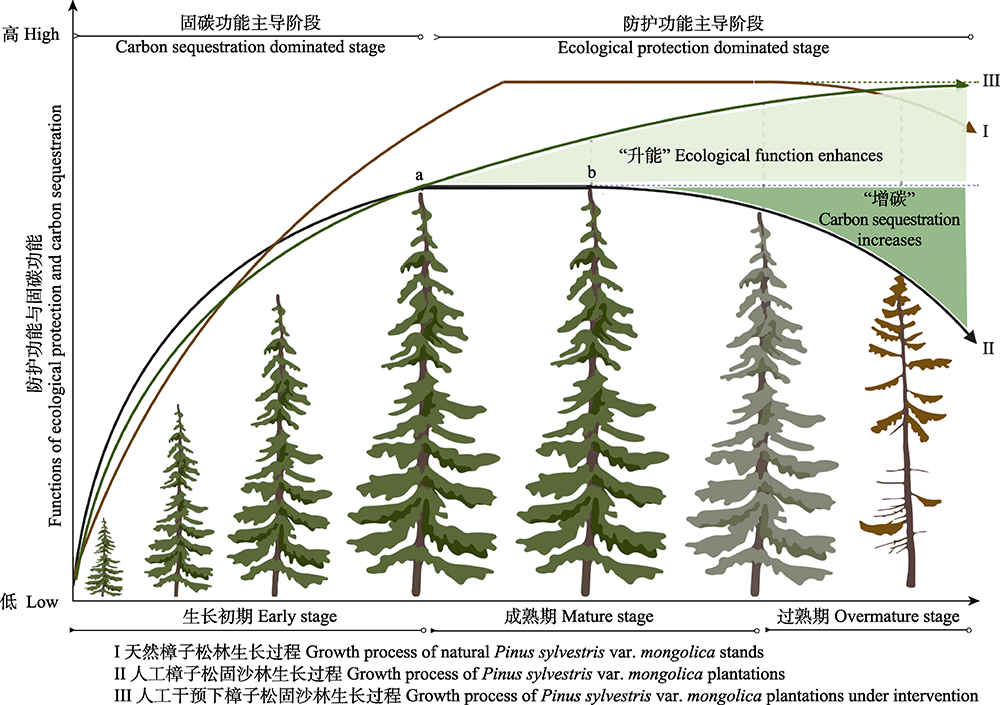
图1. 多目标平衡下樟子松防风固沙林经营动态调控框架示意图。I为天然樟子松林生长过程, 示意更晚的成熟期、更久的成熟期维持阶段和更高的防护与固碳功能。II为人工樟子松固沙林生长过程, 示意早期更高的生长速率、更早的成熟期、更短的成熟期维持阶段和更早的过熟衰退阶段。III为在多目标平衡原则下人工干预后樟子松固沙林的生长过程。人工干预包括从生长初期开始的林分密度动态调控和间伐迹地再造林。人工干预的及时跟进保障了林分在进入成熟期后系统整体的防护功能得到增强(林水关系协调, 冠层结构发育良好, 简称“升能”。图中字母a示意“升能”阶段开始时刻), 系统维持旺盛的生产力, 固碳能力不减(异龄复层结构, 简称“增碳”。图中字母b示意“增碳”阶段开始时刻)。
Fig. 1. Diagrammatic illustrations of the framework for dynamical regulations of management for Pinus sylvestris var. mongolica windbreak and sanddune-fixing forest according to the balance for multi-objectives. Stage I is the growth process of natural P. sylvestris var. mongolica stands, illustrating a delayed maturity, a longer maturity maintenance period, and a higher protection and carbon sequestration function. Stage II is the growth process of the P. sylvestris var. mongolica plantations in sandy land, illustrating a higher growth rate in the early phase, an advanced maturity, a shorter period of maturity maintenance and the accelerated overmature decline. Stage III indicate the growth process after intervention according to the principle of balance for multi-objectives. The interventions include dynamic regulation of stand density from the beginning of growth to reforestation after thinning. The timely follow-up of manual intervention ensures that the protection function of the system is enhanced after the stands enter the mature stage through harmonious forest-water relationships and well-developed canopy structure (the letter “a” in the figure indicates the beginning time of the ecological function enhancement stage). At the same time, the ecosystem maintains strong productivity and enhances carbon sequestration through an uneven aged forest stand structure (the letter “b” in the figure indicates the commencement time of the carbon sequestration increment stage).