), 张学利2, 韩辉2, 石长春3, 葛玉祥4, 马全林5, 陈帅1, 刘春颖1
), ZHANG Xue-Li2, HAN Hui2, SHI Chang-Chun3, GE Yu-Xiang4, MA Quan-Lin5, CHEN Shuai1, LIU Chun-Ying1
), 张学利2, 韩辉2, 石长春3, 葛玉祥4, 马全林5, 陈帅1, 刘春颖1
), ZHANG Xue-Li2, HAN Hui2, SHI Chang-Chun3, GE Yu-Xiang4, MA Quan-Lin5, CHEN Shuai1, LIU Chun-Ying1
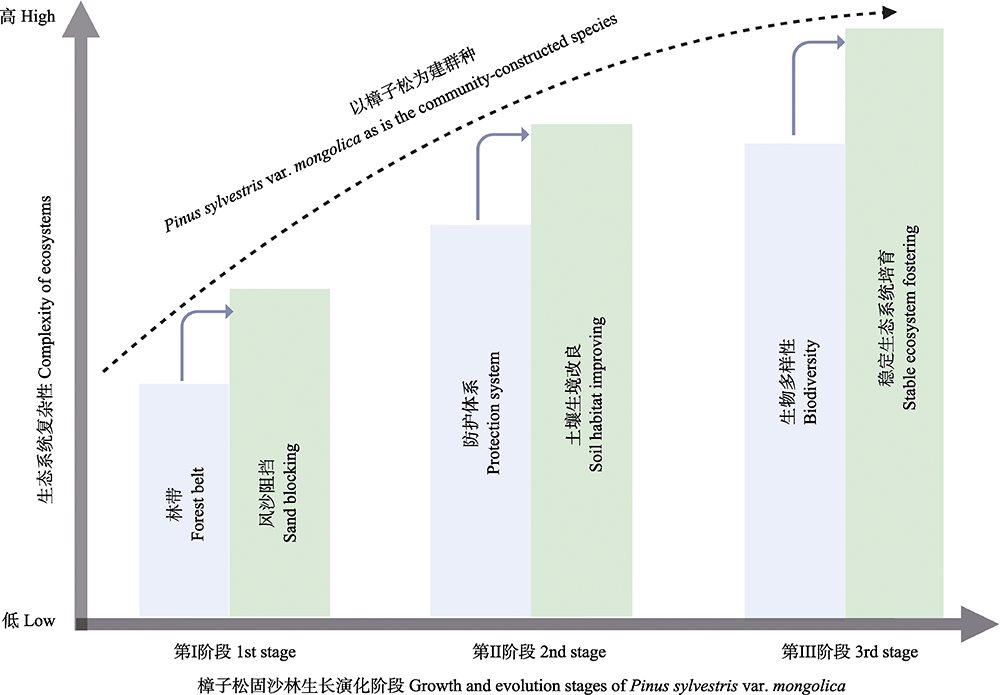
图2. 樟子松固沙林生长演化阶段框架图。在第I阶段以防风固沙、保护土壤为主要经营目标, 以营建林带为主要手段。第II阶段以土壤生境改良为主要经营目标, 以营建完善的防护林体系为主要手段。第III阶段以培育稳定的生态系统为主要经营目标, 以促进形成生物多样性为主要措施。各个阶段中需要维护樟子松的建群种地位, 最大限度地发挥樟子松固沙林生态服务功能与生产潜力, 为促进生态系统生物多样性与稳定性创造庇护条件与提供保障。
Fig. 2. Diagrammatic framework of growth and evolution stages of Pinus sylvestris var. mongolica plantations for wind-breaking and sanddune-fixation. In the first stage, the goal is to break wind, fix sand dunes and protect soil by establishing sheltbelts. In the second stage, the goal is to improve soil habitat by establishing shelterbelt systems. The third stage aims at facilitating a stable ecosystem by promoting the formation of biodiversity. In each stage, it is necessary to maintain the status of P. sylvestris var. mongolica as a constructive species to maximize the its advantages in ecological services and productivity, and to create shelter conditions and provide guarantee for promoting ecosystem biodiversity and stability.