典型草原优势植物根际细菌群落多样性和功能群组成对长期放牧的响应机制
Response mechanisms of rhizosphere bacterial community diversity and functional group composition of dominant plants in typical grasslands to long-term grazing
典型草原优势植物根际细菌群落多样性和功能群组成对长期放牧的响应机制 |
| 崔冬晴, 田晨, 宋慧敏, 鲁小名, 萨其日, 徐国庆, 杨培志, 白永飞, 田建卿 |
|
Response mechanisms of rhizosphere bacterial community diversity and functional group composition of dominant plants in typical grasslands to long-term grazing |
| CUI Dong-Qing, TIAN Chen, SONG Hui-Min, LU Xiao-Ming, SA Qi-Ri, XU Guo-Qing, YANG Pei-Zhi, BAI Yong-Fei, TIAN Jian-Qing |
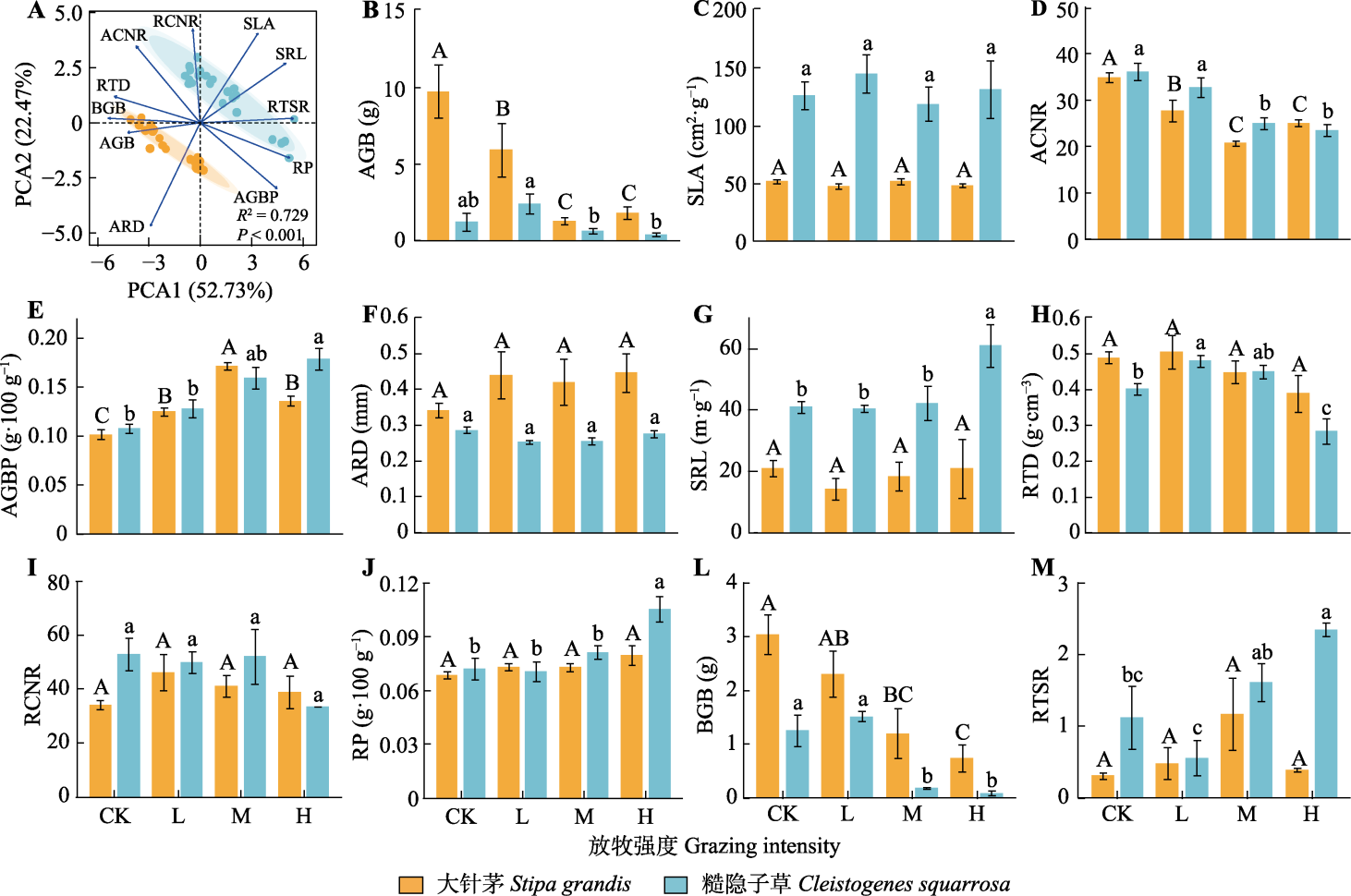
| 图1 大针茅和糙隐子草功能性状差异及不同放牧强度对二者功能性状的影响(平均值±标准误)。ACNR, 地上生物量碳氮比; AGB, 地上生物量; AGBP, 地上生物量磷含量; ARD, 根平均直径; BGB, 地下生物量; RCNR, 根碳氮比; RP, 根磷含量; RTD, 根组织密度; RTSR, 根冠比; SLA, 比叶面积; SRL, 比根长。CK、L、M和H分别代表对照、轻度放牧、中度放牧、重度放牧。不同大写和小写字母分别表示不同放牧强度对大针茅和糙隐子草植物功能性状影响差异显著(p < 0.05)。 |
| Fig. 1 Difference of plant functional traits of Stipa grandis and Cleistogenes squarrosa, and the effect of different grazing intensity on functional traits of the two species (mean ± SE). ACNR, aboveground biomass carbon to nitrogen ratio; AGB, aboveground biomass; AGBP, aboveground biomass phosphorus content; ARD, average root diameter; BGB, belowground biomass; RCNR, root carbon to nitrogen ratio; RP, root phosphorus content; RTD, root tissue density; RTSR, root-to-shoot ratio; SLA, specific leaf area; SRL, specific root length. CK, L, M and H represent the control, light grazing, moderate grazing and heavy grazing intensity, respectively. Different upper- and lower-case letters indicate significant differences (p < 0.05) in the effects of grazing intensities on plant functional traits of Stipa grandis and Cleistogenes squarrosa. |
|
|