亚热带森林不同植物及器官来源的可溶性有机质输入对土壤激发效应的影响及其作用机理
- 1福建农林大学林学院森林生态稳定同位素研究中心, 福州 350002
2内蒙古赤峰市克什克腾旗林业和草原局, 内蒙古赤峰 024005
收稿日期: 2021-08-11
录用日期: 2021-11-05
网络出版日期: 2021-12-16
基金资助
国家自然科学基金促进海峡两岸科技合作联合基金(U1805243);国家自然科学基金(42077094);国家自然科学基金(41703066)
Effects of dissolved organic matter derived from different plant and tissues in a subtropical forest on soil priming effect and the underlying mechanisms
- 1Forest Ecological Stable Isotope Research Center, Forestry College, Fujian Agricultural and Forestry University, Fuzhou 350002, China
2Forestry and Grassland Bureau of Keshiketeng Banner, Chifengshi, Inner Mongolia, Chifeng, Nei Mongol 024005, China
Received date: 2021-08-11
Accepted date: 2021-11-05
Online published: 2021-12-16
Supported by
National Natural Science Foundation of China for Promoting Cross Strait Scientific and Technological Cooperation(U1805243);National Natural Science Foundation of China(42077094);National Natural Science Foundation of China(41703066)
摘要
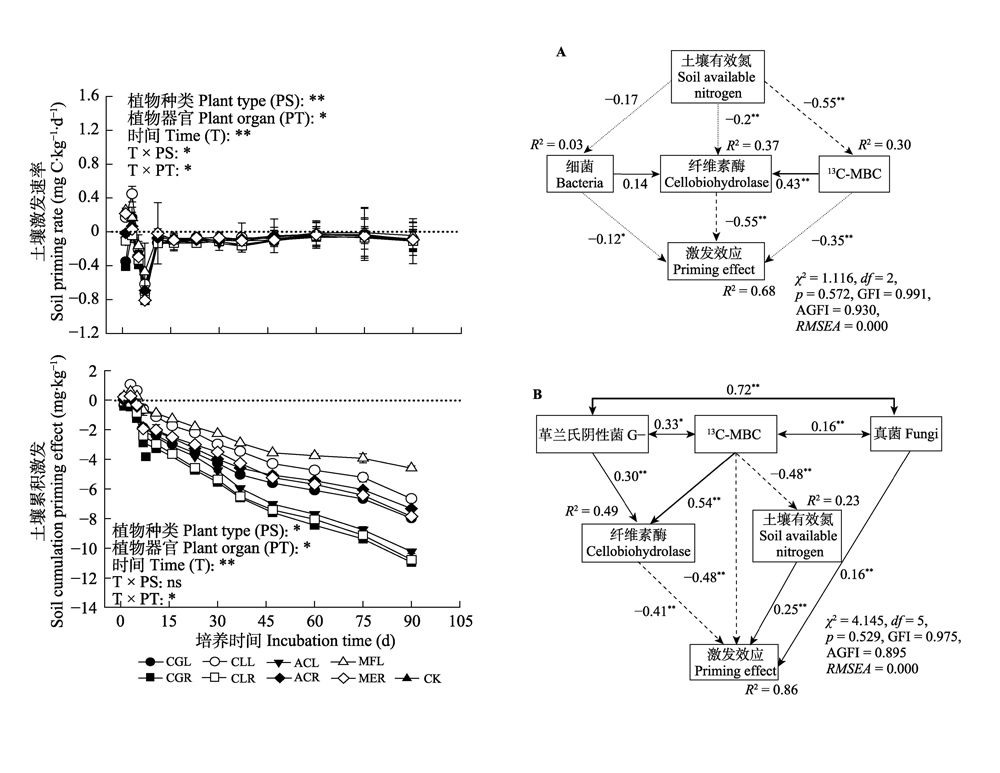
外源有机物的输入可以通过正负激发效应影响土壤有机碳(SOC)的矿化。然而, 当前的研究较少考虑不同植物及器官来源可溶性有机质(DOM)输入对土壤激发效应的影响及其作用机理。该研究以武夷山森林土壤为研究对象, 以室内培养的方式向土壤中添加13C标记青冈(Cyclobalanopsis glauca)、杉木(Cunninghamia lanceolata)、木莲(Manglietia fordiana)和相思(Acacia confusa)这4种植物的根和叶来源DOM, 研究不同植物及器官来源DOM输入对土壤激发效应的影响及其作用机理。主要结果: 不同植物及器官来源DOM添加初期加快了SOC的矿化, 呈现正激发效应, 随后转为负激发效应。从整个培养期(90天)的累积激发效应来看, DOM的输入均抑制了SOC的矿化, 使其矿化量减少22%-49%, 其中青冈根DOM输入使SOC的矿化量减少最多, 而由木莲叶DOM输入减少的SOC矿化量最少。DOM输入引起的土壤激发效应强度受不同植物器官影响明显, 具体表现在植物根来源DOM输入所引起的土壤激发效应强度显著高于植物叶来源DOM输入所引起的激发效应强度(相思除外)。DOM的输入总体上提高了土壤微生物生物量碳(MBC)含量、土壤β-葡萄糖苷酶活性、纤维素酶活性以及土壤有效氮含量, 而对微生物群落组成无明显影响。从结构方程模型来看, DOM输入所引起的土壤激发效应主要受土壤微生物对外源碳的利用(13C-MBC)、纤维素酶活性以及土壤有效氮含量的影响, 这些因子的变化可解释植物叶来源DOM和根来源DOM添加处理下土壤激发效应变化的68%和86%。该研究结果表明在土壤氮充足的条件下, DOM的输入可以通过提高微生物生物量、土壤酶活性来加快分解所添加的外源有机物, 从而减少了对SOC的分解。因此, 在该研究中“底物优先利用”是土壤激发效应的主要作用机理。
本文引用格式
甘子莹, 王浩, 丁驰, 雷梅, 杨晓刚, 蔡敬琰, 丘清燕, 胡亚林 . 亚热带森林不同植物及器官来源的可溶性有机质输入对土壤激发效应的影响及其作用机理[J]. 植物生态学报, 2022 , 46(7) : 797 -810 . DOI: 10.17521/cjpe.2021.0288
Abstract
Aims The input of exogenous organic matter can affect the mineralization of soil organic carbon (SOC) through positive or negative priming effects. However, few studies have considered the effect of dissolved organic matter (DOM) derived from different plant and tissues on soil priming effect and revealed the underlying mechanisms.
Methods In this study, we investigated the different priming effects of 13C-labeled DOM derived from roots and leaves of different plants (i.e., Cyclobalanopsis glauca, Cunninghamia lanceolata, Manglietia fordiana and Acacia confusa) on SOC mineralization and clarifying the underlying mechanisms via an incubation experiment of soils sampled from Wuyi Mountain.
Important findings Inputs of DOM derived from different plant and tissues all accelerated the mineralization of SOC, exhibiting a positive priming effect at the initial stage after DOM input, and then showed a negative priming effect. For the cumulative priming effect during the whole incubation period (90 d), the input of DOM inhibited the mineralization of SOC, with the reduction magnitude ranging from 22% to 49%. Among them, the input of DOM derived from roots of Cyclobalanopsis glauca had the most pronounced effect on the reduction of SOC mineralization, while the input of DOM derived from leaves of M. glauca had the least effect on reduction of SOC mineralization. The intensity of soil priming effect induced by DOM was significantly affected by different plant tissues. DOM derived from plant roots showed more pronounced negative priming effect than DOM derived from plant leaves. In general, DOM input increased soil microbial biomass carbon (MBC) and soil β-glucosidase activities and cellobiohydrolase activities and soil available nitrogen content, but had no significant effect on the composition of soil microbial community. The structural equation model showed that soil priming effect induced by DOM was mainly affected by soil 13C-MBC, cellobiohydrolase activity and soil available nitrogen content. Changes in these factors could explain 68% and 86% of the variation of priming effect induced by plant leaf-derived DOM and root-derived DOM, respectively. The results suggested that if the soil is rich in available nitrogen, DOM input can accelerate the decomposition of exogenous organic matter through increasing microbial biomass and soil enzyme activity, and thus reducing the decomposition of SOC. Therefore, “substrate preferential utilization” is the main mechanism of soil priming effect in this study.
参考文献
| [1] | Ahirwal J, Maiti SK, Singh AK (2017). Changes in ecosystem carbon pool and soil CO2 flux following post-mine reclamation in dry tropical environment, India. Science of the Total Environment, 583, 153-162. |
| [2] | Averill C, Hawkes CV (2016). Ectomycorrhizal fungi slow soil carbon cycling. Ecology Letters, 19, 937-947. |
| [3] | Batjes NH (1996). Total carbon and nitrogen in the soils of the world. European Journal of Soil Science, 47, 151-163. |
| [4] | Blagodatskaya E, Khomyakov N, Myachina O, Bogomolova I, Blagodatsky S, Kuzyakov Y (2014). Microbial interactions affect sources of priming induced by cellulose. Soil Biology & Biochemistry, 74, 39-49. |
| [5] | Blagodatskaya EV, Blagodatsky SA, Anderson TH, Kuzyakov Y (2007). Priming effects in Chernozem induced by glucose and N in relation to microbial growth strategies. Applied Soil Ecology, 37, 95-105. |
| [6] | Blagodatskaya Е, Kuzyakov Y (2008). Mechanisms of real and apparent priming effects and their dependence on soil microbial biomass and community structure: critical review. Biology and Fertility of Soils, 45, 115-131. |
| [7] | Chen FL, Jiang B, Zhang K, Zheng H, Xiao Y, Ouyang ZY, Tu NM (2011). Relationships between initial chemical composition of forest leaf litters and their decomposition rates in degraded red soil hilly region of Southern China. Chinese Journal of Applied Ecology, 22, 565-570. |
| [7] | [陈法霖, 江波, 张凯, 郑华, 肖燚, 欧阳志云, 屠乃美 (2011). 退化红壤丘陵区森林凋落物初始化学组成与分解速率的关系. 应用生态学报, 22, 565-570.] |
| [8] | Chen RR, Senbayram M, Blagodatsky S, Myachina O, Dittert K, Lin X, Blagodatskaya E, Kuzyakov Y (2014). Soil C and N availability determine the priming effect: microbial N mining and stoichiometric decomposition theories. Global Change Biology, 20, 2356-2367. |
| [9] | Cheng WX, Parton WJ, Gonzalez-Meler MA, Phillips R, Asao S, McNickle GG, Brzostek E, Jastrow JD (2014). Synthesis and modeling perspectives of rhizosphere priming. New Phytologist, 201, 31-44. |
| [10] | Cleveland CC, Neff JC, Townsend AR, Hood E (2004). Composition, dynamics, and fate of leached dissolved organic matter in terrestrial ecosystems: results from a decomposition experiment. Ecosystems, 7, 175-285. |
| [11] | Du LS, Zhu ZK, Qi YT, Zou DS, Zhang GL, Zeng XY, Ge TD, Wu JS, Xiao ZH (2020). Effects of different stoichiometric ratios on mineralisation of root exudates and its priming effect in paddy soil. Science of the Total Environment, 743, 140808. DOI: 10.1016/j.scitotenv.2020.140808. |
| [12] | Fang Y, Nazaries L, Singh BK, Singh BP (2018). Microbial mechanisms of carbon priming effects revealed during the interaction of crop residue and nutrient inputs in contrasting soils. Global Change Biology, 24, 2775-2790. |
| [13] | Fontaine S, Bardoux G, Abbadie L, Mariotti A (2004). Carbon input to soil may decrease soil carbon content. Ecology Letters, 7, 314-320. |
| [14] | Fontaine S, Henault C, Aamor A, Bdioui N, Bloor JMG, Maire V, Mary B, Revaillot S, Maron PA (2011). Fungi mediate long term sequestration of carbon and nitrogen in soil through their priming effect. Soil Biology & Biochemistry, 43, 86-96. |
| [15] | Frostegård Å, Tunlid A, Bååth E (2011). Use and misuse of PLFA measurements in soils. Soil Biology & Biochemistry, 43, 1621-1625. |
| [16] | Gregorich EG, Beare MH, Stoklas U, St-Georges P (2003). Biodegradability of soluble organic matter in maize- cropped soils. Geoderma, 113, 237-252. |
| [17] | Guenet B, Danger M, Abbadie L, Lacroix G (2010). Priming effect: bridging the gap between terrestrial and aquatic ecology. Ecology, 91, 2850-2861. |
| [18] | Hessen DO, Ågren GI, Anderson TR, Elser JJ, de Ruiter PC (2004). Carbon sequestration in ecosystems: the role of stoichiometry. Ecology, 85, 1179-1192. |
| [19] | Kalbitz K, Solinger S, Park JH, Michalzik B, Matzner E (2000). Controls on the dynamics of dissolved organic matter in soils: a review. Soil Science, 165, 277-304. |
| [20] | Kuzyakov Y (2002). Review: factors affecting rhizosphere priming effects. Journal of Plant Nutrition and Soil Science, 165, 382-396. |
| [21] | Kuzyakov Y (2010). Priming effects: interactions between living and dead organic matter. Soil Biology & Biochemistry, 42, 1363-1371. |
| [22] | Liang X, Yuan J, Yang E, Meng J (2017). Responses of soil organic carbon decomposition and microbial community to the addition of plant residues with different C:N ratio. European Journal of Soil Biology, 82, 50-55. |
| [23] | Liu SY, Liang AZ, Yang XM, Zhang XP, Jia SX, Chen XW, Zhang SX, Sun BJ, Chen SL (2015). Effects of different residue part inputs of corn straws on CO2 efflux and microbial biomass in clay loam and sandy loam black soils. Environmental Science, 36, 2686-2694. |
| [23] | [刘四义, 梁爱珍, 杨学明, 张晓平, 贾淑霞, 陈学文, 张士秀, 孙冰洁, 陈升龙 (2015). 不同部位玉米秸秆对两种质地黑土CO2排放和微生物量的影响. 环境科学, 36, 2686-2694.] |
| [24] | Lü MK, Xie JS, Wang C, Guo JF, Wang MH, Liu XF, Chen Y, Chen GS, Yang YS (2015). Forest conversion stimulated deep soil C losses and decreased C recalcitrance through priming effect in subtropical China. Biology and Fertility of Soils, 51, 857-867. |
| [25] | Luo D, Shi ZM, Tang JC, Liu SR, Lu LH (2014). Soil microbial community structure of monoculture and mixed plantation stands of native tree species in south subtropical China. Chinese Journal of Applied Ecology, 25, 2543-2550. |
| [25] | [罗达, 史作民, 唐敬超, 刘世荣, 卢立华 (2014). 南亚热带乡土树种人工纯林及混交林土壤微生物群落结构. 应用生态学报, 25, 2543-2550.] |
| [26] | Lyu MK, Xie JS, Vadeboncoeur MA, Wang MH, Qiu X, Ren YB, Jiang MH, Yang YS, Kuzyakov Y (2018). Simulated leaf litter addition causes opposite priming effects on natural forest and plantation soils. Biology and Fertility of Soils, 54, 925-934. |
| [27] | Manzoni S, Jackson RB, Trofymow JA, Porporato A (2008). The global stoichiometry of litter nitrogen mineralization. Science, 321, 684-686. |
| [28] | Nottingham AT, Griffiths H, Chamberlain PM, Stott AW, Tanner EVJ (2009). Soil priming by sugar and leaf-litter substrates: a link to microbial groups. Applied Soil Ecology, 42, 183-190. |
| [29] | Perveen N, Barot S, Maire V, Cotrufo MF, Shahzad T, Blagodatskaya E, Stewart CE, Ding WX, Siddiq MR, Dimassi B, Mary B, Fontaine S (2019). Universality of priming effect: an analysis using thirty five soils with contrasted properties sampled from five continents. Soil Biology & Biochemistry, 134, 162-171. |
| [30] | Qiao N, Schaefer D, Blagodatskaya E, Zou XM, Xu XL, Kuzyakov Y (2014). Labile carbon retention compensates for CO2 released by priming in forest soils. Global Change Biology, 20, 1943-1954. |
| [31] | Qiu QY, Wu LF, Li BB (2019). Crop residue-derived dissolved organic matter accelerates the decomposition of native soil organic carbon in a temperate agricultural ecosystem. Acta Ecologica Sinica, 39, 69-76. |
| [32] | Qiu QY, Yang Y, Wang H, Hu YL (2020). Effects of labile organic carbon application rates on the priming effect at different soil depths in an evergreen broadleaved forest of Wuyi Mountain. Chinese Journal of Ecology, 39, 1153-1163. |
| [32] | [丘清燕, 杨钰, 王浩, 胡亚林 (2020). 易分解有机碳输入量对武夷山常绿阔叶林不同土层深度土壤激发效应的影响. 生态学杂志, 39, 1153-1163.] |
| [33] | Shahbaz M, Kuzyakov Y, Heitkamp F (2017a). Decrease of soil organic matter stabilization with increasing inputs: mechanisms and controls. Geoderma, 304, 76-82. |
| [34] | Shahbaz M, Kuzyakov Y, Sanaullah M, Heitkamp F, Zelenev V, Kumar A, Blagodatskaya E (2017b). Microbial decomposition of soil organic matter is mediated by quality and quantity of crop residues: mechanisms and thresholds. Biology and Fertility of Soils, 53, 287-301. |
| [35] | Shao YJ, Yu MX, Jiang J, Cao NN, Chu GW, Yan JH (2017). Status and dynamic of soil C, N and P of three forest succession gradient in Dinghushan. Journal of Tropical and Subtropical Botany, 25, 523-530. |
| [35] | [邵宜晶, 俞梦笑, 江军, 曹楠楠, 褚国伟, 闫俊华 (2017). 鼎湖山3种演替阶段森林土壤C、N、P现状及动态. 热带亚热带植物学报, 25, 523-530.] |
| [36] | Song XZ, Jiang H, Yu SQ, Ma YD, Zhou GM, Dou RP, Guo PP (2009). Litter decomposition of dominant plant species in successional stages in mid-subtropical zone. Chinese Journal of Applied Ecology, 20, 537-542. |
| [36] | [宋新章, 江洪, 余树全, 马元丹, 周国模, 窦荣鹏, 郭培培 (2009). 中亚热带森林群落不同演替阶段优势种凋落物分解试验. 应用生态学报, 20, 537-542.] |
| [37] | Vance ED, Brookes PC, Jenkinson DS (1987). An extraction method for measuring soil microbial biomass C. Soil Biology & Biochemistry, 19, 703-707. |
| [38] | Wan JJ, Guo JF, Ji SR, Ren WL, Si YT, Yang YS (2015). Effects of different sources of dissolved organic matter on soil CO2 emission in subtropical forests. Chinese Journal of Plant Ecology, 39, 674-681. |
| [38] | [万菁娟, 郭剑芬, 纪淑蓉, 任卫岭, 司友涛, 杨玉盛 (2015). 不同来源可溶性有机物对亚热带森林土壤CO2排放的影响. 植物生态学报, 39, 674-681.] |
| [39] | Wang H, Xu WH, Hu GQ, Dai WW, Jiang P, Bai E (2015). The priming effect of soluble carbon inputs in organic and mineral soils from a temperate forest. Oecologia, 178, 1239-1250. |
| [40] | Wang H, Yang Y, Xi D, Qiu QY, Hu YL (2020). Impacts of labile organic carbon input on the priming effect of three forest soils in Wuyi Mountain. Acta Ecologica Sinica, 40, 9184-9194. |
| [40] | [王浩, 杨钰, 习丹, 丘清燕, 胡亚林 (2020). 易分解有机碳输入量对武夷山不同林型土壤激发效应的影响. 生态学报, 40, 9184-9194.] |
| [41] | Wang QK, Liu SP, Wang SL (2013). Debris manipulation alters soil CO2 efflux in a subtropical plantation forest. Geoderma, 192, 316-322. |
| [42] | Wild B, Schnecker J, Alves RJE, Barsukov P, Bárta J, Čapek P, Gentsch N, Gittel A, Guggenberger G, Lashchinskiy N, Mikutta R, Rusalimova O, Šantrůčková H, Shibistova O, Urich T, et al. (2014). Input of easily available organic C and N stimulates microbial decomposition of soil organic matter in arctic permafrost soil. Soil Biology & Biochemistry, 75, 143-151. |
| [43] | Xu YD, Ding F, Gao XD, Wang Y, Li M, Wang JK (2019). Mineralization of plant residues and native soil carbon as affected by soil fertility and residue type. Journal of Soils and Sediments, 19, 1407-1415. |
| [44] | Yin HJ, Phillips RP, Liang RB, Xu ZF, Liu Q (2016). Resource stoichiometry mediates soil C loss and nutrient transformations in forest soils. Applied Soil Ecology, 108, 248-257. |
| [45] | Zhang L, Jia SX, Li XL, Lu YM, Liu XF, Guo JF (2021). Effects of litter and root inputs on soil organic carbon fractions in a subtropical natural forest of Castanopsis carlesii. Journal of Soil and Water Conservation, 35, 244-251. |
| [45] | [张磊, 贾淑娴, 李啸灵, 陆宇明, 刘小飞, 郭剑芬 (2021). 凋落物和根系输入对亚热带米槠天然林土壤有机碳组分的影响. 水土保持学报, 35, 244-251.] |
| [46] | Zhang WD, Wang SL (2012). Effects of NH4+ and NO3- on litter and soil organic carbon decomposition in a Chinese fir plantation forest in South China. Soil Biology & Biochemistry, 47, 116-122. |
| [47] | Zhang Z, Cai XZ, Tang CD, Guo JF (2017). Priming effect of dissolved organic matter in the surface soil of a Cunninghamia lanceolata plantation. Acta Ecologica Sinica, 37, 7660-7667. |
| [47] | [张政, 蔡小真, 唐偲頔, 郭剑芬 (2017). 可溶性有机质输入对杉木人工林表层土壤有机碳矿化的激发效应. 生态学报, 37, 7660-7667.] |
| [48] | Zhu ZK, Zeng GJ, Ge TD, Hu YJ, Tong CL, Shibistova O, He XH, Wang J, Guggenberger G, Wu JS (2016). Fate of rice shoot and root residues, rhizodeposits, and microbe- assimilated carbon in paddy soil-Part 1: decomposition and priming effect. Biogeosciences, 13, 4481-4489. |