中亚热带同质园不同生活型树种微量元素重吸收效率的差异
- 1福建师范大学湿润亚热带生态-地理过程教育部重点实验室, 福州 350007
2福建三明森林生态系统国家野外科学观测研究站, 福建三明 365002
收稿日期: 2022-03-08
录用日期: 2022-09-28
网络出版日期: 2022-09-28
基金资助
国家自然科学基金(32171641);国家自然科学基金(31922052)
Variations of trace-elements resorption efficiency in leaves of different tree species as affected by life forms in a mid-subtropical common garden
- 1Key Laboratory for Humid Subtropical Eco-Geographical Processes of the Ministry of Education, Fujian Normal University, Fuzhou 350007, China
2Fujian Sanming Forest Ecosystem National Observation and Research Station, Sanming, Fujian 365002, China
Received date: 2022-03-08
Accepted date: 2022-09-28
Online published: 2022-09-28
Supported by
The National Natural Science Foundation of China(32171641);The National Natural Science Foundation of China(31922052)
摘要
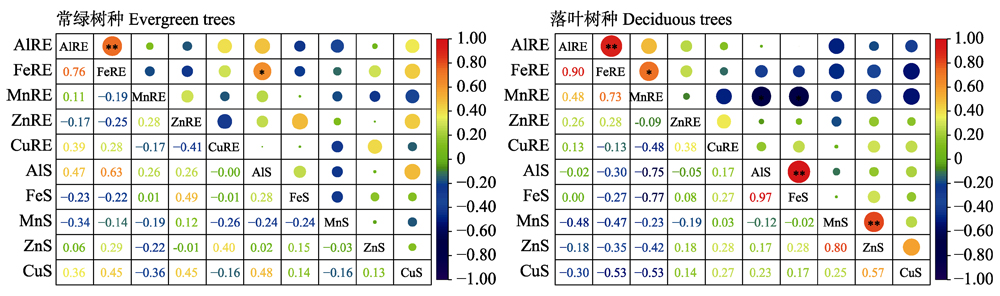
林木叶片对营养元素的重吸收作用可以减少对外界环境的依赖并适应外界环境的改变, 但相对于关注较多的大量元素, 微量元素重吸收规律仍然未知。因此, 该研究主要比较同一立地条件下不同生活型树种对微量元素的重吸收效率差异。以中亚热带同质园中处于生长旺盛期的8个树种为研究对象, 于2019年8月调查了不同树种成熟叶和衰老叶中微量元素Al、Fe、Mn、Zn和Cu的含量, 并分析元素的重吸收效率, 探索其养分利用策略。结果显示: 常绿树种(包括针叶和阔叶)对Mn、Zn和Cu的重吸收效率均明显高于落叶阔叶树种, 但8个树种对Al和Fe均未表现出明显的元素重吸收特征。相对于其他树种, 马尾松(Pinus massoniana)和樟(Cinnamomum camphora)对Mn的重吸收效率较高(>30%), 米槠(Castanopsis carlesii)、醉香含笑(Michelia macclurei)和无患子(Sapindus saponaria)对Mn的重吸收不明显。樟对Zn的重吸收效率达67%, 鹅掌楸(Liriodendron chinense)对Cu的重吸收效率达52%, 枫香树(Liquidambar formosana)对Zn和Cu表现为在衰老叶中积累(-30%和-23%)。此外, 微量元素重吸收效率与土壤元素含量之间表现出明显的负相关关系, 微量元素的重吸收效率与大量元素重吸收效率之间也存在一定的协同性。这些结果充分证明常绿阔叶树种相对于其他生活型树种对微量元素的重吸收效率更高, 具有更好的微量元素利用效率。
本文引用格式
张慧玲, 张耀艺, 彭清清, 杨静, 倪祥银, 吴福忠 . 中亚热带同质园不同生活型树种微量元素重吸收效率的差异[J]. 植物生态学报, 2023 , 47(7) : 978 -987 . DOI: 10.17521/cjpe.2022.0087
Abstract
Aims Trees can resorb the nutrients from senescing leaves, which could reduce their dependence on the changing external nutrient availability and improve their adaptability to the environments. Compared with the well addressed macronutrients, however, trace elements have received far less attentions in their resorption efficiency. Therefore, we conducted a field sampling to address the variations in trace element resorption efficiency of the leaves of different tree species with different life forms in a common garden.
Methods In August 2019, we investigated the concentrations of five trace elements (Al, Fe, Mn, Zn, and Cu) in green and senescent leaves of eight tree species in a common garden in mid-subtropical region, and analyzed the resorption efficiency of these elements to explore the nutrient use strategies.
Important findings Evergreen trees (including needleleaf and broadleaf species) exhibited relatively higher resorption efficiencies of Mn, Zn and Cu than deciduous broadleaf trees, although there were insignificant resorption characteristics of Al and Fe regardless of tree species. Higher Mn resorption efficiencies (>30%) were detected in Pinus massoniana and Cinnamomum camphora than in other tree species, while the resorption efficiencies of Mn were insignificant from zero in Castanopsis carlesii, Michelia macclureiand Sapindus saponaria. In contrast, the resorption efficiencies of Zn in Cinnamomum camphoraand Cu in Liriodendron chinensewere 67% and 52% respectively. Liquidambar formosana showed obvious accumulation of Zn and Cu in senescent leaves (-30% and -23%). Moreover, negative correlations were observed between the resorption efficiency of trace elements and the content of corresponding soil elements, and the nutrient resorption efficiency of trace elements displayed synergy relationships with that of major elements. These results strongly suggested that evergreen broadleaf species could develop better nutrient use strategies with more efficient resorption of trace elements than trees of other life forms in this region.
参考文献
| [1] | ?gren GI, Weih M (2012). Plant stoichiometry at different scales: element concentration patterns reflect environment more than genotype. New Phytologist, 194, 944-952. |
| [2] | Alvarenga ICA, Boldrin PF, Pacheco FV, Silva ST, Bertolucci SKV, Pinto JEBP (2015). Effects on growth, essential oil content and composition of the volatile fraction of Achillea millefolium L. cultivated in hydroponic systems deficient in macro- and microelements. Scientia Horticulturae, 197, 329-338. |
| [3] | Chen H, Reed SC, Lü XT, Xiao KC, Wang KL, Li DJ (2021). Global resorption efficiencies of trace elements in leaves of terrestrial plants. Functional Ecology, 35, 1596-1602. |
| [4] | Chen YG, Ding LX, Ge HL, Zhang MZ, Hu Y (2011). Hyperspectral bambusoideae discrimination based on Mann-Whitney non-parametric test and SVM. Spectroscopy and Spectral Analysis, 31, 3010-3013. |
| [4] | [陈永刚, 丁丽霞, 葛宏立, 张茂震, 胡芸 (2011). 基于Mann- Whitney非参数检验和SVM的竹类高光谱识别. 光谱学与光谱分析, 31, 3010-3013.] |
| [5] | Deng MF, Liu LL, Jiang L, Liu WX, Wang X, Li SP, Yang S, Wang B (2018). Ecosystem scale trade-off in nitrogen acquisition pathways. Nature Ecology & Evolution, 2, 1724-1734. |
| [6] | Du BM, Ji HW, Peng C, Liu XJ, Liu CJ (2017). Altitudinal patterns of leaf stoichiometry and nutrient resorption in Quercus variabilis in the Baotianman Mountains, China. Plant and Soil, 413, 193-202. |
| [7] | Field C, Merino J, Mooney HA (1983). Compromises between water-use efficiency and nitrogen-use efficiency in five species of California evergreens. Oecologia, 60, 384-389. |
| [8] | Guo K, Liu CC, Dong M (2011). Ecological adaptation of plants and control of rocky-desertification on karst region of Southwest China. Chinese Journal of Plant Ecology, 35, 991-999. |
| [8] | [郭柯, 刘长成, 董鸣 (2011). 我国西南喀斯特植物生态适应性与石漠化治理. 植物生态学报, 35, 991-999.] |
| [9] | Han WX, Fang JY, Reich PB, Woodward FI, Wang ZH (2011). Biogeography and variability of eleven mineral elements in plant functional type in China. Ecology Letters, 14, 788-796. |
| [10] | Jiang DL, Xu X, Ruan HH (2017). Review of nutrient resorption and its regulating in plants. Journal of Nanjing Forestry University (Natural Sciences Edition), 41, 183-188. |
| [10] | [江大龙, 徐侠, 阮宏华 (2017). 植物养分重吸收及其影响研究进展. 南京林业大学学报(自然科学版), 41, 183-188.] |
| [11] | Kobe RK, Lepczyk CA, Iyer M (2005). Resorption efficiency decreases with increasing green leaf nutrients in a global data set. Ecology, 86, 2780-2792. |
| [12] | Kunstler G, Falster D, Coomes DA, Hui F, Kooyman RM, Laughlin DC, Poorter L, Vanderwel M, Vieilledent G, Wright SJ, Aiba M, Baraloto C, Caspersen J, Cornelissen JHC, Gourlet-Fleury S (2016). Plant functional traits have globally consistent effects on competition. Nature, 529, 204-207. |
| [13] | Liu CC, Liu YG, Guo K, Wang SJ, Yang Y (2014). Concentrations and resorption patterns of 13 nutrients in different plant functional types in the karst region of south-western China. Annals of Botany, 113, 873-885. |
| [14] | Pe?arrubia L, Romero P, Carrió-Seguí A, Andrés-Bordería A, Moreno J, Sanz A (2015). Temporal aspects of copper homeostasis and its crosstalk with hormones. Frontiers in Plant Science, 6, 255. DOI: 10.3389/fpls.2015.00255. |
| [15] | Scalon MC, Wright IJ, Franco AC (2017). To recycle or steal? Nutrient resorption in Australian and Brazilian mistletoes from three low-phosphorus sites. Oikos, 126, 32-39. |
| [16] | Seidel F, Lopez MCL, Celi L, Bonifacio E, Oikawa A, Yamanaka T (2019). N isotope fractionation in tree tissues during N reabsorption and remobilization in Fagus crenata Blume. Forests, 10, 300. DOI: 10.3390/f10040330. |
| [17] | Tan B, Ni XY, Wu FZ, Li J (2019). Conventional Analysis Method of Forest Soil Experiment. Sichuan University Press, Chengdu. |
| [17] | [谭波, 倪祥银, 吴福忠, 李娇 (2019). 森林土壤实验常规分析方法. 四川大学出版社, 成都.] |
| [18] | Tian DS, Reich PB, Chen HYH, Xiang YZ, Luo YQ, Shen Y, Meng C, Han WX, Niu SL (2019). Global changes alter plant multi-element stoichiometric coupling. New Phytologist, 221, 807-817. |
| [19] | van Heerwaarden LM, Toet S, Aerts R (2003). Current measures of nutrient resorption efficiency lead to a substantial underestimation of real resorption efficiency: facts and solutions. Oikos, 101, 664-669. |
| [20] | Vergutz L, Manzoni S, Porporato A, Novais RF, Jackson RB (2012). Global resorption efficiencies and concentrations of carbon and nutrients in leaves of terrestrial plants. Ecological Monographs, 82, 205-220. |
| [21] | Wang M, Murphy MT, Moore TR (2014). Nutrient resorption of two evergreen shrubs in response to long-term fertilization in a bog. Oecologia, 174, 365-377. |
| [22] | Wei FS, Yang GZ, Jiang DZ, Liu ZH, Sun BM (1991). Basic statistics and characteristics of background value of soil elements in China. Environmental Monitoring in China, 7(1), 1-6. |
| [22] | [魏复盛, 杨国治, 蒋德珍, 刘志虹, 孙本民 (1991). 中国土壤元素背景值基本统计量及其特征. 中国环境监测, 7(1), 1-6.] |
| [23] | Westoby M, Wright IJ (2003). The leaf size-twig size spectrum and its relationship to other important spectra of variation among species. Oecologia, 135, 621-628. |
| [24] | Wright IJ, Westoby M (2003). Nutrient concentration, resorption and lifespan: leaf traits of Australian sclerophyll species. Functional Ecology, 17, 10-19. |
| [25] | Wu J, Jiang ZY, Fu XZ, Sun Q, Yang K (2021). Effects of climate change on vegetation dynamics of winter wheat crops in subtropical region. Journal of Subtropical Resources and Environment, 16(4), 26-31. |
| [25] | [吴瑾, 姜紫阳, 傅学振, 孙齐, 杨昆 (2021). 气候变化对亚热带冬小麦植被动态变化的影响. 亚热带资源与环境学报, 16(4), 26-31.] |
| [26] | Xu PC, You ZT, Ji YH, Zhou JC, Zhang QF, Zheng W, Liu XF, Lin WS, Yang ZJ, Yang YS (2019). Study on ecological strategies of 22 common woody plants in Castanopsis kawakami nature reserve. Journal of Subtropical Resources and Environment, 14(4), 23-29. |
| [26] | [徐鹏程, 游章湉, 纪宇皝, 周嘉聪, 张秋芳, 郑蔚, 刘小飞, 林伟盛, 杨智杰, 杨玉盛 (2019). 格氏栲自然保护区22种常见木本植物的生态策略. 亚热带资源与环境学报, 14(4), 23-29.] |
| [27] | Yan ER, Wang XH, Guo M, Zhong Q, Zhou W (2010). C:N:P stoichiometry across evergreen broad-leaved forests, evergreen coniferous forests and deciduous broad-leaved forests in the Tiantong region, Zhejiang Province, Eastern China. Chinese Journal of Plant Ecology, 34, 48-57. |
| [27] | [阎恩荣, 王希华, 郭明, 仲强, 周武 (2010). 浙江天童常绿阔叶林、常绿针叶林与落叶阔叶林的C:N:P化学计量特征. 植物生态学报, 34, 48-57.] |
| [28] | Yang J, Zhang YY, Tan SY, Wang DY, Yue K, Ni XY, Liao S, Wu FZ, Yang YS (2020). Soil water conservation functions of different plantations in subtropical forest. Acta Ecologica Sinica, 40, 4594-4604. |
| [28] | [杨静, 张耀艺, 谭思懿, 王定一, 岳楷, 倪祥银, 廖姝, 吴福忠, 杨玉盛 (2020). 亚热带不同树种土壤水源涵养功能. 生态学报, 40, 4594-4604.] |
| [29] | Yang YS, Xie JS, Sheng H, Chen GS, Li X (2007). The impact of land use/cover change on soil organic carbon stocks and quality in mid-subtropical mountainous area of Southern China. Acta Geographica Sinica, 62, 1123-1131. |
| [29] | [杨玉盛, 谢锦升, 盛浩, 陈光水, 李旭 (2007). 中亚热带山区土地利用变化对土壤有机碳储量和质量的影响. 地理学报, 62, 1123-1131.] |
| [30] | Yuan ZY, Chen HYH (2009). Global-scale patterns of nutrient resorption associated with latitude, temperature and precipitation. Global Ecology and Biogeography, 18, 11-18. |
| [31] | Yuan ZY, Shi XR, Jiao F, Han FP (2017). N and P resorption as functions of the needle age class in two conifer trees. Journal of Plant Ecology, 11, 780-788. |
| [32] | Zhang H, Wang JN, Wang JY, Guo ZW, Wang GG, Zeng DH, Wu TG (2018). Tree stoichiometry and nutrient resorption along a chronosequence of Metasequoia glyptostroboides forests in coastal China. Forest Ecology and Management, 430, 445-450. |
| [33] | Zhang MX, Luo Y, Yan ZB, Chen J, Eziz A, Li KH, Han WX (2019). Resorptions of 10 mineral elements in leaves of desert shrubs and their contrasting responses to aridity. Journal of Plant Ecology, 12, 358-366. |
| [34] | Zhang SB, Zhang JL, Slik JWF, Cao KF (2012). Leaf element concentrations of terrestrial plants across China are influenced by taxonomy and the environment. Global Ecology and Biogeography, 21, 809-818. |
| [35] | Zhang YY, Ni XY, Yang J, Tan SY, Liao S, Wang DY, Yue K, Wu FZ (2022). Resorption efficiency of four cations in different tree species in a subtropical common garden. Phyton, 91, 185-196. |
| [36] | Zhang YY, Ni XY, Yang J, Tan SY, Liao S, Wu FZ (2021). Nitrogen and phosphorus resorption and stoichiometric characteristics of different tree species in a mid-subtropical common-garden, China. Chinese Journal of Applied Ecology, 32, 1154-1162. |
| [36] | [张耀艺, 倪祥银, 杨静, 谭思懿, 廖姝, 吴福忠 (2021). 中亚热带同质园不同树种氮磷重吸收及化学计量特征. 应用生态学报, 32, 1154-1162.] |
| [37] | Zong N, Song MH, Zhao GS, Shi PL (2020). Nitrogen economy of alpine plants on the north Tibetan Plateau: nitrogen conservation by resorption rather than open sources through biological symbiotic fixation. Ecology and Evolution, 10, 2051-2061. |