退化程度对高寒草甸不同优势植物根系形态性状和生物量的影响
- 1青藏高原高寒草地生态保护与利用四川林业草原重点实验室, 西南民族大学草地资源学院, 青藏高原研究院, 成都 610041
2澜沧江源园区国家公园管理委员会, 西宁 810003
收稿日期: 2024-01-23
录用日期: 2024-09-28
网络出版日期: 2024-09-29
基金资助
第二次青藏高原综合科学考察研究(2019QZKK0302-02);国家自然科学基金(U20A2008);中央高校基本科研业务费专项资金(ZYN2023083)
Effects of degradation degree on the root morphological traits and biomass of dominant plant species in alpine meadows
- 1Sichuan Provincial Forest and Grassland Key Laboratory of Alpine Grassland Conservation and Utilization of Qinghai-Tibetan Plateau, Institute of Qinghai-Tibetan Plateau Research, College of Grassland Resources, Southwest Minzu University, Chengdu 610041, China
2Administrative Committee of Lancang River Source National Park, Xining 810003, China
Received date: 2024-01-23
Accepted date: 2024-09-28
Online published: 2024-09-29
Supported by
Second Tibetan Plateau Scientific Expedition and Research Program (STEP)(2019QZKK0302-02);National Natural Science Foundation of China(U20A2008);Fundamental Research Funds for the Central Universities(ZYN2023083)
摘要
本文引用格式
刘位会 , 宋小艳 , 才仁多杰 , 丁路明 , 王长庭 . 退化程度对高寒草甸不同优势植物根系形态性状和生物量的影响[J]. 植物生态学报, 2024 , 48(12) : 1666 -1682 . DOI: 10.17521/cjpe.2024.0019
Abstract
Aims Understanding the adaptive strategies of plant root morphological traits and biomass allocation in alpine meadows under degradation is crucial for exploring the synergistic relationship between root morphological plasticity and biomass distribution. This knowledge is essential for deepening our insight into the stress tolerance strategies of plants in degraded alpine meadows.
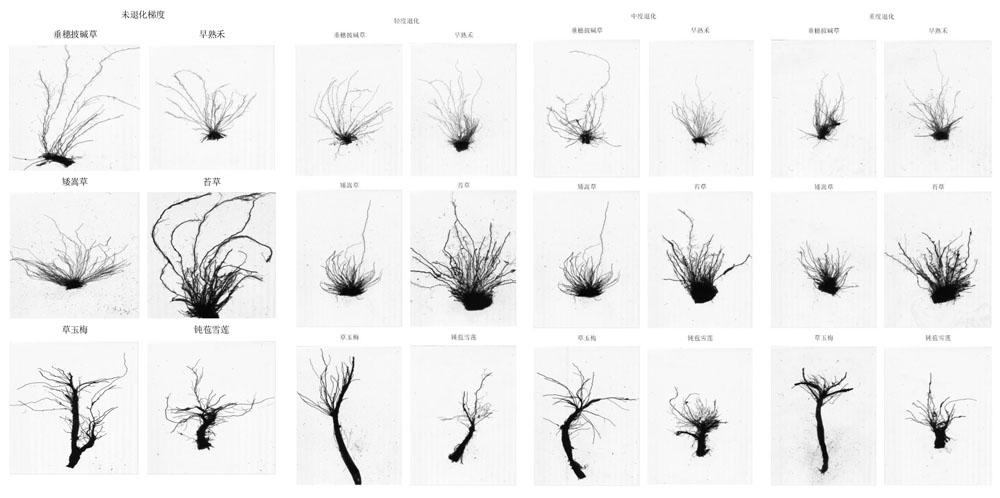
Methods In this study, we investigated the aboveground and belowground biomass, root morphological traits, and their interrelationships in grasses (Poa pratensis and Elymus nutans), sedges (Carex alatauensis and C. moorcroftii), and forbs (Anemone rivularis and Saussurea nigrescens) across alpine meadows with varying degrees of degradation (nondegraded, lightly degraded, moderately degraded, and severely degraded).
Important findings The results show that: 1) Carex alatauensis exhibited the greatest reduction in aboveground biomass under moderate degradation (71.44%) while its root-to-shoot ratio increased the most under light degradation (216.92%) among all species examined. Both Poa pratensis and Anemone rivularis showed increased aboveground and belowground biomass under moderate degradation, and their root-to-shoot ratios showed no significant change with increasing degradation. The relative abundance of aboveground biomass in Anemone rivularis and the relative abundance of belowground biomass in Elymus nutans increased the most under severe degradation (384.90% and 299.57%, respectively). 2) Carex alatauensis showed the greatest decrease in total root length under severe degradation (72.81%), whereas Carex moorcroftii had the greatest increase in total root length under light degradation (14.81%). Degradation increased the average root diameter of Poa pratensis, Carex alatauensis, Carex moorcroftii, and Anemone rivularis while recuding their specific root length. The number of root tips and branching in Poa pratensis, Elymus nutans, Carex alatauensis, Anemone rivularis and Saussurea nigrescens decreased as degradation intensified. 3) The relative abundance of Poa pratensis belowground biomass was significantly correlated with the number of root tips. The relative abundance of belowground biomass in both Elymus nutans and Carex alatauensis depended on the total root length and the number of branching. For Carex moorcroftii, the relative abundance of aboveground biomass was mainly correlated with total root surface area, while the relative abundance of belowground biomass depended on root volume and specific root length. The relative abundance of aboveground biomass in both Anemone rivularis and Saussurea nigrescens was significantly associated with total root length, while their relative abundance of belowground biomass was influenced by specific root length. In conclusion, different dominant plant species adapt to the soil microenvironments caused by degradation by adjusting their biomass allocation and root morphological traits, and these adaptive strategies vary among species, reflecting the diversity of stress tolerance strategies in alpine meadow plants.
参考文献
| [1] | Ade LJ, He B, Wang CT, Hu L, Zi HB (2015). Effects of Chenopodium ambrosioides on soil enzyme activity, microorganism quantity and soil nutrient content of three cultivated pastures of rhizosphere soil in northwestern Sichuan. Southwest China Journal of Agricultural Sciences, 28, 815-821. |
| [ 阿的鲁骥, 何兵, 王长庭, 胡雷, 字洪标 (2015). 入侵植物土荆芥对川西北高寒草甸3种培育牧草根际土壤酶活性、微生物数量及土壤养分的影响. 西南农业学报, 28, 815-821.] | |
| [2] | Ban ZH, Wang Q (2015). Response of drought-loving lotus grass and elderberry competition to simulated warming. Chinese Journal of Plant Ecology, 39, 43-51. |
| [ 班芷桦, 王琼 (2015). 喜旱莲子草和接骨草竞争对模拟增温的响应. 植物生态学报, 39, 43-51.] | |
| [3] | Bergmann J, Weigelt A, van der Plas F, Laughlin DC, Kuyper TW, Guerrero-Ramirez N, Valverde-Barrantes OJ, Bruelheide H, Freschet GT, Iversen CM, Kattge J, McCormack ML, Meier IC, Rillig MC, Roumet C, et al. (2020). The fungal collaboration gradient dominates the root economics space in plants. Science Advances, 6, eaba3756. DOI: 10.1126/sciadv.aba3756. |
| [4] | Bouma TJ, Nielsen KL, van Hal J, Koutstaal B (2001). Root system topology and diameter distribution of species from habitats differing in inundation frequency. Functional Ecology, 15, 360-369. |
| [5] | Cao J, Adamowski JF, Deo RC, Xu X, Gong Y, Feng Q (2019). Grassland degradation on the Qinghai-Tibetan Plateau: reevaluation of causative factors. Rangeland Ecology & Management, 72, 988-995. |
| [6] | Cao J, Wei C, Adamowski JF, Biswas A, Li Y, Zhu G, Liu C, Feng Q (2021). On China’s Qinghai-Tibetan Plateau, duration of grazing exclosure alters R:S ratio, root morphology and attending root biomass. Soil and Tillage Research, 209, 104969. DOI: 10.1016/j.still.2021.104969. |
| [7] | Caruso T, Mafrica R, Bruno M, Vescio R, Sorgonà A (2021). Root architectural traits of rooted cuttings of two fig cultivars: treatments with arbuscular mycorrhizal fungi formulation. Scientia Horticulturae, 283, 110083. DOI: 10.1016/j.scienta.2021.110083. |
| [8] | Chen XX, Shi FX, Sun FD, Li F(2019). Spatial Distribution Characteristics of the Number and Structure of Grazing Livestock in Typical Pastoral Counties in Northwest Sichuan. Chinese Journal of Applied & Environmental Biology, 25, 63-69. |
| [ 陈晓霞, 石福孙, 孙飞达, 李飞(2019). 川西北典型牧业县放牧家畜数量及结构的空间分布特征. 应用与环境生物学报, 25, 63-69.] | |
| [9] | Cheng D, Niklas K (2007). Above- and below-ground biomass relationships across 1534 forested communities. Annals of Botany, 99, 95-102. |
| [10] | Dong S, Shang Z, Gao J, Boone RB (2020). Enhancing sustainability of grassland ecosystems through ecological restoration and grazing management in an era of climate change on Qinghai-Tibetan Plateau. Agriculture, Ecosystems & Environment, 287, 106684. DOI: 10.1016/j. agee.2019.106684. |
| [11] | Dong SK, Wen L, Li YY, Wang XX, Zhu L, Li XY (2012). Soil-quality effects of grassland degradation and restoration on the Qinghai-Tibetan Plateau. Soil Science Society of America Journal, 76, 2256-2264. |
| [12] | Du JH, Liu AL, Dong YX, Hu MY, Liang J, Li W (2014). Architectural characteristics of roots in typical coastal psammophytes of South China. Chinese Journal of Plant Ecology, 38, 888-895. |
| [ 杜建会, 刘安隆, 董玉祥, 胡绵友, 梁杰, 李薇 (2014). 华南海岸典型沙生植物根系构型特征. 植物生态学报, 38, 888-895.] | |
| [13] | Du ZY, Cong N (2024). Response of vegetation and soil characteristics to different levels of degraded grassland on the Tibetan Plateau. Acta Ecologica Sinica, 44, 2504-2516. |
| [ 杜志勇, 丛楠 (2024). 植被与土壤特征对青藏高原不同程度退化草地的响应研究. 生态学报, 44, 2504-2516.] | |
| [14] | Enquist BJ, Niklas KJ (2002). Global allocation rules for patterns of biomass partitioning in seed plants. Science, 295, 1517-1520. |
| [15] | Fitter AH, Stickland TR (1991). Architectural analysis of plant root systems. 2. Influence of nutrient supply on architecture in contrasting plant species. New Phytologist, 118, 383-389. |
| [16] | Fort F, Cruz P, Jouany C (2014). Hierarchy of root functional trait values and plasticity drive early-stage competition for water and phosphorus among grasses. Functional Ecology, 28, 1030-1040. |
| [17] | Freschet GT, Kichenin E, Wardle DA (2015). Explaining within-community variation in plant biomass allocation: a balance between organ biomass and morphology above vs below ground? Journal of Vegetation Science, 26, 431-440. |
| [18] | Ge ZC, Xu WZ, Wu ZX, Liu Y, Shi L, Qiao Y, Geng JC (2022). Root morphological characteristics of different alfalfa varieties in sandy grass bottomland of Yulin. Guizhou Agricultural Sciences, 50(8), 54-63. |
| [ 葛志超, 徐伟洲, 武治兴, 刘阳, 史雷, 乔雨, 耿金才 (2022). 榆林风沙草滩地不同品种紫花苜蓿的根系形态特征. 贵州农业科学, 50(8), 54-63.] | |
| [19] | Guo X, Hu ZM, Li SG, Guo Q (2021). Effects of nitrogen and phosphorus addition on belowground biomass of temperate typical steppe in Inner Mongolia. Chinese Journal of Ecology, 40, 929-939. |
| [ 郭旋, 胡中民, 李胜功, 郭群 (2021). 氮磷添加对内蒙古温带典型草原地下生物量的影响. 生态学杂志, 40, 929-939.] | |
| [20] | Hawkes CV, Sullivan JJ (2001). The impact of herbivory on plants in different resource conditions: a meta-analysis. Ecology, 82, 2045-2058. |
| [21] | Hector A, Schmid B, Beierkuhnlein C, Caldeira MC, Diemer M, Dimitrakopoulos PG, Finn JA, Freitas H, Giller PS, Good J, Harris R, Hogberg P, Huss-Danell K, Joshi J, Jumpponen A, et al. (1999). Plant diversity and productivity experiments in European grasslands. Science, 286, 1123-1127. |
| [22] | Hou LL, Yan RR, Zhang Y, Xin XP (2020). Effects of grazing intensity on functional traits of Leymus chinensis in meadow steppe. Scientia Agricultura Sinica, 53, 2562-2572. |
| [ 侯路路, 闫瑞瑞, 张宇, 辛晓平 (2020). 放牧强度对草甸草原羊草功能性状的影响. 中国农业科学, 53, 2562-2572.] | |
| [23] | Kong D, Wang J, Kardol P, Wu H, Zeng H, Deng X, Deng Y (2015). The root economics spectrum: divergence of absorptive root strategies with root diameter. Biogeosciences Discussions, 12, 13041-13067. |
| [24] | Laliberté E (2017). Below-ground frontiers in trait-based plant ecology. New Phytologist, 213, 1597-1603. |
| [25] | Li Q, Zhao CZ, Kang MP, Li XY (2021). The relationship of the main root-shoot morphological characteristics and biomass allocation of Saussurea salsa under different habitat conditions in Sugan Lake wetland on the northern margin of the Qinghai-Tibet Plateau. Ecological Indicators, 128, 107836. DOI: 10.1016/j.ecolind.2021. 107836. |
| [26] | Li TL, Huo GW, Wu YN (2022). Comparison of root traits of Stipa krylovii and Allium polyrhizum under grazing in typical steppe. Chinese Journal of Applied Ecology, 33, 360-368. |
| [ 李天良, 霍光伟, 乌云娜 (2022). 放牧影响下典型草原克氏针茅和多根葱根系属性比较. 应用生态学报, 33, 360-368.] | |
| [27] | Li XL, Feng YH (2015). Research advance on relation of aerial part and root traits of rice. Chinese Agricultural Science Bulletin, 31(6), 1-6. |
| [ 李香玲, 冯跃华 (2015). 水稻根系生长特性及其与地上部分关系的研究进展. 中国农学通报, 31(6), 1-6.] | |
| [28] | Li XP, Zhao CZ, Ren Y, Zhang J, Lei L (2018). Fractal root systems of Elymus nutans under different density conditions in Gahai Wetland. Acta Ecologica Sinica, 38, 1176-1182. |
| [ 李雪萍, 赵成章, 任悦, 张晶, 雷蕾 (2018). 尕海湿地不同密度条件下垂穗披碱草根系分形结构. 生态学报, 38, 1176-1182.] | |
| [29] | Li YH, Luo T, Lu Q (2008). Plant height as a simple predictor of the root to shoot ratio: evidence from alpine grasslands on the Tibetan Plateau. Journal of Vegetation Science, 19, 245-252. |
| [30] | Li YY, Dong SK, Li XY, Wen L (2012). Effect of enclosure on vegetation photosynthesis and biomass of degraded grasslands in headwater area of Qinghai-Tibetan Plateau. Acta Agrestia Sinica, 20, 621-625. |
| [ 李媛媛, 董世魁, 李小艳, 温璐 (2012). 围栏封育对三江源区退化高寒草地植物光合作用及生物量的影响. 草地学报, 20, 621-625.] | |
| [31] | Liu H, Mi Z, Lin LI, Wang Y, Zhang Z, Zhang F, Wang H, Liu L, Zhu B, Cao G, Zhao X (2018). Shifting plant species composition in response to climate change stabilizes grassland primary production. Proceedings of the National Academy of Sciences of the United States of America, 115, 4051-4056. |
| [32] | Liu SL, Wang CT, Zhang CB, Hu L, Tang LT, Pan P (2021). A comparative study of root characteristics of three gramineous herbage species in the Northwest Sichuan Plateau. Acta Prataculturae Sinica, 30(3), 41-53. |
| [ 刘斯莉, 王长庭, 张昌兵, 胡雷, 唐立涛, 潘攀 (2021). 川西北高原3种禾本科牧草根系特征比较研究. 草业学报, 30(3), 41-53.] | |
| [33] | Liu Y, Wang GL, Liu GB, Qu QL, Yuan ZC (2010). Difference and inherent linkage of root characteristics in different root classification of Pinus tabulaeformis seedlings. Chinese Journal of Plant Ecology, 34, 1386-1393. |
| [ 刘莹, 王国梁, 刘国彬, 曲秋玲, 袁子成 (2010). 不同分类系统下油松幼苗根系特征的差异与联系. 植物生态学报, 34, 1386-1393.] | |
| [34] | Luo FL, Zhang FW, Zhang GR, Wang CY, Zhu JB, Yang YS, Li YN (2021). Effects of grazing intensity on community characteristics and vegetation living states in alpine meadows. Pratacultural Science, 38, 2097-2105. |
| [ 罗方林, 张法伟, 张光茹, 王春雨, 祝景彬, 杨永胜, 李英年 (2021). 放牧强度对高寒草甸群落特征及植被生存状态的影响. 草业科学, 38, 2097-2105.] | |
| [35] | Ma XZ, Wang XP (2021). Aboveground and belowground biomass and its’ allometry for Salsola passerina shrub in degraded steppe desert in Northwestern China. Land Degradation & Development, 32, 714-722. |
| [36] | Mensah S, Glèlè Kaka? R, Seifert T (2016). Patterns of biomass allocation between foliage and woody structure: the effects of tree size and specific functional traits. Annals of Forest Research, 59, 49-60. |
| [37] | Nicotra AB, Atkin OK, Bonser SP, Davidson AM, Finnegan EJ, Mathesius U, Poot P, Purugganan MD, Richards CL, Valladares F, van Kleunen M (2010). Plant phenotypic plasticity in a changing climate. Trends in Plant Science, 15, 684-692. |
| [38] | Ostonen I, Püttsepp ü, Biel C, Alberton O, Bakker MR, L?hmus K, Majdi H, Metcalfe D, Olsthoorn AFM, Pronk A, Vanguelova E, Weih M, Brunner I (2007). Specific root length as an indicator of environmental change. Plant Biosystems, 141, 426-442. |
| [39] | Peng F, Xue X, You Q, Huang C, Dong S, Liao J, Duan H, Tsunekawa A, Wang T (2018). Changes of soil properties regulate the soil organic carbon loss with grassland degradation on the Qinghai-Tibet Plateau. Ecological Indicators, 93, 572-580. |
| [40] | Peng Y, Yang Y (2016). Allometric biomass partitioning under nitrogen enrichment: evidence from manipulative experiments around the world. Scientific Reports, 6, 28918. DOI: 10.1038/srep28918. |
| [41] | Poorter H, Niklas KJ, Reich PB, Oleksyn J, Poot P, Mommer L (2012). Biomass allocation to leaves, stems and roots: meta-analyses of interspecific variation and environmental control. New Phytologist, 193, 30-50. |
| [42] | Reich PB (2014). The world-wide ‘fast-slow’ plant economics spectrum: a traits manifesto. Journal of Ecology, 102, 275-301. |
| [43] | Roa-Fuentes LL, Campo J, Parra-Tabla V (2012). Plant biomass allocation across a precipitation gradient: an approach to seasonally dry tropical forest at Yucatán, Mexico. Ecosystems, 15, 1234-1244. |
| [44] | Shipley B, Meziane D (2002). The balanced-growth hypothesis and the allometry of leaf and root biomass allocation. Functional Ecology, 16, 326-331. |
| [45] | Song WJ, Su JS, Zhang MD, Zhao YJ, Wang ZW, Jia YS, Bai YF (2023). Compensatory growth of grassland plants and optimal grazing intensity in northern China: an integrated analysis based on grazing experiments. Chinese Science Bulletin, 68, 1330-1342. |
| [ 宋伟江, 苏纪帅, 张梦迪, 赵玉金, 王忠武, 贾玉山, 白永飞 (2023). 中国北方草地植物补偿性生长与合理放牧强度: 基于放牧实验的整合分析. 科学通报, 68, 1330-1342.] | |
| [46] | Su JS, Zhao J, Jing GH, Wei L, Liu J, Cheng JM, Zhang JE (2017). Root pattern of Stipa plants in semiarid grassland after long-term grazing exclusion. Acta Ecologica Sinica, 37, 6571-6580. |
| [47] | Sun GJ, Zhang R, Zhou L (2003). Trends and advances in researches on plant functional diversity and functional groups. Acta Ecologica Sinica, 23, 1430-1435. |
| [ 孙国钧, 张荣, 周立 (2003). 植物功能多样性与功能群研究进展. 生态学报, 23, 1430-1435.] | |
| [48] | Sun JH, Shi HL, Chen KY, Ji BM, Zhang J (2023). Research advances on trade-off relationships of plant fine root functional traits. Chinese Journal of Plant Ecology, 47, 1055-1070. |
| [ 孙佳慧, 史海兰, 陈科宇, 纪宝明, 张静 (2023). 植物细根功能性状的权衡关系研究进展. 植物生态学报, 47, 1055-1070.] | |
| [49] | Suo CX, Fei X, Liu YZ, Xiang S, Sun SC (2023). Functional group characteristics of plant community at different grazing intensities in alpine grassland of northwestern Sichuan. Chinese Journal of Applied and Environmental Biology, 29, 109-116. |
| [ 锁才序, 费璇, 刘银占, 向双, 孙书存 (2023). 不同放牧强度下川西北高寒草地植物功能群特征变化. 应用与环境生物学报, 29, 109-116.] | |
| [50] | Tilman D, Knops J, Wedin D, Reich P, Ritchie M, Siemann E (1997). The influence of functional diversity and composition on ecosystem processes. Science, 277, 1300-1302. |
| [51] | Wang CT, Long RJ, Ding LM (2004). The effects of differences in functional group diversity and composition on plant community productivity in four types of alpine meadow communities. Chinese Biodiversity, 12, 403-409. |
| [ 王长庭, 龙瑞军, 丁路明 (2004). 高寒草甸不同草地类型功能群多样性及组成对植物群落生产力的影响. 生物多样性, 12, 403-409.] | |
| [52] | Wang CT, Long RJ, Wang QL, Jing ZC, Shi JJ (2009). Changes in plant diversity, biomass and soil C, in alpine meadows at different degradation stages in the headwater region of three rivers, China. Land Degradation & Development, 20, 187-198. |
| [53] | Wang CT, Long RJ, Wang QL, Jing ZC, Shi JJ, Du YG, Cao GM (2008). Changes in soil organic carbon and microbial biomass carbon at different degradation successional stages of alpine meadows in the headwater region of three rivers in China. Chinese Journal of Applied & Environmental Biology, 14, 225-230. |
| [ 王长庭, 龙瑞军, 王启兰, 景增春, 施建军, 杜岩功, 曹广民 (2008). 三江源区高寒草甸不同退化演替阶段土壤有机碳和微生物量碳的变化. 应用与环境生物学报, 14, 225-230.] | |
| [54] | Wang JW, Zhao CZ, Zhao LC, Wang XP, Li Q (2018). Response of root morphology and biomass of Phragmites australis to soil salinity in inland salt marsh. Acta Ecologica Sinica, 38, 4843-4851. |
| [ 王继伟, 赵成章, 赵连春, 王小鹏, 李群 (2018). 内陆盐沼芦苇根系形态及生物量分配对土壤盐分因子的响应. 生态学报, 38, 4843-4851.] | |
| [55] | Wang N, Pan XC, Bai SB, Zhang T (2020). Effects of acid rain on root morphology and distribution pattern in the buffer zone of broad-leaved forest invaded by Moso bamboo. Acta Ecologica Sinica, 40, 4670-4678. |
| [ 王楠, 潘小承, 白尚斌, 张拓 (2020). 酸雨对毛竹入侵阔叶林缓冲区根系形态及分布格局的影响. 生态学报, 40, 4670-4678.] | |
| [56] | Wang XF, Wang ZY, Liang JH, Wang LQ (2013). Study on the root architecture of cespitose plants in the grassland of Inner Mongolia. Journal of Inner Mongolia Agricultural University (Natural Science Edition), 34(3), 77-82. |
| [ 王旭峰, 王占义, 梁金华, 王立群 (2013). 内蒙古草地丛生型植物根系构型的研究. 内蒙古农业大学学报(自然科学版), 34(3), 77-82.] | |
| [57] | Wang XX, Dong SK, Yang B, Li YY, Su XK (2014). The effects of grassland degradation on plant diversity, primary productivity, and soil fertility in the alpine region of Asia’s headwaters. Environmental Monitoring and Assessment, 186, 6903-6917. |
| [58] | Weemstra M, Kiorapostolou N, van Ruijven J, Mommer L, de Vries J, Sterck F (2020). The role of fine-root mass, specific root length and life span in tree performance: a whole-tree exploration. Functional Ecology, 34, 575-585. |
| [59] | Weemstra M, Kuyper TW, Sterck FJ, Uma?a MN (2023). Incorporating belowground traits: avenues towards a whole-tree perspective on performance. Oikos, 2023, e08827. DOI: 10.1111/oik.08827. |
| [60] | Wen L, Dong SK, Li YY, Wang XX, Li XY, Shi JJ, Dong QM (2013). The impact of land degradation on the C pools in alpine grasslands of the Qinghai-Tibet Plateau. Plant and Soil, 368, 329-340. |
| [61] | Wright IJ, Ackerly DD, Bongers F, Harms KE, Ibarra-Manriquez G, Martinez-Ramos M, Mazer SJ, Muller-Landau HC, Paz H, Pitman NCA, Poorter L, Silman MR, Vriesendorp CF, Webb CO, Westoby M, Wright SJ (2007). Relationships among ecologically important dimensions of plant trait variation in seven neotropical forests. Annals of Botany, 99, 1003-1015. |
| [62] | Wu GL, Wang D, Liu Y, Ding LM, Liu ZH (2017). Warm-season grazing benefits species diversity conservation and topsoil nutrient sequestration in alpine meadow. Land Degradation & Development, 28, 1311-1319. |
| [63] | Xu TW, Zhao JC, Mao SJ, Geng YY, Liu HJ, Zhao XQ, Xu SX (2020). Response of plant community structure and biomass to short-term rest grazing in an alpine meadow in Haibei Autonomous Prefecture of Qinghai. Acta Prataculturae Sinica, 29(4), 1-8. |
| [ 徐田伟, 赵炯昌, 毛绍娟, 耿远月, 刘宏金, 赵新全, 徐世晓 (2020). 青海省海北地区高寒草甸群落特征和生物量对短期休牧的响应. 草业学报, 29(4), 1-8.] | |
| [64] | Yang YD, Ma JL, Ma HB, Zhou Y, Li C, Dong C (2023). Effects of grazing exclusion on root trait characteristics of dominant plants in the desert steppe. Pratacultural Science, 40, 1507-1517. |
| [ 杨彦东, 马静利, 马红彬, 周瑶, 李成, 董川 (2023). 封育对荒漠草原优势植物根系性状特征的影响. 草业科学, 40, 1507-1517.] | |
| [65] | Yang Y, Fang J, Ma W, Guo D, Mohammat A (2010). Large-scale pattern of biomass partitioning across China’s grasslands. Global Ecology and Biogeography, 19, 268-277. |
| [66] | Yang YH, Luo YQ (2011). Isometric biomass partitioning pattern in forest ecosystems: evidence from temporal observations during stand development. Journal of Ecology, 99, 431-437. |
| [67] | Zhang F, Li YC, Wang X, Zhu JX (2021). Effect of rangeland degradation on biomass allocation in alpine meadows on the Qinghai-Tibet Plateau, China. Pratacultural Science, 38, 1451-1458. |
| [ 张帆, 李元淳, 王新, 朱剑霄 (2021). 青藏高原高寒草甸退化对草地群落生物量及其分配的影响. 草业科学, 38, 1451-1458.] | |
| [68] | Zhang T, Zou XH, Li LX, Tao CZ, Wu PF (2023). Research progress on the cost and benefit of root acquisition metabolism from plant resources. Journal of Northwest Forestry University, 38(4), 149-155. |
| [ 张婷, 邹显花, 李林鑫, 陶长铸, 吴鹏飞 (2023). 根系获取资源过程中的代谢成本权衡策略研究进展. 西北林学院学报, 38(4), 149-155.] | |
| [69] | Zhang WT, Zhao CZ, Song QH, Wang JW, Wang JL, Yao WX, Li Q (2017). The relationship between root branching number and connection length of Potentilla acaulis in alpine degraded grasslands. Acta Ecologica Sinica, 37, 8518-8525. |
| [ 张伟涛, 赵成章, 宋清华, 王继伟, 王建良, 姚文秀, 李群 (2017). 高寒退化草地星毛委陵菜根系分叉数和连接长度的关系. 生态学报, 37, 8518-8525.] | |
| [70] | Zhang Y, Zheng QZ, Gao XX, Ma YD, Liang KM, Yue HT, Huang XX, Wu KT, Wang XR (2022). Land degradation changes the role of above- and belowground competition in regulating plant biomass allocation in an alpine meadow. Frontiers in Plant Science, 13, 822594. DOI: 10.3389/fpls.2022.822594. |
| [71] | Zhang YM, Hu HY, Bai XM, Cory M, Javier GF, Iván OP (2022). Effects of soil water restriction on root growth and root morphology of perennial ryegrass and pasture brome. Chinese Journal of Eco-Agriculture, 30, 1784-1794. |
| [ 张咏梅, 胡海英, 白小明, Cory M, Javier GF, Iván OP (2022). 多年生黑麦草、雀麦根系形态和生长对土壤干旱的适应性. 中国生态农业学报, 30, 1784-1794.] | |
| [72] | Zhou YS, Wang LQ, Zhang P, Liang JH, Wang XF (2011). Responses of the root architecture of Stipa grandis to grassland degradation. Pratacultural Science, 28, 1962-1966. |
| [ 周艳松, 王立群, 张鹏, 梁金华, 王旭峰 (2011). 大针茅根系构型对草地退化的响应. 草业科学, 28, 1962-1966.] | |
| [73] | Zou S, Lv FC (2016). Two special vegetation types in Tibetan Plateau: alpine grassland and alpine meadow. Geography Teaching, 57, 4-7. |