Chinese Journal of Plant Ecology >
Effects of biochar addition on dynamics of soil respiration and temperature sensitivity in a Phyllostachys edulis forest
- 1Research Institute of Subtropical Forestry, Chinese Academy of Forestry, Hangzhou 311400, China
2Qianjiangyuan Forest Ecosystem Research Station, State Forestry Administration, Hangzhou 311400, China
3State Forestry Administration Key Laboratory of Forest Ecology and Environment;Research Institute of Forest Ecology, Environment and Protection, Chinese Academy of Forestry, Beijing 100091, China
4Shouchang Forest Center of Jiande, Shouchang, Zhejiang 311600, China
Received date: 2017-04-10
Accepted date: 2017-08-29
Online published: 2017-11-10
Abstract
Aims Recent studies have shown that artificial addition of biochar is an effective way to mitigate atmospheric carbon dioxide concentrations. However, it is still unclear how biochar addition influences soil respiration in Phyllostachys edulis forests of subtropical China. Our objectives were to examine the effects of biochar addition on the dynamics of soil respiration, soil temperature, soil moisture, and the cumulative soil carbon emission, and to determine the relationships of soil respiration with soil temperature and moisture.
Methods We conducted a two-year biochar addition experiment in a subtropical P. edulis forest from 2014.05 to 2016.04. The study site is located in the Miaoshanwu Nature Reserve in Fuyang district of Hangzhou, Zhejiang Province, in southern China. The biochar addition treatments included: control (CK, no biochar addition), low rate of biochar addition (LB, 5 t·hm-2), medium rate of biochar addition (MB, 10 t·hm-2), and high rate of biochar addition (HB, 20 t·hm-2). Soil respiration was measured by using a LI-8100 soil CO2 efflux system.
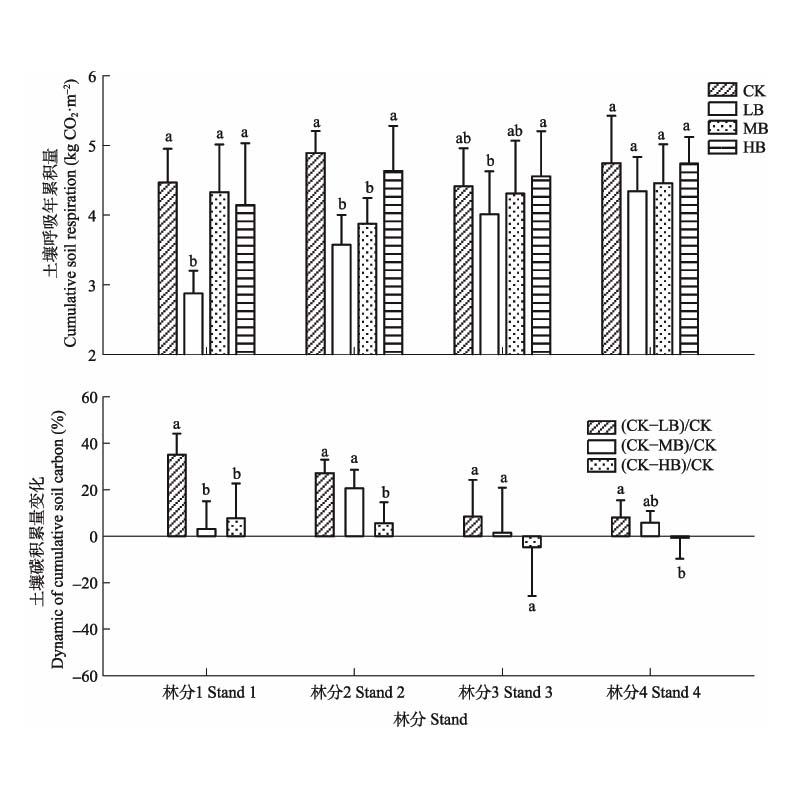
Important findings Soil respiration was significantly reduced by biochar addition, and exhibited an apparent seasonal pattern, with the maximum occurring in June or July (except LB in one of the replicated stand) and the minimum in January or February. There were significant differences in soil respiration between the CK and the treatments. Annual mean soil respiration rate in the CK, LB, MB and HB were 3.32, 2.66, 3.04 and 3.24 μmol·m-2·s-1, respectively. Compared with CK, soil respiration rate was 2.33%-54.72% lower in the LB, 1.28%-44.21% lower in the MB, and 0.09%-39.22% lower in the HB. The soil moisture content was increased by 0.97%-75.58% in LB, 0.87%-48.18% in MB, and 0.68%-74.73% in HB, respectively, compared with CK. Soil respiration exhibited a significant exponential relationship with soil temperature and a significant linear relationship with combination of soil temperature and moisture at the depth of 5 cm; no significant relationship was found between soil respiration and soil moisture alone. The temperature sensitivity (Q10) value was reduced in LB and HB. Annual accumulative soil carbon emission in the LB, MB and HB was reduced by 7.98%-35.09%, 1.48%-20.63%, and -4.71%-7.68%, respectively. Biochar addition significantly reduced soil carbon emission and soil temperature sensitivity, highlighting its role in mitigating climate change.
Cite this article
Xiao-Gai GE, Ben-Zhi ZHOU, Wen-Fa XIAO, Xiao-Ming WANG, Yong-Hui CAO, Ming YE . Effects of biochar addition on dynamics of soil respiration and temperature sensitivity in a Phyllostachys edulis forest[J]. Chinese Journal of Plant Ecology, 2017 , 41(11) : 1177 -1189 . DOI: 10.17521/cjpe.2017.0098
References
| [1] | Almagro M, López J, Querejeta JI, Martínez-Mena M (2009). Temperature dependence of soil CO2 efflux is strongly modulated by seasonal patterns of moisture availability in a Mediterranean ecosystem.Soil Biology & Biochemistry, 41, 594-605. |
| [2] | Ameloot N, Graber ER, Verheijen FGA, de Neve S (2013). Interactions between biochar stability and soil organisms: Review and research needs.European Journal of Soil Science, 64, 379-390. |
| [3] | Bamminger C, Marschner B, Jüschke E (2014). An incubation study on the stability and biological effects of pyrogenic and hydrothermal biochar in two soils.European Journal of Soil Science, 65, 72-82. |
| [4] | Bruun S, Clauson-Kaas S, Bobu?ská L, Thomsen IK (2014). Carbon dioxide emissions from biochar in soils: Role of clay, microorganisms and carbonates.European Journal of Soil Science, 65, 52-59. |
| [5] | Chen JH, Li SH, Liang CF, Xu QF, Li YC, Qin H, Fuhrmann JF (2017). Response of microbial community structure and function to short-term biochar amendment in an intensively managed bamboo (Phyllostachys praecox) plantation soil: Effect of particle size and addition rate. Science of the Total Environment, 574, 24-33. |
| [6] | Cross A, Sohi SP (2011). The priming potential of biochar products in relation to labile carbon contents and soil organic matter status.Soil Biology & Biochemistry, 43, 2127-2134. |
| [7] | DeLuca TH, MacKenzie MD, Gundale MJ, Holben WE (2006). Wildfire-produced charcoal directly influences nitrogen cycling in Ponderosa pine forests.Soil Science Society of America Journal, 70, 448-453. |
| [8] | Fierer N, Strickland MS, Liptzin D, Bradford MA, Cleveland CC (2009). Global patterns in belowground communities.Ecology Letters, 12, 1238-1249. |
| [9] | Forbes MS, Raison RJ, Skjemstad JO (2006). Formation, transformation and transport of black carbon (charcoal) in terrestrial and aquatic ecosystems.Science of the Total Environment, 370, 190-206. |
| [10] | Ge XG, Zhou BZ, Xiao WF, Wang XM, Cao YH (2016). Priming effect of biochar addition on soil carbon emission: A review.Ecology and Environmental Sciences, 25, 339-345. (in Chinese with English abstract)[葛晓改, 周本智, 肖文发, 王小明, 曹永慧 (2016). 生物质炭输入对土壤碳排放的激发效应研究进展. 生态环境学报, 25, 339-345.] |
| [11] | Hardie M, Clothier B, Bound S, Oliver G, Close D (2014). Does biochar influence soil physical properties and soil water availability?Plant and Soil, 376, 347-361. |
| [12] | Hashimoto S, Carvalhais N, Ito A, Migliavacca M, Nishina K, Reichstein M (2015). Global spatiotemporal distribution of soil respiration modeled using a global database.Biogeosciences, 12, 4121-4132. |
| [13] | He XH, Du ZL, Wang YD, Lu N, Zhang QZ (2016). Sensitivity of soil respiration to soil temperature decreased under deep biochar amended soils in temperate croplands.Applied Soil Ecology, 108, 204-210. |
| [14] | Herath HMSK, Camps-Arbestain M, Hedley MJ, Kirschbaum MUF, Wang T, van Hale R (2015). Experimental evidence for sequestering C with biochar by avoidance of CO2 emissions from original feedstock and protection of native soil organic matter.Global Change Biology Bioenergy, 7, 512-526. |
| [15] | Hughes RF, Kauffman JB, Jaramillo VJ (1999). Biomass, carbon, and nutrient dynamics of secondary forests in a humid tropical region of méxico.Ecology, 80, 1892-1907. |
| [16] | Jassal RS, Black TA, Novak MD, Gaumont-Guay D, Nesic Z (2008). Effect of soil water stress on soil respiration and its temperature sensitivity in an 18-year-old temperate Douglas-fir stand.Global Change Biology, 14, 1305-1318. |
| [17] | Jones DL, Murphy DV, Khalid M, Ahmad W, Edwards-Jones G, DeLuca TH (2011). Short-term biochar-induced increase in soil CO2 release is both biotically and abiotically mediated.Soil Biology & Biochemistry, 43, 1723-1731. |
| [18] | Kammann CI, Linsel S, G?βling JW, Koyro HW (2011). Influence of biochar on drought tolerance ofChenopodium quinoa Willd and on soil-plant relations. Plant and Soil, 345, 195-210. |
| [19] | Kuzyakov Y, Friedel JK, Stahr K (2000). Review of mechanisms and quantification of priming effects.Soil Biology & Biochemistry, 32, 1485-1498. |
| [20] | Lal R, Follett RF, Stewart BA, Kimble JM (2007). Soil carbon sequestration to mitigate climate change and advance food security.Soil Science, 172, 943-956. |
| [21] | Lehmann J, Gaunt J, Rondon M (2006). Bio-char sequestration terrestrial ecosystems—A review.Mitigation and Adaptation Strategies for Global Change, 11, 403-427. |
| [22] | Lellei-Kovács E, Botta-Dukát Z, de Dato G, Estiarte M, Guidolotti G, Kopittke GR, Kovács-Láng E, Kr?el-Dulay G, Larsen KS, Pe?uelas J, Smith AR, Sowerby A, Tietema A, Schmidt IK (2016). Temperature dependence of soil respiration modulated by thresholds in soil water availability across European shrubland ecosystems.Ecosystems, 19, 1460-1477. |
| [23] | Liang BQ, Lehmann J, Sohi SP, Thies JE, O’Neill B, Trujillo L, Gaunt J, Solomon D, Grossman J, Neves EG, Luiz?o FJ (2010). Black carbon affects the cycling of non-black carbon in soil.Organic Geochemistry, 41, 206-213. |
| [24] | Liu DJ, Zhang JX, Lu Q, Li X, Wu Z (2016). Effects of rain supplementation on the temperature sensitivity of soil respiration inNitraria sphaerocarpa community in a hyperarid area of Dunhuang, China. Chinese Journal of Ecology, 35, 584-590. (in Chinese with English abstract)[刘殿君, 张金鑫, 卢琦, 李旭, 武哲 (2016). 极端干旱区增雨对泡泡刺(Nitraria sphaerocarpa)群落土壤呼吸温度敏感性的影响. 生态学杂志, 35, 584-590.] |
| [25] | Liu XY, Zheng JF, Zhang DX, Cheng K, Zhou HM, Zhang AF, Li LQ, Joseph S, Smith P, Crowley D, Kuzyakov Y, Pan GX (2016). Biochar has no effect on soil respiration across Chinese agricultural soils. Science of the Total Environment, 554-555, 259-265. |
| [26] | Luo Y, Durenkamp M, de Nobili M, Lin Q, Brookes PC (2011). Short term soil priming effects and the mineralization of biochar following its incorporation to soils of different pH.Soil Biology & Biochemistry, 43, 2304-2314. |
| [27] | Major J, Rondon M, Molina D, Riha SJ, Lehmann J (2010). Maize yield and nutrition during 4 years after biochar application to a Colombian savanna oxisol.Plant and Soil, 333, 117-128. |
| [28] | Marland E, Marland G (2003). The treatment of long-lived, carbon-containing products in inventories of carbon dioxide emissions to the atmosphere.Environmental Science & Policy, 6, 139-152. |
| [29] | Mitchell PJ, Simpson AJ, Soong R, Simpson MJ (2015). Shifts in microbial community and water-extractable organic matter composition with biochar amendment in a temperate forest soil.Soil Biology & Biochemistry, 81, 244-254. |
| [30] | Novak JM, Busscher WJ, Watts DW, Laird DA, Ahmedna MA, Naiandou MAS (2010). Short-term CO2 mineralization after additions of biochar and switchgrass to a typic kandiudult.Geoderma, 154, 281-288. |
| [31] | Prendergast-Miller MT, Duvall M, Sohi SP (2014). Biochar- root interactions are mediated by biochar nutrient content and impacts on soil nutrient availability.European Journal of Soil Science, 65, 173-185. |
| [32] | Saiz G, Byrne KA, Butterbach-Bahl K, Kiese R, Blujdea V, Farrell EP (2006). Stand age-related effects on soil respiration in a first rotation Sitka spruce chronosequence in central Ireland.Global Change Biology, 12, 1007-1020. |
| [33] | Sohi SP, Krull E, Lopez-Capel E, Bol R (2010). A review of biochar and its use and function in soil. In: Donald LS ed. Advances in Agronomy. Academic Press, Burlington, USA. 47-82. |
| [34] | Spokas KA, Baker JM, Reicosky DC (2010). Ethylene: Potential key for biochar amendment impacts.Plant and Soil, 333, 443-452. |
| [35] | Suseela V, Conant RT, Wallenstein MD, Dukes JS (2012). Effects of soil moisture on the temperature sensitivity of heterotrophic respiration vary seasonally in an old-field climate change experiment.Global Change Biology, 18, 336-348. |
| [36] | Tammeorg P, Simojoki A, M?kel? P, Stoddard FL, Alakukku L, Helenius J (2014). Short-term effects of biochar on soil properties and wheat yield formation with meat bone meal and inorganic fertiliser on a boreal loamy sand.Agriculture, Ecosystems and Environment, 191, 108-116. |
| [37] | Thomas SC, Gale N (2015). Biochar and forest restoration: A review and meta-analysis of tree growth responses.New Forest, 46, 931-946. |
| [38] | Ulyett J, Sakrabani R, Kibblewhite M, Hann M (2014). Impact of biochar addition on water retention, nitrification and carbon dioxide evolution from two sandy loam soils.European Journal of Soil Science, 65, 96-104. |
| [39] | Verheijen FGA, Graber ER, Ameloot N, Bastos AC, Sohi S, Knicker H (2014). Biochars in soils: New insights and emerging research needs. European Journal of Soil Science, 65, 22-27. |
| [40] | Wardle DA, Nilsson MC, Zackrisson O (2008). Fire-derived charcoal causes loss of forest humus.Science, 320, 629. |
| [41] | Wu JJ, Yang ZJ, Liu XF, Xiong DC, Lin WS, Chen CQ, Wang XH (2014). Analysis of soil respiration and components inCastanopsis carlesii and Cunninghamia lanceolata plantations. Chinese Journal of Plant Ecology, 38, 45-53. (in Chinese with English abstract)[吴君君, 杨智杰, 刘小飞, 熊德成, 林伟盛, 陈朝琪, 王小红 (2014). 米槠和杉木人工林土壤呼吸及其组分分析. 植物生态学报, 38, 45-53.] |
| [42] | Xu Y (2012). Research on Community Structure and Carbon Accumulation of Moso Bamboo Forest. PhD dissertation, Zhejiang University, Hangzhou. (in Chinese with English abstract)[徐涌 (2012). 毛竹林群落结构与碳积累规律研究. 博士学位论文, 浙江大学, 杭州.] |
| [43] | Yang QP, Xu M, Liu HS, Wang JS, Liu LX, Chi YG, Zheng YP (2011). Impact factors and uncertainties of the temperature sensitivity of soil respiration.Acta Ecologica Sinica, 31, 2301-2311. (in Chinese with English abstract)[杨庆朋, 徐明, 刘洪升, 王劲松, 刘丽香, 迟永刚, 郑云普 (2011). 土壤呼吸温度敏感性的影响因素和不确定性. 生态学报, 31, 2301-2311.] |
| [44] | Yuste JC, Baldocchi DD, Gershenson A, Goldstein A, Misson L, Wong S (2007). Microbial soil respiration and its dependency on carbon inputs, soil temperature and moisture. Global Change Biology, 13, 2018-2035. |
| [45] | Zhou BZ (2006). Dynamics of Bamboo’s Below-ground System Based on Minirhizotron Technique. PhD dissertation, Chinese Academy of Forestry, Beijing. (in Chinese with English abstract)[周本智 (2006). 基于小观察窗技术的竹林地下系统动态研究. 博士学位论文, 中国林业科学研究院, 北京.] |
| [46] | Zimmerman AR, Gao B, Ahn MY (2011). Positive and negative carbon mineralization priming effects among a variety of biochar-amended soils.Soil Biology & Biochemistry, 43, 1169-1179. |