
植物生态学报 ›› 2017, Vol. 41 ›› Issue (8): 815-825.DOI: 10.17521/cjpe.2017.0018 cstr: 32100.14.cjpe.2017.0018
所属专题: 菌根真菌
• 研究论文 • 下一篇
徐丽娇1,2, 姜雪莲1,3, 郝志鹏1, 李涛1, 吴照祥1,4, 陈保冬1,2,*( )
)
出版日期:2017-08-10
发布日期:2017-09-29
作者简介:康璟瑶(1991-),男,江苏南京人,硕士生,主要从事旅游地理与旅游规划研究,E-mail: 基金资助:
Li-Jiao XU1,2, Xue-Lian JIANG1,3, Zhi-Peng HAO1, Tao LI1, Zhao-Xiang WU1,4, Bao-Dong CHEN1,2,*()
Online:2017-08-10
Published:2017-09-29
About author:KANG Jing-yao(1991-), E-mail: 摘要:
丛枝菌根(AM)共生体系对于植物适应低磷胁迫具有重要作用。AM不仅直接调节宿主植物对低磷胁迫的响应, 还可能通过分泌物影响相邻的非菌根植物。该研究采用分室培养系统, 以玉米(Zea mays)和AM真菌Rhizophagus irregularis为试验材料, 考察低磷(10 mg·kg-1)和高磷(100 mg·kg-1)条件下, 菌根共生体系对植物生长、磷营养以及碳磷代谢相关基因表达的影响, 以揭示AM调节植物低磷胁迫响应的生理机制。分室培养系统由0.45 μm微孔滤膜分隔成供体室、缓冲室和受体室3个分室, 以供体室菌根化植物为AM分泌物来源, 通过微孔膜阻止菌根真菌对未接种受体植物的直接影响, 但允许AM分泌物在分室间的扩散。采用实时荧光定量PCR技术分析玉米以及AM真菌自身碳磷代谢相关基因的表达情况。试验结果表明, 低磷条件下接种AM真菌显著提高了供体植物干质量和磷浓度, 上调了玉米碳磷代谢相关基因的表达。AM真菌磷转运蛋白基因和碳代谢相关基因在低磷条件下的表达水平显著高于高磷水平; 对于受体植物而言, 仅高磷处理显著提高了玉米植株干质量和磷含量, 而接种处理显著上调了受体植物磷转运蛋白基因和碳代谢相关基因的表达水平。该研究表明, 低磷胁迫下AM可能通过分泌物调控植物碳磷代谢相关基因的表达, 进而调节植物对低磷胁迫的生理响应。
徐丽娇, 姜雪莲, 郝志鹏, 李涛, 吴照祥, 陈保冬. 丛枝菌根通过调节碳磷代谢相关基因的表达增强植物对低磷胁迫的适应性. 植物生态学报, 2017, 41(8): 815-825. DOI: 10.17521/cjpe.2017.0018
Li-Jiao XU, Xue-Lian JIANG, Zhi-Peng HAO, Tao LI, Zhao-Xiang WU, Bao-Dong CHEN. Arbuscular mycorrhiza improves plant adaptation to phosphorus deficiency through regulating the expression of genes relevant to carbon and phosphorus metabolism. Chinese Journal of Plant Ecology, 2017, 41(8): 815-825. DOI: 10.17521/cjpe.2017.0018
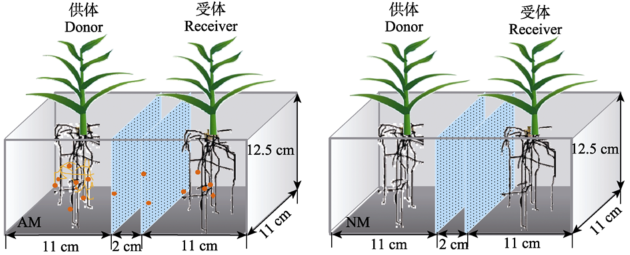
图1 分室培养系统示意图。以0.45 μm微孔滤膜区隔不同分室。AM和NM分别代表供体植物接种AM真菌和不接种对照处理。 处理分为高磷和低磷(10 mg?kg-1和100 mg?kg-1)两个水平, 每个处理三个重复(n = 3)。
Fig. 1 Diagram of the compartment cultivation system. Different compartments were separated by microporous filter with pore size of 0.45 μm. AM and NM represent inoculation of donor plants with AM fungus and the non-mycorrhizal control respectively. There are two phosphorus levels (10 mg?kg-1 and 100 mg?kg-1), and three replications for each treatment (n = 3).
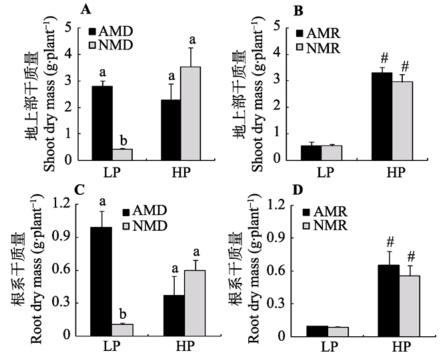
图2 不同磷浓度下接种AM真菌对玉米植株干质量的影响(平均值±标准偏差)。LP和HP分别代表低磷和高磷处理。AMD和NMD分别代表供体植物接种AM真菌和不接种对照处理; AMR和NMR分别代表受体植物受到AM分泌物处理和对照处理。柱形上方标示不同字母代表不同处理间在5%水平有显著性差异。“#”代表在相同接种处理下不同磷水平之间在5%水平差异显著。
Fig. 2 Effects of mycorrhizal inoculation on maize dry mass under different P levels (mean ± SD). LP and HP refer to low P level (10 mg·kg-1) and high P level (100 mg·kg-1) respectively. AMD and NMD represent donor plants with and without AM fungus incubation, while AMR and NMR represent receiver plants with and without AM exudates respectively. Different letters above the columns indicate significant difference (p < 0.05) between corresponding treatments. # indicates significant difference (p < 0.05) between different P levels under the same inoculation treatment.
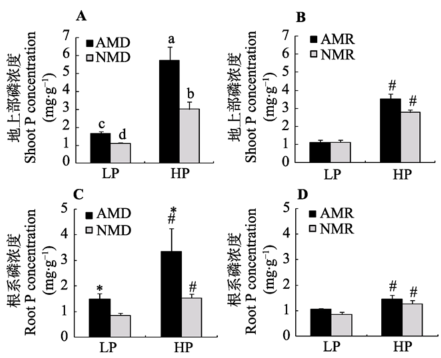
图3 不同磷浓度下接种AM真菌对玉米植株磷浓度的影响(平均值±标准偏差)。LP和HP分别代表低磷和高磷处理。AMD和NMD代表供体植物接种AM真菌和不接种对照处理; AMR和NMR代表供体和受体植物受到AM分泌物处理和对照处理。不同字母代表处理间在5%水平上有显著性差异。“#”代表在相同AM真菌分泌物受体不同磷浓度处理间在5%水平上差异显著。“*”代表在相同磷浓度处理下AM真菌处理间在5%水平上差异显著。
Fig. 3 Effects of inoculation with AM fungus on maize P concentrations under different P levels (mean ± SD). LP and HP refer to low P level (10 mg·kg-1) and high P level (100 mg·kg-1) respectively. AMD and NMD represent donor plants with and without AM fungus incubation, while AMR and NMR represent receiver plants with and without AM exudates respectively. The different letters indicates significant difference (p < 0.05) between corresponding treatments. # indicates significant difference (p < 0.05) between different P levels under the same inoculation treatment; * indicates significant difference (p < 0.05) between inoculation treatments under the same P level.
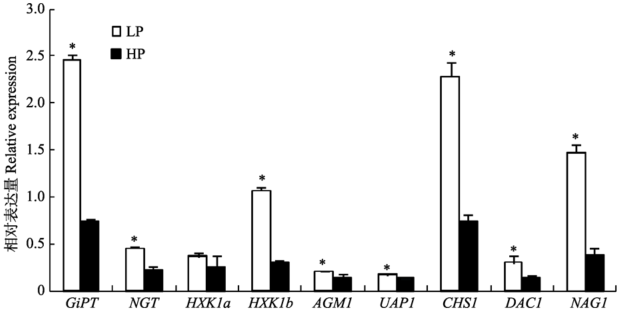
图4 不同磷水平下AM真菌碳磷代谢相关基因表达(平均值±标准偏差)。LP为低磷处理, HP为高磷处理; *表示不同磷水平之间差异显著(p < 0.05)。GiPT, AM真菌磷转运蛋白基因; NGT1, N-乙酰葡糖胺(GlcNAc)转运蛋白基因; HXK1b, GlcNAc激酶b基因; AGM1, GlcNAc磷酸变位酶基因; UAP1, UDP-GlcNAc焦磷酸化酶基因; CHS1, 几丁质合酶基因; DAC1, GlcNAc-6-磷酸去乙酰化酶基因; NAG1, 葡糖胺-6-磷酸异构酶基因。
Fig. 4 Expression of AM fungal genes relevant to C and P metabolisms under different P levels (mean ± SD). LP refers to low P treatments, HP refers to high P treatments, * indicates significant difference (p < 0.05) between different P levels. GiPT, AM fungal P transporter gene; NGT1, GlcNAc transporter gene, HXK1b, GlcNAc kinase gene; AGM1, GlcNAc phosphomutase gene; UAP1, UDP GlcNAc pyrophosphorylase gene; CHS1, chitin synthase gene; DAC1, GlcNAc-6-phosphate deacetylase gene; NAG1, glucosamine- 6-phosphate isomerase gene.
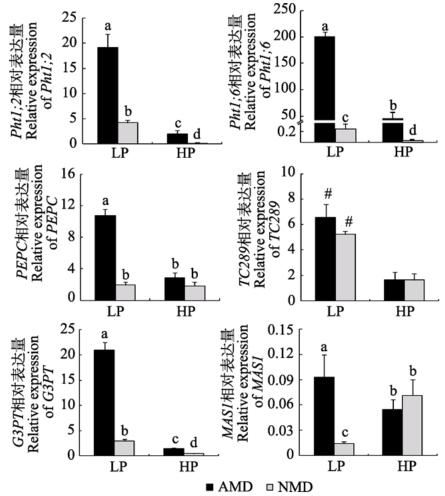
图5 不同磷水平下供体玉米碳磷代谢基因表达情况(平均值±标准偏差)。LP和HP分别代表低磷和高磷处理。AMD和NMD代表供体植物接种AM真菌和不接种对照处理。柱形上方标示不同字母代表相应处理之间在5%水平有显著性差异。“#”表示相同接种处理不同磷水平之间在5%水平差异显著。Pht1;2, Pht1;6, 磷转运蛋白基因; PEPC, 磷酸烯醇式丙酮酸羧化酶基因; G3PT, 甘油-3-磷酸转运蛋白基因; TC289, 无机焦磷酸化酶基因; MAS1, 苹果酸合酶基因。
Fig. 5 Expression of genes relevant to C and P metabolism in maize roots from donor compartment under different P levels (mean ± SD). LP and HP refer to low P level (10 mg?kg-1) and high P level (100 mg?kg-1) respectively. AMD and NMD represent donor plants with and without AM fungus. Different letters above the columns indicate significant difference (p < 0.05) between corresponding treatments. # indicates significant difference (p < 0.05) between different P levels. Pht1;2, Pht1;6, P transporter genes; PEPC, phosphoenolpiruvate carboxylase gene; TC289, inorganic pyrophosphatase gene; G3PT, glycerol- 3-phosphate transporter gene; MAS1, malate synthase gene.
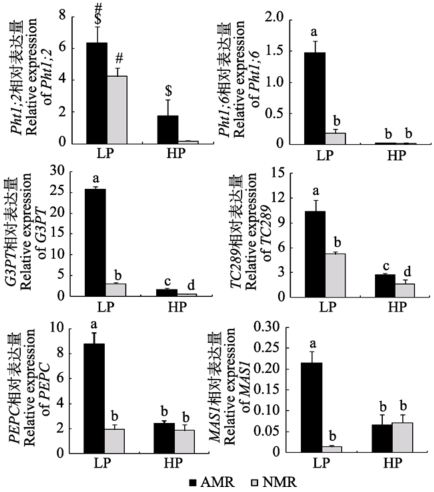
图6 不同磷水平下受体玉米碳磷代谢相关基因表达情况(平均值±标准偏差)。LP和HP分别代表低磷和高磷处理。AMR和NMR代表供体和受体植物受到AM分泌物处理和对照处理。柱形上方标示不同字母代表相应处理之间在5%水平有显著性差异。“#”表示相同接种处理不同磷水平之间在5%水平差异显著, 而“$”代表在相同磷水平下不同接种处理之间在5%水平上差异显著。Pht1;2, Pht1;6, 磷转运蛋白基因; PEPC, 磷酸烯醇式丙酮酸羧化酶基因; G3PT, 甘油-3-磷酸转运蛋白基因; TC289, 无机焦磷酸化酶基因; MAS1, 苹果酸合酶基因。
Fig. 6 Expression of genes relevant to C and P metabolism in maize roots from receiver compartment under different P levels (mean ± SD). LP and HP refer to low P level (10 mg?kg-1) and high P level (100 mg?kg-1) respectively. AMR and NMR represent receiver plants with and without AM exudates respectively. # indicates significant difference (p < 0.05) between different P levels, while $ indicates significant difference (p < 0.05) between inoculation treatments under the same P level. Pht1;2, Pht1;6, P transporter genes; PEPC, phosphoenolpiruvate carboxylase gene; TC289, inorganic pyrophosphatase gene; G3PT, glycerol-3-phosphate transporter gene; MAS1, malate synthase gene.
| 基因 Gene | 正向引物 Forward primer | 反向引物 Reverse primer | 文献 Reference |
|---|---|---|---|
| Action | GTCCGTGCGTTTCCTTTTGT | AAACCGGCCTTGACCATTCC | Soderlund et al., 2009 |
| Pht1;2 | CCAACTTGCTTGGCTTTATCCT | AGCCTCCCCGGACATCTC | Schnable et al., 2009 |
| Pht1;6 | CTACAGCCAGAACCTGACCC | ACATGACGCCCATCAGTAGC | Schnable et al., 2009 |
| G3PT | TTCACCGCCTGCGTCCTT | TCGCTGGGCTCCTCTTGAG | Carlos et al., 2008 |
| PEPC | CACGCTGATCCTGACCATGA | TCGCAAACCGAGTATGTATCTT | Carlos et al., 2008 |
| TC289 | CCCTTGGCATGATCTGGAGAT | CCTTGCTGCCCCTTGGTAT | Carlos et al., 2008 |
| MAS1 | TGGACGCGTACAACCTCATC | CTGACTCCACTGCCGACAAA | Carlos et al., 2008 |
附录I 玉米中碳磷代谢相关功能基因定量PCR引物序列
Appendix I The PCR primer sequences for functional genes in maize plants
| 基因 Gene | 正向引物 Forward primer | 反向引物 Reverse primer | 文献 Reference |
|---|---|---|---|
| Action | GTCCGTGCGTTTCCTTTTGT | AAACCGGCCTTGACCATTCC | Soderlund et al., 2009 |
| Pht1;2 | CCAACTTGCTTGGCTTTATCCT | AGCCTCCCCGGACATCTC | Schnable et al., 2009 |
| Pht1;6 | CTACAGCCAGAACCTGACCC | ACATGACGCCCATCAGTAGC | Schnable et al., 2009 |
| G3PT | TTCACCGCCTGCGTCCTT | TCGCTGGGCTCCTCTTGAG | Carlos et al., 2008 |
| PEPC | CACGCTGATCCTGACCATGA | TCGCAAACCGAGTATGTATCTT | Carlos et al., 2008 |
| TC289 | CCCTTGGCATGATCTGGAGAT | CCTTGCTGCCCCTTGGTAT | Carlos et al., 2008 |
| MAS1 | TGGACGCGTACAACCTCATC | CTGACTCCACTGCCGACAAA | Carlos et al., 2008 |
| 基因 Gene | 正向引物 Forward primer | 反向引物 Reverse primer | 文献 Reference |
|---|---|---|---|
| EF1β | CCCATGCAGCTCGATGGTA | TGCCAGGAAGTGAAGAAAATGA | Yoshihiro et al., 2015 |
| NGT1 | TGGCGCAGCACTTTTGTG | CGTTCGGTAGGGTAAGATAACATGA | Yoshihiro et al., 2015 |
| HXK1a | CGATTGCCAACTGGTATGGA | GCGCAAATTAGTCCCACCTAAG | Yoshihiro et al., 2015 |
| HXK1b | GGAATCCCAACTGGCAAAGA | ACATTCGTAAATTTGTACCTCCAAGA | Yoshihiro et al., 2015 |
| AGM1 | AAAACAATTCGATCTGCTGAAGGT | ATGCTCGTAATTTTTCGATTGCT | Yoshihiro et al., 2015 |
| UAP1 | TGAACGCGTCAACCGAATC | CGGTACCGGGAGCAATTTC | Yoshihiro et al., 2015 |
| CHS1 | CGGCACAATTTAGGGATATAGTGA | GGTTCCCCATGAATCAAACTAGTAA | Yoshihiro et al., 2015 |
| DAC1 | TTTGGAAGAGTTGGTTAATTTTGGT | AATACGGTCGCGGACGAA | Yoshihiro et al., 2015 |
| NAG1 | GGCGTTAGCTCTTGCCAAGT | CGCCGAAACGGTAAACATG | Yoshihiro et al., 2015 |
| GiPT | CTGCTGTTGATTATTGTTGGC | GAACGGTTCCCATAATAGTG | Maldonado-Mendoza et al., 2001 |
附录II AM真菌中碳磷代谢相关功能基因定量PCR引物序列
Appendix II The PCR primer sequences for AM fungal genes
| 基因 Gene | 正向引物 Forward primer | 反向引物 Reverse primer | 文献 Reference |
|---|---|---|---|
| EF1β | CCCATGCAGCTCGATGGTA | TGCCAGGAAGTGAAGAAAATGA | Yoshihiro et al., 2015 |
| NGT1 | TGGCGCAGCACTTTTGTG | CGTTCGGTAGGGTAAGATAACATGA | Yoshihiro et al., 2015 |
| HXK1a | CGATTGCCAACTGGTATGGA | GCGCAAATTAGTCCCACCTAAG | Yoshihiro et al., 2015 |
| HXK1b | GGAATCCCAACTGGCAAAGA | ACATTCGTAAATTTGTACCTCCAAGA | Yoshihiro et al., 2015 |
| AGM1 | AAAACAATTCGATCTGCTGAAGGT | ATGCTCGTAATTTTTCGATTGCT | Yoshihiro et al., 2015 |
| UAP1 | TGAACGCGTCAACCGAATC | CGGTACCGGGAGCAATTTC | Yoshihiro et al., 2015 |
| CHS1 | CGGCACAATTTAGGGATATAGTGA | GGTTCCCCATGAATCAAACTAGTAA | Yoshihiro et al., 2015 |
| DAC1 | TTTGGAAGAGTTGGTTAATTTTGGT | AATACGGTCGCGGACGAA | Yoshihiro et al., 2015 |
| NAG1 | GGCGTTAGCTCTTGCCAAGT | CGCCGAAACGGTAAACATG | Yoshihiro et al., 2015 |
| GiPT | CTGCTGTTGATTATTGTTGGC | GAACGGTTCCCATAATAGTG | Maldonado-Mendoza et al., 2001 |
| 地上部干质量 Shoot dry mass | 根系干质量 Root dry mass | 地上部磷浓度 Shoot P concentration | 根系磷浓度 Root P concentration | Pht1;2 | Pht1;6 | G3PT | PEPC | TC289 | MAS1 | |
|---|---|---|---|---|---|---|---|---|---|---|
| 供体植物 Donor | ||||||||||
| 接种处理 Inoculation treatment (I) | * | ** | * | ** | ** | ** | ** | ** | ns | ** |
| 磷水平 P levels (P) | ** | ns | ** | ** | ** | ** | ** | ** | ** | ns |
| 交互作用 I × P | ** | ** | ns | * | ** | ** | ** | ** | ns | ** |
| 受体植物 Receiver | ||||||||||
| 接种处理 Inoculation treatment (I) | ns | ns | ns | ns | ** | ** | ** | ** | ** | ** |
| 磷水平 P levels (P) | * | * | * | * | ** | ** | ** | ** | ** | ** |
| 交互作用 I × P | ns | ns | ns | ns | ns | ** | ** | ** | ** | ** |
附录III 植物干质量、磷含量、碳磷代谢基因表达的双因素方差分析结果
Appendix III Two-way ANOVA of shoot and root dry mass, P concentrations and expression of genes related to C and P metabolisms as influenced by mycorrhizal inoculation and soil P levels
| 地上部干质量 Shoot dry mass | 根系干质量 Root dry mass | 地上部磷浓度 Shoot P concentration | 根系磷浓度 Root P concentration | Pht1;2 | Pht1;6 | G3PT | PEPC | TC289 | MAS1 | |
|---|---|---|---|---|---|---|---|---|---|---|
| 供体植物 Donor | ||||||||||
| 接种处理 Inoculation treatment (I) | * | ** | * | ** | ** | ** | ** | ** | ns | ** |
| 磷水平 P levels (P) | ** | ns | ** | ** | ** | ** | ** | ** | ** | ns |
| 交互作用 I × P | ** | ** | ns | * | ** | ** | ** | ** | ns | ** |
| 受体植物 Receiver | ||||||||||
| 接种处理 Inoculation treatment (I) | ns | ns | ns | ns | ** | ** | ** | ** | ** | ** |
| 磷水平 P levels (P) | * | * | * | * | ** | ** | ** | ** | ** | ** |
| 交互作用 I × P | ns | ns | ns | ns | ns | ** | ** | ** | ** | ** |
| [1] |
Bago B, Pfeffer PE, Shachar-Hill Y (2000). Carbon metabolism and transport in arbuscular mycorrhizas.Plant Physiology, 124, 949-958.
DOI URL |
| [2] | Bao SD (2000). Soil and Agricultural Chemistry Analysis. China Agriculture Press, Beijing. 81.(in Chinese)[鲍士旦 (2000). 土壤农化分析. 中国农业出版社, 北京. 81.] |
| [3] |
Barto EK, Hilker M, Müller F, Mohney BK, Weidenhamer JD, Rillig MC (2011). The fungal fast lane: Common mycorrhizal networks extend bioactive zones of allelochemicals in soils.PLOS ONE, 6, e27195. doi: 10.1371/ journal.pone.0027195.
DOI URL PMID |
| [4] |
Biermann B, Linderman RG (1981). Quantifying vesicular- arbuscular mycorrhizae: A proposed method towards standardization.New Phytologist, 87, 63-67.
DOI URL |
| [5] |
Breuillin F, Schramm J, Hajirezaei M, Ahkami A, Favre P, Druege U, Hause B, Bucher M, Kretzschmar T, Bossolini C, Kuhlemeier C, Martinoia E, Franken P, Scholz U, Reinhardt D (2010). Phosphate systemically inhibits development of arbuscular mycorrhiza in Petunia hybrida and represses genes involved in mycorrhizal functioning.The Plant Journal, 64, 1002-1017.
DOI URL PMID |
| [6] |
Carlos CV, Enrique IL, Juan CP, Herrera-Estrella L (2008). Transcript profiling of Zea mays roots reveals gene responses to phosphate deficiency at the plant-and species- specific levels.Journal of Experimental Botany, 59, 2479-2497.
DOI URL PMID |
| [7] |
Casieri L, Lahmidi NA, Doidy J, Veneault-Fourrey C, Migeon A, Bonneau L, Courty P, Garcia K, Charbonnier M, Delteil A, Brun A, Zimmermann S, Plassard C, Wipf D (2013). Biotrophic transportome in mutualistic plant-fungal interactions.Mycorrhiza, 23, 597-625.
DOI URL PMID |
| [8] |
Chabaud M, Genre A, Sieberer BJ, Faccio A, Fournier J, Novero M, Barker DG, Bonfante P (2011). Arbuscular mycorrhizal hyphopodia and germinated spore exudates trigger Ca2+ spiking in the legume and nonlegume root epidermis.New Phytologist, 189, 347-355.
DOI URL PMID |
| [9] |
Chen A, Hu J, Sun S, Xu G (2007). Conservation and divergence of both phosphate- and mycorrhiza-regulated physiological responses and expression patterns of phosphate transporters in solanaceous species.New Phytologist, 173, 817-831.
DOI URL |
| [10] | Cunningham JE, Kuiack C (1992). Production of citric and oxalic acids and solubilization of calcium phosphate by Penicillium bilaii.Applied and Environmental Microbiology, 58, 1451-1458. |
| [11] | Fixen P (2002). Soil test levels in North America.Better Crops, 86, 12-15. |
| [12] |
Fukayama H, Hatch MD, Tamai T, Tsuchida H, Sudoh S, Furbank RT, Miyao M (2003). Activity regulation and physiological impacts of maize C4-specific phosphoenolpyruvate carboxylase overproduced in transgenic rice plants.Photosynthesis Research, 77, 227-239.
DOI URL PMID |
| [13] |
Gardner WK, Barber DA, Parbery DG (1983). The acquisition of phosphorus by Lupinus albus L.: 3. The probable mechanism by which phosphorus movement in the soil/ root interface is enhanced.Plant Soil, 70, 107-124.
DOI URL |
| [14] |
Gu M, Chen AQ, Dai XL, Liu W, Xu G (2011). How does phosphate status influence the development of the arbuscular mycorrhizal symbiosis?Plant Signalling and Behavior, 6, 1300-1304.
DOI URL PMID |
| [15] |
Guimil S, Chang HS, Zhu T, Sesma A, Osbourn A, Roux C, Ioannidis V, Oakeley EJ, Docquier M, Descombes P, Briggs SP, Paszkowski U (2005). Comparative transcriptomics of rice reveals an ancient pattern of response to microbial colonization.Proceedings of the National Academy of Sciences of the United States of America, 102, 8066-8070.
DOI URL PMID |
| [16] |
Gutjahr C, Casieri L, Paszkowski U (2009). Glomus intraradices induces changes in root system architecture of rice independently of common symbiosis signaling.New Phytologist, 182, 829-837.
DOI URL PMID |
| [17] |
Harrison MJ, Dewbre GR, Liu J (2002). A phosphate transporter from Medicago truncatula involved in the acquisition of phosphate released by arbuscular mycorrhizal fungi.Plant Cell, 14, 2413-2429.
DOI URL PMID |
| [18] | Harrison MJ, Pumplin N, Breuillin FJ, Noar RD, Park HJ (2010). Phosphate transporters in arbuscular mycorrhizal symbiosis. In: Koltai H, Kapulnik Y eds. Arbuscular Mycorrhizas: Physiology and Function. Springer, Dordrecht, The Netherlands. 117-135. |
| [19] |
Javot H, Pumplin N, Harrison M (2007). Phosphate in the arbuscular mycorrhizal symbiosis: Transport properties and regulatory roles.Plant, Cell & Environment, 30, 310-322.
DOI URL PMID |
| [20] |
Kosuta S, Chabaud M, Lougnon G, Gough C, Dénarié J, Barker DG, Bécard G (2003). A diffusible factor from arbuscular mycorrhizal fungi induces symbiosis-specific MtENOD11 expression in roots of Medicago truncatula.Plant Physiology, 131, 952-962.
DOI URL PMID |
| [21] |
Li T, Chen BD (2012). Arbuscular mycorrhizal fungi improving drought tolerance of maize plants by up-regulation of aquaporin gene expressions in roots and the fungi themselves.Chinese Journal of Plant Ecology, 36, 973-981.(in Chinese with English abstract)[李涛, 陈保冬 (2012). 丛枝菌根真菌通过上调根系及自身水孔蛋白基因表达提高玉米抗旱性, 植物生态学报,36, 973-981.]
DOI URL |
| [22] |
Maillet F, Poinsot V, Andre O, Puech-Pagès V, Haouy A, Gueunier M, Cromer L, Giraudet D, Formey D, Niebel A, Martinez EA, Driguez H, Bécard G, Dénarié J (2011). Fungal lipochitooligosaccharide symbiotic signals in arbuscular mycorrhiza.Nature, 469, 58-63.
DOI URL PMID |
| [23] |
Maldonado-Mendoza IE, Dewbre GR, Harrison MJ (2001). A phosphate transporter gene from the extra-radical mycelium of an arbuscular mycorrhizal fungus Glomus intraradices is regulated in response to phosphate in the environment.Molecular Plant-Microbe Interactions, 14, 1140-1148.
DOI URL PMID |
| [24] | Marschner H (1995).Mineral Nutrition of Higher Plants. 2nd edn. Academic Pres. London. |
| [25] |
Nagy F, Karandashov V, Chague W, Kalinkevich K, Tamasloukht MB, Xu G, Jakobsen I, Levy AA, Amrhein N, Bucher M (2005). The characterization of novel mycorrhiza-specific phosphate transporters from Lycopersicon esculentum and Solanum tuberosum uncovers functional redundancy in symbiotic phosphate transport in solanaceous species.The Plant Journal, 42, 236-250.
DOI URL |
| [26] |
Nagy R, Drissner D, Amrhein N, Jakobsen I, Bucher M (2009). Mycorrhizal phosphate uptake pathway in tomato is phosphorus-repressible and transcriptionally regulated.New Phytologist, 181, 950-959.
DOI URL PMID |
| [27] |
Oláh B, Brière C, Bécard G, Dénarié J, Gough C (2005). Nod factors and a diffusible factor from arbuscular mycorrhizal fungi stimulate lateral root formation in Medicago truncatula via the DMI1/DMI2 signalling pathway.The Plant Journal, 44, 195-207.
DOI URL PMID |
| [28] |
Olsson PA, Hansson MC, Burleigh SH (2006). Effect of P availability on temporal dynamics of carbon allocation and Glomus intraradices high-affinity P transporter gene induction in arbuscular mycorrhiza.Applied and Environmental Microbiology, 72, 4115-4120.
DOI URL PMID |
| [29] |
Pfaffl MW (2001). A new mathematical model for relative quantification in real-time RT-PCR.Nucleic Acids Research, 29, e45.
DOI URL PMID |
| [30] |
Phillips JM, Hayman DS (1970). Improved procedures for clearing roots and staining parasitic and vesicular-arbuscular mycorrhizal fungi for rapid assessment of infection.Transactions of the British Mycological Society, 55, 158-161.
DOI URL |
| [31] |
Plénet D, Etchebest S, Mollier A, Pellerin S (2000). Growth analysis of maize field crops under phosphorus deficiency.Plant and Soil, 223, 119-132.
DOI URL |
| [32] |
Radchuk R, Radchuk V, G?tz KP, Weichert H, Richter A, Emery RJ, Winfriede W, Weber H (2007). Ectopic expression of phosphoenolpyruvate carboxylase in Vicia narbonensis seeds: Effects of improved nutrient status on seed maturation and transcriptional regulatory networks.The Plant Journal, 51, 819-839.
DOI URL PMID |
| [33] |
Ramaiah M, Jain A, Baldwin JC, Karthikeyan AS, Raghothama KG (2011). Characterization of the phosphate starvation- induced glycerol-3-phosphate permease gene family inArabidopsis. Plant physiology, 157, 279-291.
DOI URL PMID |
| [34] |
Rich MK, Schorderet M, Reinhardt D (2014). The role of the cell wall compartment in mutualistic symbioses of plants.Frontiers in Plant Science, 5, 238.
DOI URL PMID |
| [35] |
Rojas-Beltrán JA, Dubois F, Mortiaux F, Portetelle D, Gebhardt C, Sangwan RS, du Jardin P (1999). Identification of cytosolic Mg2+-dependent soluble inorganic pyrophosphatases in potato and phylogenetic analysis.Plant Molecular Biology, 39, 449-461.
DOI URL |
| [36] |
Rolletschek H, Borisjuk L, Radchuk R, Miranda M, Heim U, Wobus U, Weber H (2004). Seed-specific expression of a bacterial phosphoenolpyruvate carboxylase in Vicia narbonensis increases protein content and improves carbon economy.Plant Biotechnology Journal, 2, 211-219.
DOI URL PMID |
| [37] |
Schnable PS, Ware D, Fulton RS, Stein JC, Wei F, Pasternak S, Liang C, Zhang J, Fulton L, Graves TA, Minx P, Reily AD, Courtney L, Kruchowski SS, Tomlinson C, Strong C, Delehaunty K, Fronick C, Courtney B, Rock SM, Belter E, Du F, Kim K, Abbott RM, Cotton M, Levy A, Marchetto P, Ochoa K, Jackson SM, Gillam B, Chen W, Yan L, Higginbotham J, Cardenas M, Waligorski J, Applebaum E, Phelps L, Falcone J, Kanchi K, Thane T, Scimone A, Thane N, Henke J, Wang T, Ruppert J, Shah N, Rotter K, Hodges J, Ingenthron E, Cordes M, Kohlberg S, Sgro J, Delgado B, Mead K, Chinwalla A, Leonard S, Crouse K, Collura K, Kudrna D, Currie J, He R, Angelova A, Rajasekar S, Mueller T, Lomeli R, Scara G, Ko A, Delaney K, Wissotski M, Lopez G, Campos D, Braidotti M, Ashley E, Golser W, Kim H, Lee S, Lin J, Dujmic Z, Kim W, Talag J, Zuccolo A, Fan C, Sebastian A, Kramer M, Spiegel L, Nascimento L, Zutavern T, Miller B, Ambroise C, Muller S, Spooner W, Narechania A, Ren L, Wei S, Kumari S, Faga B, Levy MJ, McMahan L, Van Buren P, Vaughn MW, Ying K, Yeh CT, Emrich SJ, Jia Y, Kalyanaraman A, Hsia AP, Barbazuk WB, Baucom RS, Brutnell TP, Carpita NC, Chaparro C, Chia JM, Deragon JM, Estill JC, Fu Y, Jeddeloh JA, Han Y, Lee H, Li P, Lisch DR, Liu S, Liu Z, Nagel DH, McCann MC, SanMiguel P, Myers AM, Nettleton D, Nguyen J, Penning BW, Ponnala L, Schneider KL, Schwartz DC, Sharma A, Soderlund C, Springer NM, Sun Q, Wang H, Waterman M, Westerman R, Wolfgruber TK, Yang L, Yu Y, Zhang L, Zhou S, Zhu Q, Bennetzen JL, Dawe RK, Jiang J, Jiang N, Presting GG, Wessler SR, Aluru S, Martienssen RA, Clifton SW, McCombie WR, Wing RA, Wilson RK (2009). The B73 maize genome: Complexity, diversity, and dynamics.Science, 326, 1112-1115.
DOI URL PMID |
| [38] | Smith SE, Read DJ (2008). Arbuscular mycorrhizas.Mycorrhizal Symbiosis, 3, 11-145. |
| [39] | Tyler G (1999). Plant distribution and soil-plant interactions on shallow soils.Acta Phytogeographica Suecica, 84, 21-32. |
| [40] |
van der Heijden MGA, Horton TR (2009). Socialism in soil? The importance of mycorrhizal fungal networks for facilitation in natural ecosystems.Journal of Ecology, 97, 1139-1150.
DOI URL |
| [41] |
Wright DP, Read DJ, Scholes JD (1998). Mycorrhizal sink strength influences whole plant carbon balance of Trifolium repens L.Plant, Cell & Environment, 21, 881-891.
DOI URL |
| [42] |
Yoshihiro K, Miki K, Katsuharu S, Kikuchi Y, Ezawa T, Maeshima M, Hata S, Fujiwara T (2015). Up-regulation of genes involved in N-acetylglucosamine uptake and metabolism suggests a recycling mode of chitin in intraradical mycelium of arbuscular mycorrhizal fungi.Mycorrhiza, 25, 411-417.
DOI URL PMID |
| [1] | 赵掷艺, 黄伟权, 胡婧妍, 王义越, 虞梦婕, 吴玉环. 泥炭沼泽湿地植物残体分解及微生物作用机理研究进展[J]. , 2026, 50(预发表): 0-. |
| [2] | 魏莉, 王鹏森, 刘珊, 樊锐, 黄楠, 张建国, 其美拉姆, 苟扬, 刘沫含, 黄婷, 周冀琼. 丛枝菌根真菌对豆禾混播植物垂直生态位养分吸收的影响[J]. 植物生态学报, 2026, 50(3): 760-773. |
| [3] | 周春菡, 熊智诚, 杨明新, 史海兰, 周亚星, 唐玉, 张静, 纪宝明, 代心灵. 黄河源园区高寒湿地菌根真菌群落特征及其影响因素[J]. 植物生态学报, 2026, 50(3): 625-638. |
| [4] | 姜庆宏, 丁露, 王哲, 郑春丽, 冯昭绰. 丛枝菌根真菌与不同功能细菌联用对苜蓿的促生作用[J]. 植物生态学报, 2026, 50(3): 774-788. |
| [5] | 马建辉, 童鑫, 张思榕, 毛子昆, 秦俊, 马克平. 菌根真菌生理生态功能研究进展及展望[J]. 植物生态学报, 2026, 50(3): 498-514. |
| [6] | 王海浪, 付伟, 伍松林, 陈保冬. 丛枝菌根真菌生态功能及群落调控[J]. 植物生态学报, 2026, 50(3): 515-535. |
| [7] | 方迪, 马宁, 李胜功, 郑甲佳, 褚云馨, 杨锦昌, 杨赞明, 张龙宁, 孟盛旺, 高德才, 戴晓琴, 付晓莉, 王辉民, 寇亮. 菌根共生类型对森林养分内循环的调控作用[J]. 植物生态学报, 2026, 50(3): 552-565. |
| [8] | 秦斐斐, 唐朝辉, 司彤, 慈敦伟. 盐碱耐受型和敏感型花生生长发育及根际土壤特性对丛枝菌根真菌的响应[J]. 植物生态学报, 2026, 50(3): 742-759. |
| [9] | 邹纪开, 吴佳怡, 谷云懿, 陈宝明. 不同形态氮添加与丛枝菌根真菌对外来入侵植物白花鬼针草竞争力的影响[J]. 植物生态学报, 2026, 50(3): 722-730. |
| [10] | 何正嘉, 曾歆然, 王琳影, 薛昕宇, 苏钦泽, 李宇, 张寅杰, 吴辉煌, 陈成聪, 吴良泉, 魏安妮, 仇云鹏, 郭梨锦. 茶园丛枝菌根真菌群落和土壤有机碳对镁肥的响应[J]. 植物生态学报, 2026, 50(3): 700-709. |
| [11] | 段世龙, 余成瑾, 许心垚, 冯固, 谢贤安, 张林. 植物-丛枝菌根真菌-细菌连续体及其维持机制[J]. 植物生态学报, 2026, 50(3): 600-611. |
| [12] | 江康威, 吕程, 王亚菲, 李宏, 张芷晴, 王雨, 张青青, 吐尔逊娜依•热依木. 放牧干扰下丛枝菌根真菌群落对土壤多功能性的影响[J]. 植物生态学报, 2026, 50(3): 685-699. |
| [13] | 何堂庆, 王变变, 曹鑫鑫, 张康成, 汪晓东, 王浩, 白彤硕, 赵叶新, 张艺, 王益, 仇云鹏, 胡水金. 半干旱草地植物和丛枝菌根真菌群落对长期降水增加的响应[J]. 植物生态学报, 2026, 50(3): 674-684. |
| [14] | 刘润洪, 阳柳蓉, 梁慧婷, 申卫军. 丛枝菌根和外生菌根植物磷获取与利用策略研究进展与展望[J]. 植物生态学报, 2026, 50(3): 566-583. |
| [15] | 王梦雪, 胡明艳, 储诚进, 陈阳, 罗文启, 马子龙. 亚热带森林不同菌根真菌树种叶片和细根的碳氮磷化学计量特征[J]. 植物生态学报, 2026, 50(2): 334-343. |
| 阅读次数 | ||||||
|
全文 |
|
|||||
|
摘要 |
|
|||||
Copyright © 2026 版权所有 《植物生态学报》编辑部
地址: 北京香山南辛村20号, 邮编: 100093
Tel.: 010-62836134, 62836138; Fax: 010-82599431; E-mail: apes@ibcas.ac.cn, cjpe@ibcas.ac.cn
备案号: 京ICP备16067583号-19

