
植物生态学报 ›› 2017, Vol. 41 ›› Issue (1): 5-13.DOI: 10.17521/cjpe.2016.0202 cstr: 32100.14.cjpe.2016.0202
所属专题: 中国灌丛生态系统碳储量的研究; 凋落物
葛结林1, 熊高明1, 李家湘1, 徐文婷1, 赵常明1, 卢志军2, 李跃林3, 谢宗强1,*( )
)
收稿日期:2016-06-14
接受日期:2016-11-10
出版日期:2017-01-10
发布日期:2017-01-23
作者简介:* 通信作者Author for correspondence (E-mail:基金资助:
Jie-Lin GE1, Gao-Ming XIONG1, Jia-Xiang LI1, Wen-Ting XU1, Chang-Ming ZHAO1, Zhi-Jun LU2, Yue-Lin LI3, Zong-Qiang XIE1,*()
Received:2016-06-14
Accepted:2016-11-10
Online:2017-01-10
Published:2017-01-23
About author:KANG Jing-yao(1991-), E-mail: 摘要:
凋落物是陆地生态系统的重要组成部分, 在区域尺度上阐明其现存量的分布特征及其影响因子有助于理解陆地生态系统碳循环的机理。该研究采用分层随机抽样调查方法分析了中国南方灌丛生态系统凋落物现存量的空间分布格局及其影响因子。结果发现: 该区域灌丛凋落物现存量的平均值为0.32 kg·m-2, 是中国森林凋落物现存量(0.47 kg·m-2)的68%, 是中国草地凋落物现存量(0.06 kg·m-2)的5倍;凋落物现存量呈现出明显的纬度格局,随着纬度的增加而升高;该区域的灌丛生态系统凋落物现存量的碳转换系数为0.41,显著低于植被活体转换系数0.50;凋落物现存量与年平均气温、土壤全磷含量和土壤pH值显著负相关,与年降水量、土壤碳、氮以及有机碳含量相关性不显著。研究表明:该区域灌丛凋落物现存量是中国陆地生态系统碳库不可忽视的组分;年平均气温是影响该区域内灌丛生态系统凋落物现存量的重要环境因子;采用常用的植被活体碳转换系数可能会高估凋落物现存量碳库的22%。
葛结林, 熊高明, 李家湘, 徐文婷, 赵常明, 卢志军, 李跃林, 谢宗强. 中国南方灌丛凋落物现存量. 植物生态学报, 2017, 41(1): 5-13. DOI: 10.17521/cjpe.2016.0202
Jie-Lin GE, Gao-Ming XIONG, Jia-Xiang LI, Wen-Ting XU, Chang-Ming ZHAO, Zhi-Jun LU, Yue-Lin LI, Zong-Qiang XIE. Litter standing crop of shrubland ecosystems in southern China. Chinese Journal of Plant Ecology, 2017, 41(1): 5-13. DOI: 10.17521/cjpe.2016.0202
| 地点 Place | 年份 Year | 样点数 No. of sites | 纬度 Latitude (N) (°) | 经度 Longitude (E) (°) | 海拔 Altitude (m) | 年平均气温 Mean annual temperature (℃) | 年降水量 Mean annual precipitation (mm) | 土壤全碳 Soil total carbon (%) | 土壤全氮 Soil total nitrogen (%) | 土壤全磷 Soil total phosphorus (mg·g-1) |
|---|---|---|---|---|---|---|---|---|---|---|
| 江苏 Jiangsu | 2012-2013 | 5 | 31.6-34.6 | 118.1-120.3 | 18-388 | 16.1 | 1 019.6 | 1.4 | 0.1 | 0.5 |
| 浙江 Zhejiang | 2011-2013 | 26 | 27.5-31.1 | 118.4-122.3 | 27-631 | 18.2 | 1 784.3 | 1.8 | 0.2 | 0.3 |
| 安徽 Anhui | 2011-2012 | 20 | 29.7-31.6 | 115.9-119.4 | 47-553 | 17.2 | 1 692.1 | 2.1 | 0.2 | 0.5 |
| 湖北 Hubei | 2011-2013 | 74 | 29.1-32.9 | 108.7-115.8 | 61-1 865 | 16.3 | 1 375.2 | 2.3 | 0.2 | 0.6 |
| 江西 Jiangxi | 2011-2013 | 49 | 25.0-29.6 | 113.9-117.5 | 28-601 | 20.0 | 1 641.0 | 1.7 | 0.2 | 0.4 |
| 福建 Fujian | 2011-2013 | 39 | 24.1-27.9 | 116.4-120.2 | 42-1 132 | 20.3 | 1 795.1 | 1.3 | 0.1 | 0.2 |
| 广东 Guangdong | 2011-2014 | 35 | 21.7-25.0 | 111.3-116.5 | 0-678 | 22.6 | 2 009.2 | 2.2 | 0.2 | 0.3 |
| 湖南 Hunan | 2011-2013 | 70 | 25.1-29.7 | 109.6-113.9 | 61-1 405 | 18.6 | 1 547.3 | 2.5 | 0.2 | 0.4 |
| 重庆 Chongqing | 2011-2013 | 50 | 28.5-32.0 | 105.9-110.0 | 173-1 506 | 16.8 | 1 355.3 | 2.9 | 0.2 | 0.6 |
| 广西 Guangxi | 2011-2014 | 44 | 21.7-25.0 | 105.2-111.4 | 33-1 259 | 22.0 | 1 669.8 | 3.0 | 0.3 | 0.8 |
| 海南 Hainan | 2011-2012 | 20 | 18.3-20.0 | 108.7-111.0 | 4-147 | 26.1 | 1 569.3 | 0.9 | 0.1 | 0.4 |
表1 所研究省市自治区的地理位置、气候和土壤养分概况
Table 1 General information on geographic location, climate and soil for different provinces, municipalities and autonomous regions
| 地点 Place | 年份 Year | 样点数 No. of sites | 纬度 Latitude (N) (°) | 经度 Longitude (E) (°) | 海拔 Altitude (m) | 年平均气温 Mean annual temperature (℃) | 年降水量 Mean annual precipitation (mm) | 土壤全碳 Soil total carbon (%) | 土壤全氮 Soil total nitrogen (%) | 土壤全磷 Soil total phosphorus (mg·g-1) |
|---|---|---|---|---|---|---|---|---|---|---|
| 江苏 Jiangsu | 2012-2013 | 5 | 31.6-34.6 | 118.1-120.3 | 18-388 | 16.1 | 1 019.6 | 1.4 | 0.1 | 0.5 |
| 浙江 Zhejiang | 2011-2013 | 26 | 27.5-31.1 | 118.4-122.3 | 27-631 | 18.2 | 1 784.3 | 1.8 | 0.2 | 0.3 |
| 安徽 Anhui | 2011-2012 | 20 | 29.7-31.6 | 115.9-119.4 | 47-553 | 17.2 | 1 692.1 | 2.1 | 0.2 | 0.5 |
| 湖北 Hubei | 2011-2013 | 74 | 29.1-32.9 | 108.7-115.8 | 61-1 865 | 16.3 | 1 375.2 | 2.3 | 0.2 | 0.6 |
| 江西 Jiangxi | 2011-2013 | 49 | 25.0-29.6 | 113.9-117.5 | 28-601 | 20.0 | 1 641.0 | 1.7 | 0.2 | 0.4 |
| 福建 Fujian | 2011-2013 | 39 | 24.1-27.9 | 116.4-120.2 | 42-1 132 | 20.3 | 1 795.1 | 1.3 | 0.1 | 0.2 |
| 广东 Guangdong | 2011-2014 | 35 | 21.7-25.0 | 111.3-116.5 | 0-678 | 22.6 | 2 009.2 | 2.2 | 0.2 | 0.3 |
| 湖南 Hunan | 2011-2013 | 70 | 25.1-29.7 | 109.6-113.9 | 61-1 405 | 18.6 | 1 547.3 | 2.5 | 0.2 | 0.4 |
| 重庆 Chongqing | 2011-2013 | 50 | 28.5-32.0 | 105.9-110.0 | 173-1 506 | 16.8 | 1 355.3 | 2.9 | 0.2 | 0.6 |
| 广西 Guangxi | 2011-2014 | 44 | 21.7-25.0 | 105.2-111.4 | 33-1 259 | 22.0 | 1 669.8 | 3.0 | 0.3 | 0.8 |
| 海南 Hainan | 2011-2012 | 20 | 18.3-20.0 | 108.7-111.0 | 4-147 | 26.1 | 1 569.3 | 0.9 | 0.1 | 0.4 |
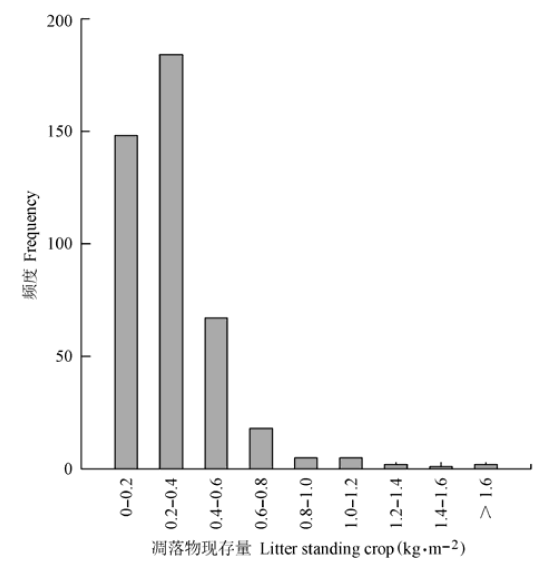
图1 中国南方灌丛凋落物现存量的频度分布图。
Fig. 1 Frequency distribution of litter standing crop of shrublands in southern China.
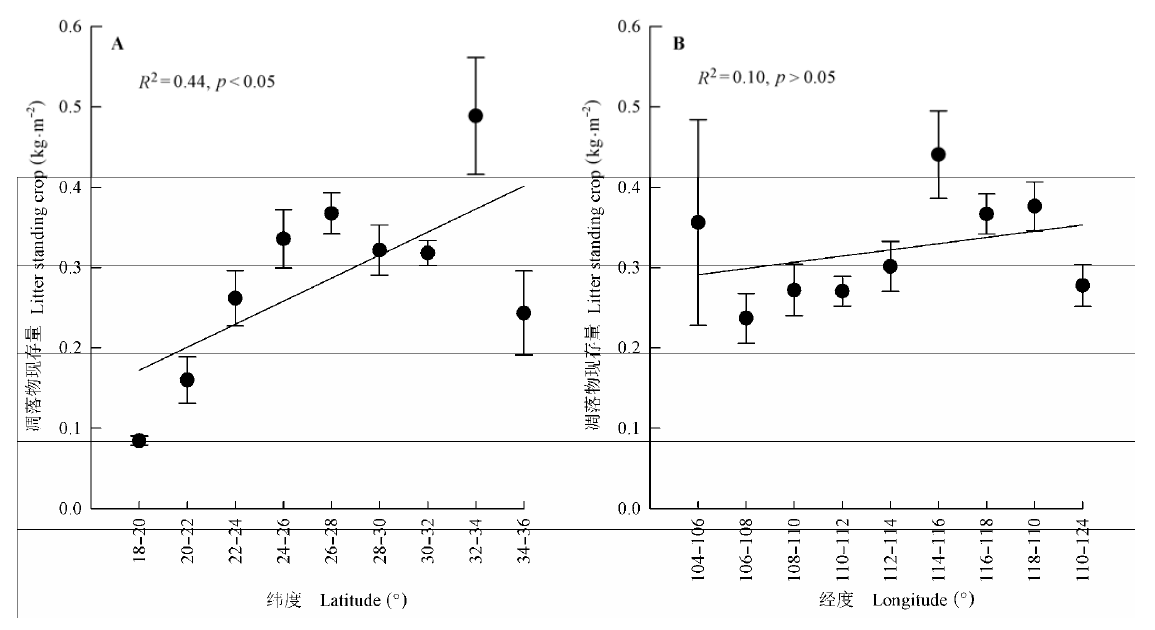
图2 中国南方灌丛凋落物现存量随经纬度的变化(平均值±标准误差)。A, 纬度。B, 经度。
Fig. 2 Variation in litter standing crop of shrublands across the latitudinal and longitudinal gradients in southern China (mean ± SE). A, Latitude. B, Longitude.
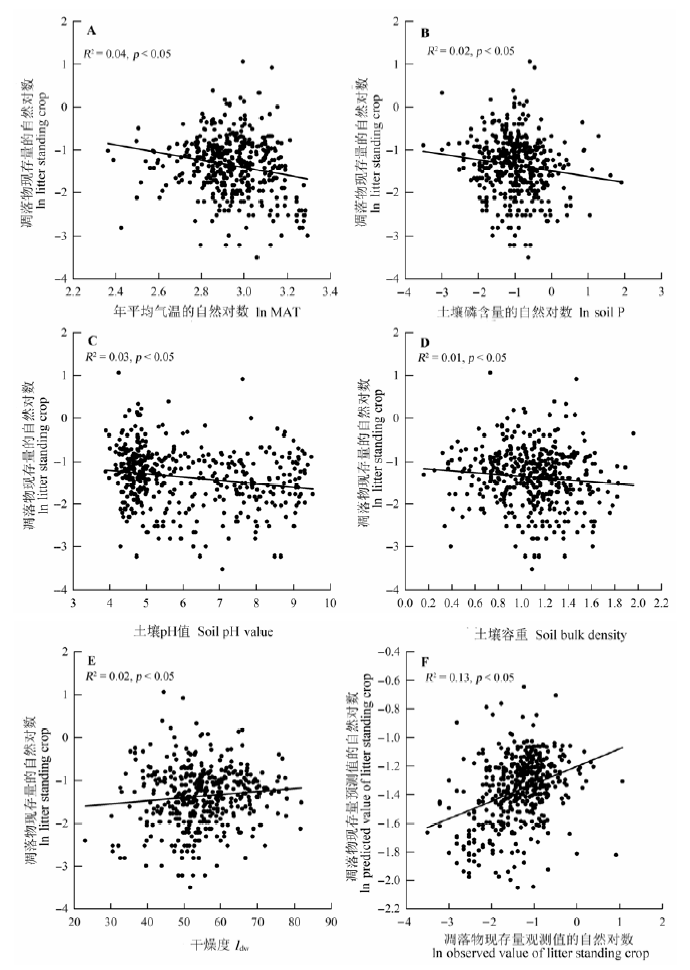
图3 中国南方灌丛凋落物现存量与环境因子的关系。本文仅显示凋落物现存量与环境因子关系显著的图。A-E, 现存量与单个环境因子(年平均气温、土壤全磷含量、土壤容重和干燥度)的关系。F, 现存量与年平均气温(MAT)、土壤全磷含量和土壤pH值之间的多元线性回归关系。
Fig. 3 Variation in litter standing crop of shrublands of southern China in relation to environmental factors in China. We only showed the figures that depicted the significant relationship between litter standing crop and environmental factors. A-E, The relationship between litter standing crop and single environmental variables including mean annual temperature (MAT), soil total phosphorus (P) content, soil pH value, soil bulk density and climatic dryness (Idw). F, Observed value vs. predicted value of litter standing crop from multiple regression using mean annual temperature (MAT), soil P content and soil pH value as predictors.
| [1] | Aerts R (1997). Climate, leaf litter chemistry and leaf litter decomposition in terrestrial ecosystems: A triangular relationship.Oikos, 79, 439-449. |
| [2] | Chave J, Navarrete D, Almeida S, Alvarez E, Aragão LE, Bonal D, Châtelet P, Silva-Espejo J, Goret JY, Hildebrand P (2010). Regional and seasonal patterns of litterfall in tropical South America.Biogeosciences, 7, 43-55. |
| [3] | Chen SS, Liu HY, Guo DL (2010). Litter stocks and chemical quality of natural birch forest along temperature and precipitation gradients in eastern Inner Mongolia, China.Chinese Journal of Plant Ecology, 34, 1007-1015. (in Chinese with English abstract)[陈莎莎, 刘鸿雁, 郭大立 (2010). 内蒙古东部天然白桦林的凋落物性质和储量及其随温度和降水梯度的变化格局. 植物生态学报, 34, 1007-1015.] |
| [4] | Descheemaeker K, Muys B, Nyssen J, Poesen J, Raes D, Haile M, Deckers J (2006). Litter production and organic matter accumulation in exclosures of the Tigray highlands, Ethiopia. Forest Ecology and Management, 233, 21-35. |
| [5] | Domke GM, Perry CH, Walters BF, Woodall CW, Russell MB, Smith JE (2016). Estimating litter carbon stocks on forest land in the United States.Science of Total Environment, 557, 469-478. |
| [6] | Dorrepaal E, Cornelissen JHC, Aerts R, Wallén B, van Logtestijn RSP (2005). Are growth forms consistent predictors of leaf litter quality and decomposability across peatlands along a latitudinal gradient?Journal of Ecology, 93, 817-828. |
| [7] | Fang JY, Huang Y, Zhu JL, Sun WJ, Hu HF (2015a). Carbon budget of forest ecosystems and its driving forces.China Basic Science, 3, 20-25. (in Chinese with English abstract)[方精云, 黄耀, 朱江玲, 孙文娟, 胡会峰 (2015a). 森林生态系统碳收支及其影响机制. 中国基础科学, 3, 20-25.] |
| [8] | Fang JY, Yu GR, Ren XB, Liu GH, Zhao XQ (2015b). Carbon sequestration in China’s terrestrial ecosystems under climate change—Progress on ecosystem carbon sequestration from the CAS Strategic Priority Research Program. Bulletin of Chinese Academy of Sciences, 30, 848-857. (in Chinese with English abstract)[方精云, 于贵瑞, 任小波, 刘国华, 赵新全 (2015b). 中国陆地生态系统固碳效应——中国科学院战略性先导科技专项“应对气候变化的碳收支认证及相关问题”之生态系统固碳任务群研究进展. 中国科学院院刊, 30, 848-857. ] |
| [9] | García-Palacios P, McKie BG, Handa IT, Frainer A, Hättenschwiler S (2016). The importance of litter traits and decomposers for litter decomposition: A comparison of aquatic and terrestrial ecosystems within and across biomes.Functional Ecology, 30, 819-829. |
| [10] | Hijmans RJ, Cameron SE, Parra JL, Jones PG, Jarvis A (2005). Very high resolution interpolated climate surfaces for global land areas.International Journal of Climatology, 25, 1965-1978. |
| [11] | Hilli S, Stark S, Derome J (2010). Litter decomposition rates in relation to litter stocks in boreal coniferous forests along climatic and soil fertility gradients.Applied Soil Ecology, 46, 200-208. |
| [12] | Hu HF, Wang ZH, Liu GH, Fu BJ (2006). Vegetation carbon storage of major shrublands in China.Journal of Plant Ecology (Chinese Version), 30, 539-544. (in Chinese with English abstract)[胡会峰, 王志恒, 刘国华, 傅伯杰 (2006). 中国主要灌丛植被碳储量. 植物生态学报, 30, 539-544.] |
| [13] | Li Q, Zhou DW, Chen XY (2014). The accumulation, decomposition and ecological effects of above-ground litter in terrestrial ecosystem.Acta Ecologica Sinica, 34, 3807-3819. (in Chinese with English abstract)[李强, 周道玮, 陈笑莹 (2014). 地上枯落物的累积、分解及其在陆地生态系统中的作用. 生态学报, 34, 3807-3819.] |
| [14] | Liu C, Westman CJ, Berg B, Kutsch W, Wang GZ, Man R, Ilvesniemi H (2004). Variation in litterfall-climate relationships between coniferous and broadleaf forests in Eurasia.Global Ecology and Biogeography, 13, 105-114. |
| [15] | Liu GS (1997). Soil Physical and Chemical Analysis and the Profile Description. China Standard Publishing House, Beijing. (in Chinese)[刘光崧 (1997). 土壤理化分析与剖面描述. 中国标准出版社, 北京.] |
| [16] | Lü GH, Li RP, Wen RH, Xie YB, Wang XY (2014). Analysis of climatic effects on the components of forest litterfall production.Chinese Agricultural Science Bulletin, 30, 1-6. (in Chinese with English abstract)[吕国红, 李荣平, 温日红, 谢艳兵, 王笑影 (2014). 森林凋落物组分的气象影响分析. 中国农学通报, 30, 1-6. ] |
| [17] | Ma YZ, Cheng DL, Zhong QL, Jin BJ, Xu CB, Hu B (2013). Allometric relationships among different components of forest litterfall in China.Chinese Journal of Plant Ecology, 37, 1071-1079. (in Chinese with English abstract)[马玉珠, 程栋梁, 钟全林, 靳冰洁, 徐朝斌, 胡波 (2013). 中国森林凋落物不同组分异速比例关系. 植物生态学报, 37, 1071-1079. ] |
| [18] | Marty C, Houle D, Gagnon C (2015). Variation in stocks and distribution of organic C in soils across 21 eastern Canadian temperate and boreal forests.Forest Ecology and Management, 345, 29-38. |
| [19] | Matthews E (1997). Global litter production, pools, and turnover times: Estimates from measurement data and regression models. Journal of Geophysical Research: Atmospheres, 102, 18771-18800. |
| [20] | [中华人民共和国环境保护部, 中国科学院(. Cited: 2016-06-14. |
| [21] | Parsons SA, Congdon RA, Lawler IR (2014a). Determinants of the pathways of litter chemical decomposition in a tropical region.New Phytologist, 203, 873-882. |
| [22] | Parsons SA, Congdon RA, Shoo LP, Valdez-Ramirez V, Williams SE (2014b). Spatial variability in litterfall, litter standing crop and litter quality in a tropical rain forest region.Biotropica, 46, 378-386. |
| [23] | Peng SL, Liu Q (2002) The dynamics of forest litter and its responses to global warming.Acta Ecologica Sinica, 22, 1534-1544. (in Chinese with English abstract)[彭少麟, 刘强 (2002). 森林凋落物动态及其对全球变暖的响应. 生态学报, 22, 1534-1544. ] |
| [24] | Piao S, Fang J, Ciais P, Peylin P, Huang Y, Sitch S, Wang T (2009). The carbon balance of terrestrial ecosystems in China.Nature, 458, 1009-1013. |
| [25] | Pitkänen A, Simola H, Turunen J (2012). Dynamics of organic matter accumulation and decomposition in the surface soil of forestry-drained peatland sites in Finland.Forest Ecology and Management, 284, 100-106. |
| [26] | Portillo-Estrada M, Pihlatie M, Korhonen JF, Levula J, Frumau AK, Ibrom A, Lembrechts JJ, Morillas L, Horváth L, Jones SK (2016). Climatic controls on leaf litter decomposition across European forests and grasslands revealed by reciprocal litter transplantation experiments.Biogeosciences, 13, 1621-1633. |
| [27] | Ray-Mukherjee J, Nimon K, Mukherjee S, Morris DW, Slotow R, Hamer M (2014). Using commonality analysis in multiple regressions: A tool to decompose regression effects in the face of multicollinearity.Methods in Ecology and Evolution, 5, 320-328. |
| [28] | Salinas N, Malhi Y, Meir P, Silman M, Roman Cuesta R, Huaman J, Salinas D, Huaman V, Gibaja A, Mamani M (2011). The sensitivity of tropical leaf litter decomposition to temperature: Results from a large-scale leaf translocation experiment along an elevation gradient in Peruvian forests.New Phytologist, 189, 967-977. |
| [29] | Schreeg LA, Mack MC, Turner BL (2013). Nutrient-specific solubility patterns of leaf litter across 41 lowland tropical woody species. Ecology, 94, 94-105. |
| [30] | Simmons JA, Fernandez IJ, Briggs RD, Delaney MT (1996). Forest floor carbon pools and fluxes along a regional climate gradient in Maine, USA.Forest Ecology and Management, 84, 81-95. |
| [31] | Sun X, Kang H, Chen HYH, Berg B, Bartels SF, Liu C (2016). Biogeographic patterns of nutrient resorption from Quercus variabilis Blume leaves across China. Plant Biology, 18, 505-513. |
| [32] | Tang SS, Yang WQ, Yin R, Xiong L, Wang HP, Wang B, Zhang Y, Peng YJ, Chen QS, Xu ZF (2014). Spatial characteristics in decomposition rate of foliar litter and controlling factors in Chinese forest ecosystems.Chinese Journal of Plant Ecology, 38, 529-539. (in Chinese with English abstract)[唐仕姗, 杨万勤, 殷睿, 熊莉, 王海鹏, 王滨, 张艳, 彭艳君, 陈青松, 徐振锋 (2014). 中国森林生态系统凋落叶分解速率的分布特征及其控制因子. 植物生态学报, 38, 529-539.] |
| [33] | Technical Manual Writing Group of Ecosystem Carbon Sequestration Project (2015). Observation and Investigation for Carbon Sequestration in Terrestrial Ecosystems. Science Press, Beijing. (in Chinese)[生态系统固碳项目技术规范编写组 (2015). 生态系统固碳观测与调查技术规范. 科学出版社, 北京. ] |
| [34] | Twilley RW, Lugo AE, Patterson-Zucca C (1986). Litter production and turnover in basin mangrove forests in southwest Florida.Ecology, 67, 670-683. |
| [35] | Vergutz L, Manzoni S, Porporato A, Novais RF, Jackson RB (2012). Global resorption efficiencies and concentrations of carbon and nutrients in leaves of terrestrial plants.Ecological Monograph, 82, 205-220. |
| [36] | Wang SL, Chen CY (2010). The Ecology of Forest Litter. Science Press, Beijing.(in Chinese) [汪思龙, 陈楚莹 (2010). 森林残留物生态学. 科学出版社, 北京.] |
| [37] | Wen D, He NP (2016). Spatial patterns of litter density and their controlling factors in forest and grasslands of China. Acta Ecologica Sinica, 36, 2876-2884. (in Chinese with English abstract)[温丁, 何念鹏 (2016). 中国森林和草地凋落物现存量的空间分布格局及其控制因素. 生态学报, 36, 2876-2884.] |
| [38] | Westcott V, Enright N, Miller B, Fontaine J, Lade J, Lamont B (2014). Biomass and litter accumulation patterns in species-rich shrublands for fire hazard assessment.International Journal of Wildland Fire, 23, 860-871. |
| [39] | Wu ZY (1980). Vegetation of China. Science Press, Beijing. (in Chinese)[吴征镒 (1980). 中国植被. 科学出版社, 北京.] |
| [40] | Yan ER, Wang XH, Zhou W (2008). Characteristics of litterfall in relation to soil nutrients in mature and degraded evergreen broad-leaved forests of Tiantong, East China.Journal of Plant Ecology (Chinese Version), 32, 1-12. (in Chinese with English abstract)[阎恩荣, 王希华, 周武 (2008). 天童常绿阔叶林不同退化群落的凋落物特征及与土壤养分动态的关系. 植物生态学报, 32, 1-12.] |
| [41] | Zhang D, Hui D, Luo Y, Zhou G (2008). Rates of litter decomposition in terrestrial ecosystems: Global patterns and controlling factors.Journal of Plant Ecology, 1, 85-93. |
| [42] | Zhang X, Wang W (2015). Control of climate and litter quality on leaf litter decomposition in different climatic zones.Journal of Plant Research, 128, 791-802. |
| [43] | Zhang XP, Wang XP, Zhu B, Zong ZJ, Peng CH, Fang JY (2008). Litter fall production in relation to enviromental factors in northeast China’s forests.Journal of Plant Ecology (Chinese Version), 32, 1031-1040. (in Chinese with English abstract)[张新平, 王襄平, 朱彪, 宗占江, 彭长辉, 方精云 (2008). 我国东北主要森林类型的凋落物产量及其影响因素. 植物生态学报, 32, 1031-1040.] |
| [44] | Zhao HM, Huang G, Ma J, Li Y, Zhou L (2012). Responses of surface litter decomposition to seasonal water addition in desert.Chinese Journal of Plant Ecology, 36, 471-482. (in Chinese with English abstract)[赵红梅, 黄刚, 马健, 李彦, 周丽 (2012). 荒漠区地表凋落物分解对季节性降水增加的响应. 植物生态学报, 36, 471-482.] |
| [45] | Zheng L, Lu LH (2012). Standing crop and nutrient characteristics of forest floor litter in China.Journal of Northwest Forestry University, 27, 63-69. (in Chinese with English abstract)[郑路, 卢立华 (2012). 我国森林地表凋落物现存量及养分特征. 西北林学院学报, 27, 63-69.] |
| [46] | Zhou X, Talley M, Luo Y (2009). Biomass, litter, and soil respiration along a precipitation gradient in southern Great Plains, USA.Ecosystems, 12, 1369-1380. |
| [1] | 曹伊菲, 苏涛, 曹敏, 汪海燕, 杨洁. 新生代被子植物叶脉密度演化的驱动因素研究:气候适应与植食压力[J]. , 2027, 51(动植物互作): 0-. |
| [2] | 常鹏飞, 李平, 纳尔斯格, 王静, 王振华, 杨森, 贾舟, 杨璐, 刘玲莉, 邓美凤. 内蒙古温带草原不同草地类型土壤有机碳和无机碳储量对总碳储量的贡献及其驱动因素[J]. 植物生态学报, 2025, 49(9): 1374-1387. |
| [3] | 张琳, 袁伟影, 宋创业, 吴冬秀. 1998-2010年中国典型生态系统长期监测样地环境要素、物种丰富度和生物量动态数据集[J]. 植物生态学报, 2025, 49(8): 1182-1190. |
| [4] | 范亚冉, 夏少攀, 于冰冰, 朱紫琪, 杨威, 范豫川, 刘晓雨, 张旭辉, 郑聚锋. 大气CO2浓度升高和增温对土壤有机碳库积累、分子组成和结构稳定性的影响[J]. 植物生态学报, 2025, 49(7): 1053-1069. |
| [5] | 李港墩, 钱尼澎, 王林旭, 董淳超, 刘琪璟. 长白山红松和春榆径向生长季节动态对环境因子的响应[J]. 植物生态学报, 2025, 49(7): 1110-1118. |
| [6] | 刘新月, 王立平, 刘春和, 孙艳丽, 刘鹏, 田赟, 贾昕, 查天山, 钱多. 北京不同林龄人工林生物量空间格局及其影响因素[J]. 植物生态学报, 2025, 49(6): 939-951. |
| [7] | 刘碧颖, 陈子豪, 源思浩, 周婷. 植被志书研编中图表绘制的常见问题与技术参考[J]. 植物生态学报, 2025, 49(6): 911-921. |
| [8] | 乔沛阳, 顾肖璇, 刘昌鑫, 曹泽宇, 张婷婷, 林晨, 陈钦常, 彭修凡, 陈菲菲, 李华亮, 陈伟, 陈鹭真. 超强台风“摩羯”登陆点海南东寨港红树林受损状况研究[J]. 植物生态学报, 2025, 49(4): 540-551. |
| [9] | 周思琪, 艾灵, 倪祥银, 吴福忠, 吴秋霞, 朱晶晶, 张欣影. 全球植物凋落物纤维素分解速率的变化特征及其影响因子[J]. 植物生态学报, 2025, 49(3): 393-403. |
| [10] | 李博文, 周阳, 吕静雅, 阿旺, 陈兰英, 刘世章, 伍晶, 吕汪汪, 孙建平, 贾跃凤, 赵矿, 汪诗平. 山脚基带调查低估了青藏高原山地物种丰富度: 以珠峰绒布河流域山体垂直带为例[J]. 植物生态学报, 2025, 49(3): 404-414. |
| [11] | 王堃莹, 邱贵福, 刘子赫, 孟君, 刘宇轩, 贾国栋. 气候变化对不同退化程度小叶杨林分生长和内在水分利用效率的调节[J]. 植物生态学报, 2025, 49(2): 343-355. |
| [12] | 王惺琪, 范宇阳, 张维琛, 王博杰. 基于生态系统服务和景观形态的浑善达克沙地生态安全格局[J]. 植物生态学报, 2025, 49(12): 2030-2042. |
| [13] | 黄美红, 牛梦秋, 杨鹏飞, 林洁, 廖周瑜, 陈建国, 向建英. 不同温度和埋藏深度对高山垫状植物山生福禄草种子出苗及幼苗生长的影响[J]. 植物生态学报, 2025, 49(12): 2092-2104. |
| [14] | 陆磊琴, 孙龙, 宋宇轩, 杨光, 蔡慧颖. 火后时间对大兴安岭越橘叶-枝-根非结构性碳水化合物的影响[J]. 植物生态学报, 2025, 49(12): 2105-2118. |
| [15] | 李晓花, 刘杰, 李丹丹, 张乐华. 濒危植物小溪洞杜鹃种群结构与动态特征[J]. 植物生态学报, 2025, 49(11): 1844-1857. |
| 阅读次数 | ||||||
|
全文 |
|
|||||
|
摘要 |
|
|||||
Copyright © 2026 版权所有 《植物生态学报》编辑部
地址: 北京香山南辛村20号, 邮编: 100093
Tel.: 010-62836134, 62836138; Fax: 010-82599431; E-mail: apes@ibcas.ac.cn, cjpe@ibcas.ac.cn
备案号: 京ICP备16067583号-19

