
植物生态学报 ›› 2021, Vol. 45 ›› Issue (10): 1127-1139.DOI: 10.17521/cjpe.2020.0116 cstr: 32100.14.cjpe.2020.0116
所属专题: 全球变化与生态系统; 生态系统结构与功能; 生物多样性
李周园1, 叶小洲2, 王少鹏1,*( )
)
收稿日期:2020-04-22
接受日期:2020-12-14
出版日期:2021-10-20
发布日期:2021-01-05
作者简介:(shaopeng.wang@pku.edu.cn)基金资助:
LI Zhou-Yuan1, YE Xiao-Zhou2, WANG Shao-Peng1,*()
Received:2020-04-22
Accepted:2020-12-14
Online:2021-10-20
Published:2021-01-05
Supported by:摘要:
在全球变化背景下, 生态系统能否长期有效地维持功能并提供服务, 有赖于其稳定性。生态系统稳定性及其与生物多样性的关系, 是生态学研究的核心问题, 生物多样性能否促进生态系统稳定性曾引起很多争论。该文在前期国内外综述和研究的基础上, 重点从以下三个方面对近期进展做了总结。第一, 介绍了近期理论研究在生态系统稳定性的内涵及不同稳定性指标间的内在关联方面取得的新认识。第二, 梳理了最近基于生物多样性实验开展的多项整合分析研究和理论探索, 以及在多维度框架下开展的多样性-稳定性关系研究。第三, 详细介绍了最近发展起来的多尺度稳定性理论框架, 对稳定性的尺度依赖、多样性-稳定性的多尺度关系等新议题做了探讨。最后, 提出了本领域有待进一步研究的关键问题和方向建议。
李周园, 叶小洲, 王少鹏. 生态系统稳定性及其与生物多样性的关系. 植物生态学报, 2021, 45(10): 1127-1139. DOI: 10.17521/cjpe.2020.0116
LI Zhou-Yuan, YE Xiao-Zhou, WANG Shao-Peng. Ecosystem stability and its relationship with biodiversity. Chinese Journal of Plant Ecology, 2021, 45(10): 1127-1139. DOI: 10.17521/cjpe.2020.0116
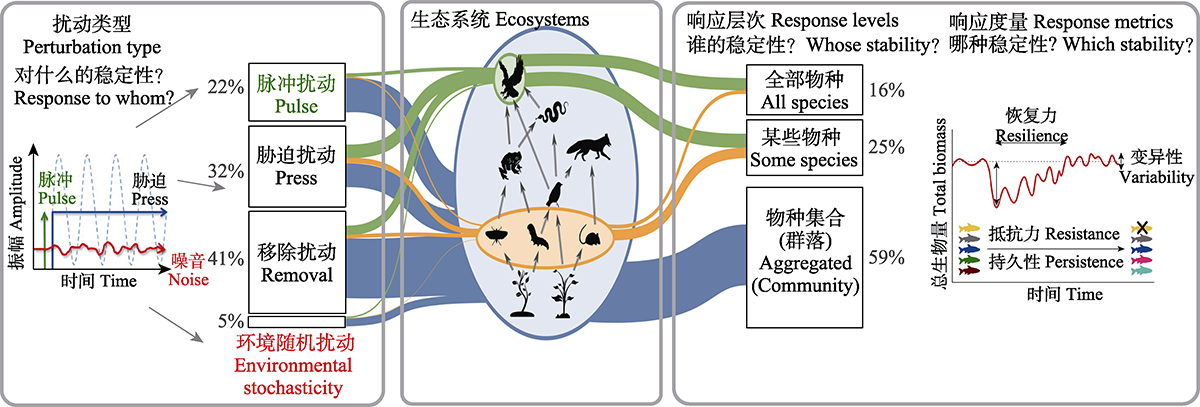
图1 评价生态系统稳定性需要确定扰动类型、生态系统、响应层次和响应度量。图上的百分比和不同颜色连接曲线的粗细表示在所引文献数据库中研究的数量比例(修改自Donohue et al., 2016; Kéfi et al., 2019)。
Fig. 1 Assessing stability in ecological systems requires identifying the perturbation type, ecosystem component, response level, and response metrics. The percentages and the width of the colored linking lines indicate the percentage of studies included in the references database (adapted from Donohue et al., 2016; Kéfi et al., 2019).
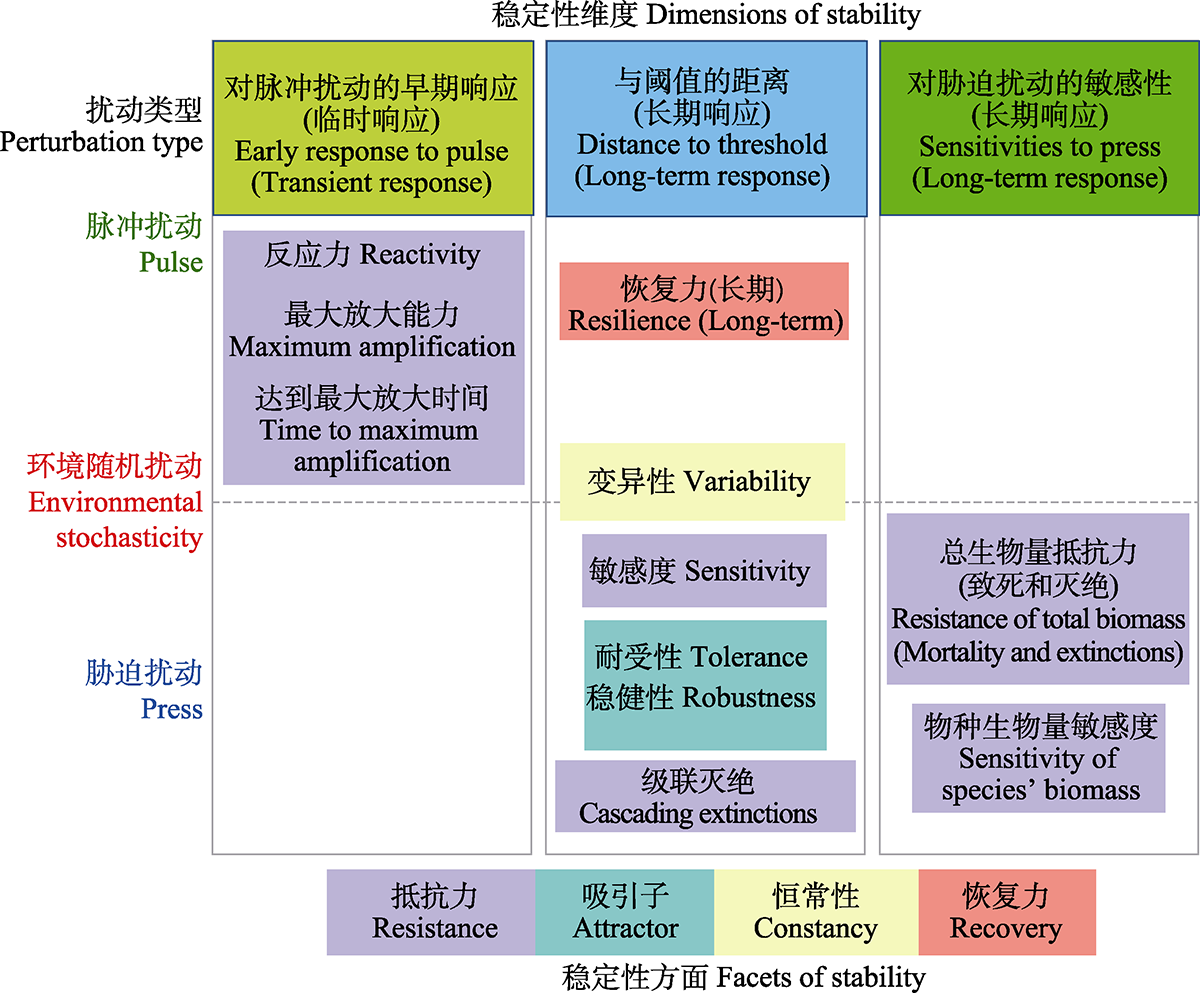
图2 稳定性的多维聚类度量及其与扰动类型的对应关系(修改自Domínguez-García et al., 2019)。
Fig. 2 Multidimensional clustering of stability and their correspondence with perturbation types (adapted from Domínguez-García et al., 2019).
| 稳定性指标 Stability metrics | 定义 Definition | 对应扰动形式 Perturbation type | 响应层次 Response level | 维度分类 Dimensionality |
|---|---|---|---|---|
| 抵抗力 Resistance | 系统抵抗扰动并使自身的结构和功能保持原状的能力。 The ability of the system to resist perturbations and keep its structure and function intact. | 胁迫扰动 Press | 物种、群落 Species, community | 对胁迫扰动的敏感性 Sensitivities to press |
| 恢复力 Resilience | 系统在遭到扰动因素的破坏以后恢复到原状的能力。 The ability of the system to return to its original state after being destroyed by perturbations. | 脉冲扰动 Pulse | 物种、群落 Species, community | 与阈值的距离 Distance to threshold |
| 持久性 Persistence | 在一定边界范围内, 系统保持恒定或维持某一特定状态的持续时间。 The duration of the system remains constant or maintains a certain state for the duration within a certain boundary. | 环境随机扰动 Environmental stochasticity | 群落 Community | 对胁迫扰动的敏感性 Sensitivities to press |
| 变异性 Variability | 系统随时间受扰动作用下产生的变化幅度。 The amplitude of change caused by perturbation in the system over time. | 环境随机扰动 Environmental stochasticity | 物种、群落 Species, community | 与阈值的距离 Distance to threshold |
| 反应力 Reactivity | 系统受外部扰动状态放大时的最大瞬时速率。 Maximum instantaneous rate at which perturbations can be amplified. | 脉冲扰动 Pulse | 群落 Community | 对脉冲扰动的早期响应 Early response to pulse |
| 最大放大能力 Maximum amplification | 系统受脉冲扰动后状态放大到最大幅度的能力。 The ability by which the perturbation that grows the largest is amplified after a pulse perturbation. | 脉冲扰动 Pulse | 群落 Community | 对脉冲扰动的早期响应 Early response to pulse |
| 达到最大放大的时间 Time to maximum amplification | 系统受脉冲扰动后状态达到最大放幅度的时间。 Time to achieve the maximum amplification after a pulse perturbation. | 脉冲扰动 Pulse | 群落 Community | 对脉冲扰动的早期响应 Early response to pulse |
| 敏感度 Sensitivity | 系统受胁迫扰动下物种生物量的平均变化范围。 Average change in the biomass of species after a press perturbation. | 胁迫扰动 Press | 物种、群落 Species, community | 与阈值的距离 Distance to threshold |
| 耐受性 Tolerance | 系统所有物种收到胁迫扰动下导致出现至少一个物种灭绝的全局或局部的最小致死增长量。 Minimum global increase in mortality that leads to at least one extinction under press perturbation. | 胁迫扰动 Press | 物种 Species | 与阈值的距离 Distance to threshold |
| 稳健性 Robustness | 将存活物种数量减少到原始数量的一半以下所需的主动灭绝的数量。 Number of actively performed extinctions required to reduce the number of surviving species to 50% of the original number. | 胁迫扰动 Press | 物种 Species | 与阈值的距离 Distance to threshold |
| 级联灭绝 Cascading extinctions | 首次灭绝后次生灭绝发生的平均数量。 Average number of secondary extinctions following first extinction. | 胁迫扰动 Press | 物种 Species | 与阈值的距离 Distance to threshold |
表1 稳定性主要的测度指标及其定义、对应扰动形式、响应层次和维度分类(图1, 图2)(修改自Domínguez-García et al., 2019)
Table 1 Major metrics of stability: definition, perturbation type, response level, and dimensionality (Fig. 1 and Fig. 2)(adapted from Domínguez-García et al., 2019).
| 稳定性指标 Stability metrics | 定义 Definition | 对应扰动形式 Perturbation type | 响应层次 Response level | 维度分类 Dimensionality |
|---|---|---|---|---|
| 抵抗力 Resistance | 系统抵抗扰动并使自身的结构和功能保持原状的能力。 The ability of the system to resist perturbations and keep its structure and function intact. | 胁迫扰动 Press | 物种、群落 Species, community | 对胁迫扰动的敏感性 Sensitivities to press |
| 恢复力 Resilience | 系统在遭到扰动因素的破坏以后恢复到原状的能力。 The ability of the system to return to its original state after being destroyed by perturbations. | 脉冲扰动 Pulse | 物种、群落 Species, community | 与阈值的距离 Distance to threshold |
| 持久性 Persistence | 在一定边界范围内, 系统保持恒定或维持某一特定状态的持续时间。 The duration of the system remains constant or maintains a certain state for the duration within a certain boundary. | 环境随机扰动 Environmental stochasticity | 群落 Community | 对胁迫扰动的敏感性 Sensitivities to press |
| 变异性 Variability | 系统随时间受扰动作用下产生的变化幅度。 The amplitude of change caused by perturbation in the system over time. | 环境随机扰动 Environmental stochasticity | 物种、群落 Species, community | 与阈值的距离 Distance to threshold |
| 反应力 Reactivity | 系统受外部扰动状态放大时的最大瞬时速率。 Maximum instantaneous rate at which perturbations can be amplified. | 脉冲扰动 Pulse | 群落 Community | 对脉冲扰动的早期响应 Early response to pulse |
| 最大放大能力 Maximum amplification | 系统受脉冲扰动后状态放大到最大幅度的能力。 The ability by which the perturbation that grows the largest is amplified after a pulse perturbation. | 脉冲扰动 Pulse | 群落 Community | 对脉冲扰动的早期响应 Early response to pulse |
| 达到最大放大的时间 Time to maximum amplification | 系统受脉冲扰动后状态达到最大放幅度的时间。 Time to achieve the maximum amplification after a pulse perturbation. | 脉冲扰动 Pulse | 群落 Community | 对脉冲扰动的早期响应 Early response to pulse |
| 敏感度 Sensitivity | 系统受胁迫扰动下物种生物量的平均变化范围。 Average change in the biomass of species after a press perturbation. | 胁迫扰动 Press | 物种、群落 Species, community | 与阈值的距离 Distance to threshold |
| 耐受性 Tolerance | 系统所有物种收到胁迫扰动下导致出现至少一个物种灭绝的全局或局部的最小致死增长量。 Minimum global increase in mortality that leads to at least one extinction under press perturbation. | 胁迫扰动 Press | 物种 Species | 与阈值的距离 Distance to threshold |
| 稳健性 Robustness | 将存活物种数量减少到原始数量的一半以下所需的主动灭绝的数量。 Number of actively performed extinctions required to reduce the number of surviving species to 50% of the original number. | 胁迫扰动 Press | 物种 Species | 与阈值的距离 Distance to threshold |
| 级联灭绝 Cascading extinctions | 首次灭绝后次生灭绝发生的平均数量。 Average number of secondary extinctions following first extinction. | 胁迫扰动 Press | 物种 Species | 与阈值的距离 Distance to threshold |
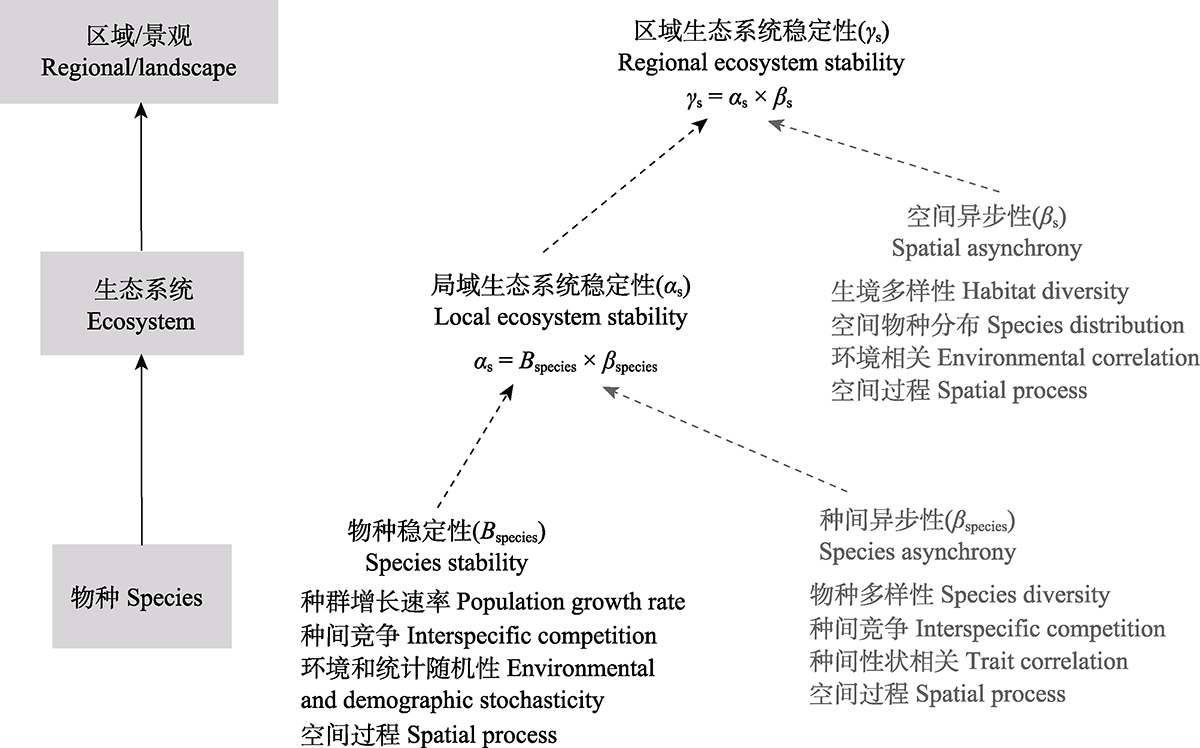
图3 不同尺度稳定性之间的内在关联。区域生态系统稳定性可以分解为局域稳定性和空间异步性的乘积, 局域稳定性可进一步分解为物种稳定性和种间异步性的乘积。不同生态学过程通过影响物种稳定性、种间异步性和空间异步性, 最终决定区域生态系统的稳定性(修改自Wang & Loreau, 2014)。
Fig. 3 Intrinsic links between stability at different scales. Regional ecosystem stability can be partitioned into the product of local ecosystem stability and spatial asynchrony, and local ecosystem stability can be further decomposed into the product of species stability and species asynchrony. Different ecological processes can influence the stability of regional ecosystems by affecting species stability, inter-species asynchrony, and spatial asynchrony (adapted from Wang & Loreau, 2014).
| [1] |
Arnoldi J-F, Loreau M, Haegeman B (2016). Resilience, reactivity and variability: a mathematical comparison of ecological stability measures. Journal of Theoretical Biology, 389, 47-59.
DOI PMID |
| [2] |
Arnoldi J-F, Loreau M, Haegeman B (2019). The inherent multidimensionality of temporal variability: How common and rare species shape stability patterns. Ecology Letters, 22, 1557-1567.
DOI URL |
| [3] |
Bai Y, Han X, Wu J, Chen Z, Li L (2004). Ecosystem stability and compensatory effects in the Inner Mongolia grassland. Nature, 431, 181-184.
DOI URL |
| [4] |
Brose U (2008). Complex food webs prevent competitive exclusion among producer species. Proceedings of the Royal Society B: Biological Sciences, 275, 2507-2514.
DOI URL |
| [5] |
Brose U, Williams RJ, Martinez ND (2006). Allometric scaling enhances stability in complex food webs. Ecology Letters, 9, 1228-1236.
DOI URL |
| [6] | Cadotte MW, Dinnage R, Tilman D (2012). Phylogenetic diversity promotes ecosystem stability. Ecology, 93, S223-S233. |
| [7] |
Cardinale BJ, Gross K, Fritschie K, Flombaum P, Fox JW, Rixen C, van Ruijven J, Reich PB, Scherer-Lorenzen M, Wilsey BJ (2013). Biodiversity simultaneously enhances the production and stability of community biomass, but the effects are independent. Ecology, 94, 1697-1707.
PMID |
| [8] |
Catano CP, Fristoe TS, LaManna JA, Myers JA (2020). Local species diversity, β-diversity and climate influence the regional stability of bird biomass across North America. Proceedings of the Royal Society B: Biological Sciences, 287, 20192520. DOI: 10.1098/rspb.2019.2520.
DOI URL |
| [9] | Craven D, Eisenhauer N, Pearse WD, Hautier Y, Roscher C, Isbell F, Connolly J, Ebeling A, Griffin J, Hines J, Jentsch A, Lemoine N, Meyer ST, van Ruijven J, Smith M, et al. (2018). Multiple facets of biodiversity drive the diversity- stability relationship. Nature Ecology & Evolution, 2, 1579-1587. |
| [10] |
de Boeck HJ, Bloor JMG, Kreyling J, Ransijn JCG, Nijs I, Jentsch A, Zeiter M (2018). Patterns and drivers of biodiversity-stability relationships under climate extremes. Journal of Ecology, 106, 890-902.
DOI URL |
| [11] |
de Laender F, Rohr JR, Ashauer R, Baird DJ, Berger U, Eisenhauer N, Grimm V, Hommen U, Maltby L, Meliàn CJ, Pomati F, Roessink I, Radchuk V, van den Brink PJ (2016). Reintroducing environmental change drivers in biodiversity-Ecosystem functioning research. Trends in Ecology & Evolution, 31, 905-915.
DOI URL |
| [12] |
de Mazancourt C, Isbell F, Larocque A, Berendse F, de Luca E, Grace JB, Haegeman B, Wayne Polley H, Roscher C, Schmid B, Tilman D, van Ruijven J, Weigelt A, Wilsey BJ, Loreau M (2013). Predicting ecosystem stability from community composition and biodiversity. Ecology Letters, 16, 617-625.
DOI PMID |
| [13] |
Dı́az S, Cabido M (2001). Vive la différence: plant functional diversity matters to ecosystem processes. Trends in Ecology & Evolution, 16, 646-655.
DOI URL |
| [14] |
Domínguez-García V, Dakos V, Kéfi S (2019). Unveiling dimensions of stability in complex ecological networks. Proceedings of the National Academy of Sciences of the United States of America, 116, 25714-25720.
DOI PMID |
| [15] |
Donohue I, Hillebrand H, Montoya JM, Petchey OL, Pimm SL, Fowler MS, Healy K, Jackson AL, Lurgi M, McClean D, O’Connor NE, O’Gorman EJ, Yang Q (2016). Navigating the complexity of ecological stability. Ecology Letters, 19, 1172-1185.
DOI PMID |
| [16] |
Donohue I, Petchey OL, Montoya JM, Jackson AL, McNally L, Viana M, Healy K, Lurgi M, O’Connor NE, Emmerson MC (2013). On the dimensionality of ecological stability. Ecology Letters, 16, 421-429.
DOI PMID |
| [17] |
Downing AL, Brown BL, Leibold MA (2014). Multiple diversity- stability mechanisms enhance population and community stability in aquatic food webs. Ecology, 95, 173-184.
PMID |
| [18] | Elton CS (1958). The Ecology of Invasions by Animals and Plants. Springer, Boston. |
| [19] | Gao D, He XH (2010). Research advances on biodiversity and ecosystem stability. Chinese Journal of Ecology, 29, 2507-2513. |
| [ 高东, 何霞红 (2010). 生物多样性与生态系统稳定性研究进展. 生态学杂志, 29, 2507-2513.] | |
| [20] |
Gonzalez A, Germain RM, Srivastava DS, Filotas E, Dee LE, Gravel D, Thompson PL, Isbell F, Wang SP, Kéfi S, Montoya J, Zelnik YR, Loreau M (2020). Scaling-up biodiversity-ecosystem functioning research. Ecology Letters, 23, 757-776.
DOI PMID |
| [21] |
Grimm V, Wissel C (1997). Babel, or the ecological stability discussions: an inventory and analysis of terminology and a guide for avoiding confusion. Oecologia, 109, 323-334.
DOI PMID |
| [22] |
Haegeman B, Arnoldi J-F, Wang S de Mazancourt C, Montoya JM, Loreau M (2016). Resilience, invariability, and ecological stability across levels of organization. bioRxiv, 85852. DOI: 10.1101/085852.
DOI |
| [23] |
Hallett LM, Stein C, Suding KN (2017). Functional diversity increases ecological stability in a grazed grassland. Oecologia, 183, 831-840.
DOI PMID |
| [24] |
Hautier Y, Seabloom EW, Borer ET, Adler PB, Harpole WS, Hillebrand H, Lind EM, MacDougall AS, Stevens CJ, Bakker JD, Buckley YM, Chu C, Collins SL, Daleo P, Damschen EI, et al. (2014). Eutrophication weakens stabilizing effects of diversity in natural grasslands. Nature, 508, 521-525.
DOI URL |
| [25] |
Hautier Y, Tilman D, Isbell F, Seabloom EW, Borer ET, Reich PB (2015). Plant ecology. Anthropogenic environmental changes affect ecosystem stability via biodiversity. Science, 348, 336-340.
DOI PMID |
| [26] |
He NP, Liu CC, Piao SL, Sack L, Xu L, Luo YQ, He JS, Han XG, Zhou GS, Zhou XH, Lin Y, Yu Q, Liu SR, Sun W, Niu SL, Li SG, Zhang JH, Yu GR (2019). Ecosystem traits linking functional traits to macroecology. Trends in Ecology & Evolution, 34, 200-210.
DOI URL |
| [27] |
Hector A, Hautier Y, Saner P, Wacker L, Bagchi R, Joshi J, Scherer-Lorenzen M, Spehn EM, Bazeley-White E, Weilenmann M, Caldeira MC, Dimitrakopoulos PG, Finn JA, Huss-Danell K, Jumpponen A, et al. (2010). General stabilizing effects of plant diversity on grassland productivity through population asynchrony and overyielding. Ecology, 91, 2213-2220.
PMID |
| [28] |
Hooper DU, Carol Adair E, Cardinale BJ, Byrnes JEK, Hungate BA, Matulich KL, Gonzalez A, Emmett Duffy J, Gamfeldt L, O’Connor MI (2012). A global synthesis reveals biodiversity loss as a major driver of ecosystem change. Nature, 486, 105-108.
DOI URL |
| [29] |
Houlahan JE, Currie DJ, Cottenie K, Cumming GS, Findlay CS, Fuhlendorf SD, Legendre P, Muldavin EH, Noble D, Russell R, Stevens RD, Willis TJ, Wondzell SM (2018). Negative relationships between species richness and temporal variability are common but weak in natural systems. Ecology, 99, 2592-2604.
DOI PMID |
| [30] |
Huang JH, Han XG (1995). Biodiversity and ecosystem stability. Biodiversity Science, 3, 31-37.
DOI URL |
| [ 黄建辉, 韩兴国 (1995). 生物多样性和生态系统稳定性. 生物多样性, 31-37.] | |
| [31] |
Isbell F, Craven D, Connolly J, Loreau M, Schmid B, Beierkuhnlein C, Bezemer TM, Bonin C, Bruelheide H de Luca E, Ebeling A, Griffin JN, Guo Q, Hautier Y, Hector A, et al. (2015). Biodiversity increases the resistance of ecosystem productivity to climate extremes. Nature, 526, 574-577.
DOI URL |
| [32] |
Ives AR, Carpenter SR (2007). Stability and diversity of ecosystems. Science, 317, 58-62.
DOI URL |
| [33] |
Ives AR, Gross K, Klug JL (1999). Stability and variability in competitive communities. Science, 286, 542-544.
PMID |
| [34] |
Ives AR, Hughes JB (2002). General relationships between species diversity and stability in competitive systems. The American Naturalist, 159, 388-395.
DOI URL |
| [35] |
Jacquet C, Moritz C, Morissette L, Legagneux P, Massol F, Archambault P, Gravel D (2016). No complexity-stability relationship in empirical ecosystems. Nature Communications, 7, 12573. DOI: 10.1038/ncomms12573.
DOI PMID |
| [36] |
Jiang L, Joshi H, Patel SN (2009). Predation alters relationships between biodiversity and temporal stability. The American Naturalist, 173, 389-399.
DOI PMID |
| [37] |
Jiang L, Pu Z (2009). Different effects of species diversity on temporal stability in single-trophic and multitrophic communities. The American Naturalist, 174, 651-659.
DOI PMID |
| [38] |
Jørgensen SE, Nielsen SN (2013). The properties of the ecological hierarchy and their application as ecological indicators. Ecological Indicators, 28, 48-53.
DOI URL |
| [39] |
Kéfi S, Domínguez-García V, Donohue I, Fontaine C, Thébault E, Dakos V (2019). Advancing our understanding of ecological stability. Ecology Letters, 22, 1349-1356.
DOI URL |
| [40] |
Krause S, Le Roux X, Niklaus PA, van Bodegom PM, Lennon JT, Bertilsson S, Grossart H-P, Philippot L, Bodelier PLE (2014). Trait-based approaches for understanding microbial biodiversity and ecosystem functioning. Frontiers in Microbiology, 5, 251. DOI: 10.3389/fmicb.2014.00251.
DOI |
| [41] |
Lamy T, Wang S, Renard D, Lafferty KD, Reed DC, Miller RJ (2019). Species insurance trumps spatial insurance in stabilizing biomass of a marine macroalgal metacommunity. The Bulletin of the Ecological Society of America, 100, e01557. DOI: 10.1002/bes2.1557.
DOI |
| [42] | Liu XW, Zhou HC, Li P, Peng SL (2004). A conceptual analysis of ecosystem stability. Acta Ecologica Sinica, 24, 2635-2640. |
| [ 柳新伟, 周厚诚, 李萍, 彭少麟 (2004). 生态系统稳定性定义剖析. 生态学报, 24, 2635-2640.] | |
| [43] | Liu ZW, Li YS (1997). History and status of research of ecosystem stability. Chinese Journal of Ecology, 16, 58-61. |
| [ 刘增文, 李雅素 (1997). 生态系统稳定性研究的历史与现状. 生态学杂志, 16, 58-61.] | |
| [44] |
Loreau M (2010). Linking biodiversity and ecosystems: towards a unifying ecological theory. Philosophical Transactions of the Royal Society B: Biological Sciences, 365, 49-60.
DOI URL |
| [45] |
Loreau M de Mazancourt C (2013). Biodiversity and ecosystem stability: a synthesis of underlying mechanisms. Ecology Letters, 16, 106-115.
DOI URL |
| [46] | Ma FY (2002). Research advances on ecosystem stability. Journal of Desert Research, 22, 401-407. |
| [ 马风云 (2002). 生态系统稳定性若干问题研究评述. 中国沙漠, 22, 401-407.] | |
| [47] |
MacArthur R (1955). Fluctuations of animal populations and a measure of community stability. Ecology, 36, 533-536.
DOI URL |
| [48] | Manning P, Loos J, Barnes AD, Batáry P, Bianchi FJJA, Buchmanni N de Deyn GB, Ebeling A, Eisenhauer N, Fischer M, Fründ J, Grass I, Isselstein J, Jochum M, Klein AM, et al. (2019). Transferring biodiversity-ecosystem function research to the management of “real-world” ecosystems//Eisenhauer N, Bohan DA, Dumbrell AJ. Mechanisms Underlying the Relationship Between Biodiversity and Ecosystem Function. Academic Press, London. 323-356. |
| [49] |
Mason NWH, Mouillot D, Lee WG, Wilson JB (2005). Functional richness, functional evenness and functional divergence: the primary components of functional diversity. Oikos, 111, 112-118.
DOI URL |
| [50] | May RM (1973). Stability and Complexity in Model Ecosystems. Princeton University Press, Princeton. |
| [51] |
Mazzochini GG, Fonseca CR, Costa GC, Santos RM, Oliveira-Filho AT, Ganade G (2019). Plant phylogenetic diversity stabilizes large-scale ecosystem productivity. Global Ecology and Biogeography, 28, 1430-1439.
DOI |
| [52] |
McCann K, Hastings A, Huxel GR (1998). Weak trophic interactions and the balance of nature. Nature, 395, 794-798.
DOI URL |
| [53] |
McCann KS (2000). The diversity-stability debate. Nature, 405, 228-233.
DOI URL |
| [54] | Mehrabi Z, Ramankutty N (2019). Synchronized failure of global crop production. Nature Ecology & Evolution, 3, 780-786. |
| [55] | Odum EP (1953). Fundamentals of Ecology. Saunders, Philadelphia, USA. |
| [56] |
Pennekamp F, Pontarp M, Tabi A, Altermatt F, Alther R, Choffat Y, Fronhofer EA, Ganesanandamoorthy P, Garnier A, Griffiths JI, Greene S, Horgan K, Massie TM, Mächler E, Palamara GM, Seymour M, Petchey OL (2018). Biodiversity increases and decreases ecosystem stability. Nature, 563, 109-112.
DOI URL |
| [57] |
Pimm SL (1984). The complexity and stability of ecosystems. Nature, 307, 321-326.
DOI URL |
| [58] |
Pu Z, Daya P, Tan J, Jiang L (2014). Phylogenetic diversity stabilizes community biomass. Journal of Plant Ecology, 7, 176-187.
DOI URL |
| [59] |
Radchuk V de Laender F, Cabral JS, Boulangeat I, Crawford M, Bohn F, de Raedt J, Scherer C, Svenning J-C, Thonicke K, Schurr FM, Grimm V, Kramer-Schadt S (2019). The dimensionality of stability depends on disturbance type. Ecology Letters, 22, 674-684.
DOI URL |
| [60] |
Thébault E, Fontaine C (2010). Stability of ecological communities and the architecture of mutualistic and trophic networks. Science, 329, 853-856.
DOI PMID |
| [61] |
Thibaut LM, Connolly SR (2013). Understanding diversity- stability relationships: towards a unified model of portfolio effects. Ecology Letters, 16, 140-150.
DOI PMID |
| [62] | Tilman D (1999). The ecological consequences of changes in biodiversity: a search for general principles. Ecology, 80, 1455-1474. |
| [63] |
Tilman D, Isbell F, Cowles JM (2014). Biodiversity and ecosystem functioning. Annual Review of Ecology, Evolution, and Systematics, 45, 471-493.
DOI URL |
| [64] |
Tilman D, Reich PB, Isbell F (2012). Biodiversity impacts ecosystem productivity as much as resources, disturbance, or herbivory. Proceedings of the National Academy of Sciences of the United States of America, 109, 10394-10397.
DOI PMID |
| [65] |
Tilman D, Reich PB, Knops JMH (2006). Biodiversity and ecosystem stability in a decade-long grassland experiment. Nature, 441, 629-632.
DOI URL |
| [66] |
Tredennick AT, Adler PB, Adler FR (2017). The relationship between species richness and ecosystem variability is shaped by the mechanism of coexistence. Ecology Letters, 20, 958-968.
DOI PMID |
| [67] |
Wang GH (2002). Further thoughts on diversity and stability in ecosystems. Biodiversity Science, 10, 126-134.
DOI URL |
|
[ 王国宏 (2002). 再论生物多样性与生态系统的稳定性. 生物多样性, 10, 126-134.]
DOI |
|
| [68] |
Wang S, Lamy T, Hallett LM, Loreau M (2019). Stability and synchrony across ecological hierarchies in heterogeneous metacommunities: linking theory to data. Ecography, 42, 1200-1211.
DOI URL |
| [69] |
Wang S, Loreau M (2014). Ecosystem stability in space: α, β and γ variability. Ecology Letters, 17, 891-901.
DOI URL |
| [70] |
Wang S, Loreau M (2016). Biodiversity and ecosystem stability across scales in metacommunities. Ecology Letters, 19, 510-518.
DOI URL |
| [71] |
Wang S, Loreau M, Arnoldi J-F, Fang J, Rahman KA, Tao S, de Mazancourt C (2017). An invariability-area relationship sheds new light on the spatial scaling of ecological stability. Nature Communications, 8, 15211. DOI: 10.1038/ ncomms15211.
DOI URL |
| [72] |
Wilcox KR, Tredennick AT, Koerner SE, Grman E, Hallett LM, Avolio ML, La Pierre KJ, Houseman GR, Isbell F, Johnson DS, Alatalo JM, Baldwin AH, Bork EW, Boughton EH, Bowman WD, et al. (2017). Asynchrony among local communities stabilises ecosystem function of metacommunities. Ecology Letters, 20, 1534-1545.
DOI PMID |
| [73] |
Xu GH, Li XY, Shi CH (2019). The complexity-stability relationship: progress in mathematical models. Biodiversity Science, 27, 1364-1378.
DOI URL |
|
[ 徐光华, 李小玉, 施春华 (2019). 复杂性-稳定性研究: 数学模型的进展. 生物多样性, 27, 1364-1378.]
DOI |
|
| [74] |
Yachi S, Loreau M (1999). Biodiversity and ecosystem productivity in a fluctuating environment: the insurance hypothesis. Proceedings of the National Academy of Sciences of the United States of America, 96, 1463-1468.
PMID |
| [75] |
Yeager ME, Gouhier TC, Hughes AR (2020). Predicting the stability of multitrophic communities in a variable world. Ecology, 101, e02992. DOI: 10.1002/ecy.2992.
DOI |
| [76] |
Yu Q, Chen Q, Elser JJ, He N, Wu H, Zhang G, Wu J, Bai Y, Han X (2010). Linking stoichiometric homoeostasis with ecosystem structure, functioning and stability. Ecology Letters, 13, 1390-1399.
DOI URL |
| [77] |
Yuan Z, Ali A, Wang S, Wang X, Lin F, Wang Y, Fang S, Hao Z, Loreau M, Jiang L (2019). Temporal stability of aboveground biomass is governed by species asynchrony in temperate forests. Ecological Indicators, 107, 105661. DOI: 10.1016/j.ecolind.2019.105661.
DOI URL |
| [78] | Zhang JH, Huang YM (2016). Biodiversity and stability mechanisms: understanding and future research. Acta Ecologica Sinica, 36, 3859-3870. |
| [ 张景慧, 黄永梅 (2016). 生物多样性与稳定性机制研究进展. 生态学报, 36, 3859-3870.] | |
| [79] |
Zhang L, Thygesen UH, Knudsen K, Andersen KH (2013). Trait diversity promotes stability of community dynamics. Theoretical Ecology, 6, 57-69.
DOI URL |
| [80] |
Zhang Y, Feng J, Loreau M, He N, Han X, Jiang L (2019). Nitrogen addition does not reduce the role of spatial asynchrony in stabilising grassland communities. Ecology Letters, 22, 563-571.
DOI URL |
| [81] |
Zhao N, Weng ZW, Shao X, Wang K (2016). Diversity components and assembly patterns of plant functional traits determine community spatial stability under resource gradients in a desert steppe. The Rangeland Journal, 38, 511-521.
DOI URL |
| [82] |
Zhao Q, van den Brink PJ, Carpentier C, Wang YXG, Rodríguez-Sánchez P, Xu C, Vollbrecht S, Gillissen F, Vollebregt M, Wang SP, de Laender F (2019). Horizontal and vertical diversity jointly shape food web stability against small and large perturbations. Ecology Letters, 22, 1152-1162.
DOI URL |
| [1] | 马建辉, 童鑫, 张思榕, 毛子昆, 秦俊, 马克平. 菌根真菌生理生态功能研究进展及展望[J]. 植物生态学报, 2026, 50(3): 498-514. |
| [2] | 江康威, 吕程, 王亚菲, 李宏, 张芷晴, 王雨, 张青青, 吐尔逊娜依•热依木. 放牧干扰下丛枝菌根真菌群落对土壤多功能性的影响[J]. 植物生态学报, 2026, 50(3): 685-699. |
| [3] | 范亚冉, 夏少攀, 于冰冰, 朱紫琪, 杨威, 范豫川, 刘晓雨, 张旭辉, 郑聚锋. 大气CO2浓度升高和增温对土壤有机碳库积累、分子组成和结构稳定性的影响[J]. 植物生态学报, 2025, 49(7): 1053-1069. |
| [4] | 王尧, 王耀彬, 陈子彦, 伊如汉, 白永飞, 赵玉金, 金晶炜. 连续干旱对蒙古高原草地恢复力和抵抗力的影响[J]. 植物生态学报, 2025, 49(7): 1070-1081. |
| [5] | 马富龙, 王雨晴, 郝瑜, 段继超, 刘霏霏, 席琳乔, 韩路. 海拔梯度对昆仑山北坡中部草原植物与土壤微生物群落结构与多样性的影响[J]. 植物生态学报, 2025, 49(5): 732-747. |
| [6] | 李冬梅, 孙龙, 韩宇, 胡同欣, 杨光, 蔡慧颖. 计划火烧对红松人工林生物多样性与生态系统多功能性关系的影响[J]. 植物生态学报, 2025, 49(3): 379-392. |
| [7] | 刘柯言, 韩璐, 宋午椰, 张初蕊, 胡旭, 许行, 陈立欣. 基于日光诱导叶绿素荧光探测干旱对黄土高原植被光合稳定性的影响[J]. 植物生态学报, 2025, 49(3): 415-431. |
| [8] | 吴闫宁, 郝珉辉, 何怀江, 张春雨, 赵秀海. 长白山森林功能多样性与地上碳汇功能的关系及其随演替的变化[J]. 植物生态学报, 2025, 49(2): 232-243. |
| [9] | 邱丹妮, 彭清清, 张慧玲, 温辉辉, 吴福忠. 中亚热带常绿阔叶林典型乔木树种对蚂蚁群落季节性动态的影响[J]. 植物生态学报, 2025, 49(11): 1805-1816. |
| [10] | 胡同欣, 石林, 窦旭, 于澄, 韩宇, 孙龙. 林火对兴安落叶松根际与非根际土壤微生物群落的影响[J]. 植物生态学报, 2025, 49(10): 1755-1766. |
| [11] | 高雨轩, 苏艳军, 冯育才, 张军, 汪小全, 刘玲莉. 珍稀濒危孑遗植物银杉的研究与保护现状[J]. 植物生态学报, 2025, 49(10): 1572-1582. |
| [12] | 李利平, 余堃, 陈芳淼, 陈强, 景雨航, 牛振国, 胡辰璐, 覃海宁, 黄慧萍, 田亦陈. 基于IUCN全球评估数据的中国高等植物红色名录指数[J]. 植物生态学报, 2025, 49(10): 1612-1625. |
| [13] | 郑立媛, 徐茜竹, 尹嘉淇, 孙小雯, 王艳. 城郊近河退耕地野大豆群落生态位和种间联结[J]. 植物生态学报, 2025, 49(10): 1685-1697. |
| [14] | 贺艺, 周静, 陈宸, 房庭舟, 苏剑, 高浩杰, 曹嘉浩, 杨飞宇, 范淇博, 朱乐瑶, 陈薏名, 杨飞, 王毅腾, 冯雷, 刘飞, 梁爽, 蒋明凯, 陈军, 赵云鹏, 陈伟乐, 赵颖, 黄建国. 浙江海岛濒危树种的保护与恢复[J]. 植物生态学报, 2025, 49(10): 1583-1599. |
| [15] | 马煦晗, 黄菊莹, 余海龙, 韩翠, 李冰. 降水量变化及氮添加下荒漠草原土壤有机碳及其易分解组分研究[J]. 植物生态学报, 2024, 48(8): 1065-1077. |
| 阅读次数 | ||||||
|
全文 |
|
|||||
|
摘要 |
|
|||||
Copyright © 2026 版权所有 《植物生态学报》编辑部
地址: 北京香山南辛村20号, 邮编: 100093
Tel.: 010-62836134, 62836138; Fax: 010-82599431; E-mail: apes@ibcas.ac.cn, cjpe@ibcas.ac.cn
备案号: 京ICP备16067583号-19

