
植物生态学报 ›› 2026, Vol. 50 ›› Issue (2): 344-351.DOI: 10.17521/cjpe.2024.0373 cstr: 32100.14.cjpe.2024.0373
王蓉钧1, 吴福忠1,2,3, 吴秋霞1, 朱晶晶1, 倪祥银1,2,3,*( )
)
收稿日期:2024-10-21
接受日期:2025-01-27
出版日期:2026-02-28
发布日期:2026-04-01
通讯作者:
*倪祥银(nixy@fjnu.edu.cn)基金资助:
WANG Rong-Jun1, WU Fu-Zhong1,2,3, WU Qiu-Xia1, ZHU Jing-Jing1, NI Xiang-Yin1,2,3,*()
Received:2024-10-21
Accepted:2025-01-27
Online:2026-02-28
Published:2026-04-01
Contact:
*NI Xiang-Yin (nixy@fjnu.edu.cn)Supported by:摘要:
植物叶片对氮的重吸收能够降低凋落物分解后根系对土壤氮的依赖程度, 但叶片氮重吸收效率是否受叶片初始氮含量、土壤氮含量的调控并不明晰, 这种关系在不同生活型的植物之间是否存在差异也不清楚。该研究沿中国热带亚热带森林样带采集了92种常见木本植物新鲜叶和衰老叶, 进一步整理了全球已发表的54篇相关文献数据, 分析了不同生活型植物叶片氮重吸收效率及其与叶片初始氮含量和土壤氮含量的关系。结果发现: 1)在热带亚热带森林样带和全球尺度上, 常绿木本与落叶木本植物叶片氮重吸收效率无显著差异, 被子植物和裸子植物也无显著差异; 在全球尺度上, 乔木叶片氮重吸收效率显著高于灌木; 外生菌根木本植物叶片氮重吸收效率显著高于丛枝菌根木本植物。2)常绿木本植物、乔木和灌木叶片氮重吸收效率均与叶片初始氮含量显著相关, 被子植物与裸子植物、丛枝菌根与外生菌根木本植物则与叶片初始氮含量无显著相关性。3)常绿木本植物、被子植物和丛枝菌根木本植物叶片氮重吸收效率与土壤氮含量显著相关, 落叶木本植物、裸子植物和外生菌根木本植物则与土壤氮含量无显著相关性。这些结果表明, 植物叶片氮重吸收效率在不同生活型之间存在差异, 这种差异主要受养分获取策略的影响, 这对于揭示不同生活型植物差异化的养分利用策略具有重要意义。
王蓉钧, 吴福忠, 吴秋霞, 朱晶晶, 倪祥银. 不同生活型植物叶片氮重吸收效率的差异. 植物生态学报, 2026, 50(2): 344-351. DOI: 10.17521/cjpe.2024.0373
WANG Rong-Jun, WU Fu-Zhong, WU Qiu-Xia, ZHU Jing-Jing, NI Xiang-Yin. Differences in leaf nitrogen reabsorption efficiency among plants with different life forms. Chinese Journal of Plant Ecology, 2026, 50(2): 344-351. DOI: 10.17521/cjpe.2024.0373
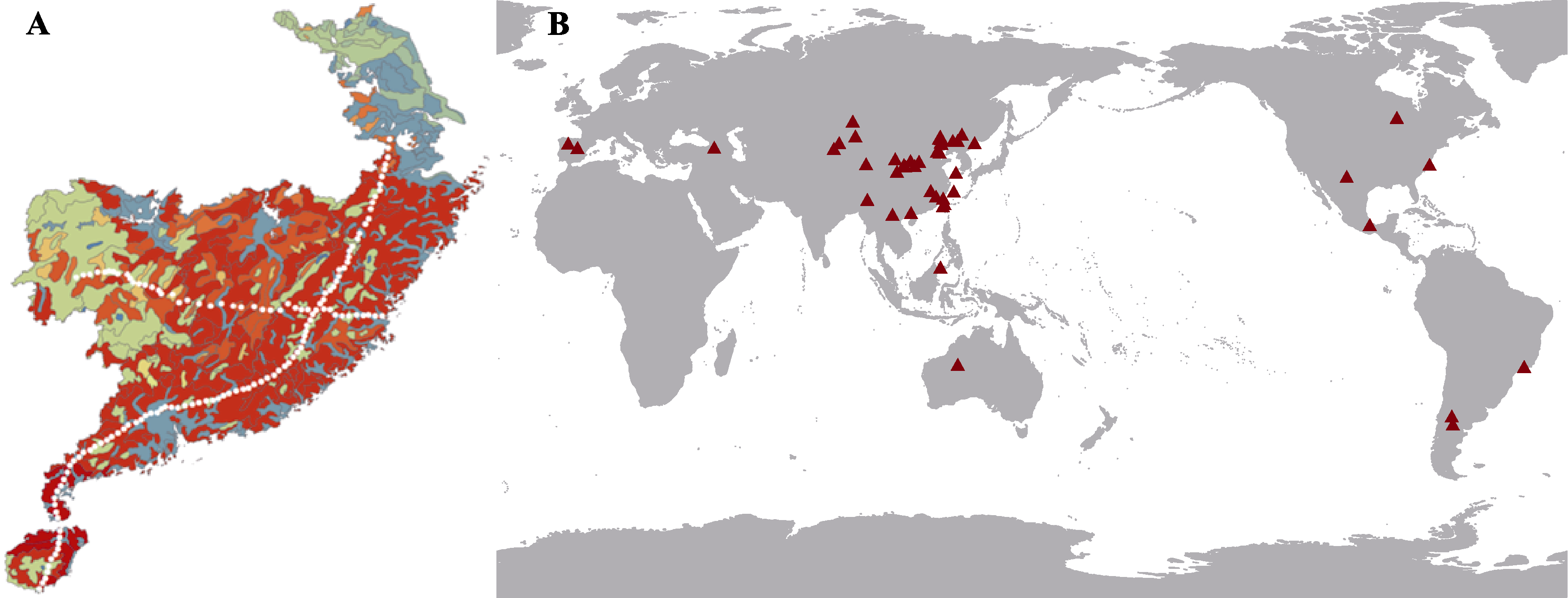
图1 热带亚热带森林、全球植物叶片氮重吸收效率研究地点的地理分布。A, 热带亚热带森林样带。其中红色区域为铁铝土分布区。B, 全球数据集。
Fig. 1 Distribution of sampling plots of studied sites for nitrogen reabsorption efficiency in leaves of tropical and subtropical forest transect in southern China and global plant. A, Tropical and subtropical forest transect in southern China, with read areas representing Ferralsols. B, Global dataset of leaf nitrogen reabsorption.
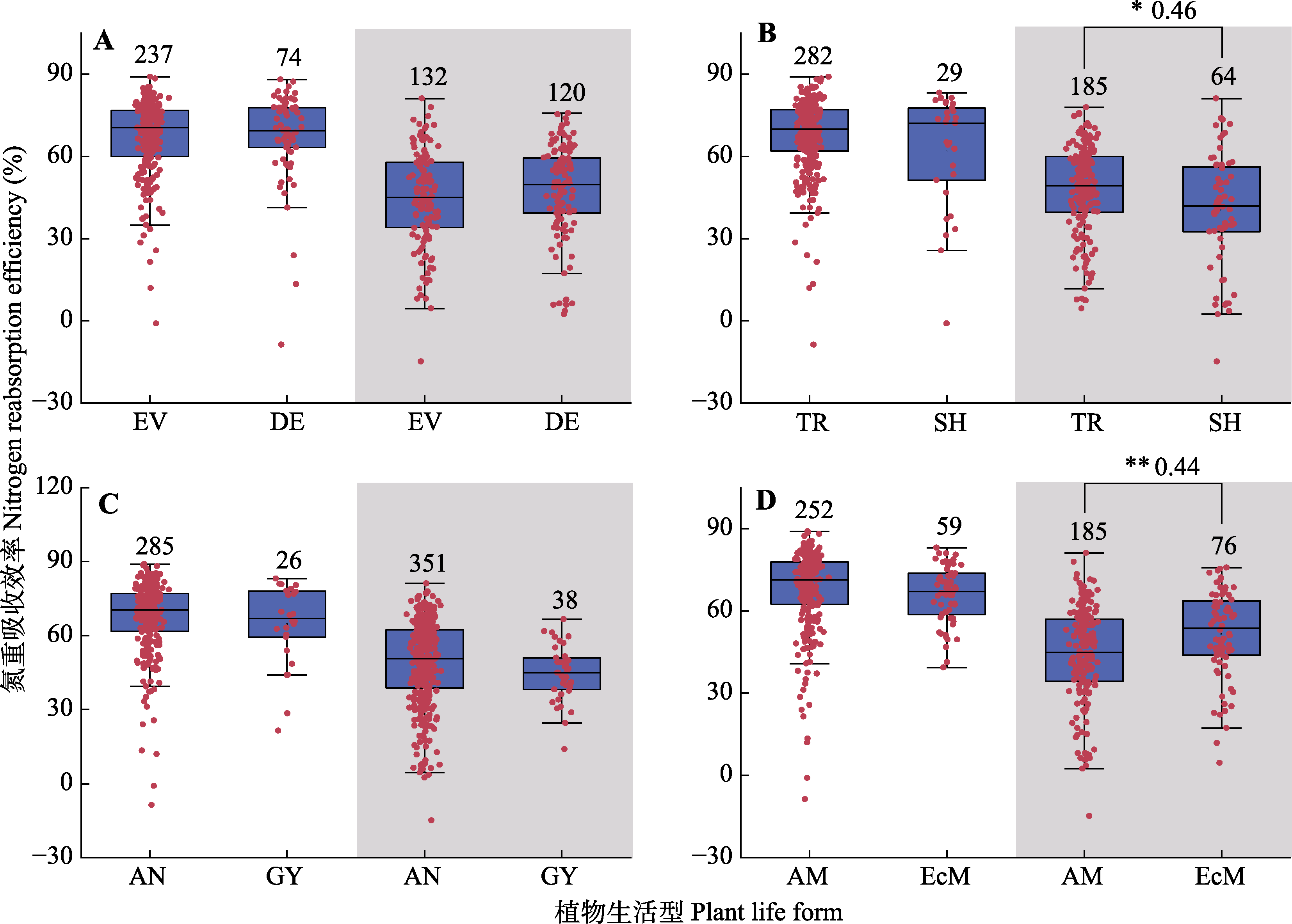
图2 不同生活型的植物叶片氮重吸收效率。AM, 丛枝菌根木本植物; AN, 被子植物; DE, 落叶木本植物; EcM, 外生菌根木本植物; EV, 常绿木本植物; GY, 裸子植物; SH, 灌木; TR, 乔木。无阴影部分表示热带亚热带森林的数据, 阴影部分表示全球尺度的数据。数值为中位数和25%置信区间。星号表示基于秩和检验的不同生活型植物之间差异显著(*, p < 0.05; **, p < 0.01)。星号旁的数字表示Cohen’s D值。数字表示样本量。
Fig. 2 Nitrogen reabsorption efficiency in plants with different life forms. AM, arbuscular mycorrhizal tree species; AN, angiosperms; DE, deciduous tree species; EcM, ectomycorrhizal tree species; EV, evergreen tree species; GY, gymnosperms; SH, shrubs; TR, trees. The unshaded and shaded areas show data collected from tropical and subtropical forest transect and global dataset, respectively. The boxplots show the median (center line) and interquartile ranges (box). Asterisks denote significant differences between plants with different life forms based on the Wilcoxon rank-sum test (*, p < 0.05; **, p < 0.01). The number next to the asterisk indicates the Cohen’s D value. The numbers denote sample sizes.
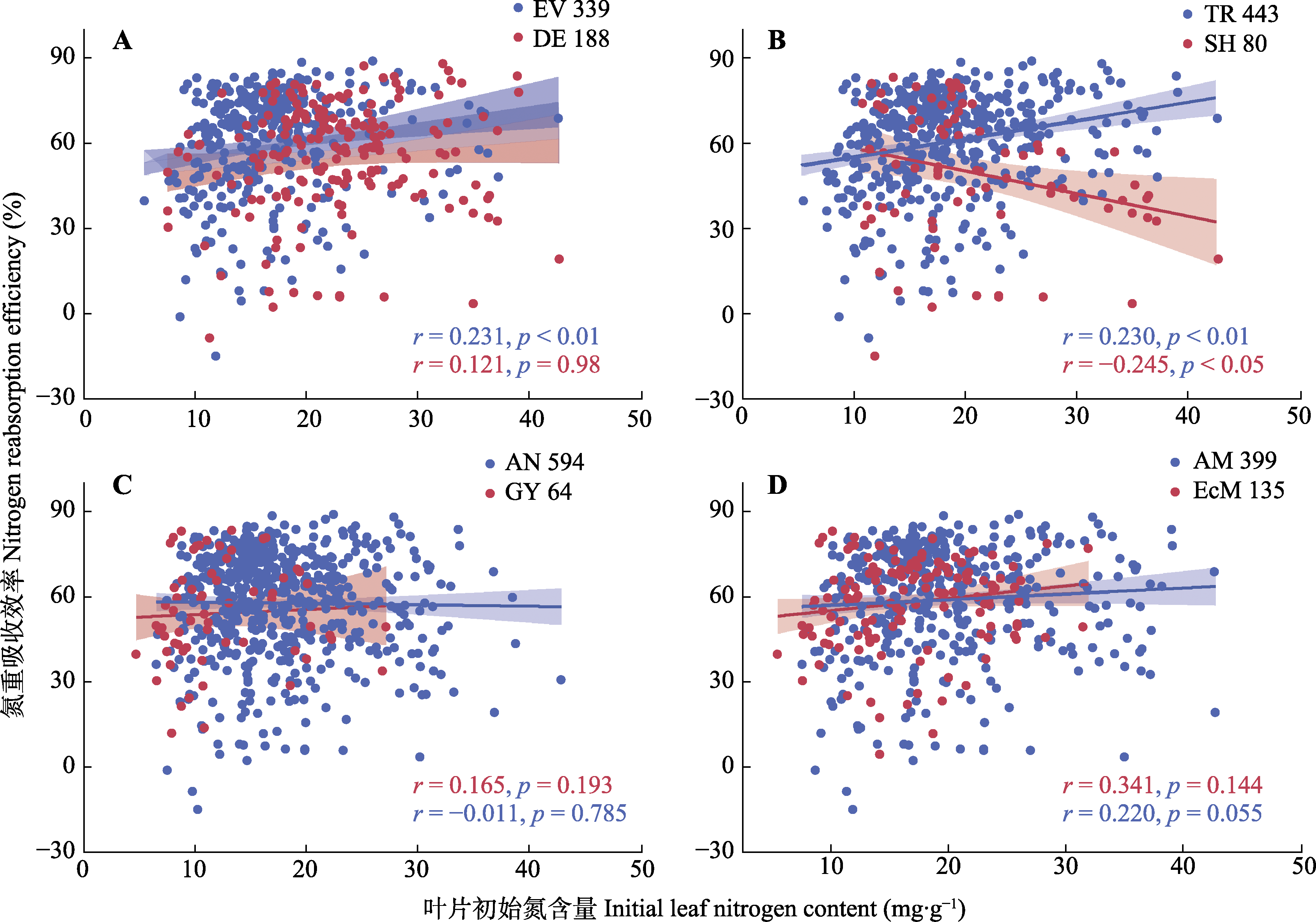
图3 不同生活型的植物叶片氮重吸收效率与叶片初始氮含量的关系。AM, 丛枝菌根木本植物; AN, 被子植物; DE, 落叶木本植物; EcM, 外生菌根木本植物; EV, 常绿木本植物; GY, 裸子植物; SH, 灌木; TR, 乔木。拟合线表示基于线性混合模型的斜率(r), 阴影部分表示95%置信区间。数字表示样本量。数据来自热带亚热带森林样带和全球数据集。
Fig. 3 Correlations between nitrogen reabsorption efficiency and initial nitrogen content in fresh leaves. AM, arbuscular mycorrhizal tree species; AN, angiosperms; DE, deciduous tree species; EcM, ectomycorrhizal tree species; EV, evergreen tree species; GY, gymnosperms; SH, shrubs; TR, trees. The fitted lines represent slopes from linear mixed effect models with 95% confidence intervals (shaded). The numbers denote sample sizes. The data are derived from tropical and subtropical forest transects and a global dataset.
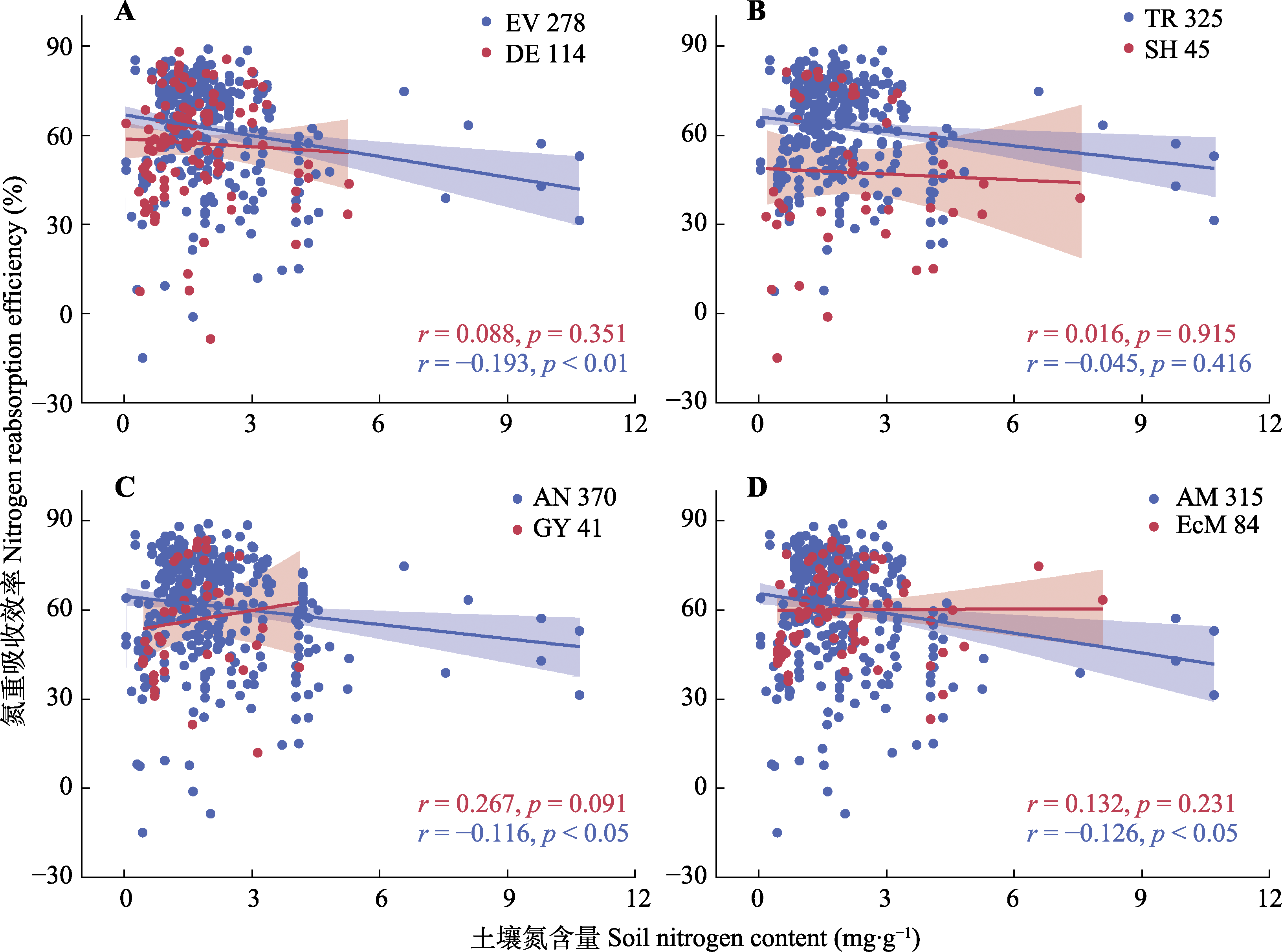
图4 不同生活型的植物叶片氮重吸收效率与土壤氮含量的关系。AM, 丛枝菌根木本植物; AN, 被子植物; DE, 落叶木本植物; EcM, 外生菌根木本植物; EV, 常绿木本植物; GY, 裸子植物; SH, 灌木; TR, 乔木。拟合线表示基于线性混合模型的斜率(r), 阴影部分表示95%置信区间。数字表示样本量。数据来自热带亚热带森林样带和全球数据集。
Fig. 4 Correlations between nitrogen reabsorption efficiency and soil nitrogen content. AM, arbuscular mycorrhizal tree species; AN, angiosperms; DE, deciduous tree species; EcM, ectomycorrhizal tree species; EV, evergreen tree species; GY, gymnosperms; SH, shrubs; TR, trees. The fitted lines represent slopes from linear mixed effect models with 95% confidence intervals (shaded). The numbers denote sample sizes. The data are derived from tropical and subtropical forest transects and a global dataset.
| [1] |
Achat DL, Pousse N, Nicolas M, Augusto L (2018). Nutrient remobilization in tree foliage as affected by soil nutrients and leaf life span. Ecological Monographs, 88, 408-428.
DOI URL |
| [2] |
Aerts R (1996). Nutrient resorption from senescing leaves of perennials: Are there general patterns. Journal of Ecology, 84, 597-608.
DOI URL |
| [3] |
Brant AN, Chen HYH (2015). Patterns and mechanisms of nutrient resorption in plants. Critical Reviews in Plant Sciences, 34, 471-486.
DOI URL |
| [4] |
Brundrett MC, Tedersoo L (2018). Evolutionary history of mycorrhizal symbioses and global host plant diversity. New Phytologist, 220, 1108-1115.
DOI PMID |
| [5] | Chapin III FS (1980). The mineral nutrition of wild plants. Annual Review of Ecology, Evolution, and Systematics, 11, 233-260. |
| [6] |
Cleveland CC, Houlton BZ, Smith WK, Marklein AR, Reed SC, Parton WJ, Del Grosso SJ, Running SW (2013). Patterns of new versus recycled primary production in the terrestrial biosphere. Proceedings of the National Academy of Sciences of the United States of America, 110, 12733-12737.
DOI PMID |
| [7] | Deng MF, Liu LL, Jiang L, Liu WX, Wang X, Li SP, Yang SP, Wang B (2018). Ecosystem scale trade-off in nitrogen acquisition pathways. Nature Ecology & Evolution, 2, 1724-1734. |
| [8] |
Drenovsky RE, Pietrasiak N, Short TH (2019). Global temporal patterns in plant nutrient resorption plasticity. Global Ecology and Biogeography, 28, 728-743.
DOI |
| [9] |
Du E, Terrer C, Pellegrini AFA, Ahlström A, van Lissa CJ, Zhao X, Xia N, Wu X, Jackson RB (2020). Global patterns of terrestrial nitrogen and phosphorus limitation. Nature Geoscience, 13, 221-226.
DOI |
| [10] |
Eckstein RL, Karlsson PS, Weih M (1999). Leaf life span and nutrient resorption as determinants of plant nutrient conservation in temperate-arctic regions. New Phytologist, 143, 177-189.
DOI URL |
| [11] |
Elser JJ, Bracken MES, Cleland EE, Gruner DS, Stanley Harpole W, Hillebrand H, Ngai JT, Seabloom EW, Shurin JB, Smith JE (2007). Global analysis of nitrogen and phosphorus limitation of primary producers in freshwater, marine and terrestrial ecosystems. Ecology Letters, 10, 1135-1142.
DOI PMID |
| [12] |
Freschet GT, Cornelissen JHC, van Logtestijn RSP, Aerts R (2010). Substantial nutrient resorption from leaves, stems and roots in a subarctic flora: What is the link with other resource economics traits. New Phytologist, 186, 879-889.
DOI URL |
| [13] |
Gerdol R, Iacumin P, Brancaleoni L (2019). Differential effects of soil chemistry on the foliar resorption of nitrogen and phosphorus across altitudinal gradients. Functional Ecology, 33, 1351-1361.
DOI URL |
| [14] | Guo JF, Yang YS, Chen GS, Lin P, Xie JS (2006). A review on decomposition in forest ecosystem. Scientia Silvae Sinicae, 42(4), 93-100. |
| [郭剑芬, 杨玉盛, 陈光水, 林鹏, 谢锦升 (2006). 森林凋落物分解研究进展. 林业科学, 42(4), 93-100.] | |
| [15] | Guo LL, Deng MF, Li XF, Schmid B, Huang JS, Wu YT, Peng ZY, Yang L, Liu LL (2024). Evolutionary and ecological forces shape nutrient strategies of mycorrhizal woody plants. Ecology Letters, 27, e14330. DOI: 10.1111/ele.14330. |
| [16] |
He XH, Critchley C, Bledsoe C (2003). Nitrogen transfer within and between plants through common mycorrhizal networks (CMNs). Critical Reviews in Plant Sciences, 22, 531-567.
DOI URL |
| [17] |
Kobe RK, Lepczyk CA, Iyer M (2005). Resorption efficiency decreases with increasing green leaf nutrients in a global data set. Ecology, 86, 2780-2792.
DOI URL |
| [18] |
Kull O, Kruijt B (1999). Acclimation of photosynthesis to light: a mechanistic approach. Functional Ecology, 13, 24-36.
DOI URL |
| [19] | Li FP, Qing T, Wu FZ, Yue K, Zhu JJ, Ni XY (2024). Trade-off in the partitioning of recent photosynthate carbon under global change. Global Change Biology, 30, e17110. DOI: 10.1111/gcb.17110. |
| [20] |
Liu B, Gao DC, Chang Q, Liu ZP, Fan XL, Meng D, Bai E (2022). Leaf enzyme plays a more important role in leaf nitrogen resorption efficiency than soil properties along an elevation gradient. Journal of Ecology, 110, 2603-2614.
DOI URL |
| [21] |
Liu CC, Liu YG, Guo K, Wang SJ, Yang Y (2014). Concentrations and resorption patterns of 13 nutrients in different plant functional types in the karst region of south-western China. Annals of Botany, 113, 873-885.
DOI URL |
| [22] | Ma BY, Ge JL, Zhao CM, Xu WT, Xu K, Xie ZQ (2024). Correction: Plant economics spectrum governs leaf nitrogen and phosphorus resorption in subtropical transitional forests. BMC Plant Biology, 24, 791. DOI: 10.1186/s12870-024-05521-7. |
| [23] |
Mediavilla S, Escudero A (2003). Leaf life span differs from retention time of biomass and nutrients in the crowns of evergreen species. Functional Ecology, 17, 541-548.
DOI URL |
| [24] | Özbucak T, Kutbay HG, Kiliç DD, Korkmaz H, Bilgin A, Yalçın E, Apaydin Z (2008). Foliar resorption of nutrients in selected sympatric tree species in gallery forest (Black Sea region). Polish Journal of Ecology, 56, 227-237. |
| [25] |
Phillips RP, Brzostek E, Midgley MG (2013). The mycorrhizal associated nutrient economy: a new framework for predicting carbon-nutrient couplings in temperate forests. New Phytologist, 199, 41-51.
DOI PMID |
| [26] |
Prescott CE, Grayston SJ, Helmisaari HS, Kaštovská E, Körner C, Lambers H, Meier IC, Millard P, Ostonen I (2020). Surplus carbon drives allocation and plant-soil interactions. Trends in Ecology & Evolution, 35, 1110-1118.
DOI URL |
| [27] |
Shao J, Chen XP, Li JL, Hu DD, Wang MT, Zhong QL, Cheng DL (2021). Nitrogen and phosphorus contents and resorption efficiency of thirty broadleaved woody plants in Yangjifeng, Jiangxi, China. Chinese Journal of Applied Ecology, 32, 1193-1200.
DOI |
|
[邵静, 陈晓萍, 李锦隆, 胡丹丹, 王满堂, 钟全林, 程栋梁 (2021). 江西阳际峰30种阔叶树叶片氮磷含量及再吸收效率. 应用生态学报, 32, 1193-1200.]
DOI |
|
| [28] |
Tang L, Han WX, Chen YH, Fang JY (2013). Resorption proficiency and efficiency of leaf nutrients in woody plants in eastern China. Journal of Plant Ecology, 6, 408-417.
DOI |
| [29] |
Vergutz L, Manzoni S, Porporato A, Novais RF, Jackson RB (2012). Global resorption efficiencies and concentrations of carbon and nutrients in leaves of terrestrial plants. Ecological Monographs, 82, 205-220.
DOI URL |
| [30] |
Vitousek PM, Porder S, Houlton BZ, Chadwick OA (2010). Terrestrial phosphorus limitation: mechanisms, implications, and nitrogen-phosphorus interactions. Ecological Applications, 20, 5-15.
PMID |
| [31] |
Wright IJ, Westoby M (2003). Nutrient concentration, resorption and lifespan: leaf traits of Australian sclerophyll species. Functional Ecology, 17, 10-19.
DOI URL |
| [32] |
Yuan ZY, Chen HYH (2009). Global-scale patterns of nutrient resorption associated with latitude, temperature and precipitation. Global Ecology and Biogeography, 18, 11-18.
DOI URL |
| [33] |
Zhang HY, Lü XT, Hartmann H, Keller A, Han XG, Trumbore S, Phillops RP (2018). Foliar nutrient resorption differs between arbuscular mycorrhizal and ectomycorrhizal trees at local and global scales. Global Ecology and Biogeography, 27, 875-885.
DOI URL |
| [1] | 张安宁, 肖亚宁, 赵霞, 张淼, 崔瀚文, 陈书燕, 安黎哲. 青藏高原灌木化与氮添加对土壤线虫及功能性状的交互作用[J]. 植物生态学报, 2026, 50(预发表): 0-. |
| [2] | 陈欣蕊, 宋维峰, 王燚, 王浩, 孙诗瑶, 王彩江, 蔡世鹏, 任红, 何玉陶, 潘珉, 曹光秀, 严毅, 谢志勇, 王行. 滇池湖滨带典型挺水植物氮磷重吸收特征及其适应策略[J]. , 2026, 50(预发表): 0-. |
| [3] | 李燚, 黄欢, 赵艳超, 陈立同. 养分添加对不同海拔高寒草甸群落多样性及组成的影响[J]. 植物生态学报, 2026, 50(预发表): 0-. |
| [4] | 张诚航, 卫星, 吴纯泽, 王裕尧, 李浩楠. 大气还原态氮干湿沉降下水曲柳和兴安落叶松菌根化苗木生长响应[J]. 植物生态学报, 2026, 50(3): 649-659. |
| [5] | 邹纪开, 吴佳怡, 谷云懿, 陈宝明. 不同形态氮添加与丛枝菌根真菌对外来入侵植物白花鬼针草竞争力的影响[J]. 植物生态学报, 2026, 50(3): 722-730. |
| [6] | 魏莉, 王鹏森, 刘珊, 樊锐, 黄楠, 张建国, 其美拉姆, 苟扬, 刘沫含, 黄婷, 周冀琼. 丛枝菌根真菌对豆禾混播植物垂直生态位养分吸收的影响[J]. 植物生态学报, 2026, 50(3): 760-773. |
| [7] | 谭秋颜, 张清, 高程, 褚海燕, 杨腾. 外生菌根真菌: 高寒生态系统碳氮循环的关键驱动者[J]. 植物生态学报, 2026, 50(3): 584-599. |
| [8] | 陈淼, 陈健, 刘顺, 许格希, 冯秋红, 史作民. 外生菌根真菌对青藏高原东缘岷江冷杉和糙皮桦氮获取的贡献及其影响因素[J]. 植物生态学报, 2026, 50(3): 731-741. |
| [9] | 贾会丽, 王睿, 常玉良, 林茂, 栗国梁, 武帅楷, 苏原, 董宽虎, $\boxed{\hbox{王常慧}}$. 不同水平氮添加下晋北赖草叶片化学计量特征及其对光合的影响[J]. 植物生态学报, 2026, 50(2): 429-441. |
| [10] | 陈雅轩, 韩雨音, 陈艳梅, 刘倩愿. 华北不同林龄人工林植物功能性状与碳氮化学计量[J]. 植物生态学报, 2026, 50(2): 318-333. |
| [11] | 汪子轩, 邢爱军, 陈子歆, 沈海花, 方精云. 长期氮添加对北方森林林下植物功能性状的影响[J]. 植物生态学报, 2026, 50(2): 244-255. |
| [12] | 冉佳鑫, 何舒婷, 罗素萍, 王云, 毛超. 森林土壤氮转化速率特征及其影响因素[J]. 植物生态学报, 2026, 50(1): 45-54. |
| [13] | 皮惠之, 张秋芳, 孙浩, 曾泉鑫, 彭园珍, 元晓春, 徐建国, 陈岳民. 微生物碳氮不平衡影响罗浮栲林土壤微生物氮利用效率对氮富集的响应[J]. 植物生态学报, 2026, 50(1): 34-44. |
| [14] | 戴允泽, 姚良锦, 陈淼, 徐小牛. 氮磷添加对常绿阔叶林土壤团聚体稳定性及其碳氮含量的影响[J]. 植物生态学报, 2026, 50(1): 55-69. |
| [15] | 张法伟, 李红琴, 祝景彬, 樊博, 周华坤, 李英年, 梁乃申. 氮添加和降水改变对高寒草甸生态系统地上与地下碳储的影响[J]. 植物生态学报, 2025, 49(9): 1399-1409. |
| 阅读次数 | ||||||
|
全文 |
|
|||||
|
摘要 |
|
|||||
Copyright © 2026 版权所有 《植物生态学报》编辑部
地址: 北京香山南辛村20号, 邮编: 100093
Tel.: 010-62836134, 62836138; Fax: 010-82599431; E-mail: apes@ibcas.ac.cn, cjpe@ibcas.ac.cn
备案号: 京ICP备16067583号-19

