
植物生态学报 ›› 2026, Vol. 50 ›› Issue (1): 1-23.DOI: 10.17521/cjpe.2025.0220 cstr: 32100.14.cjpe.2025.0220
• 侯学煜评述 • 下一篇
方精云1,*( ), 石岳2, 朱江玲1, 沈海花2, 王志恒1
收稿日期:2025-06-12
接受日期:2025-10-17
出版日期:2026-01-20
发布日期:2026-02-13
通讯作者:
*方精云, E-mail: jyfang@urban.pku.edu.cn作者简介:方精云, 北京大学教授、植被结构功能与建造全国重点实验室主任。中国科学院院士、欧洲科学院外籍院士、第三世界科学院院士。主要从事全球变化生态学、植被生态、生态遥感、草牧业等方面的研究。发表论文500余篇, 论文总引用8万余次。曾获国家自然科学奖二等奖、长江学者成就奖以及美国生态学会惠特克杰出生态学家奖等奖项基金资助:
FANG Jing-Yun1,*(), SHI Yue2, ZHU Jiang-Ling1, SHEN Hai-Hua2, WANG Zhi-Heng1
Received:2025-06-12
Accepted:2025-10-17
Online:2026-01-20
Published:2026-02-13
Supported by:摘要:
生态学是研究宏观生命系统内在规律及变化的科学, 是生态文明建设的科学基础。为适应学科发展的需要, 我国将生态学从生物学中独立出来, 作为独立的一级学科。为此, 亟须对生态学的学科体系、科学内涵、研究范畴及应用拓展进行梳理和重塑。该文对生态学的定义是: 研究宏观生命系统的结构、功能及其动态的科学, 它为人类认识、保护和利用自然提供理论基础和解决方案。现代生态学的研究涉及从分子、器官、个体到生物圈等不同组织层次, 但核心是个体、种群、群落、生态系统和景观五个层次。生态学的主干分支包括植物生态学、动物生态学、微生物生态学、生态系统生态学、景观生态学、修复生态学和可持续生态学。经过近160年的发展, 生态学产生了一系列重要概念和重要理论, 对推动自然科学的发展和人类文明的进步产生了重要影响。现代生态学具有鲜明的特点: 一是研究内容和研究范畴不断向宏观和微观方向拓展; 二是分子生物学、信息科学等技术和方法得到广泛应用; 三是野外控制实验和观测网络已成为发展趋势, 区域性和全球尺度的观测平台相继建立; 四是应用生态学受到更多重视, 为人类社会解决区域性和全球性生态与环境问题提供更多支持。生态学是人类认识和理解生命世界的自然观, 也是保护和改造自然世界的实践论。生态学认识和改造生命世界的方法论可以概括为五点: 层次观(生命系统具有多样的层次结构)、整体论(从整体论视角认识不同层次的生命现象)、系统论(以系统的观点看待生命世界)、演变论(从动态和演化的视角理解生命系统)和实践观(为保护、利用和改造自然世界提供方案和技术)。生态学研究的具体方法包括: 野外调查与观测、室内和室外实验、模型模拟, 以及整合分析等。虽然生态学及其各主干方向具有完整的理论体系, 但缺乏技术体系, 因此创建和发展核心技术对学科的持续健康发展至关重要。
方精云, 石岳, 朱江玲, 沈海花, 王志恒. 生态学的再思考: 历史、理论和实践. 植物生态学报, 2026, 50(1): 1-23. DOI: 10.17521/cjpe.2025.0220
FANG Jing-Yun, SHI Yue, ZHU Jiang-Ling, SHEN Hai-Hua, WANG Zhi-Heng. Rethinking about ecology: development, theories, and applications. Chinese Journal of Plant Ecology, 2026, 50(1): 1-23. DOI: 10.17521/cjpe.2025.0220
| 序号 No. | 概念 Concept | 定义或简介 Definition or description | 提出者及年代 Proposer(s) and year(s) |
|---|---|---|---|
| 1 | 种群 Population | 在一定时间内占据一定空间的同种生物的所有个体 All individuals of the same species occupying a certain space within a certain time period | 乔治•居维叶(法国) (1812) George Cuvier (France) (1812) |
| 2 | 群落 Community | 一定时间和一定空间上由不同种群构成的集合体 An assemblage of different populations within a certain space and time | 卡尔•莫比乌斯(德国) (1877) Karl Möbius (Germany) (1877) |
| 3 | 生态系统 Ecosystem | 生物群落与非生物环境通过能量流动、物质循环和信息传递形成的动态功能整体 A dynamic functional whole formed by biological communities and abiotic environment through energy flow, material cycling, and information transfer | 亚瑟•坦斯利(英国) (1935) Arthur Tansley (UK) (1935) |
| 4 | 景观 Landscape | 由相互作用的、具有不同生态特性的空间单元构成的空间镶嵌体 A spatial mosaic composed of interacting spatial units with different ecological characteristics | 亚历山大•洪堡(德国)拓展这一概念(1845), 卡尔•特罗尔(德国)创造“景观生态学”一词(1939) Concept expanded by Alexander von Humboldt (Germany) (1845); term “landscape ecology” coined by Carl Troll (Germany) (1939) |
| 5 | 生物圈 Biosphere | 地球上生物及其生存环境的总称, 或地球生态系统的总称, 由大气圈、水圈和土壤岩石圈及生活其中的生物共同组成 The sum of all life on Earth and their living environments, or the global sum of all ecosystems on Earth, consisting of the atmosphere, hydrosphere, lithosphere, and organisms living within | 爱德华•苏斯(奥地利)首次提出这一术语(1875), 弗拉基米尔•维尔纳德斯基(苏联)给出严格科学定义(1920) Term first proposed by Eduard Suess (Austria) (1875); scientifically defined by Vladimir Vernadsky (Soviet Union) (1920) |
| 6 | 竞争 Competition | 生物个体在种内或种间相互争夺某类资源的现象, 是达尔文进化论核心机制 The phenomenon of individuals competing within or between species for certain resources; a core mechanism of Darwinian evolutionary theory | 查尔斯•达尔文(英国) (1859) Charles Darwin (UK) (1859) |
| 7 | 自然选择 Natural selection | 适应环境的个体更易生存并传递基因, 驱动物种进化 Individuals better adapted to their environment are more likely to survive and pass on genes, driving species evolution | 查尔斯•达尔文(英国) (1859) Charles Darwin (UK) (1859) |
| 8 | 协同进化 Coevolution | 两个或多个物种通过相互作用驱动彼此进化(如传粉昆虫与开花植物) The process by which two or more species reciprocally influence each other’s evolution (e.g., pollinating insects and flowering plants) | 保罗•埃利希(美国)和彼得•雷文(美国)共同提出(1964) Proposed jointly by Paul Ehrlich (USA) and Peter Raven (USA) (1964) |
| 9 | 生态位 Ecological niche | 物种在生态系统中, 在时间、空间上所占据的位置及与其他种群之间相互关系的总和 The total sum of a species’ position in space and time within an ecosystem and its interactions with other populations | 约瑟夫•格林尼尔(美国) (1913)、查尔斯•埃尔顿(英国) (1927)分别独立阐述这一概念 Proposed independently by Joseph Grinnell (USA) (1913) and Charles Elton (UK) (1927) |
| 10 | 演替 Succession | 群落的物种组成和结构随时间推移而发生演化的过程 The process by which species composition and structure of a community change over time | 让-安德烈•德吕克(英国)首次使用这一术语(1806), 弗雷德里克•克莱门茨(美国)发展这一概念(1916) Term first used by Jean-André Deluc (UK) (1806); developed by Frederic Clements (USA) (1916) |
| 11 | 关键种 | 在群落中起重要作用, 且重要程度与其数量或生物量不成比例的物种 Species that play a critical role in a community whose importance is disproportionately large compared to their abundance or biomass | 罗伯特•佩因(美国) (1969) Robert Paine (USA) (1969) |
| 12 | 食物链/食物网 Food chain/food web | 物种间通过取食与被取食关系形成的能量传递链/网络 Chain/networks of energy transfer formed by feeding and being fed upon relationships among species | 查尔斯•埃尔顿(英国) (1927) Charles Elton (UK) (1927) |
| 13 | 营养级 Trophic level | 有机体在食物链中所处的层级 The level occupied by an organism within a food chain | 雷蒙德•林德曼(美国) (1942) Raymond Lindeman (USA) (1942) |
| 14 | 生物地球化学循环 Biogeochemical cycle | 碳、氮、磷等元素在生物与非生物环境间的循环(如碳循环、氮循环) Cycles of elements such as carbon, nitrogen, and phosphorus between biotic and abiotic environments (e.g., carbon cycle, nitrogen cycle) | 弗拉基米尔•维尔纳德斯基(苏联) (1926) Vladimir Vernadsky (Soviet Union) (1926) |
| 15 | 生物多样性 Biodiversity | 一定时空范围内所有生物及其变异的总和, 包括基因、物种和生态系统多样性 The total variety of life and its variation within a given time and space, including genetic, species, and ecosystem diversity | 爱德华•威尔逊(美国)推广这一概念(1988) The concept popularized by Edward Wilson (USA) (1988) |
表1 对生态学产生重大影响的15个重要概念(按组织层次排序)
Table 1 Fifteen important concepts with significant influence on ecology (sorted by ecological levels)
| 序号 No. | 概念 Concept | 定义或简介 Definition or description | 提出者及年代 Proposer(s) and year(s) |
|---|---|---|---|
| 1 | 种群 Population | 在一定时间内占据一定空间的同种生物的所有个体 All individuals of the same species occupying a certain space within a certain time period | 乔治•居维叶(法国) (1812) George Cuvier (France) (1812) |
| 2 | 群落 Community | 一定时间和一定空间上由不同种群构成的集合体 An assemblage of different populations within a certain space and time | 卡尔•莫比乌斯(德国) (1877) Karl Möbius (Germany) (1877) |
| 3 | 生态系统 Ecosystem | 生物群落与非生物环境通过能量流动、物质循环和信息传递形成的动态功能整体 A dynamic functional whole formed by biological communities and abiotic environment through energy flow, material cycling, and information transfer | 亚瑟•坦斯利(英国) (1935) Arthur Tansley (UK) (1935) |
| 4 | 景观 Landscape | 由相互作用的、具有不同生态特性的空间单元构成的空间镶嵌体 A spatial mosaic composed of interacting spatial units with different ecological characteristics | 亚历山大•洪堡(德国)拓展这一概念(1845), 卡尔•特罗尔(德国)创造“景观生态学”一词(1939) Concept expanded by Alexander von Humboldt (Germany) (1845); term “landscape ecology” coined by Carl Troll (Germany) (1939) |
| 5 | 生物圈 Biosphere | 地球上生物及其生存环境的总称, 或地球生态系统的总称, 由大气圈、水圈和土壤岩石圈及生活其中的生物共同组成 The sum of all life on Earth and their living environments, or the global sum of all ecosystems on Earth, consisting of the atmosphere, hydrosphere, lithosphere, and organisms living within | 爱德华•苏斯(奥地利)首次提出这一术语(1875), 弗拉基米尔•维尔纳德斯基(苏联)给出严格科学定义(1920) Term first proposed by Eduard Suess (Austria) (1875); scientifically defined by Vladimir Vernadsky (Soviet Union) (1920) |
| 6 | 竞争 Competition | 生物个体在种内或种间相互争夺某类资源的现象, 是达尔文进化论核心机制 The phenomenon of individuals competing within or between species for certain resources; a core mechanism of Darwinian evolutionary theory | 查尔斯•达尔文(英国) (1859) Charles Darwin (UK) (1859) |
| 7 | 自然选择 Natural selection | 适应环境的个体更易生存并传递基因, 驱动物种进化 Individuals better adapted to their environment are more likely to survive and pass on genes, driving species evolution | 查尔斯•达尔文(英国) (1859) Charles Darwin (UK) (1859) |
| 8 | 协同进化 Coevolution | 两个或多个物种通过相互作用驱动彼此进化(如传粉昆虫与开花植物) The process by which two or more species reciprocally influence each other’s evolution (e.g., pollinating insects and flowering plants) | 保罗•埃利希(美国)和彼得•雷文(美国)共同提出(1964) Proposed jointly by Paul Ehrlich (USA) and Peter Raven (USA) (1964) |
| 9 | 生态位 Ecological niche | 物种在生态系统中, 在时间、空间上所占据的位置及与其他种群之间相互关系的总和 The total sum of a species’ position in space and time within an ecosystem and its interactions with other populations | 约瑟夫•格林尼尔(美国) (1913)、查尔斯•埃尔顿(英国) (1927)分别独立阐述这一概念 Proposed independently by Joseph Grinnell (USA) (1913) and Charles Elton (UK) (1927) |
| 10 | 演替 Succession | 群落的物种组成和结构随时间推移而发生演化的过程 The process by which species composition and structure of a community change over time | 让-安德烈•德吕克(英国)首次使用这一术语(1806), 弗雷德里克•克莱门茨(美国)发展这一概念(1916) Term first used by Jean-André Deluc (UK) (1806); developed by Frederic Clements (USA) (1916) |
| 11 | 关键种 | 在群落中起重要作用, 且重要程度与其数量或生物量不成比例的物种 Species that play a critical role in a community whose importance is disproportionately large compared to their abundance or biomass | 罗伯特•佩因(美国) (1969) Robert Paine (USA) (1969) |
| 12 | 食物链/食物网 Food chain/food web | 物种间通过取食与被取食关系形成的能量传递链/网络 Chain/networks of energy transfer formed by feeding and being fed upon relationships among species | 查尔斯•埃尔顿(英国) (1927) Charles Elton (UK) (1927) |
| 13 | 营养级 Trophic level | 有机体在食物链中所处的层级 The level occupied by an organism within a food chain | 雷蒙德•林德曼(美国) (1942) Raymond Lindeman (USA) (1942) |
| 14 | 生物地球化学循环 Biogeochemical cycle | 碳、氮、磷等元素在生物与非生物环境间的循环(如碳循环、氮循环) Cycles of elements such as carbon, nitrogen, and phosphorus between biotic and abiotic environments (e.g., carbon cycle, nitrogen cycle) | 弗拉基米尔•维尔纳德斯基(苏联) (1926) Vladimir Vernadsky (Soviet Union) (1926) |
| 15 | 生物多样性 Biodiversity | 一定时空范围内所有生物及其变异的总和, 包括基因、物种和生态系统多样性 The total variety of life and its variation within a given time and space, including genetic, species, and ecosystem diversity | 爱德华•威尔逊(美国)推广这一概念(1988) The concept popularized by Edward Wilson (USA) (1988) |
| 序号 No. | 理论 Theory | 核心内容 Core content | 科学意义及影响 Scientific significance | 提出者及年代 Proposer(s) and year(s) | |||||
|---|---|---|---|---|---|---|---|---|---|
| 1 | 贝格曼法则与阿伦法则 Bergmann’s Rule and Allen’s Rule | 贝格曼法则指同种或近缘种恒温动物, 在低温地区有更大体型的现象。阿伦法则是贝格曼法则的补充, 指同种及近缘种之间, 生活在寒冷地区的个体呈现浑圆型体型(即器官突出的部分较短) Bergmann’s rule states that within the same or closely related species of endotherms, individuals in colder regions tend to have larger body sizes. Allen’s rule complements this, indicating that individuals in colder areas have more compact body shapes (i.e., shorter extremities) | 揭示了生物对环境的适应进化特征 Revealed evolutionary adaptations of organisms to their environments | 卡尔•贝格曼(德国) (1847)、乔伊•阿伦(美国) (1877)分别提出 Proposed respectively by Carl Bergmann (Germany) (1847) and Joel Allen (USA) (1877) | |||||
| 2 | 李比希最小因子定律与谢尔福德耐受性定律 Liebig’s Law of the Minimum and Shelford’s Law of Tolerance | 前者指有机体的生长发育过程由其最稀缺必需因子所决定; 后者拓展了前者, 指有机体的存活受限于环境因子的临界范围 Liebig’s law states that an organism’s growth is limited by the scarcest essential factor; the law of tolerance extends this by stating that an organism’s survival is limited by the critical ranges of environmental factors | 量化物种分布与环境适应的关系 Quantified the relationship between species distribution and environmental adaptation | 尤斯图斯•李比希(德国) (1855)、维克托•谢尔福德(美国) (1913)分别提出 Proposed respectively by Justus Liebig (Germany) (1855) and Victor Shelford (USA) (1913) | |||||
| 3 | 自然选择理论 Theory of Natural Selection | 适应环境的个体更易生存并传递基因, 驱动物种进化 Individuals better adapted to the environment are more likely to survive and pass on genes, driving species evolution | 奠定生态学与进化生物学的共同根基 Laid the foundational basis for both ecology and evolutionary biology | 查尔斯•达尔文(英国) (1859) Charles Darwin (UK) (1859) | |||||
| 4 | r/K选择理论 r/K Selection Theory | 生物演化出两种资源分配策略: r策略适应不稳定环境, K策略适应稳定环境 Organisms evolve two resource allocation strategies: r-strategy for unstable environments and K-strategy for stable ones | 链接种群生态学与进化理论 Linked population ecology with evolutionary theory | 罗伯特•麦克阿瑟(美国)和爱德华•威尔逊(美国)共同提出(1967) Proposed jointly by Robert MacArthur (USA) and Edward Wilson (USA) (1967) | |||||
| 5 | 洛特卡-沃尔泰拉模型 Lotka-Volterra Model | 描述捕食者与猎物之间相互作用的方程, 分别用Logistic方程刻画两者种群数量的变化 Equations describing predator-prey interactions, using Logistic equations to depict population changes of both species | 奠定了种间竞争关系研究的理论基础 Established the theoretical basis for studying interspecific competition | 阿尔弗雷德•洛特卡(美国) (1925)、维托里奥•沃尔泰拉(意大利) (1926)分别独立提出 Proposed independently by Alfred Lotka (USA) (1925) and Vito Volterra (Italy) (1926) | |||||
| 6 | 竞争排除原理 Competitive Exclusion Principle | 生态位完全重叠的物种无法长期共存, 必有一方被淘汰 Species with completely overlapping ecological niches cannot coexist long-term; one will be excluded | 解释物种共存的生态位分化机制 Explained the mechanism of niche differentiation enabling species coexistence | 格奥尔基•高斯(苏联) (1934) Georgii Gause (Soviet Union) (1934) | |||||
| 7 | 生态位理论 Ecological Niche Theory | 物种的生存由其资源需求、环境耐受范围及种间关系共同定义 A species’ existing is determined by its resource requirements, environmental tolerance, and interspecific relationships | 构建群落生态学理论框架 Constructed the theoretical framework for community ecology | 伊夫林•哈钦森(美国)发展(1957) Developed by G. Evelyn Hutchinson (USA) (1957) | |||||
| 8 | -3/2自然稀疏法则 The -3/2 Law of Self-thinning | 由竞争导致种群自然稀疏的过程, 可用幂指数为-3/2的幂函数表示 The natural thinning of populations due to competition follows a power law with an exponent of -3/2 | 为达尔文进化理论提供数量基础 Provided a quantitative basis for Darwinian evolutionary theory | 依田恭二(日本)和吉良龙夫(日本)共同提出(1963) Proposed jointly by Yoda Kyoji (Japan) and Kira Tatsuo (Japan) (1963) | |||||
| 9 | 竞争-密度理论 Competition- density Theories | 由种群密度不同引起的密度-生长关系变化的一系列理论和法则, 如最终产量恒定法则和竞争-密度倒数式等 A series of theories and laws explaining changes in density-growth relationships due to population density, such as the constant final yield law and inverse density-competition law | 量化了达尔文生存竞争的理论和观点 Quantified Darwinian theory on survival competition | 吉良龙夫(日本)、篠崎吉郎(日本)等共同提出(1953, 1956) Proposed jointly by Kira Tatsuo (Japan), Shinozaki Kichiro (Japan), etc. (1953, 1956) | |||||
| 10 | 相关生长原理 Principles of Allometric Growth | 描述生物个体量与部分量之间的数量关系, 又称异速生长原理 Describes quantitative relationships between organismal size and parts, also known as the principles of allometric scaling | 为整体量与部分量之间关系的研究提供方法 Provided methods to study the relationship between whole and parts | 朱利安•赫胥黎(英国)提出, 并创造“allometry”一词(1936) Julian Huxley (UK), who coined the term “allometry” (1936) | |||||
| 11 | 岛屿生物地理学理论 Island Biogeography Theory | 岛屿物种多样性由迁入率与灭绝率的动态平衡决定 Species diversity on islands is determined by a dynamic balance between immigration and extinction rates | 指导保护生物学与生境碎片化研究 Guided conservation biology and habitat fragmentation researches | 罗伯特•麦克阿瑟(美国)和爱德华•威尔逊(美国)共同提出(1967) Proposed jointly by Robert MacArthur (USA) and Edward Wilson (USA) (1967) | |||||
| 12 | 环境梯度理论 Theory of Environmental Gradients | 沿环境梯度的连续性变化, 群落及其环境共同构成的生态系统, 在结构与功能上也呈现相一致的格局 Along continuous environmental gradients, communities and the ecosystems formed by these communities and their environments exhibit structural and functional patterns corresponding to those gradients | 为生态系统结构、功能及其机制研究提供理论构架 Provided a theoretical framework for studying ecosystem structure, function, and mechanisms | 罗伯特•惠特克(美国) (1948) Robert Whittaker (USA) (1948) | |||||
| 13 | 群落演替理论 Community Succession Theory | 认识群落演替性质、解释物种更替过程以及顶极群落决定因素的一系列学说和理论 A series of theories explaining the nature of community succession, species replacement processes, and determinants of climax communities | 指导生态恢复与灾害管理 Guided ecological restoration and disaster management | 弗雷德雷克•克莱门茨(美国)早期提出(1905, 1916), 亨利•格里森(美国) (1917)、弗兰克•埃格勒(美国) (1954)、罗伯特•惠特克(美国) (1960)等人发展 Proposed early by Frederic Clements (USA) (1905, 1916), and further developed by Henry Gleason (USA) (1917), Frank Egler (USA) (1954), Robert Whittaker (USA) (1960), and others | |||||
| 14 | 中性理论 Neutral Theory | 群落中物种多度分布可由随机过程(如扩散、出生死亡)解释, 无需生态位分化 Species abundance distributions in communities can be explained by stochastic processes (e.g., dispersal, birth, death) without niche differentiation | 挑战传统生态位理论, 推动群落生态学范式革新 Challenged traditional niche theory and promoted paradigm shifts in community ecology | 斯蒂芬•哈贝尔(美国) (2001) Stephen Hubbell (USA) (2001) | |||||
| 15 | 生态系统理论 Ecosystem Theory | 生物群落与非生物环境通过能量流动、物质循环和信息传递形成的功能整体 Biological communities and abiotic environments form a functional whole through energy flow, material cycling, and information transfer | 确立生态学系统研究的范式 Established the paradigm for ecosystem-level ecological research | 亚瑟•坦斯利(英国)提出“生态系统”概念(1935); 多人发展了生态系统理论, 如雷蒙德•林德曼(美国)提出营养级关系(1942), 查尔斯•埃尔顿(英国)提出食物链/食物网概念(1927), 奥德姆兄弟(美国)提出“能流模型” (1956, 1968)、“系统生态学” (1983)等 Arthur Tansley (UK) proposed the concept of “ecosystem” (1935). The theory of ecosystems was further developed by many scholars, including Raymond Lindeman (USA), who introduced the concept of trophic levels (1942); Charles Elton (UK), who proposed the concepts of food chains/food webs (1927); and Eugene Odum and Howard Odum (USA), who developed the “energy flow model” (1956, 1968) and “systems ecology” (1983) | |||||
表2 对生态学产生重大影响的15个重要理论(按组织层次排序)
Table 2 Fifteen important theories with significant influence on ecology (sorted by ecological levels)
| 序号 No. | 理论 Theory | 核心内容 Core content | 科学意义及影响 Scientific significance | 提出者及年代 Proposer(s) and year(s) | |||||
|---|---|---|---|---|---|---|---|---|---|
| 1 | 贝格曼法则与阿伦法则 Bergmann’s Rule and Allen’s Rule | 贝格曼法则指同种或近缘种恒温动物, 在低温地区有更大体型的现象。阿伦法则是贝格曼法则的补充, 指同种及近缘种之间, 生活在寒冷地区的个体呈现浑圆型体型(即器官突出的部分较短) Bergmann’s rule states that within the same or closely related species of endotherms, individuals in colder regions tend to have larger body sizes. Allen’s rule complements this, indicating that individuals in colder areas have more compact body shapes (i.e., shorter extremities) | 揭示了生物对环境的适应进化特征 Revealed evolutionary adaptations of organisms to their environments | 卡尔•贝格曼(德国) (1847)、乔伊•阿伦(美国) (1877)分别提出 Proposed respectively by Carl Bergmann (Germany) (1847) and Joel Allen (USA) (1877) | |||||
| 2 | 李比希最小因子定律与谢尔福德耐受性定律 Liebig’s Law of the Minimum and Shelford’s Law of Tolerance | 前者指有机体的生长发育过程由其最稀缺必需因子所决定; 后者拓展了前者, 指有机体的存活受限于环境因子的临界范围 Liebig’s law states that an organism’s growth is limited by the scarcest essential factor; the law of tolerance extends this by stating that an organism’s survival is limited by the critical ranges of environmental factors | 量化物种分布与环境适应的关系 Quantified the relationship between species distribution and environmental adaptation | 尤斯图斯•李比希(德国) (1855)、维克托•谢尔福德(美国) (1913)分别提出 Proposed respectively by Justus Liebig (Germany) (1855) and Victor Shelford (USA) (1913) | |||||
| 3 | 自然选择理论 Theory of Natural Selection | 适应环境的个体更易生存并传递基因, 驱动物种进化 Individuals better adapted to the environment are more likely to survive and pass on genes, driving species evolution | 奠定生态学与进化生物学的共同根基 Laid the foundational basis for both ecology and evolutionary biology | 查尔斯•达尔文(英国) (1859) Charles Darwin (UK) (1859) | |||||
| 4 | r/K选择理论 r/K Selection Theory | 生物演化出两种资源分配策略: r策略适应不稳定环境, K策略适应稳定环境 Organisms evolve two resource allocation strategies: r-strategy for unstable environments and K-strategy for stable ones | 链接种群生态学与进化理论 Linked population ecology with evolutionary theory | 罗伯特•麦克阿瑟(美国)和爱德华•威尔逊(美国)共同提出(1967) Proposed jointly by Robert MacArthur (USA) and Edward Wilson (USA) (1967) | |||||
| 5 | 洛特卡-沃尔泰拉模型 Lotka-Volterra Model | 描述捕食者与猎物之间相互作用的方程, 分别用Logistic方程刻画两者种群数量的变化 Equations describing predator-prey interactions, using Logistic equations to depict population changes of both species | 奠定了种间竞争关系研究的理论基础 Established the theoretical basis for studying interspecific competition | 阿尔弗雷德•洛特卡(美国) (1925)、维托里奥•沃尔泰拉(意大利) (1926)分别独立提出 Proposed independently by Alfred Lotka (USA) (1925) and Vito Volterra (Italy) (1926) | |||||
| 6 | 竞争排除原理 Competitive Exclusion Principle | 生态位完全重叠的物种无法长期共存, 必有一方被淘汰 Species with completely overlapping ecological niches cannot coexist long-term; one will be excluded | 解释物种共存的生态位分化机制 Explained the mechanism of niche differentiation enabling species coexistence | 格奥尔基•高斯(苏联) (1934) Georgii Gause (Soviet Union) (1934) | |||||
| 7 | 生态位理论 Ecological Niche Theory | 物种的生存由其资源需求、环境耐受范围及种间关系共同定义 A species’ existing is determined by its resource requirements, environmental tolerance, and interspecific relationships | 构建群落生态学理论框架 Constructed the theoretical framework for community ecology | 伊夫林•哈钦森(美国)发展(1957) Developed by G. Evelyn Hutchinson (USA) (1957) | |||||
| 8 | -3/2自然稀疏法则 The -3/2 Law of Self-thinning | 由竞争导致种群自然稀疏的过程, 可用幂指数为-3/2的幂函数表示 The natural thinning of populations due to competition follows a power law with an exponent of -3/2 | 为达尔文进化理论提供数量基础 Provided a quantitative basis for Darwinian evolutionary theory | 依田恭二(日本)和吉良龙夫(日本)共同提出(1963) Proposed jointly by Yoda Kyoji (Japan) and Kira Tatsuo (Japan) (1963) | |||||
| 9 | 竞争-密度理论 Competition- density Theories | 由种群密度不同引起的密度-生长关系变化的一系列理论和法则, 如最终产量恒定法则和竞争-密度倒数式等 A series of theories and laws explaining changes in density-growth relationships due to population density, such as the constant final yield law and inverse density-competition law | 量化了达尔文生存竞争的理论和观点 Quantified Darwinian theory on survival competition | 吉良龙夫(日本)、篠崎吉郎(日本)等共同提出(1953, 1956) Proposed jointly by Kira Tatsuo (Japan), Shinozaki Kichiro (Japan), etc. (1953, 1956) | |||||
| 10 | 相关生长原理 Principles of Allometric Growth | 描述生物个体量与部分量之间的数量关系, 又称异速生长原理 Describes quantitative relationships between organismal size and parts, also known as the principles of allometric scaling | 为整体量与部分量之间关系的研究提供方法 Provided methods to study the relationship between whole and parts | 朱利安•赫胥黎(英国)提出, 并创造“allometry”一词(1936) Julian Huxley (UK), who coined the term “allometry” (1936) | |||||
| 11 | 岛屿生物地理学理论 Island Biogeography Theory | 岛屿物种多样性由迁入率与灭绝率的动态平衡决定 Species diversity on islands is determined by a dynamic balance between immigration and extinction rates | 指导保护生物学与生境碎片化研究 Guided conservation biology and habitat fragmentation researches | 罗伯特•麦克阿瑟(美国)和爱德华•威尔逊(美国)共同提出(1967) Proposed jointly by Robert MacArthur (USA) and Edward Wilson (USA) (1967) | |||||
| 12 | 环境梯度理论 Theory of Environmental Gradients | 沿环境梯度的连续性变化, 群落及其环境共同构成的生态系统, 在结构与功能上也呈现相一致的格局 Along continuous environmental gradients, communities and the ecosystems formed by these communities and their environments exhibit structural and functional patterns corresponding to those gradients | 为生态系统结构、功能及其机制研究提供理论构架 Provided a theoretical framework for studying ecosystem structure, function, and mechanisms | 罗伯特•惠特克(美国) (1948) Robert Whittaker (USA) (1948) | |||||
| 13 | 群落演替理论 Community Succession Theory | 认识群落演替性质、解释物种更替过程以及顶极群落决定因素的一系列学说和理论 A series of theories explaining the nature of community succession, species replacement processes, and determinants of climax communities | 指导生态恢复与灾害管理 Guided ecological restoration and disaster management | 弗雷德雷克•克莱门茨(美国)早期提出(1905, 1916), 亨利•格里森(美国) (1917)、弗兰克•埃格勒(美国) (1954)、罗伯特•惠特克(美国) (1960)等人发展 Proposed early by Frederic Clements (USA) (1905, 1916), and further developed by Henry Gleason (USA) (1917), Frank Egler (USA) (1954), Robert Whittaker (USA) (1960), and others | |||||
| 14 | 中性理论 Neutral Theory | 群落中物种多度分布可由随机过程(如扩散、出生死亡)解释, 无需生态位分化 Species abundance distributions in communities can be explained by stochastic processes (e.g., dispersal, birth, death) without niche differentiation | 挑战传统生态位理论, 推动群落生态学范式革新 Challenged traditional niche theory and promoted paradigm shifts in community ecology | 斯蒂芬•哈贝尔(美国) (2001) Stephen Hubbell (USA) (2001) | |||||
| 15 | 生态系统理论 Ecosystem Theory | 生物群落与非生物环境通过能量流动、物质循环和信息传递形成的功能整体 Biological communities and abiotic environments form a functional whole through energy flow, material cycling, and information transfer | 确立生态学系统研究的范式 Established the paradigm for ecosystem-level ecological research | 亚瑟•坦斯利(英国)提出“生态系统”概念(1935); 多人发展了生态系统理论, 如雷蒙德•林德曼(美国)提出营养级关系(1942), 查尔斯•埃尔顿(英国)提出食物链/食物网概念(1927), 奥德姆兄弟(美国)提出“能流模型” (1956, 1968)、“系统生态学” (1983)等 Arthur Tansley (UK) proposed the concept of “ecosystem” (1935). The theory of ecosystems was further developed by many scholars, including Raymond Lindeman (USA), who introduced the concept of trophic levels (1942); Charles Elton (UK), who proposed the concepts of food chains/food webs (1927); and Eugene Odum and Howard Odum (USA), who developed the “energy flow model” (1956, 1968) and “systems ecology” (1983) | |||||
| 序号 No. | 姓名及生卒年 Name and birth-death years | 主要贡献 Major contribution |
|---|---|---|
| 1 | 亚历山大•洪堡(1769-1859) Alexander von Humboldt (1769-1859) | 提出“自然整体性”概念, 开创生物地理学 Proposed the concept of “the unity of nature” and pioneered biogeography |
| 2 | 查尔斯•达尔文(1809-1882) Charles Darwin (1809-1882) | 创建自然选择理论, 推动种内和种间竞争研究 Proposed the theory of natural selection and advanced research on intra- and interspecific competition |
| 3 | 恩斯特•海克尔(1834-1919) Ernst Haeckel (1834-1919) | 首次定义“生态学”, 确立学科独立性 First defined “ecology” and established it as an independent discipline |
| 4 | 欧根纽斯•瓦尔明(1841-1924) Eugenius Warming (1841-1924) | 提出植被分布的环境解释, 出版第一本生态学教科书, 推动生态学体系化 Provided environmental explanations for vegetation distribution, published the first ecology textbook, and promoted the systematization of ecology |
| 5 | 弗拉基米尔•维尔纳德斯基(1863-1945) Vladimir Vernadsky (1863-1945) | 提出“生物圈”概念的严格科学释义, 定义生物地球化学循环 Gave a rigorous scientific definition of the “biosphere” concept and defined biogeochemical cycles |
| 6 | 亚瑟•坦斯利(1871-1955) Arthur Tansley (1871-1955) | 提出“生态系统”概念, 整合生物与非生物组分纳入统一研究框架 Proposed the concept of the “ecosystem”, integrating biotic and abiotic components into a unified research framework |
| 7 | 弗雷德里克•克莱门茨(1874-1945) Frederic Clements (1874-1945) | 提出群落演替“单元顶极理论”, 主张群落为超级有机体 Proposed “the monoclimax theory” of community succession and advocated that communities function as superorganisms |
| 8 | 查尔斯•埃尔顿(1900-1991) Charles Elton (1900-1991) | 动物生态学先驱, 定义食物链、生态金字塔概念 Pioneer of animal ecology, defined the concepts of the food chain and the ecological pyramid |
| 9 | 伊夫林•哈钦森(1903-1991) G. Evelyn Hutchinson (1903-1991) | 现代生态学理论奠基人, 拓展生态位概念, 提出湖泊生态系统模型 Founder of modern ecological theory, expanded the concept of ecological niche, and proposed the lake ecosystem models |
| 10 | 尤金•奥德姆(1913-2002) Eugene Odum (1913-2002) | 出版《生态学基础》, 生态系统生态学的重要创立者 Published Fundamentals of Ecology, a key founder of ecosystem ecology |
| 11 | 雷蒙德•林德曼(1915-1942) Raymond Lindeman (1915-1942) | 提出能量流动“十分之一定律” Proposed the “ten percent law” of energy flows in ecosystems |
| 12 | 吉良龙夫(1919-2011) Kira Tatsuo (1919-2011) | 提出竞争-密度效应模型和-3/2自疏法则 Proposed the competition-density model and the -3/2 law of self-thinning |
| 13 | 罗伯特•惠特克(1920-1980) Robert Whittaker (1920-1980) | 发展环境梯度理论, 提出多样性概念和测度 Developed the theory of environmental gradients, proposed concepts and metrics for diversity |
| 14 | 爱德华•威尔逊(1929-2021) Edward Wilson (1929-2021) | 共同提出岛屿生物地理学理论, 生物多样性保护理论与“半地球计划”倡导者 Co-proposed the island biogeography theory, advocated biodiversity conservation and the Half-Earth Project |
| 15 | 罗伯特•麦克阿瑟(1930-1972) Robert MacArthur (1930-1972) | 共同提出岛屿生物地理学理论 Co-proposed the island biogeography theory |
表3 对生态学做出重大贡献的15位已逝生态学家(按出生年排序)
Table 3 Fifteen late ecologists who made great contributions to ecology (sorted by year of birth)
| 序号 No. | 姓名及生卒年 Name and birth-death years | 主要贡献 Major contribution |
|---|---|---|
| 1 | 亚历山大•洪堡(1769-1859) Alexander von Humboldt (1769-1859) | 提出“自然整体性”概念, 开创生物地理学 Proposed the concept of “the unity of nature” and pioneered biogeography |
| 2 | 查尔斯•达尔文(1809-1882) Charles Darwin (1809-1882) | 创建自然选择理论, 推动种内和种间竞争研究 Proposed the theory of natural selection and advanced research on intra- and interspecific competition |
| 3 | 恩斯特•海克尔(1834-1919) Ernst Haeckel (1834-1919) | 首次定义“生态学”, 确立学科独立性 First defined “ecology” and established it as an independent discipline |
| 4 | 欧根纽斯•瓦尔明(1841-1924) Eugenius Warming (1841-1924) | 提出植被分布的环境解释, 出版第一本生态学教科书, 推动生态学体系化 Provided environmental explanations for vegetation distribution, published the first ecology textbook, and promoted the systematization of ecology |
| 5 | 弗拉基米尔•维尔纳德斯基(1863-1945) Vladimir Vernadsky (1863-1945) | 提出“生物圈”概念的严格科学释义, 定义生物地球化学循环 Gave a rigorous scientific definition of the “biosphere” concept and defined biogeochemical cycles |
| 6 | 亚瑟•坦斯利(1871-1955) Arthur Tansley (1871-1955) | 提出“生态系统”概念, 整合生物与非生物组分纳入统一研究框架 Proposed the concept of the “ecosystem”, integrating biotic and abiotic components into a unified research framework |
| 7 | 弗雷德里克•克莱门茨(1874-1945) Frederic Clements (1874-1945) | 提出群落演替“单元顶极理论”, 主张群落为超级有机体 Proposed “the monoclimax theory” of community succession and advocated that communities function as superorganisms |
| 8 | 查尔斯•埃尔顿(1900-1991) Charles Elton (1900-1991) | 动物生态学先驱, 定义食物链、生态金字塔概念 Pioneer of animal ecology, defined the concepts of the food chain and the ecological pyramid |
| 9 | 伊夫林•哈钦森(1903-1991) G. Evelyn Hutchinson (1903-1991) | 现代生态学理论奠基人, 拓展生态位概念, 提出湖泊生态系统模型 Founder of modern ecological theory, expanded the concept of ecological niche, and proposed the lake ecosystem models |
| 10 | 尤金•奥德姆(1913-2002) Eugene Odum (1913-2002) | 出版《生态学基础》, 生态系统生态学的重要创立者 Published Fundamentals of Ecology, a key founder of ecosystem ecology |
| 11 | 雷蒙德•林德曼(1915-1942) Raymond Lindeman (1915-1942) | 提出能量流动“十分之一定律” Proposed the “ten percent law” of energy flows in ecosystems |
| 12 | 吉良龙夫(1919-2011) Kira Tatsuo (1919-2011) | 提出竞争-密度效应模型和-3/2自疏法则 Proposed the competition-density model and the -3/2 law of self-thinning |
| 13 | 罗伯特•惠特克(1920-1980) Robert Whittaker (1920-1980) | 发展环境梯度理论, 提出多样性概念和测度 Developed the theory of environmental gradients, proposed concepts and metrics for diversity |
| 14 | 爱德华•威尔逊(1929-2021) Edward Wilson (1929-2021) | 共同提出岛屿生物地理学理论, 生物多样性保护理论与“半地球计划”倡导者 Co-proposed the island biogeography theory, advocated biodiversity conservation and the Half-Earth Project |
| 15 | 罗伯特•麦克阿瑟(1930-1972) Robert MacArthur (1930-1972) | 共同提出岛屿生物地理学理论 Co-proposed the island biogeography theory |
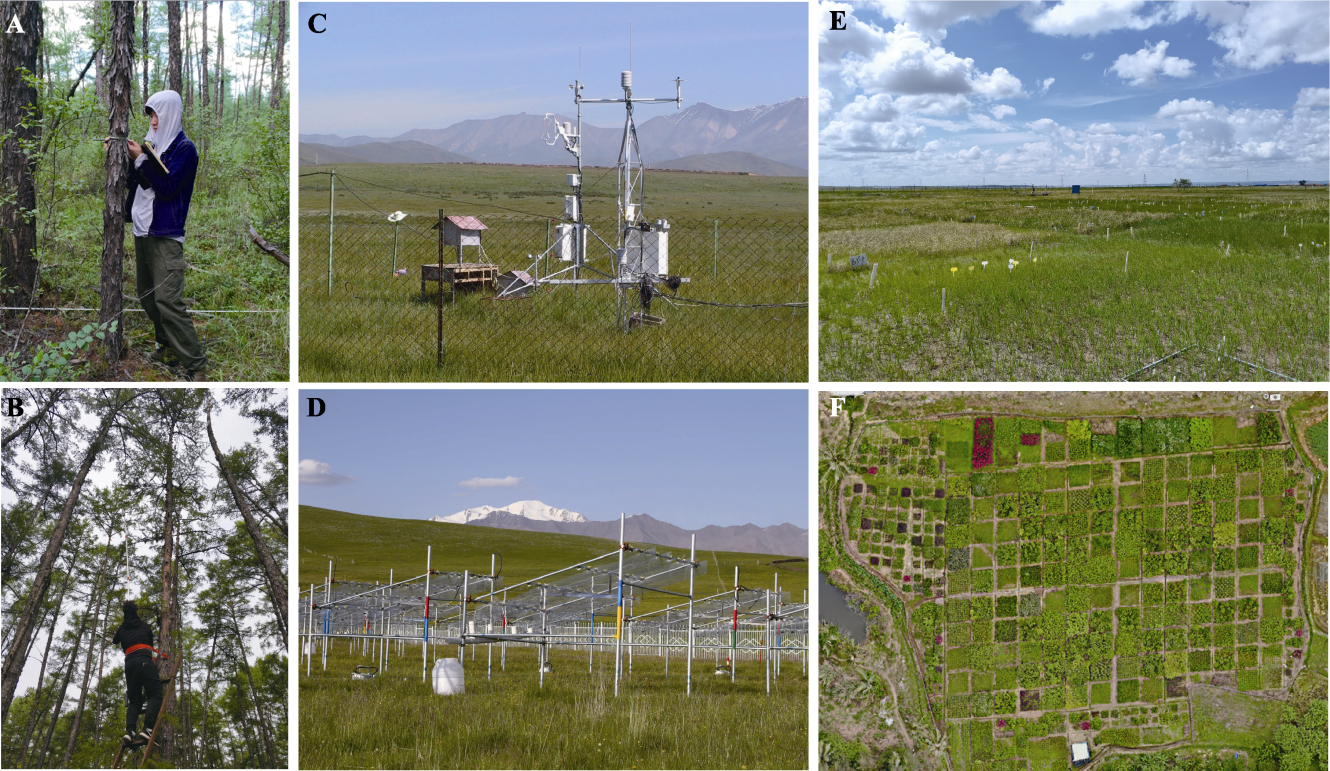
图1 野外观测方法和控制实验若干实例。A, 胸径测定实例照片。B, 叶片取样实例照片。C, 青藏高原通量观测。D, 青藏高原增温-降水控制实验。E, 内蒙古草地养分添加和刈割控制实验。F, 海南灌丛生物多样性-生态系统功能实验。
Fig. 1 Selected examples of field survey methods and controlled experiments. A, Diameter at breast height (DBH) measurement. B, Leaf sampling. C, Flux observation on the Qingzang Plateau. D, Warming-precipitation manipulation experiment on the Qingzang Plateau. E, Nutrient addition and mowing experiment on Nei Mongol grassland. F, Shrub biodiversity-ecosystem functioning experiment in Hainan.
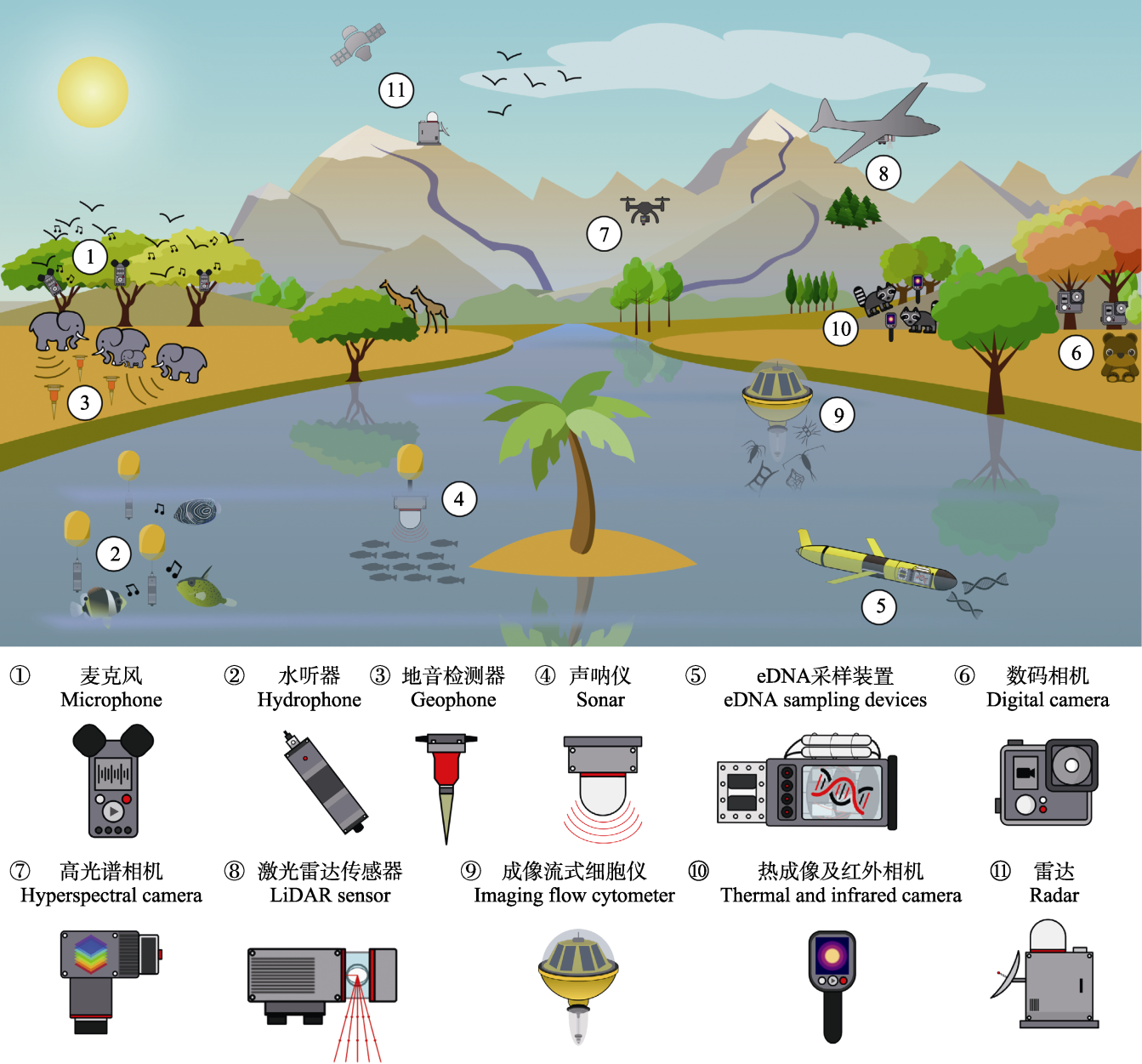
图2 生态群落的无损伤智能观测设备和装置。①鸣鸟观测麦克风; ②发声鱼类水听器及浮标; ③感知大象行走的地音检测器; ④鱼群声呐仪; ⑤环境DNA (eDNA)采样装置及水下滑翔机; ⑥熊类等动物监测数码相机; ⑦森林监测高光谱相机及无人机; ⑧林冠监测激光雷达传感器及无人机; ⑨浮游生物群落成像流式细胞仪及浮标; ⑩大中型动物夜间监测热成像及红外相机; ⑪监测鸟类和大型兽类种群的固定雷达和星载雷达。这些观测设备或装置可用于物种数量、动态及功能性状的监测。改自Besson等(2022)。
Fig. 2 Non-invasive and smart monitoring devices and instruments for ecological communities. ① Microphones for monitoring vocalizing birds; ② Hydrophones mounted on buoys for recording soniferous fishes; ③ Geophones for detecting walking elephants; ④ Sonar for detecting fish shoals; ⑤ Environmental DNA (eDNA) sampling devices and underwater gliders; ⑥ Digital camera traps for detecting bears and other animals; ⑦ Hyperspectral cameras mounted on drones for monitoring forest; ⑧ LiDAR sensors on unmanned aerial vehicles for monitoring forest canopy; ⑨ Imaging flow cytometers mounted on buoys for recording plankton communities; ⑩ Thermal and infrared cameras for nocturnal monitoring of medium- and large-sized animals; ⑪ Ground-based and satellite radar for monitoring bird and large-mammal populations. These devices can be used to monitor species abundance, dynamics, and functional traits. Adapted from Besson et al. (2022).
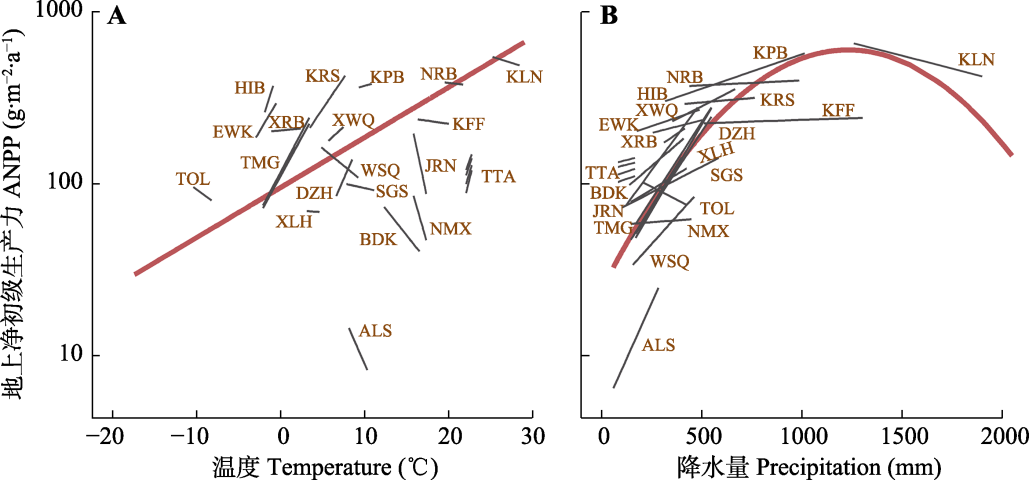
图3 全球不同地点草地地上净初级生产力(ANPP)沿年平均气温(A)和年降水量(B)梯度的变化。3个大写字母表示实验地, 其直线表示该实验地ANPP沿温度或降水梯度的变化趋势; 粗红线表示这些地点的总体趋势。可见, 不仅不同实验地的趋势差异显著(增加、减少或不变), 总趋势与各个地点的趋势也相差甚大。改自Sun等(2021)。
Fig. 3 Variations in aboveground net primary productivity (ANPP) across grassland sites worldwide along gradients of mean annual temperature (A) and mean annual precipitation (B). The three uppercase letters represent experimental sites, with solid lines indicating site-specific ANPP trends along the temperature or precipitation gradient; the bold red line represents the overall trend across all sites. Notably, trends differ substantially among sites (increasing, decreasing, or unchanged), and the overall trend also diverges markedly from those of individual sites. Adapted from Sun et al. (2021).
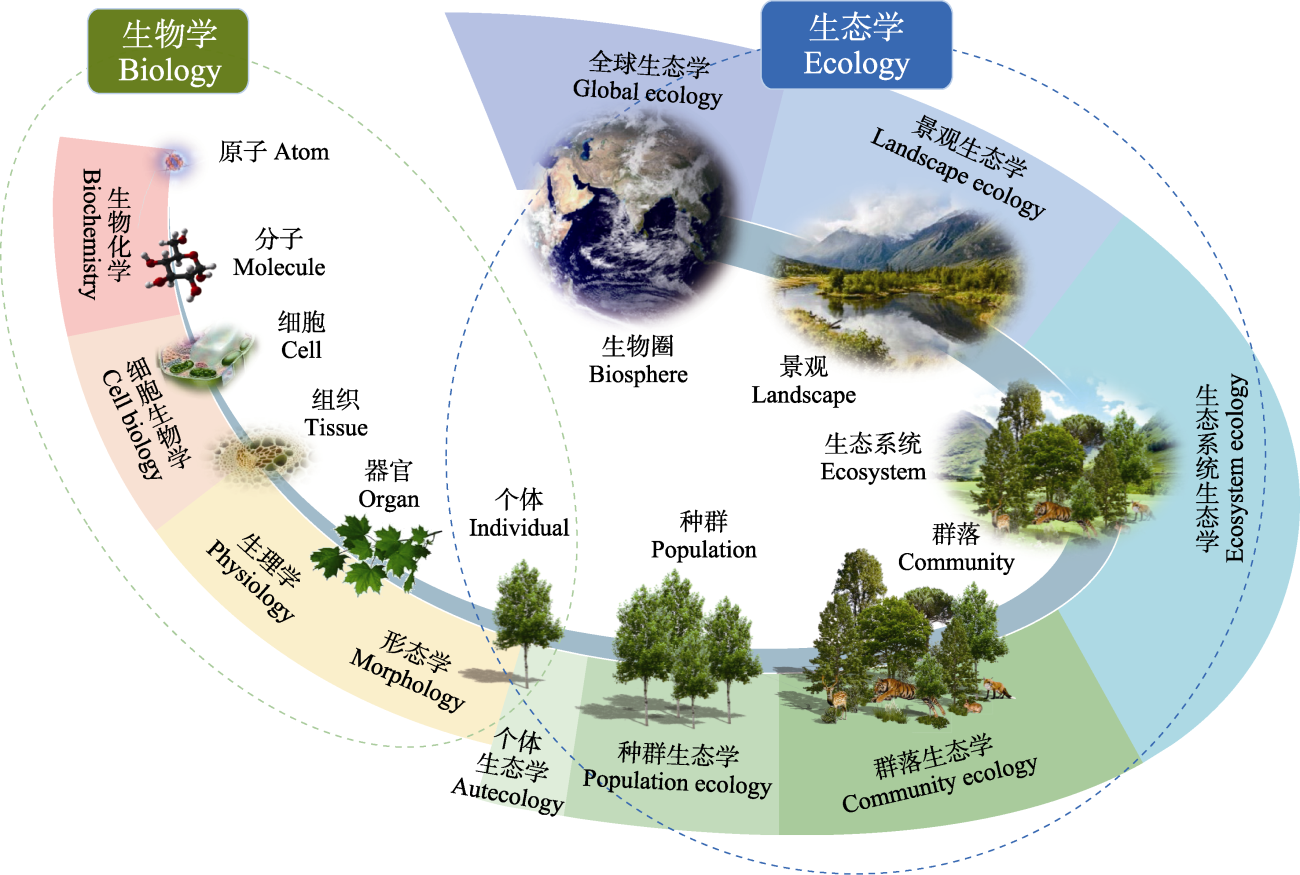
图4 生态学在生命系统研究中的地位(改自方精云(2021)。生态学的主要研究层次包括个体、种群、群落、生态系统、景观乃至地球生物圈, 而它的母体——生物学则主要研究从原子、分子到组织、器官和个体水平的生命活动。
Fig. 4 Position of ecology within the study of living systems (adapted from Fang (2021)). Ecology focuses on organization levels ranging from individuals, populations, and communities to ecosystems, landscapes, and the entire biosphere, whereas its parent discipline, biology, primarily explores life processes from the atomic and molecular levels to tissues, organs, and individuals.
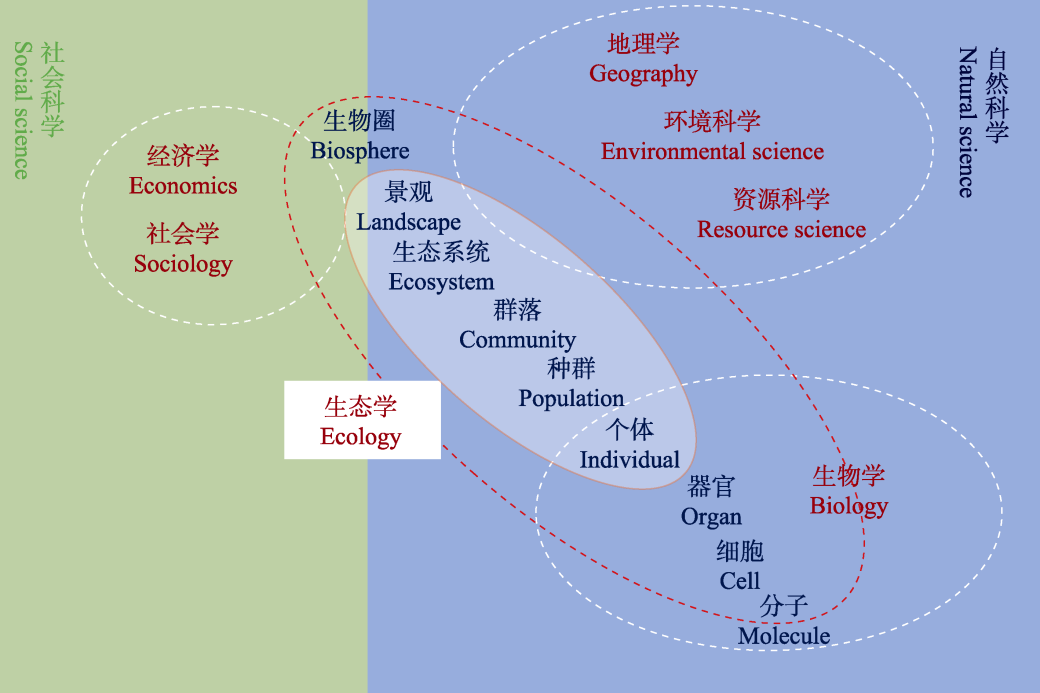
图5 生态学与其他学科的关联。尽管生态学研究尺度从分子、器官, 直到生态系统和地球生物圈, 但它的核心研究内容是个体、种群、群落、生态系统和景观五个层次。生态学的母体是生物学, 与生物学深度关联; 生态学同时又与地理学、环境科学、资源科学, 甚至社会科学中的经济学和社会学等学科有交叉融合。
Fig. 5 Relationships between ecology and other disciplines. Although the scopes of ecological research range from molecules to the biosphere, its core focus is on five organizational levels: individuals, populations, communities, ecosystems, and landscapes. Ecology originates from, and is closely linked to, biology, while it also intersects and integrates with geography, environmental science, resource science, and even social sciences such as economics and sociology.
| [1] |
Barrett GW (2001). Closing the ecological cycle: the emergence of integrative science. Ecosystem Health, 7, 79-84.
DOI URL |
| [2] |
Barrett GW, Likens GE (2002). Eugene P. Odum: Pioneer of ecosystem ecology. BioScience, 52, 1047-1048.
DOI URL |
| [3] |
Besson M, Alison J, Bjerge K, Gorochowski TE, Høye TT, Jucker T, Mann HMR, Clements CF (2022). Towards the fully automated monitoring of ecological communities. Ecology Letters, 25, 2753-2775.
DOI PMID |
| [4] | Clements FE (1905). Research Methods in Ecology. University Publishing Company, Lincoln. |
| [5] | Clements FE (1916). Plant Succession: an Analysis of the Development of Vegetation. Carnegie Institution of Washington, Washington D.C. |
| [6] |
Currie DJ (2010). The theory of island biogeography revisited. BioScience, 60, 952-953.
DOI URL |
| [7] |
de Boeck HJ, Vicca S, Roy J, Nijs I, Milcu A, Kreyling J, Jentsch A, Chabbi A, Campioli M, Callaghan T, Beierkuhnlein C, Beier C (2015). Global change experiments. BioScience, 65, 922-931.
DOI URL |
| [8] | Editorial Committee of Selected Works of Li Jitong (1986). Selected Works of Li Jitong. Science Press, Beijing. |
| [《李继侗文集》编辑委员会 (1986). 李继侗文集. 科学出版社, 北京.] | |
| [9] | Editorial Group of Selected Works of Liu Shen’e (1985). Selected Works of Liu Shen’e. Science Press, Beijing. |
| [《刘慎谔文集》编辑组 (1985). 刘慎谔文集. 科学出版社, 北京.] | |
| [10] | Egerton FN (2001). A history of the ecological sciences, part 2: Aristotle and Theophrastos. The Bulletin of the Ecological Society of America, 82, 149-152. |
| [11] | Egerton FN (2009). A history of the ecological sciences, part 32: Humboldt, nature’s geographer. The Bulletin of the Ecological Society of America, 90, 253-282. |
| [12] | Egerton FN (2010). History of the ecological sciences, part 35: the beginnings of British marine biology: Edward forbes and Philip Gosse. The Bulletin of the Ecological Society of America, 91, 176-201. |
| [13] | Egerton FN (2011). History of ecological sciences, part 39: Henry David Thoreau, ecologist. The Bulletin of the Ecological Society of America, 92, 251-275. |
| [14] | Egerton FN (2013). History of ecological sciences, part 48: Formalizing plant ecology, about 1870 to mid-1920s. The Bulletin of the Ecological Society of America, 94, 341-378. |
| [15] | Egerton FN (2014). History of ecological sciences, part 49: Formalizing animal ecology, 1870s to 1920s. The Bulletin of the Ecological Society of America, 95, 59-81. |
| [16] | Egerton FN (2015). History of ecological sciences, part 54: Succession, community, and continuum. The Bulletin of the Ecological Society of America, 96, 426-474. |
| [17] | Elton CS (1927). Animal Ecology. Sidgwick and Jackson, London. |
| [18] | Fang JY (1995). Kira Tatsuo and the development of ecology. Chinese Journal of Ecology, 14, 70-75. |
| [方精云 (1995). 吉良龙夫与生态学的发展. 生态学杂志, 14, 70-75.] | |
| [19] | Fang JY (2021). Re-constructing the disciplinary system of ecology in a new age. Universities and Disciplines, 2(4), 61-73. |
| [方精云 (2021). 生态学学科体系的再构建. 大学与学科, 2(4), 61-73.] | |
| [20] | Fang JY (2025). The Encyclopedia of China (Third Edition): Ecology. Encyclopedia of China Publishing House, Beijing. |
| [方精云 (2025). 中国大百科全书(第三版): 生态学. 中国大百科全书出版社, 北京.] | |
| [21] | Fang JY, Liu LL (2021). Ecosystem Ecology: Reviews and Perspectives. Higher Education Press, Beijing. |
| [方精云, 刘玲莉 (2021). 生态系统生态学——回顾与展望. 高等教育出版社, 北京.] | |
| [22] | Fang JY, Song YC, Liu HY, Piao SL (2002). Vegetation-climate relationship and its application in the division of vegetation zone in China. Journal of Integrative Plant Biology, 44, 1105-1122. |
| [方精云, 宋永昌, 刘鸿雁, 朴世龙 (2002). 植被气候关系与我国的植被分区. 植物学报, 44, 1105-1122.] | |
| [23] |
Fang JY, Wang XP, Shen ZH, Tang ZY, He JS, Yu D, Jiang Y, Wang ZH, Zheng CY, Zhu JL, Guo ZD (2009). Methods and protocols for plant community inventory. Biodiversity Science, 17, 533-548.
DOI |
|
[方精云, 王襄平, 沈泽昊, 唐志尧, 贺金生, 于丹, 江源, 王志恒, 郑成洋, 朱江玲, 郭兆迪 (2009). 植物群落清查的主要内容、方法和技术规范. 生物多样性, 17, 533-548.]
DOI |
|
| [24] | Fang JY, Zhu JL, Ji CJ, Tang ZY, He JS (2013). Ecological perspectives on ecological civilization construction. Bulletin of Chinese Academy of Sciences, 28, 182-188. |
| [方精云, 朱江玲, 吉成均, 唐志尧, 贺金生 (2013). 从生态学观点看生态文明建设. 中国科学院院刊, 28, 182-188.] | |
| [25] | Feng ZW, Chen CY, Zhang JW, Wang KP, Zhao JL, Gao H (1982). Determination of biomass of Pinus massoniana stand in Huitong County, Hunan Province. Scientia Silvae Sinicae, 18, 127-134. |
| [冯宗炜, 陈楚莹, 张家武, 王开平, 赵吉录, 高虹 (1982). 湖南会同地区马尾松林生物量的测定. 林业科学, 18, 127-134.] | |
| [26] |
Gleason HA (1917). The structure and development of the plant association. Bulletin of the Torrey Botanical Club, 44, 463-481.
DOI URL |
| [27] | Guo YT, Li SC, Wang Z, Xie Y, Yang X, Zhou GJ, You CH, Zhu SN, Gao JX (2025). Coverage and distribution of national key protected wild species in China’s nature reserves. Biodiversity Science, 33, 198-206. |
| [郭雨桐, 李素萃, 王智, 解焱, 杨雪, 周广金, 尤春赫, 朱萨宁, 高吉喜 (2025). 全国自然保护地对国家重点保护野生物种的覆盖度及其分布状况. 生物多样性, 33, 198-206.] | |
| [28] |
Han WX, Fang JY, Guo DL, Zhang Y (2005). Leaf nitrogen and phosphorus stoichiometry across 753 terrestrial plant species in China. New Phytologist, 168, 377-385.
DOI PMID |
| [29] | Harper JL (1960). Factors controlling plant numbers//Harper JL. The Biology of Weeds, a Symposium of the British Ecological Society. Blackwells, Oxford. 119-132. |
| [30] | He JS, Han XG (2010). Ecological stoichiometry: searching for unifying principles from individuals to ecosystems. Chinese Journal of Plant Ecology, 34, 2-6. |
|
[贺金生, 韩兴国 (2010). 生态化学计量学: 探索从个体到生态系统的统一化理论. 植物生态学报, 34, 2-6.]
DOI |
|
| [31] |
He NP, Li Y, Liu CC, Xu L, Li MX, Zhang JH, He JS, Tang ZY, Han XG, Ye Q, Xiao CW, Yu Q, Liu SR, Sun W, Niu SL, et al. (2020). Plant trait networks: improved resolution of the dimensionality of adaptation. Trends in Ecology & Evolution, 35, 908-918.
DOI URL |
| [32] |
Heckel DG (2012). Ecology. Insecticide resistance after Silent Spring. Science, 337, 1612-1614.
PMID |
| [33] | Hortal J, Diniz-Filho JAF, Low MEY, Stigall AL, Yeo DCJ (2023). Alfred Russel Wallace’s legacy: an interdisciplinary conception of evolution in space and time. NPJ Biodiversity, 2, 3. DOI: 10.1038/s44185-023-00010-w. |
| [34] | Hou XY (1941). Plant distribution and soils in northern and central Guizhou. Quarterly of Soil, 1(3), 8-21. |
| [侯学煜 (1941). 贵州中北部之植物分布与土壤. 土壤季刊, 1(3), 8-21.] | |
| [35] | Jørgensen SE (2016). Ecological Model Types. Elsevier, Amsterdam. |
| [36] |
Kendeigh SC (1968). Victor Ernest Shelford, Eminent Ecologist, 1968. The Bulletin of the Ecological Society of America, 49, 97-100.
DOI URL |
| [37] |
Kingsland S (1982). The refractory model: the logistic curve and the history of population ecology. The Quarterly Review of Biology, 57, 29-52.
DOI URL |
| [38] |
Kormondy EJ (2012). A brief introduction to the history of ecology. The American Biology Teacher, 74, 441-443.
DOI URL |
| [39] |
Kovda VA (1993). The earth’s living matter: biosphere and soils. Environmental Conservation, 20, 199-204.
DOI URL |
| [40] | Krebs CJ (2001). Ecology: the Experimental Analysis of Distribution and Abundance. 5th ed. Benjamin Cummings, San Francisco. |
| [41] |
Lenton TM (2022). James Lovelock (1919-2022). Science, 377, 927.
DOI PMID |
| [42] | Li B (2000). Ecology. Higher Education Press, Beijing. |
| [李博 (2000). 生态学. 高等教育出版社, 北京.] | |
| [43] |
Li W (2010). Progresses and perspectives of ecological research in China. Journal of Resources and Ecology, 1, 3-14.
DOI |
| [44] | Li WH, Deng KM, Li F (1981). Study on biomass and primary production of main ecosystems in Changbai Mountain. Research of Forest Ecosystem, 2, 34-50. |
| [李文华, 邓坤枚, 李飞 (1981). 长白山主要生态系统生物量生产量的研究. 森林生态系统研究, 2, 34-50.] | |
| [45] | Likens GE (1992). The Ecosystem Approach: Its Use and Abuse. Ecology Institute, Oldenhorf/Luhe, Germany. |
| [46] |
Lindeman RL (1942). The trophic-dynamic aspect of ecology. Ecology, 23, 399-417.
DOI URL |
| [47] | Lipsey MW, Wilson DB (2001). Practical Meta-Analysis. SAGE Publications, London. |
| [48] |
Lubchenco J, Olson AM, Brubaker LB, Carpenter SR, Holland MM, Hubbell SP, Levin SA, MacMahon JA, Matson PA, Melillo JM, Mooney HA, Peterson CH, Pulliam HR, Real LA, Regal PJ, et al. (1991). The sustainable biosphere initiative: an ecological research agenda: a report from the ecological society of America. Ecology, 72, 371-412.
DOI URL |
| [49] | Wand DL (2026). On the general principles in ecology. Chinese Journal of Plant Ecology, 50, 24-33. |
|
[王德利 (2026). 生态学的基本原理. 植物生态学报, 50, 24-33.]
DOI |
|
| [50] | Mao JF, Wang B, Dai YJ (2006). Perspective on terrestrial ecosystem models and their coupling with climate system models. Climatic and Environmental Research, 11, 763-771. |
| [毛嘉富, 王斌, 戴永久 (2006). 陆地生态系统模型及其与气候模式耦合的回顾. 气候与环境研究, 11, 763-771.] | |
| [51] |
Meine C (2022). Land, ethics, justice, and Aldo Leopold. Socio-Ecological Practice Research, 4, 167-187.
DOI |
| [52] | Miller JG (1978). Living Systems. McGraw-Hill, New York. |
| [53] | Nielsen CO (1960). Fundamentals of ecology. Ecology, 41, 400-401. |
| [54] | Odum EP (1971). Fundamentals of Ecology. 3rd ed. W. B. Saunders Co., Philadelphia. |
| [55] | Odum EP (1977). The emergence of ecology as a new integrative discipline: ecology must combine holism with reductionism if applications are to benefit society. Science, 195, 1289-1293. |
| [56] | Odum EP (1986). Introductory review: perspectives of ecosystem theory and application//Polunin N. Ecosystem Theory and Application. John Wiley & Sons, Chichester. 1-11. |
| [57] |
Pence CH, Swaim DG (2018). The economy of nature: the structure of evolution in Linnaeus, Darwin, and the modern synthesis. European Journal for Philosophy of Science, 8, 435-454.
DOI |
| [58] |
Pringle H (1998). The slow birth of agriculture. Science, 282, 1446.
DOI URL |
| [59] | Quek SL (2024). The translation journey from “Œcologie” to the Chinese terms “生態”/“生態學”. Wakumon, 45, 25-44. |
| [60] |
Reich PB (2005). Global biogeography of plant chemistry: filling in the blanks. New Phytologist, 168, 263-266.
PMID |
| [61] | Ricklefs RE (2001). The Economy of Nature. 5th ed. W. H. Freeman and Company, New York. |
| [62] | Scheiner SM, Gurevitch J (2001). Design and Analysis of Ecological Experiments. 2nd ed. Oxford University Press, New York. |
| [63] | Shelford BVE (1913). Animal Communities in Temperate America as Illustrated in the Chicago Region: a Study in Animal Ecology. The University of Chicago Press, Chicago. |
| [64] | Shinozaki K, Kira T (1956). Intraspecific competition among higher plants VII: Logistic theory of the C-D effect. Journal of the Institute of Polytechnics, Osaka City University, Series D, 7, 35-72. |
| [65] |
Stauffer RC (1957). Haeckel, Darwin, and ecology. The Quarterly Review of Biology, 32, 138-144.
DOI URL |
| [66] | Sterner RW, Elser JJ (2002). Ecological Stoichiometry: the Biology of Elements from Molecules to the Biosphere. Princeton University Press, Princeton. |
| [67] |
Sukachev VN (1958). On the principles of genetic classification in biocenology. Ecology, 39, 364-367.
DOI URL |
| [68] |
Sun YF, Yang YH, Zhao X, Tang ZY, Wang SP, Fang JY (2021). Global patterns and climatic drivers of above- and belowground net primary productivity in grasslands. Science China: Life Sciences, 64, 739-751.
DOI |
| [69] |
Tansley AG (1935). The use and abuse of vegetational concepts and terms. Ecology, 16, 284-307.
DOI URL |
| [70] |
Tian D, Yan ZB, Fang JY (2021). Review on characteristics and main hypotheses of plant ecological stoichiometry. Chinese Journal of Plant Ecology, 45, 682-713.
DOI |
|
[田地, 严正兵, 方精云 (2021). 植物生态化学计量特征及其主要假说. 植物生态学报, 45, 682-713.]
DOI |
|
| [71] |
van der Ploeg RR, Böhm W, Kirkham MB (1999). On the origin of the theory of mineral nutrition of plants and the law of the minimum. Soil Science Society of America Journal, 63, 1055-1062.
DOI URL |
| [72] | Yoda K, Kira T, Ogawa H, Hozumi K (1963). Self-thinning in overcrowded pure stands under cultivated and natural conditions. Journal of Biology, Osaka City University, 14, 107-129. |
| [73] | Yu GR, Yu XB (2013). Chinese Ecosystem Research Network (CERN) and natural ecosystem protection. Bulletin of Chinese Academy of Sciences, 28, 275-283. |
| [于贵瑞, 于秀波 (2013). 中国生态系统研究网络与自然生态系统保护. 中国科学院院刊, 28, 275-283.] | |
| [74] | Zheng FY, Lu HF, Peng SL (2005). Advantages and disadvantages in ecological meta-analyses. Ecology and Environment, 14, 417-421. |
| [郑凤英, 陆宏芳, 彭少麟 (2005). 整合分析在生态学应用中的优势及存在的问题. 生态环境, 14, 417-421.] | |
| [75] | Zheng SZ, Wu QH, Wang HB, Tao Y (1994). General Ecology: Principles, Methods, and Applications. Fudan University Press, Shanghai. |
| [郑师章, 吴千红, 王海波, 陶芸 (1994). 普通生态学:原理、方法和应用. 复旦大学出版社, 上海.] | |
| [76] | Zhou LY (1984). In memory of professor Zhang Ting on the centenary of his birth. Bulletin of Biology, 19(6), 61-62. |
| [周凌云 (1984). 纪念张珽教授诞辰一百周年. 生物学通报, 19(6), 61-62.] |
| No related articles found! |
| 阅读次数 | ||||||
|
全文 |
|
|||||
|
摘要 |
|
|||||
Copyright © 2026 版权所有 《植物生态学报》编辑部
地址: 北京香山南辛村20号, 邮编: 100093
Tel.: 010-62836134, 62836138; Fax: 010-82599431; E-mail: apes@ibcas.ac.cn, cjpe@ibcas.ac.cn
备案号: 京ICP备16067583号-19

