
植物生态学报 ›› 2009, Vol. 33 ›› Issue (6): 1156-1164.DOI: 10.3773/j.issn.1005-264x.2009.06.016 cstr: 32100.14.j.issn.1005-264x.2009.06.016
所属专题: 青藏高原植物生态学:种群生态学
侯勤正1,3, 段元文2, 司庆文1,3, 杨慧玲1,*( )
)
收稿日期:2009-03-31
接受日期:2009-07-13
出版日期:2009-03-31
发布日期:2021-04-29
作者简介:*(yanghuiling@nwipb.ac.cn)基金资助:
HOU Qin-Zheng1,3, DUAN Yuan-Wen2, SI Qing-Wen1,3, YANG Hui-Ling1,*()
Received:2009-03-31
Accepted:2009-07-13
Online:2009-03-31
Published:2021-04-29
摘要:
线叶龙胆(Gentiana lawrencei var. farreri)主要分布在青藏高原, 在晚秋和早冬开花。为了探明线叶龙胆繁育系统特点, 探讨其对环境的繁殖适应特征, 对其传粉生态学过程进行了连续3年的观察。线叶龙胆自然状态下的结籽率很低, 存在严重的花粉限制。雌雄异位和不完全雌雄异熟的花特征表明其结实必须依赖昆虫传粉。繁育系统实验表明, 部分套袋花也能结实, 这可能主要是由蓟马(Thripidae spp.)和蚂蚁(Formica spp.)等小昆虫协助自交所致。克什米尔熊蜂(Bombus kashmirensis)和苏氏熊蜂(B. sushikini)是线叶龙胆的有效传粉昆虫, 但其访花频率非常低, 分别为0.006和0.005 time·flower-1·h-1。线叶龙胆花持续期和柱头可授能力都长于其他已报道的龙胆类植物, 从而在温度低、传粉昆虫少的情况下提供了更多传粉机会。线叶龙胆同时具有协助自交和杂交的繁殖现象, 以及较长的花持续期和柱头持续能力, 这可能是其在青藏高原地区赖以存活和延续的一个重要原因。
侯勤正, 段元文, 司庆文, 杨慧玲. 青藏高原晚期开花植物线叶龙胆的传粉生态学. 植物生态学报, 2009, 33(6): 1156-1164. DOI: 10.3773/j.issn.1005-264x.2009.06.016
HOU Qin-Zheng, DUAN Yuan-Wen, SI Qing-Wen, YANG Hui-Ling. POLLINATION ECOLOGY OF GENTIANA LAWRENCEI VAR. FARRERI, A LATE-FLOWERING QINGHAI-TIBET PLATEAU SPECIES. Chinese Journal of Plant Ecology, 2009, 33(6): 1156-1164. DOI: 10.3773/j.issn.1005-264x.2009.06.016
| 处理 Treatments | 雄性期 Male phase | 雌性期 Female phase | 总花期 Total longevity |
|---|---|---|---|
| 自然状态 Natural pollination | 2.2 ± 0.9 ( n=20)a | 8.3 ± 3.2 ( n=20)a | 10.5 ± 3.4 ( n=20)a |
| 隔离昆虫 Isolation insects | 3.9 ± 1.5 ( n=10)b | 11.4 ± 3.0 ( n=10)b | 15.3 ± 2.7 ( n=10)b |
| 补充授粉 Supplemental pollination | - | 3.7 ± 0.5 ( n=10)c | - |
表1 线叶龙胆在自然状态、隔离昆虫和补充授粉条件下的花雄性期、雌性期和总花期(平均值±标准偏差)
Table 1 The male, female phase and total longevity of Gentiana lawrencei var. farreriunder natural, insects-isolated and artificially pollinated conditions (mean±SD)
| 处理 Treatments | 雄性期 Male phase | 雌性期 Female phase | 总花期 Total longevity |
|---|---|---|---|
| 自然状态 Natural pollination | 2.2 ± 0.9 ( n=20)a | 8.3 ± 3.2 ( n=20)a | 10.5 ± 3.4 ( n=20)a |
| 隔离昆虫 Isolation insects | 3.9 ± 1.5 ( n=10)b | 11.4 ± 3.0 ( n=10)b | 15.3 ± 2.7 ( n=10)b |
| 补充授粉 Supplemental pollination | - | 3.7 ± 0.5 ( n=10)c | - |
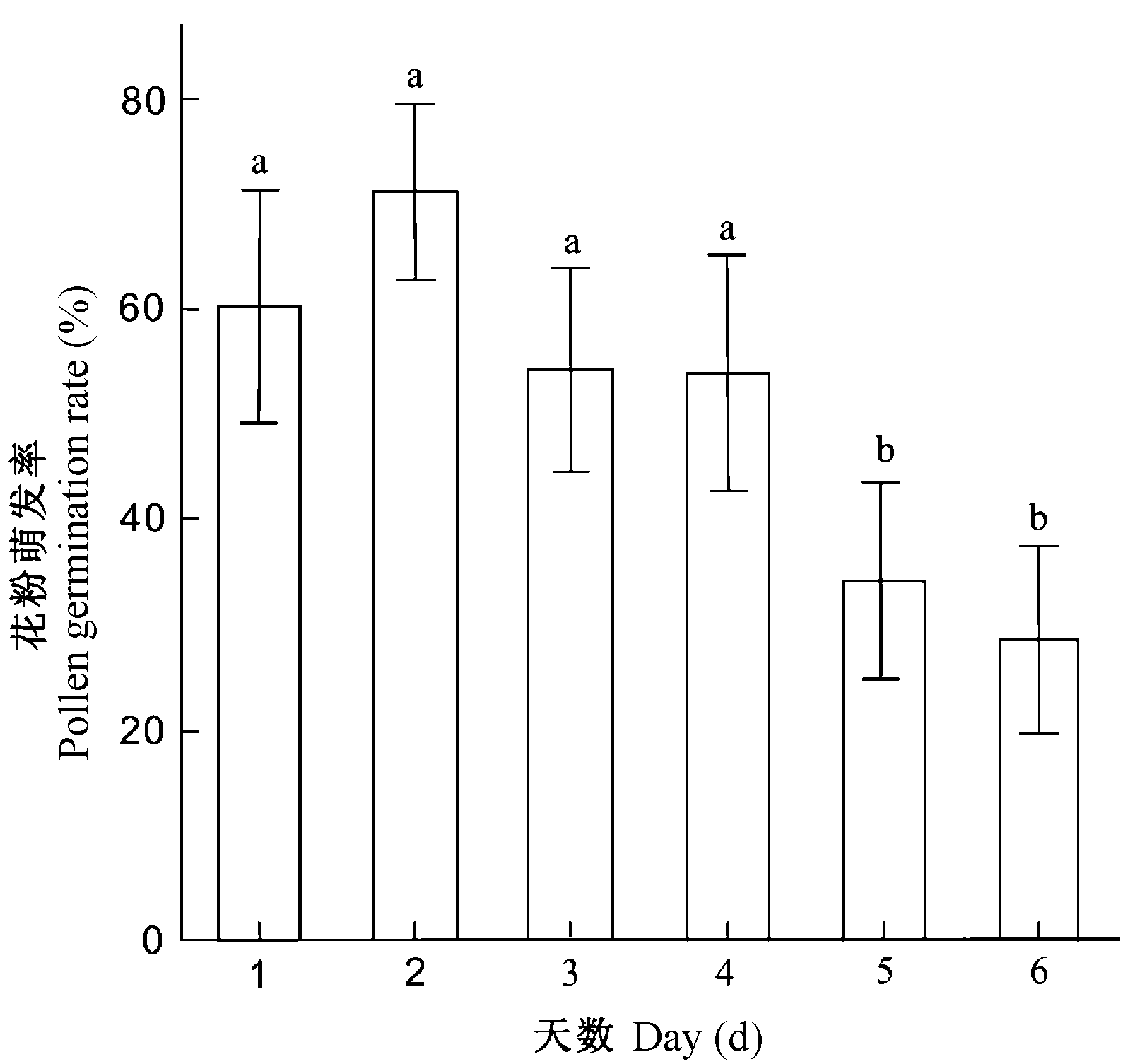
图1 线叶龙胆在不同天数的花粉萌发率 (平均值±标准偏差) 不同的字母表示在0.01水平上有显著性差异 Different letters indicate significant difference at p=0.01
Fig. 1 Pollen germination rate of Gentiana lawrencei var.farreri at different days (mean±SD)
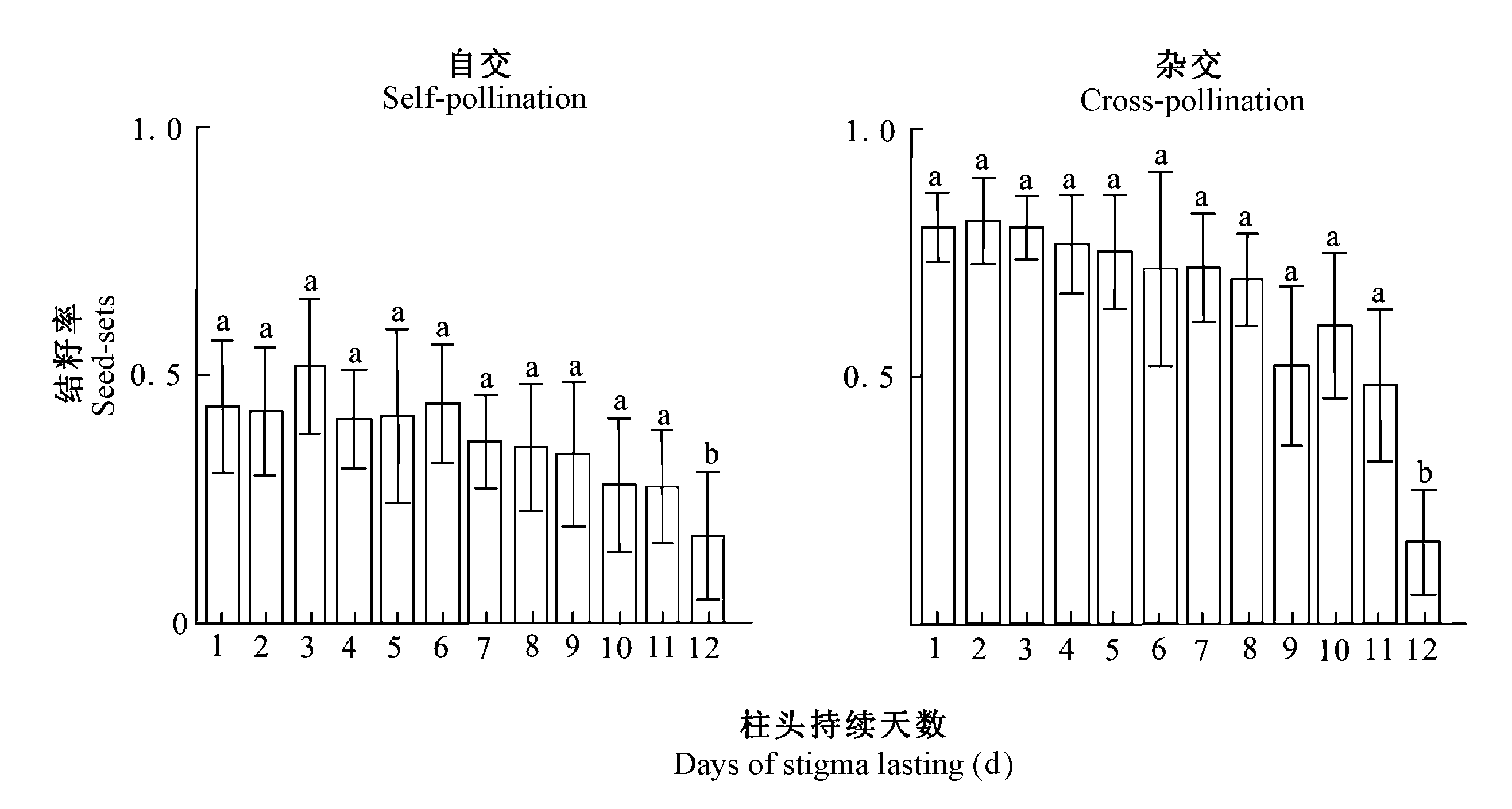
图2 线叶龙胆柱头在不同的持续天数分别在自交和杂交情况下的结籽率(平均值±标准偏差) 同一处理内不同的字母表示在0.01水平上有显著性差异 Different letters in the same treatment indicate significant difference at p=0.01
Fig. 2 Seed-set of Gentiana lawrenceivar. farreri obtained after self- and cross-pollination at different days of the stigma lasting (mean±SD)
| 处理 Treatments | 年份 Year | 显著性 Sig. | |
|---|---|---|---|
| 2006 | 2008 | ||
| 自然状态 Natural pollination | 0.17 ± 0.19 ( n=20, fr=0.70)a | 0.10 ± 0.10 ( n=24, fr=0.63)a | 0.19 |
| 去雄后自然传粉 Natural pollination after emasculation | 0.10 ± 0.22 ( n=20, fr=0.43)b | 0.05 ± 0.05 ( n=25, fr=0.36)b | 0.91 |
| 套袋不去雄 Bagging without emasculation | 0.04 ± 0.08 ( n=20, fr=0.43)b | 0.06 ± 0.15 ( n=27, fr=0.13)b | 0.44 |
| 去雄套袋 Bagging after emasculation | 0 (n=20, fr=0)c | 0 (n=30, fr=0)c | - |
表2 线叶龙胆在2006年和2008年繁育系统中4种处理的结籽率(平均值±标准偏差)
Table 2 Seed sets of four different breeding treatments of Gentiana lawrencei var. ferreri in 2006 and 2008 (mean±SD)
| 处理 Treatments | 年份 Year | 显著性 Sig. | |
|---|---|---|---|
| 2006 | 2008 | ||
| 自然状态 Natural pollination | 0.17 ± 0.19 ( n=20, fr=0.70)a | 0.10 ± 0.10 ( n=24, fr=0.63)a | 0.19 |
| 去雄后自然传粉 Natural pollination after emasculation | 0.10 ± 0.22 ( n=20, fr=0.43)b | 0.05 ± 0.05 ( n=25, fr=0.36)b | 0.91 |
| 套袋不去雄 Bagging without emasculation | 0.04 ± 0.08 ( n=20, fr=0.43)b | 0.06 ± 0.15 ( n=27, fr=0.13)b | 0.44 |
| 去雄套袋 Bagging after emasculation | 0 (n=20, fr=0)c | 0 (n=30, fr=0)c | - |
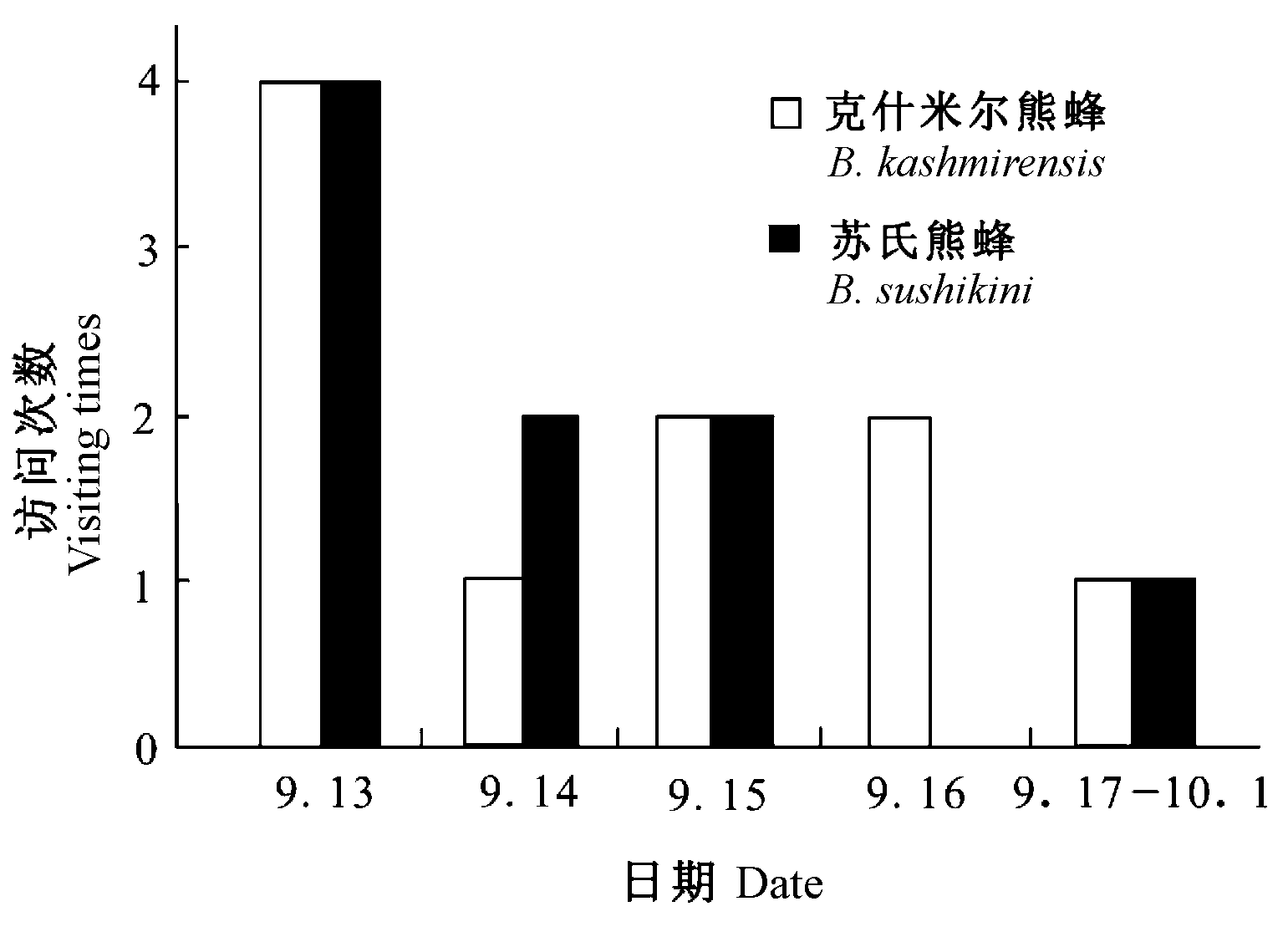
图3 2006年克什米尔熊蜂和苏氏熊蜂对线叶龙胆每个观察日的访问次数
Fig. 3 Visiting times of Bombus sushikini and B. kashmirensison Gentiana lawrencei var.farreri at different days in 2006
| [1] |
Anderson B, Midgley JJ, Stewart BA (2003). Facilitated selfing offers reproductive assurance: a mutualism between a hemipteran and carnivorous plant. American Journal of Botany, 90,1009-1015.
DOI URL PMID |
| [2] | Arroyo MTK, Armesto JJ, Primack RB (1985). Community studies in pollination ecology in the high temperate Andes of Central Chile Ⅱ. Effect of temperature on visitation rates and pollination possibilities. Plant Systematics and Evolution, 149,187-203. |
| [3] | Ashman TL, Schoen DJ (1994). How long should flowers lives? Nature, 371,788-791. |
| [4] |
Becerra J, Lloyd DG (1992). Competition-dependent abscission of self-pollinated flowers of Phormium tenax (Agavaceae): a second action of self-incompatibility at the whole-flower level. Evolution, 46,458-469.
URL PMID |
| [5] | Bertin RI, Newman CW (1993). Dichogamy in angiosperms. The Botanical Review, 59,112-152. |
| [6] |
Bhardwaj M, Eckert CG (2001). Functional analysis of synchronous dichogamy in flowering rush,Butomus umbellatus (Butomaceae). American Journal of Botany, 88,2204-2213.
URL PMID |
| [7] | Blionis GJ, Halley JM, Volou D (2001). Flowering phenology of Campanula on Mt. Olynipos, Greece. Ecography, 24,696-706. |
| [8] | Bingham RA, Orthner RA (1998). Efficient pollination of alpine plants. Nature, 391,238-239. |
| [9] | Dafni A (1992). Pollination Ecology: a Practical Approach. Oxford University Press, Oxford, UK, 1-57. |
| [10] | Duan YW, He YP, Liu JQ (2005). Reproductive ecology of the Qinghai-Tibet Plateau endemic Gentiana straminea (Gentianaceae), a hermaphrodite perennial characterized by herkogamy and dichogamy. Acta Oecologica, 27,225-232. |
| [11] | Duan YW, Zhang TF, Liu JQ (2007). Interannual fluctuations in floral longevity, pollinator visitation and pollination limitation of an alpine plant ( Gentiana straminea Maxim., Gentianaceae) at two altitudes in the Qinghai-Tibet Plateau. Plant Systematics and Evolution, 267,255-265. |
| [12] | Duan YW (段元文), Zhang TF (张挺峰), Liu JQ (刘建全) (2007). Pollination biology of Anisodus tanguticus (Solanaceae). Biodiversity Science (生物多样性), 15,584-591. ( in Chinese with English abstract). |
| [13] | Duan YW (段元文), Liu JQ (刘建全) (2003). Floral syndrome and insect pollination of the Qinghai-Tibet Plateau endemic Swertia przewalskii (Gentianaceae). Acta Phytotaxonomica Sinica (植物分类学报), 41,465-474. (in Chinese with English abstract) |
| [14] | Fabbro T, Körner C (2004). Altitudinal differences in flower traits and reproductive allocation. Flora, 199,70-81. |
| [15] | Fritz AL (1990). Deceit pollination of Orchis spitzelli (Orchidaceae) on the island of Gotland in the Baltic: a suboptimal system. Nordic Journal of Botany, 9,577-587. |
| [16] | Goodwillie C, Stiller JW (2001). Evidence for polyphyly in a species of Linantbus (Polemoniaceae): convergent evolution in self-fertilizing taxa. Systematic Botany, 26,273-282. |
| [17] | Grant V, Temeles EJ (1992). Foraging ability of rufous hummingbirds on hummingbird flowers and hawkmoth flowers. Ecology, 89,9400-9404. |
| [18] | He YP, Duan YW, Liu JQ, Smith WK (2006). Floral closure in response to temperature and pollination in Gentiana straminea Maxim. (Gentianaceae), an alpine perennial in the Qinghai-Tibetan Plateau. Plant Systematics and Evolution, 256,17-33. |
| [19] | He YP (何亚平), Fei SM (费世民), Liu JQ (刘建全), Chen XM (陈秀明), Wang P (王鹏), Jiang JM (蒋俊明), He F (何飞) (2005). A preliminary review of studies of alpine plant breeding system. Journal of Sichuan Forestry Science and Technology (四川林业科技), 26(4),43-49. ( in Chinese with English abstract). |
| [20] | He YP (何亚平), Liu JQ (刘建全) (2003). A review on recent advances in the studies of plant breeding system. Acta Phytoecologica Sinica (植物生态学报), 27,151-163. ( in Chinese with English abstract). |
| [21] |
Herlihy CR, Eckert CG (2005). Evolution of self-fertilization at geographical range margins? A comparison of demographic, floral, and mating variables in central vs. peripheral populations of Aquilegia canadensis (Ranunculaceae). American Journal of Botany, 92,744-751.
DOI URL PMID |
| [22] | Ho TN, Liu SW (2001). A Worldwide Monograph of Gentiana. Science Press,Beijing. |
| [23] | Hodges SA (1995). The influence of nectar production on hawkmoth behavior, selfpollination and seed production in Mirabilis multiflora (Nyctaginaceae). American Journal of Botany, 82,197-229. |
| [24] | Hou QZ (侯勤正), Meng LH (孟丽华), Yang HL (杨慧玲) (2008). Pollination ecology of Gentiana siphonantha (Gentianaceae) and a further comparison with its sympatric congener species. Acta Phytotaxonomica Sinica (植物分类学报), 46,554-562. (in Chinese with English abstract) |
| [25] |
Internicola AI, Juillet N, Smithson A, Gigord LDB (2006). Experimental investigation of the effect of spatial aggregation on reproductive success in a rewardless orchid. Oecologia, 150,435-441.
DOI URL PMID |
| [26] |
Ishii HS, Sakai S (2002). Temporal variation in floral display size and individual floral sex allocation in racemes of Narthecium asiaticum (Liliaceae). American Journal of Botany, 89,441-446.
DOI URL PMID |
| [27] |
Jones CE, Cruzan MB (1999). Floral morphological changes and reproductive success in deer weed (Lotus scoparius, Fabaceae). American Journal of Botany, 86,273-277.
URL PMID |
| [28] | Kudo G (1993). Relationship between flowering time and fruit set of the entomophilous alpine shrub,Rhododendron aureum (Ericaceae), inhabiting snow patches. American Journal of Botany, 80,1300-1304. |
| [29] | Lloyd DG (1965). Evolution of self-compatibility and racial differentiation in Leavenworthia (Cruciferae). Contri- bution from the Gray Herbarium of Harvard University, 195,3-134. |
| [30] | Lloyd DG, Webb CJ (1986). The avoidance of interference between the presentation of pollen and stigmas in angiosperms. I. Dichogamy. New Zealand Journal of Botany, 24,135-162. |
| [31] | Molau U (1993). Relationships between flowering phenology and life history strategies in Tundra plants. Arctic and Alpine Research, 55,391-402. |
| [32] |
Molau U, Nordenhall U, Eriksen B (2005). Onset of flowering and climate variability in an alpine landscape: a 10-year study from Swedish Lapland. American Journal of Botany, 92,422-431.
DOI URL PMID |
| [33] | Petanidou T, Ellis-Adam AC, den Nijs HCM, Oostermeijer JGB (2001). Differential pollination success in the course of individual flower development and flowering time in Gentiana pneumonanthe L. (Gentianaceae). Botanical Journal of the Linnean Society, 135,25-33. |
| [34] | Plitmann U, Levin DA (1990). Breeding system in the Polemoniaceae. Plant Systematics and Evolution, 170,205-214. |
| [35] | Primack RB (1985). Longevity of individual flowers. Annual Review of Ecology and Systematics, 16,15-37. |
| [36] |
Roberts LA, Parra-Tablla V, Navarro J (2007). Is floral longevity influenced by reproductive costs and pollination success in Cohniella ascendens (Orchidaceae)? Annals of Botany, 100,1367-1371.
DOI URL PMID |
| [37] |
Schoen DJ, Ashman TL (1995). The evolution of floral longevity: resource allocation to maintenance vs. construction of repeated parts in modular organisms. Evolution, 49,131-139.
DOI URL PMID |
| [38] |
Smithson A, Macnair MR (1997). Negative frequency-dependent selection by pollinators on artificial flowers without rewards. Evolution, 51,715-723.
DOI URL PMID |
| [39] |
Spira TP, Pollak OD (1986). Comparative reproductive biology of alpine biennial and perennial gentianas ( Gentiana: Gentianaceae) in California. American Journal of Botany, 73,39-47.
DOI URL PMID |
| [40] | Webb CJ, Lloyd DG (1986). The avoidance of interference between the presentation of pollen and stigmas in angiosperms II. Herkogamy. New Zealand Journal of Botany, 24,163-178. |
| [1] | 吴云, 刘玉蓉, 彭瀚, 杨勇, 刘光立, 操国兴, 张强. 高山植物全缘叶绿绒蒿在不同海拔地区的传粉生态学研究[J]. 植物生态学报, 2015, 39(1): 1-13. |
| [2] | 戴攀峰, 谭敦炎. 雪莲的开花生物学特性及其生态适应意义[J]. 植物生态学报, 2011, 35(1): 56-65. |
| [3] | 任明迅. 两性花的雄蕊运动: 多样性和适应意义[J]. 植物生态学报, 2010, 34(7): 867-875. |
| [4] | 陈磊, 叶其刚, 潘丽珠, 徐立铭, 黄宏文. 长江中下游湖泊两种混生苦草属植物生活史特征与共存分布格局[J]. 植物生态学报, 2008, 32(1): 106-113. |
| 阅读次数 | ||||||
|
全文 |
|
|||||
|
摘要 |
|
|||||
Copyright © 2026 版权所有 《植物生态学报》编辑部
地址: 北京香山南辛村20号, 邮编: 100093
Tel.: 010-62836134, 62836138; Fax: 010-82599431; E-mail: apes@ibcas.ac.cn, cjpe@ibcas.ac.cn
备案号: 京ICP备16067583号-19

