
内蒙古温带草原不同草地类型土壤有机碳和无机碳储量对总碳储量的贡献及其驱动因素
收稿日期: 2024-12-06
录用日期: 2025-04-16
网络出版日期: 2025-04-17
基金资助
国家自然科学基金(32271625);国家自然科学基金(32330066);国家自然科学基金(32125025);国家重点研发计划(2022YFF0801901)
Contributions of soil organic carbon and inorganic carbon stocks to total soil carbon stock and their driving factors across different types in Nei Mongol temperate grasslands
Received date: 2024-12-06
Accepted date: 2025-04-16
Online published: 2025-04-17
Supported by
National Natural Science Foundation of China(32271625);National Natural Science Foundation of China(32330066);National Natural Science Foundation of China(32125025);National Key R&D Program of China(2022YFF0801901)
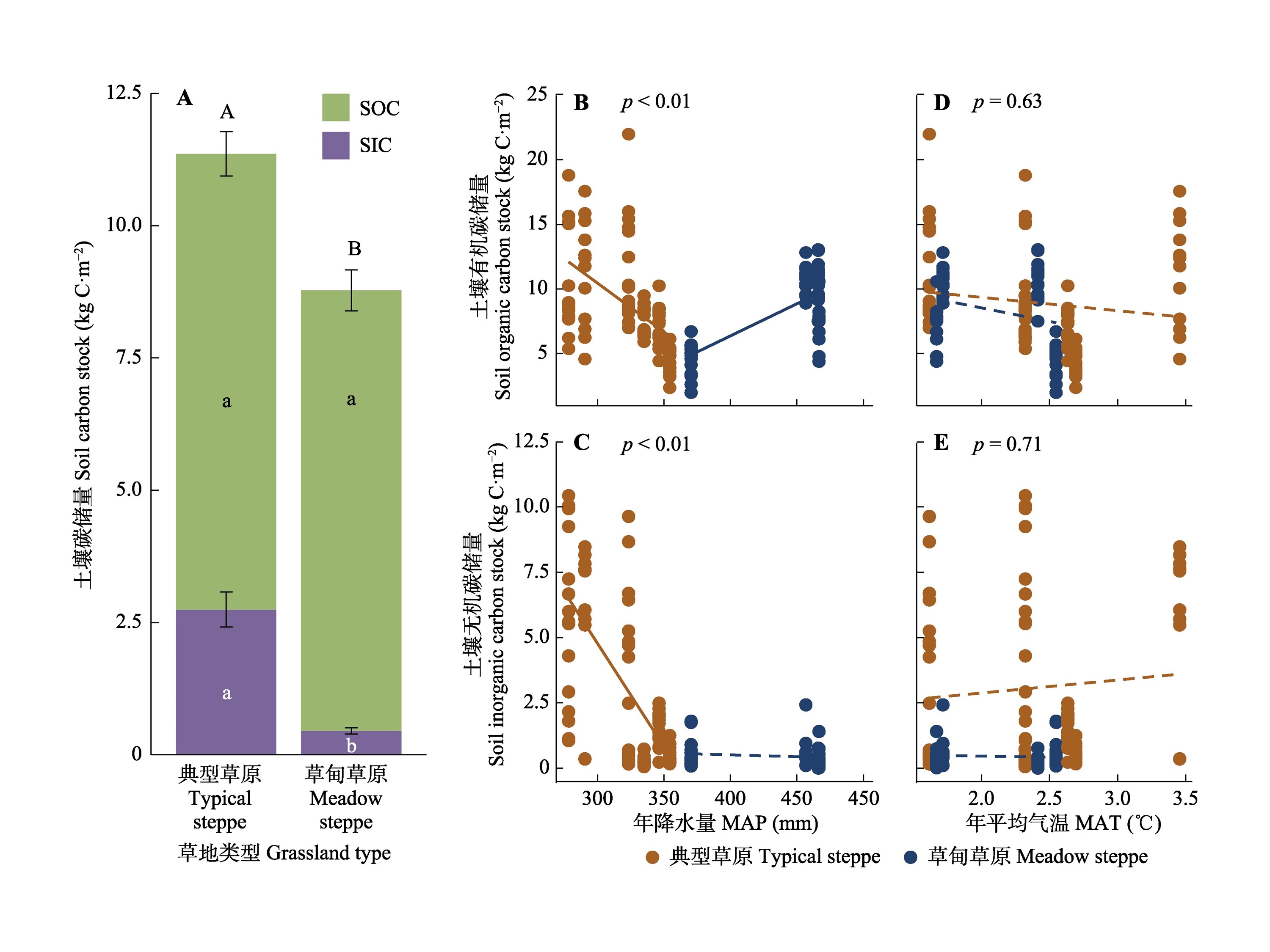
草地土壤碳库作为陆地生态系统碳库的核心组分, 其有机和无机组分在陆地碳循环和气候反馈中发挥着重要作用。然而, 现有研究多聚焦于土壤有机碳动态, 对综合考量两种组分的碳储量调控机制认知不足, 且对不同草地类型土壤碳储量在组分和空间分布的整体认识仍有待深化。该研究基于内蒙古温带草地的实地调查, 选取典型草原和草甸草原两种主要草地类型, 测定土壤理化性质、植物生物量及化学性状, 以及微生物生物量碳和群落组成。在此基础上, 利用增强回归树和结构方程模型, 探究气候、土壤、植物和微生物四类因素对土壤总碳及其有机和无机组分储量的相对重要性, 并探讨其潜在影响机制。研究发现, 典型草原0-60 cm土壤无机碳储量((2.75 ± 0.15) kg C·m-2)显著高于草甸草原((0.45 ± 0.03) kg C·m-2), 而土壤有机碳储量无显著差异(分别为(8.61 ± 0.19)和(8.32 ± 0.17) kg C·m-2), 致使典型草原的土壤总碳储量显著高于草甸草原。两类草地土壤有机碳含量均随深度递减; 但土壤无机碳含量在典型草原深层积累, 而草甸草原无此趋势。植被特征、气候和土壤属性等多种生物和非生物因素共同驱动了土壤总碳及其有机和无机组分储量的变化。不同草地类型土壤碳储量的主要调控因素存在差异: 在受水分限制较强的典型草原, 土壤碳储量主要受气候因素的调控; 而水分条件较好的草甸草原, 更多受到土壤因素的影响。该结果为准确评估温带草地土壤碳储量, 理解多因素交互作用下的土壤碳储量分配机制提供了科学依据。
关键词: 温带草地; 土壤碳储量; 土壤碳组分; 有机-无机碳耦合; 气候-植物-土壤互作
常鹏飞 , 李平 , 纳尔斯格 , 王静 , 王振华 , 杨森 , 贾舟 , 杨璐 , 刘玲莉 , 邓美凤 . 内蒙古温带草原不同草地类型土壤有机碳和无机碳储量对总碳储量的贡献及其驱动因素[J]. 植物生态学报, 2025 , 49(9) : 1374 -1387 . DOI: 10.17521/cjpe.2024.0443
Aims As a key component of terrestrial ecosystem carbon pools, soil carbon storage in grasslands, encompassing both soil organic carbon (SOC) and soil inorganic carbon (SIC) pools, plays a crucial role in terrestrial carbon cycling and climate feedback. However, current research has primarily focused on SOC dynamic, while the regulatory mechanisms governing the storage of both SOC and SIC remain poorly understood. The comprehensive understanding of soil carbon storage, including its composition and spatial distribution across different grassland types, is still lacking.
Methods Here, we conducted a field survey in temperate grasslands of Nei Mongol, selecting two grassland types: typical steppe and meadow steppe. We measured soil physicochemical properties, plant biomass and chemical traits, as well as microbial biomass carbon and community composition. Based on these data, we applied boosted regression trees and structural equation modeling to investigate the relative importance of the four explanatory factors—climatic, edaphic, vegetational, and microbial variables, in shaping total soil carbon storage and its organic and inorganic components. Additionally, we explored the mechanisms underlying their influence.
Important findings This study found that the SIC stock in the 0-60 cm soil layer of typical steppe ((2.75 ± 0.15) kg C·m-2) was significantly higher than that in meadow ((0.45 ± 0.03) kg C·m-2), while there was no significant difference in soil organic carbon storage ((8.61 ± 0.19) kg C·m-2 for typical steppe and (8.32 ± 0.17) kg C·m-2 for meadow), resulting in a significantly higher total soil carbon storage in typical grasslands compared to meadow grasslands. The SOC content of both grassland types decreased with soil depth. However, the SIC content in typical steppe exhibited pronounced accumulation in deeper soil layers, a pattern that was absent in meadow. Biotic and abiotic factors, including vegetation characteristics, climate, and soil properties, jointly influenced total soil carbon and its SOC and SIC components, with distinct regulatory mechanisms between grassland types. In typical steppe with strong water limitations, soil carbon storage was primarily regulated by climate factors, whereas in meadow steppe with relatively higher moisture availability, soil properties played a more prominent role. These findings provide a scientific basis for accurately assessing the soil carbon storage in temperate grasslands and enhance our understanding of the distribution mechanisms of soil carbon under multi-factor interactions.
| [1] | Bai YF, Cotrufo MF (2022). Grassland soil carbon sequestration: current understanding, challenges, and solutions. Science, 377, 603-608. |
| [2] | Basile-Doelsch I, Balesdent J, Pellerin S (2020). Reviews and syntheses: the mechanisms underlying carbon storage in soil. Biogeosciences, 17, 5223-5242. |
| [3] | Beerling DJ, Kantzas EP, Lomas MR, Wade P, Eufrasio RM, Renforth P, Sarkar B, Andrews MG, James RH, Pearce CR, Mercure JF, Pollitt H, Holden PB, Edwards NR, Khanna M, et al. (2020). Potential for large-scale CO2 removal via enhanced rock weathering with croplands. Nature, 583, 242-248. |
| [4] | Bossio DA, Cook-Patton SC, Ellis PW, Fargione J, Sanderman J, Smith P, Wood S, Zomer RJ, von Unger M, Emmer IM, Griscom BW (2020). The role of soil carbon in natural climate solutions. Nature Sustainability, 3, 391-398. |
| [5] | Bundy LG, Bremner JM (1972). A simple titrimetric method for determination of inorganic carbon in soils. Soil Science Society of America Journal, 36, 273-275. |
| [6] | Chen YJ, Fang K, Qin SQ, Guo YJ, Yang YH (2023). Spatial patterns and determinants of soil organic carbon component contents and decomposition rate in temperate grasslands of Nei Mongol, China. Chinese Journal of Plant Ecology, 47, 1245-1255. |
| [陈颖洁, 房凯, 秦书琪, 郭彦军, 杨元合 (2023). 内蒙古温带草地土壤有机碳组分含量和分解速率的空间格局及其影响因素. 植物生态学报, 47, 1245-1255.] | |
| [7] | Chen ZZ, Wang SP (2000). Typical Steppe Ecosystems of China. Science Press, Beijing. |
| [陈佐忠, 汪诗平 (2000). 中国典型草原生态系统. 科学出版社, 北京.] | |
| [8] | de Deyn GB, Cornelissen JHC, Bardgett RD (2008). Plant functional traits and soil carbon sequestration in contrasting biomes. Ecology Letters, 11, 516-531. |
| [9] | Deng MF, Li P, Liu WX, Chang PF, Yang L, Wang ZH, Wang J, Liu LL (2023). Deepened snow cover increases grassland soil carbon stocks by incorporating carbon inputs into deep soil layers. Global Change Biology, 29, 4686-4696. |
| [10] | Dong LW, Ran JZ, Luo JL, Bai L, Sun Y, Aqeel M, Zhang YH, Wang XT, Du QJ, Xiong JL, Gong HY, Hou QQ, Deng Y, Xia R, Wang L, et al. (2024). Inorganic carbon pools and their drivers in grassland and desert soils. Global Change Biology, 30, e17536. DOI: 10.1111/gcb.17536. |
| [11] | Feng JG, He KY, Zhang QF, Han MG, Zhu B (2022). Changes in plant inputs alter soil carbon and microbial communities in forest ecosystems. Global Change Biology, 28, 3426-3440. |
| [12] | Ferdush J, Paul V (2021). A review on the possible factors influencing soil inorganic carbon under elevated CO2. Catena, 204, 105434. DOI: 10.1016/j.catena.2021.105434. |
| [13] | Frank J, Stuanes AO (2003). Short-term effects of liming and vitality fertilization on forest soil and nutrient leaching in a Scots pine ecosystem in Norway. Forest Ecology and Management, 176, 371-386. |
| [14] | Frosteg?rd A, B??th E (1996). The use of phospholipid fatty acid analysis to estimate bacterial and fungal biomass in soil. Biology and Fertility of Soils, 22, 59-65. |
| [15] | Gandois L, Perrin AS, Probst A (2011). Impact of nitrogenous fertiliser-induced proton release on cultivated soils with contrasting carbonate contents: a column experiment. Geochimica et Cosmochimica Acta, 75, 1185-1198. |
| [16] | Georgiou K, Jackson RB, Vindu?ková O, Abramoff RZ, Ahlstr?m A, Feng WT, Harden JW, Pellegrini AFA, Polley HW, Soong JL, Riley WJ, Torn MS (2022). Global stocks and capacity of mineral-associated soil organic carbon. Nature Communications, 13, 3797. DOI: 10.1038/s41467-022-31540-9. |
| [17] | Huang XL, Jiang H, Li Y, Ma YC, Tang HY, Ran W, Shen QR (2016). The role of poorly crystalline iron oxides in the stability of soil aggregate-associated organic carbon in a rice-wheat cropping system. Geoderma, 279, 1-10. |
| [18] | Jackson RB, Lajtha K, Crow SE, Hugelius G, Kramer MG, Pi?eiro G (2017). The ecology of soil carbon: pools, vulnerabilities, and biotic and abiotic controls. Annual Review of Ecology, Evolution, and Systematics, 48, 419-445. |
| [19] | Jobbágy EG, Jackson RB (2000). The vertical distribution of soil organic carbon and its relation to climate and vegetation. Ecological Applications, 10, 423-436. |
| [20] | Kleber M, Bourg IC, Coward EK, Hansel CM, Myneni SCB, Nunan N (2021). Dynamic interactions at the mineral-organic matter interface. Nature Reviews Earth & Environment, 2, 402-421. |
| [21] | Li AG, Chen YR, Peng ZY, Ru JY, Liu WX (2025). Litter decomposition characteristics of steppe ecosystems with different precipitation gradients. Scientia Agricultura Sinica, 58, 117-126. |
| [李澳归, 陈亚茹, 彭子洋, 茹靖益, 刘卫星 (2025). 不同降水强度的草原生态系统凋落物分解特征. 中国农业科学, 58, 117-126.] | |
| [22] | Liang C, Schimel JP, Jastrow JD (2017). The importance of anabolism in microbial control over soil carbon storage. Nature Microbiology, 2, 17105. DOI: 10.1038/nmicrobiol.2017.105. |
| [23] | Liu LL, Sayer EJ, Deng MF, Li P, Liu WX, Wang X, Yang S, Huang JS, Luo J, Su YJ, Grünzweig JM, Jiang L, Hu SJ, Piao SL (2023). The grassland carbon cycle: mechanisms, responses to global changes, and potential contribution to carbon neutrality. Fundamental Research, 3, 209-218. |
| [24] | Liu WX, Zhang Z, Wan SQ (2009). Predominant role of water in regulating soil and microbial respiration and their responses to climate change in a semiarid grassland. Global Change Biology, 15, 184-195. |
| [25] | Lu RK (2000). Soil Agricultural Chemical Analysis Method. China Agricultural Science and Technology Press, Beijing. |
| [鲁如坤 (2000). 土壤农业化学分析方法. 中国农业科学技术出版社, 北京.] | |
| [26] | Lugato E, Lavallee JM, Haddix ML, Panagos P, Cotrufo MF (2021). Different climate sensitivity of particulate and mineral-associated soil organic matter. Nature Geoscience, 14, 295-300. |
| [27] | Ma WH, Yang YH, He JS, Zeng H, Fang JY (2008). Above- and belowground biomass in relation to environmental factors in temperate grasslands, Inner Mongolia. Science in China Series C: Life Sciences, 38, 84-92. |
| [马文红, 杨元合, 贺金生, 曾辉, 方精云 (2008). 内蒙古温带草地生物量及其与环境因子的关系. 中国科学C辑: 生命科学, 38, 84-92.] | |
| [28] | Ma YQ, Yu Y, Nan SZ, Chai Y, Xu WY, Qin Y, Li XL, Bodner G (2024). Conversion of SIC to SOC enhances soil carbon sequestration and soil structural stability in alpine ecosystems of the Qinghai-Tibet Plateau. Soil Biology & Biochemistry, 195, 109452. DOI: 10.1016/j.soilbio.2024.109452. |
| [29] | Malik AA, Martiny JBH, Brodie EL, Martiny AC, Treseder KK, Allison SD (2020). Defining trait-based microbial strategies with consequences for soil carbon cycling under climate change. The ISME Journal, 14, 1-9. |
| [30] | Malik AA, Puissant J, Buckeridge KM, Goodall T, Jehmlich N, Chowdhury S, Gweon HS, Peyton JM, Mason KE, van Agtmaal M, Blaud A, Clark IM, Whitaker J, Pywell RF, Ostle N, et al. (2018). Land use driven change in soil pH affects microbial carbon cycling processes. Nature Communications, 9, 3591. DOI: 10.1038/s41467-018-05980-1. |
| [31] | McLauchlan KK (2006). Effects of soil texture on soil carbon and nitrogen dynamics after cessation of agriculture. Geoderma, 136, 289-299. |
| [32] | Mi N, Wang SQ, Liu JY, Yu GR, Zhang WJ, Jobbágy E (2008). Soil inorganic carbon storage pattern in China. Global Change Biology, 14, 2380-2387. |
| [33] | Naorem A, Jayaraman S, Dalal RC, Patra A, Rao CS, Lal R (2022). Soil inorganic carbon as a potential sink in carbon storage in dryland soils—A review. Agriculture, 12, 1256. DOI: 10.3390/agriculture12081256. |
| [34] | Pan JX, Wang JS, Tian DS, Zhang RY, Li Y, Song L, Yang JM, Wei CX, Niu SL (2022). Biotic factors dominantly determine soil inorganic carbon stock across Tibetan alpine grasslands. Soil, 8, 687-698. |
| [35] | Raza S, Irshad A, Margenot A, Zamanian K, Li N, Ullah S, Mehmood K, Khan MA, Siddique N, Zhou JB, Mooney SJ, Kurganova I, Zhao XN, Kuzyakov Y (2024). Inorganic carbon is overlooked in global soil carbon research: a bibliometric analysis. Geoderma, 443, 116831. DOI: 10.1016/j.geoderma.2024.116831. |
| [36] | Raza S, Zamanian K, Ullah S, Kuzyakov Y, Virto I, Zhou JB (2021). Inorganic carbon losses by soil acidification jeopardize global efforts on carbon sequestration and climate change mitigation. Journal of Cleaner Production, 315, 128036. DOI: 10.1016/j.jclepro.2021.128036. |
| [37] | Retallack GJ (2005). Pedogenic carbonate proxies for amount and seasonality of precipitation in paleosols. Geology, 33, 333-336. |
| [38] | Sharififar A, Minasny B, Arrouays D, Boulonne L, Chevallier T, van Deventer P, Field DJ, Gomez C, Jang HJ, Jeon SH, Koch J, McBratney AB, Malone BP, Marchant BP, Martin MP, et al. (2023). Soil inorganic carbon, the other and equally important soil carbon pool: distribution, controlling factors, and the impact of climate change. Advances in Agronomy, 178, 165-231. |
| [39] | Sokol NW, Kuebbing SE, Karlsen-Ayala E, Bradford MA (2019). Evidence for the primacy of living root inputs, not root or shoot litter, in forming soil organic carbon. New Phytologist, 221, 233-246. |
| [40] | Tao JJ, Raza S, Zhao MZ, Cui JJ, Wang PZ, Sui YY, Zamanian K, Kuzyakov Y, Xu MG, Chen ZJ, Zhou JB (2022). Vulnerability and driving factors of soil inorganic carbon stocks in Chinese croplands. Science of the Total Environment, 825, 154087. DOI: 10.1016/j.scitotenv.2022.154087. |
| [41] | Vance ED, Brookes PC, Jenkinson DS (1987). An extraction method for measuring soil microbial biomass C. Soil Biology & Biochemistry, 19, 703-707. |
| [42] | Villarino SH, Pinto P, Jackson RB, Pi?eiro G (2021). Plant rhizodeposition: a key factor for soil organic matter formation in stable fractions. Science Advances, 7, eabd3176. DOI: 10.1126/sciadv.abd3176. |
| [43] | Wang BR, An SS, Liang C, Liu Y, Kuzyakov Y (2021). Microbial necromass as the source of soil organic carbon in global ecosystems. Soil Biology & Biochemistry, 162, 108422. DOI: 10.1016/j.soilbio.2021.108422. |
| [44] | Wu HB, Guo ZT, Gao Q, Peng CH (2009). Distribution of soil inorganic carbon storage and its changes due to agricultural land use activity in China. Agriculture, Ecosystems & Environment, 129, 413-421. |
| [45] | Wu HB, Guo ZT, Peng CH (2003). Distribution and storage of soil organic carbon in China. Global Biogeochemical Cycles, 17, 2001GB001844. DOI: 10.1029/2001GB001844. |
| [46] | Xiao KQ, Zhao Y, Liang C, Zhao MY, Moore OW, Otero-Fari?a A, Zhu YG, Johnson K, Peacock CL (2023). Introducing the soil mineral carbon pump. Nature Reviews Earth & Environment, 4, 135-136. |
| [47] | Yang YH, Shi Y, Sun WJ, Chang JF, Zhu JX, Chen LY, Wang X, Guo YP, Zhang HT, Yu LF, Zhao SQ, Xu K, Zhu JL, Shen HH, Wang YY, et al. (2022). Terrestrial carbon sinks in China and around the world and their contribution to carbon neutrality. Scientia Sinica Vitae, 52, 534-574. |
| [杨元合, 石岳, 孙文娟, 常锦峰, 朱剑霄, 陈蕾伊, 王欣, 郭焱培, 张宏图, 于凌飞, 赵淑清, 徐亢, 朱江玲, 沈海花, 王媛媛, 等 (2022). 中国及全球陆地生态系统碳源汇特征及其对碳中和的贡献. 中国科学: 生命科学, 52, 534-574.] | |
| [48] | Zaharescu DG, Burghelea CI, Dontsova K, Reinhard CT, Chorover J, Lybrand R (2020). Biological weathering in the terrestrial system: an evolutionary perspective// Dontsova K, Balogh-Brunstad Z, Le Roux G. Biogeochemical Cycles: Ecological Drivers and Environmental Impact. Wiley, Hoboken. |
| [49] | Zamanian K, Kuzyakov Y (2019). Contribution of soil inorganic carbon to atmospheric CO2: more important than previously thought. Global Change Biology, 25, e1-e3. |
| [50] | Zamanian K, Pustovoytov K, Kuzyakov Y (2016). Pedogenic carbonates: forms and formation processes. Earth-Science Reviews, 157, 1-17. |
| [51] | Zeglin LH, Bottomley PJ, Jumpponen A, Rice CW, Arango M, Lindsley A, McGowan A, Mfombep P, Myrold DD (2013). Altered precipitation regime affects the function and composition of soil microbial communities on multiple time scales. Ecology, 94, 2334-2345. |
| [52] | Zeng XM, Bastida F, Plaza C, Zhou GY, Vera A, Liu YR, Delgado-Baquerizo M (2023). The contribution of biotic factors in explaining the global distribution of inorganic carbon in surface soils. Global Biogeochemical Cycles, 37, e2023GB007957. DOI: 10.1029/2023GB007957. |
| [53] | Zhang YL, Xu AM, Shang HB, Ma AS (2006). Determination study of total nitrogen in soil and plant by continuous flow analytical system. Journal of Northwest A&F University (Natural Science Edition), 34(10), 128-132. |
| [张英利, 许安民, 尚浩博, 马爱生 (2006). AA3型连续流动分析仪测定土壤和植物全氮的方法研究. 西北农林科技大学学报(自然科学版), 34(10), 128-132.] | |
| [54] | Zhao QL, Li QC (2011). Simultaneous determination of 54 components in soil samples by inductively coupled plasma-atomic emission spectrometry. Rock and Mineral Analysis, 30, 75-78. |
| [赵庆令, 李清彩 (2011). 电感耦合等离子体发射光谱法同时测定土壤样品中54种组分. 岩矿测试, 30, 75-78.] | |
| [55] | Zhao W, Zhang R, Huang CQ, Wang BQ, Cao H, Koopal LK, Tan WF (2016). Effect of different vegetation cover on the vertical distribution of soil organic and inorganic carbon in the Zhifanggou Watershed on the Loess Plateau. Catena, 139, 191-198. |
| [56] | Zhao XN, Zhao CY, Stahr K, Kuzyakov Y, Wei XR (2020). The effect of microorganisms on soil carbonate recrystallization and abiotic CO2 uptake of soil. Catena, 192, 104592. DOI: 10.1016/j.catena.2020.104592. |
/
| 〈 |
|
〉 |
Copyright © 2026 版权所有 《植物生态学报》编辑部
地址: 北京香山南辛村20号, 邮编: 100093
Tel.: 010-62836134, 62836138; Fax: 010-82599431; E-mail: apes@ibcas.ac.cn, cjpe@ibcas.ac.cn
备案号: 京ICP备16067583号-19

