
生态学的再思考: 历史、理论和实践
收稿日期: 2025-06-12
录用日期: 2025-10-17
网络出版日期: 2025-12-25
基金资助
国家自然科学基金(32588202)
Rethinking about ecology: development, theories, and applications
Received date: 2025-06-12
Accepted date: 2025-10-17
Online published: 2025-12-25
Supported by
National Natural Science Foundation of China(32588202)
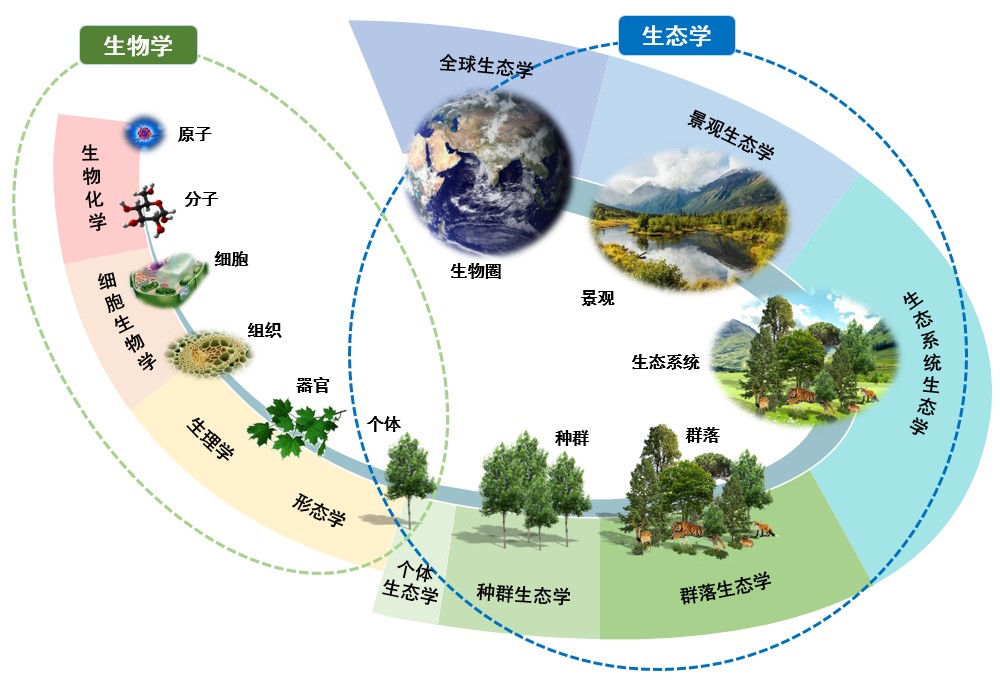
生态学是研究宏观生命系统内在规律及变化的科学, 是生态文明建设的科学基础。为适应学科发展的需要, 我国将生态学从生物学中独立出来, 作为独立的一级学科。为此, 亟须对生态学的学科体系、科学内涵、研究范畴及应用拓展进行梳理和重塑。该文对生态学的定义是: 研究宏观生命系统的结构、功能及其动态的科学, 它为人类认识、保护和利用自然提供理论基础和解决方案。现代生态学的研究涉及从分子、器官、个体到生物圈等不同组织层次, 但核心是个体、种群、群落、生态系统和景观五个层次。生态学的主干分支包括植物生态学、动物生态学、微生物生态学、生态系统生态学、景观生态学、修复生态学和可持续生态学。经过近160年的发展, 生态学产生了一系列重要概念和重要理论, 对推动自然科学的发展和人类文明的进步产生了重要影响。现代生态学具有鲜明的特点: 一是研究内容和研究范畴不断向宏观和微观方向拓展; 二是分子生物学、信息科学等技术和方法得到广泛应用; 三是野外控制实验和观测网络已成为发展趋势, 区域性和全球尺度的观测平台相继建立; 四是应用生态学受到更多重视, 为人类社会解决区域性和全球性生态与环境问题提供更多支持。生态学是人类认识和理解生命世界的自然观, 也是保护和改造自然世界的实践论。生态学认识和改造生命世界的方法论可以概括为五点: 层次观(生命系统具有多样的层次结构)、整体论(从整体论视角认识不同层次的生命现象)、系统论(以系统的观点看待生命世界)、演变论(从动态和演化的视角理解生命系统)和实践观(为保护、利用和改造自然世界提供方案和技术)。生态学研究的具体方法包括: 野外调查与观测、室内和室外实验、模型模拟, 以及整合分析等。虽然生态学及其各主干方向具有完整的理论体系, 但缺乏技术体系, 因此创建和发展核心技术对学科的持续健康发展至关重要。
方精云 , 石岳 , 朱江玲 , 沈海花 , 王志恒 . 生态学的再思考: 历史、理论和实践[J]. 植物生态学报, 2026 , 50(1) : 1 -23 . DOI: 10.17521/cjpe.2025.0220
Ecology explores the fundamental principles and dynamics of macro living-systems and provides the scientific foundation of ecological civilization. China has separated the ecology as an independent subject from the biology subject to better promote its development. This transition calls for a broader conceptual framework for the subject of ecology. In this article, we define “ecology” as “the science that studies the structures, functions and dynamics of macro living-systems”, which provides a theoretical guidance and practical solutions for maintaining sustainable biosphere. Current ecology encompasses multiple living-system levels from molecules to the biosphere, with its core focus on five key levels: individual, population, community, ecosystem, and landscape. The sub-subject system of ecology comprises seven core disciplines: Plant Ecology, Animal Ecology, Microbial Ecology, Ecosystem Ecology, Landscape Ecology, Restoration Ecology, and Sustainable Ecology. Over nearly 160 years, ecology has generated seminal concepts and landmark theories that have profoundly influenced natural science advancement and human civilization. Current ecology is characterized with four distinctive features: (1) expansion of research scope to both macro- and micro-scales; (2) broad adoption of methodologies from other fields such as molecular biology or information science; (3) increased attention to field-based experiments and observational networks, with platforms now established at regional and global scales; and (4) enhanced emphasis on applied ecology to address ecological challenges of human society. Serving as both a natural philosophy for comprehending the living world and a praxeology for conserving and utilizing nature, ecology can be framed through five core perspectives: (1) hierarchical perspective (recognizing the multiple structural levels of living systems), (2) holistic perspective (approaching ecological phenomena from an integrative viewpoint), (3) systematic perspective (viewing the living world as interconnected networks), (4) evolutionary perspective (understanding life systems as dynamic and evolving), and (5) practical perspective (developing solutions for sustainable stewardship of nature). Methodologically, ecological research relies on four principal approaches: field investigations, laboratory and in-situ controlled experiments, model simulations, and meta-analyses. Although ecology and its branches possess robust theoretical frameworks, they lack their own technological systems. Consequently, the development of core ecological technologies is essential to promote continued vitality and progression of the ecology discipline.
| [1] | Barrett GW (2001). Closing the ecological cycle: the emergence of integrative science. Ecosystem Health, 7, 79-84. |
| [2] | Barrett GW, Likens GE (2002). Eugene P. Odum: Pioneer of ecosystem ecology. BioScience, 52, 1047-1048. |
| [3] | Besson M, Alison J, Bjerge K, Gorochowski TE, H?ye TT, Jucker T, Mann HMR, Clements CF (2022). Towards the fully automated monitoring of ecological communities. Ecology Letters, 25, 2753-2775. |
| [4] | Clements FE (1905). Research Methods in Ecology. University Publishing Company, Lincoln. |
| [5] | Clements FE (1916). Plant Succession: an Analysis of the Development of Vegetation. Carnegie Institution of Washington, Washington D.C. |
| [6] | Currie DJ (2010). The theory of island biogeography revisited. BioScience, 60, 952-953. |
| [7] | de Boeck HJ, Vicca S, Roy J, Nijs I, Milcu A, Kreyling J, Jentsch A, Chabbi A, Campioli M, Callaghan T, Beierkuhnlein C, Beier C (2015). Global change experiments. BioScience, 65, 922-931. |
| [8] | Editorial Committee of Selected Works of Li Jitong (1986). Selected Works of Li Jitong. Science Press, Beijing. |
| [《李继侗文集》编辑委员会 (1986). 李继侗文集. 科学出版社, 北京.] | |
| [9] | Editorial Group of Selected Works of Liu Shen’e (1985). Selected Works of Liu Shen’e. Science Press, Beijing. |
| [《刘慎谔文集》编辑组 (1985). 刘慎谔文集. 科学出版社, 北京.] | |
| [10] | Egerton FN (2001). A history of the ecological sciences, part 2: Aristotle and Theophrastos. The Bulletin of the Ecological Society of America, 82, 149-152. |
| [11] | Egerton FN (2009). A history of the ecological sciences, part 32: Humboldt, nature’s geographer. The Bulletin of the Ecological Society of America, 90, 253-282. |
| [12] | Egerton FN (2010). History of the ecological sciences, part 35: the beginnings of British marine biology: Edward forbes and Philip Gosse. The Bulletin of the Ecological Society of America, 91, 176-201. |
| [13] | Egerton FN (2011). History of ecological sciences, part 39: Henry David Thoreau, ecologist. The Bulletin of the Ecological Society of America, 92, 251-275. |
| [14] | Egerton FN (2013). History of ecological sciences, part 48: Formalizing plant ecology, about 1870 to mid-1920s. The Bulletin of the Ecological Society of America, 94, 341-378. |
| [15] | Egerton FN (2014). History of ecological sciences, part 49: Formalizing animal ecology, 1870s to 1920s. The Bulletin of the Ecological Society of America, 95, 59-81. |
| [16] | Egerton FN (2015). History of ecological sciences, part 54: Succession, community, and continuum. The Bulletin of the Ecological Society of America, 96, 426-474. |
| [17] | Elton CS (1927). Animal Ecology. Sidgwick and Jackson, London. |
| [18] | Fang JY (1995). Kira Tatsuo and the development of ecology. Chinese Journal of Ecology, 14, 70-75. |
| [方精云 (1995). 吉良龙夫与生态学的发展. 生态学杂志, 14, 70-75.] | |
| [19] | Fang JY (2021). Re-constructing the disciplinary system of ecology in a new age. Universities and Disciplines, 2(4), 61-73. |
| [方精云 (2021). 生态学学科体系的再构建. 大学与学科, 2(4), 61-73.] | |
| [20] | Fang JY (2025). The Encyclopedia of China (Third Edition): Ecology. Encyclopedia of China Publishing House, Beijing. |
| [方精云 (2025). 中国大百科全书(第三版): 生态学. 中国大百科全书出版社, 北京.] | |
| [21] | Fang JY, Liu LL (2021). Ecosystem Ecology: Reviews and Perspectives. Higher Education Press, Beijing. |
| [方精云, 刘玲莉 (2021). 生态系统生态学——回顾与展望. 高等教育出版社, 北京.] | |
| [22] | Fang JY, Song YC, Liu HY, Piao SL (2002). Vegetation-climate relationship and its application in the division of vegetation zone in China. Journal of Integrative Plant Biology, 44, 1105-1122. |
| [方精云, 宋永昌, 刘鸿雁, 朴世龙 (2002). 植被气候关系与我国的植被分区. 植物学报, 44, 1105-1122.] | |
| [23] | Fang JY, Wang XP, Shen ZH, Tang ZY, He JS, Yu D, Jiang Y, Wang ZH, Zheng CY, Zhu JL, Guo ZD (2009). Methods and protocols for plant community inventory. Biodiversity Science, 17, 533-548. |
| [方精云, 王襄平, 沈泽昊, 唐志尧, 贺金生, 于丹, 江源, 王志恒, 郑成洋, 朱江玲, 郭兆迪 (2009). 植物群落清查的主要内容、方法和技术规范. 生物多样性, 17, 533-548.] | |
| [24] | Fang JY, Zhu JL, Ji CJ, Tang ZY, He JS (2013). Ecological perspectives on ecological civilization construction. Bulletin of Chinese Academy of Sciences, 28, 182-188. |
| [方精云, 朱江玲, 吉成均, 唐志尧, 贺金生 (2013). 从生态学观点看生态文明建设. 中国科学院院刊, 28, 182-188.] | |
| [25] | Feng ZW, Chen CY, Zhang JW, Wang KP, Zhao JL, Gao H (1982). Determination of biomass of Pinus massoniana stand in Huitong County, Hunan Province. Scientia Silvae Sinicae, 18, 127-134. |
| [冯宗炜, 陈楚莹, 张家武, 王开平, 赵吉录, 高虹 (1982). 湖南会同地区马尾松林生物量的测定. 林业科学, 18, 127-134.] | |
| [26] | Gleason HA (1917). The structure and development of the plant association. Bulletin of the Torrey Botanical Club, 44, 463-481. |
| [27] | Guo YT, Li SC, Wang Z, Xie Y, Yang X, Zhou GJ, You CH, Zhu SN, Gao JX (2025). Coverage and distribution of national key protected wild species in China’s nature reserves. Biodiversity Science, 33, 198-206. |
| [郭雨桐, 李素萃, 王智, 解焱, 杨雪, 周广金, 尤春赫, 朱萨宁, 高吉喜 (2025). 全国自然保护地对国家重点保护野生物种的覆盖度及其分布状况. 生物多样性, 33, 198-206.] | |
| [28] | Han WX, Fang JY, Guo DL, Zhang Y (2005). Leaf nitrogen and phosphorus stoichiometry across 753 terrestrial plant species in China. New Phytologist, 168, 377-385. |
| [29] | Harper JL (1960). Factors controlling plant numbers//Harper JL. The Biology of Weeds, a Symposium of the British Ecological Society. Blackwells, Oxford. 119-132. |
| [30] | He JS, Han XG (2010). Ecological stoichiometry: searching for unifying principles from individuals to ecosystems. Chinese Journal of Plant Ecology, 34, 2-6. |
| [贺金生, 韩兴国 (2010). 生态化学计量学: 探索从个体到生态系统的统一化理论. 植物生态学报, 34, 2-6.] | |
| [31] | He NP, Li Y, Liu CC, Xu L, Li MX, Zhang JH, He JS, Tang ZY, Han XG, Ye Q, Xiao CW, Yu Q, Liu SR, Sun W, Niu SL, et al. (2020). Plant trait networks: improved resolution of the dimensionality of adaptation. Trends in Ecology & Evolution, 35, 908-918. |
| [32] | Heckel DG (2012). Ecology. Insecticide resistance after Silent Spring. Science, 337, 1612-1614. |
| [33] | Hortal J, Diniz-Filho JAF, Low MEY, Stigall AL, Yeo DCJ (2023). Alfred Russel Wallace’s legacy: an interdisciplinary conception of evolution in space and time. NPJ Biodiversity, 2, 3. DOI: 10.1038/s44185-023-00010-w. |
| [34] | Hou XY (1941). Plant distribution and soils in northern and central Guizhou. Quarterly of Soil, 1(3), 8-21. |
| [侯学煜 (1941). 贵州中北部之植物分布与土壤. 土壤季刊, 1(3), 8-21.] | |
| [35] | J?rgensen SE (2016). Ecological Model Types. Elsevier, Amsterdam. |
| [36] | Kendeigh SC (1968). Victor Ernest Shelford, Eminent Ecologist, 1968. The Bulletin of the Ecological Society of America, 49, 97-100. |
| [37] | Kingsland S (1982). The refractory model: the logistic curve and the history of population ecology. The Quarterly Review of Biology, 57, 29-52. |
| [38] | Kormondy EJ (2012). A brief introduction to the history of ecology. The American Biology Teacher, 74, 441-443. |
| [39] | Kovda VA (1993). The earth’s living matter: biosphere and soils. Environmental Conservation, 20, 199-204. |
| [40] | Krebs CJ (2001). Ecology: the Experimental Analysis of Distribution and Abundance. 5th ed. Benjamin Cummings, San Francisco. |
| [41] | Lenton TM (2022). James Lovelock (1919-2022). Science, 377, 927. |
| [42] | Li B (2000). Ecology. Higher Education Press, Beijing. |
| [李博 (2000). 生态学. 高等教育出版社, 北京.] | |
| [43] | Li W (2010). Progresses and perspectives of ecological research in China. Journal of Resources and Ecology, 1, 3-14. |
| [44] | Li WH, Deng KM, Li F (1981). Study on biomass and primary production of main ecosystems in Changbai Mountain. Research of Forest Ecosystem, 2, 34-50. |
| [李文华, 邓坤枚, 李飞 (1981). 长白山主要生态系统生物量生产量的研究. 森林生态系统研究, 2, 34-50.] | |
| [45] | Likens GE (1992). The Ecosystem Approach: Its Use and Abuse. Ecology Institute, Oldenhorf/Luhe, Germany. |
| [46] | Lindeman RL (1942). The trophic-dynamic aspect of ecology. Ecology, 23, 399-417. |
| [47] | Lipsey MW, Wilson DB (2001). Practical Meta-Analysis. SAGE Publications, London. |
| [48] | Lubchenco J, Olson AM, Brubaker LB, Carpenter SR, Holland MM, Hubbell SP, Levin SA, MacMahon JA, Matson PA, Melillo JM, Mooney HA, Peterson CH, Pulliam HR, Real LA, Regal PJ, et al. (1991). The sustainable biosphere initiative: an ecological research agenda: a report from the ecological society of America. Ecology, 72, 371-412. |
| [49] | Wand DL (2026). On the general principles in ecology. Chinese Journal of Plant Ecology, 50, 24-33. |
| [王德利 (2026). 生态学的基本原理. 植物生态学报, 50, 24-33.] | |
| [50] | Mao JF, Wang B, Dai YJ (2006). Perspective on terrestrial ecosystem models and their coupling with climate system models. Climatic and Environmental Research, 11, 763-771. |
| [毛嘉富, 王斌, 戴永久 (2006). 陆地生态系统模型及其与气候模式耦合的回顾. 气候与环境研究, 11, 763-771.] | |
| [51] | Meine C (2022). Land, ethics, justice, and Aldo Leopold. Socio-Ecological Practice Research, 4, 167-187. |
| [52] | Miller JG (1978). Living Systems. McGraw-Hill, New York. |
| [53] | Nielsen CO (1960). Fundamentals of ecology. Ecology, 41, 400-401. |
| [54] | Odum EP (1971). Fundamentals of Ecology. 3rd ed. W. B. Saunders Co., Philadelphia. |
| [55] | Odum EP (1977). The emergence of ecology as a new integrative discipline: ecology must combine holism with reductionism if applications are to benefit society. Science, 195, 1289-1293. |
| [56] | Odum EP (1986). Introductory review: perspectives of ecosystem theory and application//Polunin N. Ecosystem Theory and Application. John Wiley & Sons, Chichester. 1-11. |
| [57] | Pence CH, Swaim DG (2018). The economy of nature: the structure of evolution in Linnaeus, Darwin, and the modern synthesis. European Journal for Philosophy of Science, 8, 435-454. |
| [58] | Pringle H (1998). The slow birth of agriculture. Science, 282, 1446. |
| [59] | Quek SL (2024). The translation journey from “?cologie” to the Chinese terms “生態”/“生態學”. Wakumon, 45, 25-44. |
| [60] | Reich PB (2005). Global biogeography of plant chemistry: filling in the blanks. New Phytologist, 168, 263-266. |
| [61] | Ricklefs RE (2001). The Economy of Nature. 5th ed. W. H. Freeman and Company, New York. |
| [62] | Scheiner SM, Gurevitch J (2001). Design and Analysis of Ecological Experiments. 2nd ed. Oxford University Press, New York. |
| [63] | Shelford BVE (1913). Animal Communities in Temperate America as Illustrated in the Chicago Region: a Study in Animal Ecology. The University of Chicago Press, Chicago. |
| [64] | Shinozaki K, Kira T (1956). Intraspecific competition among higher plants VII: Logistic theory of the C-D effect. Journal of the Institute of Polytechnics, Osaka City University, Series D, 7, 35-72. |
| [65] | Stauffer RC (1957). Haeckel, Darwin, and ecology. The Quarterly Review of Biology, 32, 138-144. |
| [66] | Sterner RW, Elser JJ (2002). Ecological Stoichiometry: the Biology of Elements from Molecules to the Biosphere. Princeton University Press, Princeton. |
| [67] | Sukachev VN (1958). On the principles of genetic classification in biocenology. Ecology, 39, 364-367. |
| [68] | Sun YF, Yang YH, Zhao X, Tang ZY, Wang SP, Fang JY (2021). Global patterns and climatic drivers of above- and belowground net primary productivity in grasslands. Science China: Life Sciences, 64, 739-751. |
| [69] | Tansley AG (1935). The use and abuse of vegetational concepts and terms. Ecology, 16, 284-307. |
| [70] | Tian D, Yan ZB, Fang JY (2021). Review on characteristics and main hypotheses of plant ecological stoichiometry. Chinese Journal of Plant Ecology, 45, 682-713. |
| [田地, 严正兵, 方精云 (2021). 植物生态化学计量特征及其主要假说. 植物生态学报, 45, 682-713.] | |
| [71] | van der Ploeg RR, B?hm W, Kirkham MB (1999). On the origin of the theory of mineral nutrition of plants and the law of the minimum. Soil Science Society of America Journal, 63, 1055-1062. |
| [72] | Yoda K, Kira T, Ogawa H, Hozumi K (1963). Self-thinning in overcrowded pure stands under cultivated and natural conditions. Journal of Biology, Osaka City University, 14, 107-129. |
| [73] | Yu GR, Yu XB (2013). Chinese Ecosystem Research Network (CERN) and natural ecosystem protection. Bulletin of Chinese Academy of Sciences, 28, 275-283. |
| [于贵瑞, 于秀波 (2013). 中国生态系统研究网络与自然生态系统保护. 中国科学院院刊, 28, 275-283.] | |
| [74] | Zheng FY, Lu HF, Peng SL (2005). Advantages and disadvantages in ecological meta-analyses. Ecology and Environment, 14, 417-421. |
| [郑凤英, 陆宏芳, 彭少麟 (2005). 整合分析在生态学应用中的优势及存在的问题. 生态环境, 14, 417-421.] | |
| [75] | Zheng SZ, Wu QH, Wang HB, Tao Y (1994). General Ecology: Principles, Methods, and Applications. Fudan University Press, Shanghai. |
| [郑师章, 吴千红, 王海波, 陶芸 (1994). 普通生态学:原理、方法和应用. 复旦大学出版社, 上海.] | |
| [76] | Zhou LY (1984). In memory of professor Zhang Ting on the centenary of his birth. Bulletin of Biology, 19(6), 61-62. |
| [周凌云 (1984). 纪念张珽教授诞辰一百周年. 生物学通报, 19(6), 61-62.] |
/
| 〈 |
|
〉 |
Copyright © 2026 版权所有 《植物生态学报》编辑部
地址: 北京香山南辛村20号, 邮编: 100093
Tel.: 010-62836134, 62836138; Fax: 010-82599431; E-mail: apes@ibcas.ac.cn, cjpe@ibcas.ac.cn
备案号: 京ICP备16067583号-19

