
生态学的基本原理
收稿日期: 2025-06-19
录用日期: 2026-01-21
网络出版日期: 2026-01-26
基金资助
国家自然科学基金(32061143027)
On the general principles in ecology
Received date: 2025-06-19
Accepted date: 2026-01-21
Online published: 2026-01-26
Supported by
National Natural Science Foundation of China(32061143027)
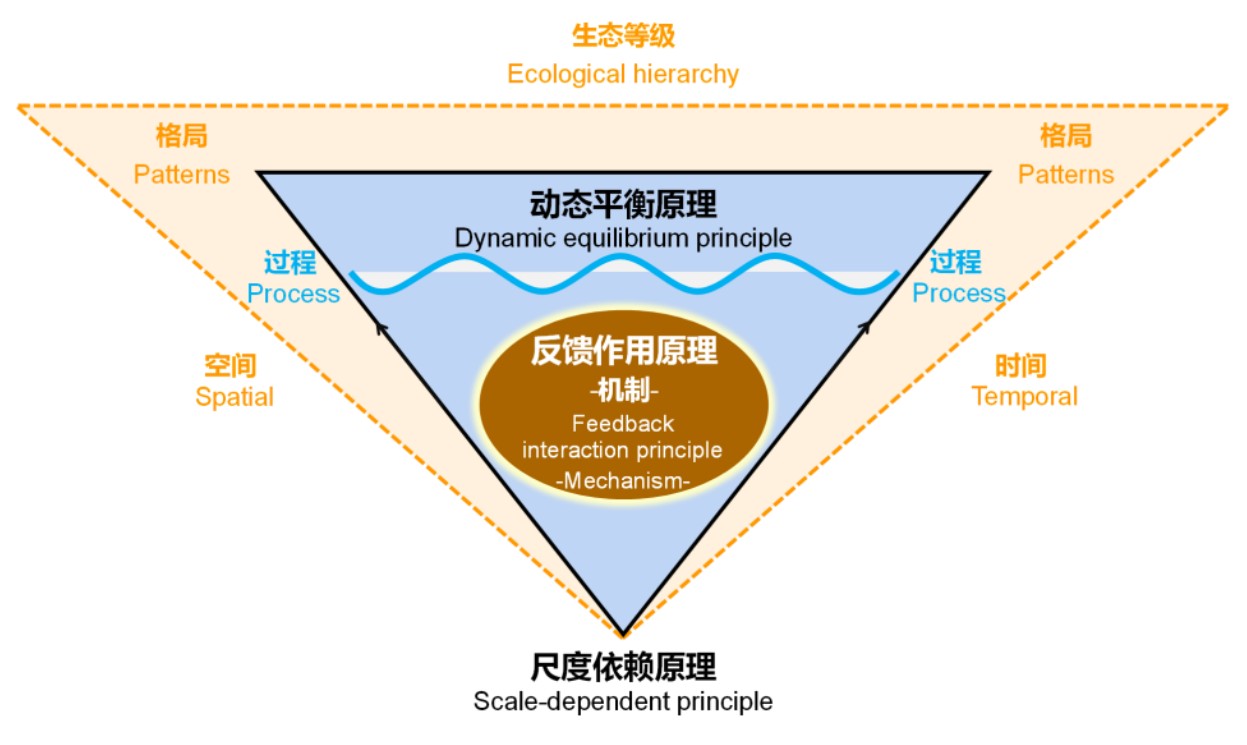
从学科的基本概念与理论现状来看, 生态学的学科体系正处于快速发展阶段。该文通过分析、综合及辩证的方式, 详细阐述了生态学可能的基本原理: (1)尺度依赖原理: 所有生态过程变化的规律性和作用机制均依赖于时空尺度, 以及生态组织或等级性, 相应的概念和理论基本上是适应于一定尺度而被提出, 试图构建横跨所有尺度的理论始终面临着挑战; (2)动态平衡原理: 由于生态系统的开放性, 尤其是生物和生态代谢的特性, 某一阶段的生态过程或某一状态的生态系统仅能形成动态平衡, 其性质取决于系统自身的调节能力(抵抗力与恢复力)和所处的演替阶段, 演替顶极通常是系统的一个稳定平衡状态, 此后系统开始转向非平衡状态; (3)反馈作用原理: 反馈作用决定或调控生态过程或生态系统的性质与功能, 正反馈可以导致生态过程或系统呈现单向增加或减少的变化, 而负反馈则能够维持生态平衡(包括生物稳态), 在生态-进化过程中反馈作用之间的平衡调控着生态系统的稳定或不稳定状态。实际上, 尺度依赖原理是针对生态现象和过程的总体认识视角而言, 动态平衡原理是着重于生态过程或状态的性质之考虑, 而反馈作用原理是聚焦于生态学核心问题——相互作用(生物与生物之间和生物与非生物之间)的概括。这些生态学基本原理既具有相对的独立性, 也存在一定的相容性, 它们存在着内在的必然联系。认识并确立生态学的基本原理, 不仅会促进生态学概念与理论的发展, 更有益于生态学科学框架的构建及精进完善。
王德利 . 生态学的基本原理[J]. 植物生态学报, 2026 , 50(1) : 24 -33 . DOI: 10.17521/cjpe.2025.0232
In line with the evolution of fundamental concepts and theories in the discipline, ecology persists in developing its conceptual and theoretical framework. This paper puts forward and expounds on the potential foundational principles of ecology through the application of analytical, synthetic, and dialectical methods. (1) Scale-dependent principle. The regularities and mechanisms governing ecological processes are contingent upon spatial and temporal scales, as well as ecological organization or hierarchy. Corresponding concepts and theories are typically formulated for specific scales. Constructing a comprehensive theory that spans all scales continues to pose a substantial challenge. (2) Dynamic equilibrium principle. Considering the openness of ecosystems, especially their biological and ecological metabolic characteristics, a specific stage in an ecological process or a particular state of an ecosystem can only attain a dynamic equilibrium. The nature of this equilibrium depends on the system’s inherent regulatory capacity, encompassing both resistance and resilience, as well as the stage of succession. Typically, the climax of ecological succession signifies a stable equilibrium state for the ecosystem or community. Following this climax, the system may possibly shift into a non-equilibrium condition. (3) Feedback interaction principle. Feedback interactions play a crucial role in determining and regulating the nature and function of ecological processes and systems. Positive feedback can lead to unidirectional amplification or diminishment of these processes, while negative feedback generally maintains the equilibrium of ecological systems, including biological homeostasis. The dynamic balance between positive and negative feedback mechanisms within the ecological-evolutionary process governs the stability or instability of ecosystems. In actuality, the scale-dependent principle addresses the overarching cognitive perspective of ecological phenomena and processes, while the dynamic equilibrium principle focuses on the intrinsic nature of ecological processes or states. The feedback interaction principle, underscores the core issues in ecology, particularly the interactions among living organisms and between living organisms and non-living entities. These fundamental ecological principles or rules exhibit both relative independence and a degree of compatibility, yet they are inherently and inevitably interconnected. Understanding and establishing the fundamental principles of ecology will not only facilitate the progress of ecological concepts and theories but also contribute to the development and improvement of the scientific framework of ecology.
| [1] | Bechtel W, Bich L (2024). Situating homeostasis in organisms: maintaining organization through time. Journal of Physiology, 602, 6003-6020. |
| [2] | Belyea LR, Lancaster J (1999). Assembly rules within a contingent ecology. Oikos, 86, 402-416. |
| [3] | Berryman AA (1999). Principles of Population Dynamics and Their Application. Taylor & Francis, London. |
| [4] | Bonanomi G, Giannino F, Mazzoleni S (2005). Negative plant-soil feedback and species coexistence. Oikos, 111, 311-321. |
| [5] | Brown JH, Gillooly JF, Allen AP, Savage VM, West GB (2004). Toward a metabolic theory of ecology. Ecology, 85, 1771-1789. |
| [6] | Clements FE (1916). Plant Succession: an Analysis of the Development of Vegetation. Carnegie Institution of Washington, Washington D.C. |
| [7] | Clements FE (1936). Nature and structure of the climax. Journal of Ecology, 24, 252-284. |
| [8] | Cuddington K (2001). The “balance of nature” metaphor and equilibrium in population ecology. Biology and Philosophy, 16, 463-479. |
| [9] | Dakos V, Matthews B, Hendry AP, Levine J, Loeuille N, Norberg J, Nosil P, Scheffer M, de Meester L (2019). Ecosystem tipping points in an evolving world. Nature Ecology & Evolution, 3, 355-362. |
| [10] | DeAngelis DL, Waterhouse JC (1987). Equilibrium and nonequilibrium concepts in ecological models. Ecological Monographs, 57, 1-21. |
| [11] | Elton C (1927). Animal Ecology. MacMillan, New York. |
| [12] | Fang JY (2021). Re-constructing the disciplinary system of ecology in a new age. Universities and Disciplines, 2(4), 61-73. |
| [方精云 (2021). 生态学学科体系的再构建. 大学与学科, 2(4), 61-73.] | |
| [13] | Fang JY, Shi Y, Zhu JL, Shen HH, Wang ZH (2026). Rethinking about ecology: development, theories, and applications. Chinese Journal of Plant Ecology, 50, 1-23. |
| [方精云, 石岳, 朱江玲, 沈海花, 王志恒 (2026). 生态学的再思考: 历史、理论和实践. 植物生态学报, 50, 1-23.] | |
| [14] | Gause GF (1934). Experimental analysis of Vito Volterra’s mathematical theory of the struggle for existence. Science, 79, 16-17. |
| [15] | Grinnell J (1917). The niche-relationships of the California thrasher. The Auk, 34, 427-433. |
| [16] | Han WX, Fang JY (2008). Self-thinning Law in plant populations: -3/2 vs -4/3? Acta Scientiarum Naturalium Universitatis Pekinensis, 44, 661-668. |
| [韩文轩, 方精云 (2008). 植物种群的自然稀疏规律——-3/2还是-4/3? 北京大学学报(自然科学版), 44, 661-668.] | |
| [17] | Hatton IA, Mazzarisi O, Altieri A, Smerlak M (2024). Diversity begets stability: sublinear growth and competitive coexistence across ecosystems. Science, 383, eadg8488. DOI: 10.1126/science.adg8488. |
| [18] | Hooper DU, Chapin FS III, Ewel JJ, Hector A, Inchausti P, Lavorel S, Lawton JH, Lodge DM, Loreau M, Naeem S, Schmid B, Set?l? H, Symstad AJ, Vandermeer J, Wardle DA (2005). Effects of biodiversity on ecosystem functioning: a consensus of current knowledge. Ecological Monographs, 75, 3-35. |
| [19] | Janzen DH (1980). When is it coevolution? Evolution, 34, 611-612. |
| [20] | Lawton JH (1999). Are there general laws in elology? Oikos, 84, 177-192. |
| [21] | Leibold MA, Holyoak M, Mouquet N, Amarasekare P, Chase JM, Hoopes MF, Holt RD, Shurin JB, Law R, Tilman D, Loreau M, Gonzalez A (2004). The metacommunity concept: a framework for multi-scale community ecology. Ecology Letters, 7, 601-613. |
| [22] | Levins R (1969). Some demographic and genetic consequences of environmental heterogeneity for biological control. Bulletin of Entomological Society America, 15, 237-240. |
| [23] | Levin SA (1992). The problem of pattern and scale in ecology. Ecology, 73, 1943-1967. |
| [24] | Lindeman RL (1942). The trophic-dynamic aspect of ecology. Ecology, 23, 399-417. |
| [25] | Loreau M, de Mazancourt C (2013). Biodiversity and ecosystem stability: a synthesis of underlying mechanisms. Ecology Letters, 16, 106-115. |
| [26] | Lotka AJ (1925). Elements of Physical Biology. Williams & Wilkins, Baltimore. |
| [27] | Lovelock JE, Margulis L (1974). Atmospheric homeostasis by and for the biosphere: the gaia hypothesis. Tellus, 26, 2-9. |
| [28] | MacArthur RH, Wilson EO (1963). An equilibrium theory of insular zoogeography. Evolution, 17, 373-387. |
| [29] | Marquet PA, Allen AP, Brown JH, Dunne JA, Enquist BJ, Gillooly JF, Gowaty PA, Green JL, Harte J, Hubbell SP, O’Dwyer J, Okie JG, Ostling A, Ritchie M, Storch D, et al. (2014). On theory in ecology. BioScience, 64, 701-710. |
| [30] | May RM (1971). Stability in multispecies community models. Mathematical Biosciences, 12, 59-79. |
| [31] | May RM (1973). Qualitative stability in model ecosystems. Ecology, 54, 638-641. |
| [32] | May RM (1977). Thresholds and breakpoints in ecosystems with a multiplicity of stable states. Nature, 269, 471-477. |
| [33] | Morris DW (1987). Tests of density-dependent habitat selection in a patchy environment. Ecological Monographs, 57, 269-281. |
| [34] | Niu S, Xing X, Zhang Z, Xia J, Zhou X, Song B, Li L, Wan S (2011). Water-use efficiency in response to climate change: from leaf to ecosystem in a temperate steppe. Global Change Biology, 17, 1073-1082. |
| [35] | Odum EP (1968). Energy flow in ecosystems: a historical review. The American Zoologist, 8, 11-18. |
| [36] | Odum EP (1969). The strategy of ecosystem development. Science, 164, 262-270. |
| [37] | Paine RT (1966). Food web complexity and species diversity. American Naturalist, 100, 65-75. |
| [38] | Pásztor L, Botta-Dukát Z, Magyar G, Czárán T, Meszéna G (2016). Theory-Based Ecology: a Darwinian Approach. Oxford University Press, Oxford. |
| [39] | Perry DA (1995). Self-organizing systems across scales. Trends in Ecology & Evolution, 10, 241-244. |
| [40] | Pringle RM, Abraham JO, Anderson TM, Coverdale TC, Davies AB, Dutton CL, Gaylard A, Goheen JR, Holdo RM, Hutchinson MC, Kimuyu DM, Long RA, Subalusky AL, Veldhuis MP (2023). Impacts of large herbivores on terrestrial ecosystems. Current Biology, 33, R584-R610. |
| [41] | Qi QH, Yin CJ, Sheng XW (1997). Modelling relationships between photosynthetic rate and environmental factors in different growing periods in Aneurolepidium chinense community. Acta Ecologica Sinica, 17, 170-175. |
| [戚秋慧, 尹承军, 盛修武 (1997). 不同时期羊草群落光合速率与环境条件之间的关系模型. 生态学报, 17, 170-175.] | |
| [42] | Reed JM, Wolfe BE, Romero LM (2024). Is resilience a unifying concept for the biological sciences? iScience, 27, 109478. DOI: 10.1016/j.isci.2024.109478. |
| [43] | Reynolds HL, Packer A, Bever JD, Clay K (2003). Grassroots ecology: plant-microbe-soil interactions as drivers of plant community structure and dynamics. Ecology, 84, 2281-2291. |
| [44] | Rietkerk M, Dekker SC, de Ruiter PC, Koppel J (2004). Self-organized patchiness and catastrophic shifts in ecosystems. Science, 305, 1926-1929. |
| [45] | Rietkerk M, van de Koppel J (2008). Regular pattern formation in real ecosystems. Trends in Ecology & Evolution, 23, 169-175. |
| [46] | Russo NJ, Davies AB, Blakey RV, Ordway EM, Smith TB (2023). Feedback loops between 3D vegetation structure and ecological functions of animals. Ecology Letters, 26, 1597-1613. |
| [47] | Scheiner SM, Willig MR (2008). A general theory of ecology. Theoretical Ecology, 1, 21-28. |
| [48] | Stephens DW, Krebs JR (1986). Foraging Theory. Princeton University Press, Princeton. |
| [49] | Sterner RW, Elser JJ (2002). Ecological Stoichiometry: the Biology of Elements from Molecules to the Biosphere. Princeton University Press, Princeton. |
| [50] | Sullivan BW, DuBose RL, Nasto MK, Alvarez-Clare S, Dencker CM, Soper FM, Shoemaker KT, Ishida FY, Zaragoza- Castells J, Davidson EA, Cleveland CC (2019). Biogeochemical recuperation of lowland tropical forest during succession. Ecology, 100, e02641. DOI: 10.1002/ecy.2641. |
| [51] | Sveen TR, Hannula SE, Bahram M (2024). Microbial regulation of feedbacks to ecosystem change. Trends in Microbiology, 32, 68-78. |
| [52] | Tilman D, Reich PB, Knops JMH (2006). Biodiversity and ecosystem stability in a decade-long grassland experiment. Nature, 441, 629-632. |
| [53] | Tilman D, Isbell F, Cowles JM (2014). Biodiversity and ecosystem functioning. Annual Review of Ecology, Evolution, and Systematics, 45, 471-493. |
| [54] | Turchin P (2001). Does population ecology have general laws? Oikos, 94, 17-26. |
| [55] | van Breugel M, Bongers F, Norden N, Meave JA, Amissah L, Chanthorn W, Chazdon R, Craven D, Farrior C, Hall JS, Hérault B, Jakovac C, Lebrija-Trejos E, Martínez-Ramos M, Mu?oz R, et al. (2024). Feedback loops drive ecological succession: towards a unified conceptual framework. Biological Reviews, 99, 928-949. |
| [56] | Volterra V (1926). Fluctuations in the abundance of a species considered mathematically. Nature, 118, 558-560. |
| [57] | Wang DL, Wang ZW, Zhang XJ (1999). The comparison of photosynthetic physiological characteristics between the two divergent Aneurolepidium chinense types. Acta Ecologica Sinica, 19, 837-843. |
| [王德利, 王正文, 张喜军 (1999). 羊草两个趋异类型的光合生理生态特性比较的初步研究. 生态学报, 19, 837-843.] | |
| [58] | Wang DL, Liang CZ (2023). Restoration state of degraded grasslands: climate climax or disturbance climax? Chinese Journal of Plant Ecology, 47, 1464-1470. |
| [王德利, 梁存柱 (2023). 退化草原的恢复状态: 气候顶极或干扰顶极? 植物生态学报, 47, 1464-1470.] | |
| [59] | Wang SP, Loreau M (2014). Ecosystem stability in space: α, β and γ variability. Ecology Letters, 17, 891-901. |
| [60] | West GB, Brown JH, Enquist BJ (1999). The fourth dimension of life fractal geometry and allometric scaling of organisms. Science, 284, 1677-1679. |
| [61] | Whittaker RH (1972). Evolution and measurement of species diversity. Taxon, 21, 213-251. |
| [62] | Wiens JA (1989). Spatial scaling in ecology. Funtional Ecology, 3, 385-397. |
| [63] | Wu J, Jones KB, Li H, Loucks OL (2006). Scaling and Uncertainty Analysis in Ecology: Methods and Applications. Springer, The Netherlands. |
| [64] | Yoda K, Kira T, Ogawa H, Hozumi H (1963). Self-thinning in overcrowded pure stands under cultivated and natural conditions. Journal of Biology, 14, 107-129. |
| [65] | Yu GR, Yu ZX, Wang QF, Hao TX, Yang M, Chen Z (2025). Constructing a knowledge system for theoretical research and practical application in macroecosystem science. Chinese Journal of Applied Ecology, 36, 2257-2269. |
| [于贵瑞, 于宗绪, 王秋凤, 郝天象, 杨萌, 陈智 (2025). 宏观生态系统科学理论研究和实践应用知识体系的构建. 应用生态学报, 36, 2257-2269.] | |
| [66] | Zelnik YR, Barbier M, Shanafelt DW, Loreau M, Germain RM (2024). Linking intrinsic scales of ecological processes to characteristic scales of biodiversity and functioning patterns. Oikos, e10514. DOI: 10.1111/oik.10514. |
| [67] | Zobel M, Moora M, P?rtel M, Semchenko M, Tedersoo L, ?pik M, Davison J (2023). The multiscale feedback theory of biodiversity. Trends in Ecology & Evolution, 38, 171-182. |
/
| 〈 |
|
〉 |
Copyright © 2026 版权所有 《植物生态学报》编辑部
地址: 北京香山南辛村20号, 邮编: 100093
Tel.: 010-62836134, 62836138; Fax: 010-82599431; E-mail: apes@ibcas.ac.cn, cjpe@ibcas.ac.cn
备案号: 京ICP备16067583号-19

