
新疆北部草地典型灌木的碳氮特征
网络出版日期: 2018-05-17
基金资助
中国科学院战略性先导科技专项(XDA05050400);新疆维吾尔自治区土壤学重点学科资助项目(XDA05050400)
Carbon and nitrogen traits of typical shrubs in grassland of northern Xinjiang, China
Online published: 2018-05-17
Supported by
Supported by the Strategic Priority Research Program of the Chinese Academy of Sciences(XDA05050400);the Soil Key Subjects of Xinjiang Autonomous Regional Level(XDA05050400)
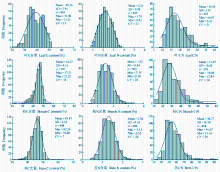
灌木在维持干旱半干旱区生态系统稳定性方面发挥着重要的作用。该研究调查了新疆北部草地典型灌木物种, 并分析了这些灌木叶、枝、茎的碳(C)、氮(N)含量特征, 可为新疆草地植被碳氮储量的准确估算以及碳氮循环过程提供基础数据。结果表明: 北疆地区草地的典型灌木有白刺(Nitraria spp.)、刺旋花(Convolvulus tragacanthoides)、红砂(Reaumuria soongarica)、假木贼(Anabasis spp.)、 锦鸡儿(Caragana spp.)、麻黄(Ephedra spp.)、沙拐枣(Calligonum mongolicum)、梭梭(Haloxylon spp.)、金丝桃叶绣线菊(Spiraea hypericifolia)、驼绒藜(Krascheninnikovia spp.)、小蓬(Nanophyton erinaceum)、盐爪爪(Kalidium spp.)、猪毛菜(Salsola spp.)等, 归属于蔷薇科、豆科、麻黄科、柽柳科、蒺藜科、蓼科、旋花科、藜科。北疆草地典型灌木各器官C含量为茎(45.76 ± 3.43)% >枝(44.27 ± 4.51)% >叶(39.15 ± 5.91)%, N含量为叶(2.21 ± 0.59)% >枝(1.55 ± 0.44)% >茎(1.34 ± 0.35)%, C:N为茎(36.74 ± 10.80) >枝(31.07 ± 10.43) >叶(18.94 ± 5.82)。灌木地上部分C含量为(43.77 ± 4.43)%, N含量为(1.56 ± 0.45)%, C:N为(31.78 ± 10.12); C含量变异程度较小, 变异系数为10%, N含量的变异系数为27%, C:N的变异系数为32%。灌木同一器官的C、N含量及C:N在不同科间有显著差异, 蔷薇科各器官的C含量显著大于其他科(p < 0.05); 豆科叶和茎的N含量显著大于其他科(p < 0.05), 麻黄科枝的N含量显著大于其他科(p < 0.05); 旋花科叶和枝的C:N显著大于其他科(p < 0.05), 蔷薇科茎的C:N显著大于其他科(p < 0.05)。
张静, 刘耘华, 盛建东, 柴强, 李瑞霞, 赵丹 . 新疆北部草地典型灌木的碳氮特征[J]. 植物生态学报, 2018 , 42(3) : 307 -316 . DOI: 10.17521/cjpe.2015.1086
Shrub is an important vegetation type for maintaining ecosystem stability in arid and semiarid zones. We investigated typical shrub species in grassland of northern Xinjiang, and analyzed their carbon (C) and nitrogen (N) contents in leaves, branches and stems, in order to accurately estimate the C and N pools in shrubland, and to obtain basic data for C and N cycling study.
Methods Leaf, branch and stem samples of 13 shrub species were collected in northern Xinjiang, and determined for C and N contents.
Important findings In northern Xinjiang, the typical shrub species include Nitraria spp., Convolvulus tragacanthoides, Reaumuria songarica, Anabasis spp., Caragana spp., Ephedra spp., Calligonum mongolicum, Haloxylon spp., Spiraea hypericifolia, Krascheninnikovia spp., Nanophyton erinaceum, Kalidium spp., and Salsola spp. These shrubs belong to the families of Rosaceae, Leguminosae, Ephedraceae, Tamaricaceae, Zygophyllaceae, Polygonaceae, Convolvulaceae, and Chenopodiaceae, respectively. The C contents in different organs ranked in the order of stems (45.76 ± 3.43)% > branches (44.27 ± 4.51)% > leaves (39.15 ± 5.91)%, and the N contents ranked in the order of leaves (2.21 ± 0.59)% > branches (1.55 ± 0.44)% > stems (1.34 ± 0.35)%; the C:N followed the order of stems (36.74 ± 10.80) > branches (31.07 ± 10.43) > leaves (18.94 ± 5.82). The contents of C and N as well as C:N within organs were significantly different among shrub species of different families (p < 0.05); the C contents in different organs in the species of Rosaceae were significantly greater (p < 0.05); the N contents in leaves and stems in the species of Leguminosae were significantly greater (p < 0.05); the N content in branches in the species of Ephedraceae was significantly greater (p < 0.05); the values of C:N in leaves and branches in Convolvulus tragacanthoides were significantly greater (p < 0.05); the value of C:N in stems in the species of Rosaceae was significantly greater (p < 0.05), those in those of other families. The average values in the aboveground tissues across the shrub species studied was (43.77 ± 4.43)% for the C content, (1.56 ± 0.45)% for the N content, and 31.78 ± 10.12 for C:N. The degree of variation was low for the C content, with average coefficient of variation of only 10%, in contrast to the average coefficient of variation of 27% for the N content and 32% for C:N.
Key words: carbon content; nitrogen content; typical shrubs; northern Xinjiang; grassland
| [1] | Aerts R, Chapin FS III ( 1999). The mineral nutrition of wild plants revisited: A re-evaluation of processes and patterns. Advances in Ecological Research, 30, 1-67. |
| [2] | Archer S, Schimel DS, Holland EA ( 1995). Mechanisms of shrubland expansion: Land use, climate, or CO2. Climatic Change, 29(1), 91-99. |
| [3] | Barth RC, Klemmedson JO ( 1978). Shrub-induced spatial patterns of dry matter, nitrogen, and organic carbon. Soil Science Society of America Journal, 42, 804-809. |
| [4] | Boutton TW, Archer SR, Midwood AJ, Zitzer SF, Bol R ( 1998). δ 13C values of soil organic carbon and their use in documenting vegetation change in a subtropical savanna ecosystem. Geoderma, 82, 5-41. |
| [5] | Brantley ST, Young DR ( 2010). Shrub expansion stimulates soil C and N storage along a coastal soil chronosequence. Global Change Biology, 16, 2052-2061. |
| [6] | Broadley MR, Bowen HC, Cotterill HL, Hammond JP, Meacham MC, Mead A, White PJ ( 2004). Phylogenetic variation in the shoot mineral concentration of angiosperms. Journal of Experimental Botany, 55, 321-336. |
| [7] | Chapin FS III, Bloom AJ, Field CB, Waring RH ( 1987). Plant responses to multiple environmental factors. BioScience, 37, 49-57. |
| [8] | Department of Animal Husbandry and Veterinary the General Station of Animal Husbandry and Veterinary, Ministry of Agriculture of the People’s Republic of China ( 1996). Grassland Resources of China. Chinese Science and Technology Press, Beijing. |
| [8] | 中华人民共和国农业部畜牧兽医司, 全国畜牧兽医总站( 1996). 中国草地资源. 中国科学技术出版社, 北京. |
| [9] | Eldridge DJ, Bowker MA, Maestre FT, Roger E, Reynolds JF, Whitford WG ( 2011). Impacts of shrub encroachment on ecosystem structure and functioning: Towards a global synthesis. Ecology Letters, 14, 709-722. |
| [10] | Elser JJ, Fagan WF, Denno RF, Dobberfuhl DR, Folarin A, Huberty A, Interlandi S, Kilham SS, McCauley E, Schulz KL, Siemann EH, Sterner RW ( 2000a ). Nutritional constraints in terrestrial land freshwater food webs. Nature, 408, 578-580. |
| [11] | Elser JJ, Sterner RW, Gorokhova E, Fagan WF, Markow TA, Cotner JB, Harrison JF, Hobbie SE, Odell GM, Weider LW ( 2000b ). Biological stoichiometry from genes to ecosystems. Ecology Letters, 3, 540-550. |
| [12] | Field C, Mooney HA ( 1992). Grasslands and Grassland Sciences in Northern China. National Academy Press, Washington. 341. |
| [13] | Gao W ( 2010). The Study of Carbon-Nitrogen Dynamics and the Ecological Effects of Nitrogen Addition for Degraded Grassland Ecosystem Carbon―Ecological Effects of Nitrogen and Nitrogen Added Variation. PhD dissertation, Inner Mongolia University, Hohhot. 5-26. |
| [13] | 高伟 ( 2010). 退化草地生态系统碳氮变化规律及氮添加的生态效应研究. 博士学位论文, 内蒙古大学, 呼和浩特. 5-26. |
| [14] | Glasener KM, Wagger MG, MacKown CT, Volk RJ ( 2002). Contributions of shoot and root nitrogen-15 labeled legume nitrogen sources to a sequence of three cereal crops. Soil Science Society of America Journal, 66, 523-530. |
| [15] | Goodale CL, Davidson EA ( 2002). Carbon cycle: Uncertain sinks in the shrubs. Nature, 418, 593-594. |
| [16] | Grover HD, Musick HB ( 1990). Shrubland encroachment in southern New Mexico, U.S.A.: An analysis of desertification processes in the American southwest. Climate Change, 17, 305-330. |
| [17] | Han WX, Fang JY, Guo DL, Zhang Y ( 2005). Leaf nitrogen and phosphorus stoichiometry across 753 terrestrial plant species in China. New Phytologist, 168, 377-385. |
| [18] | He JS, Han XG ( 2010). Ecological stoichiometry: Searching for unifying principles from individuals to ecosystems. Chinese Journal of Plant Ecology, 34, 2-6. |
| [18] | 贺金生, 韩兴国 ( 2010). 生态化学计量学: 探索从个体到生态系统的统一化理论. 植物生态学报, 34, 2-6. |
| [19] | He JS, Wang L, Flynn DFB, Wang X, Ma W, Fang J ( 2008). Leaf nitrogen: Phosphorus stoichiometry across Chinese grassland Biomes. Oecologia, 155, 301-310. |
| [20] | He YT, Liu WZ, Dang GD, Zhang QF ( 2008). Study on content of C and N contents of 30 plant species in subalpine meadow of Qinling Mountains. Pratacultural Science, 25(10), 1-5. |
| [20] | 何亚婷, 刘文治, 党高弟, 张全发 ( 2008). 秦岭亚高山草甸30种草本植物的碳、氮分布研究. 草业科学, 25(10), 1-5. |
| [21] | Herbert DA, Williams M, Rastetter EB ( 2003). A model analysis of N and P limitation on carbon accumulation in Amazonian secondary forest after alternate land-use abandonment. Biogeochemistry, 65(1), 121-150. |
| [22] | Hou XY ( 1982). A Brief Description of Vegetation Maps People’s Republic of China. Map Press, Beijing. 1542-1548. |
| [22] | 侯学煜 ( 1982). 中华人民共和国植被图简要说明. 地图出版社, 北京. 1542-1548. |
| [23] | Jackson RB, Schenk HJ, Jobbágy EG, Canadell J, Colello GD, Dickinson RE, Field CB, Friedlingstein P, Heimann M, Hibbard K, Kicklighter DW, Kleidon A, Neilson RP, Parton WJ, Sala OE, Sykes MT ( 2000). Belowground consequences of vegetation change and their treatment in models. Ecological Applications, 10, 470-483. |
| [24] | Knapp AK, Briggs JM, Collins SL, Archer SR, Bret-Harte MS, Ewers BE, Peters DP, Young DR, Shaver GR, Pendall E, Cleary MB ( 2008). Shrub encroachment in North American grasslands: Shifts in growth form dominance rapidly alters control of ecosystem carbon inputs. Global Change Biology, 14, 615-623. |
| [25] | Li QH, Jiang ZP, Zhang JB, Zhao YM ( 2006). The progress and perspective of research on the ecological characteristics and benefits of shrub. Journal of Arid Land Resources and Environment, 20(2), 159-164. |
| [25] | 李清河, 江泽平, 张景波, 赵英铭 ( 2006). 灌木的生态特性与生态效能的研究与进展. 干旱区资源与环境, 20(2), 159-164. |
| [26] | Li XR ( 2000). Discussion on the characteristics of shrubby diversity of Ordos Plateau. Resources Science, 22(3), 54-59. |
| [26] | 李新荣 ( 2000). 试论鄂尔多斯高原灌木多样性的若干特点. 资源科学, 22(3), 54-59. |
| [27] | Ma QY, Chen XL, Wang J, Lin C, Kang FF, Cao WQ, Ma ZB, Li WY ( 2002). Carbon content rate in constructive species of main forest types in Northern China. Journal of Beijing Forestry University, 24(5-6), 96-100. |
| [27] | 马钦彦, 陈遐林, 王娟, 蔺琛, 康峰峰, 曹文强, 马志波, 李文宇 ( 2002). 华北主要森林类型建群种的含碳率分析. 北京林业大学学报, 24(5-6), 96-100. |
| [28] | Nepstad DC, de Carvalho CR, Davidson EA, Jipp PH, Lefebvre PA, Negreiros GH, da Silva ED, Stone TA, Trumbore SE, Vieira S ( 1994). The role of deep roots in the hydrological and carbon cycles of Amazonian forests and pastures. Nature, 372, 666-669. |
| [29] | Ni J ( 2002). Carbon storage in grasslands of China. Journal of Arid Environments, 50, 205-218. |
| [30] | Ni J ( 2004). Forage yield-based carbon storage in grasslands of China. Climatic Change, 67, 237-246. |
| [31] | Northup BK, Zitzer SF, Archer S, Mc Murtry CR, Boutton TW ( 2005). Above-ground biomass and carbon and nitrogen content of woody species in a subtropical thornscrub parkland. Journal of Arid Environments, 62, 23-43. |
| [32] | Reich PB, Oleksyn J ( 2004). Global patterns of plant leaf N and P in relation to temperature and latitude. Proceedings of the National Academy of Sciences of the United States of America, 101, 11001-11006. |
| [33] | Sabik H, Jeannot R, Rondeau B ( 2000). Multiresidue methods using solid-phase extraction techniques for monitoring priority pesticides, including triazines and degradation products, in ground and surface waters. Journal of Chromatography A, 885, 217-236. |
| [34] | Smith TM, Woodward FI, Shugart HH ( 1992). Grasslands and Grassland Sciences in Northern China. National Academy Press, Washington. 352-356. |
| [35] | Sun GJ, Zhang R, Zhou L ( 2003). Trends and advances in researches on plant functional diversity and functional groups. Acta Ecologica Sinica, 23, 1430-1435. |
| [35] | 孙国钧, 张荣, 周立 ( 2003). 植物功能多样性与功能群研究进展. 生态学报, 23, 1430-1435. |
| [36] | Tingey DT, Mckane RB, Olszyk DM, Johnson MG, Rygiewicz PT, Lee EH ( 2003). Elevated CO2 and temperature alter nitrogen allocation in Douglas-fir. Global Change Biology, 9, 1038-1050. |
| [37] | Trewavas A ( 1992). Grasslands and Grassland Sciences in Northern China. National Academy Press, Washington. 159-162. |
| [38] | van Auken OW ( 2000). Shrub invasions of North American semiarid grasslands. Annual Review of Ecology and Systematics, 31, 197-215. |
| [39] | Woodell SRJ, Evenari M, Noy-Meir I, Goodall DW ( 1986). Hot deserts and arid shrublands A. Journal of Ecology, 74, 1215. |
| [40] | Xu HC ( 2008). Botany. 2nd edn. China Forestry Publishing House, Beijing. 96-97. |
| [40] | 许鸿川 ( 2008). 植物学. 第2版. 中国林业出版社, 北京. 96-97. |
| [41] | Xu P, Alimujiang, Wang B ( 1993). Resources and Use of Grassland in Xinjiang. Xinjiang Science and Technology Health Press, ürü mqi. 1213-2151. |
| [41] | 许鹏, 阿里木江, 王博 ( 1993). 新疆草地资源及其利用. 新疆科技卫生出版社, 乌鲁木齐. 1213-2151. |
| [42] | Xu ZZ, Zhou GS, Xiao CW, Wang YH ( 2004). Responses of two dominated desert shrubs to soil drought under doubled CO2 condition. Acta Ecologica Sinica, 24, 2186-2191. |
| [42] | 许振柱, 周广胜, 肖春旺, 王玉辉 ( 2004). CO2浓度倍增条件下土壤干旱对两种沙生灌木碳氮含量及其适应性的影响. 生态学报, 24, 2186-2191. |
| [43] | Yang LD, Yang Y, Wang GX, Guo JY, Yang Y ( 2011). Short-term effects of warming on growth and stoichiometrical characteristics of Abies fabiri( Mast.) Craib seedling in Gongga Mountain. Acta Ecologica Sinica, 31, 3668-3676. |
| [43] | 羊留冬, 杨燕, 王根绪, 郭剑英, 杨阳 ( 2011). 短期增温对贡嘎山峨眉冷杉幼苗生长季及其CNP化学计量学特征的影响. 生态学报, 31, 3668-3676. |
| [44] | Yang YS, He ZM, Qiu RH, Luo XS ( 1999). Effects of different recover and restoration measures on plant diversity and soil fertility for serious degradation ecosystem. Acta Ecologica Sinica, 19, 490-494. |
| [44] | 杨玉盛, 何宗明, 邱仁辉, 罗学升 ( 1999). 严重退化生态系统不同恢复和重建措施的植物多样性与地力差异研究. 生态学报, 19, 490-494. |
/
| 〈 |
|
〉 |
Copyright © 2026 版权所有 《植物生态学报》编辑部
地址: 北京香山南辛村20号, 邮编: 100093
Tel.: 010-62836134, 62836138; Fax: 010-82599431; E-mail: apes@ibcas.ac.cn, cjpe@ibcas.ac.cn
备案号: 京ICP备16067583号-19

