
青藏高原东缘主要针叶树种叶片碳氮磷化学计量分布格局及其驱动因素
收稿日期: 2019-09-27
录用日期: 2019-12-05
网络出版日期: 2020-01-26
基金资助
第二次青藏高原综合科学考察研究专题(2019QZKK0301)(STEP2019QZKK0301);中国科学院前沿科学重点研究项目(QYZDB-SSW-SMC023);国家自然科学基金(31872700);国家自然科学基金(31700387);四川省重点研发项目(18ZDYF1821)
Distribution patterns and driving factors of leaf C, N and P stoichiometry of coniferous species on the eastern Qinghai-Xizang Plateau, China
Received date: 2019-09-27
Accepted date: 2019-12-05
Online published: 2020-01-26
Supported by
Supported by the Second Qinghai-Xizang Plateau Scientific Expedition and Research Program(STEP2019QZKK0301);Frontier Science Key Research Programs of Chinese Academy of Science(QYZDB-SSW-SMC023);National Natural Science Foundation of China(31872700);National Natural Science Foundation of China(31700387);Key Research Programs of Sichuan Province(18ZDYF1821)
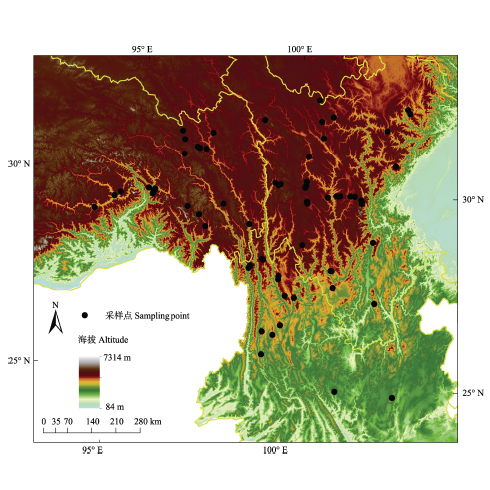
理解植物叶片化学计量特征及其驱动因素对认识植物种群分布规律及预测植物对环境变化响应具有重要意义。该研究采集了青藏高原东缘针叶林84个样点共29种主要针叶树种叶片, 探讨该区域常绿针叶树种叶片碳(C)、氮(N)、磷(P)化学计量特征和分布格局及其驱动因素。结果表明: (1)在科和属水平上, 不同针叶树种叶片C、N含量和C:N差异显著; 叶片N:P < 14, 表明该区域针叶树种主要受N限制。(2)叶片N、P含量在环境梯度上表现出一致的分布规律: 均呈现出随纬度和海拔增加而显著降低, 随年平均气温(MAT)和年降水量(MAP)增加而显著增加的趋势; 而叶片C含量与纬度、海拔、MAT和MAP均未表现出显著相关性。(3)叶片C:N、C:P呈现出与N、P含量变化相反的分布格局: 均随纬度和海拔增加而显著增加, 随MAT和MAP增加而显著降低; 而叶片N:P与海拔、MAT和MAP均无显著相关性。(4)进一步分析表明, 叶片C、N、P含量及其化学计量比的主要驱动因素不尽相同。具体而言: 土壤特性是叶片C含量和N:P变异的主要驱动因子, 而叶片N、P含量和C:N、C:P的变异主要由气候因素决定。总之, 该区域针叶树种叶片化学计量沿环境梯度的变异规律有力地支持了温度生物地球化学假说, 在一定程度上丰富了对环境变化下植物叶片化学计量分布格局及其驱动机制的认识。
蔡琴, 丁俊祥, 张子良, 胡君, 汪其同, 尹明珍, 刘庆, 尹华军 . 青藏高原东缘主要针叶树种叶片碳氮磷化学计量分布格局及其驱动因素[J]. 植物生态学报, 2019 , 43(12) : 1048 -1060 . DOI: 10.17521/cjpe.2019.0221
Aims The leaf stoichiometry and potential driving factors play a vital role in understanding the distribution patterns of plant community and predicting the plant responses to environmental changes. In this study, we aimed to investigate the spatial distribution patterns and driving factors of leaf carbon (C), nitrogen (N) and phosphorus (P) stoichiometry of coniferous species on the eastern Qinghai-Xizang Plateau, China.
Methods We collected leaf and soil samples from 29 coniferous tree species at 84 sampling sites on the eastern Qinghai-Xizang Plateau. Linear fitting was used to analyze the variation patterns of leaf stoichiometry along geographical and climatic gradients. Partial redundancy analysis was used to characterize the relative contributions of climate and soil factors to leaf stoichiometry variation patterns.
Important findings (1) At the level of family and genus, C and N concentrations as well as C:N of leaves were significantly different across distinct conifer species. The leaf N:P was less than 14, indicating that conifer species in the study region were mainly N-limited. (2) Leaf N and P concentrations showed a consistent distribution pattern along environmental gradients. Specifically, N and P concentrations of leaves were significantly decreased with elevated latitude and altitude, while remarkably increased with the increase of mean annual temperature (MAT) and mean annual precipitation (MAP). In comparison, leaf C concentration had no significant correlation with latitude, altitude, MAT or MAP. (3) The leaf C:N and C:P showed an opposite distribution pattern with leaf N and P concentrations, which significantly increased with elevated latitude and altitude, while markedly declined with the increase of MAT and MAP. Leaf N:P had no significant correlation with altitude, MAT or MAP. (4) The main driving factors of leaf C, N, P concentrations and their stoichiometric characteristics were different. Specifically, soil properties were the main driving factors accounting for the variations of leaf C concentration and N:P. The variations of leaf N and P concentrations as well as ratios of C:N and C:P were primarily explained by climatic factors. Collectively, variations of leaf stoichiometry of coniferous species along environmental gradients in the study region provided a compelling support for the Temperature Biogeochemistry Hypothesis. These findings largely improved the understanding of the distribution patterns and driving mechanism of leaf stoichiometry under changing environments.
| [1] | Aerts R, Chapin Ⅲ FS ( 1999). The mineral nutrition of wild plants revisited: A re-evaluation of processes and patterns. Advances in Ecological Research, 30, 1-67. |
| [2] | Bai YF, Wu JG, Clark CM, Pan QM, Zhang LX, Chen SP, Wang QB, Han XG ( 2012). Grazing alters ecosystem functioning and C: N: P stoichiometry of grasslands along a regional precipitation gradient. Journal of Applied Ecology, 49, 1204-1215. |
| [3] | Bao SD (2000). Soil and Agricultural Chemistry Analysis. 3rd edn. China Agriculture Press, Beijing. |
| [3] | [ 鲍士旦 (2000). 土壤农化分析. 第三版. 中国农业出版社, 北京.] |
| [4] | Chen YH, Han WX, Tang LY, Tang ZY, Fang JY ( 2013). Leaf nitrogen and phosphorus concentrations of woody plants differ in responses to climate, soil and plant growth form. Ecography, 36, 178-184. |
| [5] | Elser JJ, Fagan WF, Kerkhoff AJ, Swenson NG, Enquist BJ ( 2010). Biological stoichiometry of plant production: Metabolism, scaling and ecological response to global change. New Phytologist, 186, 593-608. |
| [6] | Fang Z, Li DD, Jiao F, Yao J, Du HT ( 2019). The latitudinal patterns of leaf and soil C: N: P stoichiometry in the Loess Plateau of China. Frontiers in Plant Science, 10, 85. DOI: 10.3389/fpls.2019.00085. |
| [7] | Fisher JB, Malhi Y, Torres IC, Metcalfe DB, van de Weg MJ, Meir P, Silva-Espejo JE, Huasco WH ( 2013). Nutrient limitation in rainforests and cloud forests along a 3,000-m elevation gradient in the Peruvian Andes. Oecologia, 172, 889-902. |
| [8] | Han WX, Fang JY, Guo DL, Zhang Y ( 2005). Leaf nitrogen and phosphorus stoichiometry across 753 terrestrial plant species in China. New Phytologist, 168, 377-385. |
| [9] | He HL, Yang XC, Li DD, Yin CY, Li YX, Zhou GY, Zhang L, Liu Q ( 2017). Stoichiometric characteristics of carbon, nitrogen and phosphorus of Sibiraea angustata shrub on the eastern Tibetan Plateau. Chinese Journal of Plant Ecology, 41, 126-135. |
| [9] | [ 贺合亮, 阳小成, 李丹丹, 尹春英, 黎云祥, 周国英, 张林, 刘庆 ( 2017). 青藏高原东部窄叶鲜卑花碳、氮、磷化学计量特征. 植物生态学报, 41, 126-135.] |
| [10] | He JS, Fang JY, Wang ZH, Guo DL, Flynn DFB, Geng Z ( 2006). Stoichiometry and large-scale patterns of leaf carbon and nitrogen in the grassland biomes of China. Oecologia, 149, 115-122. |
| [11] | He JS, Wang L, Flynn DFB, Wang XP, Ma WH, Fang JY ( 2008). Leaf nitrogen:phosphorus stoichiometry across Chinese grassland biomes. Oecologia, 155, 301-310. |
| [12] | He NP, Liu CC, Piao SL, Sack L, Xu L, Luo YQ, He JS, Han XG, Zhou GS, Zhou XH, Lin Y, Yu Q, Liu SR, Sun W, Niu SL, Li SG, Zhang JH, Yu GR ( 2019). Ecosystem traits linking functional traits to macroecology. Trends in Ecology & Evolution, 34, 200-210. |
| [13] | Koerselman W, Meuleman AFM ( 1996). The vegetation N:P ratio: A new tool to detect the nature of nutrient limitation. Journal of Applied Ecology, 33, 1441-1450. |
| [14] | Lai JS, Mi XC (2012). Ordination analysis of ecological data using vegan package in R. In: Chinese National Committee for DIVERSITAS eds. Advances in Biodiversity Conservation and Research in China Ⅸ. China Meteorological Press , Beijing. 332-343. |
| [14] | [ 赖江山, 米湘成 (2010). 基于Vegan软件包的生态学数据排序分析. 出自: 国际生物多样性计划中国委员会编, 中国生物多样性保护与研究进展Ⅸ. 中国气象出版社, 北京 . 332-343.] |
| [15] | Liu JX, Fang X, Tang XL, Wang WT, Zhou GY, Xu S, Huang WJ, Wang GX, Yan JH, Ma KP, Du S, Li SG, Han SJ, Ma YX ( 2019). Patterns and controlling factors of plant nitrogen and phosphorus stoichiometry across China’s forests. Biogeochemistry, 143, 191-205. |
| [16] | Liu Q (2002). Ecological Research on Subalpine Coniferous Forests in China. Sichuan University Press, Chengdu. |
| [16] | [ 刘庆 (2002). 亚高山针叶林生态学研究. 四川大学出版社, 成都.] |
| [17] | Liu QH ( 1997). Variation partitioning by partial redundancy analysis (RDA). Environmetrics, 8, 75-85. |
| [18] | Minden V, Kleyer M ( 2014). Internal and external regulation of plant organ stoichiometry. Plant Biology, 16, 897-907. |
| [19] | Reich PB, Oleksyn J ( 2004). Global patterns of plant leaf N and P in relation to temperature and latitude. Proceedings of the National Academy of Sciences of the United States of America, 101, 11001-11006. |
| [20] | Ren SJ, Yu GR, Tao B, Wang SQ ( 2007). Leaf nitrogen and phosphorus stoichiometry across 654 terrestrial plant species in NSTEC. Chinese Journal of Environmental Science, 28, 2665-2673. |
| [20] | [ 任书杰, 于贵瑞, 陶波, 王绍强 ( 2007). 中国东部南北样带654种植物叶片氮和磷的化学计量学特征研究. 环境科学, 28, 2665-2673.] |
| [21] | Sardans J, Pe?uelas J ( 2013). Tree growth changes with climate and forest type are associated with relative allocation of nutrients, especially phosphorus, to leaves and wood. Global Ecology and Biogeography, 22, 494-507. |
| [22] | Shi WQ, Wang GA, Han WX ( 2012). Altitudinal variation in leaf nitrogen concentration on the eastern slope of Mount Gongga on the Tibetan Plateau, China. PLOS ONE, 7, e44628. DOI: 10.1371/journal.pone.0044628. |
| [23] | Sistla SA, Schimel JP ( 2012). Stoichiometric flexibility as a regulator of carbon and nutrient cycling in terrestrial ecosystems under change. New Phytologist, 196, 68-78. |
| [24] | Tang ZY, Xu WT, Zhou GY, Bai YF, Li JX, Tang XL, Chen DM, Liu Q, Ma WH, Xiong GM, He HL, He NP, Guo YP, Guo Q, Zhu JL, Han WX, Hu HF, Fang JY, Xie ZQ ( 2018). Patterns of plant carbon, nitrogen, and phosphorus concentration in relation to productivity in China’s terrestrial ecosystems. Proceedings of the National Academy of Sciences of the United States of America, 115, 4033-4038. |
| [25] | Tian D, Yan ZB, Fang JY ( 2018). Plant stoichiometry: A research frontier in ecology. Chinese Journal of Nature, 40, 235-241. |
| [25] | [ 田地, 严正兵, 方精云 ( 2018). 植物化学计量学: 一个方兴未艾的生态学研究方向. 自然杂志, 40, 235-241.] |
| [26] | Tian D, Yan ZB, Ma SH, Ding YH, Luo YK, Chen YH, Du EZ, Han WX, Kovacs ED, Shen HH, Hu HF, Kattge J, Schmid B, Fang JY ( 2019). Family-level leaf nitrogen and phosphorus stoichiometry of global terrestrial plants. Science China Life Sciences, 62, 1047-1057. |
| [27] | Tian D, Yan ZB, Niklas KJ, Han WX, Kattge J, Reich PB, Luo YK, Chen YH, Tang ZY, Hu HF, Wright IJ, Schmid B, Fang JY ( 2017). Global leaf nitrogen and phosphorus stoichiometry and their scaling exponent. National Science Review, 5, 728-739. |
| [28] | Tyler G, Olsson T ( 2001). Plant uptake of major and minor mineral elements as influenced by soil acidity and liming. Plant and Soil, 230, 307-321. |
| [29] | Wang Z, Xia CX, Yu D, Wu ZG ( 2015). Low-temperature induced leaf elements accumulation in aquatic macrophytes across Tibetan Plateau. Ecological Engineering, 75, 1-8. |
| [30] | Xia CX, Yu D, Wang Z, Xie D ( 2014). Stoichiometry patterns of leaf carbon, nitrogen and phosphorous in aquatic macrophytes in eastern China. Ecological Engineering, 70, 406-413. |
| [31] | Yang H, Yin CY, Zheng DH, Tang B, Zhao WQ, Li N, Pu XZ, Liu Q ( 2017). Leaf C:N:P stoichiometry in a growing season and nongrowing season of Picea asperata and Abies faxoniana, dominant tree species in subalpine coniferous forests of western Sichuan. Chinese Journal of Applied and Environmental Biology, 23, 1089-1095. |
| [31] | [ 杨欢, 尹春英, 郑东辉, 唐波, 赵文强, 李娜, 濮晓珍, 刘庆 ( 2017). 川西亚高山针叶林云杉和冷杉生长季和非生长季叶片碳氮磷化学计量特征. 应用与环境生物学报, 23, 1089-1095.] |
| [32] | Yang L, Sun H, Fan YW, Han W, Zeng LB, Liu C, Wang XP ( 2017). Changes in leaf nitrogen and phosphorus stoichiometry of woody plants along an altitudinal gradient in Changbai Mountain, China. Chinese Journal of Plant Ecology, 41, 1228-1238. |
| [32] | [ 杨蕾, 孙晗, 樊艳文, 韩威, 曾令兵, 刘超, 王襄平 ( 2017). 长白山木本植物叶片氮磷含量的海拔梯度格局及影响因子. 植物生态学报, 41, 1228-1238.] |
| [33] | Yu Q, Elser JJ, He NP, Wu HH, Chen QS, Zhang GM, Han XG ( 2011). Stoichiometric homeostasis of vascular plants in the Inner Mongolia grassland. Oecologia, 166, 1-10. |
| [34] | Yuan ZY, Chen HYH ( 2009). Global trends in senesced-leaf nitrogen and phosphorus. Global Ecology and Biogeography, 18, 532-542. |
| [35] | Zhang GQ, Zhang P, Peng SZ, Chen YM, Cao Y ( 2017). The coupling of leaf, litter, and soil nutrients in warm temperate forests in northwestern China. Scientific Reports, 7, 11754. DOI: 10.1038/s41598-017-12199-5. |
| [36] | Zhang LX, Bai YF, Han XG ( 2004). Differential responses of N:P stoichiometry of Leymus chinensis and Carex korshinskyi to N additions in a steppe ecosystem in Nei Mongol. Acta Botanica Sinica, 46, 259-270. |
| [37] | Zhang MM, Gao RX ( 2012). Research review on comparative anatomy and ecological anatomy of conifers blade. Forest Engineering, 28, 9-13. |
| [37] | [ 张明明, 高瑞馨 ( 2012). 针叶植物叶片比较解剖及生态解剖研究综述. 森林工程, 28, 9-13.] |
| [38] | Zhang Y, Li C, Wang ML ( 2019). Linkages of C:N:P stoichiometry between soil and leaf and their response to climatic factors along altitudinal gradients. Journal of Soils and Sediments, 19, 1820-1829. |
| [39] | Zhao N, He NP, Wang QF, Zhang XY, Wang RL, Xu ZW, Yu GR ( 2014). The altitudinal patterns of leaf C:N:P stoichiometry are regulated by plant growth form, climate and soil on Changbai Mountain, China. PLOS ONE, 9, e95196. DOI: 10.1371//journal.pone.0095196. |
| [40] | Zhao WQ, Reich PB, Yu QN, Zhao N, Yin CY, Zhao CZ, Li DD, Hu J, Li T, Yin HJ, Liu Q ( 2018). Shrub type dominates the vertical distribution of leaf C:N:P stoichiometry across an extensive altitudinal gradient. Biogeosciences, 15, 2033-2053. |
/
| 〈 |
|
〉 |
Copyright © 2026 版权所有 《植物生态学报》编辑部
地址: 北京香山南辛村20号, 邮编: 100093
Tel.: 010-62836134, 62836138; Fax: 010-82599431; E-mail: apes@ibcas.ac.cn, cjpe@ibcas.ac.cn
备案号: 京ICP备16067583号-19

