
基于随机森林模型的内陆干旱区植被指数变化与驱动力分析: 以北天山北坡中段为例
收稿日期: 2020-04-20
录用日期: 2020-06-02
网络出版日期: 2020-07-07
基金资助
国家自然科学基金(41671108);中国科学院国际合作局对外合作重点项目(131965KYSB20160004)
Analysis of vegetation index changes and driving forces in inland arid areas based on random forest model: a case study of the middle part of northern slope of the north Tianshan Mountains
Received date: 2020-04-20
Accepted date: 2020-06-02
Online published: 2020-07-07
Supported by
National Natural Science Foundation of China(41671108);International Partnership Program of Chinese Academy of Sciences(131965KYSB20160004)
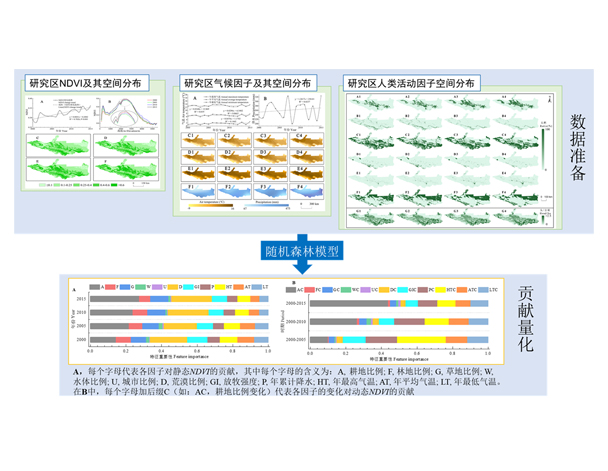
全球变化背景下的干旱区植被变化受气候变化和人类活动双重影响。定量评价植被变化特征及其驱动机制, 对监测干旱区区域生态环境变化, 促进区域可持续发展有重要意义。由于复杂多样的人类活动难以量化, 有关这方面的研究多局限于植被对气候变化的响应, 而对人类活动影响考虑不足, 导致关于这方面的认识存在较大的偏差和不确定性。该文首先提出与土地利用相关的人类活动量化表征方法; 然后运用多元线性回归模型和随机森林模型中的较优模型, 分析气候变化和具体的人类活动对北天山北坡中段归一化植被指数(NDVI)的影响。主要结果: (1) 2000-2015年期间北天山北坡中段年NDVI总体呈增加趋势; 基于随机森林构建的NDVI与气候因子和人类活动的模型拟合精度明显优于多元线性回归模型, 其决定系数(R2)至少提高了24%; (2)研究期内与耕地有关的人类活动对北天山北坡中段NDVI分布及时空变化的影响呈增加的特征, 在2000-2015年期间人类活动对NDVI变化的贡献率为0.59, 超过了气候因子。该项研究为气候变化和人类活动对植被的影响研究提供了新思路, 也为干旱区生态环境保护和恢复提供了科学依据。
张文强, 罗格平, 郑宏伟, 王浩, HAMDI Rafiq, 何惠丽, 蔡鹏, 陈春波 . 基于随机森林模型的内陆干旱区植被指数变化与驱动力分析: 以北天山北坡中段为例[J]. 植物生态学报, 2020 , 44(11) : 1113 -1126 . DOI: 10.17521/cjpe.2020.0111
Aims In the context of global change, vegetation changes in arid areas in the context of global change are both affected by climate change and human activities. Quantifying the vegetation dynamics and their driving mechanism are essential for monitoring the ecological environment change in arid areas and for promoting the sustainable development. Because of the complexity of human activities, most researches are limited to the response of normalized differential vegetation index (NDVI) to climate change, while the impacts of human activities have not yet been comprehensively considered.
Methods Firstly, we proposed a quantification method to quantify the main human activities related to land use. Then, the contribution of climate change and human activities to the NDVI in the middle part of the northern slope of the north Tianshan Mountains was analyzed using the multiple linear regression model and random forest model.
Important findings We found that an overall upward trend was evident in NDVI variations from 2000 to 2015. The fitting accuracy of NDVI based on the random forest model was significantly better than the multiple linear regression model with an improved R2 of about 24%. The contribution of human activities related to arable land to NDVI change in the study area showed an increasing trend which was greater than climatic factors from 2000 to 2015. This study provides new insight into the effects of climate change and human activities on vegetation and a scientific basis for the protection and restoration of the ecological environment in the arid areas.
| [1] | Belgiu M, Dr?gu? L (2016). Random Forest in Remote Sensing: a review of applications and future directions. ISPRS Journal of Photogrammetry and Remote Sensing, 114, 24-31. |
| [2] | Breiman L (2001). Random forests. Machine Learning, 45, 5-32. |
| [3] | Cai P, Hamdi R, Luo GP, He HL, Zhang M, Termonia P, de Maeyer P (2019). Agriculture intensification increases summer precipitation in Tianshan Mountains, China. Atmospheric Research, 227, 140-146. |
| [4] | Chen X, Luo GP, Xia J, Zhou KF, Lou SP, Ye MQ (2004). Ecological response of climate change on the northern slope of Tianshan Mountains in Xinjiang. Science in China Series D, 34, 1166-1175. |
| [4] | [ 陈曦, 罗格平, 夏军, 周可法, 娄少平, 叶民权 (2004). 新疆天山北坡气候变化的生态响应研究. 中国科学D辑, 34, 1166-1175.] |
| [5] | Fang XR, Wen ZF, Chen JL, Wu SJ, Huang YY, Ma MH (2019). Remote sensing estimation of suspended sediment concentration based on Random Forest Regression Model. Journal of Remote Sensing, 23, 756-772. |
| [5] | [ 方馨蕊, 温兆飞, 陈吉龙, 吴胜军, 黄远洋, 马茂华 (2019). 随机森林回归模型的悬浮泥沙浓度遥感估算. 遥感学报, 23, 756-772.] |
| [6] | Gang C, Zhou W, Wang Z, Chen Y, Li J, Chen J, Qi J, Odeh I, Groisman PY (2015). Comparative assessment of grassland NPP dynamics in response to climate change in China, North America, Europe and Australia from 1981 to 2010. Journal of Agronomy and Crop Science, 201, 57-68. |
| [7] | Gao JB, Jiao KW, Wu SH (2019). Revealing the climatic impacts on spatial heterogeneity of NDVI in China during 1982-2013. Acta Geographica Sinica, 74, 534-543. |
| [7] | [ 高江波, 焦珂伟, 吴绍洪 (2019). 1982-2013年中国植被NDVI空间异质性的气候影响分析. 地理学报, 74, 534-543.] |
| [8] | Gilbert M, Nicolas G, Cinardi G, van Boeckel TP, Vanwambeke SO, Wint GRW, Robinson TP (2018). Global distribution data for cattle, buffaloes, horses, sheep, goats, pigs, chickens and ducks in 2010. Scientific Data, 5, 180227. DOI: 10.1038/sdata.2018.227. |
| [9] | Gu ZJ, Duan XW, Shi YD, Li Y, Pan X (2018). Spatiotemporal variation in vegetation coverage and its response to climatic factors in the Red River Basin, China. Ecological Indicators, 93, 54-64. |
| [10] | Han QF, Luo GP, Li CF, Shakir A, Wu M, Saidov A (2016). Simulated grazing effects on carbon emission in Central Asia. Agricultural and Forest Meteorology, 216, 203-214. |
| [11] | He K, Wu SX, Yang Y, Wang D, Zhang SY, Yin N (2018). Dynamic changes of land use and oasis in Xinjiang in the last 40 years. Arid Land Geography, 41, 1333-1340. |
| [11] | [ 贺可, 吴世新, 杨怡, 王丹, 张寿雨, 尹楠 (2018). 近40 a新疆土地利用及其绿洲动态变化. 干旱区地理, 41, 1333-1340.] |
| [12] | Hu S, Wang FY, Zhan CS, Zhao RX, Mo XG, Liu LMZ (2019). Detecting and attributing vegetation changes in Taihang Mountain, China. Journal of Mountain Science, 16, 337-350. |
| [13] | Huang XT, Luo GP, He HL, Wang XX, Amuti T (2017). Ecological effects of grazing in the northern Tianshan Mountains. Water, 9, 932. DOI: 10.3390/w9120932. |
| [14] | Huang XT, Luo GP, Ye FP, Han QF (2018). Effects of grazing on net primary productivity, evapotranspiration and water use efficiency in the grasslands of Xinjiang, China. Journal of Arid Land, 10, 588-600. |
| [15] | Kasza J, Wolfe R (2014). Interpretation of commonly used statistical regression models. Respirology, 19(1), 14-21. |
| [16] | Krishnaswamy J, John R, Joseph S (2014). Consistent response of vegetation dynamics to recent climate change in tropical mountain regions. Global Change Biology, 20, 203-215. |
| [17] | Li JJ, Peng SZ, Li Z (2017). Detecting and attributing vegetation changes on China’s Loess Plateau. Agricultural and Forest Meteorology, 247, 260-270. |
| [18] | Liu Q, Yang ZP, Han F, Wang ZG, Wang CR (2016). NDVI-based vegetation dynamics and their response to recent climate change: a case study in the Tianshan Mountains, China. Environmental Earth Sciences, 75, 1189. DOI: 10.1007/s12665-016-5987-5. |
| [19] | Liu Y, Nie L, Yang Y (2018). Spatio-temporal evolution and climatic driving characteristics of grassland in Tianshan Mountain area in 2001-2015. Ecology and Environmental Sciences, 27, 802-810. |
| [19] | [ 刘艳, 聂磊, 杨耘 (2018). 2001-2015年天山地区草地NDVI时空演变和气候驱动特征分析. 生态环境学报, 27, 802-810.] |
| [20] | Liu ZJ, Liu YS, Li YR (2018). Anthropogenic contributions dominate trends of vegetation cover change over the farming-pastoral ecotone of northern China. Ecological Indicators, 95, 370-378. |
| [21] | Lujan-Moreno GA, Howard PR, Rojas OG, Montgomery DC (2018). Design of experiments and response surface methodology to tune machine learning hyperparameters, with a random forest case-study. Expert Systems with Applications, 109, 195-205. |
| [22] | Ma QM, Jia XP, Wang HB, Li YS, Li SN (2019). Recent advances in driving mechanisms of climate and anthropogenic factors on vegetation change. Journal of Desert Research, 39(6), 48-55. |
| [22] | [ 马启民, 贾晓鹏, 王海兵, 李永山, 李劭宁 (2019). 气候和人为因素对植被变化影响的评价方法综述. 中国沙漠, 39(6), 48-55.] |
| [23] | Seddon AWR, Macias-Fauria M, Long PR, Benz D, Willis KJ (2016). Sensitivity of global terrestrial ecosystems to climate variability. Nature, 531, 229-232. |
| [24] | Sung S, Nicklas F, Georg K, Lee DK (2016). Estimating net primary productivity under climate change by application of Global Forest Model (G4M). Journal of the Korean Society People, Plants, and Environment, 19, 549-558. |
| [25] | Wang H, Zhou SL, Li XB, Liu HH, Chi DK, Xu KK (2016). The influence of climate change and human activities on ecosystem service value. Ecological Engineering, 87, 224-239. |
| [26] | Wang JB, Zhao J, Li CH, Zhu Y, Kang CY, Gao C (2019). The spatial-temporal patterns of the impact of human activities on vegetation coverage in China from 2001 to 2015. Acta Geographica Sinica, 74, 504-519. |
| [26] | [ 王建邦, 赵军, 李传华, 朱钰, 康重阳, 高超 (2019). 2001-2015年中国植被覆盖人为影响的时空格局. 地理学报, 74, 504-519.] |
| [27] | Wang ZY, Xu DY, Yang H, Ding X, Li DJ (2017). Impacts of climate change and human activities on vegetation dynamics in Inner Mongolia, 1981-2010. Progress in Geography, 36, 1025-1032. |
| [27] | [ 王子玉, 许端阳, 杨华, 丁雪, 李达净 (2017). 1981-2010年气候变化和人类活动对内蒙古地区植被动态影响的定量研究. 地理科学进展, 36, 1025-1032.] |
| [28] | Yang HF, Yao L, Wang YB, Li JL (2017). Relative contribution of climate change and human activities to vegetation degradation and restoration in north Xinjiang, China. The Rangeland Journal, 39, 289-302. |
| [29] | Zhang M, Luo GP, Cao XS, Hamdi R, Li T, Cai P, Ye H, He HL (2019). Numerical simulation of the irrigation effects on surface fluxes and local climate in typical mountain-oasis-desert systems in the central Asia arid area. Journal of Geophysical Research: Atmospheres, 124, 12485-12506. |
| [30] | Zhang Q, Yuan XL, Chen X, Luo GP, Li LH (2016). Vegetation change and its response to climate change in Central Asia from 1982 to 2012. Chinese Journal of Plant Ecology, 40, 13-23. |
| [30] | [ 张琪, 袁秀亮, 陈曦, 罗格平, 李龙辉 (2016). 1982-2012年中亚植被变化及其对气候变化的响应. 植物生态学报, 40, 13-23.] |
| [31] | Zhang RP, Zhang YL, Guo J, Feng QS, Liang TG (2018). Comparison of spatial interpolation methods for precipitation distribution in Xinjiang region. Pratacultural Science, 35, 521-529. |
| [31] | [ 张仁平, 张云玲, 郭靖, 冯琦胜, 梁天刚 (2018). 新疆地区降水分布的空间插值方法比较. 草业科学, 35, 521-529.] |
| [32] | Zheng K, Wei JZ, Pei JY, Cheng H, Zhang XL, Huang FQ, Li FM, Ye JS (2019). Impacts of climate change and human activities on grassland vegetation variation in the Chinese Loess Plateau. Science of the Total Environment, 660, 236-244. |
/
| 〈 |
|
〉 |
Copyright © 2026 版权所有 《植物生态学报》编辑部
地址: 北京香山南辛村20号, 邮编: 100093
Tel.: 010-62836134, 62836138; Fax: 010-82599431; E-mail: apes@ibcas.ac.cn, cjpe@ibcas.ac.cn
备案号: 京ICP备16067583号-19

