
中度强度森林火灾对马尾松次生林土壤有机碳密度的影响
收稿日期: 2020-03-30
录用日期: 2020-08-24
网络出版日期: 2020-11-09
基金资助
国家自然科学基金(41371109);国家重点研发计划(2018YFE0207800);广东省林业科技创新项目(2020KJCX003);广东省灾害防治及应急管理专项资金(2020-06)
Effects of moderate forest fires on soil organic carbon density in secondary forests of Pinus massoniana
Received date: 2020-03-30
Accepted date: 2020-08-24
Online published: 2020-11-09
Supported by
National Natural Science Foundation of China(41371109);National Key R&D Program of China(2018YFE0207800);Guangdong Province Forestry Science and Technology Innovation Project(2020KJCX003);Guangdong Province Special Fund for Disaster Prevention and Emergency Management(2020-06)
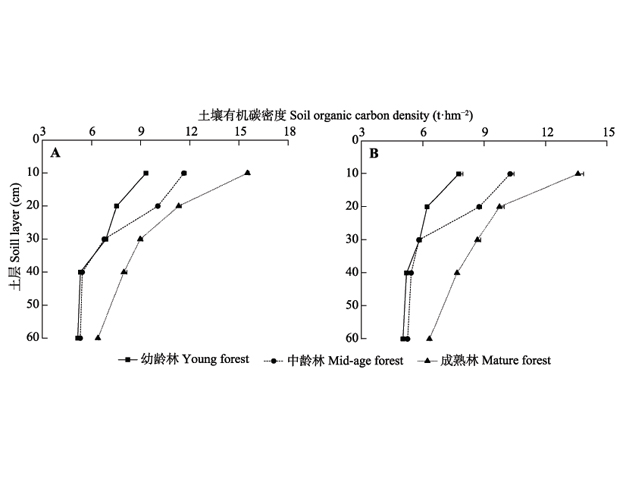
森林火灾作为森林非连续的干扰因子, 是生物地球化学循环的驱动因子, 显著改变生态系统的结构和功能及养分循环与能量传递, 引起森林碳库与碳分配格局的变化, 进而影响森林演替进程及固碳能力。该研究以广东省马尾松(Pinus massoniana)次生林为研究对象, 采用相邻样地比较法和空间代替时间法, 以野外调查采样与室内试验分析为主要手段, 定量研究突发性森林火灾对土壤有机碳密度的影响, 探讨森林火灾对土壤有机碳固持的影响机制。结果表明: 与对照相比, 森林火灾后的幼龄林、中龄林和成熟林的土壤有机碳密度分别为35.12、40.80和52.34 t·hm-2, 依次降低了10.93%、8.52%和7.56%。相比对照, 幼龄林、中龄林和成熟林土壤剖面(0-60 cm)的土壤有机碳密度变化范围分别为5.04-7.76、5.26-10.27和6.33-13.58 t·hm-2, 依次降低了2.51%-16.83%、1.31%-11.85%和1.09%-12.50%; 森林火灾显著降低了幼龄林和中龄林0-30 cm的土壤有机碳密度, 显著降低了成熟林0-20 cm的土壤有机碳密度。马尾松次生林土壤有机碳密度与土壤理化性质具有显著相关关系。通径分析表明, 对照样地和过火样地中, 土壤全氮含量均对土壤有机碳密度的直接作用最大, 土壤细根生物量对土壤有机碳密度的直接作用较小, 但其通过土壤全氮含量对土壤有机碳密度的影响均表现在间接作用上。嵌套方差分析表明, 土壤深度解释了土壤有机碳密度变异的70.60%, 林龄解释了其变异的25.35%, 森林火灾解释了其变异的2.34%。研究发现: 森林火灾减少了马尾松次生林各林龄的土壤有机碳密度。在水平方向上, 随着林龄增长, 土壤有机碳密度的减少幅度降低; 在垂直方向上, 土壤有机碳密度随着土壤土层深度加深而降低, 且随林龄增长减少幅度下降。研究森林火灾对森林生态系统土壤有机碳的影响, 有助于理解森林生态系统土壤碳固持和碳循环过程, 对制定旨在减缓全球变化的科学合理的林火管理策略具有重要意义。
罗斯生, 罗碧珍, 魏书精, 胡海清, 李小川, 吴泽鹏, 王振师, 周宇飞, 钟映霞 . 中度强度森林火灾对马尾松次生林土壤有机碳密度的影响[J]. 植物生态学报, 2020 , 44(10) : 1073 -1086 . DOI: 10.17521/cjpe.2020.0084
Aims As a discontinuous disturbance factor, forest fire is one of the drivers of biogeochemical cycles. It significantly changes the structure and function, nutrient cycling, and energy transfer of ecosystems and alters the forest carbon pools and carbon distribution patterns, consequently affecting the processes of forest succession and carbon sequestration capacity. This study aims to determine the impacts of incidental forest fire on soil organic carbon density, and to explore the mechanisms of forest fire impacts on soil organic carbon fixation.
Methods The study was conducted in secondary Pinus massoniana forests of different ages in Guangdong Province, using the method of space for time substitution. The sampling plots were set up on adjacent sites of burned and control stands, and soil samples (0-60 cm) were collected from each plot for indoor tests and analysis of the physical and chemical properties. The soil organic carbon components were measured and calculated for density. Changes in soil physical and chemical properties and soil organic carbon with forest ages were quantified.
Important findings Fire reduced the soil organic carbon density in secondary P. massoniana forests; the level of reduction in soil organic carbon density decreased with forest age and soil depth. Compared with the controls, the soil organic carbon density in the burned plots of young, mid-age and mature forests were 10.93%, 8.52% and 7.56% lower, respectively. The soil organic carbon density in the burned plots of young, mid-age and mature forests varied in the range of 5.04-7.76, 5.26-10.27 and 6.33-13.58 t·hm-2, respectively, along the soil profile of 0-60 cm, which were 2.51%-16.83%, 1.31%-11.85% and 1.09%-12.50% lower, respectively, than the controls. Fire significantly reduced the soil organic carbon density of the young and the mid-age forests in the 0-30 cm soil layer, and of the mature forest in the 0-20 cm soil layer. There were significant correlations between soil organic carbon density and soil physical and chemical properties. Path analysis revealed the greatest direct effect of soil total nitrogen content on soil organic carbon density in both the control and burned plots; fine root biomass had a smaller direct effect, but imposed an indirect effect on soil organic carbon density via its controls on soil total nitrogen content. Nested ANOVA showed that soil depth accounted for 70.60% of the variations in soil organic carbon density, forest age 25.35%, and fire 2.34%.
| [1] | Alca?iz M, Outeiro L, Francos M, úbeda X (2018). Effects of prescribed fires on soil properties: a review. Science of the Total Environment, 613, 944-957. |
| [2] | Alexander ME (1982). Calculating and interpreting forest fire intensities. Canadian Journal of Botany, 60, 349-357. |
| [3] | Andela N, Morton DC, Giglio L, Chen Y, van der Werf GR, Kasibhatla PS, Bachelet D (2017). A human-driven decline in global burned area. Science, 356, 1356-1362. |
| [4] | Andreae MO, Merlet P (2001). Emissions of trace gases and aerosols from biomass burning. Global Biogeochemical Cycles, 15, 955-966. |
| [5] | Augusto L, de Schrijver A, Vesterdal L, Smolander A, Prescott C, Ranger J (2015). Influences of evergreen gymnosperm and deciduous angiosperm tree species on the functioning of temperate and boreal forests. Biological Reviews, 90, 444-466. |
| [6] | Barbero R, Abatzoglou JT, Larkin NK, Kolden CA, Stocks B (2015). Climate change presents increased potential for very large fires in the contiguous United States. International Journal of Wildland Fire, 24, 892-899. |
| [7] | Bennett LT, Aponte C, Baker TG, Tolhurst KG (2014). Evaluating long-term effects of prescribed fire regimes on carbon stocks in a temperate eucalypt forest. Forest Ecology and Management, 328, 219-228. |
| [8] | Bennett LT, Bruce MJ, Machunter J, Kohout M, Krishnaraj SJ, Aponte C (2017). Assessing fire impacts on the carbon stability of fire-tolerant forests. Ecological Applications, 27, 2497-2513. |
| [9] | Boruvka L, Mladkova L, Drabek O (2005). Factors controlling spatial distribution of soil acidification and Al forms in forest soils. Journal of Inorganic Biochemistry, 99, 1796-1806. |
| [10] | Cleverly J, Boulain N, Villalobos-Vega R, Grant N, Faux R, Wood C, Cook PG, Yu Q, Leigh A, Eamus D (2013). Dynamics of component carbon fluxes in a semi-arid Acacia woodland, central Australia. Biogeosciences, 118, 1168-1185. |
| [11] | Cochrane MA (2003). Fire science for rainforests. Nature, 421, 913-919. |
| [12] | Cui XY, Hao JM, Zhao SS, Sang Y, Wang HQ, Di XY (2012). Temporal and spacial changes of total soil organic carbon content as affected by an experimental forest fire in the Greater Xing?an Mountains. Journal of Soil and Water Conservation, 26(5), 195-200. |
| [12] | [ 崔晓阳, 郝敬梅, 赵山山, 桑英, 王海淇, 邸雪颖 (2012). 大兴安岭北部试验林火影响下土壤有机碳含量的时空变化. 水土保持学报, 26(5), 195-200.] |
| [13] | Dixon RK, Solomon AM, Brown S, Houghton RA, Trexier MC, Wisniewski J (1994). Carbon pools and flux of global forest ecosystems. Science, 263, 185-190. |
| [14] | French NHF, Goovaerts P, Kasischke ES (2004). Uncertainty in estimating carbon emissions from boreal forest fires. Journal of Geophysical Research, 109, D14S08. DOI: 10.1029/2003JD003635. |
| [15] | Giglio L, Randerson JT, van der Werf GR (2013). Analysis of daily, monthly, and annual burned area using the fourth- generation global fire emissions database (GFED4). Journal of Geophysical Research, 118, 317-328. |
| [16] | Gleason CJ, Im J (2011). A review of remote sensing of forest biomass and biofuel: options for small-area applications. Mapping Sciences & Remote Sensing, 48(2), 141-170. |
| [17] | Hammill KA, Bradstock RA (2006). Remote sensing of fire severity in the Blue Mountains: influence of vegetation type and inferring fire intensity. International Journal of Wildland Fire, 15, 213-226. |
| [18] | He M, Dijkstra FA (2014). Drought effect on plant nitrogen and phosphorus: a meta-analysis. New Phytologist, 204, 924-931. |
| [19] | Heikkinen RK, Luoto M, Kuussaari M, P?yry J (2005). New insights into butterfly-environment relationships using partitioning methods. Proceedings of the Royal Society B: Biological Sciences, 272, 2203-2210. |
| [20] | Holland EA, Braswell BH, Lamarque JF, Townsend A, Sulzman J, Müller JF, Roelofs GJ (1997). Variations in the predicted spatial distribution of atmospheric nitrogen deposition and their impact on carbon uptake by terrestrial ecosystems. Journal of Geophysical Research, 102, 15849-15866. |
| [21] | Hu HQ (2005). Forest Fire Ecology and Management. China Forestry Publishing House, Beijing. 98. |
| [21] | [ 胡海清 (2005). 北京林业大学学报, 林火生态与管理. 中国林业出版社, 北京. 98.] |
| [22] | Hu HQ, Luo SS, Luo BZ, Wei SJ, Wang ZJ, Wu ZP (2019). Effects of forest fire disturbance on soil organic carbon and its components of Cunninghamia lanceolata forest in Guangdong Province, southern China. Journal of Beijing Forestry University, 41(12), 108-118. |
| [22] | [ 胡海清, 罗斯生, 罗碧珍, 魏书精, 王振师, 吴泽鹏 (2019). 林火干扰对广东省杉木林土壤有机碳及其组分的影响. 北京林业大学学报, 41(12), 108-118.] |
| [23] | Hu HQ, Luo SS, Luo BZ, Wei SJ, Wu ZP, Wang ZS, Li XC, Zhou YF (2020). Effects of forest fire disturbance on soil organic carbon in forest ecosystems: a review. Acta Ecologica Sinica, 40, 1839-1850. |
| [23] | [ 胡海清, 罗斯生, 罗碧珍, 魏书精, 吴泽鹏, 王振师, 李小川, 周宇飞 (2020). 林火干扰对森林生态系统土壤有机碳的影响研究进展. 生态学报, 40, 1839-1850.] |
| [24] | Hu HQ, Wei SJ, Sun L (2012). Estimation of carbon emissions from forest fires in 2010 in Huzhong of Daxing?anling Mountain. Scientia Silvae Sinicae, 48(10), 109-119. |
| [24] | [ 胡海清, 魏书精, 孙龙 (2012). 大兴安岭呼中区2010年森林火灾碳排放的计量估算. 林业科学, 48(10), 109-119.] |
| [25] | Huang CY, Xu JM (2010). Soil Science. 3rd ed. China Agriculture Press, Beijing. 33. |
| [25] | [ 黄昌勇, 徐建明 (2010). 土壤学. 3版. 中国农业出版社, 北京. 33.] |
| [26] | Hume A, Chen HYH, Taylor AR, Kayahara GJ, Man R (2016). Soil C:N:P dynamics during secondary succession following fire in the boreal forest of central Canada. Forest Ecology and Management, 369, 1-9. |
| [27] | Jobbágy EG, Jackson RB (2000). The vertical distribution of soil organic carbon and its relation to climate and vegetation. Ecological Applications, 10, 423-436. |
| [28] | Johnson DW, Curtis PS (2001). Effects of forest management on soil C and N storage: meta analysis. Forest Ecology and Management, 140, 227-238. |
| [29] | Kong JJ, Yang J (2014). Short- and long-term effects of fire on soil properties in a Dahurian larch forest in Great Xing?an Mountains. Chinese Journal of Ecology, 33, 1445-1450. |
| [29] | [ 孔健健, 杨健 (2014). 林火对大兴安岭落叶松林土壤性质的短期与长期影响. 生态学杂志, 33, 1445-1450.] |
| [30] | Laganière J, Pare D, Bradley RL (2010). How does a tree species influence litter decomposition? Separating the relative contribution of litter quality, litter mixing, and forest floor conditions. Canadian Journal of Forest Research, 40, 465-475. |
| [31] | Lohbeck M, Poorter L, Martínez-Ramos M, Bongers F (2015). Biomass is the main driver of changes in ecosystem process rates during tropical forest succession. Ecology, 96, 1242-1252. |
| [32] | Luo BZ, Luo SS, Wei SJ, Sun L, Hu HQ (2018). Review on emission from biomass combustion. Journal of Nanjing Forestry University (Natural Sciences Edition), 42(6), 191-196. |
| [32] | [ 罗碧珍, 罗斯生, 魏书精, 孙龙, 胡海清 (2018). 生物质燃烧排放物研究进展. 南京林业大学学报(自然科学版), 42(6), 191-196.] |
| [33] | McGroddy ME, Daufresne T, Hedin LO (2004). Scaling of C:N:P stoichiometry in forests worldwide: implications of terrestrial redfield-type ratios. Ecology, 85, 2390-2401. |
| [34] | Meersmans J, de Ridder F, Canters F, De Baets S, van Molle M (2008). A multiple regression approach to assess the spatial distribution of Soil Organic Carbon (SOC) at the regional scale (Flanders, Belgium). Geoderma, 143, 1-13. |
| [35] | Mládková L, Boruvka L, Drábek O (2004). Distribution of aluminium among its mobilizable forms in soils of the Jizera mountains region. Plant Soil and Environment, 50, 346-351. |
| [36] | Mouteva GO, Czimczik CI, Fahrni SM, Wiggins EB, Rogers BM, Veraverbeke S, Randerson JT (2015). Black carbon aerosol dynamics and isotopic composition in Alaska linked with boreal fire emissions and depth of burn in organic soils. Global Biogeochemical Cycles, 29, 1977-2000. |
| [37] | Neary DG, Klopatek CC, DeBano LF, Ffolliott PF (1999). Fire effects on belowground sustainability: a review and synthesis. Forest Ecology and Management, 122, 51-71. |
| [38] | Page SS, Siegert F, Rieley JO, Boehm HDV, Jaya A, Limin S (2002). The amount of carbon released from peat and forest fires in Indonesia during 1997. Nature, 420, 61-65. |
| [39] | Paré D, Bergeron Y, Camiré C (1993). Changes in the forest floor of Canadian southern boreal forest after disturbance. Journal of Vegetation Science, 4, 811-818. |
| [40] | Pellegrini AFA, Ahlstr?m A, Hobbie SE, Reich PB, Nieradzik LP, Staver AC, Jackson RB (2018). Fire frequency drives decadal changes in soil carbon and nitrogen and ecosystem productivity. Nature, 553, 194-198. |
| [41] | Prescott CE, Chappell HN, Vesterdal L (2000). Nitrogen turnover in forest floors of coastal douglas-fir at sites differing in soil nitrogen capital. Ecology, 81, 1878-1886. |
| [42] | Schulze ED, Schulze W, Koch H, Arneth A, Bauer G, Kelliher FM, Ziegler W (1995). Aboveground biomass and nitrogen nutrition in a chronosequence of pristine Dahurian Larix stands in eastern Siberia. Canadian Journal of Forest Research, 25, 943-960. |
| [43] | Seiler W, Crutzen JP (1980). Estimates of the gross and net fluxes of carbon between the biosphere and the atmosphere from biomass burning. Climatic Change, 2, 207-247. |
| [44] | Shrestha BM, Chen HYH (2010). Effects of stand age, wildfire and clearcut harvesting on forest floor in boreal mixedwood forests. Plant and Soil, 336, 267-277. |
| [45] | Springob G, Kirchmann H (2003). Bulk soil C to N ratio as a simple measure of net N mineralization from stabilized soil organic matter in sandy arable soils. Soil Biology & Biochemistry, 35, 629-632. |
| [46] | Sun MX (2011). The Impacts on Soil Properties and Revegetation from Forest Fire in Tahe Forest Region. PhD dissertation, Beijing Forestry University, Beijing. |
| [46] | [ 孙明学 (2011). 塔河林区林火对土壤性质与植被恢复的影响. 博士学位论文, 北京林业大学, 北京.] |
| [47] | Sun Q, Meyer WS, Koerber GR, Marschner P (2016). A wildfire event influences ecosystem carbon fluxes but not soil respiration in a semi-arid woodland. Agricultural and Forest Meteorology, 226, 57-66. |
| [48] | Survey and Design Institute of State Forestry Administration (2011). Technical regulations for inventory for forest management planning and design: China, GBT26424- 2010. 2011-01-14. |
| [48] | [ 国家林业局调查规划设计院 (2011). 森林资源规划设计调查技术规程: 中国, GBT26424-2010. 2011-01-14.] |
| [49] | Vergnoux A, Di Rocco R, Domeizel M, Guiliano M, Doumenq P, Théraulaz F (2011). Effects of forest fires on water extractable organic matter and humic substances from Mediterranean soils: UV-vis and fluorescence spectroscopy approaches. Geoderma, 160, 434-443. |
| [50] | Wang XQ, Wang CK (2019). Variations in topsoil carbon and nitrogen contents of five temperate plantations in Northeast China. Chinese Journal of Applied Ecology, 30, 1911-1918. |
| [50] | [ 王薪琪, 王传宽 (2019). 东北5种温带人工林表层土壤碳氮含量的分异. 应用生态学报, 30, 1911-1918.] |
| [51] | Yuan ZY, Chen HYH (2012). A global analysis of fine root production as affected by soil nitrogen and phosphorus. Proceedings of the Royal Society B: Biological Sciences, 279, 3796-3802. |
| [52] | Zhang PX, Fan SS, Hou CM, Hu CZ, Ren H (2012). The conception planning study on ecological forestry in Heshan city, Guangdong Province. Ecological Science, 31, 488-493. |
| [52] | [ 张佩霞, 范桑桑, 侯长谋, 胡成志, 任海 (2012). 广东省鹤山市林业生态规划研究. 生态科学, 31, 488-493.] |
| [53] | Zhang SJ, Li YM, Zhou Y, Su ZY (2010). Distribution patterns of soil organic carbon density in western Guangdong and its influencing factors. Journal of Central South University of Forestry & Technology, 30(5), 22-28. |
| [53] | [ 张苏峻, 黎艳明, 周毅, 苏志尧 (2010). 粤西桉树人工林土壤有机碳密度及其影响因素. 中南林业科技大学学报, 30(5), 22-28.] |
| [54] | Zhou G, Guan L, Wei X, Zhang D, Zhang Q, Yan J, Kong G (2007). Litterfall production along successional and altitudinal gradients of subtropical monsoon evergreen broadleaved forests in Guangdong, China. Plant Ecology, 188, 77-89. |
/
| 〈 |
|
〉 |
Copyright © 2026 版权所有 《植物生态学报》编辑部
地址: 北京香山南辛村20号, 邮编: 100093
Tel.: 010-62836134, 62836138; Fax: 010-82599431; E-mail: apes@ibcas.ac.cn, cjpe@ibcas.ac.cn
备案号: 京ICP备16067583号-19

