
陆地生境岛屿藓类植物小岛屿效应驱动因素分析——以太行山脉中段山顶为例
收稿日期: 2022-06-28
录用日期: 2022-08-22
网络出版日期: 2022-09-05
基金资助
国家自然科学基金(32160315);国家自然科学基金(32060050);河北省自然科学基金(D2019205019);河北省高等学校科学技术研究项目(ZD20211035)
Drivers of the small-island effect in moss assemblages on terrestrial habitat islands: a case study in mountaintops of the Middle Taihang Mountains, China
Received date: 2022-06-28
Accepted date: 2022-08-22
Online published: 2022-09-05
Supported by
National Natural Science Foundation of China(32160315);National Natural Science Foundation of China(32060050);Natural Science Foundation of Hebei Province(D2019205019);Science and Technology Research Project of Universities in Hebei Province(ZD20211035)
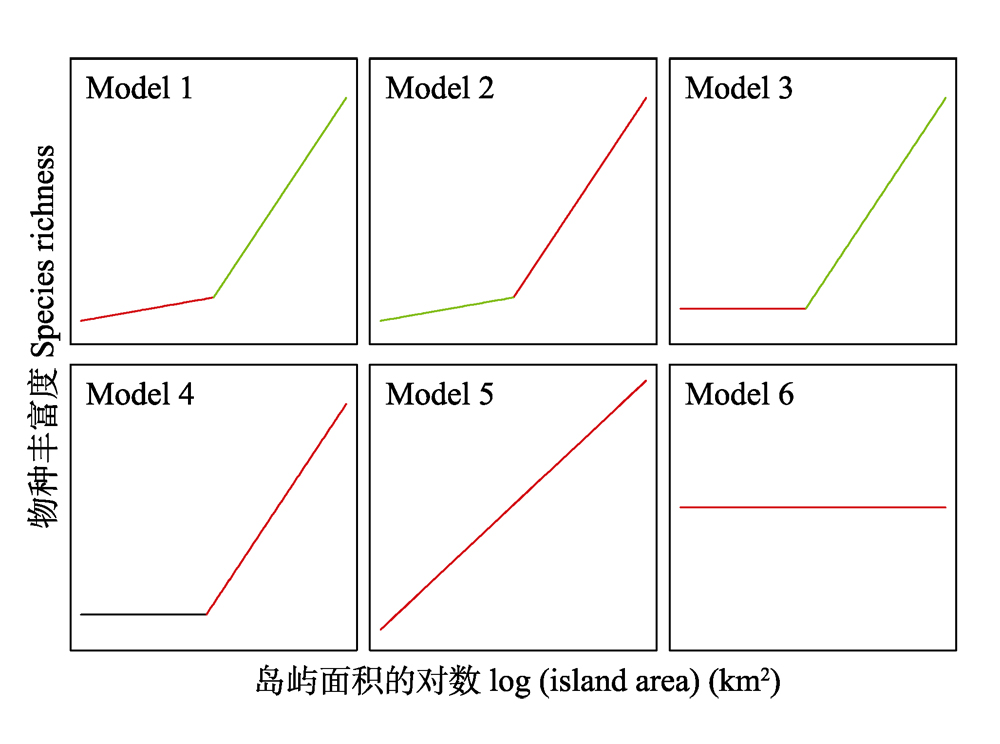
小岛屿效应描述了种-面积关系的一种特殊现象, 是当前生物地理学和生物多样性研究理论框架的重要组成部分。随着气候变暖, 山顶物种的生存受到威胁, 然而以山顶生境岛屿为载体对小岛屿效应的研究还十分缺乏。该研究以太行山脉中段19个面积0.06-801.58 km2的山顶生境岛屿为研究区, 在2019-2021年的夏秋季对藓类进行调查。共记录到藓类131种, 隶属于23科68属。采用6种种-面积关系回归模型, 分别检测了所有藓和6个常见藓科是否存在小岛屿效应。根据小岛屿效应形成机制的生境多样性假说、灭亡假说和营养补给假说, 选择了岛屿高度、温度年变化范围和单位面积净初级生产力作为变量, 对小岛屿效应的驱动因素进行分析。在各类群组中, 使用多元线性回归和变差分解分别评估上述3个变量对物种丰富度变化的线性影响。首先使用5个面积最小的岛屿进行分析, 计算出3个变量对物种丰富度变化的贡献, 然后以迭代的方式逐次加入面积更大的1个岛屿, 并再次进行变差分解分析。最后使用广义线性回归分析了3个变量对物种丰富度变化的贡献在迭代过程中的变化趋势。结果显示, 所有藓和6个常见藓科均存在小岛屿效应, 其面积阈值分布在0.36-106.91 km2间。各组藓类小岛屿效应的驱动因素具有差异性, 其中, 除了紫萼藓科之外, 其他各组均支持生境假说; 除了丛藓科、真藓科、紫萼藓科和灰藓科之外, 其他各组均支持灭亡假说; 而各组在不同程度上普遍支持营养补给假说。整体而言, 面积约为10 km2以上的岛屿维持了大量的藓类物种多样性, 需要重点保护。对于生境要求较为单一的紫萼藓科而言, 保护石生环境是保护其物种多样性的关键; 而对于其他科藓类而言, 生境类型多样性的保护是维持物种多样性的重要保障。营养补给假说的普遍适用性揭示了山顶下方森林生态系统的资源补给作用减缓了由于面积的减小而造成的藓类物种数量下降, 因此保护山顶下方林地内物种多样性和群落稳定性对维持山顶藓类物种多样性具有重要意义。
曹珍, 刘永英, 宋世凯, 张莉娜, 高德 . 陆地生境岛屿藓类植物小岛屿效应驱动因素分析——以太行山脉中段山顶为例[J]. 植物生态学报, 2023 , 47(1) : 65 -76 . DOI: 10.17521/cjpe.2022.0272
Aims As an anomalous feature of the species-area relationship (SAR), the small-island effect (SIE) is an important pattern in the fields of island biogeography and biodiversity science. However, the existing work has rarely explored the SIE in fragmented mountaintops. Moreover, the underlying factors determining the SIE remain largely untested. In this paper, we aimed to evaluate the prevalence and underlying factors determining the occurrence of SIEs in mosses on mountaintops of the Middle Taihang Mountains.
Methods We investigated and compiled data on the species richness of all mosses and six most common moss families on 19 mountaintops of the Middle Taihang Mountains. For each of the seven taxonomic groups, we applied six SAR models, including four piecewise regressions with two segments, a linear regression, and a zero-slope regression as a null model, to detect the SIE and then used the corrected Akaike’s information criterion (AICc) as a criterion to select the best model. We obtained three environmental variables, including island height, annual temperature range, and net primary productivity per unit area that are linked to the habitat diversity hypothesis, the extinction hypothesis, and the subsidized island biogeography hypothesis, respectively, in order to explore the underlying drivers of the SIE. We applied iterative multiple linear regression and variation partitioning to determine the effects of island area and each of environmental variables on species richness for islands of varying sizes. Finally, we analyzed the trends of environmental variables’ contributions to species richness variation over the iterative process by using generalized linear regressions with polynomials of area up to the second degree.
Important findings A total of 131 moss species, belonging to 23 genera under 68 families, were identified. SIEs were detected for all mosses and six most common moss families, with the area thresholds varing between 0.36 km2 and 106.91 km2. The driving factors of the SIE differentiate among groups. Among them, Grimmiaceae did not support the habitat diversity hypothesis; Pottiaceae, Bryaceae, Grimmiaceae, and Hypnaceae did not support the extinction hypothesis; whereas, the subsidized island biogeography hypothesis was generally supported by each group to varying degrees. On the whole, mountaintops with an area of over 10 km2 maintain a large diversity of moss species and thus be identified as site conservation targets. For mosses with relatively unique habitat requirement, such as Grimmiaceae, protecting the stony habitat is the key to maintain its species diversity; as for other mosses, conservation of habitat diversity is the key to maintain their species diversity. The general applicability of the subsidized island biogeography hypothesis suggests that the resource replenishment of the forest ecosystem below the mountaintops counteracts the removal of mosses’ species richness due to area reduction. Therefore, conservation of species diversity and community stability in the forest below the mountaintops is essential for sustaining moss species diversity in fragmented mountaintops.
| [1] | Anderson WB, Wait DA (2001). Subsidized Island Biogeography Hypothesis: another new twist on an old theory. Ecology Letters, 4, 289-291. |
| [2] | Boyle WA (2008). Can variation in risk of nest predation explain altitudinal migration in tropical birds? Oecologia, 155, 397-403. |
| [3] | Boyle WA, Norris DR, Guglielmo CG (2010). Storms drive altitudinal migration in a tropical bird. Proceedings of the Royal Society B: Biological Sciences, 277, 2511-2519. |
| [4] | Brown JH (1971). Mammals on mountaintops: nonequilibrium insular biogeography. The American Naturalist, 105, 467-478. |
| [5] | Burnham KP, Anderson DR (2002). Model Selection and Multimodel Inference: a Practical Information-theoretic Approach. Springer, New York. |
| [6] | Chaves-Campos J (2004). Elevational movements of large frugivorous birds and temporal variation in abundance of fruits along an elevational gradient. Ornitologia Neotropical, 15, 433-445. |
| [7] | Chen CW, Yang XR, Tan XW, Wang YP (2020). The role of habitat diversity in generating the small-island effect. Ecography, 43, 1241-1249. |
| [8] | Chen IC, Hill JK, Ohlemüller R, Roy DB, Thomas CD (2011). Rapid range shifts of species associated with high levels of climate warming. Science, 333, 1024-1026. |
| [9] | Crist TO, Veech JA (2006). Additive partitioning of rarefaction curves and species-area relationships: unifying alpha-, beta- and gamma-diversity with sample size and habitat area. Ecology Letters, 9, 923-932. |
| [10] | Dengler J (2010). Robust methods for detecting a small island effect. Diversity and Distributions, 16, 256-266. |
| [11] | Ficetola GF, Denoёl M (2009). Ecological thresholds: an assessment of methods to identify abrupt changes in species- habitat relationships. Ecography, 32, 1075-1084. |
| [12] | Fleishman E, Ray C, Sjogren-Gulve P, Boggs CL, Murphy DD (2002). Assessing the roles of patch quality, area, and isolation in predicting metapopulation dynamics. Conservation Biology, 16, 706-716. |
| [13] | Francisco-Ramos V, Arias-González JE (2013). Additive partitioning of coral reef fish diversity across hierarchical spatial scales throughout the Caribbean. PLoS ONE, 8, e78761. DOI: 10.1371/journal.pone.0078761. |
| [14] | Gao D, Cao Z, Xu P, Perry G (2019). On piecewise models and species-area patterns. Ecology and Evolution, 9, 8351-8361. |
| [15] | Gao D, Fu LQ, Sun JX, Li Y, Cao Z, Liu YY, Xu P, Zhao JC (2021). The mid-domain effect and habitat complexity applied to elevational gradients: moss species richness in a temperate semihumid monsoon climate mountain of China. Ecology and Evolution, 11, 7448-7460. |
| [16] | Gao D, Perry G (2016a). Detecting the small island effect and nestedness of herpetofauna of the West Indies. Ecology and Evolution, 6, 5390-5403. |
| [17] | Gao D, Perry G (2016b). Species-area relationships and additive partitioning of diversity of native and nonnative herpetofauna of the West Indies. Ecology and Evolution, 6, 7742-7762. |
| [18] | Gao D, Wang YP (2022). A global synthesis of the small-island effect in amphibians and reptiles. Ecography, 2022, e05957. DOI: 10.1111/ecog.05957. |
| [19] | Gilpin ME, Diamond JM (1976). Calculation of immigration and extinction curves from the species-area-distance relation. Proceedings of the National Academy of Sciences of the United States of America, 73, 4130-4134. |
| [20] | He XL, He KS, Hyv?nen J (2016). Will bryophytes survive in a warming world? Perspectives in Plant Ecology, Evolution and Systematics, 19, 49-60. |
| [21] | Hijmans RJ, Cameron SE, Parra JL, Jones PG, Jarvis A (2005). Very high resolution interpolated climate surfaces for global land areas. International Journal of Climatology, 25, 1965-1978. |
| [22] | Jarvis A, Reuter HI, Nelson A, Guevara E (2008). Hole-filled seamless SRTM data V4, International Centre for Tropical Agriculture (CIAT).[2022-06-01]http://srtm.csi.cgiar.org. |
| [23] | Jensen DA, Ma KP, Svenning JC (2020). Steep topography buffers threatened gymnosperm species against anthropogenic pressures in China. Ecology and Evolution, 10, 1838-1855. |
| [24] | Kimura MT (2021). Altitudinal migration of insects. Entomological Science, 24, 35-47. |
| [25] | Kürschner H (2004). Life strategies and adaptations in bryophytes from the Near and Middle East. Turkish Journal of Botany, 28, 73-84. |
| [26] | Lenoir J, Svenning JC (2015). Climate-related range shifts—A global multidimensional synthesis and new research directions. Ecography, 38, 15-28. |
| [27] | Lomolino MV (2000). Ecology’s most general, yet protean pattern: the species-area relationship. Journal of Biogeography, 27, 17-26. |
| [28] | Lomolino MV, Weiser MD (2001). Towards a more general species-area relationship: diversity on all islands, great and small. Journal of Biogeography, 28, 431-445. |
| [29] | MacArthur RH, Wilson EO (1967). The Theory of Island Biogeography. Princeton University Press, Princeton, USA. |
| [30] | Marris E (2007). The escalator effect. Nature Reports Climate Change, 1, 94-96. |
| [31] | Matthews TJ, Rigal F, Kougioumoutzis K, Trigas P, Triantis KA (2020). Unravelling the small-island effect through phylogenetic community ecology. Journal of Biogeography, 47, 2341-2352. |
| [32] | Matthews TJ, Steinbauer MJ, Tzirkalli E, Triantis KA, Whittaker RJ (2014). Thresholds and the species-area relationship: a synthetic analysis of habitat island datasets. Journal of Biogeography, 41, 1018-1028. |
| [33] | Menegotto A, Rangel TF, Schrader J, Weigelt P, Kreft H (2020). A global test of the subsidized island biogeography hypothesis. Global Ecology and Biogeography, 29, 320-330. |
| [34] | Morrison LW (2014). The small-island effect: empty islands, temporal variability and the importance of species composition. Journal of Biogeography, 41, 1007-1017. |
| [35] | Niering WA (1963). Terrestrial ecology of Kapingamarangi Atoll, Caroline Islands. Ecological Monographs, 33, 131-160. |
| [36] | Pageau C, Vale MM, de Menezes MA, Bar?ante L, Shaikh M, Alves MAS, Reudink MW (2020). Evolution of altitudinal migration in passerines is linked to diet. Ecology and Evolution, 10, 3338-3345. |
| [37] | Pati?o J, Weigelt P, Guilhaumon F, Kreft H, Triantis KA, Naranjo-Cigala A, Sólymos P, Vanderpoorten A (2014). Differences in species-area relationships among the major lineages of land plants: a macroecological perspective. Global Ecology and Biogeography, 23, 1275-1283. |
| [38] | Prugh LR, Hodges KE, Sinclair ARE, Brashares JS (2008). Effect of habitat area and isolation on fragmented animal populations. Proceedings of the National Academy of Sciences of the United States of America, 105, 20770-20775. |
| [39] | Schnabel F, Liu XJ, Kunz M, Barry KE, Bongers FJ, Bruelheide H, Fichtner A, H?rdtle W, Li S, Pfaff CT, Schmid B, Schwarz JA, Tang ZY, Yang B, Bauhus J, et al. (2021). Species richness stabilizes productivity via asynchrony and drought-tolerance diversity in a large-scale tree biodiversity experiment. Science Advances, 7, eabk1643. DOI: 10.1126/sciadv.abk1643. |
| [40] | Schrader J, K?nig C, Triantis KA, Trigas P, Kreft H, Weigelt P (2020). Species-area relationships on small islands differ among plant growth forms. Global Ecology and Biogeography, 29, 814-829. |
| [41] | Sekercioglu CH, Schneider SH, Fay JP, Loarie SR (2008). Climate change, elevational range shifts, and bird extinctions. Conservation Biology, 22, 140-150. |
| [42] | Sfenthourakis S, Triantis KA (2009). Habitat diversity, ecological requirements of species and the Small Island Effect. Diversity and Distributions, 15, 131-140. |
| [43] | Tingley MW, Koo MS, Moritz C, Rush AC, Beissinger SR (2012). The push and pull of climate change causes heterogeneous shifts in avian elevational ranges. Global Change Biology, 18, 3279-3290. |
| [44] | Triantis KA, Vardinoyannis K, Tsolaki EP, Botsaris I, Lika K, Mylonas M (2006). Re-approaching the small island effect. Journal of Biogeography, 33, 914-923. |
| [45] | Vanderpoorten A, Goffinet B (2009). Introduction to Bryophytes. Cambridge University Press, London. |
| [46] | Wang YP, Chen CW, Millien V (2018a). A global synthesis of the small-island effect in habitat islands. Proceedings of the Royal Society B: Biological Sciences, 285, 20181868. DOI: 10.1098/rspb.2018.1868. |
| [47] | Wang YP, Millien V, Ding P (2016). On empty islands and the small-island effect. Global Ecology and Biogeography, 25, 1333-1345. |
| [48] | Wang YP, Wang X, Wu Q, Chen CS, Xu AC, Ding P (2018b). The small-island effect in amphibian assemblages on subtropical land-bridge islands of an inundated lake. Current Zoology, 64, 303-309. |
| [49] | Watson DM (2002). A conceptual framework for studying species composition in fragments, islands and other patchy ecosystems. Journal of Biogeography, 29, 823-834. |
| [50] | Whitehead DR, Jones CE (1969). Small islands and the equilibrium theory of insular biogeography. Evolution, 23, 171-179. |
| [51] | Yu J, Li DD, Zhang ZY, Guo SL (2020). Species-area relationship and small-island effect of bryophytes on the Zhoushan Archipelago, China. Journal of Biogeography, 47, 978-992. |
| [52] | Yu J, Shen L, Li DD, Guo SL (2019). Determinants of bryophyte species richness on the Zhoushan Archipelago, China. Basic and Applied Ecology, 37, 38-50. |
| [53] | Zajac RN, Vozarik JM, Gibbons BR (2013). Spatial and temporal patterns in macrofaunal diversity components relative to sea floor landscape structure. PLoS ONE, 8, e65823. DOI: 10.1371/journal.pone.0065823. |
| [54] | Zhang YM, Cao T, Pan BR (2002). A review on the studies of bryophyte ecology in arid and semi-arid areas. Acta Ecologica Sinica, 22, 1129-1134. |
| [54] | [ 张元明, 曹同, 潘伯荣 (2002). 干旱与半干旱地区苔藓植物生态学研究综述. 生态学报, 22, 1129-1134.] |
| [55] | Zhu Y, Sheng S, Zheng JF, Wu S, Zhang K, Xu Y (2022). Small-island effect in bird assemblages on fragmented woodlots in Huaxi university areas, Guizhou, China. Chinese Journal of Zoology, 57, 205-212. |
| [55] | [ 朱芸, 盛尚, 郑进凤, 伍素, 张凯, 徐雨 (2022). 贵州花溪大学城破碎化林地中鸟类群落的小岛屿效应. 动物学杂志, 57, 205-212.] |
/
| 〈 |
|
〉 |
Copyright © 2026 版权所有 《植物生态学报》编辑部
地址: 北京香山南辛村20号, 邮编: 100093
Tel.: 010-62836134, 62836138; Fax: 010-82599431; E-mail: apes@ibcas.ac.cn, cjpe@ibcas.ac.cn
备案号: 京ICP备16067583号-19

