
神农架自然遗产地植被垂直带谱的特点和代表性
收稿日期: 2017-04-07
录用日期: 2017-08-29
网络出版日期: 2017-11-10
基金资助
中国科学院院级科研项目(QYZDY-SSW-SMC011-2)、国家重点研发计划(2016YFC050310101和2016YFC050330304)和科技部科技基础性工作专项(2015FY1103002)
Characteristic and representativeness of the vertical vegetation zonation along the altitudinal gradient in Shennongjia Natural Heritage
Received date: 2017-04-07
Accepted date: 2017-08-29
Online published: 2017-11-10
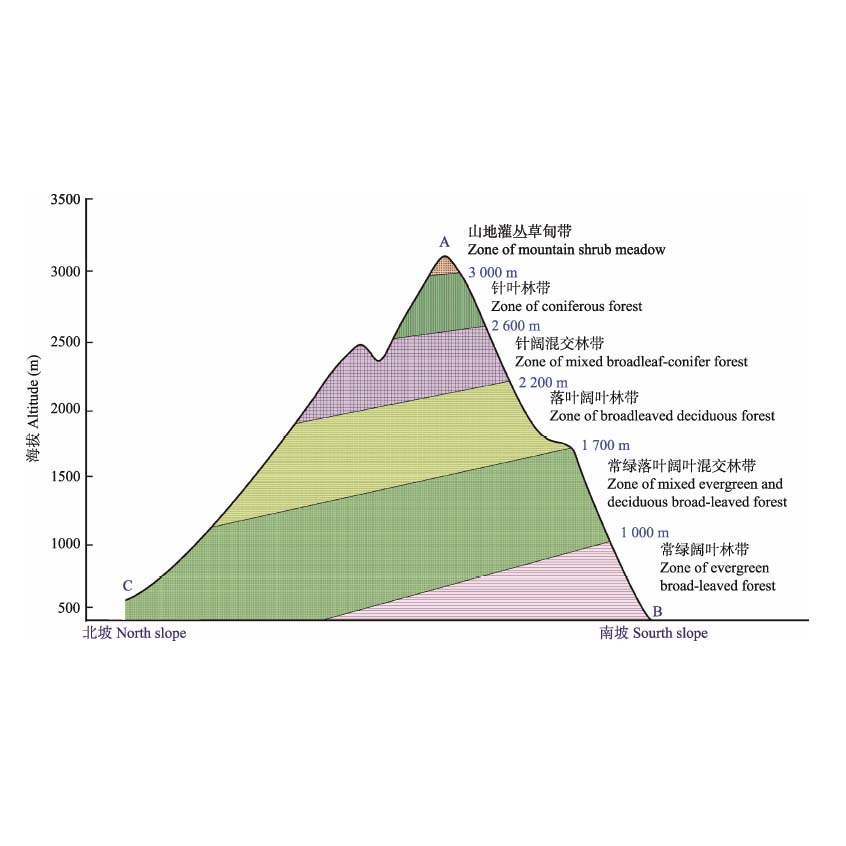
充分认识并掌握我国自然遗产地山地植被垂直带谱代表性, 对正确评估自然遗产地的价值进而制定相关保护管理政策具有重要的科学意义和现实意义。该研究基于群落调查数据、全球1 km2土地利用数据, 通过对比分析、空间分析等方法, 从植被垂直带谱的地带性、完整性及不同垂直带群落物种更替等角度, 分析论证了神农架自然遗产地植被垂直带谱的代表性。结果显示: 神农架自然遗产地从低海拔到高海拔依次发育有常绿阔叶林带(遗产地南坡)、常绿落叶阔叶混交林带、落叶阔叶林带、针阔混交林带、针叶林带及亚高山灌丛和草甸带, 其北坡保存的地带性常绿落叶阔叶混交林是北半球常绿落叶阔叶混交林生态系统的最典型代表。神农架自然遗产地拥有的植被垂直带谱是“全球生物地理区划”中东方落叶林生物地理省最完整的植被垂直带谱, 在东方落叶林生物地理省具有唯一性和代表性, 在较小的水平距离范围内浓缩了中亚热带、北亚热带、暖温带、温带和寒温带等生态系统特征, 成为研究全球气候变化下山地生态系统垂直分异规律及其生态学过程的杰出范例, 具有突出的世界自然遗产价值。
关键词: 海拔梯度; 地带性植被; 常绿落叶阔叶混交林; 东方落叶林生物地理省; 完整性
马明哲, 申国珍, 熊高明, 赵常明, 徐文婷, 周友兵, 谢宗强 . 神农架自然遗产地植被垂直带谱的特点和代表性[J]. 植物生态学报, 2017 , 41(11) : 1127 -1139 . DOI: 10.17521/cjpe.2017.0092
Aims Mountains contain broad environmental gradients, which are to be an outstanding universal value representing significant on-going ecological and biological processes in the evolution and development of zonal vegetation along the elevation gradients. Exploring the biological and ecological value of the vegetation zonation along the elevation gradients of Chinese mountain natural heritage site is important for biodiversity conservation and management.
Methods Based on the community survey data of the six vegetation zonation along the elevational gradients in Shennongjia, the global land use dataset, and the literature data of the communities along the altitudinal gradients of other natural heritage sites and the nominated world natural heritage sites in Oriental Deciduous Forest Biogeographic Province by Udvardy, we explored the outstanding universal value of the zonal vegetation along the altitude gradients by the methods of spatial analysis.
Important findings Shennongjia heritage site preserves the intact vegetation zonation of the typical Oriental Deciduous Forest Biogeographical Province in the Classification of the Biogeographical Provinces of the World by Udvardy, including evergreen broad-leaved forests (South Slope of the Heritage Site), evergreen deciduous broad-leaved mixed forests, deciduous broad-leaved forests, coniferous and broad-leaved mixed forests, coniferous forests and subalpine shrub and meadow along the elevation gradients. The altitudinal zonation of vegetation in the Shennongjia heritage site represented a variety of bio-ecological processes, such as the turnover of the dominant trees along the altitudinal gradients, and is an outstanding example of the ongoing ecological processes occurring in the development of intact subtropical mixed broadleaved evergreen and deciduous forest in the Northern Hemisphere.
| [1] | Bahram M, Polme S, Koljalg U, Zarre S, Tedersoo L (2012). Regional and local patterns of ectomycorrhizal fungal diversity and community structure along an altitudinal gradient in the Hyrcanian forests of northern Iran. New Phytologist, 193, 465-473. |
| [2] | Barthlott W, Lauer WA, Placke A (1996). Global distribution of species diversity in vascular Plants: Towards a world map of phytodiversity.Erdkunde, 50, 317-327. |
| [3] | Beniston M (2003). Climatic change in mountain regions: A review of possible impacts.Climatic Change, 59, 5-31.> |
| [4] | Colwell RK, Brehm G, Cardelus CL, Gilman AC, Longino JT (2008). Global warming, elevational range shifts, and lowland biotic attrition in the wet tropics.Science, 322, 258-261. |
| [5] | Editorial Board of Anhui’s Forest (1990). Forest of Anhui. Anhui Scientific and Technical Press, Hefei. (in Chinese)[安徽森林编委会 (1990). 安徽森林. 安徽科学技术出版社, 合肥.] |
| [6] | Editorial Board of Anhui’s Vegetation (1983). Vegetation of Anhui. Anhui Scientific and Technical Press, Hefei. (in Chinese)[安徽植被编委会 (1983). 安徽植被. 安徽科学技术出版社, 合肥.] |
| [7] | Editorial Board of Guizhou’s Forest (1989). Forest of Guizhou, China Forestry Publishing House, Beijing. (in Chinese)[贵州森林编委会 (1989). 贵州森林. 中国林业出版社, 北京.] |
| [8] | Editorial Board of Hubei’s Forest (1990). Forest of Hubei. China Forestry Publishing House,, Wuhan. (in Chinese)[湖北森林编委会 (1990). 湖北森林. 中国林业出版社, 武汉.] |
| [9] | Editorial Board of Hunan’s Forest (1991). Forest of Hunan. Hunan Scientific and Technical Press, Changsha. (in Chinese)[湖南森林编委会 (1991). 湖南森林. 湖南科学技术出版社, 长沙.] |
| [10] | Editorial Board of Jiangxi’s Forest (1983). Forest of Jiangxi. China Forestry Publishing House, Beijing. (in Chinese)[江西森林编委会 (1983). 江西森林. 中国林业出版社, 北京.] |
| [11] | Board of Physical Geography of China, Chinese Academy of Sciences (1980). The Physical Geography of China (Volume of Physiognomy). Science Press, Beijing. (in Chinese)[中国科学院中国自然地理编委会 (1980). 中国自然地理·地貌卷. 科学出版社, 北京.] |
| [12] | Editorial Board of Shaanxi’s Forest (1989). Forest of Shaanxi. China Forestry Publishing House, Beijing. (in Chinese)[陕西森林编委会 (1989). 陕西森林. 中国林业出版社, 北京.] |
| [13] | Editorial Board of Sichuan’s Forest (1983). Forest of Sichuan, China Forestry Publishing House, Beijing. (in Chinese)[四川森林编委会 (1983). 四川森林. 中国林业出版社, 北京.] |
| [14] | Editorial Committee of Vegetation Map of China, Chinese Academy of Sciences (2007). Vegetation Map of People’s Republic of China. Geological Publishing House, Beijing. (in Chinese)[中国科学院中国植被图编辑委员会 (2007). 中国植被及其地理格局. 地质出版社, 北京.] |
| [15] | Gomez-Hernandez M, Williams-Linera G, Guevara R, Lodge DJ (2012). Patterns of macromycete community assemblage along an elevation gradient: Options for fungal gradient and metacommunity analyses.Biodiversity and Conservation, 21, 2247-2268. |
| [16] | Gonzalez LG, Geeraerad AH, Spilimbergo S, Elstk K, Ginneken LV, Debevere J, van Impe JF, Devlieghere F (2007). High pressure carbon dioxide inactivation of microorganisms in foods: The past, the present and the future.International Journal of Food Microbiology, 117, 1-28. |
| [17] | Grinnell J (1924). Geography and evolution.Ecology, 5, 225-229. |
| [18] | He F (2006). Forest vegetation in Japan.Journal of Sichuan Forestry Science and Technology, (3), 38-41. (in Chinese with English abstract)[何飞 (2006). 日本的森林植被. 四川林业科技, (3), 38-41.] |
| [19] | He X, Hou E, Wen D (2016). Altitudinal patterns and controls of plant and soil nutrient concentrations and stoichiometry in subtropical China.Scientific Reports, 6, 24261. doi: 10.1038/srep24261. |
| [20] | Hodkinson ID (2005). Terrestrial insects along elevation gradients: Species and community responses to altitude.Biology Review, 80, 489-513. |
| [21] | Jiang MQ, Chen RJ, Sun YF (1982). The vegetation in Huangshan. Nature Journal, (3), 222-226, 197. (in Chinese with English abstract)[蒋木青, 陈仁钧, 孙毓飞 (1982). 黄山的植被. 自然杂志,(3), 222-226, 197.] |
| [22] | Korner C (2007). The use of “altitude” in ecological research.Trends in Ecology and Evolution, 22, 569-574. |
| [23] | Lei MD (1999). Vegetation of Shaanxi. Science Press, Beijing. (in Chinese)[雷明德 (1999). 陕西植被. 科学出版社, 北京.] |
| [24] | Li XD (1985). Research about vertical zonation of vegetation on the southern slope of the west Qinling.Shanxi Forest Science and Technology, (3), 88-92. (in Chinese with English abstract)[李晓东 (1985). 对陕西秦岭西段南坡植被垂直带划分问题的一点认识. 陕西林业科技, (3), 88-92.] |
| [25] | Li YM, Xu L, Ma Y, Yang JY, Yang YH (2003). The species richness of nonvolant mammals in Shennongjia Nature Reserve, Hubei Province, China: Distribution patterns along elevational gradient. Biodiversity Science, 11, 1-9. (in Chinese with English abstract)[李义明, 许龙, 马勇, 杨敬元, 杨玉慧 (2003). 神农架自然保护区非飞行哺乳动物的物种丰富度: 沿海拔梯度的分布格局. 生物多样性, 11, 1-9. |
| [26] | Liao MY (2015). Comprehensive Survey Report of Natural Resources in Shennongjia Area. China Forestry Publishing House, Beijing. (in Chinese)[廖明尧 (2015). 神农架地区自然资源综合调查报告. 中国林业出版社, 北京.] |
| [27] | Ma KP (2016). Conservation of world natural heritage should be ensured and its contribution to local sustainable development promoted.Biodiversity Science, 24, 861-862. (in Chinese with English abstract)[马克平 (2016). 世界自然遗产既要加强保护也要适度利用. 生物多样性, 24, 861-862.] |
| [28] | Malhi Y, Silman M, Salinas N, Bush M, Meir P, Saatchi S (2010). Introduction: Elevation gradients in the tropics: Laboratories for ecosystem ecology and global change research.Global Change Biology, 16, 3171-3175. |
| [29] | McCain CM (2009). Global analysis of bird elevational diversity.Global Ecology and Biogeography, 18, 346-360. |
| [30] | Ohsawa M (1984). Differentiation of vegetation zones and species strategies in the subalpine region of Mt. Fuji.Vegetatio, 57, 15-52. |
| [31] | Olson DM (1994). The distribution of leaf litter invertebrates along a Neotropical altitudinal gradient.Journal of Tropical Ecology, 10, 129-150. |
| [32] | Palin OF, Eggleton P, Malhi Y, Girardin CAJ, Rozas-D’avila A, Parr CL (2011). Termite diversity along an Amazon- Andes elevation gradient, Peru.Biotropica, 43, 100-107. |
| [33] | Qi CJ (1990). Hunan Vegetation. Hunan Scientific and Technical Press, Changsha. (in Chinese)[祁承经 (1990). 湖南植被. 湖南科学技术出版社, 长沙.] |
| [34] | Rahbek C (2005). The role of spatial scale and the perception of large-scale species-richness patterns.Ecology Letters, 8, 224-239. |
| [35] | Raich JW, Russell AE, Vitousek PM (1997). Primary productivity and ecosystem development along an elevational gradient on Mauna Loa, Hawaii.Ecology, 78, 707-721. |
| [36] | Salinas N, Malhi Y, Meir P, Silman M, Roman Cuesta R, Huaman J, Salinas D, Huaman V, Gibaja A, Mamani M, Farfan F (2011). The sensitivity of tropical leaf litter decomposition to temperature: Results from a large-scale leaf translocation experiment along an elevation gradient in Peruvian forests.New Phytologist, 189, 967-977. |
| [37] | Sanders NJ, Lessard JP, Fitzpatrick MC, Dunn RR (2007). Temperature, but not productivity or geometry, predicts elevational diversity gradients in ants across spatial grains. Global Ecology and Biogeography, 16, 640-649. |
| [38] | Sundqvist MK, Sanders NJ, Wardle DA (2013). Community and ecosystem responses to elevational gradients: Processes, mechanisms, and insights for global change.Annual Review of Ecology, Evolution and Systematics, 44, 261-280. |
| [39] | Tan JS, Ban JD, Wang ZX (1982). The vegetation regionalization of Huibei Province.Journal of Central China Normal University (Natural Sciences), (3), 102-127. (in Chinese with English abstract)[谭景燊, 班继德, 王增学 (1982). 湖北植被区划. 华中师院学报(自然科学版), (3), 102-127.] |
| [40] | Tanner EVJ, Vitousek PM, Cuevas E (1998). Experimental investigation of nutrient limitation of forest growth on wet tropical mountains.Ecology, 79, 10-22. |
| [41] | Tian ZQ (2002). The Vegetation of Shennongjia and 1:200, 000 Vegetation Map. PhD dissertation, Institute of Botany, Chinese Academy of Sciences, Beijing. (in Chinese with English abstract)[田自强 (2002). 神农架的植被及其1:200, 000植被图的编制. 博士学位论文, 中国科学院植物研究所, 北京.] |
| [42] | Udvardy MDF (1975). A Classification of the Biogeographical Provinces of the World. IUCN Occasional Paper. . |
| [43] | Vitousek PM, Matson PA, Turner DR (1988). Elevational and age gradients in Hawaiian montane rainforest: Foliar and soil nutrients.Oecologia, 77, 565-570. |
| [44] | Wagai R, Kitayama K, Satomura T, Fujinuma R, Balser T (2011). Interactive influences of climate and parent material on soil microbial community structure in Bornean tropical forest ecosystems.Ecological Research, 26, 627-636. |
| [45] | Walter H (1984). World Vegetation. Translated by Institute of Botany, Chinese Academy of Sciences. Science Press, Beijing. (in Chinese)[沃尔特 (1984). 世界植被. 中国科学院植物研究所, 译. 科学出版社, 北京.] |
| [46] | Wang XP, Wang ZH, Fang JY (2004). Mountain ranges and peaks in China.Biodiversity Science, 12, 206-212. (in Chinese with English abstract)[王襄平, 王志恒, 方精云 (2004). 中国的主要山脉和山峰. 生物多样性, 12, 206-212.] |
| [47] | Wardle DA (2002). Communities and Ecosystems: Linking the Aboveground and Belowground Components. Princeton University Press, Princeton, USA. |
| [48] | Whittaker RH (1956). Vegetation of the Great Smokey Mountains.Ecological Monographys, 26, 1-80. |
| [49] | Whittaker RH (1960). Vegetation of the Siskiyou Mountains, Oregon and California.Ecological Monographys, 30, 279-338. |
| [50] | Wu GF, Zhou XJ, Tang YF (1988). The vegetation types and their distributions in Sanqingshan Jiangxi Province.Journal of East China Normal University (Natural Science), (2), 87-96. (in Chinese with English abstract)[吴国芳, 周秀佳, 汤艺峰 (1988). 江西省三清山的植被类型及其分布. 华东师范大学学报(自然科学版), (2), 87-96.] |
| [51] | Ying JS, Chen ML (2011). Plant Geography of China. Shanghai Scientific and Technical Publishers, Shanghai. (in Chinese)[应俊生, 陈梦玲 (2011). 中国植物地理. 上海科学技术出版社, 上海.] |
| [52] | Zhang B (2014). Diversity of Bird Communities in Shennongjia National Nature Reserve. PhD dissertation, Central China Normal University, Wuhan. (in Chinese with English abstract)[章波 (2014). 神农架国家级自然保护区鸟类群落多样性研究. 博士学位论文, 华中师范大学, 武汉.] |
| [53] | Zhu ZQ, Song CS(1999). Scientific Survey of Shennongjia Nature Reserve. China Forestry Publishing House, Beijing. (in Chinese)[朱兆泉, 宋朝枢 (1999). 神农架自然保护区科学考察集. 中国林业出版社, 北京.] |
/
| 〈 |
|
〉 |
Copyright © 2026 版权所有 《植物生态学报》编辑部
地址: 北京香山南辛村20号, 邮编: 100093
Tel.: 010-62836134, 62836138; Fax: 010-82599431; E-mail: apes@ibcas.ac.cn, cjpe@ibcas.ac.cn
备案号: 京ICP备16067583号-19

