
连续干旱对蒙古高原草地恢复力和抵抗力的影响
收稿日期: 2024-04-07
录用日期: 2024-05-27
网络出版日期: 2024-10-11
基金资助
国家草业技术创新中心(筹)重大创新平台建设专项(CCPTZX2023B02-1);内蒙古自治区科技重大专项(2021ZD0011-04)
Effect of consecutive drought on the resilience and resistance of the grasslands on the Mongolian Plateau
Received date: 2024-04-07
Accepted date: 2024-05-27
Online published: 2024-10-11
Supported by
National Center of Pratacultural Technology Innovation (under preparation) Special Fund for Innovation Platform Construction(CCPTZX2023B02-1);Key Science & Technology Special Program of Inner Mongolia(2021ZD0011-04)
王尧 , 王耀彬 , 陈子彦 , 伊如汉 , 白永飞 , 赵玉金 , 金晶炜 . 连续干旱对蒙古高原草地恢复力和抵抗力的影响[J]. 植物生态学报, 2025 , 49(7) : 1070 -1081 . DOI: 10.17521/cjpe.2024.0100
Aims The grasslands of Mongolian Plateau are the core of the Eurasian grassland ecosystem and serve as an important ecological barrier in northern China. Climate change has significantly increased the intensity, frequency, and duration of drought events across the Mongolian Plateau. Therefore, assessing the resistance and resilience of the Mongolian Plateau grasslands quantitatively helps deepen our understanding of their responses to climatic anomalies. However, few studies have explored how different grassland types on the Mongolian Plateau withstand consecutive droughts.
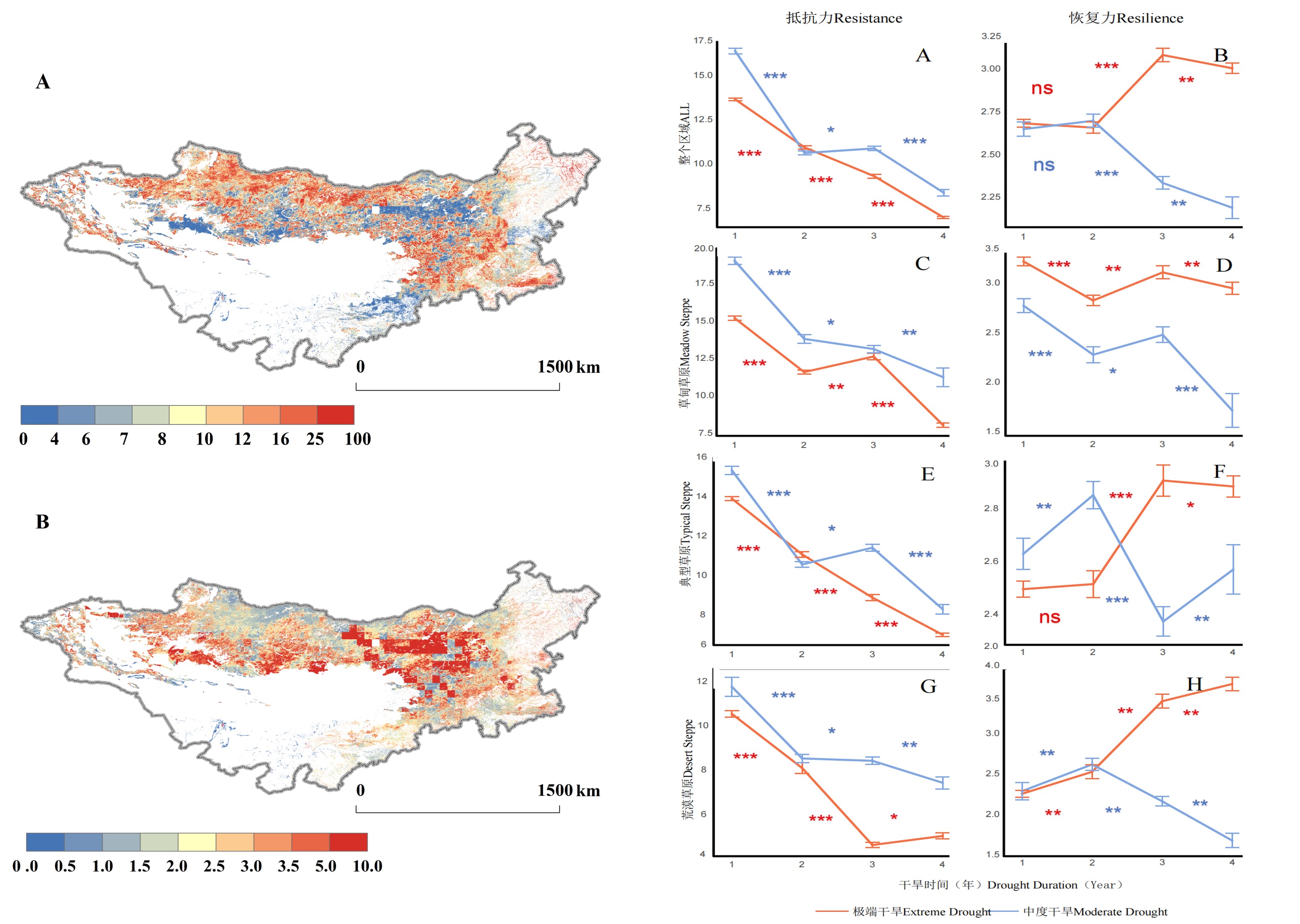
Methods In this study, we used long-term series data from 2000 to 2020 on the standardized precipitation evapotranspiration index (SPEI) and net primary productivity (NPP) to quantify the resistance and resilience of the Mongolian Plateau grassland ecosystem to consecutive droughts (1-4 a) and analyze its spatiotemporal variations. Furthermore, we compared the responses of three main types of grasslands (meadow steppe, typical steppe, and desert steppe) to extreme and moderate droughts.
Important findings Our results show that: (1) Grasslands generally exhibit higher resistance under moderate drought compared to extreme drought, except during two consecutive drought years. However, they are more resilient to extreme drought. (2) As the number of consecutive drought years increases, the resistance declines for both extreme and moderate droughts, while resilience initially increases under extreme drought but decreases under moderate drought. (3) Along the spatial gradient of decreasing precipitation, meadow steppe exhibits the highest resistance, followed by typical steppe, while desert steppe shows the lowest resistance. In contrast, desert steppe demonstrates the highest resilience, whereas meadow steppe has the lowest resilience. (4) Over time, the resistance of grasslands was higher from 2011-2020 compared to 2001-2010, while resilience was lower in the later period. As consecutive drought years increase, the resistance for all types of grasslands declines in both periods (2000-2010 and 2011-2020), while resilience initially increases (2000-2010) and then decreases (2011-2020). These insights are crucial for maintaining the Mongolian Plateau’s ecological barrier, ensuring its ecological services, and supporting both regional and global ecological security and sustainable development.
Key words: Mongolian Plateau; grassland ecosystem; drought; resistance; resilience
| [1] | Bai YF, Han XG, Wu JG, Chen ZZ, Li LH (2004). Ecosystem stability and compensatory effects in the Inner Mongolia grassland. Nature, 431, 181-184. |
| [2] | Carroll CJW, Slette IJ, Griffin-Nolan RJ, Baur LE, Hoffman AM, Denton EM, Gray JE, Post AK, Johnston MK, Yu Q, Collins SL, Luo YQ, Smith MD, Knapp AK (2021). Is a drought a drought in grasslands? Productivity responses to different types of drought. Oecologia, 197, 1017-1026. |
| [3] | Chen XN, Tao X, Yang YP (2022). Distribution and attribution of gross primary productivity increase over the Mongolian Plateau, 2001-2018. IEEE Access, 10, 25125-25134. |
| [4] | Craven D, Eisenhauer N, Pearse WD, Hautier Y, Isbell F, Roscher C, Bahn M, Beierkuhnlein C, B?nisch G, Buchmann N, Byun C, Catford JA, Cerabolini BEL, Cornelissen JHC, Craine JM, et al. (2018). Multiple facets of biodiversity drive the diversity-stability relationship. Nature Ecology & Evolution, 2, 1579-1587. |
| [5] | de Keersmaecker W, Lhermitte S, Tits L, Honnay O, Somers B, Coppin P (2015). A model quantifying global vegetation resistance and resilience to short-term climate anomalies and their relationship with vegetation cover. Global Ecology and Biogeography, 24, 539-548. |
| [6] | Forzieri G, Dakos V, McDowell NG, Ramdane A, Cescatti A (2022). Emerging signals of declining forest resilience under climate change. Nature, 608, 534-539. |
| [7] | Gao G, Li Y, Chen YX, Feng AQ (2023). The evolution characteristics of drought spatio-temporal law in China in the recent 30 years. China Flood & Drought Management, 33(7), 1-8. |
| [高歌, 李莹, 陈逸骁, 冯爱青 (2023). 30年来中国干旱时空规律演变特征. 中国防汛抗旱, 33(7), 1-8.] | |
| [8] | Gu Y, Dong K, Geisen S, Yang W, Yan Y, Gu D, Liu N, Borisjuk N, Luo Y, Friman VP (2020). The effect of microbial inoculant origin on the rhizosphere bacterial community composition and plant growth-promotion. Plant and Soil, 452, 105-117. DOI: 10.1007/s11104-020-04545-w. |
| [9] | Guo J, Yang X, Jiang W, Xing X, Zhang M, Chen A, Yang D, Yang M, Wei L, Xu B (2023). Resistance of grassland under different drought types in the Inner Mongolia Autonomous Region of China. Remote Sensing, 15, 5045. DOI: 10.3390/rs15205045. |
| [10] | Hoover DL, Knapp AK, Smith MD (2014). Resistance and resilience of a grassland ecosystem to climate extremes. Ecology, 95, 2646-2656. |
| [11] | Hossain ML, Li J, Hoffmann S, Beierkuhnlein C (2022). Biodiversity showed positive effects on resistance but mixed effects on resilience to climatic extremes in a long-term grassland experiment. Science of the Total Environment, 827, 154322. DOI: 10.1016/j.scitotenv.2022.154322. |
| [12] | Hossain ML, Li J, Lai Y, Beierkuhnlein C (2023). Long-term evidence of differential resistance and resilience of grassland ecosystems to extreme climate events. Environmental Monitoring and Assessment, 195, 734. DOI: 10.1007/s10661-023-11269-8. |
| [13] | Huang WJ, Wang W, Cao M, Fu G, Xia JY, Wang ZX, Li JS (2021). Local climate and biodiversity affect the stability of China’s grasslands in response to drought. Science of the Total Environment, 768, 145482. DOI: 10.1016/j.scitotenv.2021.145482. |
| [14] | Isbell F, Craven D, Connolly J, Loreau M, Schmid B, Beierkuhnlein C, Bezemer TM, Bonin C, Bruelheide H, de Luca E, Ebeling A, Griffin JN, Guo QF, Hautier Y, Hector A, et al. (2015). Biodiversity increases the resistance of ecosystem productivity to climate extremes. Nature, 526, 574-577. |
| [15] | Ivits E, Horion S, Erhard M, Fensholt R (2016). Assessing European ecosystem stability to drought in the vegetation growing season. Global Ecology and Biogeography, 25, 1131-1143. |
| [16] | Komatsu KJ, Avolio ML, Lemoine NP, Isbell F, Grman E, Houseman GR, Koerner SE, Johnson DS, Wilcox KR, Alatalo JM, Anderson JP, Aerts R, Baer SG, Baldwin AH, Bates J, et al. (2019). Global change effects on plant communities are magnified by time and the number of global change factors imposed. Proceedings of the National Academy of Sciences of the United States of America, 116, 17867-17873. |
| [17] | Kong DD, Zhang Q, Gu XH, Wang Y, Li HZ (2016). Vegetation responses to drought at different time scales in China. Acta Ecologica Sinica, 36, 7908-7918. |
| [孔冬冬, 张强, 顾西辉, 王月, 李华贞 (2016). 植被对不同时间尺度干旱事件的响应特征及成因分析. 生态学报, 36, 7908-7918.] | |
| [18] | Lei T, Feng J, Lv J, Wang J, Song H, Song W, Gao X (2020). Net Primary Productivity Loss under different drought levels in different grassland ecosystems. Journal of Environmental Management, 274, 111144. DOI: 10.1016/j.jenvman.2020.111144. |
| [19] | Li X, Piao S, Wang K, Wang X, Wang T, Ciais P, Chen A, Lian X, Peng S, Pe?uelas J (2020). Temporal trade-off between gymnosperm resistance and resilience increases forest sensitivity to extreme drought. Nature Ecology & Evolution, 4, 1075-1083. |
| [20] | Li ZY, Ye XZ, Wang SP (2021). Ecosystem stability and its relationship with biodiversity. Chinese Journal of Plant Ecology, 45, 1127-1139. |
| [李周园, 叶小洲, 王少鹏 (2021). 生态系统稳定性及其与生物多样性的关系. 植物生态学报, 45, 1127-1139.] | |
| [21] | Liu L, Guan JY, Zheng JH, Wang YD, Han WQ, Liu YJ (2023). Cumulative effects of drought have an impact on net primary productivity stability in Central Asian grasslands. Journal of Environmental Management, 344, 118734. DOI: 10.1016/j.jenvman.2023.118734. |
| [22] | Luo W, Ma W, Song L, Te N, Chen J, Muraina TO, Wilkins K, Griffin-Nolan RJ, Ma T, Qian J, Xu C, Yu Q, Wang Z, Han X, Collins SL (2023). Compensatory dynamics drive grassland recovery from drought. Journal of Ecology, 111, 1281-1291. |
| [23] | Luo W, Zuo X, Griffin-Nolan RJ, Xu C, Ma W, Song L, Helsen K, Lin Y, Cai J, Yu Q, Wang Z, Smith MD, Han X, Knapp AK (2019). Long term experimental drought alters community plant trait variation, not trait means, across three semiarid grasslands. Plant and Soil, 442, 343-353. |
| [24] | Miao LJ, Jiang C, He B, Liu Q, Zhu F, Cui XF (2014). Response of vegetation coverage to climate change in Mongolian Plateau during recent 10 years. Acta Ecologica Sinica, 34, 1295-1301. |
| [缪丽娟, 蒋冲, 何斌, 刘强, 朱枫, 崔雪锋 (2014). 近10年来蒙古高原植被覆盖变化对气候的响应. 生态学报, 34, 1295-1301.] | |
| [25] | Schwalm CR, Anderegg WRL, Michalak AM, Fisher JB, Biondi F, Koch G, Litvak M, Ogle K, Shaw JD, Wolf A, Huntzinger DN, Schaefer K, Cook R, Wei Y, Fang Y, et al. (2017). Global patterns of drought recovery. Nature, 548, 202-205. |
| [26] | Shi H, Tian H, Lange S, Yang J, Pan S, Fu B, Reyer CPO (2021). Terrestrial biodiversity threatened by increasing global aridity velocity under high-level warming. Proceedings of the National Academy of Sciences of the United States of America, 118, e2015552118. DOI: 10.1073/pnas.2015552118. |
| [27] | Smith MD (2011). An ecological perspective on extreme climatic events: a synthetic definition and framework to guide future research. Journal of Ecology, 99, 656-663. |
| [28] | Song L, Luo WT, Ma W, He P, Liang XS, Wang ZW (2020). Extreme drought effects on nonstructural carbohydrates of dominant plant species in a meadow grassland. Chinese Journal of Plant Ecology, 44, 669-676. |
| [宋琳, 雒文涛, 马望, 何鹏, 梁潇洒, 王正文 (2020). 极端干旱对草甸草原优势植物非结构性碳水化合物的影响. 植物生态学报, 44, 669-676.] | |
| [29] | Stuart-Ha?ntjens E, de Boeck HJ, Lemoine NP, M?nd P, Kr?el-Dulay G, Schmidt IK, Jentsch A, Stampfli A, Anderegg WRL, Bahn M, Kreyling J, Wohlgemuth T, Lloret F, Classen AT, Gough CM, Smith MD (2018). Mean annual precipitation predicts primary production resistance and resilience to extreme drought. Science of the Total Environment, 636, 360-366. |
| [30] | Tong S, Zhang J, Bao Y, Lai Q, Lian X, Li N, Bao Y (2018). Analyzing vegetation dynamic trend on the Mongolian Plateau based on the Hurst exponent and influencing factors from 1982-2013. Journal of Geographical Sciences, 28, 595-610. |
| [31] | Vicente-Serrano SM, Gouveia C, Camarero JJ, Beguería S, Trigo R, López-Moreno JI, Azorín-Molina C, Pasho E, Lorenzo-Lacruz J, Revuelto J, Morán-Tejeda E, Sanchez-Lorenzo A (2013). Response of vegetation to drought time-scales across global land biomes. Proceedings of the National Academy of Sciences of the United States of America, 110, 52-57. |
| [32] | Wang B (2023). Characteristics of Plant Communities and Soil Organic Carbon Mineralization in Desert Steppe of Western Inner Mongolia. Master degree dissertation, Shanxi University, Taiyuan. |
| [王犇 (2023). 内蒙古西部荒漠草原植物群落特征与土壤有机碳矿化研究. 硕士学位论文, 山西大学, 太原.] | |
| [33] | Wei YX, Chen LJ, Feng Q, Xi HY, Guo R, Zhang CQ (2024). Progress on microbial characteristics in arid salt-affected soils and related factors. Journal of Desert Research, 44(3), 18-30. |
| [卫雨西, 陈丽娟, 冯起, 席海洋, 郭瑞, 张成琦 (2024). 干旱区盐碱土微生物特征及其影响因素研究进展. 中国沙漠, 44(3), 18-30.] | |
| [34] | Xu C, Ke Y, Zhou W, Luo W, Ma W, Song L, Smith MD, Hoover DL, Wilcox KR, Fu W (2021). Resistance and resilience of a semi-arid grassland to multi-year extreme drought. Ecological Indicators, 131, 108139. DOI: 10.1016/j.ecolind.2021.108139. |
| [35] | Xu YQ (2020). Study on the Remote Sensing-based Measurement Model of Vegetation Resilience. PhD dissertation, China University of Mining and Technology, Xuzhou, Jiangsu. |
| [徐雅晴 (2020). 植被恢复力遥感测度模型研究. 博士学位论文, 中国矿业大学, 江苏徐州.] | |
| [36] | Zhang B, Zhu JJ, Liu HM, Pan QM (2014). Effects of extreme rainfall and drought events on grassland ecosystems. Chinese Journal of Plant Ecology, 38, 1008-1018. |
| [张彬, 朱建军, 刘华民, 潘庆民 (2014). 极端降水和极端干旱事件对草原生态系统的影响. 植物生态学报, 38, 1008-1018.] | |
| [37] | Zhang P, Jeong JH, Yoon JH, Kim H, Wang SYS, Linderholm HW, Fang K, Wu X, Chen D (2020). Abrupt shift to hotter and drier climate over inner East Asia beyond the tipping point. Science, 370, 1095-1099. |
| [38] | Zhao SY, Gon ZN, Liu XY (2015). Correlation analysis between vegetation coverage and climate drought conditions in North China during 2001-2013. Acta Geographica Sinica, 70, 717-729. |
| [赵舒怡, 宫兆宁, 刘旭颖 (2015). 2001-2013年华北地区植被覆盖度与干旱条件的相关分析. 地理学报, 70, 717-729.] | |
| [39] | Zhou Y, Ma HB, Lu Q, Ma JL, Shen Y, Wang GH (2024). Different responses of leaf and root economics spectrum to grazing time at the community level in desert steppe, China. Science of the Total Environment, 909, 168547. DOI: 10.1016/j.scitotenv.2023.168547. |
/
| 〈 |
|
〉 |
Copyright © 2026 版权所有 《植物生态学报》编辑部
地址: 北京香山南辛村20号, 邮编: 100093
Tel.: 010-62836134, 62836138; Fax: 010-82599431; E-mail: apes@ibcas.ac.cn, cjpe@ibcas.ac.cn
备案号: 京ICP备16067583号-19

