


全球变化主要与大气中CO2以及其他温室气体浓度的增加有关, 但其他的人类活动过程同样影响着当地和全球的环境。在这些人类活动中, 化石燃料的燃烧、农牧业含氮化肥的施用以及畜牧养殖活动产生的活性氮对生态系统的功能具有深远的影响(Galloway et al., 2004)。据估算, 全球活性氮排放从1860年的15 Tg N·a-1增加到1995年的156 Tg N·a-1, 2005年增加到187 Tg N·a-1 (Galloway et al., 2008)。由于人口的持续增长、化石燃料消费以及工业化肥生产的日益增加, 未来几十年内氮的输入将会持续增加(Galloway et al., 1994; Vitousek et al., 1997)。虽然许多温带和寒带的生态系统的生产力受到氮素限制, 但是在部分地区已经出现氮饱和现象并超过了生态系统的临界负荷。大气氮沉降已经引起一些地区森林的富营养化和土壤酸化, 并由氮限制逐渐转变为磷限制, 影响到森林生态系统中树木的生长、碳贮存以及生物多样性(Wright et al., 1995; Wedin & Tilman, 1996; Matson et al., 1999; Wassen et al., 2005; Siddique et al., 2010)。
植物和土壤的碳氮同位素组成记录了植物新陈代谢和氮循环影响因子的综合作用, 在氮输入对生态系统碳氮循环的研究中, 使用同位素测量方法具有以下优势: 一是对大面积区域的调查研究具有可行性; 二是它不受取样时间和空间的限制(Nadelhoffer et al., 1996; Robinson, 2001; Kahmen et al., 2008); 另外, 测量简单(Templer et al., 2007)。因此, 稳定同位素技术在生态学的各个领域得到了广泛的应用。例如, 碳同位素自然丰度可以估计光合作用中气孔的调节, 还可以作为长期水分利用效率的可靠指标(Farquhar et al., 1989); 大气中的O2和δ13C已用于推算全球碳汇及其动态变化(Battle et al., 2000)。氧同位素与温度和降雨有关, 并且已经用于过去几个世纪气候变化的研究中(Treydte et al., 2006)。岩芯和冰芯中的氮同位素也记录了从远古到现在氮循环的变化(Garvin et al., 2009; Hastings et al., 2009)。植物自然15N丰度值是氮循环转化的综合结果, 提供了氮输入、转化和输出的综合信息, 间接反映了陆地生态系统氮循环的特征; 15N丰度值可以用来评估生态系统的氮通量, 并且已被部分学者用作生态系统氮饱和状态的指示指标(Nadelhoffer & Fry, 1994; Högberg, 1997; Pardo et al., 2001; Kahmen et al., 2008; Xu et al., 2010)。
为了深入了解氮输入以及环境改变对陆地植物生理生态造成的影响以及预测由此引发的环境状况变化, 我们通过稳定氮同位素技术在氮循环研究中的应用, 总结了氮输入和其他环境因素的改变对局域尺度陆地生态系统氮循环的影响。在全球变化及其生态效应的研究中还存在很大的不确定性, 深入探讨氮输入以及土地利用方式改变对陆地生态系统的影响及陆地生态系统的响应和反馈, 对于合理制定政策措施以保证陆地生态系统的可持续发展具有重要意义。
1 δ15N在氮循环研究中的应用
1.1 氮循环过程中的同位素分馏
生态系统中的氮循环过程大致可以分为三部分, 即: 氮的输入、氮在生态系统中的转化和氮的输出(Menyailo et al., 2003)。在这三个过程中均发生着不同程度的氮同位素分馏效应(图1)。氮的输入主要是生物固氮, 但是在生物固氮过程中发生的氮同位素分馏通常比较小, 生物固定氮的δ15N值与大气δ15N值相近, 所以此过程中的分馏效应可以忽略不计(Shearer & Kohl, 1988)。
图1
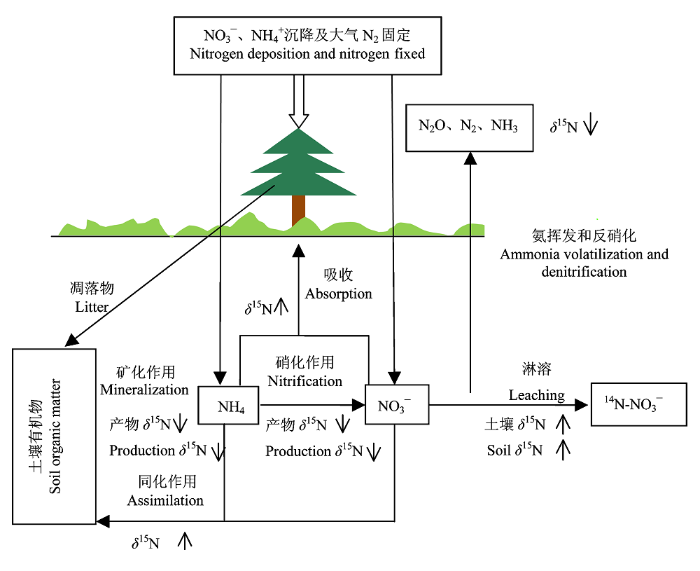
图1
森林生态系统氮循环过程中的同位素分馏(参考Nadelhoffer & Fry, 1994)。
Fig. 1
Isotope fraction in the process of nitrogen cycling in forest ecosystem (Reference to Nadelhoffer & Fry, 1994).
植物在吸收、利用和同化NO3-、NH4+等无机盐的过程中也会发生同位素分馏。一般而言, 被吸收、同化后的氮素15N丰度较吸收前具有富集效应。并且, Falkengren-Grerup等(2004)研究得出, δ15N可以作为林下物种NO3-吸收的相对指标, 与氮有效性的其他指标结合起来会更好。但植物吸收氮素引起的δ15N值的变化有时是非常复杂的, 不同的植物之间可能存在很大差异(Kohzu et al., 2003)。例如: Tsialtas等(2005)研究得出, 氮(尿素)添加虽然引起草地早熟禾(Poa pratensis)和高羊茅(Festuca valida) δ15N的增加, 但是造成了蒲公英(Taraxacum officinale) δ15N的显著衰减。再加上不同的环境条件等因素, 其响应也可能是多方面的(Tognetti & Peñuelas, 2003)。在氮素转化和输出过程中(硝化、矿化、反硝化、氨挥发以及氮淋溶等)也会发生氮同位素分馏效应, 其中矿化对土壤的δ15N值的变化起了主要作用。一般来说, 矿化和硝化过程后产物的15N丰度相对于矿化、硝化前的反应底物均有不同程度的贫化作用(Mariotti et al., 1981; Nadelhoffer & Fry, 1994) 。例如, Kahmen等(2008)研究发现, 土壤的δ15N值随着净氮矿化和净硝化显著增加, 然而土壤δ15N值与净氨化表现出不显著的负相关。氨挥发过程中的同位素分馏通常产生15N贫化的NH3和15N富集的NH4+库。反硝化作用也能够产生15N贫化的气体, 同时使剩余的NO3-库富集15N。然而, 氨挥发过程和反硝化作用在大多数森林中的氮同位素效应都不大(Högberg, 1997)。但也有研究显示, 在一定条件下, 表层土的δ15N值可以作为氮循环速率(氨挥发和N2O的排放)的指标(Xu et al., 2010)。
植物或土壤的δ15N能够预测氮淋溶和土壤净矿化速率吗?Vervaet等(2002)通过对比利时5个森林生态系统土壤剖面取样, 分析了0-10、10-20和20-30 cm深度土壤的δ15N变化。研究得出土壤剖面的δ15N可能是评估氮淋溶和氮矿化行为的有用指标, 然而这还需要进一步的研究来证实。Templer等(2007)为了检验植物和土壤15N自然丰度作为森林土壤氮循环速率指示指标的潜力, 分析了山毛榉(Fagus grandifolia)、加拿大铁杉(Tsuga canadensis)、美国红橡树(Quercus rubra)和糖槭(Acer saccharum)的叶片、细根、凋落物、树干、地表凋落物层和有机土壤的δ15N值。研究发现, 与其他林分相比, 糖槭林分细根和有机土壤的δ15N值最高, 并且与较高的净矿化速率和硝化速率显著正相关(部分原因可能是菌根群落和氮的吸收形式的种间差异), 这个结果表明, 细根和有机土壤的δ15N可以作为土壤氮循环相对速率的指示指标。没有发现山毛榉林分(中氮水平)中叶片、树干和凋落物的δ15N与净矿化速率和硝化速率显著相关, 这表明, 与地上部相比地下部的δ15N值是土壤氮循环相对速率更好的指示指标, 因为在氮吸收过程中植物地上组织能够导致分馏的过程更少(Handley & Raven, 1992)。植物和土壤δ15N是评定不同生态系统植物N吸收模式和表征土壤氮循环的有用指标和理想工具(Kahmen et al., 2008; Cheng et al., 2010), 在生态系统氮循环的研究中的应用越来越多。
除了氮循环会影响植物的δ15N值之外, 其影响因素还有(Högberg, 1997; Nadelhoffer et al., 1999; Pardo et al., 2006): (1)植物吸收的氮素在土壤中的深度; (2)土壤氮的利用形式(有机氮、铵态氮和硝态氮); (3)共生菌根的影响; (4)植物物候; (5) δ15N作为土壤氮状况的敏感指标, 还受林龄以及土地使用历史的影响(Cheng et al., 2010; Fang et al., 2011)。因此, 在使用δ15N时需要对已知的方法、土壤和植物的限制深思熟虑(Falkengren-Grerup et al., 2004)。
1.2 δ15N作为生态系统氮饱和的指示指标
随着一些地区氮沉降的不断增加以及生态系统表现出的不良响应, 有关氮饱和的研究也逐渐增多。近期研究表明, δ15N可以用来评定氮饱和(Garten, 1993)。Aber等(1989)定义氮饱和为氮的有效性超过了植物和微生物的需求。因为在氮饱和的生态系统中, 氮循环是开放的, 与内部氮循环相比, 外部的氮输入和输出量更大(Hedin et al., 1995; Matson et al., 1999; Martinelli et al., 1999), 所以随着硝化作用和硝酸盐淋溶的增加, 大量贫化氮的流失会导致土壤表面和叶片δ15N的值更高(Högberg et al., 1996; Pardo et al., 2002)。因此, 生态系统越接近氮饱和, 土壤和叶片的δ15N值会越高。
为了评估叶片δ15N能否作为森林生态系统氮饱和的指标, Pardo等(2006)收集了美国东北部、科罗拉多州、阿拉斯加州、智利南部以及欧洲一些地区有关大气氮沉降、叶片和根δ15N和氮含量、土壤C:N以及矿化和硝化的数据, 分析得出, 叶片δ15N值的测量也许能够帮助我们进一步理解森林是如何响应氮沉降的级联效应的。另外, 与叶片N百分含量相比, 植物δ15N值和土壤氮循环的相关性更密切, 它们比叶片N百分含量更适合用作氮饱和早期的指示指标。Högberg等(1992)通过对23年间挪威云杉(Picea abies)当年针叶15N自然丰度的研究预测, 9 kg N·hm-2·a-1 (约是当地沉降量的2倍)的氮沉降量会使生态系统在100年后达到氮饱和。Sah (2005)在大气氮沉降和气候条件不同的挪威云杉林调查了叶片和土壤氮同位素比值的变化, 发现在氮饱和的林分中针叶氮含量和δ15N值要显著高于氮贫乏的林分。这是因为随着氮沉降的增加, 土壤中氮的有效性也增加, 土壤中氮循环过程(如: 硝化和反硝化)中存在质量歧视效应, 这导致土壤中15N的富集(因为较轻的14N从系统中流失了), 较重的15N转移到叶片, 从而导致叶片中δ15N值较高(Watmough, 2010)。
森林氮饱和可以改变森林生态系统土壤的理化性质和植物的营养状况, Aniansson和钟晓红(1990)在杂志《世界环境》中提到了酸化和氮饱和将会给生态系统带来的影响, 并呼吁应该尽早采取行动对策。而关于氮饱和的研究国际上也处于初步探索阶段, 要更合理客观地确定氮饱和以及临界负荷需要进行更多的研究。而利用植物和土壤的δ15N作为氮饱和的判断依据目前还存在争议。Koopmans等(1997)认为, 在考虑氮沉降中δ15N值和同位素分馏因素的前提下, 15N值自然丰度值仅可以作为判断一个生态系统氮饱和阶段的指标。蒋春来等(2009)对我国西南部氮沉降量不同的森林小流域中土壤δ15N的分布特征进行了研究, 得出土壤的15N丰度值在我国西南部并不一定能单独作为森林生态系统氮饱和程度的指示指标, 但土壤和植被的δ15N值对于理解当地森林生态系统的氮循环具有一定的意义。
1.3 氮同位素作为氮循环长期变化趋势的指示指标
叶片和树轮的氮同位素可以作为氮循环长期变化的指示指标。McLauchlan等(2010)通过对植物标本馆1876年至2008年间545种植物标本和24种维管植物的叶片稳定氮同位素分析, 建立了氮循环的模型, 并进行了一系列的敏感性分析, 研究了北美中部草原植物132年来氮有效性的变化。这个模型包括4个氮库(土壤有机质、土壤NH4+、土壤NO3-和植物)和8个氮通量(净矿化、净硝化、沉降的氮转化为NO3-、植物吸收NH4+、植物吸收NO3-、反硝化、氮淋溶以及植物中的氮转移到土壤有机质)。研究结果显示, 132年来叶片氮含量和δ15N值降低了, 这表明尽管20世纪人类活动产生的氮沉降不断增加, 土壤氮的有效性仍然表现出下降的趋势。这个结果与渐进性氮限制假说相一致, 大气中CO2浓度的增加, 使生态系统氮储存增加, 进而引起了土壤有效性的降低(Luo et al., 2004)。
氮同位素组成能够反映一个生态系统氮循环的开放程度, 生态系统的δ15N值越低, 说明氮循环越开放, 反之则越封闭(Högberg, 1997; Pardo et al., 2006)。Hietz等(2010)为了评估偏远地区原始热带雨林(与北温带相比氮沉降较高)氮含量和氮同位素组成长期的变化趋势, 分析了巴西热带雨林中西班牙柏木(Cedrela odorata)和大叶桃花心木(Swietenia macrophylla)的氮含量和δ15N值。研究结果表明, 树轮心材的δ15N值随着林龄的增加而增大, 林龄相同的树木, 只有心材(去除不稳定的氮化合物之后)的δ15N值显著增加了。Hietz等(2011)在2007年从巴拿马巴罗科罗拉多岛收集了40年以前158种植物叶片的标本, 通过对1968年来植物叶片氮含量和δ15N的分析, 研究了热带雨林氮循环的长期变化。为了评价研究得到的巴罗科罗拉多岛氮循环的变化能否更广泛地代表热带雨林, 作者还研究了泰国缅甸3种非豆科植物树轮δ15N的变化, 研究结果与前者一致, 都表明了区域氮有效性的增加归因于人类活动产生的氮沉降。热带地区大气NO2的测量和人类排放的活性氮的增加表明了热带森林活性氮的变化是普遍的。
树轮的δ15N值能够反映森林皆伐和土地利用变化对氮循环的影响(Pardo et al., 2002; Bukata & Kyser, 2005)。为了确定永久的森林皆伐引起的土地利用方式的变化是否对氮循环的变化(记录在树轮δ15N中)产生影响, Bukata和Kyser (2005)对加拿大两种偏好利用硝酸盐树种的树轮氮含量和δ15N值进行了调查。调查结果显示, 伴随着森林皆伐和土地利用的变化, 与林分中心处的树轮δ15N值相比林分周边树轮的δ15N值增加了1.5‰-2.5‰。这种变化最有可能是与森林皆伐、土地利用变化以及长期水文学的变化和伴随着土地利用方式改变后肥料的使用引起的土壤硝化速率和硝酸盐淋溶的增加有关。这表明, 森林生态系统氮循环的变化是否归因于气候变化、土地利用的变化或者其他环境的变化能够通过树轮的氮同位素组成监测, 并且树轮地球化学分析可以纳入到长期人类活动对森林生态系统影响的研究中。
2 小结与展望
在很长一段时间内, 国内稳定氮同位素技术的应用只局限于农业生态系统中氮的吸收、利用和分配, 且多用同位素示踪技术。而将15N自然丰度法应用于自然生态系统氮素循环的研究较少。随着氮沉降水平的不断增加, 研究氮沉降给森林生态系统氮循环带来的影响是必要的。但是无论是室外实验还是室内实验, 只能反映局部地区氮循环的变化。并且, 由于同位素分析仪器和样品分析的价格相对较高, 限制了同位素法更广泛的应用。目前有关长期叶片和树轮氮同位素自然丰度分析的研究主要集中在国外。我国虽有植物标本馆, 但是要获取馆内的植物标本进行研究比较困难, 若研究者亲自进行长期叶片的收集则需要花费大量的时间。树轮相对易取, 因此, 无论研究局域尺度还是大尺度范围内森林生态系统氮循环的长期变化趋势, 树轮δ15N法是一个相对较好的选择。
需要指出的是: (1)树木年轮δ15N可以作为研究长期氮循环或氮输入变化的指标, 但是作为短期变化的研究指标是有问题的。Hart和Classen (2003)对西黄松(Pinus ponderosa)的15N标记试验表明大部分标记的15N在标记一年后沉积在树木中, 但是一些标记的氮转移到了几年前或几年后生成的树轮中。Elhani等(2003)的研究也得出了类似的结果。(2)树木的边材具有运输水分和矿物质的功能, 氮可以在边材中转运; 而心材不含活细胞, 不具有传导树液与贮藏营养物质的功能, 因此树木心材和边材的氮含量和δ15N值存在差异。如果边材提取物对特别的物种表现出边缘效应, 在进行生态系统氮过程研究时, 最好去除树轮中的可溶性氮(Hietz et al., 2010)。(3)为了去除林龄对δ15N变化趋势的影响, 需要使用不同林龄的树木进行研究(Hietz et al., 2010)。(4)为了使研究结果准确可信, 在利用植物δ15N进行相关研究时, 要考虑林龄、土壤类型、菌根真菌以及是否是固氮植物等因素带来的影响。
另外, 在全球尺度上利用δ15N来研究N循环还存在三个方面的问题尚未解决: (1)菌根真菌的类型不同, 叶片的δ15N值也不同; (2)植物δ15N与气候之间的关系需要证明; (3)叶片δ15N与叶片含氮量之间看起来是相关的, 但是这种关系在全球尺度上如何变化以及它们是不是与气候无关还不确定。(4)氮沉降和CO2浓度增加的交互作用对森林系统的影响需要进行进一步的研究。
致谢
感谢导师方精云在文章写作方面给予的指导。
参考文献
Nitrogen saturation in northern forest ecosystems
DOI:10.2307/1311067 URL [本文引用: 1]
The situation surpasses our worst fears
Global carbon sinks and their variability inferred from atmospheric O2 and
Response of the nitrogen isotopic composition of tree-rings following tree-clearing and land-use change
DOI:10.1021/es050733p
URL
PMID:16295836
[本文引用: 2]

Clear-cutting of forests affects the nitrogen cycle and the nitrogen isotopic composition of bioavailable ammonium and nitrate in the soil. Here, we have used nitrogen isotopic variations of tree-rings in red oak (Quercus rubra) and white oak (Quercus alba) as indicators of changes in the nitrogen cycle on a local scale. The delta15N values of late-wood from trees at two remnant forest stands in Ontario, Canada, that underwent large-scale tree-clearing and permanent land-use change at different times were measured. Trees from the perimeter of each stand record a marked 1.5-2.5 per thousand increase in the delta15N values of their tree-rings relative to the values in trees from the center of the stand, with the shift synchronous with the tree-clearing and land-use change. This shift was most likely due to increased rates of nitrification and nitrate leaching in the soil as a result of tree-clearing combined with permanent changes in hydrology and probable fertilizer use accompanying the change in land-use. Nitrogen concentration in tree-rings was not affected bytree-clearing and the associated change in land-use. These results indicate that changes in nitrogen cycling in forest ecosystems, whether due to climate change, land-use change, or other environmental changes (increased O3, other atmospheric pollutants, insects, etc.), can be faithfully monitored with nitrogen isotopic compositions of tree-rings and that dendrogeochemical analysis can be incorporated into studies of the effects of long-term anthropogenic effects on forest ecosystems.
Foliar and soil 15N natural abundances provide field evidence on nitrogen dynamics in temperate and boreal forest ecosystems
DOI:10.1007/s11104-010-0524-x
URL
[本文引用: 2]
The natural abundance of 15N (δ15N) in plants and soils is an ideal tool for assessing ecosystem N dynamics. However, many of the mechanisms driving the variability of foliar and soil δ15N values within and across ecosystems are still unclear. In this study, we analyzed the patterns of N concentrations and δ15N values in leaves, bulk soils and soil mineral N as well as soil N turnover rates across four temperate and boreal forest ecosystems along a mountain transect. The results showed that plant species and soil properties directly controlled soil δ15N patterns and climate factors (air temperature and precipitation) indirectly affected foliar δ15N patterns. Foliar N concentrations varied consistently with the concentrations of soil available N and soil NO3−-N, whereas foliar δ15N was most closely associated with the δ15N of soil NH4+, the most abundant form of N in soil solution. 15N enrichment in surface mineral soil in high elevation forests was mainly attributed to 15N-enriched organic N accumulation. Furthermore, the foliar enrichment factor (εp/s = δ15Nfoliage−δ15Nsoil) was significantly correlated with N transformation and loss rates, and was negatively correlated with the ratio of NH4+ to total inorganic N. These results suggest that foliar δ15N value and foliar N concentration together accurately reflect the N availability of forest ecosystems. Foliar εp/s can act as an integrated proxy to reflect the status of N cycling within or across forest ecosystems. Soil nitrification and species’ NH4+ to NO3− uptake ratios are key processes controlling foliar δ15N patterns in N-limited forest ecosystems. Our findings improve the mechanistic understanding of the commonly observed variability in foliar and soil δ15N within and across forest ecosystems.
Inter-annual mobility of nitrogen between beech rings: a labelling experiment
DOI:10.1051/forest:2003043 URL [本文引用: 1]
Plant nitrate use in deciduous woodland: the relationship between leaf N, 15N natural abundance of forbs and soil N mineralisation
DOI:10.1016/j.soilbio.2004.05.009 URL [本文引用: 2]
Nitrogen-15 signals of leaf-litter-soil continuum as a possible indicator of ecosystem nitrogen saturation by forest succession and N loads
DOI:10.1007/s10533-010-9438-1
URL
[本文引用: 1]
Understanding forest carbon cycling responses to atmospheric N deposition is critical to evaluating ecosystem N dynamics. The natural abundance of N-15 (delta N-15) has been suggested as an efficient and non-invasive tool to monitor N pools and fluxes. In this study, three successional forests in southern China were treated with four levels of N addition. In each treatment, we measured rates of soil N mineralization, nitrification, N2O emission and inorganic N leaching as well as N concentration and delta N-15 of leaves, litters and soils. We found that foliar N concentration and delta N-15 were higher in the mature broadleaf forest than in the successional pine or mixed forests. Three-year continuous N addition did not change foliar N concentration, but significantly increased foliar delta N-15 (p < 0.05). Also, N addition decreased the delta N-15 of top soil in the N-poor pine and mixed forests and significantly increased that of organic and mineral soils in N-rich broadleaf forests (p < 0.05). In addition, the soil N2O emission flux and inorganic N leaching rate increased with increasing N addition and were positively correlated with the N-15 enrichment factor (epsilon (p/s)) of forest ecosystems. Our study indicates that delta N-15 of leaf, litter and soil integrates various information on plant species, forest stand age, exogenous N input and soil N transformation and loss, which can be used to monitor N availability and N dynamics in forest ecosystems caused by increasing N deposition in the future.
Carbon isotope discrimination and photosynthesis
DOI:10.1146/annurev.pp.40.060189.002443 URL [本文引用: 1]
Nitrogen cycles: past, present and future
DOI:10.1007/s10533-004-0370-0
URL
[本文引用: 1]
This paper contrasts the natural and anthropogenic controls on the conversion of unreactive N2 to more reactive forms of nitrogen (Nr). A variety of data sets are used to construct global N budgets for 1860 and the early 1990s and to make projections for the global N budget in 2050. Regional N budgets for Asia, North America, and other major regions for the early 1990s, as well as the marine N budget, are presented to Highlight the dominant fluxes of nitrogen in each region. Important findings are that human activities increasingly dominate the N budget at the global and at most regional scales, the terrestrial and open ocean N budgets are essentially disconnected, and the fixed forms of N are accumulating in most environmental reservoirs. The largest uncertainties in our understanding of the N budget at most scales are the rates of natural biological nitrogen fixation, the amount of Nr storage in most environmental reservoirs, and the production rates of N2 by denitrification.
Year 2020: consequences of population growth and development on deposition of oxidized nitrogen
Transformation of the nitrogen cycle: recent trends, questions, and potential solutions
DOI:10.1126/science.1136674
URL
PMID:18487183
[本文引用: 1]
Humans continue to transform the global nitrogen cycle at a record pace, reflecting an increased combustion of fossil fuels, growing demand for nitrogen in agriculture and industry, and pervasive inefficiencies in its use. Much anthropogenic nitrogen is lost to air, water, and land to cause a cascade of environmental and human health problems. Simultaneously, food production in some parts of the world is nitrogen-deficient, highlighting inequities in the distribution of nitrogen-containing fertilizers. Optimizing the need for a key human resource while minimizing its negative consequences requires an integrated interdisciplinary approach and the development of strategies to decrease nitrogen-containing waste.
Variation in foliar 15N abundance and the availability of soil nitrogen on Walker Branch Watershed
DOI:10.2307/1940855 URL [本文引用: 1]
Isotopic evidence for an aerobic nitrogen cycle in the latest Archean
DOI:10.1126/science.1165675
URL
PMID:19229033
[本文引用: 1]
The nitrogen cycle provides essential nutrients to the biosphere, but its antiquity in modern form is unclear. In a drill core though homogeneous organic-rich shale in the 2.5-billion-year-old Mount McRae Shale, Australia, nitrogen isotope values vary from +1.0 to +7.5 per mil (per thousand) and back to +2.5 per thousand over approximately 30 meters. These changes evidently record a transient departure from a largely anaerobic to an aerobic nitrogen cycle complete with nitrification and denitrification. Complementary molybdenum abundance and sulfur isotopic values suggest that nitrification occurred in response to a small increase in surface-ocean oxygenation. These data imply that nitrifying and denitrifying microbes had already evolved by the late Archean and were present before oxygen first began to accumulate in the atmosphere.
The use of natural abundance of nitrogen isotopes in plant physiology and ecology
DOI:10.1105/tpc.009217 URL [本文引用: 1]
Potential for assessing long-term dynamics in soil nitrogen availability from variations in
Anthropogenic impacts on nitrogen isotopes of ice-core nitrate
DOI:10.1126/science.1170510
URL
PMID:19498161
[本文引用: 1]
A strong, unambiguous negative trend is found in the nitrogen isotopic composition (delta15N) of nitrate over the industrial period, on the basis of a 100-meter ice core from Summit, Greenland. This record indicates that ice-core nitrate reflects changes in nitrogen oxide (NOx) source emissions and that anthropogenic emissions of NOx have resulted in a 12 per mil decline in delta15N of atmospheric nitrate from preindustrial values to present. Variations in the isotopic composition of nitrate may affect the interpretation of other records of environmental change that are affected by atmospheric nitrate.
Patterns of nutrient loss from unpolluted, old-growth temperate forests: evaluation of biogeochemical theory
DOI:10.2307/1941208 URL [本文引用: 1]
Long-term trends in nitrogen isotope composition and nitrogen concentration in Brazilian rainforest trees suggest changes in nitrogen cycle
DOI:10.1021/es901383g
URL
PMID:20092248
[本文引用: 3]
Direct or indirect anthropogenic effects on ecosystem nitrogen cycles are important components of global change. Recent research has shown that N isotopes in tree rings reflect changes in ecosystem nitrogen sources or cycles and can be used to study past changes. We analyzed trends in two tree species from a remote and pristine tropical rainforest in Brazil, using trees of different ages to distinguish between the effect of tree age and long-term trends. Because sapwood differed from heartwood in delta(15)N and N concentration and N can be translocated between living sapwood cells, long-term trends are best seen in dead heartwood. Heartwood delta(15)N in Spanish cedar (Cedrela odorata) and big-leaf mahogany (Swietenia macrophylla) increased with tree age, and N concentrations increased with age in Cedrela. Controlling for tree age, delta(15)N increased significantly during the past century even when analyzing only heartwood and after removing labile N compounds. In contrast to northern temperate and boreal forests where wood delta(15)N often decreased, the delta(15)N increase in a remote rainforest is unlikely to be a direct signal of changed N deposition. More plausibly, the change in N isotopic composition indicates a more open N cycle, i.e., higher N losses relative to internal N cycling in the forest, which could be the result of changed forest dynamics.
Long-term change in the nitrogen cycle of tropical forests
DOI:10.1126/science.1211979
URL
PMID:22053047
[本文引用: 1]
Deposition of reactive nitrogen (N) from human activities has large effects on temperate forests where low natural N availability limits productivity but is not known to affect tropical forests where natural N availability is often much greater. Leaf N and the ratio of N isotopes (delta(15)N) increased substantially in a moist forest in Panama between ~1968 and 2007, as did tree-ring delta(15)N in a dry forest in Thailand over the past century. A decade of fertilization of a nearby Panamanian forest with N caused similar increases in leaf N and delta(15)N. Therefore, our results indicate regional increases in N availability due to anthropogenic N deposition. Atmospheric nitrogen dioxide measurements and increased emissions of anthropogenic reactive N over tropical land areas suggest that these changes are widespread in tropical forests.
15N natural abundance in soil-plant systems
DOI:10.1046/j.1469-8137.1997.00808.x URL [本文引用: 4]
15N abundance of surface soils, roots and mycorrhizas in profiles of European forest soils
DOI:10.1007/BF00334643
URL
PMID:28307831
[本文引用: 1]
(15)N natural abundances of soil total N, roots and mycorrhizas were studied in surface soil profiles in coniferous and broadleaved forests along a transect from central to northern Europe. Under conditions of N limitation in Sweden, there was an increase in delta(15)N of soil total N of up to 9% from the uppermost horizon of the organic mor layer down to the upper 0-5 cm of the mineral soil. The delta(15)N of roots was only slightly lower than that of soil total N in the upper organic horizon, but further down roots were up to 5% depleted under such conditions. In experimentally N-enriched forest in Sweden, i.e. in plots which have received an average of c. 100 kg N ha(-1) year(-1) for 20 years and which retain less than 50% of this added N in the stand and the soil down to 20 cm depth, and in some forests in central Europe, the increase in delta(15)N with depth in soil total N was smaller. An increase in delta(15)N of the surface soil was even observed on experimentally N-enriched plots, although other data suggest that the N fertilizer added was depleted in(15)N. In such cases roots could be enriched in(15)N relative to soil total N, suggesting that labelling of the surface soil is via the pathway: - available pools of N-plant N-litter N. Under N-limiting conditions roots of different species sampled from the same soil horizon showed similar delta(15)N. By contrast, in experimentally N-enriched forest delta(15)N of roots increased in the sequence: ericaceous dwarf shrubs
Variations in 15N abundance in a forest fertilization trial: critical loads of N, N saturation, contamination and effects of revitalization fertilization
DOI:10.1007/BF00010967 URL [本文引用: 1]
Nitrogen-15 natural abundance in the soils of forested small catchments across a nitrogen- deposition gradient, southwestern China
稳定性同位素15N自然丰度法近年来在生态系统氮素循环研究中发挥了和正在发挥着极为重要的作用。在森林生态系统中,自然15N丰度值是氮循环转换的综合结果,被有的研究者用作生态系统氮饱和状态的指示指标。在本研究中,我们测定了我国西南三个典型森林小流域的植物和土壤的自然15N丰度值,并进行了比较。植物的自然15N丰度值的变化范围为-5.0‰~2.7‰,土壤自然15N丰度值的变化范围为从有机层的 -6.9‰增加到矿质土壤的6.9‰,这些值的变化范围和温带森林生态系统的自然15N值的变化范围没有明显的区别。在土壤表层,鹿冲关和铁山坪的自然15N丰度值是明显低于雷公山流域的。在缺氮的鹿冲关流域,土壤表层低的15N丰度值表明了该流域比较封闭的氮循环状态,而在氮相对饱和的铁山坪流域表层土壤并没有出现15N富化,这可能是由于大量15N贫化的氮沉降输入的结果。这些结果表明,土壤的15N丰度值在我国西南部并不一定能单独作为森林生态系统氮饱和程度的指示指标, 但土壤和植被的δ15N值对于理解当地森林生态系统的氮循环具有一定的意义。
Foliar δ 15N values characterize soil N cycling and reflect nitrate or ammonium preference of plants along a temperate grassland gradient
DOI:10.1007/s00442-008-1028-8 URL [本文引用: 3]
Significance of rooting depth in mire plants: evidence from natural 15N abundance
DOI:10.1046/j.1440-1703.2003.00552.x
URL
[本文引用: 1]
Variation in stable nitrogen isotope ratios ( 15N) was assessed for plants comprising two wetland communities, a bog-fen system and a flood plain, in central Japan. 15N of 12 species from the bog-fen system and six species from the flood plain were remarkably variable, ranging from –5.9 to +1.1
 and from +3.1 to +8.7, respectively. Phragmites australis exhibited the highest 15N value at both sites. Rooting depth also differed greatly with plant species, ranging from 5
 cm to over 200cm in the bog-fen system. There was a tendency for plants having deeper root systems to exhibit higher 15N values; plant 15N was positively associated with rooting depth. Moreover, an increasing gradient of peat 15N was found along with depth. This evidence, together with the fact that inorganic nitrogen was depleted under a deep-rooted Phragmites australis stand, strongly suggests that deep-rooted plants actually absorb nitrogen from the deep peat layer. Thus, we successfully demonstrated the diverse traits of nitrogen nutrition among mire plants using stable isotope analysis. The ecological significance of deep rooting in mire plants is that it enables those plants to monopolize nutrients in deep substratum layers. This advantage should compensate for any consequential structural and/or physiological costs. Good evidence of the benefits of deep rooting is provided by the fact that Phragmites australis dominates as a tall mire grass.
Natural 15N abundance in two nitrogen saturated forest ecosystems
DOI:10.1007/s004420050260
URL
PMID:28308107
[本文引用: 1]
Natural (15)N abundance values were measured in needles, twigs, wood, soil, bulk precipitation, throughfall and soil water in a Douglas fir (Pseudotsuga menziesii (Mirb.) and a Scots pine (Pinus sylvestris L.) stand receiving high loads of nitrogen in throughfall (>50 kg N ha(-1) year(-1)). In the Douglas fir stand delta(15)N values of the vegetation ranged between -5.7 and -4.2 per thousand with little variation between different compartments. The vegetation of the Scots pine stand was less depleted in (15)N and varied from -3.3 to -1.2 per thousanddelta(15)N. At both sites delta(15)N values increased with soil depth, from -5.7 per thousand and -1.2 per thousand in the organic layer to +4.1 per thousand and +4.7 per thousand at 70 cm soil depth in the Douglas fir and Scots pine stand, respectively. The delta(15)N values of inorganic nitrogen in bulk precipitation showed a seasonal variation with a mean in NH4(+)-N of -0.6 per thousand at the Douglas fir stand and +10.8 per thousand at the Scots pine stand. In soil water below the organic layer NH4(+)-N was enriched and NO3(-)-N depleted in (15)N, which was interpreted as being caused by isotope fractionation accompanying high nitrification rates in the organic layers. Mean delta(15)N values of NH4(+) and NO3(-) were very similar in the drainage water at 90 cm soil depth at both sites (-7.1 to -3.8 per thousand). A dynamic N cycling model was used to test the sensitivity of the natural abundance values for the amount of N deposition, the (15)N ratio of atmospheric N deposited and for the intrinsic isotope discrimination factors associated with N transformation processes. Simulated delta(15)N values for the N saturated ecosystems appeared particularly sensitive to the (15)N ratio of atmospheric N inputs and discrimination factors during nitrification and mineralization. The N-saturated coniferous forest ecosystems studied were not characterized by elevated natural (15)N abundance values. The results indicated that the natural (15)N abundance values can only be used as indicators for the stage of nitrogen saturation of an ecosystem if the delta(15)N values of the deposited N and isotope fractionation factors are taken into consideration. Combining dynamic isotope models and natural (15)N abundance values seems a promising technique for interpreting natural (15)N abundance values found in these forest ecosystems.
Progressive nitrogen limitation of ecosystem responses to rising atmospheric carbon dioxide
DOI:10.1641/0006-3568(2004)054[0731:PNLOER]2.0.CO;2 URL [本文引用: 1]
Experimental determination of nitrogen kinetic isotope fractionation: some principles; illustration for the denitrification and nitrification pro- cesses
DOI:10.1007/BF02374138 URL [本文引用: 1]
Nitrogen stable isotopic composition of leaves and soil: tropical versus temperate forests
The globalization of N deposition: ecosystem consequences in tropical environments
Thirteen decades of foliar isotopes indicate declining nitrogen availability in central North American grasslands
DOI:10.1111/j.1469-8137.2010.03322.x
URL
PMID:20553396
[本文引用: 1]
*Humans are increasing both the deposition of reactive nitrogen (N) and concentrations of atmospheric CO(2) on Earth, but the combined effects on terrestrial ecosystems are not clear. In the absence of historical records, it is difficult to know if N availability is currently increasing or decreasing on regional scales. *To determine the nature and timing of past changes in grassland ecosystem dynamics, we measured the composition of stable carbon (C) and N isotopes in leaf tissue from 545 herbarium specimens of 24 vascular plant species collected in Kansas, USA from 1876 to 2008. We also parameterized a simple model of the terrestrial N cycle coupled with a stable isotope simulator to constrain processes consistent with observed patterns. *A prolonged decline in foliar N concentrations began in 1926, while a prolonged decline in foliar delta(15)N values began in 1940. Changes in the difference between foliar and atmospheric C isotopes reveal slightly increased photosynthetic water use efficiency since 1876. *The declines in foliar N concentrations and foliar delta(15)N suggest declining N availability in these grasslands during the 20th century despite decades of anthropogenic N deposition. Our results are consistent with progressive-nitrogen-limitation-type hypotheses where declines in N availability are driven by increased ecosystem N storage as a result of increased atmospheric CO(2).
Tree species of the central amazon and soil moisture alter stable isotope composition of nitrogen and oxygen in nitrous oxide evolved from soil
DOI:10.1080/1025601031000096745
URL
PMID:12812254
[本文引用: 1]
The use of stable isotopes of N and O in N2O has been proposed as a way to better constrain the global budget of atmospheric N2O and to better understand the relative contributions of the main microbial processes (nitrification and denitrification) responsible for N2O formation in soil. This study compared the isotopic composition of N2O emitted from soils under different tree species in the Brazilian Amazon. We also compared the effect of tree species with that of soil moisture, as we expected the latter to be the main factor regulating the proportion of nitrifier- and denitrifier-derived N2O and, consequently, isotopic signatures of N2O. Tree species significantly affected delta15N in nitrous oxide. However, there was no evidence that the observed variation in delta15N in N2O was determined by varying proportions of nitrifier- vs. denitrifier-derived N2O. We submit that the large variation in delta15N-N2O is the result of competition between denitrifying and immobilizing microorganisms for NO3(-). In addition to altering delta15N-N2O, tree species affected net rates of N2O emission from soil in laboratory incubations. These results suggest that tree species contribute to the large isotopic variation in N2O observed in a range tropical forest soils. We found that soil water affects both 15N and 18O in N2O, with wetter soils leading to more depleted N2O in both 15N and 18O. This is likely caused by a shift in biological processes for 15N and possible direct exchange of 18O between H2O and N2O.
Nitrogen deposition makes a minor contribution to carbon sequestration in temperate forests
DOI:10.1038/18205 URL [本文引用: 1]
Nitrogen isotope studies in forest ecosystems
In: Lajtha K, Michener R eds.
15N natural abundances and N use by tundra plants
DOI:10.1007/BF00328456
URL
PMID:28307268
[本文引用: 1]
Plant species collected from tundra ecosystems located along a north-south transect from central Alaska to the north coast of Alaska showed large and consistent differences in (15)N natural abundances. Foliar delta(15)N values varied by about 10% among species within each of two moist tussock tundra sites. Differences in (15)N contents among species or plant groups were consistent across moist tussock tundra at several other sites and across five other tundra types at a single site. Ericaceous species had the lowest delta(15)N values, ranging between about -8 to -6 per thousand. Foliar (15)N contents increased progressively in birch, willows and sedges to maximum delta(15)N values of about +2 per thousand in sedges. Soil (15)N contents in tundra ecosystems at our two most intensively studied sites increased with depth and delta(15)N values were usually higher for soils than for plants. Isotopic fractionations during soil N transformations and possibly during plant N uptake could lead to observed differences in (15)N contents among plant species and between plants and soils. Patterns of variation in (15)N content among species indicate that tundra plants acquire nitrogen in extremely nutrient-poor environments by competitive partitioning of the overall N pool. Differences in plant N sources, rooting depth, mycorrhizal associations, forms of N taken up, and other factors controlling plant N uptake are possible causes of variations in delta(15)N values of tundra plant species.
Response of the natural abundance of 15N in forest soils and foliage to high nitrate loss following clear- cutting
DOI:10.1139/x02-041 URL [本文引用: 2]
Long-term patterns in forest-floor nitrogen-15 natural abundance at Hubbard Brook, NH
DOI:10.2136/sssaj2001.6541279x URL [本文引用: 1]
Regional assessment of N saturation using foliar and root
δ15N as an integrator of the nitrogen cycle
DOI:10.1016/S0169-5347(00)02098-X URL [本文引用: 1]
Isotope ratios and concentration of N in needles, roots and soils of Norway spruce ( Picea abies L.) Karst.) stands as influenced by atmospheric deposition of N
DOI:10.17221/JFS URL [本文引用: 1]
Estimates of N2 fixation in ecosystems: the need for and basis of the 15N natural abundance method. In: Rundel PW, Ehleringer JR, Nagy KA eds
Nitrogen and phosphorus additions negatively affect tree species diversity in tropical forest regrowth trajectories
DOI:10.1890/09-0636.1
URL
PMID:20715634
[本文引用: 1]
Nutrient enrichment is increasingly affecting many tropical ecosystems, but there is no information on how this affects tree biodiversity. To examine dynamics in vegetation structure and tree species biomass and diversity, we annually remeasured tree species before and for six years after repeated additions of nitrogen (N) and phosphorus (P) in permanent plots of abandoned pasture in Amazonia. Nitrogen and, to a lesser extent, phosphorus addition shifted growth among woody species. Nitrogen stimulated growth of two common pioneer tree species and one common tree species adaptable to both high- and low-light environments, while P stimulated growth only of the dominant pioneer tree Rollinia exsucca (Annonaceae). Overall, N or P addition reduced tree assemblage evenness and delayed tree species accrual over time, likely due to competitive monopolization of other resources by the few tree species responding to nutrient enrichment with enhanced establishment and/or growth rates. Absolute tree growth rates were elevated for two years after nutrient addition. However, nutrient-induced shifts in relative tree species growth and reduced assemblage evenness persisted for more than three years after nutrient addition, favoring two nutrient-responsive pioneers and one early-secondary tree species. Surprisingly, N + P effects on tree biomass and species diversity were consistently weaker than N-only and P-only effects, because grass biomass increased dramatically in response to N + P addition. The resulting intensified competition probably prevented an expected positive N + P synergy in the tree assemblage. Thus, N or P enrichment may favor unknown tree functional response types, reduce the diversity of coexisting species, and delay species accrual during structurally and functionally complex tropical rainforest secondary succession.
Plant and soil natural abundance δ 15N: indicators of relative rates of nitrogen cycling in temperate forest ecosystems
DOI:10.1007/s00442-007-0746-7 URL [本文引用: 2]
Nitrogen and carbon concentrations, and stable isotope ratios in Mediterranean shrubs growing in the proximity of a CO2 spring
DOI:10.1023/A:1024342606329
URL
[本文引用: 1]
Seasonal changes in foliage nitrogen (N) and carbon (C) concentrations and δ15N and δ13C ratios were monitored during a year in Erica arborea, Myrtus communis and Juniperus communis co-occurring at a natural CO2 spring (elevated [CO2], about 700 μmol mol−1) and at a nearby control site (ambient [CO2], 360 μmol mol−1) in a Mediterranean environment. Leaf N concentration was lower in elevated [CO2] than in ambient [CO2] for M. communis, higher for J. communis, and dependent on the season for E. arborea. Leaf C concentration was negatively affected by atmospheric CO2 enrichment, regardless of the species. C/N ratio varied concomitantly to N. Leaves in elevated [CO2] showed lower δ13C, and therefore likely lower water use efficiencies than leaves at the control site, regardless of the species, suggesting substantial photosynthetic acclimation under long-term CO2-enriched atmosphere. Leaves of E. arborea showed lower values of δ15N under elevated [CO2], but this was not the case of M. communis and J. communis foliage. The use of the resources and leaf chemical composition are affected by elevated [CO2], but such an effect varies during the year, and is species-dependent. The seasonal dependency and species specificity suggest that plants are able to exploit different available water and N resources within Mediterranean sites.
The twentieth century was the wettest period in northern Pakistan over the past millennium
DOI:10.1038/nature04743
URL
PMID:16641993
[本文引用: 1]
Twentieth-century warming could lead to increases in the moisture-holding capacity of the atmosphere, altering the hydrological cycle and the characteristics of precipitation. Such changes in the global rate and distribution of precipitation may have a greater direct effect on human well-being and ecosystem dynamics than changes in temperature itself. Despite the co-variability of both of these climate variables, attention in long-term climate reconstruction has mainly concentrated on temperature changes. Here we present an annually resolved oxygen isotope record from tree-rings, providing a millennial-scale reconstruction of precipitation variability in the high mountains of northern Pakistan. The climatic signal originates mainly from winter precipitation, and is robust over ecologically different sites. Centennial-scale variations reveal dry conditions at the beginning of the past millennium and through the eighteenth and early nineteenth centuries, with precipitation increasing during the late nineteenth and the twentieth centuries to yield the wettest conditions of the past 1,000 years. Comparison with other long-term precipitation reconstructions indicates a large-scale intensification of the hydrological cycle coincident with the onset of industrialization and global warming, and the unprecedented amplitude argues for a human role.
Effects of competition and N and P supply on carbon isotope discrimination and 15N-natural abundance in four grassland species
DOI:10.1007/s10535-005-3136-1
URL
[本文引用: 1]
The effect of interspecific competition and element additions (N and P) on four grassland species (Poa pratensis, Lolium perenne, Festuca valida, Taraxacum officinale) grown under field conditions was studied. Two grasses (L. perenne, F. valida) grown in monoculture (absence of competition) showed lower carbon isotope discrimination ( 13C) and enriched
  15N values. Nitrogen addition (as urea) had inconsistent effects on species 13C while caused enrichment of 15N of P. pratensis and F. valida but strong depletion of 15N of T. officinale. Phosphorous had no significant effect on 13C but depleted 15N of all species.
Can δ 15N profiles in forest soils predict NO3 - loss and net N mineralization rates?
DOI:10.1007/s00374-002-0522-0 URL [本文引用: 1]
Human domination of earth’s ecosystems
DOI:10.1126/science.277.5325.494 URL [本文引用: 1]
Endangered plants persist under phosphorus limitation
DOI:10.1038/nature03950
URL
PMID:16177790
[本文引用: 1]
Nitrogen enrichment is widely thought to be responsible for the loss of plant species from temperate terrestrial ecosystems. This view is based on field surveys and controlled experiments showing that species richness correlates negatively with high productivity and nitrogen enrichment. However, as the type of nutrient limitation has never been examined on a large geographical scale the causality of these relationships is uncertain. We investigated species richness in herbaceous terrestrial ecosystems, sampled along a transect through temperate Eurasia that represented a gradient of declining levels of atmospheric nitrogen deposition--from approximately 50 kg ha(-1) yr(-1) in western Europe to natural background values of less than 5 kg ha(-1) yr(-1) in Siberia. Here we show that many more endangered plant species persist under phosphorus-limited than under nitrogen-limited conditions, and we conclude that enhanced phosphorus is more likely to be the cause of species loss than nitrogen enrichment. Our results highlight the need for a better understanding of the mechanisms of phosphorus enrichment, and for a stronger focus on conservation management to reduce phosphorus availability.
An assessment of the relationship between potential chemical indices of nitrogen saturation and nitrogen deposition in hardwood forests in southern Ontario
DOI:10.1007/s10661-009-0870-4
URL
[本文引用: 1]
Southern Ontario receives the highest levels of atmospheric nitrogen (N) deposition in Canada and there are concerns that forests in the region may be approaching a state of ‘N saturation’. In order to evaluate whether potential chemical indices provide evidence of N saturation, 23 hardwood plots were sampled along a modeled N-deposition gradient ranging from 9.3 to 12.8 kg/ha/year. All plots were dominated by sugar maple (Acer saccharum Marsh.) and foliar N and foliar δ15N were positively correlated with modeled N deposition. However, forest floor N content and the C:N ratio were unrelated to N deposition, but were instead related to soil pH and annual temperature; lower C:N ratios and higher N content in the forest floor were found at the most acidic sites in the cooler, northern part of the study region despite lower N deposition. Likewise, δ15N values in surface mineral soil and the 15N enrichment factor of foliage (δ15N foliage − δ15N soil) are correlated to soil pH and temperature and not N deposition. Further, potential N mineralization, ammonification, and nitrification in Ontario maple stands were highest in the northern part of the region with the lowest modeled N deposition. Nitrogen cycling in soil appears to be primarily influenced by the N status of the forest floor and other soil properties rather than N deposition, indicating that chemical indices in soil in these hardwood plots may not provide an early indicator of N saturation.
Influence of nitrogen loading and species composition on the carbon balance of grasslands
DOI:10.1126/science.274.5293.1720
URL
PMID:8939865
[本文引用: 1]
In a 12-year experimental study of nitrogen (N) deposition on Minnesota grasslands, plots dominated by native warm-season grasses shifted to low-diversity mixtures dominated by cool-season grasses at all but the lowest N addition rates. This shift was associated with decreased biomass carbon (C):N ratios, increased N mineralization, increased soil nitrate, high N losses, and low C storage. In addition, plots originally dominated by nonnative cool-season grasses retained little added N and stored little C, even at low N input rates. Thus, grasslands with high N retention and C storage rates were the most vulnerable to species losses and major shifts in C and N cycling.
NITREX: responses of coniferous forest ecosystems to experimentally changed deposition of nitrogen
DOI:10.1016/0378-1127(94)06093-X URL [本文引用: 1]
Natural 15N abundance in soils and plants in relation to N cycling in a rangeland in Inner Mongolia


