
基于固态激光雷达测高法的亚热带幼树生长物候及其对环境因子的响应
收稿日期: 2024-04-30
录用日期: 2024-12-24
网络出版日期: 2024-12-24
基金资助
国家自然科学基金(31930071);国家自然科学基金(32271727)
Subtropical tree saplings growth phenology based on solid-state Lidar altimetry and its response to environmental factors
Received date: 2024-04-30
Accepted date: 2024-12-24
Online published: 2024-12-24
Supported by
National Natural Science Foundation of China(31930071);National Natural Science Foundation of China(32271727)
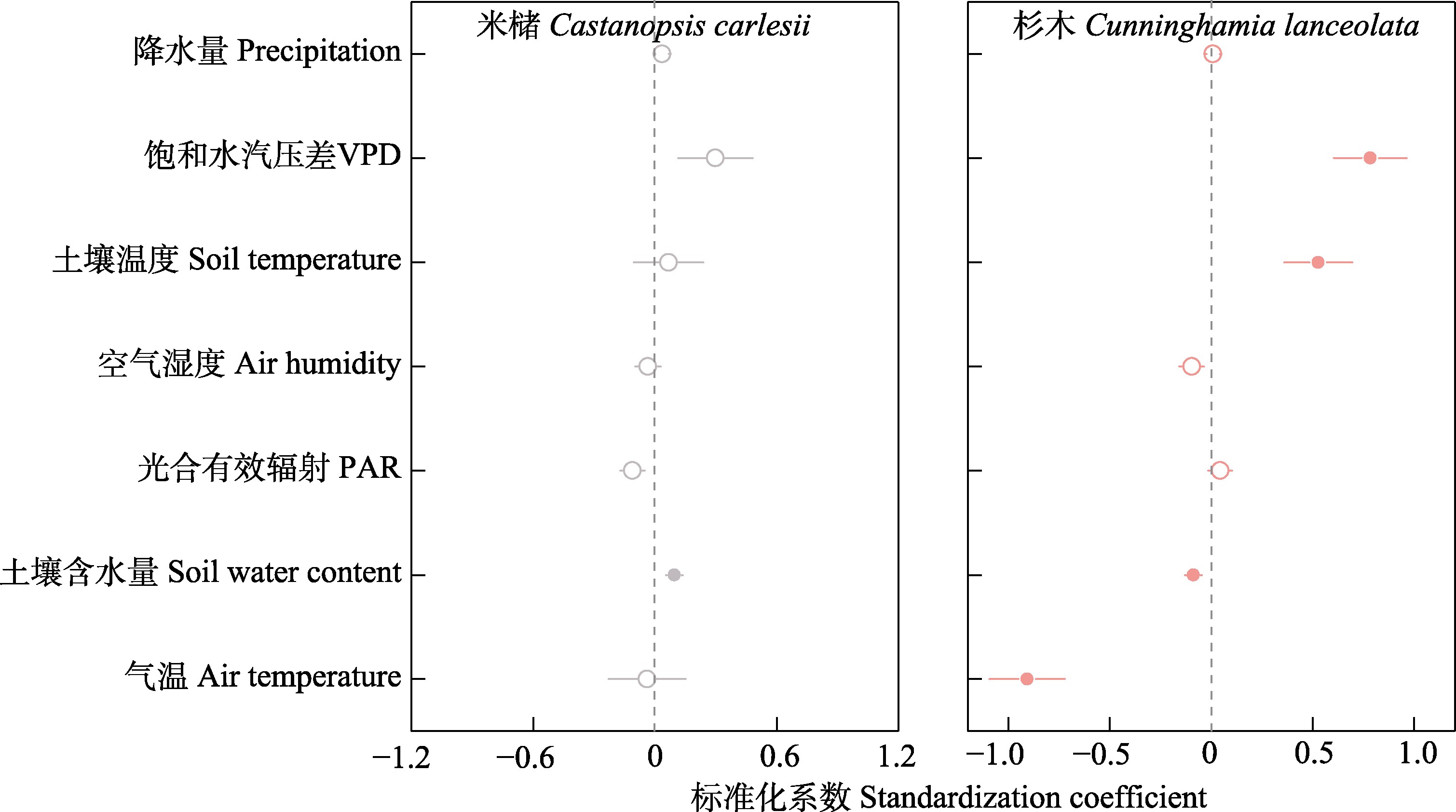
林木的生长物候是全球变化背景下森林碳汇研究的热点领域。目前为止, 由于观测的困难, 大多研究只涉及林木的径向生长, 关于林木高生长的研究仍十分缺乏, 相关研究也很少采用高频监测技术手段, 这限制了对林木高生长物候及其驱动机制的认识; 同时, 通过冠层颜色指数反演林木生长动态也成为一种趋势。因此, 该研究从基础仪器和算法的角度出发, 以亚热带典型阔叶树种米槠(Castanopsis carlesii)和针叶树种杉木(Cunninghamia lanceolata)的幼树为研究对象, 使用面阵固态激光雷达对中宇宙生长平台的树高生长动态进行了连续高频测量, 此外, 该研究从可见光延时摄影照片中提取了RGB转换的冠层颜色指数, 并将其与多气象观测系统监测的环境因子结合, 探究林木高度生长的物候及其气候驱动因素。研究结果表明: 米槠和杉木的生长季开始时间相近, 米槠的生长季结束时间显著早于杉木, 杉木的生长季长度显著大于米槠、树高年累计生长量也大于米槠; 米槠树高单日生长速率与土壤水分含量显著正相关; 杉木树高单日生长速率与气温、土壤水分含量显著负相关, 与土壤温度、饱和水汽压差(VPD)显著正相关; 米槠和杉木的冠层颜色指数在表征树高生长动态时存在差异, 杉木树高单日生长速率与绝对绿度(ExG)、相对绿度(Gcc)、绿红植被指数(GRVI)均显著正相关, 而米槠树高单日生长速率仅与绿红植被指数(GRVI)显著正相关, 与其余颜色指数的相关性较弱。综上, 该研究利用系统的林木生长物候观测仪器, 分析林木高生长物候及其影响因子; 以及冠层颜色指数对林木生长的反演, 为森林碳汇研究提供重要的理论依据。
万冬梅 , 杨智杰 , 刘小飞 , 熊德成 , 胥超 , 陈仕东 , 杨玉盛 . 基于固态激光雷达测高法的亚热带幼树生长物候及其对环境因子的响应[J]. 植物生态学报, 2025 , 49(12) : 2080 -2091 . DOI: 10.17521/cjpe.2024.0138
Aims Tree growth phenology is crucial for understanding forest carbon sequestration under global change. However, up until now, observational challenges have limited research on tree height growth, with most studies focusing on radial growth. Due to the scarcity of studies employing high-frequency monitoring, our understanding of the mechanisms driving tree growth phenology is limited. Additionally, canopy color indices are increasingly being used to study tree growth dynamics.
Methods We used area-array solid-state Lidar to continuously and at high frequency measure height growth dynamics of Cunninghamia lanceolata and Castanopsis carlesii saplings within a mesocosm experiment in subtropical china. We also derived RGB-converted canopy color indices from phenocams and integrated them with environmental factors data from a multi-factor meteorological observation system. The study aimed to explore the phenology of tree saplings height growth and its meteorological drives.
Important findings Our results indicated a synchronous start to the growing season for Castanopsis carlesii and Cunninghamia lanceolata, but a significantly earlier end for Castanopsis carlesii. Moreover, Cunninghamia lanceolata exhibited a significantly longer growing season and higher cumulative annual tree height growth than Castanopsis carlesii. The daily height growth rate of Castanopsis carlesii showed a significantly positive correlation with soil moisture. Conversely, the daily height growth rate of Cunninghamia lanceolatawas significantly negatively correlated with air temperature and soil moisture, but positively correlated with soil temperature and vapor pressure deficit (VPD). Notable differences in canopy color indices were identified between the two species: the daily height growth rate of Cunninghamia lanceolata was significantly positively correlated with the Green Excess Index (ExG), Green Chromatic Coordinate (Gcc), and Green Red Vegetation Index (GRVI), whereas Castanopsis carlesii correlated significantly with positively GRVI alone. In summary, this study utilized systematic phenological observation instruments to examine tree saplings height growth phenology and its driving factors. Furthermore, it utilized canopy color indices to retrieve tree height growth, offering key theoretical insights for forest carbon sequestration research.
Key words: tree height growth; phenology; laser radar altimetry; phenocam; canopy color index
| [1] | Anderson-Teixeira KJ, Wang MMH, McGarvey JC, LeBauer DS (2016). Carbon dynamics of mature and regrowth tropical forests derived from a pantropical database (TropForC-db). Global Change Biology, 22, 1690-1709. |
| [2] | Antonucci S, Rossi S, Lombardi F, Marchetti M, Tognetti R (2019). Influence of climatic factors on silver fir xylogenesis along the Italian Peninsula. IAWA Journal, 40, 259. DOI: 10.1163/22941932-40190222. |
| [3] | Bowman DMJS, Brienen RJW, Gloor E, Phillips OL, Prior LD (2013). Detecting trends in tree growth: not so simple. Trends in Plant Science, 18, 11-17. |
| [4] | Bréda N, Huc R, Granier A, Dreyer E (2006). Temperate forest trees and stands under severe drought: a review of ecophysiological responses, adaptation processes and long-term consequences. Annals of Forest Science, 63, 625-644. |
| [5] | Chen H, Zeng ZZ, Wu J, Peng LQ, Lakshmi V, Yang H, Liu JG (2020). Large uncertainty on forest area change in the early 21st century among widely used global land cover datasets. Remote Sensing, 12, 3502. DOI: 10.3390/rs12213502. |
| [6] | Choat B, Brodribb TJ, Brodersen CR, Duursma RA, López R, Medlyn BE (2018). Triggers of tree mortality under drought. Nature, 558, 531-539. |
| [7] | Chung H, Muraoka H, Nakamura M, Han S, Muller O, Son Y (2013). Experimental warming studies on tree species and forest ecosystems: a literature review. Journal of Plant Research, 126, 447-460. |
| [8] | Croft H, Chen JM, Zhang Y (2014). The applicability of empirical vegetation indices for determining leaf chlorophyll content over different leaf and canopy structures. Ecological Complexity, 17, 119-130. |
| [9] | Delpierre N, Vitasse Y, Chuine I, Guillemot J, Bazot S, Rutishauser T, Rathgeber CBK (2016). Temperate and boreal forest tree phenology: from organ-scale processes to terrestrial ecosystem models. Annals of Forest Science, 73, 5-25. |
| [10] | Fang K, Kou YP, Tang N, Liu J, Zhang XY, He HL, Xia RX, Zhao WQ, Li DD, Liu Q (2024). Differential responses of soil bacteria, fungi and protists to root exudates and temperature. Microbiological Research, 286, 127829. DOI: 10.1016/j.micres.2024.127829. |
| [11] | Guo XL, Yu BY, Liang HX, Huang JG (2017). Advancement in studies of tree growth and ecophysiology incorporating micro-sampling approach. Chinese Journal of Plant Ecology, 41, 795-804. |
| [郭霞丽, 余碧云, 梁寒雪, 黄建国 (2017). 结合微树芯方法的树木生长生理生态学研究进展. 植物生态学报, 41, 795-804.] | |
| [12] | Huang JG, Deslauriers A, Rossi S (2014). Xylem formation can be modeled statistically as a function of primary growth and cambium activity. New Phytologist, 203, 831-841. |
| [13] | Huang JG, Guo XL, Rossi S, Zhai LH, Yu BY, Zhang SK, Zhang MF (2018). Intra-annual wood formation of subtropical Chinese red pine shows better growth in dry season than wet season. Tree Physiology, 38, 1225-1236. |
| [14] | Jansons ā, Matisons R, Baumanis I, Puri?a L (2013). Effect of climatic factors on height increment of Scots pine in experimental plantation in Kalsnava, Latvia. Forest Ecology and Management, 306, 185-191. |
| [15] | Liu YN, Fan ZX, Lin YX, Kaewmano A, Wei XL, Fu PL, Grie?inger J, Br?uning A (2024). Impact of extreme pre-monsoon drought on xylogenesis and intra-annual radial increments of two tree species in a tropical montane evergreen broad-leaved forest, Southwest China. Tree Physiology, 44, tpae086. DOI: 10.1093/treephys/tpae086. |
| [16] | Lv KT, Zhou ML, Ding Y, Zang RG, Yao J, Luo YS, Yan DF (2023). Regeneration characteristics and influencing factors of woody plant on natural evergreen secondary broad-leaved forests in the subtropical, China. Global Ecology and Conservation, 42, e02394. DOI: 10.1016/j.gecco.2023.e02394. |
| [17] | McCollum C, Ibá?ez I (2020). Soil moisture gradients and climate change: predicting growth of a critical boreal tree species. Canadian Journal of Forest Research, 50, 1074-1080. |
| [18] | Meng SW, Yang FT, Dai XQ, Wang HM (2021). Radial growth dynamics of Chinese fir and its response to seasonal drought. Chinese Journal of Applied Ecology, 32, 3521-3530. |
| [孟盛旺, 杨风亭, 戴晓琴, 王辉民 (2021). 杉木径向生长动态及其对季节性干旱的响应. 应用生态学报, 32, 3521-3530.] | |
| [19] | Nagai S, Ichie T, Yoneyama A, Kobayashi H, Inoue T, Ishii R, Suzuki R, Itioka T (2016). Usability of time-lapse digital camera images to detect characteristics of tree phenology in a tropical rainforest. Ecological Informatics, 32, 91-106. |
| [20] | Piao SL, Liu Q, Chen AP, Janssens IA, Fu YS, Dai JH, Liu LL, Lian X, Shen MG, Zhu XL (2019). Plant phenology and global climate change: current progresses and challenges. Global Change Biology, 25, 1922-1940. |
| [21] | Ping XY, Zhou GS, Sun JS (2010). Advances in the study of photosynthate allocation and its controls. Chinese Journal of Plant Ecology, 34, 100-111. |
| [平晓燕, 周广胜, 孙敬松 (2010). 植物光合产物分配及其影响因子研究进展. 植物生态学报, 34, 100-111.] | |
| [22] | Qian NP, Gao HX, Song CJ, Dong CC, Liu QJ (2024). Seasonal dynamics of radial growth of Betula platyphylla and its response to environmental factors in Changbai Mountains. Chinese Journal of Plant Ecology, 48, 1001-1010. |
| [钱尼澎, 高浩鑫, 宋超杰, 董淳超, 刘琪璟 (2024). 长白山白桦径向生长季节动态及其对环境因子的响应. 植物生态学报, 48, 1001-1010.] | |
| [23] | Qu ZK, Lin CF, Zhao HY, Chen TT, Yao XD, Wang XH, Yang YS, Chen GS (2024). Above- and belowground phenology responses of subtropical Chinese fir (Cunninghamia lanceolata) to soil warming, precipitation exclusion and their interaction. Science of the Total Environment, 933, 173147. DOI: 10.1016/j.scitotenv.2024.173147. |
| [24] | Sanginés de Cárcer P, Vitasse Y, Pe?uelas J, Jassey VEJ, Buttler A, Signarbieux C (2018). Vapor-pressure deficit and extreme climatic variables limit tree growth. Global Change Biology, 24, 1108-1122. |
| [25] | Seyednasrollah B, Bowling DR, Cheng R, Logan BA, Magney TS, Frankenberg C, Yang JC, Young AM, Hufkens K, Arain MA, Black TA, Blanken PD, Bracho R, Jassal R, Hollinger DY, Law BE, Nesic Z, Richardson AD (2021). Seasonal variation in the canopy color of temperate evergreen conifer forests. New Phytologist, 229, 2586-2600. |
| [26] | Shi MJ, Li B, Yi LT, Liu MH (2023). Sexual divergence of Populus deltoides seedlings growth and ecophysiological response to drought and rewatering. Chinese Journal of Plant Ecology, 47, 1159-1170. |
| [施梦娇, 李斌, 伊力塔, 刘美华 (2023). 美洲黑杨幼苗生长和生理生态指标对干旱-复水响应的性别差异. 植物生态学报, 47, 1159-1170.] | |
| [27] | Soolanayakanahally RY, Guy RD, Silim SN, Song MH (2013). Timing of photoperiodic competency causes phenological mismatch in balsam poplar (Populus balsamifera L.). Plant, Cell & Environment, 36, 116-127. |
| [28] | Stuble KL, Bennion LD, Kuebbing SE (2021). Plant phenological responses to experimental warming—A synthesis. Global Change Biology, 27, 4110-4124. |
| [29] | Teng JK, Liu Y, Ding MT (2018). The evaluation of efficiency of color metrics in monitoring Robinia pseudoacacia phenology based on RGB images. Remote Sensing Technology and Application, 33, 476-485. |
| [滕佳昆, 刘宇, 丁明涛 (2018). 基于RGB图像的刺槐季节变化监测适用指数研究. 遥感技术与应用, 33, 476-485.] | |
| [30] | Vanoni M, Bugmann H, N?tzli M, Bigler C (2016). Quantifying the effects of drought on abrupt growth decreases of major tree species in Switzerland. Ecology and Evolution, 6, 3555-3570. |
| [31] | Vlam M, Baker PJ, Bunyavejchewin S, Zuidema PA (2014). Temperature and rainfall strongly drive temporal growth variation in Asian tropical forest trees. Oecologia, 174, 1449-1461. |
| [32] | Wang HL, Zhang Y, Wang T, Yang Q, Yang YL, Li Z, Li BS, Wen X, Li WY, Yin WL, Xia XL, Guo HW, Li ZH (2021). An alternative splicing variant of PtRD26 delays leaf senescence by regulating multiple NAC transcription factors in Populus. The Plant Cell, 33, 1594-1614. |
| [33] | Wei XL, Fan ZX, Kaewmano A, Lin YX, Chen LM, Fu PL (2021). Intra-annual radial growth of Garuga floribunda in tropical seasonal rain forest and its response to environmental factors in Xishuangbanna, Southwest China. Chinese Journal of Applied Ecology, 32, 3567-3575. |
| [韦小练, 范泽鑫, Kaewmano A, 林友兴, 陈礼敏, 付培立 (2021). 热带季节雨林多花白头树年内径向生长动态及其对环境因子的响应. 应用生态学报, 32, 3567-3575.] | |
| [34] | Xu KJ, Zeng HD, Zhang ZD, Xie JS, Yang YS (2015). Relating forest phenology to temperature and precipitation in the subtropical region of Fujian based on time-series MODIS-NDVI. Journal of Geo-information Science, 17, 1249-1259. |
| [徐凯健, 曾宏达, 张仲德, 谢锦升, 杨玉盛 (2015). 亚热带福建省森林生长季与气温、降水相关性的遥感分析. 地球信息科学学报, 17, 1249-1259.] | |
| [35] | Yin CM, He BB, Quan XW, Liao ZM (2016). Chlorophyll content estimation in arid grasslands from Landsat-8 OLI data. International Journal of Remote Sensing, 37, 615-632. |
| [36] | Yuan WP, Zheng Y, Piao SL, Ciais P, Lombardozzi D, Wang YP, Ryu Y, Chen GX, Dong WJ, Hu ZM, Jain AK, Jiang CY, Kato E, Li SH, Lienert S, et al. (2019). Increased atmospheric vapor pressure deficit reduces global vegetation growth. Science Advances, 5, eaax1396. DOI: 10.1126/sciadv.aax1396. |
| [37] | Zhang H, Fu PL, Lin YX, Gesang, Yang JQ, Ge R, Fan ZX (2022). Intra-annual radial growth of Abies georgei and Larix potaninii and its responses to environmental factors in the Baima Snow Mountain, Northwest Yunnan, China. Chinese Journal of Applied Ecology, 33, 2881-2888. |
| [张慧, 付培立, 林友兴, 格桑, 杨建强, 格茸取扎, 范泽鑫 (2022). 滇西北白马雪山长苞冷杉和大果红杉年内径向生长动态及其对环境因子的响应. 应用生态学报, 33, 2881-2888.] | |
| [38] | Zhang JT, Li XX, Ren P, Leavitt SW, Rossi S, Liang EY (2022). Terminal bud size, spring and summer temperatures regulate the timing of height-growth cessation of Smith fir on the southeastern Tibetan Plateau. Agricultural and Forest Meteorology, 316, 108883. DOI: 10.1016/j.agrformet.2022.108883. |
| [39] | Zhang L, Chen YJ, Hao GY, Ma KP, Bongers F, Sterck FJ (2020a). Conifer and broadleaved trees differ in branch allometry but maintain similar functional balances. Tree Physiology, 40, 511-519. |
| [40] | Zhang SK, Buttò V, Khare S, Deslauriers A, Morin H, Huang JG, Ren H, Rossi S (2020b). Calibrating PhenoCam data with phenological observations of a black spruce stand. Canadian Journal of Remote Sensing, 46, 154-165. |
| [41] | Zhang ZQ, Zhang L, Xu H, Creed IF, Blanco JA, Wei XH, Sun G, Asbjornsen H, Bishop K (2023). Forest water-use efficiency: effects of climate change and management on the coupling of carbon and water processes. Forest Ecology and Management, 534, 120853. DOI: 10.1016/j.foreco.2023.120853. |
| [42] | Zhong ZQ, He B, Wang YP, Chen HW, Chen DL, Fu YH, Chen YN, Guo LL, Deng Y, Huang L, Yuan WP, Hao XM, Tang R, Liu HM, Sun LY, Xie XM, Zhang YF (2023). Disentangling the effects of vapor pressure deficit on northern terrestrial vegetation productivity. Science Advances, 9, eadf3166. DOI: 10.1126/sciadv.adf3166. |
| [43] | Zhou L, Chi YG, Liu XT, Dai XQ, Yang FT (2020). Land surface phenology tracked by remotely sensed sun-induced chlorophyll fluorescence in subtropical evergreen coniferous forests. Acta Ecologica Sinica, 40, 4114-4125. |
| [周蕾, 迟永刚, 刘啸添, 戴晓琴, 杨风亭 (2020). 日光诱导叶绿素荧光对亚热带常绿针叶林物候的追踪. 生态学报, 40, 4114-4125.] | |
| [44] | Zweifel R, Sterck F, Braun S, Buchmann N, Eugster W, Gessler A, H?ni M, Peters RL, Walthert L, Wilhelm M, Ziemińska K, Etzold S (2021). Why trees grow at night. New Phytologist, 231, 2174-2185. |
/
| 〈 |
|
〉 |
Copyright © 2026 版权所有 《植物生态学报》编辑部
地址: 北京香山南辛村20号, 邮编: 100093
Tel.: 010-62836134, 62836138; Fax: 010-82599431; E-mail: apes@ibcas.ac.cn, cjpe@ibcas.ac.cn
备案号: 京ICP备16067583号-19

