
半干旱草原土壤呼吸组分区分与菌根呼吸的贡献
收稿日期: 2018-03-29
网络出版日期: 2018-06-01
基金资助
国家自然科学基金(41773084);国家重点研发计划(2017YFA0604801)
Partitioning of soil respiration components and evaluating the mycorrhizal contribution to soil respiration in a semiarid grassland
Received date: 2018-03-29
Online published: 2018-06-01
Supported by
Supported by the National Natural Science Foundation of China(41773084);the National Program on Key Research Project of China(2017YFA0604801)
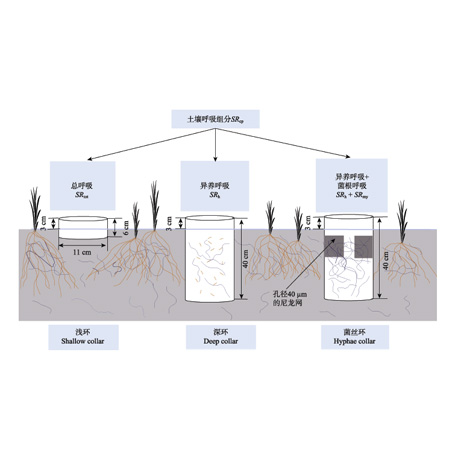
土壤呼吸组分的区分对于理解地下碳循环过程非常重要。而菌根真菌在地下碳循环过程中扮演着重要的角色, 但是有关菌根呼吸在草原生态系统中的研究相对较少。该研究在内蒙古半干旱草原应用深浅环网孔法, 结合浅环、深环(排除根系)和一个带有40 μm孔径窗口的土壤环(排除根系但是有菌根菌丝体)将根和菌丝物理分离, 来区分不同的呼吸组分。结果表明: 异养呼吸对总呼吸的贡献比例为51%, 根呼吸的贡献比例为26%, 菌根呼吸的贡献比例为23%, 菌根呼吸的比例3年变化范围为21%-26%。与国内外研究相比, 此方法提供了一个相对稳定的菌根呼吸测量精度范围, 在草原生态系统中切实可行。对菌根呼吸的准确定量将有助于预测草原生态系统土壤碳释放过程对未来气候变化的响应。
李伟晶, 陈世苹, 张兵伟, 谭星儒, 王珊珊, 游翠海 . 半干旱草原土壤呼吸组分区分与菌根呼吸的贡献[J]. 植物生态学报, 2018 , 42(8) : 850 -862 . DOI: 10.17521/cjpe.2018.0068
Aims Soil respiration component partitioning is pivotal to understand the belowground carbon (C) cycle. Mycorrhizal fungi have been proven to play an important role in the soil C turnover, but only a few studies have been conducted to quantify the contribution of mycorrhizal respiration to total soil respiration in grassland ecosystems.
Methods The mini-trenching mesh method was applied to partition soil respiration components of a semi-arid grassland in Inner Mongolia. A shallow collar (measuring soil total respiration), a deep collar (excluding roots and mycorrhizal hypahe) and a deep collar with 40 μm pore mesh window (excluding roots but not mycorrhizal hyphae) were installed in each plot. Soil respiration rate of each collar was measured every two weeks during the growing season from 2014 to 2016. The differences in the rate of soil respiration among different type of collars were used to partition the components of soil respiration.
Important findings The results showed that the contribution of heterotrophic, root and mycorrhizal respiration to total soil respiration was 49%, 28%, and 23%, respectively. Across the three years, the proportion of mycorrhizal respiration varied from 21%-26%, which is comparable with the results reported by other studies recently. Our results demonstrated that the mini-trenching mesh method is a suitable method for separating mycorrhizal respiration component in grassland ecosystems. Evaluating the contribution of mycorrhizal respiration to total soil respiration is very important for predicting the responses of soil carbon release to future climate change.
| [1] | Andrews JA, Harrison KG, Matamala R, Schlesinger WH ( 1999). Separation of root respiration from total soil respiration using carbon-13 labelling during free-air carbon dioxide enrichment (FACE). Soil Science Society of America Journal, 63, 1429-1435. |
| [2] | Balogh J, Papp M, Pinter K, Foti S, Posta K, Eugster W, Nagy Z ( 2016). Autotrophic component of soil respiration is repressed by drought more than the heterotrophic one in dry grasslands. Biogeosciences, 13, 5171-5182. |
| [3] | Bhupinderipal-Singh, Nordgren A, Ottosson-Löfvenius M, Högberg MN, Mellander PE, Högberg P ( 2003). Tree root and soil heterotrophic respiration as revealed by girdling of boreal Scots pine forest: Extending observations beyond the first year. Plant, Cell & Environment, 26, 1287-1296. |
| [4] | Cavagnaro TR, Smith FA, Smith SE, Jakobsen I ( 2005). Functional diversity in arbuscular mycorrhizas: Exploitation of soil patches with different phosphate enrichment differs among fungal species. Plant, Cell & Environment, 28, 642-650. |
| [5] | Drigo B, Pijl AS, Duyts H, Kielak AM, Gamper HA, Houtekamer MJ, Boschker HTS, Bodelier PLE, Whiteley AS, Veen JAV ( 2010). Shifting carbon flow from roots into associated microbial communities in response to elevated atmospheric CO2. Proceedings of the National Academy of Sciences of the United States of America, 107, 10938-10942. |
| [6] | Fisher FM, Gosz JR ( 1986). Effects of trenching on soil processes and properties in a New Mexico mixed-conifer forest. Biology and Fertility of Soils, 2, 35-42. |
| [7] | Friese CF, Allen MF ( 1991). The spread of VA mycorrhizal fungal hyphae in the soil: Inoculum types and external hyphal architecture. Mycologia, 83, 409-418. |
| [8] | Grimoldi AA, Kavanova M, Lattanzi FA, Schaufele R, Schnyder H ( 2006). Arbuscular mycorrhizal colonization on carbon economy in perennial ryegrass: Quantification by 13CO2/ 12CO2 steady-state labelling and gas exchange . New Phytologist, 172, 544-553. |
| [9] | Hanson PJ, Edwards NT, Garten CT, Andrews JA ( 2000). Separating root and soil microbial contributions to soil respiration: A review of methods and observations . Biogeochemistry, 48, 115-146. |
| [10] | Heinemeyer A, Hartley IP, Evans SP, de La Fuente JAC, Ineson P ( 2007). Forest soil CO2 flux: Uncovering the contribution and environmental responses of ectomycorrhizas. Global Change Biology, 13, 1786-1797. |
| [11] | Heinemeyer A, Tortorella D, Petrovicová B, Gelsomino A ( 2012). Partitioning of soil CO2 flux components in a temperate grassland ecosystem. European Journal of Soil Science, 63, 249-260. |
| [12] | Heinemeyer A, Ineson P, Ostle N, Fitter AH ( 2006). Respiration of the external myceliumin the arbuscular mycorrhizal symbiosis shows strong dependence on recent photosynthates and acclimation to temperature. New Phytologist, 171, 159-170. |
| [13] | Högberg P, Nordgren A, Buchmann N, Taylor AFS, Ekblad A, Högberg MN, Nyberg G, Ottosson-Löfvenius M, Read DJ ( 2001). Large-scale forest girdling shows that current photosynthesis drives soil respiration. Nature, 411, 789-792. |
| [14] | Jakobsen I, Abbott LK, Robson AD ( 1992). External hyphae of vesicular arbuscular mycorrhizal fungi associated with Trifolium subterraneum L. 2. Hyphal transport of 32P over defined distances. New Phytologist, 120, 509-516. |
| [15] | Jakobsen I, Rosendahl L ( 1990). Carbon flow into soil and external hyphae from roots of mycorrhizal cucumber plants. New Phytologist, 115, 77-83. |
| [16] | Johnson D, Leake JR, Read DJ ( 2001). Novel in-growth core system enables functional studies of grassland mycelial networks. New Phytologist, 152, 555-562. |
| [17] | Kernaghan G ( 2013). Functional diversity and resource partitioning in fungi associated with the fine feeder roots of forest trees. Symbiosis, 61, 113-123. |
| [18] | Koorem K, Gazol A, Öpik M, Moora M, Saks Ü, Uibopuu A, Sõber V, Zobel M ( 2014). Soil nutrient content influences the abundance of soil microbes but not plant biomass at the small-scale. PLOS ONE, 9, e91998. DOI: 10.1371/journal.pone.0091998. |
| [19] | Kuzyakov Y, Larionova AA ( 2005). Root and rhizomicrobial respiration: A review of approaches to estimate respiration by autotrophic and heterotrophic organisms in soil. Journal of Plant Nutrition and Soil Science, 168, 503-520. |
| [20] | Lauber CL, Strickland MS, Bradford MA, Fierer N ( 2008). The influence of soil properties on the structure of bacterial and fungal communities across land-use types. Soil Biology & Biochemistry, 40, 2407-2415. |
| [21] | Leake J, Johnson D, Donnelly D, Muckle G, Boddy L, Read D ( 2004). Networks of power and influence: The role of mycorrhizal mycelium in controlling plant communities and agroecosystem functioning. Canadian Journal of Botany, 82, 1016-45. |
| [22] | Lee MS, Nakane K, Nakatsubo T, Koizumi H ( 2003). Seasonal changes in the contribution of root respiration to total soil respiration in a cool-temperate deciduous forest. Plant and Soil, 255, 311-318. |
| [23] | Li YF, Gao R, Li Y, Qiu J, Cheng GS, Yin YF ( 2008). In vitro root respirations of different diameter classes for Chinese firs in relation to root parameters. Journal of Subtropical Resources & Environment, 3(2), 19-24. |
| [24] | Lilleskov EA ( 2017). How does temperature affect forest “fungus breath”? Diurnal non-exponential temperature- respiration relationship, and possible longer-term acclimation in fungal sporocarps. Fungal Ecology, 27, 24-35. |
| [25] | Luo YQ, Zhou XH ( 2006). Soil Respiration and the Environment. Higher Education Press, Beijing. 159-160. |
| [25] | [ 骆亦其, 周旭辉 ( 2006). 土壤呼吸与环境. 高等教育出版社, 北京. 159-160.] |
| [26] | Ma WH, Yang YH, He JS, Zeng H, Fang JY ( 2008). The relationship between the biomass and environmental factors in Inner Mongolia. Chinese Science C Series: Life Science, 38, 84-92. |
| [26] | [ 马文红, 杨元合, 贺金生, 曾辉, 方精云 ( 2008). 内蒙古温带草地生物量及其与环境因子的关系. 中国科学C辑: 生命科学, 38, 84-92.] |
| [27] | Miller RM, Jastrow JD, Reinhardt DR ( 1995). External hyphal production of vesicular-arbuscular mycorrhizal fungi in pasture and tallgrass prairie communities. Oecologia, 103, 17-23. |
| [28] | Moyano FE, Kutsch WL, Rebmann C ( 2008). Soil respiration fluxes in relation to photosynthetic activity in broad-leaf and needle-leaf forest stands. Agricultural and Forest Meteorology, 148, 135-143. |
| [29] | Moyano FE, Kutsch WL, Schultze ED ( 2007). Response of mycorrhizal, rhizosphere and soil basal respiration to temperature and photosynthesis in a barley field. Soil Biology & Biochemistry, 39, 843-853. |
| [30] | Neumann J, Matzner E ( 2014). Contribution of newly grown extramatrical ectomycorrhizal mycelium and fine roots to soil respiration in a young Norway spruce site. Plant and Soil, 378, 73-82. |
| [31] | Nottingham AT, Turner BL, Winter K, van der Heijden MG, Tanner EV ( 2010). Arbuscular mycorrhizal mycelial respiration in a moist tropical forest. New Phytologist, 186, 957-967. |
| [32] | Rakonczay Z, Seiler JR, Kelting DL ( 1997). Carbon efflux rates of fine roots of three tree species decline shortly after excision. Environmental and Experimental Botany, 38, 243-249. |
| [33] | Rillig MC, Field CB, Allen MF ( 1999). Soil biota responses to long-term atmospheric CO2 enrichment in two California annual grasslands. Oecologia, 119, 572-577. |
| [34] | Rodeghiero M, Cescatti A ( 2006). Indirect partitioning of soil respiration in a series of evergreen forest ecosystems. Plant and Soil, 284, 7-22. |
| [35] | Rygiewicz PT, Andersen CP ( 1994). Mycorrhizae alter quality and quantity of carbon allocated below ground. Nature, 369, 58-60. |
| [36] | Saiz G, Black K, Reidy B, Lopez S, Farrell EP ( 2007). Assessment of soil CO2 efflux and its components using a process-based model in a young temperate forest site. Geoderma, 139, 79-89. |
| [37] | Shi JJ, Geng YB ( 2014). Study on the distinguishing of root respiration from soil microbial respiration in a Leymus chinensis steppe in Inner Mongolia, China. Environmental Science, 35, 341-347. |
| [38] | Slavíková R, Püschel D, Janoušková M, Hujslová M, Konvalinková T, Gryndlerová H, Gryndler M, Weiser M, Jansa J ( 2017). Monitoring CO2 emissions to gain a dynamic view of carbon allocation to arbuscular mycorrhizal fungi. Mycorrhiza, 27, 35-51. |
| [39] | Smith SE, Read DJ ( 2008). Mycorrhizal Symbiosis. Academic Press, London. |
| [40] | Talbot JM, Allison SD, Treseder KK ( 2008). Decomposers in disguise: Mycorrhizal fungi as regulators of soil C dynamics in ecosystems under global change. Functional Ecology, 22, 955-963. |
| [41] | Tedersoo L, Bahram M, Põlme S, Kõljalg U, Yorou NS, Wijesundera R, Ruiz LV, Vasco-Palacios AM, Thu PQ, Suija A, Smith ME, Sharp C, Saluveer E, Saitta A, Rosas M, Riit T, Ratkowsky D, Pritsch K, Põldmaa K, Piepenbring M, Phosri C, Peterson M, Parts K, Pärtel K, Otsing E, Nouhra E, Njouonkou AL, Nilsson RH, Morgado LN, Mayor J, May TW, Majuakim L, Lodge DJ, Lee SS, Larsson KH, Kohout P, Hosaka K, Hiiesalu I, Henkel TW, Harend H, Guo L, Greslebin A, Grelet G, Geml J, Gates G, Dunstan W, Dunk C, Drenkhan R, Dearnaley J, Kesel AD, Dang T, Chen X, Buegger F, Brearley FQ, Bonito G, Anslan S, Abell S, Abarenkov K ( 2014). Global diversity and geography of soil fungi. Science, 346, 1-11. |
| [42] | Tomè E, Ventura M, Folegot S, Zanotelli D, Montagnani L, Mimmo T, Tonon G, Tagliavini M, Scandellari F ( 2016). Mycorrhizal contribution to soil respiration in an apple orchard. Applied Soil Ecology, 101, 165-173. |
| [43] | Wang C, Yang J ( 2007). Rhizospheric and heterotrophic components of soil respiration in six Chinese temperate forests. Global Change Biology, 13, 123-131. |
| [44] | Wilson GWT, Rice CW, Rillig MC, Springer A, Hartnett DC ( 2009). Soil aggregation and carbon sequestration are tightly correlated with the abundance of arbuscular mycorrhizal fungi: Results from long-term field experiments. Ecology Letters, 12, 452-461. |
| [45] | Xu M, DeBiase TA, Qi Y, Goldstein A, Liu Z ( 2001). Ecosystem respiration in a young ponderosa pine plantation in the Sierra Nevada Mountains, California. Tree Physiology, 21, 309-318. |
| [46] | Yan L, Chen S, Huang J, Lin G ( 2010). Differential responses of auto- and heterotrophic soil respiration to water and nitrogen addition in a semiarid temperate steppe. Global Change Biology, 16, 2345-2357. |
| [47] | Zhang Q, Lei HM, Yang DW ( 2013). Seasonal variations in soil respiration, heterotrophic respiration and autotrophic respiration of a wheat and maize rotation cropland in the North China Plain. Agricultural & Forest Meteorology, 180, 34-43. |
| [48] | Zhu JJ, Xu H, Xu ML, Kang HZ ( 2003). Review on the ecological relationships between forest trees and ectomycorrhizal fungi. Chinese Journal of Ecology, 22(6), 70-76. |
| [48] | [ 朱教君, 徐慧, 许美玲, 康宏樟 ( 2003). 外生菌根菌与森林树木的相互关系. 生态学杂志, 22(6), 70-76.] |
/
| 〈 |
|
〉 |
Copyright © 2026 版权所有 《植物生态学报》编辑部
地址: 北京香山南辛村20号, 邮编: 100093
Tel.: 010-62836134, 62836138; Fax: 010-82599431; E-mail: apes@ibcas.ac.cn, cjpe@ibcas.ac.cn
备案号: 京ICP备16067583号-19

