
《中国植被志》研编内容与规范
收稿日期: 2019-10-15
录用日期: 2019-11-25
网络出版日期: 2020-04-08
基金资助
国家科技基础性工作专项(2015FY210200);国家科技基础性工作专项2015FY210200和国家科技基础资源调查专项(2019FY202300)
Contents and protocols for the classification and description of Vegetation Formations, Alliances and Associations of vegetation of China
Received date: 2019-10-15
Accepted date: 2019-11-25
Online published: 2020-04-08
Supported by
Special Foundation for National Science and Technology Basic Research Program of China(2015FY210200);Special Foundation for National Science and Technology Basic Resources Investigation of China(2019FY202300)
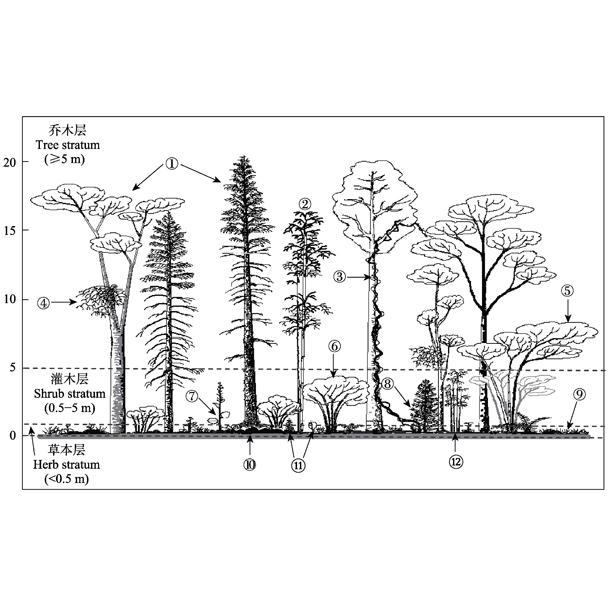
植被志是基于植被(或植物群落)调查资料, 全面记叙植被的外貌、物种组成、结构和功能, 以及地理分布和生境条件等特征, 并对同类植被进行归纳和总结的志书。《中国植被志》是第一部对中国植被进行全面记述的志书, 预计完成约48卷110册。在借鉴《中国植被》(1980)(简称“80方案”)植被分类基本原则的基础上,《中国植被志》将对中国植被分类系统的高级分类单位(植被型组、植被型和植被亚型)进行归纳和总结, 对中级和低级分类单位(群系组、群系、亚群系, 群丛组、群丛)进行详细描述。植被高级分类单位的描述具有概括性质, 是在中国植被分类系统中级和低级分类单位描述的基础上, 对其在全球和中国境内的地理分布、自然环境、群落外貌、植被类型及多样性、优势种或共优势种、生物多样性保育价值以及资源现状等进行概述, 并对“80方案”相关内容进行修订和拓展, 将提供对中国植被基本特征客观、准确的记述。在植被中级和低级分类单位中, 群系组描述的内容包括地理分布、自然环境、群落外貌、植被类型以及价值与保育等内容; 群系描述的主要内容包括地理分布、自然环境、生态特征、物种组成、群落结构、群丛组和群丛的分类与描述、优势种的生物学特性、生物量与生产力、植被动态与演替以及价值与保育等方面。作为植被志研编的核心内容, 群丛组和群丛的分类与描述主要基于植被调查资料, 采用数量分类方法, 根据群落结构和物种组成的差异划分出不同的植被类型, 并对其基本特征进行定量描述和归纳。其中, 群落的层片结构、特定植被分类单元的特征种或特征种组的筛选与甄别是植被类型划分的关键环节; 而群落外貌, 群落结构, 物种组成, 各类物种的生长习性、生境的偏适性等是群丛组和群丛描述与归纳的重点内容。该文提出了中国植被中级和低级分类单位的命名方案, 其特点在于植被类型的科学名称中同时体现了植被分类单元特征种或优势种的名称及其所属的高级植被分类单位(植被型组或植被型)的名称, 兼顾了植被名称的规范性与实用性。《中国植被志》的研编工作由文献整编、群落调查、数据分析与整理、文本撰写等环节组成。该文对植被样方的调查与收集, 文献收集与整编, 气候、土壤、地形等相关数据的来源及其整理方法, 植被分类方法, 植被命名, 植被分类单元描述的内容, 植被志章节编写大纲、体裁及撰写等多个规范进行了详细的阐述或示例。
王国宏, 方精云, 郭柯, 谢宗强, 唐志尧, 沈泽昊, 王仁卿, 王襄平, 王德利, 强胜, 于丹, 彭少麟, 达良俊, 刘庆, 梁存柱 . 《中国植被志》研编内容与规范[J]. 植物生态学报, 2020 , 44(2) : 128 -178 . DOI: 10.17521/cjpe.2019.0272
Vegegraphy, a compound word of prefix “vege-” of “vegetation” and suffix of “-graphy” (description), is a series of monographs that describe species composition, structures, functions, distribution and environmental settings of a set of plant communities and/or their combinations. The Vegegraphy of China, which will be composed of 48 volumes and about 110 issues, is the first version to describe the medium-level units (Alliance Group, Alliance) and the lower-level units (Association Group, Association), and summarizes the higher-level units (Vegetation Formation Group, Vegetation Formation, Vegetation Subformation) in the Chinese Vegetation Classification System. The description of the higher-level units is highly generalized, mainly based on the data and evidences from the classification and description of the medium- and the lower-level classification units of the Chinese vegetation classification system, focusing on the geographic distribution, natural environment, community physiognomy, vegetation type and diversity, dominant species, values for biodiversity conservation, and the status of current vegetation resources at the scales of both worldwide and China. It is an important revision and expansion of the relevant content of Vegetation of China (1980) and will be the most authoritative and accurate description of the basic characteristics of Chinese vegetation. Alliance Group in each issue is briefly described on geographical distribution, natural environment, vegetation types, significance and conservation etc. Alliance as a key medium- level unit is to be described on several aspects, i.e., geographical distribution, natural environment, ecological characteristics, vegetation composition, vegetation structure, vegetation types and characteristics, biological characteristics of dominant species, biomass and productivity, vegetation dynamics and succession, and significance and conservation. As a core content of the above mentioned aspects, vegetation classification and description are conducted under the guidance of the “80 scheme” of Vegetation of China, using vegetation survey data as credentials to quantitatively differentiate vegetation types accordingly. Specifically, a vegetation classification scheme is determined based on supraterraneous stratification, and a set of diagnostic species while vegetation descriptions focus on physiognomy, community structure, species composition, including quantitative features of dominant species, companion species, constant species and accidental species, as well as their environmental preferences. In this study, we first put forward a code of vegetation nomenclature for the medium-level units (Alliance Group, Alliance) and the lower-level units (Association Group, Association) in the Chinese Vegetation Classification System. According to this vegetation nomenclature, the name of a vegetation type is composed of the name of a diagnostic species (may also be a dominant species) of each layer of the vegetation type and the name of the higher-level units (Vegetation Formation or Vegetation Formation Group) to which it belongs, which guarantees both scientific soundness and practical sense of the vegetation nomenclature. Contents and protocols for the research and editing of “Vegegraphy of China”, including vegetation survey and sample collection, literature compilation, climate, soil and topography data collection and compilation, vegetation classification, vegetation nomenclature, vegetation description outlines, are elaborated or exemplified in detail.
| [1] | Bigwood DW, Inouye DW (1988). Spatial pattern analysis of seed banks: an improved method and optimized sampling. Ecology, 69, 497-507. |
| [2] | Breiman L, Friedman JH, Olshen RA, Stone CJ (1984). Classification and Regression Trees. Chapman & Hall, Monterey. |
| [3] | Ding YH (2013). Climate of China. Science Press, Beijing. |
| [3] | [ 丁一汇 (2013). 中国气候. 科学出版社, 北京.] |
| [4] | Faber-Langendoen D, Keeler-Wolf T, Meidinger D, Tart D, Hoagland B, Josse C, Navarro G, Ponomarenko S, Saucier J-P, Weakley A, Comer P (2014). EcoVeg: a new approach to vegetation description and classification. Ecological Monographs, 84, 533-561. |
| [5] | Fang JY, Guo K, Wang GH, Tang ZY, Xie ZQ, Shen ZH, Wang RQ, Qiang S, Liang CZ, Da LJ, Yu D (2020). Vegetation classification system and classification of vegetation types used for the compilation of vegetation of China. Chinese Journal of Plant Ecology, 44, 96-110. |
| [5] | [ 方精云, 郭柯, 王国宏, 唐志尧, 谢宗强, 沈泽昊, 王仁卿, 强胜, 梁存柱, 达良俊, 于丹 (2020). 《中国植被志》的植被分类系统、植被类型划分及编排体系. 植物生态学报, 44, 96-110.] |
| [6] | Fang JY, Wang XP, Shen ZH, Tang ZY, He JS, Yu D, Jiang Y, Wang ZH, Zheng CY, Zhu JL, Guo ZD (2009). Methods and protocols for plant community inventory. Biodiversity Science, 17, 533-548. |
| [6] | [ 方精云, 王襄平, 沈泽昊, 唐志尧, 贺金生, 于丹, 江源, 王志恒, 郑成洋, 朱江玲, 郭兆迪 (2009). 植物群落清查的主要内容、方法和技术规范. 生物多样性, 17, 533-548.] |
| [7] | Federal Geographic Data Committee (2008). National Vegetation Classification Standard. 2nd ed. [2019-10-10]. http:// www.fgdc.gov/standards/projects/FGDC-standards-projects/vegetation/NVCS_V2_FINAL_2008-02.pdf. |
| [8] | Gong ZT, Huang RJ, Zhang GL (2014). Soil Geography of China. Science Press, Beijing. |
| [8] | [ 龚子同, 黄荣金, 张甘霖 (2014). 中国土壤地理. 科学出版社, 北京.] |
| [9] | Guo K, Fang JY, Wang GH, Tang ZY, Xie ZQ, Shen ZH, Wang RQ, Qiang S, Liang CZ, Da LJ, Yu D (2020). A revised scheme of vegetation classification system of China. Chinese Journal of Plant Ecology, 44, 111-127. |
| [9] | [ 郭柯, 方精云, 王国宏, 唐志尧, 谢宗强, 沈泽昊, 王仁卿, 强胜, 梁存柱, 达良俊, 于丹 (2020). 中国植被分类系统修订方案. 植物生态学报, 44, 111-127.] |
| [10] | Jennings MD, Faber-Langendoen D, Loucks OL, Peet RK, Roberts D (2009). Standards for Associations and Alliances of the U.S. National Vegetation Classification. Ecological Monographs, 79, 173-199. |
| [11] | Lin P (1990). Vegetation of Fujian. Fujian Science and Technology Publishing House, Fuzhou. |
| [11] | [ 林鹏 (1990). 福建植被. 福建科学技术出版社, 福州.] |
| [12] | Ma B, Qiang S, Wei SH (2004). Research method of farmland weed seed bank. Weed Science, ( 2), 5-8. |
| [12] | [ 马波, 强胜, 魏守辉 (2004). 农田杂草种子库研究方法. 杂草科学, ( 2), 5-8.] |
| [13] | Qiang S (2011). Weed Science. 2nd ed. China Agriculture Press, Beijing. |
| [13] | [ 强胜 (2011). 杂草学. 2版. 中国农业出版社, 北京.] |
| [14] | Research Institute of Forestry, Chinese Academy of Forestry Sciences (1986). Forest Soil of China. Science Press, Beijing. |
| [14] | [ 中国林业科学研究院林业研究所 (1986). 中国森林土壤. 科学出版社, 北京.] |
| [15] | Rodwell JS, Pigott CD, Ratcliffe DA, Malloch AJC, Birks HJB, Proctor MCF, Shimwell DW, Huntley JP, Radford E, Wigginton MJ, Wilkins P (1991). British Plant Communities: Vol. I. Cambridge University Press, Cambridge, UK. |
| [16] | Song YC (2013). Evergreen Broad-leaved Forests in China: Classification-Ecology-Conservation. Science Press, Beijing. |
| [16] | [ 宋永昌 (2013). 中国常绿阔叶林: 分类·生态·保育. 科学出版社, 北京.] |
| [17] | Song YC (2017). Vegetation Ecology. 2nd ed. Higher Education Press, Beijing. |
| [17] | [ 宋永昌 (2017). 植被生态学. 2版. 高等教育出版社, 北京.] |
| [18] | Song YC, Yan ER, Song K (2017). An update of the vegetation classification in China. Chinese Journal of Plant Ecology, 41, 269-278. |
| [18] | [ 宋永昌, 阎恩荣, 宋坤 (2017). 再议中国的植被分类系统. 植物生态学报, 41, 269-278.] |
| [19] | The Editorial Committee of Natural Geography of China, Chinese Academy of Sciences (1980). Natural Geography of China: Landform. Science Press, Beijing. |
| [19] | [ 中国科学院《中国自然地理》编辑委员会 (1980). 中国自然地理: 地貌. 科学出版社, 北京.] |
| [20] | The Editorial Committee of Natural Geography of China, Chinese Academy of Sciences (1981). Natural Geography of China: Soil Geography. Science Press, Beijing. |
| [20] | [ 中国科学院《中国自然地理》编辑委员会 (1981). 中国自然地理: 土壤地理. 科学出版社, 北京.] |
| [21] | The Editorial Committee of Natural Geography of China, Chinese Academy of Sciences (1984). Natural Geography of China: Climate. Science Press, Beijing. |
| [21] | [ 中国科学院《中国自然地理》编辑委员会 (1984). 中国自然地理: 气候. 科学出版社, 北京.] |
| [22] | The Editorial Committee of Vegetation Map of China, Chinese Academy of Sciences (2007a). Vegetation Map of the People’s Republic of China 1:1 000 000. Geological Publishing House, Beijing. |
| [22] | [ 中国科学院中国植被图编辑委员会 (2007a). 中华人民共和国植被图1:1 000 000. 地质出版社, 北京.] |
| [23] | The Editorial Committee of Vegetation Map of China, the Chinese Academy of Sciences (2007b). Vegetation of China and Its Geographic Pattern—Illustration of the Vegetation Map of the People’s Republic of China (1:1 000 000). Geological Publishing House, Beijing. |
| [23] | [ 中国科学院中国植被图编辑委员会 (2007b). 中国植被及其地理格局——中华人民共和国植被图(1:1 000 000)说明书. 地质出版社, 北京.] |
| [24] | The Editorial Committee of Vegetation of China (1980). Vegetation of China. Science Press, Beijing. |
| [24] | [ 中国植被编辑委员会 (1980). 中国植被. 科学出版社, 北京.] |
| [25] | Thompson K, Bakker JP, Bekker RM (1997). The Soil Seed Banks of North West Europe: Methodology, Density and Longevity. Cambridge University Press, Cambridge, UK. |
| [26] | Tichy L, Holt J (2006). JUICE: program for management, analysis and classification of ecological data. [2019-10-10]. |
| [27] | Wang GH (2017). Spruce Forest of China. Science Press, Beijing. |
| [27] | [ 王国宏 (2017). 中国云杉林. 科学出版社, 北京.] |
| [28] | Weber HE, Moravec J, Theurillat JP (2000). International Code of Phytosociological Nomenclature. 3rd ed. Journal of Vegetation Science, 11, 739-768. |
| [29] | Whittaker RH (1978). Classification of Plant Communities: Handbook of Vegetation Science. Springer, Berlin. |
| [30] | You LY, Yang JC (2013). Landform of China. Science Press, Beijing. |
| [30] | [ 尤联元, 杨景春 (2013). 中国地貌. 科学出版社, 北京.] |
/
| 〈 |
|
〉 |
Copyright © 2026 版权所有 《植物生态学报》编辑部
地址: 北京香山南辛村20号, 邮编: 100093
Tel.: 010-62836134, 62836138; Fax: 010-82599431; E-mail: apes@ibcas.ac.cn, cjpe@ibcas.ac.cn
备案号: 京ICP备16067583号-19

