
种间互作网络的结构、生态系统功能及稳定性机制研究
收稿日期: 2019-06-25
录用日期: 2019-10-04
网络出版日期: 2020-11-30
基金资助
国家自然科学基金(31770565);国家自然科学基金(31971441);河南南太行山水林田湖草生态保护修复试点工程和2019年中央林业改革发展资金
Assembly, ecosystem functions, and stability in species interaction networks
Received date: 2019-06-25
Accepted date: 2019-10-04
Online published: 2020-11-30
Supported by
National Natural Science Foundation of China(31770565);National Natural Science Foundation of China(31971441);Shanshuilintianhucao Ecological Restoration Pre-Project of Henan, and Central Forestry Reform and Development Fund(2019)
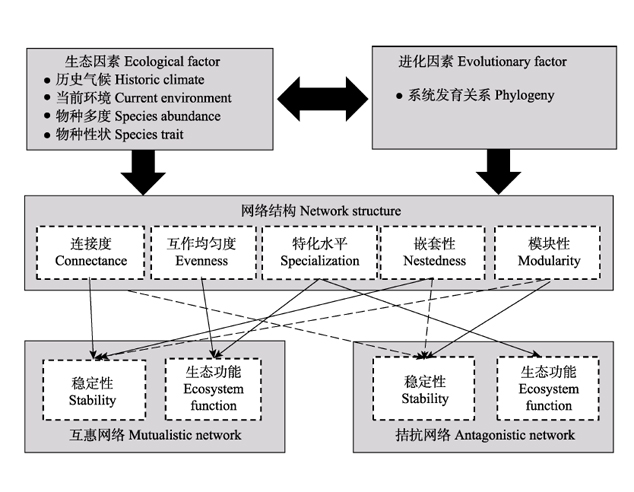
生态群落中不同物种间发生多样化的相互作用, 形成了复杂的种间互作网络。复杂生态网络的结构如何影响群落的生态系统功能及稳定性是群落生态学的核心问题之一。种间互作直接影响到物质和能量在生态系统不同组分之间的流动和循环以及群落构建过程, 使得网络结构与生态系统功能和群落稳定性密切相关。在群落及生态系统水平上开展种间互作网络研究将为群落的构建机制、生物多样性维持、生态系统稳定性、物种协同进化和性状分化等领域提供新的视野。当前生物多样性及生态系统功能受到全球变化的极大影响, 研究种间互作网络的拓扑结构、构建机制、稳定性和生态功能也可为生物多样性的保护和管理提供依据。该文从网络结构、构建机制、网络结构和稳定性关系、种间互作对生态系统功能的影响等4个方面综述当前种间网络研究进展, 并提出在今后的研究中利用机器学习和多层网络等来探究环境变化对种间互作网络结构和功能的影响, 并实现理论和实证研究的有效整合。
李海东, 吴新卫, 肖治术 . 种间互作网络的结构、生态系统功能及稳定性机制研究[J]. 植物生态学报, 2021 , 45(10) : 1049 -1063 . DOI: 10.17521/cjpe.2019.0159
Varied species interactions form complex species interaction networks in diverse ecological communities. Understanding how the network structure affects ecosystem functions and community stability is one major issue for community ecology. Species interactions can directly affect the flow and circulation of matter and energy among different components of ecosystems. As a result, the network structure is closely related to the structure, stability, and functioning of ecological communities. Prior studies on interaction networks have shed light on community assembly, biodiversity maintenance, ecosystem stability, coevolution and trait diversification. Currently, biodiversity and ecosystem functions have been largely affected by global environmental changes. The interaction networks and their relationship with biodiversity loss in a changing world have become important research topics. Exploring the structure and assembly of species interaction networks, stability, and ecosystem functions is significant for understanding the maintenance mechanism and biodiversity conservation. Here, we reviewed the research advances in the structure of ecological networks and their determinants, network stability, the relationship between network and ecosystem functions, and the mechanisms underlying these relationships. We also suggest future research directions on how to apply machine learning and multilayer network to disentangle the effects of environmental change on network structure and ecosystem functions by integrated theoretical and empirical studies.
Key words: species interaction; food web; bipartite network; ecosystem function; stability
| [1] | Abrams PA (1992). Predators that benefit prey and prey that harm predators: unusual effects of interacting foraging adaptation. The American Naturalist, 140, 573-600. |
| [2] | Aizen MA, Sabatino M, Tylianakis JM (2012). Specialization and rarity predict nonrandom loss of interactions from mutualist networks. Science, 335, 1486-1489. |
| [3] | Albrecht J, Classen A, Vollstädt MGR, Mayr A, Mollel NP, Schellenberger Costa D, Dulle HI, Fischer M, Hemp A, Howell KM, Kleyer M, Nauss T, Peters MK, Tschapka M, Steffan-Dewenter I, Böhning-Gaese K, Schleuning M (2018). Plant and animal functional diversity drive mutualistic network assembly across an elevational gradient. Nature Communications, 9, 3177. DOI: 10.1038/s41467-018-05610-w. |
| [4] | Allesina S, Tang S (2012). Stability criteria for complex ecosystems. Nature, 483, 205-208. |
| [5] | Arditi R, Michalski J, Hirzel AH (2005). Rheagogies: modelling non-trophic effects in food webs. Ecological Complexity, 2, 249-258. |
| [6] | Bascompte J, Jordano P (2007). Plant-animal mutualistic networks: the architecture of biodiversity. Annual Review of Ecology, Evolution, and Systematics, 38, 567-593. |
| [7] | Bascompte J, Jordano P (2013). Mutualistic Networks. Princeton University Press, Princeton, USA. |
| [8] | Bascompte J, Jordano P, Melián CJ, Olesen JM (2003). The nested assembly of plant-animal mutualistic networks. Proceedings of the National Academy of Sciences of the United States of America, 100, 9383-9387. |
| [9] | Bastolla U, Fortuna MA, Pascual-García A, Ferrera A, Luque B, Bascompte J (2009). The architecture of mutualistic networks minimizes competition and increases biodiversity. Nature, 458, 1018-1020. |
| [10] | Bergamini LL, Lewinsohn TM, Jorge LR, Almeida-Neto M (2017). Manifold influences of phylogenetic structure on a plant-herbivore network. Oikos, 126, 703-712. |
| [11] | Blüthgen N, Fründ J, Vázquez DP, Menzel F (2008). What do interaction network metrics tell us about specialization and biological traits. Ecology, 89, 3387-3399. |
| [12] | Boccaletti S, Bianconi G, Criado R del Genio CI, Gómez- Gardeñes J, Romance M, Sendiña-Nadal I, Wang Z, Zanin M (2014). The structure and dynamics of multilayer networks. Physics Reports, 544, 1-122. |
| [13] | Burkle LA, Marlin JC, Knight TM (2013). Plant-pollinator interactions over 120 years: loss of species, co-occurrence, and function. Science, 339, 1611-1615. |
| [14] | Chase JM (2000). Are there real differences among aquatic and terrestrial food webs? Trends in Ecology & Evolution, 15, 408-412. |
| [15] | Coverdale TC, Kartzinel TR, Grabowski KL, Shriver RK, Hassan AA, Goheen JR, Palmer TM, Pringle RM (2016). Elephants in the understory: opposing direct and indirect effects of consumption and ecosystem engineering by megaherbivores. Ecology, 97, 3219-3230. |
| [16] | Cutler DR, Edwards Jr TC, Beard KH, Cutler A, Hess KT, Gibson J, Lawler JJ (2007). Random Forests for classification in ecology. Ecology, 88, 2783-2792. |
| [17] | Dalsgaard B, Trøjelsgaard K, Martín González AM, Nogués- Bravo D, Ollerton J, Petanidou T, Sandel B, Schleuning M, Wang Z, Rahbek C, Sutherland WJ, Svenning JC, Olesen JM (2013). Historical climate-change influences modularity and nestedness of pollination networks. Ecography, 36, 1331-1340. |
| [18] | Dehling DM (2018). The structure of ecological networks// Dáttilo W, Rico-Gray V. Ecological Networks in the Tropics. Springer, Cham, Switzerland. 29-42. |
| [19] | Derocles SAP, Bohan DA, Dumbrell AJ, Kitson JJN, Massol F, Pauvert C, Plantegenest M, Vacher C, Evans DM (2018). Biomonitoring for the 21st Century: integrating next- generation sequencing into ecological network analysis. Advances in Ecological Research, 58, 1-62. |
| [20] | Dirzo R, Young HS, Galetti M, Ceballos G, Isaac NJB, Collen B (2014). Defaunation in the Anthropocene. Science, 345, 401-406. |
| [21] | Donatti CI, Guimarães PR, Galetti M, Pizo MA, Marquitti FMD, Dirzo R (2011). Analysis of a hyper-diverse seed dispersal network: modularity and underlying mechanisms. Ecology Letters, 14, 773-781. |
| [22] | Dormann CF, Fründ J, Schaefer HM (2017). Identifying causes of patterns in ecological networks: opportunities and limitations. Annual Review of Ecology, Evolution, and Systematics, 48, 559-584. |
| [23] | Dormann CF, Gruber B, Fründ J (2008). Introducing the bipartite package: analysing ecological networks. R News, 8, 8-11. |
| [24] | Dupont YL, Olesen JM (2009). Ecological modules and roles of species in heathland plant-insect flower visitor networks. Journal of Animal Ecology, 78, 346-353. |
| [25] | Dyer LA, Walla TR, Greeney HF, Stireman III JO, Hazen RF (2010). Diversity of interactions: a metric for studies of biodiversity. Biotropica, 42, 281-289. |
| [26] | Eisenhauer N (2010). The action of an animal ecosystem engineer: identification of the main mechanisms of earthworm impacts on soil microarthropods. Pedobiologia, 53, 343-352. |
| [27] | Eklöf A, Jacob U, Kopp J, Bosch J, Castro-Urgal R, Chacoff NP, Dalsgaard B de Sassi C, Galetti M, Guimarães PR, Lomáscolo SB, Martín González AM, Pizo MA, Rader R, Rodrigo A, et al. (2013). The dimensionality of ecological networks. Ecology Letters, 16, 577-583. |
| [28] | Elton CS (1958). The Ecology of Invasions by Animals and Plants. Springer, Boston, USA. |
| [29] | Fang Q, Huang SQ (2012). Relative stability of core groups in pollination networks in a biodiversity hotspot over four years. PLOS ONE, 7, e32663. DOI: 10.1371/journal.pone.0032663. |
| [30] | Farwig N, Berens DG (2012). Imagine a world without seed dispersers: a review of threats, consequences and future directions. Basic and Applied Ecology, 13, 109-115. |
| [31] | Fontaine C (2013). Abundant equals nested. Nature, 500, 411-412. |
| [32] | Fornoff F, Klein AM, Blüthgen N, Staab M (2019). Tree diversity increases robustness of multi-trophic interactions. Proceedings of the Royal Society of London B: Biological Sciences, 286, 20182399. DOI: 10.1098/rspb.2018.2399. |
| [33] | Fort H, Vázquez DP, Lan BL (2016). Abundance and generalisation in mutualistic networks: solving the chicken-and- egg dilemma. Ecology Letters, 19, 4-11. |
| [34] | Fründ J, Dormann CF, Holzschuh A, Tscharntke T (2013). Bee diversity effects on pollination depend on functional complementarity and niche shifts. Ecology, 94, 2042-2054. |
| [35] | Fründ J, McCann KS, Williams NM (2016). Sampling bias is a challenge for quantifying specialization and network structure: lessons from a quantitative niche model. Oikos, 125, 502-513. |
| [36] | García D, Donoso I, Rodríguez-Pérez J (2018). Frugivore biodiversity and complementarity in interaction networks enhance landscape-scale seed dispersal function. Functional Ecology, 32, 2742-2752. |
| [37] | Goudard A, Loreau M (2008). Nontrophic interactions, biodiversity, and ecosystem functioning: an interaction web model. The American Naturalist, 171, 91-106. |
| [38] | Gracia-Lázaro C, Hernández L, Borge-Holthoefer J, Moreno Y (2018). The joint influence of competition and mutualism on the biodiversity of mutualistic ecosystems. Scientific Reports, 8, 9253. DOI: 10.1038/s41598-018-27498-8. |
| [39] | Grass I, Jauker B, Steffan-Dewenter I, Tscharntke T, Jauker F (2018). Past and potential future effects of habitat fragmentation on structure and stability of plant-pollinator and host-parasitoid networks. Nature Ecology & Evolution, 2, 1408. DOI: 10.1038/s41559-018-0631-2. |
| [40] | Gravel D, Poisot T, Albouy C, Velez L, Mouillot D (2013). Inferring food web structure from predator-prey body size relationships. Methods in Ecology and Evolution, 4, 1083-1090. |
| [41] | Gray C, Figueroa DH, Hudson LN, Ma A, Perkins D, Woodward G (2015). Joining the dots: an automated method for constructing food webs from compendia of published interactions. Food Webs, 5, 11-20. |
| [42] | Guimarães Jr PR, Pires MM, Jordano P, Bascompte J, Thompson JN (2017). Indirect effects drive coevolution in mutualistic networks. Nature, 550, 511-514. |
| [43] | Guo YL, Meng QF, Gao WT (2012). Visulization and pattern analysis of plant-insect pollinator interaction networks in subalpine meadow in Changbai Mountain. Scientia Silvae Sinicae, 48(12), 141-147. |
| [43] | [ 郭彦林, 孟庆繁, 高文韬 (2012). 长白山高山草甸植物-传粉昆虫相互作用网络可视化及格局分析. 林业科学, 48(12), 141-147.] |
| [44] | Hackett TD, Sauve AMC, Davies N, Montoya D, Tylianakis JM, Memmott J (2019). Reshaping our understanding of species’ roles in landscape-scale networks. Ecology Letters, 22, 1367-1377. |
| [45] | Hairston NG, Smith FE, Slobodkin LB (1960). Community structure, population control, and competition. The American Naturalist, 94, 421-425. |
| [46] | Hooper DU, Chapin III FS, Ewel JJ, Hector A, Inchausti P, Lavorel S, Lawton JH, Lodge DM, Loreau M, Naeem S, Schmid B, Setälä H, Symstad AJ, Vandermeer J, Wardle DA (2005). Effects of biodiversity on ecosystem functioning: a consensus of current knowledge. Ecological Monographs, 75, 3-35. |
| [47] | Hutchinson MC, Bramon Mora B, Pilosof S, Barner AK, Kéfi S, Thébault E, Jordano P, Stouffer DB (2018). Seeing the forest for the trees: putting multilayer networks to work for community ecology. Functional Ecology, 33, 206-217. |
| [48] | Ives AR, Carpenter SR (2007). Stability and diversity of ecosystems. Science, 317, 58-62. |
| [49] | Jordano P (2016). Sampling networks of ecological interactions. Functional Ecology, 30, 1883-1893. |
| [50] | Jordano P, Bascompte J, Olesen JM (2003). Invariant properties in coevolutionary networks of plant-animal interactions. Ecology Letters, 6, 69-81. |
| [51] | Kaiser-Bunbury CN, Muff S, Memmott J, Müller CB, Caflisch A (2010). The robustness of pollination networks to the loss of species and interactions: a quantitative approach incorporating pollinator behaviour. Ecology Letters, 13, 442-452. |
| [52] | Kéfi S, Berlow EL, Wieters EA, Navarrete SA, Petchey OL, Wood SA, Boit A, Joppa LN, Lafferty KD, Williams RJ, Martinez ND, Menge BA, Blanchette CA, Iles AC, Brose U (2012). More than a meal… integrating non-feeding interactions into food webs. Ecology Letters, 15, 291-300. |
| [53] | Kondoh M (2003). Foraging adaptation and the relationship between food-web complexity and stability. Science, 299, 1388-1391. |
| [54] | Kondoh M, Kato S, Sakato Y (2010). Food webs are built up with nested subwebs. Ecology, 91, 3123-3130. |
| [55] | Liao JB, Bearup D, Blasius B (2017). Diverse responses of species to landscape fragmentation in a simple food chain. Journal of Animal Ecology, 86, 1169-1178. |
| [56] | Liao JB, Chen JH, Ying ZX, Hiebeler DE, Nijs I (2016). An extended patch-dynamic framework for food chains in fragmented landscapes. Scientific Reports, 6, 33100. DOI: 10.1038/srep33100. |
| [57] | MacArthur R (1955). Fluctuations of animal populations and a measure of community stability. Ecology, 36, 533-536. |
| [58] | Maglianesi MA, Blüthgen N, Böhning-Gaese K, Schleuning M (2014). Morphological traits determine specialization and resource use in plant-hummingbird networks in the neotropics. Ecology, 95, 3325-3334. |
| [59] | Majdi N, Boiché A, Traunspurger W, Lecerf A (2014). Predator effects on a detritus-based food web are primarily mediated by non-trophic interactions. Journal of Animal Ecology, 83, 953-962. |
| [60] | Maunsell SC, Kitching RL, Burwell CJ, Morris RJ (2015). Changes in host-parasitoid food web structure with elevation. Journal of Animal Ecology, 84, 353-363. |
| [61] | May RM (1972). Will a large complex system be stable? Nature, 238, 413-414. |
| [62] | May RM (1973). Stability and Complexity in Model Ecosystems. Monographs in Population Biology, No. 6. Princeton University Press, Princeton, USA. |
| [63] | McCann KS (2000). The diversity-stability debate. Nature, 405, 228-233. |
| [64] | McCann KS, Hastings A, Huxel GR (1998). Weak trophic interactions and the balance of nature. Nature, 395, 794-798. |
| [65] | Mello MAR, Marquitti FMD, Guimarães PR, Kalko EKV, Jordano P, de Aguiar MAM (2011). The missing part of seed dispersal networks: Structure and robustness of bat-fruit interactions. PLOS ONE, 6, e17395. DOI: 10.1371/journal. pone.0017395. |
| [66] | Memmott J, Waser NM, Price MV (2004). Tolerance of pollination networks to species extinctions. Proceedings of the Royal Society of London Series B: Biological Sciences, 271, 2605-2611. |
| [67] | Morante-Filho JC, Arroyo-Rodríguez V, Lohbeck M, Tscharntke T, Faria D (2016). Tropical forest loss and its multitrophic effects on insect herbivory. Ecology, 97, 3315-3325. |
| [68] | Morris RJ (2010). Anthropogenic impacts on tropical forest biodiversity: a network structure and ecosystem functioning perspective. Philosophical Transactions of the Royal Society B: Biological Sciences, 365, 3709-3718. |
| [69] | Neutel AM, Heesterbeek JAP, de Ruiter PC (2002). Stability in real food webs: weak links in long loops. Science, 296, 1120-1123. |
| [70] | Odum EP (1953). Fundamental of Ecology. Saunders College Publishing, Philadelphia. |
| [71] | Oksanen L, Fretwell SD, Arruda J, Niemela P (1981). Exploitation ecosystems in gradients of primary productivity. The American Naturalist, 118, 240-261. |
| [72] | Okuyama T, Holland JN (2008). Network structural properties mediate the stability of mutualistic communities. Ecology Letters, 11, 208-216. |
| [73] | Olesen JM, Bascompte J, Dupont YL, Elberling H, Rasmussen C, Jordano P (2011). Missing and forbidden links in mutualistic networks. Proceedings of the Royal Society B: Biological Sciences, 278, 725-732. |
| [74] | Olesen JM, Bascompte J, Dupont YL, Jordano P (2007). The modularity of pollination networks. Proceedings of the National Academy of Sciences of the United States of America, 104, 19891-19896. |
| [75] | Paine RT (1966). Food web complexity and species diversity. The American Naturalist, 100, 65-75. |
| [76] | Pearse IS, Altermatt F (2013). Predicting novel trophic interactions in a non-native world. Ecology Letters, 16, 1088-1094. |
| [77] | Peralta G (2016). Merging evolutionary history into species interaction networks. Functional Ecology, 30, 1917-1925. |
| [78] | Peters MK, Hemp A, Appelhans T, Becker JN, Behler C, Classen A, Detsch F, Ensslin A, Ferger SW, Frederiksen SB, Gebert F, Gerschlauer F, Gütlein A, Helbig-Bonitz M, Hemp C, et al. (2019). Climate-land-use interactions shape tropical mountain biodiversity and ecosystem functions. Nature, 568, 88-92. |
| [79] | Pilosof S, Morand S, Krasnov BR, Nunn CL (2015). Potential parasite transmission in multi-host networks based on parasite sharing. PLOS ONE, 10, e0117909. DOI: 10.1371/journal.pone.0117909. |
| [80] | Pilosof S, Porter MA, Pascual M, Kéfi S (2017). The multilayer nature of ecological networks. Nature Ecology & Evolution, 1, 101. DOI: 10.1038/s41559-017-0101. |
| [81] | Pimm SL, Pimm JW (1982). Resource use, competition, and resource availability in Hawaiian honeycreepers. Ecology, 63, 1468-1480. |
| [82] | Pocock MJO, Evans DM, Memmott J (2012). The robustness and restoration of a network of ecological networks. Science, 335, 973-977. |
| [83] | Pomeranz JPF, Thompson RM, Poisot T, Harding JS (2019). Inferring predator-prey interactions in food webs. Methods in Ecology and Evolution, 10, 356-367. |
| [84] | Poulin R, Krasnov BR, Pilosof S, Thieltges DW (2013). Phylogeny determines the role of helminth parasites in intertidal food webs. Journal of Animal Ecology, 82, 1265-1275. |
| [85] | Rezende EL, Albert EM, Fortuna MA, Bascompte J (2009). Compartments in a marine food web associated with phylogeny, body mass, and habitat structure. Ecology Letters, 12, 779-788. |
| [86] | Rezende EL, Jordano P, Bascompte J (2007). Effects of phenotypic complementarity and phylogeny on the nested structure of mutualistic networks. Oikos, 116, 1919-1929. |
| [87] | Saavedra S, Reed-Tsochas F, Uzzi B (2008). Asymmetric disassembly and robustness in declining networks. Proceedings of the National Academy of Sciences of the United States of America, 105, 16466-16471. |
| [88] | Sanders D, Jones CG, Thébault E, Bouma TJ, van der Heide T, van Belzen J, Barot S (2014). Integrating ecosystem engineering and food webs. Oikos, 123, 513-524. |
| [89] | Sanitjan S, Chen J (2009). Habitat and fig characteristics influence the bird assemblage and network properties of fig trees from Xishuangbanna, South-West China. Journal of Tropical Ecology, 25, 161-170. |
| [90] | Sazatornil FD, Moré M, Benitez-Vieyra S, Cocucci AA, Kitching IJ, Schlumpberger BO, Oliveira PE, Sazima M, Amorim FW (2016). Beyond neutral and forbidden links: morphological matches and the assembly of mutualistic hawkmoth-plant networks. Journal of Animal Ecology, 85, 1586-1594. |
| [91] | Schleuning M, Blüthgen N, Flörchinger M, Braun J, Schaefer HM, Böhning-Gaese K (2011). Specialization and interaction strength in a tropical plant-frugivore network differ among forest strata. Ecology, 92, 26-36. |
| [92] | Schleuning M, Fründ J, García D (2015). Predicting ecosystem functions from biodiversity and mutualistic networks: an extension of trait-based concepts to plant-animal interactions. Ecography, 38, 380-392. |
| [93] | Schleuning M, Ingmann L, Strauß R, Fritz SA, Dalsgaard B, Matthias Dehling D, Plein M, Saavedra F, Sandel B, Svenning JC, Böhning-Gaese K, Dormann CF (2014). Ecological, historical and evolutionary determinants of modularity in weighted seed-dispersal networks. Ecology Letters, 17, 454-463. |
| [94] | Schuldt A, Fornoff F, Bruelheide H, Klein AM, Staab M (2017). Tree species richness attenuates the positive relationship between mutualistic ant-hemipteran interactions and leaf chewer herbivory. Proceedings of the Royal Society of London B: Biological Sciences, 284, 20171489. DOI: 10.1098/rspb.2017.1489. |
| [95] | Staab M, Blüthgen N, Klein AM (2015). Tree diversity alters the structure of a tri-trophic network in a biodiversity experiment. Oikos, 124, 827-834. |
| [96] | Staab M, Bruelheide H, Durka W, Michalski S, Purschke O, Zhu CD, Klein AM (2016). Tree phylogenetic diversity promotes host-parasitoid interactions. Proceedings of the Royal Society of London B: Biological Sciences, 283, 20160275. DOI: 10.1098/rspb.2016.0275. |
| [97] | Stang M, Klinkhamer PGL, Waser NM, Stang I, van der Meijden E (2009). Size-specific interaction patterns and size matching in a plant-pollinator interaction web. Annuals of Botany, 103, 1459-1469. |
| [98] | Staniczenko PPA, Lewis OT, Jones NS, Reed-Tsochas F (2010). Structural dynamics and robustness of food webs. Ecology Letters, 13, 891-899. |
| [99] | Stouffer DB, Bascompte J (2011). Compartmentalization increases food-web persistence. Proceedings of the National Academy of Sciences of the United States of America, 108, 3648-3652. |
| [100] | Thébault E, Fontaine C (2010). Stability of ecological communities and the architecture of mutualistic and trophic networks. Science, 329, 853-856. |
| [101] | Thompson JN (2005). The Geographic Mosaic of Coevolution. University of Chicago Press, Chicago, USA. |
| [102] | Thompson RM, Brose U, Dunne JA, Hall Jr RO, Hladyz S, Kitching RL, Martinez ND, Rantala H, Romanuk TN, Stouffer DB, Tylianakis JM (2012). Food webs: reconciling the structure and function of biodiversity. Trends in Ecology & Evolution, 27, 689-697. |
| [103] | Tilman D, Isbell F, Cowles JM (2014). Biodiversity and ecosystem functioning. Annual Review of Ecology, Evolution, and Systematics, 45, 471-493. |
| [104] | Tilman D, Reich PB, Knops J, Wedin D, Mielke T, Lehman C.(2001). Diversity and productivity in a long-term grassland experiment. Science, 294, 843-845. |
| [105] | Timóteo S, Correia M, Rodríguez-Echeverría S, Freitas H, Heleno R (2018). Multilayer networks reveal the spatial structure of seed-dispersal interactions across the Great Rift landscapes. Nature Communications, 9, 140. DOI: 10.1038/s41467-017-02658-y. |
| [106] | Tylianakis JM, Laliberté E, Nielsen A, Bascompte J (2010). Conservation of species interaction networks. Biological Conservation, 143, 2270-2279. |
| [107] | Tylianakis JM, Morris RJ (2017). Ecological networks across environmental gradients. Annual Review of Ecology, Evolution, and Systematics, 48, 25-48. |
| [108] | Valdovinos FS, Brosi BJ, Briggs HM, Moisset de Espanés P, Ramos-Jiliberto R, Martinez ND (2016). Niche partitioning due to adaptive foraging reverses effects of nestedness and connectance on pollination network stability. Ecology Letters, 19, 1277-1286. |
| [109] | Vázquez DP, Blüthgen N, Cagnolo L, Chacoff NP (2009a). Uniting pattern and process in plant-animal mutualistic networks: a review. Annals of Botany, 103, 1445-1457. |
| [110] | Vázquez DP, Chacoff NP, Cagnolo L (2009b). Evaluating multiple determinants of the structure of plant-animal mutualistic networks. Ecology, 90, 2039-2046. |
| [111] | Vizentin-Bugoni J, Maruyama PK, Sazima M (2014). Processes entangling interactions in communities: forbidden links are more important than abundance in a hummingbird-plant network. Proceedings of the Royal Society of London B: Biological Sciences, 281, 20132397. DOI: 10.1098/rspb. 2013.2397. |
| [112] | Volf M, Pyszko P, Abe T, Libra M, Kotásková N, Šigut M, Kumar R, Kaman O, Butterill PT, Šipoš J, Abe H, Fukushima H, Drozd P, Kamata N, Murakami M, Novotny V (2017). Phylogenetic composition of host plant communities drives plant-herbivore food web structure. Journal of Animal Ecology, 86, 556-565. |
| [113] | Wang SP, Brose U (2018). Biodiversity and ecosystem functioning in food webs: the vertical diversity hypothesis. Ecology Letters, 21, 9-20. |
| [114] | Wang X, Zhang FL, Zhang J (2017). Biodiversity information resources. I. Species distribution, catalogue, phylogeny, and life history traits. Biodiversity Science, 25, 1223-1238. |
| [114] | [ 王昕, 张凤麟, 张健 (2017). 生物多样性信息资源. I. 物种分布、编目、系统发育与生活史性状. 生物多样性, 25, 1223-1238.] |
| [115] | Werner EE, Peacor SD (2003). A review of trait-mediated indirect interactions in ecological communities. Ecology, 84, 1083-1100. |
| [116] | Wu XW, Duffy JE, Reich PB, Sun SC (2011). A brown-world cascade in the dung decomposer food web of an alpine meadow: effects of predator interactions and warming. Ecological Monographs, 81, 313-328. |
| [117] | Yang XF, Yan C, Zhao QJ, Holyoak M, Fortuna MA, Bascompte J, Jansen PA, Zhang ZB (2018). Ecological succession drives the structural change of seed-rodent interaction networks in fragmented forests. Forest Ecology and Management, 419- 420, 42-50. |
| [118] | Zhang J (2017). Biodiversity science and macroecology in the era of big data. Biodiversity Science, 25, 355-363. |
| [118] | [ 张健 (2017). 大数据时代的生物多样性科学与宏生态学. 生物多样性, 25, 355-363.] |
| [119] | Zhang MH, He FL (2017). Plant sex affects the structure of plant-pollinator networks in a subtropical forest. Oecologia, 185, 269-279. |
| [120] | Zhao C, Griffin JN, Wu XW, Sun SC (2013). Predatory beetles facilitate plant growth by driving earthworms to lower-soil layers. Journal of Animal Ecology, 82, 749-758. |
| [121] | Zhao YH, Lázaro A, Ren ZX, Zhou W, Li HD, Tao ZB, Xu K, Wu ZK, Wolfe LM, Li DZ, Wang H (2019). The topological differences between visitation and pollen transport networks: a comparison in species rich communities of the Himalaya-Hengduan Mountains. Oikos, 128, 551-562. |
| [122] | Zhao YH, Ren ZX, Lázaro A, Wang H, Bernhardt P, Li HD, Li DZ (2016). Floral traits influence pollen vectors’ choices in higher elevation communities in the Himalaya-Hengduan Mountains. BMC Ecology, 16, 26. DOI: 10.1186/s12898-016-0080-1. |
/
| 〈 |
|
〉 |
Copyright © 2026 版权所有 《植物生态学报》编辑部
地址: 北京香山南辛村20号, 邮编: 100093
Tel.: 010-62836134, 62836138; Fax: 010-82599431; E-mail: apes@ibcas.ac.cn, cjpe@ibcas.ac.cn
备案号: 京ICP备16067583号-19

