
树冠结构对典型阔叶红松林生产力的影响
收稿日期: 2020-05-29
录用日期: 2020-08-28
网络出版日期: 2020-12-09
基金资助
国家自然科学基金(31901299)
Effects of canopy structure on productivity in a typical mixed broadleaved-Korean pine forest
Received date: 2020-05-29
Accepted date: 2020-08-28
Online published: 2020-12-09
Supported by
National Natural Science Foundation of China(31901299)
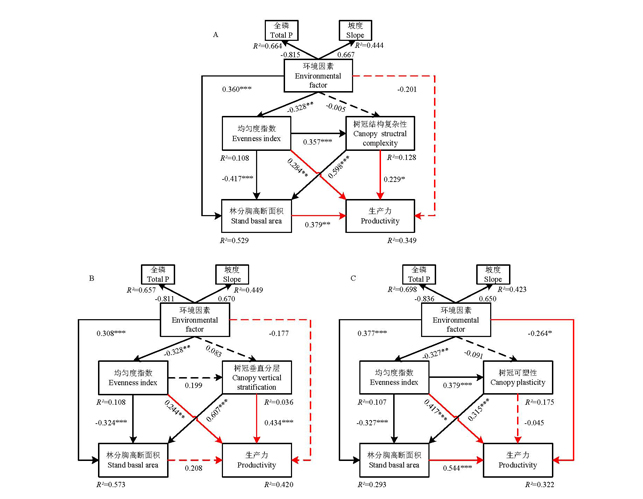
阔叶红松(Pinus koraiensis)林是东北东部山区的地带性森林植被, 阐明其生产力的影响因素, 对于理解温带森林生产力维持机制具有重要意义。该研究依托小兴安岭典型阔叶红松林9 hm2动态监测样地, 基于2005和2015年的30 m × 30 m样方内所有胸径>6.5 cm的木本植物的调查数据, 计算各样方的树冠结构复杂性、物种多样性和林分胸高断面积, 结合各样方的地形和土壤理化性质数据, 拟合结构方程模型, 定量分析影响典型阔叶红松林生产力的直接和间接因素。研究结果显示: 树冠结构复杂性和物种多样性与生产力显著正相关, 且树冠结构复杂性对生产力的影响显著高于物种多样性; 树冠结构复杂性对生产力的作用分为树冠垂直分层和树冠可塑性, 其中树冠垂直分层是树冠结构复杂性影响阔叶红松林生产力的主要因素, 而树冠可塑性无显著影响; 林分胸高断面积与生产力显著正相关, 其解释权重仅次于树冠结构复杂性, 树冠结构复杂性与物种多样性均通过影响林分胸高断面积对阔叶红松林生产力产生间接影响; 考虑不同树冠结构复杂性时, 坡度和土壤全磷含量代表的环境因素在调节生产力上发挥的作用存在差异, 移除树冠垂直分层的作用后两者与生产力呈显著的负相关关系。综上可知, 在典型阔叶红松林中, 树冠结构复杂性比物种多样性更有效地解释了生产力的变化, 同时不可忽视其他生物和非生物因素对生产力的作用。
哈努拉•塔斯肯, 蔡慧颖, 金光泽 . 树冠结构对典型阔叶红松林生产力的影响[J]. 植物生态学报, 2021 , 45(1) : 38 -50 . DOI: 10.17521/cjpe.2020.0176
Aims The mixed broadleaved-Korean pine (Pinus koraiensis) forest is a zonal vegetation type in Northeast China. Clarifying the influencing factors of productivity is of great significance for understanding the maintenance mechanism of productivity in temperate forests.
Methods The study was conducted based on survey data of a 9 hm2 permanent plot in a typical mixed broadleaved- Korean pine forest in the Xiaoxing’an Mountains. Census data of 2005 and 2015 for all individuals with diameter at breast height >6.5 cm within each 30 m × 30 m sub-plot were used to calculate canopy structural complexity, species diversity and stand basal area. We analyzed the direct and indirect factors affecting forest productivity using structural equation model and data on topography and soil physicochemical properties in each sub-plot.
Important findings Both the canopy structural complexity and the species diversity were positively related to productivity, with canopy structural complexity having a significantly greater effect than species diversity. The effects of canopy structural complexity on productivity consisted of two attributes: the vertical stratification and the plasticity. The vertical stratification played a significant role in driving the changes in forest productivity, while plasticity had no significant effect. The stand basal area was positively related to productivity, but with less effect than the canopy structural complexity. Both the canopy structural complexity and the species diversity had indirect effects on productivity via stand basal area. However, the environmental factor representative of slope and soil total phosphorus played differential roles on productivity for varying canopy structral complexity, and it was significantly and negatively correlated with productivity after removing the effects of canopy vertical stratification. In short, in a typical mixed broadleaved-Korean pine forest, the canopy structural complexity is more crucial for explaining the diversity-productivity relationship than species diversity, and the roles of other biotic and abiotic factors in productivity should not be ignored.
| [1] | Ali A, Lin SL, He JK, Kong FM, Yu JH, Jiang HS (2019). Tree crown complementarity links positive functional diversity and aboveground biomass along large-scale ecological gradients in tropical forests. Science of the Total Environment, 656,45-54. |
| [2] | Ali A, Yan ER, Chen HYH, Chang SX, Zhao YT, Yang XD, Xu MS (2016). Stand structural diversity rather than species diversity enhances aboveground carbon storage in secondary subtropical forests in Eastern China. Biogeosciences, 13,4627-4635. |
| [3] | Bartoń K (2016). Multi-model inference. Sociological Methods and Research, 33,261-304. |
| [4] | Bayer D, Seifert S, Pretzsch H (2013). Structural crown properties of Norway spruce (Picea abies L. Karst.) and European beech (Fagus sylvatica L.) in mixed versus pure stands revealed by terrestrial laser scanning. Trees, 27, 1035- 1047. |
| [5] | Bohn FJ, Huth A (2017). The importance of forest structure to biodiversity-productivity relationships. Royal Society Open Science, 4,160521. DOI: 10.1098/rsos.160521. |
| [6] | Chave J, Condit R, Lao S, Caspersen JP, Foster RB, Hubbell SP (2003). Spatial and temporal variation of biomass in a tropical forest: results from a large census plot in Panama. Journal of Ecology, 91,240-252. |
| [7] | Chen CG, Zhu JF (1989). A Handbook for Main Tree Species Biomass in Northeast China. China Forestry Press, Beijing. |
| [7] | [ 陈传国, 朱俊凤 (1989). 东北主要林木生物量手册. 中国林业出版社, 北京.] |
| [8] | D?nescu A, Albrecht AT, Bauhus J (2016). Structural diversity promotes productivity of mixed, uneven-aged forests in southwestern Germany. Oecologia, 182,319-333. |
| [9] | Fahey RT, Fotis AT, Woods KD (2015). Quantifying canopy complexity and effects on productivity and resilience in late-successional hemlock-hardwood forests. Ecological Applications, 25,834-847. |
| [10] | Forrester DI (2014). The spatial and temporal dynamics of species interactions in mixed-species forests: from pattern to process. Forest Ecology and Management, 312,282-292. |
| [11] | Fotis AT, Morin TH, Fahey RT, Hardiman BS, Bohrer G, Curtis PS (2018). Forest structure in space and time: biotic and abiotic determinants of canopy complexity and their effects on net primary productivity. Agricultural and Forest Meteorology, 250-251,181-191. |
| [12] | Grace JB, Anderson TM, Seabloom EW, Borer ET, Adler PB, Harpole WS, Hautier Y, Hillebrand H, Lind EM, P?rtel M, Bakker JD, Buckley YM, Crawley MJ, Damschen EI, Davies KF, et al. (2016). Integrative modelling reveals mechanisms linking productivity and plant species richness. Nature, 529,390-393. |
| [13] | Guo YL, Wang B, Xiang WS, Ding T, Lu SH, Huang FZ, Wen SJ, Li DX, He YL, Li XK (2016). Responses of spatial pattern of woody plants’ basal area to topographic factors in a tropical karst seasonal rainforest in Nonggang, Guangxi, southern China. Biodiversity Science, 24,30-39. |
| [13] | [ 郭屹立, 王斌, 向悟生, 丁涛, 陆树华, 黄甫昭, 文淑均, 李冬兴, 何运林, 李先琨 (2016). 喀斯特季节性雨林木本植物胸高断面积分布格局及其对地形因子的响应. 生物多样性, 24,30-39.] |
| [14] | Hardiman BS, Gough CM, Halperin A, Hofmeister KL, Nave LE, Bohrer G, Curtis PS (2013). Maintaining high rates of carbon storage in old forests: a mechanism linking canopy structure to forest function. Forest Ecology and Management, 298,111-119. |
| [15] | Hillebrand H, Bennett DM, Cadotte MW (2008). Consequences of dominance: a review of evenness effects on local and regional ecosystem processes. Ecology, 89,1510-1520. |
| [16] | Howard AL (2013). Handbook of structural equation modeling. Structural Equation Modeling: a Multidisciplinary Journal, 20,354-360. |
| [17] | Jucker T, Bouriaud O, Coomes DA (2015). Crown plasticity enables trees to optimize canopy packing in mixed-species forests. Functional Ecology, 29,1078-1086. |
| [18] | Klute A (1986). Methods of Soil Analysis: Part 1—Physical and Mineralogical Methods. 2nd ed. American Society of Agronomy, Soil Science Society of America, Madison, USA. |
| [19] | Legendre P, Mi XC, Ren HB, Ma KP, Yu MJ, Sun IF, He FL (2009). Partitioning beta diversity in a subtropical broad- leaved forest of China. Ecology, 90,663-674. |
| [20] | Liang J, Crowther TW, Picard N, Wiser S, Zhou M, Alberti G, Schulze E-D, David McGuire A, Bozzato F, Pretzsch H, de Miguel S, Paquette A, Hérault B, Scherer-Lorenzen M, Barrett CB, et al. (2016). Positive biodiversity-productivity relationship predominant in global forests. Science, 354,aaf8957. DOI: 10.1126/science.aaf8957. |
| [21] | Lin F, Comita LS, Wang XG, Bai XJ, Yuan ZQ, Xing DL, Hao ZQ (2014). The contribution of understory light availability and biotic neighborhood to seedling survival in secondary versus old-growth temperate forest. Plant Ecology, 215,795-807. |
| [22] | Muth CC, Bazzaz FA (2003). Tree canopy displacement and neighborhood interactions. Canadian Journal of Forest Research, 33,1323-1330. |
| [23] | Pretzsch H (2014). Canopy space filling and tree crown morphology in mixed-species stands compared with monocultures. Forest Ecology and Management, 327,251-264. |
| [24] | Purves DW, Lichstein JW, Pacala SW (2007). Crown plasticity and competition for canopy space: a new spatially implicit model parameterized for 250 North American tree species. PLOS ONE, 2,e870. DOI: 10.1371/journal.pone.0000870. |
| [25] | Quesada CA, Phillips OL, Schwarz M, Czimczik CI, Baker TR, Pati?o S, Fyllas NM, Hodnett MG, Herrera R, Almeida S, Alvarez Dávila E, Arneth A, Arroyo L, Chao KJ, Dezzeo N, et al. (2012). Basin-wide variations in Amazon forest structure and function are mediated by both soils and climate. Biogeosciences, 9,2203-2246. |
| [26] | Rissanen K, Martin-Guay MO, Riopel-Bouvier AS, Paquette A (2019). Light interception in experimental forests affected by tree diversity and structural complexity of dominant canopy. Agricultural and Forest Meteorology, 278,107655. DOI: 10.1016/j.agrformet.2019.107655. |
| [27] | Rosseel Y (2012). lavaan: an R package for structural equation modeling. Journal of Statistical Software, 48,2. DOI: 10.18637/jss.v048.i02. |
| [28] | Sapijanskas J, Paquette A, Potvin C, Kunert N, Loreau M (2014). Tropical tree diversity enhances light capture through crown plasticity and spatial and temporal niche differences. Ecology, 95,2479-2492. |
| [29] | Seidel D, Leuschner C, Müller A, Krause B (2011). Crown plasticity in mixed forests—Quantifying asymmetry as a measure of competition using terrestrial laser scanning. Forest Ecology and Management, 261,2123-2132. |
| [30] | Sterba H, Dirnberger G, Ritter T (2019). Vertical distribution of leaf area of European larch (Larix decidua Mill.) and Norway spruce (Picea abies L. Karst.) in pure and mixed stand. Forests, 10,570. DOI: 10.3390/f10070570. |
| [31] | To?go M, Perot T, Courbaud B, Castagneyrol B, Gégout JC, Longuetaud F, Jactel H, Vallet P (2018). Difference in shade tolerance drives the mixture effect on oak productivity. Journal of Ecology, 106,1073-1082. |
| [32] | Vockenhuber EA, Scherber C, Langenbruch C, Mei?ner M, Seidel D, Tscharntke T (2011). Tree diversity and environmental context predict herb species richness and cover in Germany?s largest connected deciduous forest. Perspectives in Plant Ecology, Evolution and Systematics, 13,111-119. |
| [33] | Wang YQ (1995). The Mixed Broadleaved-Korean Pine Forest. Northeast Forestry University Press, Harbin. |
| [33] | [ 王业蘧 (1995). 阔叶红松林. 东北林业大学出版社, 哈尔滨.] |
| [34] | Wen PY, Jin GZ (2019). Effects of topography on species diversity in a typical mixed broadleaved-Korean pine forest. Acta Ecologica Sinica, 39,945-956. |
| [34] | [ 温佩颖, 金光泽 (2019). 地形对阔叶红松林物种多样性的影响. 生态学报, 39,945-956.] |
| [35] | Williams LJ, Paquette A, Cavender-Bares J, Messier C, Reich PB (2017). Spatial complementarity in tree crowns explains overyielding in species mixtures. Nature Ecology & Evolution, 1,0063. DOI: 10.1038/s41559-016-0063. |
| [36] | Xu LN, Jin GZ (2012). Species composition and community structure of a typical mixed broadleaved-Korean pine (Pinus koraiensis) forest plot in Liangshui Nature Reserve, Northeast China. Biodiversity Science, 20,470-481. |
| [36] | [ 徐丽娜, 金光泽 (2012). 小兴安岭凉水典型阔叶红松林动态监测样地: 物种组成与群落结构. 生物多样性, 20,470-481.] |
| [37] | Yuan Z, Ali A, Wang S, Gazol A, Freckleton R, Wang X, Lin F, Ye J, Zhou L, Hao Z, Loreau M (2018). Abiotic and biotic determinants of coarse woody productivity in temperate mixed forests. Science of the Total Environment, 630,422-431. |
| [38] | Zeller L, Liang J, Pretzsch H (2018). Tree species richness enhances stand productivity while stand structure can have opposite effects, based on forest inventory data from Germany and the United States of America. Forest Ecosystems, 5,4. DOI: 10.1186/s40663-017-0127-6. |
| [39] | Zhang Y, Chen HYH, Reich PB (2012). Forest productivity increases with evenness, species richness and trait variation: a global meta-analysis. Journal of Ecology, 100,742-749. |
| [40] | Zheng LT, Chen HYH, Yan ER (2019). Tree species diversity promotes litterfall productivity through crown complementarity in subtropical forests. Journal of Ecology, 107,1852-1861. |
| [41] | Zhu Y, Cai HY, Jiang F, Jin GZ (2017). Variation of the biotic neighbourhood and topographic effects on tree survival in an old-growth temperate forest. Journal of Vegetation Science, 28,1166-1177. |
/
| 〈 |
|
〉 |
Copyright © 2026 版权所有 《植物生态学报》编辑部
地址: 北京香山南辛村20号, 邮编: 100093
Tel.: 010-62836134, 62836138; Fax: 010-82599431; E-mail: apes@ibcas.ac.cn, cjpe@ibcas.ac.cn
备案号: 京ICP备16067583号-19

