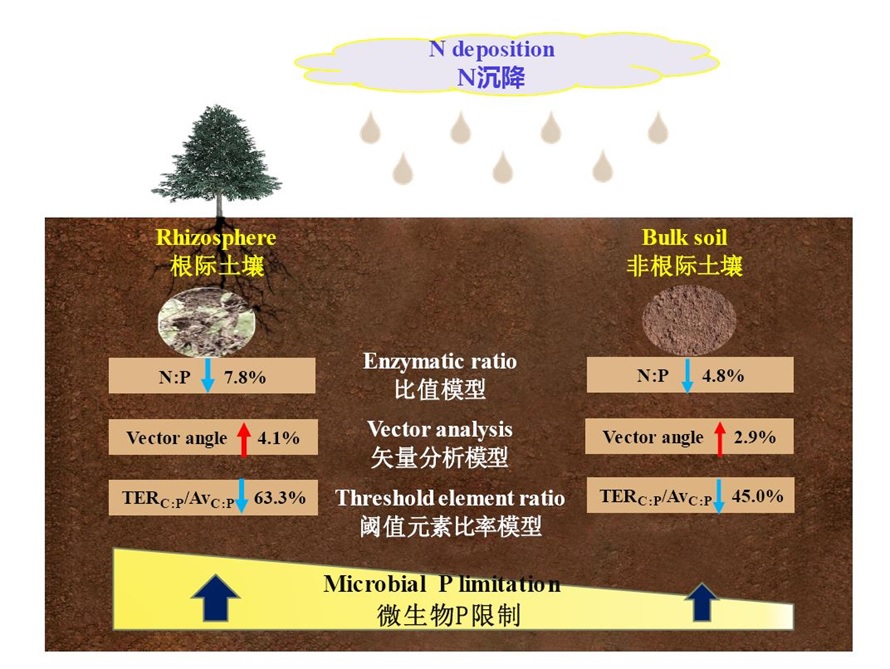
ztable width="98%" border="0" cellpadding="0" cellspacing="8">
| [1] | Bennett JA, Klironomos J (2019). Mechanisms of plant-soil feedback: interactions among biotic and abiotic drivers. New Phytologist, 222, 91-96. |
| [2] | Brzostek ER, Greco A, Drake JE, Finzi AC (2013). Root carbon inputs to the rhizosphere stimulate extracellular enzyme activity and increase nitrogen availability in temperate forest soils. Biogeochemistry, 115, 65-76. |
| [3] | Carrara JE, Walter CA, Freedman ZB, Hostetler AN, Hawkins JS, Fernandez IJ, Brzostek ER (2021). Differences in microbial community response to nitrogen fertilization result in unique enzyme shifts between arbuscular and ectomycorrhizal-dominated soils. Global Change Biology, 27, 2049-2060. |
| [4] | Carrara JE, Walter CA, Hawkins JS, Peterjohn WT, Averill C, Brzostek ER (2018). Interactions among plants, bacteria, and fungi reduce extracellular enzyme activities under long-term N fertilization. Global Change Biology, 24, 2721-2734. |
| [5] | Chai YN, Schachtman DP (2022). Root exudates impact plant performance under abiotic stress. Trends in Plant Science, 27, 80-91. |
| [6] | Chen H, Li DJ, Xiao KC, Wang KL (2018). Soil microbial processes and resource limitation in karst and non-karst forests. Functional Ecology, 32, 1400-1409. |
| [7] | Chen Z, Yin HJ, Wei YY, Liu Q (2010). Short-term effects of night warming and nitrogen addition on soil available nitrogen and microbial properties in subalpine coniferous forest, Western Sichuan, China. Chinese Journal of Plant Ecology, 34, 1254-1264. |
| [7] | [ 陈智, 尹华军, 卫云燕, 刘庆 (2010). 夜间增温和施氮对川西亚高山针叶林土壤有效氮和微生物特性的短期影响. 植物生态学报, 34, 1254-1264.] |
| [8] | Cui H, Ou Y, Lv D, Wang L, Liang A, Yan B, Li Y (2020). Aggregate-related microbial communities and nutrient stoichiometry under different croplands. Ecological Processes, 9, 33. DOI: 10.1186/s13717-020-00239-4. |
| [9] | Cui YX, Bing HJ, Fang LC, Jiang M, Shen GT, Yu JL, Wang X, Zhu H, Wu YH, Zhang XC (2021). Extracellular enzyme stoichiometry reveals the carbon and phosphorus limitations of microbial metabolisms in the rhizosphere and bulk soils in alpine ecosystems. Plant and Soil, 458, 7-20. |
| [10] | Cui YX, Fang LC, Guo XB, Wang X, Zhang YJ, Li PF, Zhang XC (2018). Ecoenzymatic stoichiometry and microbial nutrient limitation in rhizosphere soil in the arid area of the northern Loess Plateau, China. Soil Biology & Biochemistry, 116, 11-21. |
| [11] | Drake JE, Darby BA, Giasson MA, Kramer MA, Phillips RP, Finzi AC (2013). Stoichiometry constrains microbial response to root exudation-insights from a model and a field experiment in a temperate forest. Biogeosciences, 10, 821-838. |
| [12] | Eastman BA, Adams MB, Brzostek ER, Burnham MB, Carrara JE, Kelly C, McNeil BE, Walter CA, Peterjohn WT (2021). Altered plant carbon partitioning enhanced forest ecosystem carbon storage after 25 years of nitrogen additions. New Phytologist, 230, 1435-1448. |
| [13] | Fenn ME, Jovan S, Yuan F, Geiser L, Meixner T, Gimeno BS (2008). Empirical and simulated critical loads for nitrogen deposition in California mixed conifer forests. Environmental Pollution, 155, 492-511. |
| [14] | Galloway JN, Townsend AR, Erisman JW, Bekunda M, Cai ZC, Freney JR, Martinelli LA, Seitzinger SP, Sutton MA (2008). Transformation of the nitrogen cycle: recent trends, questions, and potential solutions. Science, 320, 889-892. |
| [15] | Gress SE, Nichols TD, Northcraft CC, Peterjohn WT (2007). Nutrient limitation in soils exhibiting differing nitrogen availabilities: What lies beyond nitrogen saturation? Ecology, 88, 119-130. |
| [16] | Guo WJ, Ding JX, Wang QT, Yin MZ, Zhu XM, Liu Q, Zhang ZL, Yin HJ (2021). Soil fertility controls ectomycorrhizal mycelial traits in alpine forests receiving nitrogen deposition. Soil Biology & Biochemistry, 161, 108386. DOI: 10.1016/j.soilbio.2021.108386. |
| [17] | Heuck C, Smolka G, Whalen ED, Frey S, Gundersen P, Moldan F, Fernandez IJ, Spohn M (2018). Effects of long-term nitrogen addition on phosphorus cycling in organic soil horizons of temperate forests. Biogeochemistry, 141, 167-181. |
| [18] | Jenkinson DS, Brookes PC, Powlson DS (2004). Measuring soil microbial biomass. Soil Biology & Biochemistry, 36, 5-7. |
| [19] | Jones DL, Nguyen C, Finlay RD (2009). Carbon flow in the rhizosphere: carbon trading at the soil-root interface. Plant and Soil, 321, 5-33. |
| [20] | Kuzyakov Y (2002). Review: factors affecting rhizosphere priming effects. Journal of Plant Nutrition and Soil Science, 165, 382-396. |
| [21] | Kuzyakov Y (2010). Priming effects: interactions between living and dead organic matter. Soil Biology & Biochemistry, 42, 1363-1371. |
| [22] | LeBauer DS, Treseder KK (2008). Nitrogen limitation of net primary productivity in terrestrial ecosystems is globally distributed. Ecology, 89, 371-379. |
| [23] | Liu JX, Huang WJ, Zhou GY, Zhang DQ, Liu SZ, Li YY (2013a). Nitrogen to phosphorus ratios of tree species in response to elevated carbon dioxide and nitrogen addition in subtropical forests. Global Change Biology, 19, 208-216. |
| [24] | Liu Q, Wu Y, He H (2001). Ecological problems of subalpine coniferous forest in the southwest of China. World Sci-Tech R&D, 23(2), 63-69. |
| [24] | [ 刘庆, 吴彦, 何海 (2001). 中国西南亚高山针叶林的生态学问题. 世界科技研究与发展, 23(2), 63-69.] |
| [25] | Liu X, Zhang Y, Han W, Tang A, Shen J, Cui Z, Vitousek P, Erisman JW, Goulding K, Christie P, Fangmeier A, Zhang F (2013b). Enhanced nitrogen deposition over China. Nature, 494, 459-462. |
| [26] | Lu RK (2000). Anasytical Methods for Soil and Agriculture Chemistry. China Agricultural Scientech Press, Beijing. |
| [26] | [ 鲁如坤 (2000). 土壤农业化学分析方法. 中国农业科技出版社, 北京.] |
| [27] | Midgley MG, Phillips RP (2016). Resource stoichiometry and the biogeochemical consequences of nitrogen deposition in a mixed deciduous forest. Ecology, 97, 3369-3378. |
| [28] | Moorhead DL, Rinkes ZL, Sinsabaugh RL, Weintraub MN (2013). Dynamic relationships between microbial biomass, respiration, inorganic nutrients and enzyme activities: informing enzyme-based decomposition models. Frontiers in Microbiology, 4, 223. DOI: 10.3389/fmicb.2013.00223. |
| [29] | Peñuelas J, Poulter B, Sardans J, Ciais P, van der Velde M, Bopp L, Boucher O, Godderis Y, Hinsinger P, Llusia J, Nardin E, Vicca S, Obersteiner M, Janssens IA (2013). Human-induced nitrogen-phosphorus imbalances alter natural and managed ecosystems across the globe. Nature Communications, 4, 2934-2944. |
| [30] | Philippot L, Raaijmakers JM, Lemanceau P, Putten WH (2013). Going back to the roots: the microbial ecology of the rhizosphere. Nature Reviews Microbiology, 11, 789-799. |
| [31] | Phillips RP, Finzi AC, Bernhardt ES (2011). Enhanced root exudation induces microbial feedbacks to N cycling in a pine forest under long-term CO2 fumigation. Ecology Letters, 14, 187-194. |
| [32] | Richardson AE, Simpson RJ (2011). Soil microorganisms mediating phosphorus availability update on microbial phosphorus. Plant Physiology, 156, 989-996. |
| [33] | Saiya-Cork KR, Sinsabaugh RL, Zak DR (2002). The effects of long term nitrogen deposition on extracellular enzyme activity in an Acer saccharum forest soil. Soil Biology & Biochemistry, 34, 1309-1315. |
| [34] | Sinsabaugh RL, Hill BH, Follstad Shah JJ, (2009). Ecoenzymatic stoichiometry of microbial organic nutrient acquisition in soil and sediment. Nature, 462, 795-798. |
| [35] | Sinsabaugh RL, Turner BL, Talbot JM, Waring BG, Powers JS, Kuske CR, Moorhead DL, Follstad Shah JJ (2016). Stoichiometry of microbial carbon use efficiency in soils. Ecological Monographs, 86, 172-189. |
| [36] | Sterner RW, Elser JJ (2002). Ecological Stoichiometry: the Biology of Elements from Molecules to the Biosphere. Princeton University Press, Princeton. |
| [37] | Vance ED, Brookes PC, Jenkinson DS (1987). An extraction method for measuring soil microbial biomass C. Soil Biology & Biochemistry, 19, 703-707. |
| [38] | Wu J, He ZL, Wei WX, OʼDonnell AG, Syers JK (2000). Quantifying microbial biomass phosphorus in acid soils. Biology and Fertility of Soils, 32, 500-507. |
| [39] | Xu Z, Wan C, Xiong P, Tang Z, Hu R, Cao G, Liu Q (2010). Initial responses of soil CO2 efflux and C, N pools to experimental warming in two contrasting forest ecosystems, Eastern Tibetan Plateau, China. Plant and Soil, 336, 183-195. |
| [40] | Yin MZ, Guo WJ, Zhu XM, Zhang ZL, Liu Q, Yin HJ (2021). Nutrient limiting characteristics of subalpine coniferous forests under conditions of nitrogen deposition in the southwest mountain of China. Chinese Journal of Applied and Environmental Biology, 27, 1-7. |
| [40] | [ 尹明珍, 郭婉玑, 朱晓敏, 张子良, 刘庆, 尹华军 (2021). 氮沉降下西南亚高山针叶林生长的养分限制特征. 应用与环境生物学报, 27, 1-7.] |
| [41] | Yu G, Jia Y, He N, Zhu J, Chen Z, Wang Q, Piao S, Liu X, He H, Guo X, Wen Z, Li P, Ding G, Goulding K (2019). Stabilization of atmospheric nitrogen deposition in China over the past decade. Nature Geoscience, 12, 424-429. |
| [42] | Yue K, Fornara DA, Yang W, Peng Y, Li Z, Wu F, Peng C (2017). Effects of three global change drivers on terrestrial C:N:P stoichiometry: a global synthesis. Global Change Biology, 23, 2450-2463. |
| [43] | Zechmeister-Boltenstern S, Keiblinger KM, Mooshammer M, Peñuelas J, Richter A, Sardans J, Wanek W (2015). The application of ecological stoichiometry to plant-microbial- soil organic matter transformations. Ecological Monographs, 85, 133-155. |
| [44] | Zhang R, Mu Y, Li X, Li S, Sang P, Wang X, Wu H, Xu N (2020). Response of the arbuscular mycorrhizal fungi diversity and community in maize and soybean rhizosphere soil and roots to intercropping systems with different nitrogen application rates. Science of the Total Environment, 740, 139810. DOI: 10.1016/j.scitotenv.2020.139810. |
| [45] | Zhou ZH, Wang CK (2016). Responses and regulation mechanisms of microbial decomposers to substrate carbon, nitrogen, and phosphorus stoichiometry. Chinese Journal of Plant Ecology, 40, 620-630. |
| [45] | [ 周正虎, 王传宽 (2016). 微生物对分解底物碳氮磷化学计量的响应和调节机制. 植物生态学报, 40, 620-630.] |
| [46] | Zhu JX, He NP, Wang QF, Yuan GF, Wen D, Yu GR, Jia YL (2015). The composition, spatial patterns, and influencing factors of atmospheric wet nitrogen deposition in Chinese terrestrial ecosystems. Science of the Total Environment, 511, 777-785. |
| [47] | Zhu XM, Liu M, Kou YP, Liu DY, Liu Q, Zhang ZL, Jiang Z, Yin HJ (2020). Differential effects of N addition on the stoichiometry of microbes and extracellular enzymes in the rhizosphere and bulk soils of an alpine shrubland. Plant and Soil, 449, 285-301. |