
黑沙蒿应对降水变化的木质部与韧皮部协同响应机制
收稿日期: 2023-04-14
录用日期: 2023-10-09
网络出版日期: 2023-10-10
基金资助
中央高校基本科研业务费专项资金(QNTD202303)
Synergistic response mechanisms in xylem and phloem of Artemisia ordosica to changes in precipitation
Received date: 2023-04-14
Accepted date: 2023-10-09
Online published: 2023-10-10
Supported by
Fundamental Research Funds for the Central Universities(QNTD202303)
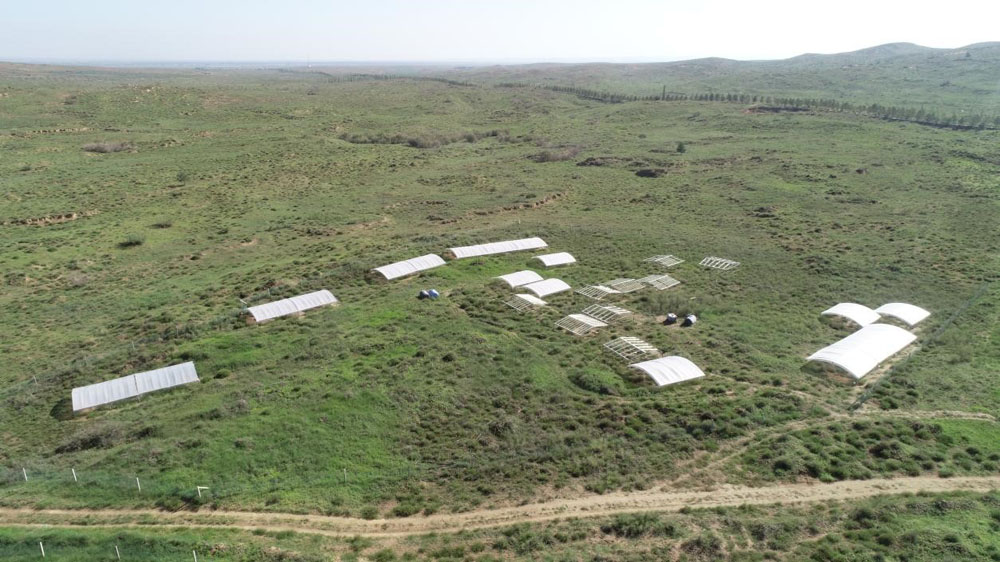
探究不同降水情景下荒漠植物茎干解剖学结构的适应性调节, 可以更好地理解未来降水格局变化下荒漠植物水和碳运输间的协调机制。该研究以毛乌素沙地黑沙蒿(Artemisia ordosica)种群为对象, 通过野外人工控制降水的方法, 模拟半干旱气候区降水变化趋势, 设置3个降水量水平(减水30%、自然降水、增水30%)以及2个降水间隔水平(降水间隔5 d、降水间隔15 d)开展双因素完全随机实验, 测定了黑沙蒿茎木质部与韧皮部解剖结构在不同降水情境下的轴向与径向变异。结果表明: 1)在降水改变的情况下, 黑沙蒿并未产生更抗栓塞的轴向木质部结构及传导效率更高的轴向韧皮部结构来适应环境; 2)降水变化通过改变40-60 cm土层含水率对黑沙蒿的木质部、韧皮部径向解剖性状产生影响。在低水分生境下, 黑沙蒿减小导管直径和增大导管壁厚度以保证水分运输的安全性, 并且通过增大韧皮部筛管面积来维持韧皮部导度保证碳的有效运输, 以此保证黑沙蒿进行正常的生理活动; 3)黑沙蒿木质部导管和韧皮部筛管具有等标度的轴向缩放规律, 二者协同关联共同维持水力功能, 且这种相关关系不受降水变化的影响。该研究表明, 黑沙蒿通过改变径向茎干结构而不是轴向结构来适应降水的改变。
张富崇 , 于明含 , 张建玲 , 王平 , 丁国栋 , 何莹莹 , 孙慧媛 . 黑沙蒿应对降水变化的木质部与韧皮部协同响应机制[J]. 植物生态学报, 2024 , 48(7) : 903 -914 . DOI: 10.17521/cjpe.2023.0103
Aims Investigating the adaptive regulation of stem anatomy in desert plants under different precipitation scenarios will lead to a better understanding of the coordination mechanisms between water and carbon transport in desert plants under future precipitation patterns.
Methods In this study, a two-factor completely randomized experiment was conducted to determine the axial and radial variation in the xylem and phloem anatomy of Artemisia ordosica stems under different precipitation conditions by manipulating precipitation in the field in a semi-arid climate zone, with three precipitation treatments in amounts (30% precipitation reduction, natural precipitation and 30% precipitation increase) and two precipitation intervals (5 d precipitation interval and 15 d precipitation interval).
Important findings The results indicate: 1) Under altered precipitation, A. ordosica did not develop more conductive axial xylem structures and more conductive axial phloem structures to adapt to the changes; 2) Precipitation changes affected the radial anatomical traits of xylem and phloem of A. ordosica by altering the moisture content of the 40-60 cm soil layer. Under low moisture habitats, A. ordosica reduced the conduit diameter and increased the conduit wall thickness to ensure the safety of water transport, and maintained the phloem conductivity by increasing the lumen area of phloem sieve cells to ensure the effective transport of carbon, thus ensuring the normal physiological activities of A. ordosica; 3) The xylem conduit and phloem lumen of A. ordosica had an equal scaling axial scaling pattern, and the two were synergistically related to each other to maintain the hydraulic function, and this correlation was not affected by changes in precipitation. This study showed that A. ordosica adapted to changes in precipitation by altering the radial stem structure rather than the axial. This study is a valuable addition to the anatomical knowledge of the hydraulic structure of desert shrubs and provides a theoretical basis for future management of vegetation stability maintenance under changing precipitation patterns in semi-arid desert areas.
Key words: precipitation change; Artemisia ordosica; xylem; phloem; allometry
| [1] | Anfodillo T, Olson ME (2021). Tree mortality: testing the link between drought, embolism vulnerability, and xylem conduit diameter remains a priority. Frontiers in Forests and Global Change, 4, 704670. DOI: 10.3389/ffgc.2021.704670. |
| [2] | Anfodillo T, Petit G, Crivellaro A (2013). Axial conduit widening in woody species: a still neglected anatomical pattern. IAWA Journal, 34, 352-364. |
| [3] | Beikircher B, Mayr S (2009). Intraspecific differences in drought tolerance and acclimation in hydraulics of Ligustrum vulgare and Viburnum lantana. Tree Physiology, 29, 765-775. |
| [4] | Blackman CJ, Gleason SM, Cook AM, Chang Y, Laws CA, Westoby M (2018). The links between leaf hydraulic vulnerability to drought and key aspects of leaf venation and xylem anatomy among 26 Australian woody angiosperms from contrasting climates. Annals of Botany, 122, 59-67. |
| [5] | Bouda M, Huggett BA, Prats KA, Wason JW, Wilson JP, Brodersen CR (2022). Hydraulic failure as a primary driver of xylem network evolution in early vascular plants. Science, 378, 642-646. |
| [6] | Cai J, Tyree MT (2010). The impact of vessel size on vulnerability curves: data and models for within-species variability in saplings of aspen, Populus tremuloides Michx. Plant, Cell & Environment, 33, 1059-1069. |
| [7] | Chang W, Stein ML, Wang J, Kotamarthi VR, Moyer EJ (2016). Changes in spatiotemporal precipitation patterns in changing climate conditions. Journal of Climate, 29, 8355-8376. |
| [8] | Choat B, Jansen S, Brodribb TJ, Cochard H, Delzon S, Bhaskar R, Bucci SJ, Feild TS, Gleason SM, Hacke UG, Jacobsen AL, Lens F, Maherali H, Martínez-Vilalta J, Mayr S, et al. (2012). Global convergence in the vulnerability of forests to drought. Nature, 491, 752-755. |
| [9] | Choat B, Lahr EC, Melcher PJ, Zwieniecki MA, Michele Holbrook N (2005). The spatial pattern of air seeding thresholds in mature sugar maple trees. Plant, Cell & Environment, 28, 1082-1089. |
| [10] | Fonti P, von Arx G, García-González I, Eilmann B, Sass- Klaassen U, G?rtner H, Eckstein D (2010). Studying global change through investigation of the plastic responses of xylem anatomy in tree rings. New Phytologist, 185, 42-53. |
| [11] | Gersony JT, Holbrook NM (2022). Phloem turgor is maintained during severe drought in Ricinus communis. Plant, Cell & Environment, 45, 2898-2905. |
| [12] | Hacke UG, Jacobsen AL, Brandon Pratt R, Maurel C, Lachenbruch B, Zwiazek J (2012). New research on plant-water relations examines the molecular, structural, and physiological mechanisms of plant responses to their environment. New Phytologist, 196, 345-348. |
| [13] | Hacke UG, Sperry JS, Pittermann J (2000). Drought experience and cavitation resistance in six shrubs from the Great Basin, Utah. Basic and Applied Ecology, 1, 31-41. |
| [14] | Hacke UG, Sperry JS, Wheeler JK, Castro L (2006). Scaling of angiosperm xylem structure with safety and efficiency. Tree Physiology, 26, 689-701. |
| [15] | Hacke UG, Spicer R, Schreiber SG, Plavcová L (2017). An ecophysiological and developmental perspective on variation in vessel diameter. Plant, Cell & Environment, 40, 831-845. |
| [16] | He P, Gleason SM, Wright IJ, Weng E, Liu H, Zhu S, Lu M, Luo Q, Li R, Wu G, Yan E, Song Y, Mi X, Hao G, Reich PB, et al. (2020). Growing-season temperature and precipitation are independent drivers of global variation in xylem hydraulic conductivity. Global Change Biology, 26, 1833-1841. |
| [17] | H?ltt? T, Mencuccini M, Nikinmaa E (2009). Linking phloem function to structure: analysis with a coupled xylem-phloem transport model. Journal of Theoretical Biology, 259, 325-337. |
| [18] | IPCC (2014). Climate Change 2013—The Physical Science Basis: Working Group I Contribution to the Fifth Assessment Report of the Intergovernmental Panel on Climate Change. Cambridge University Press, Cambridge, UK. |
| [19] | Jyske T, H?ltt? T (2015). Comparison of phloem and xylem hydraulic architecture in Picea abies stems. New Phytologist, 205, 102-115. |
| [20] | Kiorapostolou N, Camarero JJ, Carrer M, Sterck F, Brigita B, Sangüesa-Barreda G, Petit G (2020). Scots pine trees react to drought by increasing xylem and phloem conductivities. Tree Physiology, 40, 774-781. |
| [21] | Kiorapostolou N, Galiano-Pérez L, von Arx G, Gessler A, Petit G (2018). Structural and anatomical responses of Pinus sylvestris and Tilia platyphyllos seedlings exposed to water shortage. Trees, 32, 1211-1218. |
| [22] | Kiorapostolou N, Petit G (2019). Similarities and differences in the balances between leaf, xylem and phloem structures in Fraxinus ornus along an environmental gradient. Tree Physiology, 39, 234-242. |
| [23] | Klein T, Hartmann H (2018). Climate change drives tree mortality. Science, 362, 758. DOI: 10.1126/science.aav6508. |
| [24] | Lazzarin M, Crivellaro A, Williams CB, Dawson TE, Mozzi G, Anfodillo T (2016). Tracheid and pit anatomy vary in tandem in a tall Sequoiadendron giganteum tree. IAWA Journal, 37, 172-185. |
| [25] | Lechthaler S, Turnbull TL, Gelmini Y, Pirotti F, Anfodillo T, Adams MA, Petit G (2019). A standardization method to disentangle environmental information from axial trends of xylem anatomical traits. Tree Physiology, 39, 495-502. |
| [26] | Lens F, Gleason SM, Bortolami G, Brodersen C, Delzon S, Jansen S (2022). Functional xylem characteristics associated with drought-induced embolism in angiosperms. New Phytologist, 236, 2019-2036. |
| [27] | Lintunen A, Paljakka T, Jyske T, Peltoniemi M, Sterck F, von Arx G, Cochard H, Copini P, Caldeira MC, Delzon S, Gebauer R, Gr?nlund L, Kiorapostolou N, Lechthaler S, Lobo-do-Vale R, et al. (2016). Osmolality and non- structural carbohydrate composition in the secondary phloem of trees across a latitudinal gradient in Europe. Frontiers in Plant Science, 7, 726. DOI: 10.3389/fpls.2016.00726. |
| [28] | Martínez-Sancho E, Dorado-Li?án I, Hacke UG, Seidel H, Menzel A (2017). Contrasting hydraulic architectures of scots pine and sessile oak at their southernmost distribution limits. Frontiers in Plant Science, 8, 598. DOI: 10.3389/fpls.2017.00598. |
| [29] | Mayr S, Hacke U, Schmid P, Schwienbacher F, Gruber A (2006). Frost drought in conifers at the alpine timberline: xylem dysfunction and adaptations. Ecology, 87, 3175-3185. |
| [30] | McCulloh KA, Johnson DM, Petitmermet J, McNellis B, Meinzer FC, Lachenbruch B (2015). A comparison of hydraulic architecture in three similarly sized woody species differing in their maximum potential height. Tree Physiology, 35, 723-731. |
| [31] | Mencuccini M, H?ltt? T, Petit G, Magnani F (2007). Sanio’s laws revisited. Size-dependent changes in the xylem architecture of trees. Ecology Letters, 10, 1084-1093. |
| [32] | Nardini A, Pedà G, Rocca N (2012). Trade-offs between leaf hydraulic capacity and drought vulnerability: morpho- anatomical bases, carbon costs and ecological consequences. New Phytologist, 196, 788-798. |
| [33] | Nardini A, Savi T, Losso A, Petit G, Pacilè S, Tromba G, Mayr S, Trifilò P, Lo Gullo MA, Salleo S (2017). X-ray microtomography observations of xylem embolism in stems of Laurus nobilis are consistent with hydraulic measurements of percentage loss of conductance. New Phytologist, 213, 1068-1075. |
| [34] | Ning ZY, Zhao XY, Li YL, Wang LL, Lian JE, Yang HL, Li YQ (2021). Plant community C:N:P stoichiometry is mediated by soil nutrients and plant functional groups during grassland desertification. Ecological Engineering, 162, 106179. DOI: 10.1016/j.ecoleng.2021.106179. |
| [35] | Nola P, Bracco F, Assini S, Arx G, Castagneri D (2020). Xylem anatomy of Robinia pseudoacacia L. and Quercus robur L. is differently affected by climate in a temperate alluvial forest. Annals of Forest Science, 77, 1-16. |
| [36] | Nolf M, Creek D, Duursma R, Holtum J, Mayr S, Choat B (2015). Stem and leaf hydraulic properties are finely coordinated in three tropical rain forest tree species. Plant, Cell & Environment, 38, 2652-2661. |
| [37] | Olson ME, Soriano D, Rosell JA, Anfodillo T, Donoghue MJ, Edwards EJ, León-Gómez C, Dawson T, Martínez JJ, Castorena M, Echeverría A, Espinosa CI, Fajardo A, Gazol A, Isnard S, et al. (2018). Plant height and hydraulic vulnerability to drought and cold. Proceedings of the National Academy of Sciences of the United States of America, 115, 7551-7556. |
| [38] | Petit G, Anfodillo T (2009). Plant physiology in theory and practice: an analysis of the WBE model for vascular plants. Journal of Theoretical Biology, 259, 1-4. |
| [39] | Petit G, Crivellaro A (2014). Comparative axial widening of phloem and xylem conduits in small woody plants. Trees, 28, 915-921. |
| [40] | Petit G, Pfautsch S, Anfodillo T, Adams MA (2010). The challenge of tree height in Eucalyptus regnans: When xylem tapering overcomes hydraulic resistance. New Phytologist, 187, 1146-1153. |
| [41] | Petit G, Savi T, Consolini M, Anfodillo T, Nardini A (2016). Interplay of growth rate and xylem plasticity for optimal coordination of carbon and hydraulic economies in Fraxinus ornus trees. Tree Physiology, 36, 1310-1319. |
| [42] | Petit G, Zambonini D, Hesse BD, H?berle KH (2022). No xylem phenotypic plasticity in mature Picea abies and Fagus sylvatica trees after 5 years of throughfall precipitation exclusion. Global Change Biology, 28, 4668-4683. |
| [43] | Pfautsch S, Harbusch M, Wesolowski A, Smith R, MacFarlane C, Tjoelker MG, Reich PB, Adams MA (2016). Climate determines vascular traits in the ecologically diverse genus Eucalyptus. Ecology Letters, 19, 240-248. |
| [44] | Prendin A, Petit G, Fonti P, Rixen C, Dawes MA, von Arx G (2018). Axial xylem architecture of Larix decidua exposed to CO2 enrichment and soil warming at the tree line. Functional Ecology, 32, 273-287. |
| [45] | Putnam AE, Broecker WS (2017). Human-induced changes in the distribution of rainfall. Science Advances, 3, e1600871. DOI: 10.1126/sciadv.1600871. |
| [46] | Savage JA, Beecher SD, Clerx L, Gersony JT, Knoblauch J, Losada JM, Jensen KH, Knoblauch M, Holbrook NM (2017). Maintenance of carbohydrate transport in tall trees. Nature Plants, 3, 965-972. |
| [47] | Sevanto S (2014). Phloem transport and drought. Journal of Experimental Botany, 65, 1751-1759. |
| [48] | Sevanto S (2018). Drought impacts on phloem transport. Current Opinion in Plant Biology, 43, 76-81. |
| [49] | Sevanto S, Ryan M, Dickman LT, Derome D, Patera A, Defraeye T, Pangle RE, Hudson PJ, Pockman WT (2018). Is desiccation tolerance and avoidance reflected in xylem and phloem anatomy of two coexisting arid-zone coniferous trees? Plant, Cell & Environment, 41, 1551-1564. |
| [50] | Soriano D, Echeverría A, Anfodillo T, Rosell JA, Olson ME (2020). Hydraulic traits vary as the result of tip-to-base conduit widening in vascular plants. Journal of Experimental Botany, 71, 4232-4242. |
| [51] | Sperry JS, Stiller V, Hacke UG (2003). Xylem hydraulics and the soil-plant-atmosphere continuum: opportunities and unresolved issues. Agronomy Journal, 95, 1362-1370. |
| [52] | Venturas MD, Sperry JS, Hacke UG (2017). Plant xylem hydraulics: what we understand, current research, and future challenges. Journal of Integrative Plant Biology, 59, 356-389. |
| [53] | Yu MH, He YY, Zhang FC, Ding GD, Wang CY (2023). Effects of intra-year precipitation variability on shrub community productivity depend on the annual total rainfall. Plant and Soil, 487, 499-510. |
| [54] | Zhu SD, Liu H, Xu QY, Cao K, Ye Q (2016). Are leaves more vulnerable to cavitation than branches. Functional Ecology, 30, 1740-1744. |
| [55] | Zimmermann MH (1978). Hydraulic architecture of some diffuse-porous trees. Canadian Journal of Botany, 56, 2286-2295. |
/
| 〈 |
|
〉 |
Copyright © 2026 版权所有 《植物生态学报》编辑部
地址: 北京香山南辛村20号, 邮编: 100093
Tel.: 010-62836134, 62836138; Fax: 010-82599431; E-mail: apes@ibcas.ac.cn, cjpe@ibcas.ac.cn
备案号: 京ICP备16067583号-19

