Chin J Plant Ecol ›› 2022, Vol. 46 ›› Issue (7): 775-784.DOI: 10.17521/cjpe.2021.0281 cstr: 32100.14.cjpe.2021.0281
• Research Articles • Previous Articles Next Articles
ZENG Kai-Na1,2, SUN Hao-Ran1,2, SHEN Yi-Chun1, REN Ming-Xun1,2,*(
)
Received:2021-08-02
Accepted:2022-01-14
Online:2022-07-20
Published:2022-06-09
Contact:
REN Ming-Xun
Supported by:ZENG Kai-Na, SUN Hao-Ran, SHEN Yi-Chun, REN Ming-Xun. Pollination network and seasonal dynamics of Yangshan Wetland in Hainan Island, China[J]. Chin J Plant Ecol, 2022, 46(7): 775-784.
Add to citation manager EndNote|Ris|BibTeX
URL: https://www.plant-ecology.com/EN/10.17521/cjpe.2021.0281
Fig. 1 Study sites and landscapes of Yangshan Wetland in Hainan Island. A, Location of Yangshan wetland in Hainan Island. B, Four experimental plots. C, Landscape of Plot 4 in dry season. D, The most common emergent macrophytes plants Hydrocera triflora (a carpenter bee is visiting a flower on the middle plant).
| 传粉网络 Pollination network | 开花植物 Plants in blooming (P) | 传粉者Pollinator (A) | 网络尺寸 Network size (P × A) | 连接数量 Number of interaction (I) | 连接度 Connectance (I/(P × A)) | 嵌套度 Weighted nestedness | 网络特化 程度 H′2 |
|---|---|---|---|---|---|---|---|
| 旱季样地1 D1 | 10 | 19 | 190 | 37 | 0.19 | 5.73 | -0.33 |
| 旱季样地2 D2 | 14 | 21 | 294 | 49 | 0.17 | 4.78 | -0.28 |
| 旱季样地3 D3 | 19 | 29 | 551 | 73 | 0.13 | 5.70 | -0.22 |
| 旱季样地4 D4 | 22 | 45 | 990 | 84 | 0.08 | 11.71 | -0.37 |
| 旱季合计 Dry season total | 49 | 82 | 4 018 | 244 | 0.06 | 0.65 | 0.45 |
| 雨季样地1 R1 | 12 | 10 | 120 | 30 | 0.25 | 3.62 | -0.12 |
| 雨季样地2 R2 | 8 | 15 | 120 | 35 | 0.29 | 5.89 | -0.15 |
| 雨季样地3 R3 | 10 | 29 | 290 | 49 | 0.17 | 6.99 | -0.32 |
| 雨季样地4 R4 | 26 | 39 | 1 014 | 103 | 0.10 | 8.96 | -0.33 |
| 雨季合计 Rainy season total | 44 | 66 | 2 904 | 235 | 0.08 | 0.62 | 0.52 |
Table 1 Parameters of pollination network in different seasons of Yangshan Wetland in Hainan Island
| 传粉网络 Pollination network | 开花植物 Plants in blooming (P) | 传粉者Pollinator (A) | 网络尺寸 Network size (P × A) | 连接数量 Number of interaction (I) | 连接度 Connectance (I/(P × A)) | 嵌套度 Weighted nestedness | 网络特化 程度 H′2 |
|---|---|---|---|---|---|---|---|
| 旱季样地1 D1 | 10 | 19 | 190 | 37 | 0.19 | 5.73 | -0.33 |
| 旱季样地2 D2 | 14 | 21 | 294 | 49 | 0.17 | 4.78 | -0.28 |
| 旱季样地3 D3 | 19 | 29 | 551 | 73 | 0.13 | 5.70 | -0.22 |
| 旱季样地4 D4 | 22 | 45 | 990 | 84 | 0.08 | 11.71 | -0.37 |
| 旱季合计 Dry season total | 49 | 82 | 4 018 | 244 | 0.06 | 0.65 | 0.45 |
| 雨季样地1 R1 | 12 | 10 | 120 | 30 | 0.25 | 3.62 | -0.12 |
| 雨季样地2 R2 | 8 | 15 | 120 | 35 | 0.29 | 5.89 | -0.15 |
| 雨季样地3 R3 | 10 | 29 | 290 | 49 | 0.17 | 6.99 | -0.32 |
| 雨季样地4 R4 | 26 | 39 | 1 014 | 103 | 0.10 | 8.96 | -0.33 |
| 雨季合计 Rainy season total | 44 | 66 | 2 904 | 235 | 0.08 | 0.62 | 0.52 |
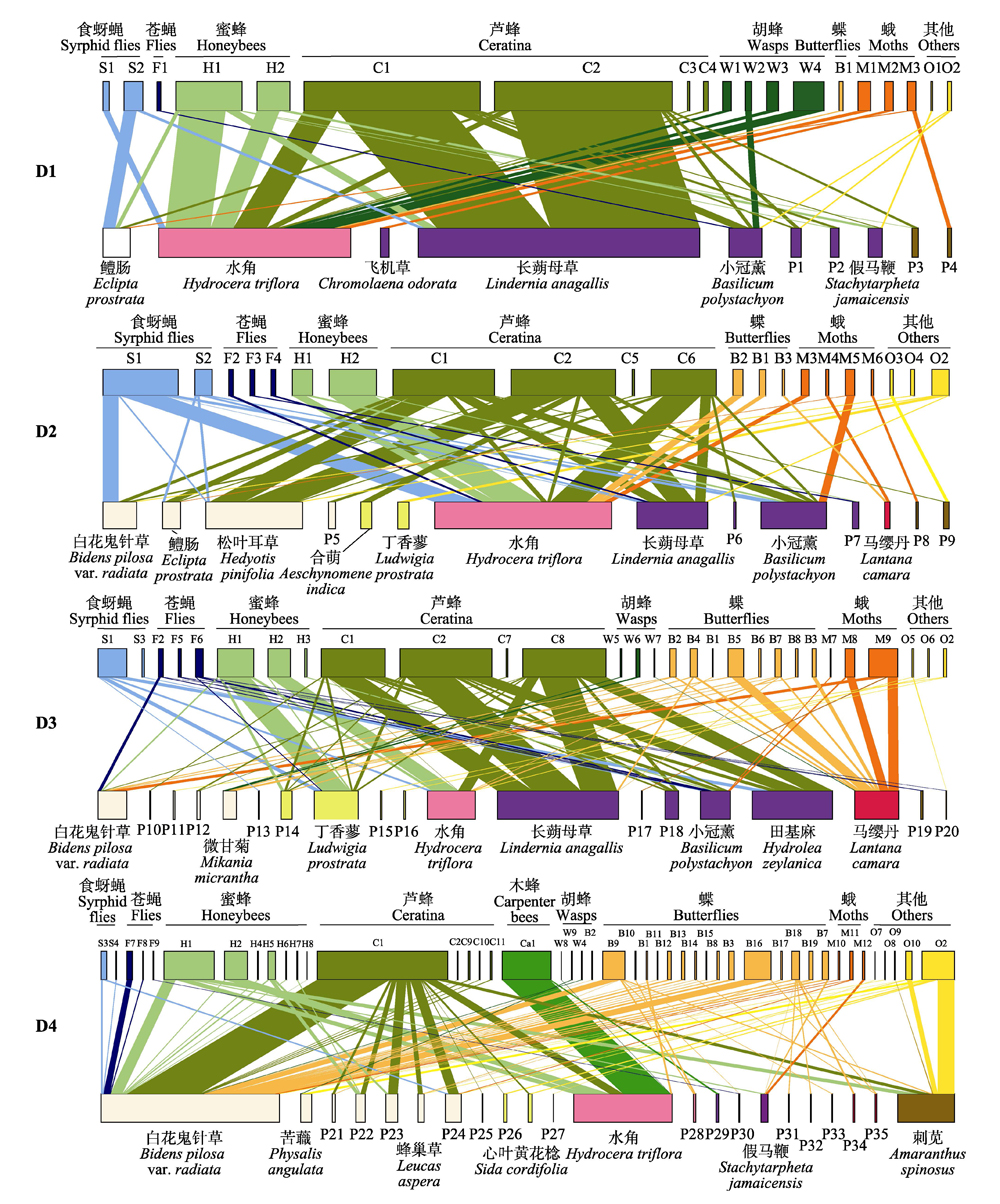
Fig. 2 Pollination network in dry season of four plots (D1-D4) of Yangshan Wetland in Hainan Island. In each pollination network, the top and bottom represent pollinators and plants, respectively. The size indicates relative abundancy and the width of the link represents the correlation strength. P1-P35 are plants (Supplement VI) and codes under each pollinator functional group represent different species.
Fig. 3 Pollination network in rainy season of four plots (R1-R4) of Yangshan Wetland in Hainan Island. In each pollination network, the top and bottom represent pollinators and plants, respectively. The size indicates relative abundancy and the width of the link represents the correlation strength. P1-P35 are plants (Supplement VI) and codes under each pollinator functional group represent the different species.
| 植物 Plant | 传粉网络 Pollination network | 传粉者种类 Pollinator species | 物种强度 Species strength | 专一性 Standardized Kullback- Leibler distance (d′) |
|---|---|---|---|---|
| 白花鬼针草 Bidens pilosa var. radiata | 旱季 DZ | 40 | 12.484 0 | 0.551 0 |
| 雨季 RZ | 18 | 3.852 7 | 0.671 4 | |
| 水角 Hydrocera triflora | 旱季 DZ | 20 | 26.212 4 | 0.462 4 |
| 雨季 RZ | 12 | 6.977 5 | 0.455 6 | |
| 假马鞭 Stachytarpheta jamaicensis | 旱季 DZ | 7 | 2.266 9 | 0.477 4 |
| 雨季 RZ | 15 | 7.707 9 | 0.696 1 | |
| 马缨丹 Lantana camara | 旱季 DZ | 12 | 5.657 1 | 0.773 4 |
| 雨季 RZ | 10 | 5.248 1 | 0.646 1 | |
| 小冠薰 Basilicum polystachyon | 旱季 DZ | 17 | 7.241 9 | 0.317 5 |
| 雨季 RZ | 12 | 2.439 9 | 0.508 6 |
Table 2 Species level parameters of common plants of the Yangshan Wetland in Hainan Island
| 植物 Plant | 传粉网络 Pollination network | 传粉者种类 Pollinator species | 物种强度 Species strength | 专一性 Standardized Kullback- Leibler distance (d′) |
|---|---|---|---|---|
| 白花鬼针草 Bidens pilosa var. radiata | 旱季 DZ | 40 | 12.484 0 | 0.551 0 |
| 雨季 RZ | 18 | 3.852 7 | 0.671 4 | |
| 水角 Hydrocera triflora | 旱季 DZ | 20 | 26.212 4 | 0.462 4 |
| 雨季 RZ | 12 | 6.977 5 | 0.455 6 | |
| 假马鞭 Stachytarpheta jamaicensis | 旱季 DZ | 7 | 2.266 9 | 0.477 4 |
| 雨季 RZ | 15 | 7.707 9 | 0.696 1 | |
| 马缨丹 Lantana camara | 旱季 DZ | 12 | 5.657 1 | 0.773 4 |
| 雨季 RZ | 10 | 5.248 1 | 0.646 1 | |
| 小冠薰 Basilicum polystachyon | 旱季 DZ | 17 | 7.241 9 | 0.317 5 |
| 雨季 RZ | 12 | 2.439 9 | 0.508 6 |
| [1] |
Aizen MA, Morales CL, Morales JM (2008). Invasive mutualists erode native pollination webs. PLOS Biology, 6, e31. DOI: 10.1371/journal.pbio.0060031.
DOI URL |
| [2] |
Asada T (2002). Vegetation gradients in relation to temporal fluctuation of environmental factors in Bekanbeushi peatland, Hokkaido, Japan. Ecological Research, 17, 505-518.
DOI URL |
| [3] |
Bascompte J, Jordano P (2007). Plant-animal mutualistic networks: the architecture of biodiversity. Annual Review of Ecology, Evolution, and Systematics, 38, 567-593.
DOI URL |
| [4] |
Bascompte J, Jordano P, Melián CJ, Olesen JM (2003). The nested assembly of plant-animal mutualistic networks. Proceedings of the National Academy of Sciences of the United States of America, 100, 9383-9387.
DOI PMID |
| [5] |
Bascompte J, Jordano P, Olesen JM (2006). Asymmetric coevolutionary networks facilitate biodiversity maintenance. Science, 312, 431-433.
PMID |
| [6] |
Bastolla U, Fortuna MA, Pascual-García A, Ferrera A, Luque B, Bascompte J (2009). The architecture of mutualistic networks minimizes competition and increases biodiversity. Nature, 458, 1018-1020.
DOI URL |
| [7] |
Blüthgen N, Menzel F, Blüthgen N (2006). Measuring specialization in species interaction networks. BMC Ecology, 6, 9. DOI: 10.1186/1472-6785-6-9.
DOI PMID |
| [8] |
Blüthgen N, Menzel F, Hovestadt T, Fiala B, Blüthgen N (2007). Specialization, constraints, and conflicting interests in mutualistic networks. Current Biology, 17, 341-346.
PMID |
| [9] | CaraDonna PJ, Burkle LA, Schwarz B, Resasco J, Knight TM, Benadi G, Blüthgen N, Dormann CF, Fang Q, Fründ J, Gauzens B, Kaiser-Bunbury CN, Winfree R, Vázquez DP (2021). Seeing through the static: the temporal dimension of plant-animal mutualistic interactions. Ecology Letters, 24, 149-161. |
| [10] |
Casanova M, Brock M (2000). How do depth, duration and frequency of flooding influence the establishment of wetland plant communities? Plant Ecology, 147, 237-250.
DOI URL |
| [11] |
Castro-Urgal R, Traveset A (2014). Differences in flower visitation networks between an oceanic and a continental island. Botanical Journal of the Linnean Society, 174, 478- 488.
DOI URL |
| [12] |
Cuartas-Hernández S, Medel R (2015). Topology of plant-flower-visitor networks in a tropical mountain forest: insights on the role of altitudinal and temporal variation. PLOS ONE, 10, e0141804. DOI: 10.1371/journal.pone.0141804.
DOI URL |
| [13] |
Dormann CF, Fründ J, Schaefer HM (2017). Identifying causes of patterns in ecological networks: opportunities and limitations. Annual Review of Ecology, Evolution, and Systematics, 48, 559-584.
DOI URL |
| [14] |
Dupont YL, Padrón B, Olesen JM, Petanidou T (2009). Spatio- temporal variation in the structure of pollination networks. Oikos, 118, 1261-1269.
DOI URL |
| [15] |
Fang Q, Huang SQ (2012). Progress in pollination networks: network structure and dynamics. Biodiversity Science, 20, 300-307.
DOI URL |
|
[方强, 黄双全 (2012). 传粉网络的研究进展: 网络的结构和动态. 生物多样性, 20, 300-307.]
DOI |
|
| [16] |
Fang Q, Huang SQ (2012). Relative stability of core groups in pollination networks in a biodiversity hotspot over four years. PLOS ONE, 7, e32663. DOI: 10.1371/journal.pone.0032663.
DOI URL |
| [17] |
Gómez JM, Perfectti F, Jordano P (2011). The functional consequences of mutualistic network architecture. PLOS ONE, 6, e16143. DOI: 10.1371/journal.pone.0016143.
DOI URL |
| [18] |
Haapalehto TO, Vasander H, Jauhiainen S, Tahvanainen T, Kotiaho JS (2011). The effects of peatland restoration on water-table depth, elemental concentrations, and vegetation: 10 years of changes. Restoration Ecology, 19, 587-598.
DOI URL |
| [19] |
Jones KN, Klemetti SM (2012). Managing marginal populations of the rare wetland plant Trollius laxus Salisbury (spreading globeflower): consideration of light levels, herbivory, and pollination. Northeastern Naturalist, 19, 267-278.
DOI URL |
| [20] | Kaiser-Bunbury CN, Muff S, Memmott J, Müller CB, Caflisch A (2010). The robustness of pollination networks to the loss of species and interactions: a quantitative approach incorporating pollinator behaviour. Ecology Letters, 13, 442-452. |
| [21] |
Lundgren R, Olesen JM (2005). The dense and highly connected world of greenland's plants and their pollinators. Arctic, Antarctic, and Alpine Research, 37, 514-520.
DOI URL |
| [22] |
Olesen JM, Bascompte J, Elberling H, Jordano P (2008). Temporal dynamics in a pollination network. Ecology, 89, 1573-1582.
PMID |
| [23] | Olesen JM, Jordano P (2002). Geographic patterns in plant- pollinator mutualistic networks. Ecology, 83, 2416-2424. |
| [24] |
Pawar S (2014). Why are plant-pollinator networks nested? Science, 345, 383. DOI: 10.1126/science.1256466.
DOI URL |
| [25] |
Ponisio LC, Gaiarsa MP, Kremen C (2017). Opportunistic attachment assembles plant-pollinator networks. Ecology Letters, 20, 1261-1272.
DOI PMID |
| [26] |
Saavedra S, Rohr RP, Fortuna MA, Selva N, Bascompte J (2016). Seasonal species interactions minimize the impact of species turnover on the likelihood of community persistence. Ecology, 97, 865-873.
PMID |
| [27] |
Santamaría S, Galeano J, Pastor JM, Méndez M (2016). Removing interactions, rather than species, casts doubt on the high robustness of pollination networks. Oikos, 125, 526-534.
DOI URL |
| [28] |
Schleuning M, Fründ J, Klein AM, Abrahamczyk S, Alarcón R, Albrecht M, Andersson GKS, Bazarian S, Böhning-Gaese K, Bommarco R, Dalsgaard B, Dehling DM, Gotlieb A, Hagen M, Hickler T, et al. (2012). Specialization of mutualistic interaction networks decreases toward tropical latitudes. Current Biology, 22, 1925-1931.
DOI PMID |
| [29] |
Souza CS, Maruyama PK, Aoki C, Sigrist MR, Raizer J, Gross CL, de Araujo AC (2018). Temporal variation in plant- pollinator networks from seasonal tropical environments: higher specialization when resources are scarce. Journal of Ecology, 106, 2409-2420.
DOI URL |
| [30] | State Forestry Administration of the People's Republic of China (2015). China Wetlands Resources Hainan Volume. China Forestry Publishing House, Beijing. |
| [中华人民共和国国家林业局 (2015). 中国湿地资源: 海南卷. 中国林业出版社, 北京.] | |
| [31] |
Tu YL, Wang LP, Wang XL, Wang LL, Duan YW (2019). Status of invasive plants on local pollination networks: a case study of Tagetes minuta in Tibet based on pollen grains from pollinators. Biodiversity Science, 27, 306-313.
DOI URL |
|
[土艳丽, 王力平, 王喜龙, 王林林, 段元文 (2019). 利用昆虫携带的花粉初探西藏入侵植物印加孔雀草在当地传粉网络中的地位. 生物多样性, 27, 306-313.]
DOI |
|
| [32] | Vasander H (1982). Plant biomass and production in virgin, drained and fertilized sites in a raised bog in southern Finland. Annales Botanici Fennici, 19, 103-125. |
| [33] |
Vázquez DP, Simberloff D (2002). Ecological specialization and susceptibility to disturbance: conjectures and refutations. The American Naturalist, 159, 606-623.
DOI PMID |
| [1] | Qing He, Xudong Yuan, Boshen Ren, Zhiyang Feng, Mengzhen Lu, Qiaoling Lin, Qinghu Jiang, Linsen Yang, Huiliang Yu, Hui Yao, Jingyuan Yang, Feng Liu, Mingxi Jiang. Effects of Erigeron annuus invasion on plant community structure and diversity in subalpine peat wetlands [J]. Chin J Plant Ecol, 2026, 50(预发表): 0-. |
| [2] | ZHOU Chun-Han, XIONG Zhi-Cheng, YANG Ming-Xin, SHI Hai-Lan, ZHOU Ya-Xing, TANG Yu, ZHANG Jing, JI Bao-Ming, DAI Xin-Ling. Community characteristics and drivers of arbuscular mycorrhizal fungi in alpine wetlands of the Yellow River Source Region [J]. Chin J Plant Ecol, 2026, 50(3): 625-638. |
| [3] | ZHANG Jing-Wen, LI Jing, WANG Ru-Miao, WANG He-Nian, CUI Li-Juan. Ecological stoichiometry characteristics and homeostasis analysis of plant roots and soil in coastal wetlands at different latitudes [J]. Chin J Plant Ecol, 2026, 50(2): 461-473. |
| [4] | JIA Zi-Xuan, FANG Tao, ZHANG Shu-Xin, LIU Yi-Fan, ZHAO Wei, WANG Rong, CHANG Hai-Chao, ZHU Yao-Jun, LUO Fang-Li, GUO Yun-Qian, YU Fei-Hai. Responses of aboveground-belowground traits of Phragmites australis in different marsh wetlands to changes in soil moisture [J]. Chin J Plant Ecol, 2025, 49(9): 1448-1460. |
| [5] | HUI Cheng-Yang, ZHANG Qiao-Yi, LIU Teng-Teng, LIU Wei-Yong, ZHOU Li-Na, JIN Xin-Jie, ZHANG Yong-Hua, LIU Jin-Liang. Main vegetation types and species composition of Daluo Mountain, Wenzhou, Zhejiang, China [J]. Chin J Plant Ecol, 2025, 49(6): 990-998. |
| [6] | DUAN Jun-Cheng, WANG Zhi-Yong, GAO Wei-Cong, ZHANG Cheng-Kai, GAO Chang-Hong, LIU Xiao-Tong, LI Zhen-Jin. Spatiotemporal evolution and landscape pattern analysis of the invasive species Spartina alterniflora in the Yellow River Delta wetland [J]. Chin J Plant Ecol, 2025, 49(6): 922-938. |
| [7] | LIU Ying-Lin, LI Chun-Ming, WANG Hao, WU Chang-Lu, HE Qiang. Trophic cascades of waterbirds on benthic microalgal communities in coastal wetlands in the Yangtze estuary [J]. Chin J Plant Ecol, 2025, 49(3): 367-378. |
| [8] | ZHANG Xu-Dong, LIU Bo, ZHANG Dan, WU Hai-Tao, PAN Yuan, ZHENG Hao-Wen, LI Rui, YAN Shuo, SHEN Min-Yan, LAI Ming-Zi. Differential responses of wetland plant species to water depth changes and litter cover [J]. Chin J Plant Ecol, 2025, 49(12): 2069-2079. |
| [9] | LI Xiao-Hua, LIU Jie, LI Dan-Dan, ZHANG Le-Hua. Population structure and dynamic characteristics of the endangered plant Rhododendron xiaoxidongense [J]. Chin J Plant Ecol, 2025, 49(11): 1844-1857. |
| [10] | GAO Yu-Xuan, SU Yan-Jun, FENG Yu-Cai, ZHANG Jun, WANG Xiao-Quan, LIU Ling-Li. Research and conservation status of the rare and endangered relict plant Cathaya argyrophylla [J]. Chin J Plant Ecol, 2025, 49(10): 1572-1582. |
| [11] | ZHANG Zi-Rui, ZHOU Jing, HU Yan-Ping, LIANG Shuang, MA Yong-Peng, CHEN Wei-Le. Root-associated fungal communities of the critically endangered plant Pinus squamata [J]. Chin J Plant Ecol, 2025, 49(10): 1600-1611. |
| [12] | XU Yan-Qin, ZENG Wen-Min, LI Meng-Xue, LI Feng-Qin, HU Sheng-Fu, GONG Mei-Yin, GAO Jing, SHAN Zhang-Jian, TANG Qin. Geographical distribution and conservation status recommendations of threatened Epimedium species in China [J]. Chin J Plant Ecol, 2025, 49(10): 1656-1676. |
| [13] | HE Yi, ZHOU Jing, CHEN Chen, FANG Ting-Zhou, SU Jian, GAO Hao-Jie, CAO Jia-Hao, YANG Fei-Yu, FAN Qi-Bo, ZHU Le-Yao, CHEN Yi-Ming, YANG Fei, WANG Yi-Teng, FENG Lei, LIU Fei, LIANG Shuang, JIANG Ming-Kai, CHEN Jun, ZHAO Yun-Peng, CHEN Wei-Le, ZHAO Ying, HUANG Jian-Guo. Protection and restoration of endangered tree species on coastal islands of Zhejiang, China [J]. Chin J Plant Ecol, 2025, 49(10): 1583-1599. |
| [14] | MA Dong-Feng, JIA Cun-Zhi, WANG Xue-Peng, ZHAO Peng-Peng, HU Xiao-Wen. Effect of multi-species grouping on restoration of alpine degraded meadows in Gannan, China [J]. Chin J Plant Ecol, 2025, 49(1): 93-102. |
| [15] | WANG Xiao-Ying, SUN Zhi-Gao, CHEN Bing-Bing, WU Hui-Hui, ZHANG Dang-Yu. Ex situ decomposition and phosphorus release characteristics of Spartina alterniflora litter in Minjiang estuary [J]. Chin J Plant Ecol, 2024, 48(7): 844-857. |
| Viewed | ||||||
|
Full text |
|
|||||
|
Abstract |
|
|||||
Copyright © 2026 Chinese Journal of Plant Ecology
Tel: 010-62836134, 62836138, E-mail: apes@ibcas.ac.cn, cjpe@ibcas.ac.cn