
Chin J Plant Ecol ›› 2026, Vol. 50 ›› Issue (4): 859-869.DOI: 10.17521/cjpe.2025.0119 cstr: 32100.14.cjpe.2025.0119
• Research Articles • Previous Articles Next Articles
ZHANG An-Ning1, XIAO Ya-Ning2, ZHAO Xia2, ZHANG Miao1, CUI Han-Wen2, CHEN Shu-Yan1,*( ), AN Li-Zhe1,3,*()
Received:2025-04-02
Accepted:2025-09-09
Online:2026-04-20
Published:2026-06-25
Contact:
CHEN Shu-Yan, AN Li-Zhe
Supported by:ZHANG An-Ning, XIAO Ya-Ning, ZHAO Xia, ZHANG Miao, CUI Han-Wen, CHEN Shu-Yan, AN Li-Zhe. Interactions between shrub encroachment and nitrogen addition on nematode community and functional traits on Qingzang Plateau[J]. Chin J Plant Ecol, 2026, 50(4): 859-869.
Add to citation manager EndNote|Ris|BibTeX
URL: https://www.plant-ecology.com/EN/10.17521/cjpe.2025.0119
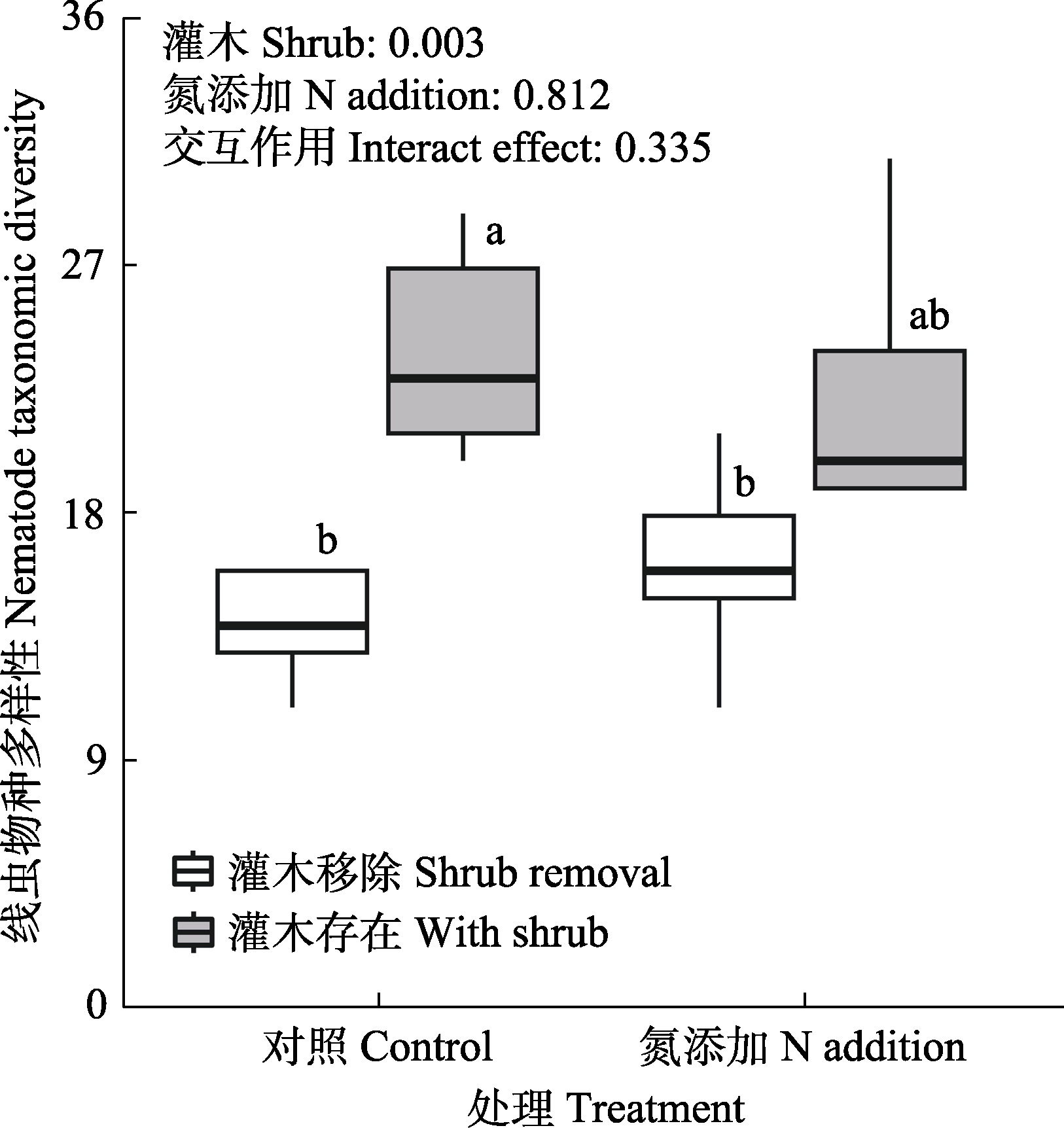
Fig. 1 Effects of shrub removal, nitrogen (N) addition, and their interaction on the nematode taxonomic diversity. Different lowercase letters indicate significant difference (p < 0.05).
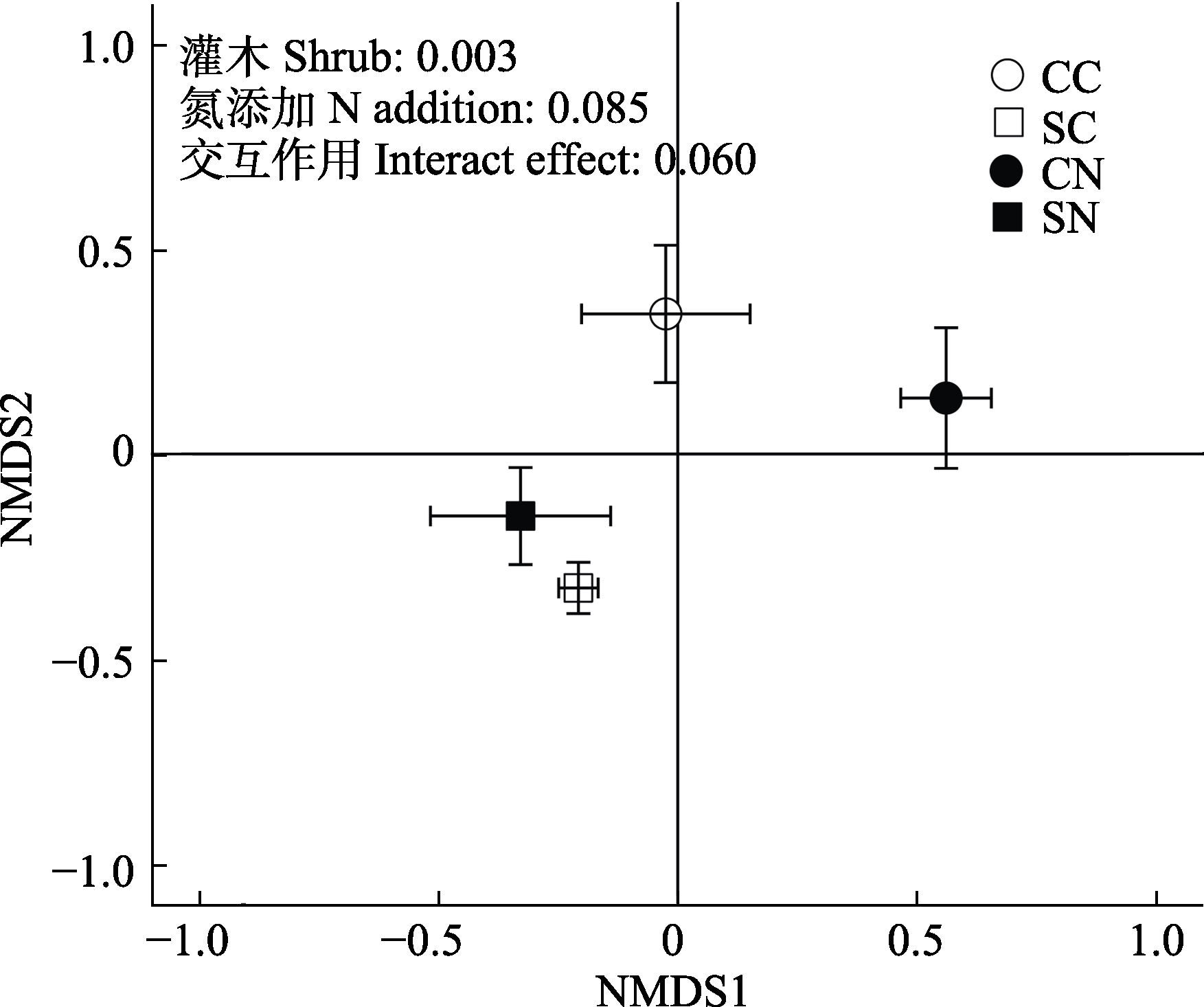
Fig. 2 Effects of shrub removal, nitrogen (N) addition, and their interaction on the nematode community composition. CC, shrub removal and no N addition; CN, shrub removal and N addition; SC, with shrub and no N addition; SN, with shrub and N addition. NMDS, non-metric multidimensional scaling analysis.
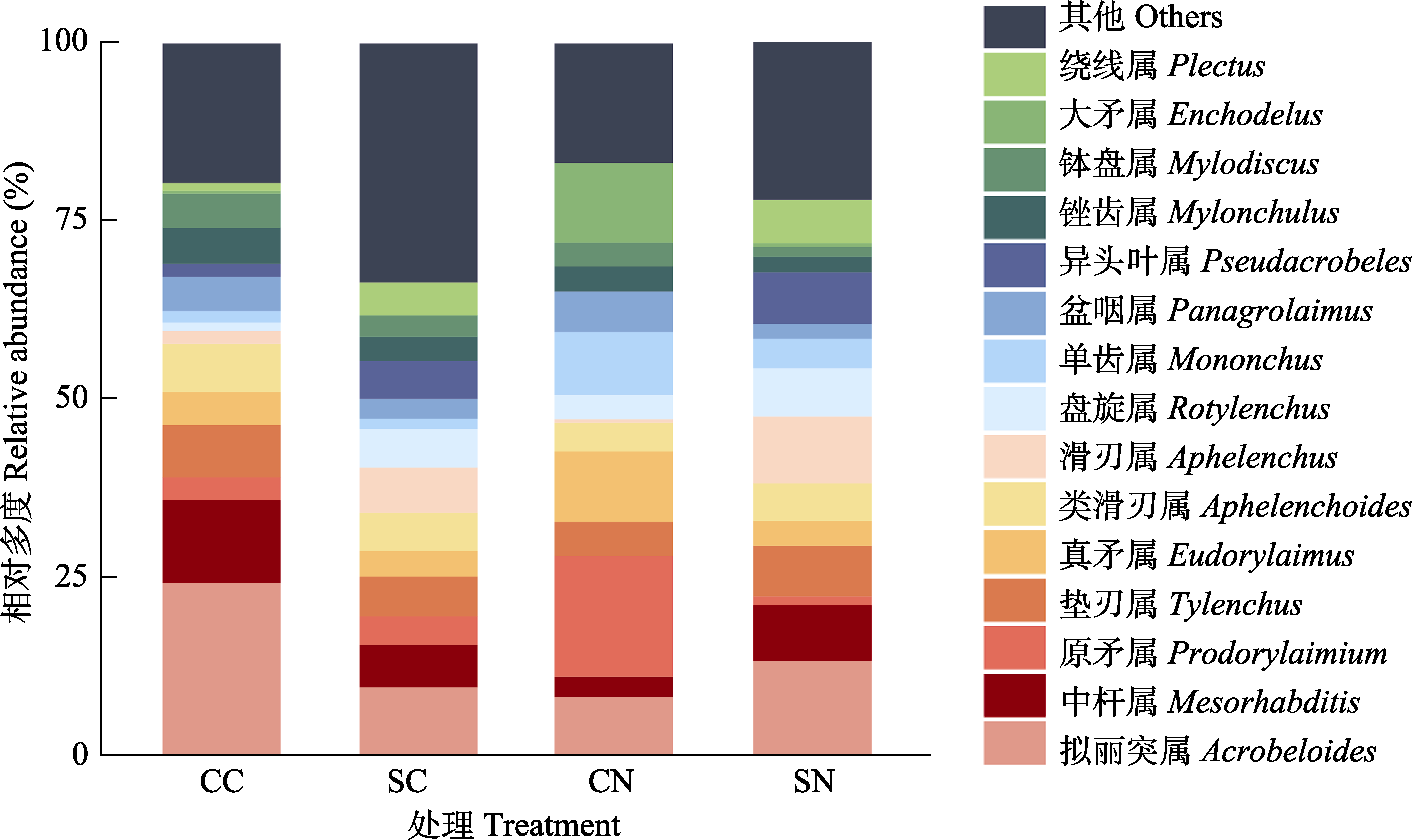
Fig. 3 Stacked bar of the effects of shrub removal, nitrogen addition, and their interaction on the relative abundance of nematode genera. CC, shrub removal and no nitrogen addition; CN, shrub removal and nitrogen addition; SC, with shrub and no nitrogen addition; SN, with shrub and nitrogen addition.
| 线虫属 Nematode | 对照 Control | 氮添加 Nitrogen addition | p | ||||
|---|---|---|---|---|---|---|---|
| 灌木存在 With shrub | 灌木移除 Shrub removal | 灌木存在 With shrub | 灌木移除 Shrub removal | 灌木效应 Shrub | 氮效应 Nitrogen | 交互作用 Shrub × nitrogen | |
| 拟丽突属 Acrobeloides | 12.44 ± 3.69a | 23.43 ± 4.99a | 15.64 ± 4.16a | 2.40 ± 1.17b | 0.075 | <0.001 | <0.001 |
| 中杆属 Mesorhabditis | 10.31 ± 4.30ab | 1.94 ± 1.16b | 10.94 ± 24.45a | 3.08 ± 1.82ab | 0.012 | 0.464 | 0.635 |
| 原矛属 Prodorylaimium | 4.82 ± 2.28b | 1.82 ± 1.04b | 0.91 ± 0.53b | 15.21 ± 4.37a | 0.946 | 0.076 | 0.002 |
| 垫刃属 Tylenchus | 7.95 ± 3.44a | 2.81 ± 1.68a | 9.27 ± 3.63a | 2.50 ± 1.36a | 0.167 | 0.864 | 0.746 |
| 真矛属 Eudorylaimus | 3.47 ± 1.91ab | 0.84 ± 0.58b | 3.51 ± 1.92ab | 9.45 ± 4.45a | 0.034 | <0.001 | 0.004 |
| 类滑刃属 Aphelenchoides | 4.26 ± 2.87a | 4.30 ± 2.57a | 3.66 ± 2.31a | 1.58 ± 1.10a | 0.986 | 0.083 | 0.279 |
| 滑刃属 Aphelenchus | 7.04 ± 1.86a | 0.46 ± 0.26b | 9.86 ± 2.21a | 0.22 ± 0.13b | <0.001 | 0.258 | 0.138 |
| 盘旋属 Rotylenchus | 8.72 ± 3.55a | 1.38 ± 0.82b | 2.98 ± 1.62ab | 2.57 ± 1.43ab | 0.002 | 0.318 | 0.045 |
| 单齿属 Mononchus | 1.26 ± 0.76b | 1.27 ± 0.76b | 2.42 ± 1.35ab | 10.08 ± 3.73a | 0.998 | <0.001 | 0.086 |
| 盆咽属 Panagrolaimus | 2.77 ± 1.52a | 2.66 ± 1.36a | 1.80 ± 0.97a | 4.30 ± 2.21a | 0.937 | 0.341 | 0.246 |
| 异头叶属 Pseudacrobeles | 5.80 ± 1.36a | 0.57 ± 0.29b | 7.61 ± 1.56a | 0.11 ± 0.07c | <0.001 | 0.010 | 0.007 |
| 锉齿属 Mylonchulus | 1.81 ± 1.16a | 5.50 ± 2.83a | 2.27 ± 1.25a | 2.36 ± 1.30a | 0.097 | 0.184 | 0.219 |
| 钵盘属 Mylodiscus | 2.12 ± 1.19ab | 7.22 ± 2.95a | 1.13 ± 0.69b | 1.22 ± 0.73b | 0.035 | 0.003 | 0.167 |
| 大矛属 Enchodelus | 0.33 ± 0.22b | 0.41 ± 0.28b | 0.41 ± 0.28b | 10.51 ± 3.12a | 0.733 | <0.001 | <0.001 |
| 绕线属 Plectus | 5.01 ± 1.00a | 0.12 ± 0.07b | 6.42 ± 1.14a | 0.07 ± 0.04b | <0.001 | 0.373 | 0.231 |
Table 1 Effects of shrub removal, nitrogen addition, and their interaction on the abundance of first 15 nematode genera (mean ± SE)
| 线虫属 Nematode | 对照 Control | 氮添加 Nitrogen addition | p | ||||
|---|---|---|---|---|---|---|---|
| 灌木存在 With shrub | 灌木移除 Shrub removal | 灌木存在 With shrub | 灌木移除 Shrub removal | 灌木效应 Shrub | 氮效应 Nitrogen | 交互作用 Shrub × nitrogen | |
| 拟丽突属 Acrobeloides | 12.44 ± 3.69a | 23.43 ± 4.99a | 15.64 ± 4.16a | 2.40 ± 1.17b | 0.075 | <0.001 | <0.001 |
| 中杆属 Mesorhabditis | 10.31 ± 4.30ab | 1.94 ± 1.16b | 10.94 ± 24.45a | 3.08 ± 1.82ab | 0.012 | 0.464 | 0.635 |
| 原矛属 Prodorylaimium | 4.82 ± 2.28b | 1.82 ± 1.04b | 0.91 ± 0.53b | 15.21 ± 4.37a | 0.946 | 0.076 | 0.002 |
| 垫刃属 Tylenchus | 7.95 ± 3.44a | 2.81 ± 1.68a | 9.27 ± 3.63a | 2.50 ± 1.36a | 0.167 | 0.864 | 0.746 |
| 真矛属 Eudorylaimus | 3.47 ± 1.91ab | 0.84 ± 0.58b | 3.51 ± 1.92ab | 9.45 ± 4.45a | 0.034 | <0.001 | 0.004 |
| 类滑刃属 Aphelenchoides | 4.26 ± 2.87a | 4.30 ± 2.57a | 3.66 ± 2.31a | 1.58 ± 1.10a | 0.986 | 0.083 | 0.279 |
| 滑刃属 Aphelenchus | 7.04 ± 1.86a | 0.46 ± 0.26b | 9.86 ± 2.21a | 0.22 ± 0.13b | <0.001 | 0.258 | 0.138 |
| 盘旋属 Rotylenchus | 8.72 ± 3.55a | 1.38 ± 0.82b | 2.98 ± 1.62ab | 2.57 ± 1.43ab | 0.002 | 0.318 | 0.045 |
| 单齿属 Mononchus | 1.26 ± 0.76b | 1.27 ± 0.76b | 2.42 ± 1.35ab | 10.08 ± 3.73a | 0.998 | <0.001 | 0.086 |
| 盆咽属 Panagrolaimus | 2.77 ± 1.52a | 2.66 ± 1.36a | 1.80 ± 0.97a | 4.30 ± 2.21a | 0.937 | 0.341 | 0.246 |
| 异头叶属 Pseudacrobeles | 5.80 ± 1.36a | 0.57 ± 0.29b | 7.61 ± 1.56a | 0.11 ± 0.07c | <0.001 | 0.010 | 0.007 |
| 锉齿属 Mylonchulus | 1.81 ± 1.16a | 5.50 ± 2.83a | 2.27 ± 1.25a | 2.36 ± 1.30a | 0.097 | 0.184 | 0.219 |
| 钵盘属 Mylodiscus | 2.12 ± 1.19ab | 7.22 ± 2.95a | 1.13 ± 0.69b | 1.22 ± 0.73b | 0.035 | 0.003 | 0.167 |
| 大矛属 Enchodelus | 0.33 ± 0.22b | 0.41 ± 0.28b | 0.41 ± 0.28b | 10.51 ± 3.12a | 0.733 | <0.001 | <0.001 |
| 绕线属 Plectus | 5.01 ± 1.00a | 0.12 ± 0.07b | 6.42 ± 1.14a | 0.07 ± 0.04b | <0.001 | 0.373 | 0.231 |
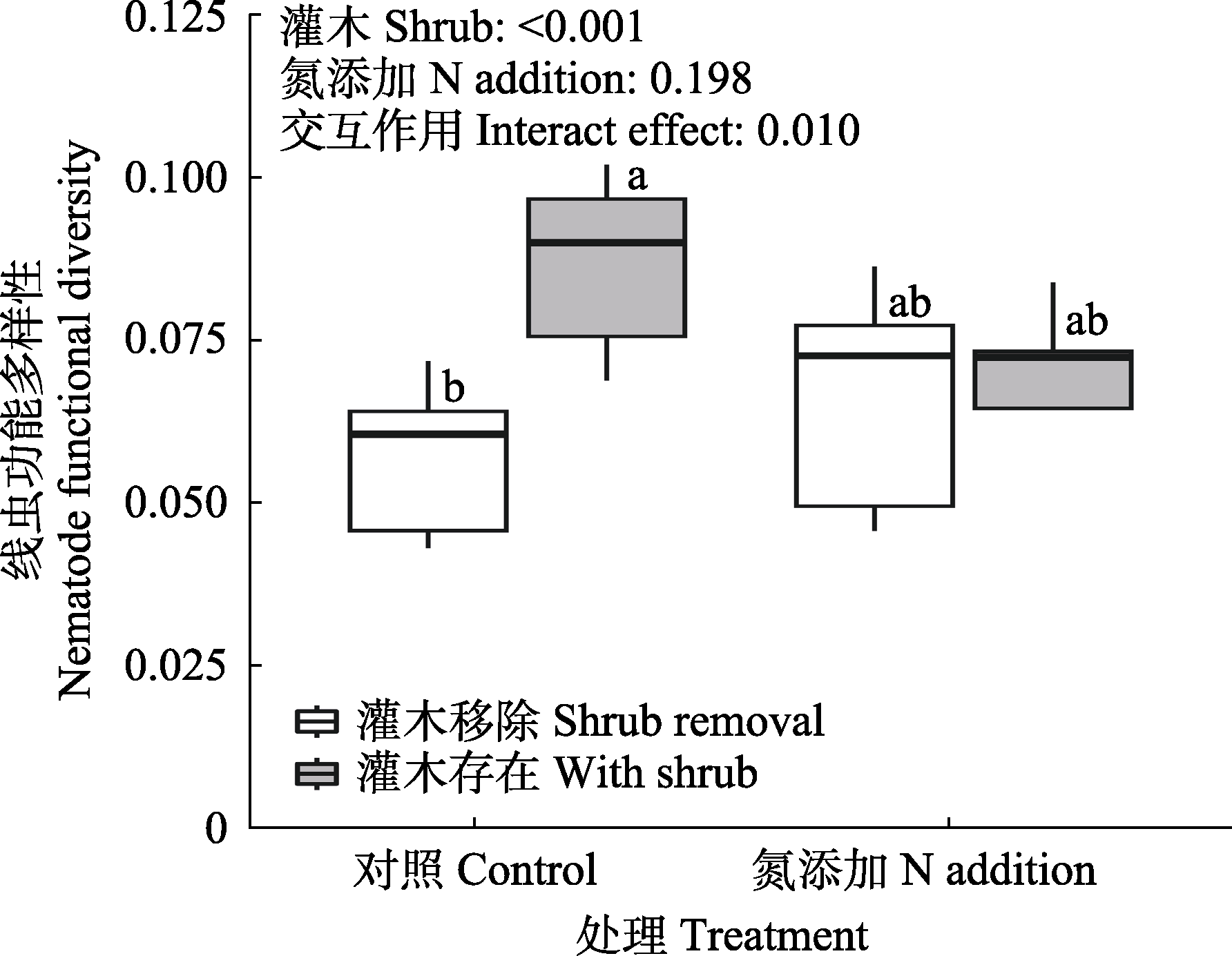
Fig. 4 Effects of shrub removal, nitrogen (N) addition, and their interaction on the nematode functional diversity. Different lowercase letters indicate significant difference (p < 0.05).
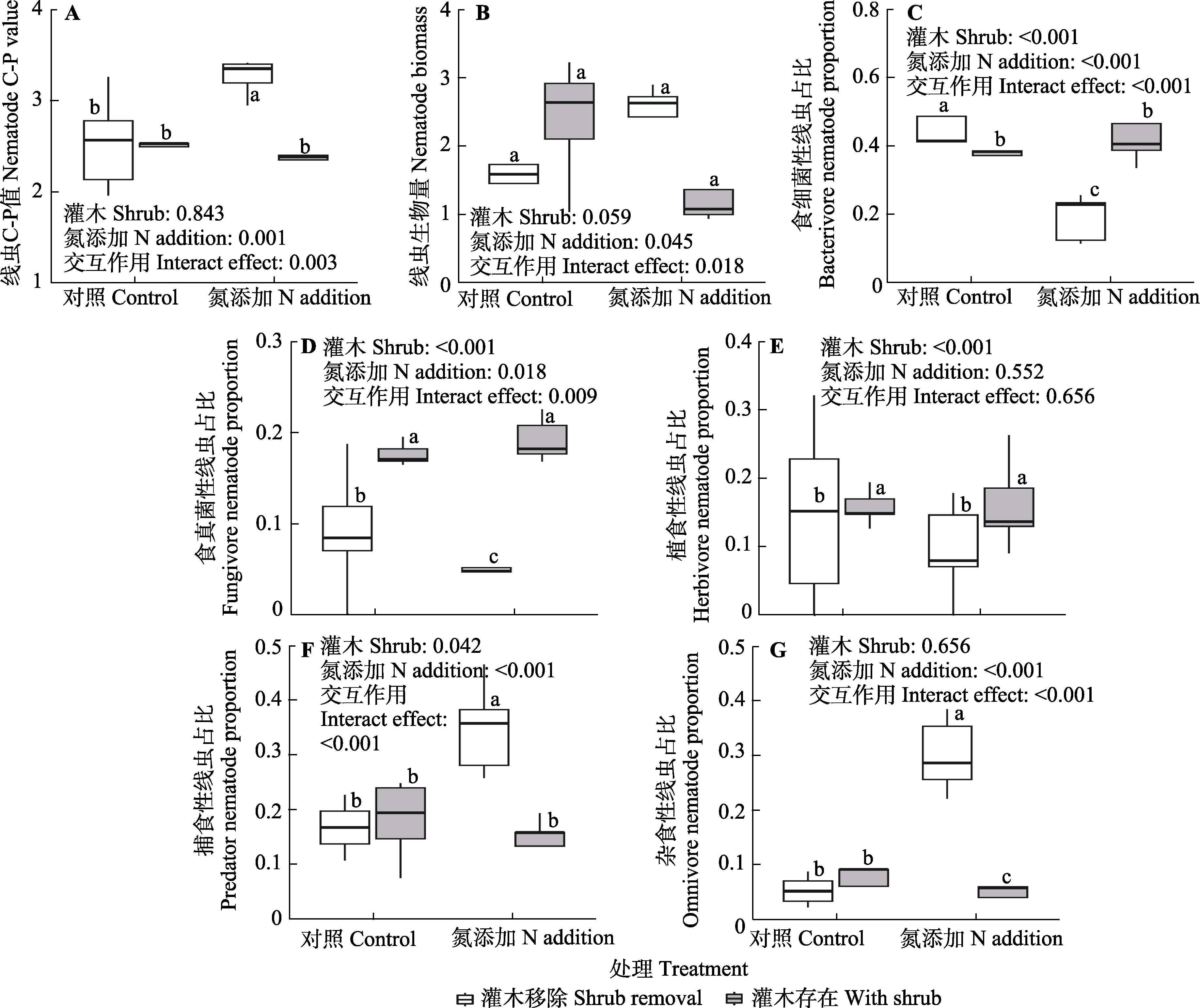
Fig. 5 Effects of shrub removal, nitrogen (N) addition, and their interaction on the functional traits of nematode communities. A, Community weighted mean of nematode C-P value. B, Community weighted mean of nematode biomass. C, Bacterivore nematode proportion. D, Fungivore nematode proportion. E, Herbivore nematode proportion. F, Predator nematode proportion. G, Omnivore nematode proportion. Proportion refers to abundance proportion. Different lowercase letters indicate significant difference (p < 0.05).
| 线虫指标 Nematode indicator | 土壤 pH | 电导率 Electrical conductivity | 含水量 Soil moisture | 土壤总磷含量 Total phosphorus content | 土壤硝态氮含量 Ammonium nitrogen content | 土壤铵态氮含量 Nitrate nitrogen content | 植物生物量 Plant biomass | 植物丰富度 Plant richness |
|---|---|---|---|---|---|---|---|---|
| 物种多样性 Taxonomic diversity | -0.096 | 0.168 | 0.083 | -0.535* | 0.043 | 0.025 | -0.253 | -0.032 |
| 功能多样性 Functional diversity | -0.001 | 0.090 | 0.184 | -0.342 | 0.072 | -0.145 | -0.171 | -0.020 |
| C-P值 C-P value | 0.139 | -0.125 | 0.412 | 0.108 | -0.498* | 0.089 | 0.350 | 0.275 |
| 线虫生物量 Biomass | 0.233 | 0.195 | 0.554* | -0.458* | -0.394 | 0.060 | -0.055 | 0.094 |
| 食细菌性占比 Bacterivore proportion | -0.068 | 0.199 | -0.341 | -0.044 | 0.462* | -0.131 | -0.301 | -0.154 |
| 食真菌性占比 Fungivore proportion | -0.047 | 0.072 | -0.175 | -0.321 | 0.216 | 0.063 | 0.486* | -0.356 |
| 植食性占比 Herbivore proportion | -0.136 | 0.136 | -0.372 | -0.134 | 0.168 | 0.013 | -0.278 | -0.227 |
| 杂食性占比 Omnivore proportion | -0.103 | -0.170 | 0.165 | 0.091 | -0.226 | 0.206 | 0.397 | 0.078 |
| 捕食性占比 Predator proportion | 0.269 | -0.191 | 0.546* | 0.224 | -0.522* | -0.076 | 0.415 | 0.427 |
Table 2 Correlation between the diversity and functional traits of soil nematodes and environmental factors
| 线虫指标 Nematode indicator | 土壤 pH | 电导率 Electrical conductivity | 含水量 Soil moisture | 土壤总磷含量 Total phosphorus content | 土壤硝态氮含量 Ammonium nitrogen content | 土壤铵态氮含量 Nitrate nitrogen content | 植物生物量 Plant biomass | 植物丰富度 Plant richness |
|---|---|---|---|---|---|---|---|---|
| 物种多样性 Taxonomic diversity | -0.096 | 0.168 | 0.083 | -0.535* | 0.043 | 0.025 | -0.253 | -0.032 |
| 功能多样性 Functional diversity | -0.001 | 0.090 | 0.184 | -0.342 | 0.072 | -0.145 | -0.171 | -0.020 |
| C-P值 C-P value | 0.139 | -0.125 | 0.412 | 0.108 | -0.498* | 0.089 | 0.350 | 0.275 |
| 线虫生物量 Biomass | 0.233 | 0.195 | 0.554* | -0.458* | -0.394 | 0.060 | -0.055 | 0.094 |
| 食细菌性占比 Bacterivore proportion | -0.068 | 0.199 | -0.341 | -0.044 | 0.462* | -0.131 | -0.301 | -0.154 |
| 食真菌性占比 Fungivore proportion | -0.047 | 0.072 | -0.175 | -0.321 | 0.216 | 0.063 | 0.486* | -0.356 |
| 植食性占比 Herbivore proportion | -0.136 | 0.136 | -0.372 | -0.134 | 0.168 | 0.013 | -0.278 | -0.227 |
| 杂食性占比 Omnivore proportion | -0.103 | -0.170 | 0.165 | 0.091 | -0.226 | 0.206 | 0.397 | 0.078 |
| 捕食性占比 Predator proportion | 0.269 | -0.191 | 0.546* | 0.224 | -0.522* | -0.076 | 0.415 | 0.427 |
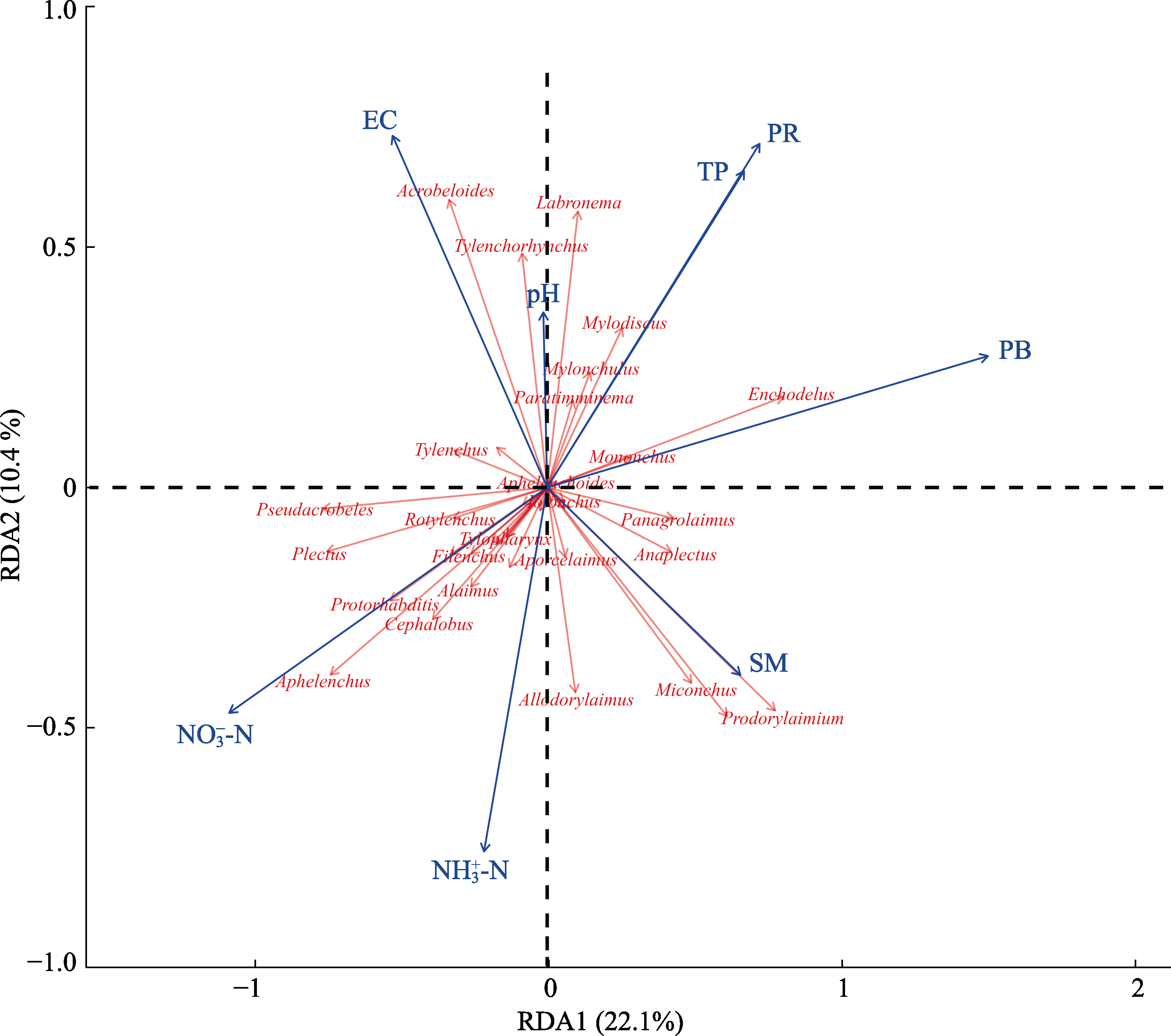
Fig. 6 Redundancy analysis (RDA) of two-dimensional diagram of the relationship between soil nematode community distribution and environment factors. Red lines represent nematode genera, and blue lines represent environmental factors. EC, electrical conductivity; NH+4-N, ammonium nitrogen content; NO-3-N, nitrate nitrogen content; PB, plant biomass; pH, soil pH; PR, plant richness; SM, soil moisture; TP, total phosphorus content.
| 变量 Variable | df | F | p |
|---|---|---|---|
| 土壤含水量 Soil moisture | 1 | 2.505 | 0.010 |
| 植物生物量 Plant biomass | 1 | 2.180 | 0.027 |
| 土壤总磷含量 Soil total phosphorus content | 1 | 1.622 | 0.092 |
| 电导率 Electrical conductivity | 1 | 1.211 | 0.247 |
| 土壤pH Soil pH | 1 | 0.891 | 0.547 |
| 土壤硝态氮含量 Soil ammonium nitrogen content | 1 | 1.313 | 0.191 |
| 土壤铵态氮含量 Soil nitrate nitrogen content | 1 | 1.254 | 0.223 |
| 植物丰富度 Plant richness | 1 | 0.838 | 0.581 |
| 残差 Residual | 11 |
Table 3 Redundancy analysis of the effect of environment factors on the nematode community composition
| 变量 Variable | df | F | p |
|---|---|---|---|
| 土壤含水量 Soil moisture | 1 | 2.505 | 0.010 |
| 植物生物量 Plant biomass | 1 | 2.180 | 0.027 |
| 土壤总磷含量 Soil total phosphorus content | 1 | 1.622 | 0.092 |
| 电导率 Electrical conductivity | 1 | 1.211 | 0.247 |
| 土壤pH Soil pH | 1 | 0.891 | 0.547 |
| 土壤硝态氮含量 Soil ammonium nitrogen content | 1 | 1.313 | 0.191 |
| 土壤铵态氮含量 Soil nitrate nitrogen content | 1 | 1.254 | 0.223 |
| 植物丰富度 Plant richness | 1 | 0.838 | 0.581 |
| 残差 Residual | 11 |
| [1] | An XL, Zhang ZH, Yang JP (2024). Expansion dynamics of the alpine shrub Potentilla fruticosa. Pratacultural Science, 41, 2823-2832. |
| [安栩立, 张振华, 杨建平 (2024). 青藏高原高寒灌木金露梅扩张态势分析. 草业科学, 41, 2823-2832.] | |
| [2] | Andriuzzi WS, Franco ALC, Ankrom KE, Cui SY, de Tomasel CM, Guan PT, Gherardi LA, Sala OE, Wall DH (2020). Body size structure of soil fauna along geographic and temporal gradients of precipitation in grasslands. Soil Biology & Biochemistry, 140, 107638. DOI: 10.1016/j.soilbio.2019.107638. |
| [3] |
Aranibar JN, Otter L, Macko SA, Feral CJW, Epstein HE, Dowty PR, Eckardt F, Shugart HH, Swap RJ (2004). Nitrogen cycling in the soil-plant system along a precipitation gradient in the Kalahari sands: nitrogen cycling in the Kalahari. Global Change Biology, 10, 359-373.
DOI URL |
| [4] | Bao SD (2000). Soil and Agrochemistry Analysis. 3 rd ed. China Agriculture Press, Beijing. |
| [鲍士旦 (2000) 土壤农化分析(第三版). 中国农业出版社, 北京.] | |
| [5] |
Biederman LA, Boutton TW (2009). Biodiversity and trophic structure of soil nematode communities are altered following woody plant invasion of grassland. Soil Biology & Biochemistry, 41, 1943-1950.
DOI URL |
| [6] | Blonder B (2016). Do hypervolumes have holes? The American Naturalist, 187, E93-E105. |
| [7] |
Collins CG, Stajich JE, Weber SE, Pombubpa N, Diez JM (2018). Shrub range expansion alters diversity and distribution of soil fungal communities across an alpine elevation gradient. Molecular Ecology, 27, 2461-2476.
DOI PMID |
| [8] | Erktan A, Or D, Scheu S (2020). The physical structure of soil: determinant and consequence of trophic interactions. Soil Biology & Biochemistry, 148, 107876. DOI: 10.1016/j.soilbio.2020.107876 |
| [9] |
Fitoussi N, Pen-Mouratov S, Steinberger Y (2016). Soil free-living nematodes as bio-indicators for assaying the invasive effect of the alien plant Heterotheca subaxillaris in a coastal dune ecosystem. Applied Soil Ecology, 102, 1-9.
DOI URL |
| [10] |
Franco ALC, Gherardi LA, de Tomasel CM, Andriuzzi WS, Ankrom KE, Shaw EA, Bach EM, Sala OE, Wall DH (2019). Drought suppresses soil predators and promotes root herbivores in mesic, but not in xeric grasslands. Proceedings of the National Academy of Sciences of the United States of America, 116, 12883-12888.
DOI PMID |
| [11] |
Gao Z, Huang J, Gao W, Jia MQ, Li XD, Han GD, Zhang GG (2023). Exploring the effects of warming and nitrogen deposition on desert steppe based on soil nematodes. Land Degradation & Development, 34, 682-697.
DOI URL |
| [12] | He X, Bai MM, Xu CL, Song MJ, Wang PB, Yu XJ (2021). Soil and vegetation successional responses in natural restoration of mixed Potentilla parvifolia-Salix cupularis shrubland in the Eastern Qilian Mountains. Acta Prataculturae Sinica, 30(8), 12-24. |
|
[贺翔, 白梅梅, 徐长林, 宋美娟, 汪鹏斌, 鱼小军 (2021). 东祁连山小叶金露梅+杯腺柳灌丛草地植被和土壤对其自然恢复演替的响应. 草业学报, 30(8), 12-24.]
DOI |
|
| [13] | Hodson AK, Ferris H, Hollander AD, Jackson LE (2014). Nematode food webs associated with native perennial plant species and soil nutrient pools in California riparian oak woodlands. Geoderma, 228, 182-191. |
| [14] |
Li XP, Zhu HM, Geisen S, Bellard C, Hu F, Li HX, Chen XY, Liu MQ (2020). Agriculture erases climate constraints on soil nematode communities across large spatial scales. Global Change Biology, 26, 919-930.
DOI PMID |
| [15] |
Liu T, Guo R, Ran W, Whalen JK, Li HX (2015). Body size is a sensitive trait-based indicator of soil nematode community response to fertilization in rice and wheat agroecosystems. Soil Biology & Biochemistry, 88, 275-281.
DOI URL |
| [16] |
Liu WX, Liu LL, Yang X, Deng MF, Wang Z, Wang PD, Yang S, Li P, Peng ZY, Yang L, Jiang L (2021). Long-term nitrogen input alters plant and soil bacterial, but not fungal beta diversity in a semiarid grassland. Global Change Biology, 27, 3939-3950.
DOI URL |
| [17] |
Mammola S, Cardoso P (2020). Functional diversity metrics using kernel density n-dimensional hypervolumes. Methods in Ecology and Evolution, 11, 986-995.
DOI URL |
| [18] | Wang GX, Mao TX, Chang J, Du JZ (2014). Impacts of surface soil organic content on the soil thermal dynamics of alpine meadows in permafrost regions: data from field observations. Geoderma, 232, 414-425. |
| [19] |
Wang HY, Wu JQ, Li G, Yan LJ, Wei XX, Ma WW (2022). Effects of simulated nitrogen deposition on soil active carbon fractions in a wet meadow in the Qinghai-Tibet Plateau. Journal of Soil Science and Plant Nutrition, 22, 2943-2954.
DOI |
| [20] | Wang XT, Xiao S, Yang XL, Liu ZY, Zhou XH, Du GZ, Zhang LM, Guo AF, Chen SY, Nielsen UN (2019). Dominant plant species influence nematode richness by moderating understory diversity and microbial assemblages. Soil Biology & Biochemistry, 137, 107566. DOI: 10.1016/j.soilbio.2019.107566. |
| [21] |
Wang YF, Liang EY, Lu XM, Camarero JJ, Babst F, Shen MG, Peñuelas J (2021). Warming-induced shrubline advance stalled by moisture limitation on the Tibetan Plateau. Ecography, 44, 1631-1641.
DOI URL |
| [22] | Wang YY, Xiao JF, Ma YM, Ding JZ, Chen XL, Ding ZY, Luo YQ (2023). Persistent and enhanced carbon sequestration capacity of alpine grasslands on Earth’s Third Pole. Science Advances, 9, eade6875. DOI: 10.1126/sciadv.ade6875. |
| [23] | Xing W, Lu XM, Niu SL, Chen DM, Wang JS, Liu Y, Wang BX, Zhang S, Li ZL, Yao XJ, Yu Q, Tian DS (2022). Global patterns and drivers of soil nematodes in response to nitrogen enrichment. Catena, 213, 106235. DOI: 10.1016/j.catena.2022.106235. |
| [24] | Xu QM, Gu XM, Wang YY, Du YG (2023). Simulated nitrogen deposition significantly increases nitrous oxide emission rate from alpine grassland on the Tibetan Plateau. Acta Agrestia Sinica, 31, 3785-3792. |
|
[许庆民, 顾晓梦, 王云英, 杜岩功 (2023). 模拟氮沉降显著提高青藏高原高寒草地氧化亚氮排放速率. 草地学报, 31, 3785-3792.]
DOI |
|
| [25] | Yang LC, Li CB, Ning Y, Nie XQ, Xu WH, Zhou GY (2017). Carbon density and its spatial distribution in the Potentilla fruticosa dominated alpine shrub in Qinghai, China. Chinese Journal of Plant Ecology, 41, 62-70. |
|
[杨路存, 李长斌, 宁祎, 聂秀青, 徐文华, 周国英 (2017). 青海高寒金露梅灌丛碳密度及其分配格局. 植物生态学报, 41, 62-70.]
DOI |
|
| [26] |
Yang XX, Ren F, Zhou HK, He JS (2014). Responses of plant community biomass to nitrogen and phosphorus additions in an alpine meadow on the Qinghai-Xizang Plateau. Chinese Journal of Plant Ecology, 38, 159-166.
DOI URL |
|
[杨晓霞, 任飞, 周华坤, 贺金生 (2014). 青藏高原高寒草甸植物群落生物量对氮、磷添加的响应. 植物生态学报, 38, 159-166.]
DOI |
|
| [27] | Yin WY (2000). Pictorial Keys to Soil Animal of China. Science Press, Beijing. |
| [尹文英 (2000). 中国土壤动物检索图鉴. 科学出版社, 北京.] | |
| [28] |
Zhang AN, Chen SY, Chen JW, Cui HW, Jiang XX, Xiao S, Wang JJ, Gao HN, An LZ, Cardoso P (2023). Shrub and precipitation interactions shape functional diversity of nematode communities on the Qinghai-Tibet Plateau. Global Change Biology, 29, 2746-2758.
DOI URL |
| [29] | Zhang AN, Song HX, Liu ZY, Cui HW, Ding HT, Chen SY, Xiao S, An LZ, Cardoso P (2024). Effects of plant taxonomic position on soil nematode communities in Antarctica. Conservation Biology, 38, e14264. DOI: 10.1111/cobi.14264. |
| [30] | Zhao F, Zhang MW, Wang CW, Mei XF, Xie LN, Ma CC (2022). Effects of Caragana shrub encroachment on soil nematode community composition and metabolic footprints in steppe desert region. Acta Ecologica Sinica, 42, 4124-4136. |
| [赵芳, 张明伟, 王春雯, 梅续芳, 解李娜, 马成仓 (2022). 锦鸡儿属灌丛化对草原化荒漠区土壤线虫群落组成和代谢足迹的影响. 生态学报, 42, 4124-4136.] |
| [1] | Jia-Le Chen, Ying-Fei Zhao, Hai-Chao Chang, Bi-Cheng Dong, Fei-Hai Yu. A framework and evaluation system for plant trait extraction based on large language models [J]. , 2026, 50(生态统计方法专题): 0-. |
| [2] | DING Ming-li, 魏 瑶, Jian-yu Jian-yu, LAN Yu-Ting, LIU Huiying, Zhang Zhen-hua. Response of antioxidant and osmotic adjustment systems to seasonal drought and photosynthetic regulation in typical alpine plants [J]. Chin J Plant Ecol, 2026, 50(5): 1187-1201. |
| [3] | Xinya BU, Wang Xiuwei. Effects of different forms of nitrogen addition on leaf traits and growth of seedlings of four temperate tree species [J]. Chin J Plant Ecol, 2026, 50(5): 1092-1104. |
| [4] | FENG Yi-Fan, ZHU Shi-Ying, ZHOU Shu-Rong, JIANG Le-Le, CHEN Long, WANG Miao, DENG Guo-Fang, LIU Lan. Impacts of soil microorganisms on survival and growth traits of different mycorrhizal tree seedlings in tropical secondary forest restoration [J]. Chin J Plant Ecol, 2026, 50(4): 846-858. |
| [5] | HONG Ling-Gui, AN Qi, ZHANG Fo-Jun, REN Yu-Fei, REN Zheng-Wei, ZHOU Xiao-Long. Nitrogen and phosphorus addition enhances deterministic processes in community assembly of alpine grasslands in Tianshan Mountains [J]. Chin J Plant Ecol, 2026, 50(4): 883-894. |
| [6] | RAO Chao-Kang, TANG Liang. Characteristics and drivers of mangrove phyllosphere microbial communities across different tidal elevations [J]. Chin J Plant Ecol, 2026, 50(4): 987-1002. |
| [7] | LIN Lin-Lin, XIAO Jin-Xiang, HUANG Shen-Shen, ZHAO Yang-Mei, ZHANG De-Xu, CHENG Yi-Kang, LONG Wen-Xing. Effects of phosphorus addition on functional traits across seedlings and saplings in a tropical cloud forest [J]. Chin J Plant Ecol, 2026, 50(4): 917-928. |
| [8] | DUAN Jian-Lin, MENG Sheng, CHEN Ren-Li, XIONG Lin-Feng, LU Chun-Yang, XI Nian-Xun. Impact of multiple global change factors on traits of mycorrhizal plants [J]. Chin J Plant Ecol, 2026, 50(4): 907-916. |
| [9] | LI Yi, HUANG Huan, ZHAO Yan-Chao, CHEN Li-Tong. Effects of nutrient addition on species diversity and composition of alpine meadows at different altitudes [J]. Chin J Plant Ecol, 2026, 50(4): 870-882. |
| [10] | ZHANG Yong-Jun, LI Jing-Dong, AN Qi, HONG Ling-Gui, REN Zheng-Wei, ZHANG Rui, ZHOU Xiao-Long. Effects of nitrogen addition and warming on community traits in an alpine grassland community of Tianshan Mountains [J]. Chin J Plant Ecol, 2026, 50(2): 417-428. |
| [11] | ZHANG Jing, CHEN Jie, LI Yan-Peng, PAN Li-Jun, XU Han, LI Yi-De, HE Hai-Sheng. Comparison of plant biomass in conifer and broadleaf mixed artificial forests in south subtropical area and analyses of influential factors [J]. Chin J Plant Ecol, 2026, 50(2): 400-416. |
| [12] | DAI Li-Jun, XIANG Ling-Yi, JIAN Chen, WANG Xiao-Feng. Intensified local differentiation in plant functional traits among typical herbaceous plants by backwater disturbance within riparian zone of small watersheds in the Three Gorges Reservoir area [J]. Chin J Plant Ecol, 2026, 50(2): 442-460. |
| [13] | WANG Shuang, CHEN Ya-Xuan, CHEN Yan-Mei, WANG Jia-Le, LIU Qian-Yuan. Root resource-acquisition strategies of Ziziphus jujuba in different habitats in typical areas of Taihang Mountains [J]. Chin J Plant Ecol, 2026, 50(2): 374-387. |
| [14] | CHEN Ya-Xuan, HAN Yu-Yin, CHEN Yan-Mei, LIU Qian-Yuan. Plant functional traits and carbon-nitrogen stoichiometry of plantations at different forest ages in North China [J]. Chin J Plant Ecol, 2026, 50(2): 318-333. |
| [15] | LIANG Tian-Hao, WU Fan, HUANG Jin-Xue, JING Chen-Hong, FU He-Jing, YANG Zhi-Jie, XIONG De-Cheng. Effects of soil warming on fine root growth and morphology of Castanopsis kawakamii in mid-subtropical forests [J]. Chin J Plant Ecol, 2026, 50(1): 94-106. |
| Viewed | ||||||
|
Full text |
|
|||||
|
Abstract |
|
|||||
Copyright © 2026 Chinese Journal of Plant Ecology
Tel: 010-62836134, 62836138, E-mail: apes@ibcas.ac.cn, cjpe@ibcas.ac.cn

