
Chin J Plant Ecol ›› 2026, Vol. 50 ›› Issue (6): 1496-1506.DOI: 10.17521/cjpe.2025.0191 cstr: 32100.14.cjpe.2025.0191
• Data Paper • Previous Articles
JIN Lian-Tong1, HOU Ya-Nan1, WANG Xian-Ting2, LANG Ze-Dong2, YU Li-Peng2, ZHANG Li-Fang3,*( ), LIU Li-Bin1,*(), NI Jian1
Received:2025-06-03
Accepted:2025-08-25
Online:2026-06-28
Published:2026-08-17
Contact:
ZHANG Li-Fang, LIU Li-Bin
Supported by:JIN Lian-Tong, HOU Ya-Nan, WANG Xian-Ting, LANG Ze-Dong, YU Li-Peng, ZHANG Li-Fang, LIU Li-Bin, NI Jian. Community characteristics and population dynamics of Parrotia subaequalis in its primary habitat within the Zhejiang Hynobius amjiensis National Nature Reserve[J]. Chin J Plant Ecol, 2026, 50(6): 1496-1506.
Add to citation manager EndNote|Ris|BibTeX
URL: https://www.plant-ecology.com/EN/10.17521/cjpe.2025.0191
| 样方编号 Plot number | 纬度 Latitude (N) | 经度 Longitude (E) | 海拔 Altitude (m) | 植被类型 Vegetation type |
|---|---|---|---|---|
| J1 | 30.41° | 119.44° | 824 | 小叶青冈林 Cyclobalanopsis gracilis Forest |
| J2 | 30.41° | 119.43° | 678 | 小叶白辛树林 Pterostyrax corymbosus Forest |
| J3 | 30.39° | 119.41° | 894 | 水青冈林 Fagus longipetiolata Forest |
| J4 | 30.39° | 119.41° | 900 | 山核桃林 Carya cathayensis Forest |
| J5 | 30.39° | 119.41° | 890 | 银缕梅林 Parrotia subaequalis Forest |
| J6 | 30.39° | 119.41° | 894 | 香果树、苦木林 Emmenopterys henryi, Picrasma quassioides Forest |
| J7 | 30.40° | 119.41° | 913 | 水青冈林 Fagus longipetiolata Forest |
| J8 | 30.40° | 119.41° | 839 | 臭椿林 Ailanthus altissima Forest |
| J9 | 30.40° | 119.41° | 770 | 银缕梅林 Parrotia subaequalis Forest |
| J10 | 30.40° | 119.41° | 897 | 杉木林 Cunninghamia lanceolata Forest |
| J11 | 30.40° | 119.41° | 672 | 杉木林 Cunninghamia lanceolata Forest |
| J12 | 30.40° | 119.41° | 664 | 金钱松林 Pseudolarix amabilis Forest |
| J13 | 30.40° | 119.41° | 656 | 银缕梅林 Parrotia subaequalis Forest |
| J14 | 30.40° | 119.41° | 652 | 短柄枹栎、化香树林 Quercus serrata, Platycarya strobilacea Forest |
| J15 | 30.42° | 119.42° | 777 | 秀丽槭、香槐、银缕梅林 Acer elegantulum, Cladrastis wilsonii, Parrotia subaequalis Forest |
| J16 | 30.42° | 119.42° | 797 | 银缕梅林 Parrotia subaequalis Forest |
| J17 | 30.40° | 119.39° | 694 | 小叶白辛树林 Pterostyrax corymbosus Forest |
| J18 | 30.40° | 119.39° | 726 | 青钱柳、杉木林 Cyclocarya paliurus, Cunninghamia lanceolata Forest |
| J19 | 30.40° | 119.41° | 677 | 紫弹树林 Celtis biondii Forest |
| J20 | 30.40° | 119.41° | 919 | 水青冈林 Fagus longipetiolata Forest |
| J21 | 30.40° | 119.41° | 930 | 苦木、紫弹树林 Picrasma quassioides, Celtis biondii Forest |
| J22 | 30.40° | 119.41° | 1 007 | 银缕梅林 Parrotia subaequalis Forest |
Table 1 Plot information of Parrotia subaequalis communities in their primary habitats within the Zhejiang Hynobius amjiensis National Nature Reserve
| 样方编号 Plot number | 纬度 Latitude (N) | 经度 Longitude (E) | 海拔 Altitude (m) | 植被类型 Vegetation type |
|---|---|---|---|---|
| J1 | 30.41° | 119.44° | 824 | 小叶青冈林 Cyclobalanopsis gracilis Forest |
| J2 | 30.41° | 119.43° | 678 | 小叶白辛树林 Pterostyrax corymbosus Forest |
| J3 | 30.39° | 119.41° | 894 | 水青冈林 Fagus longipetiolata Forest |
| J4 | 30.39° | 119.41° | 900 | 山核桃林 Carya cathayensis Forest |
| J5 | 30.39° | 119.41° | 890 | 银缕梅林 Parrotia subaequalis Forest |
| J6 | 30.39° | 119.41° | 894 | 香果树、苦木林 Emmenopterys henryi, Picrasma quassioides Forest |
| J7 | 30.40° | 119.41° | 913 | 水青冈林 Fagus longipetiolata Forest |
| J8 | 30.40° | 119.41° | 839 | 臭椿林 Ailanthus altissima Forest |
| J9 | 30.40° | 119.41° | 770 | 银缕梅林 Parrotia subaequalis Forest |
| J10 | 30.40° | 119.41° | 897 | 杉木林 Cunninghamia lanceolata Forest |
| J11 | 30.40° | 119.41° | 672 | 杉木林 Cunninghamia lanceolata Forest |
| J12 | 30.40° | 119.41° | 664 | 金钱松林 Pseudolarix amabilis Forest |
| J13 | 30.40° | 119.41° | 656 | 银缕梅林 Parrotia subaequalis Forest |
| J14 | 30.40° | 119.41° | 652 | 短柄枹栎、化香树林 Quercus serrata, Platycarya strobilacea Forest |
| J15 | 30.42° | 119.42° | 777 | 秀丽槭、香槐、银缕梅林 Acer elegantulum, Cladrastis wilsonii, Parrotia subaequalis Forest |
| J16 | 30.42° | 119.42° | 797 | 银缕梅林 Parrotia subaequalis Forest |
| J17 | 30.40° | 119.39° | 694 | 小叶白辛树林 Pterostyrax corymbosus Forest |
| J18 | 30.40° | 119.39° | 726 | 青钱柳、杉木林 Cyclocarya paliurus, Cunninghamia lanceolata Forest |
| J19 | 30.40° | 119.41° | 677 | 紫弹树林 Celtis biondii Forest |
| J20 | 30.40° | 119.41° | 919 | 水青冈林 Fagus longipetiolata Forest |
| J21 | 30.40° | 119.41° | 930 | 苦木、紫弹树林 Picrasma quassioides, Celtis biondii Forest |
| J22 | 30.40° | 119.41° | 1 007 | 银缕梅林 Parrotia subaequalis Forest |
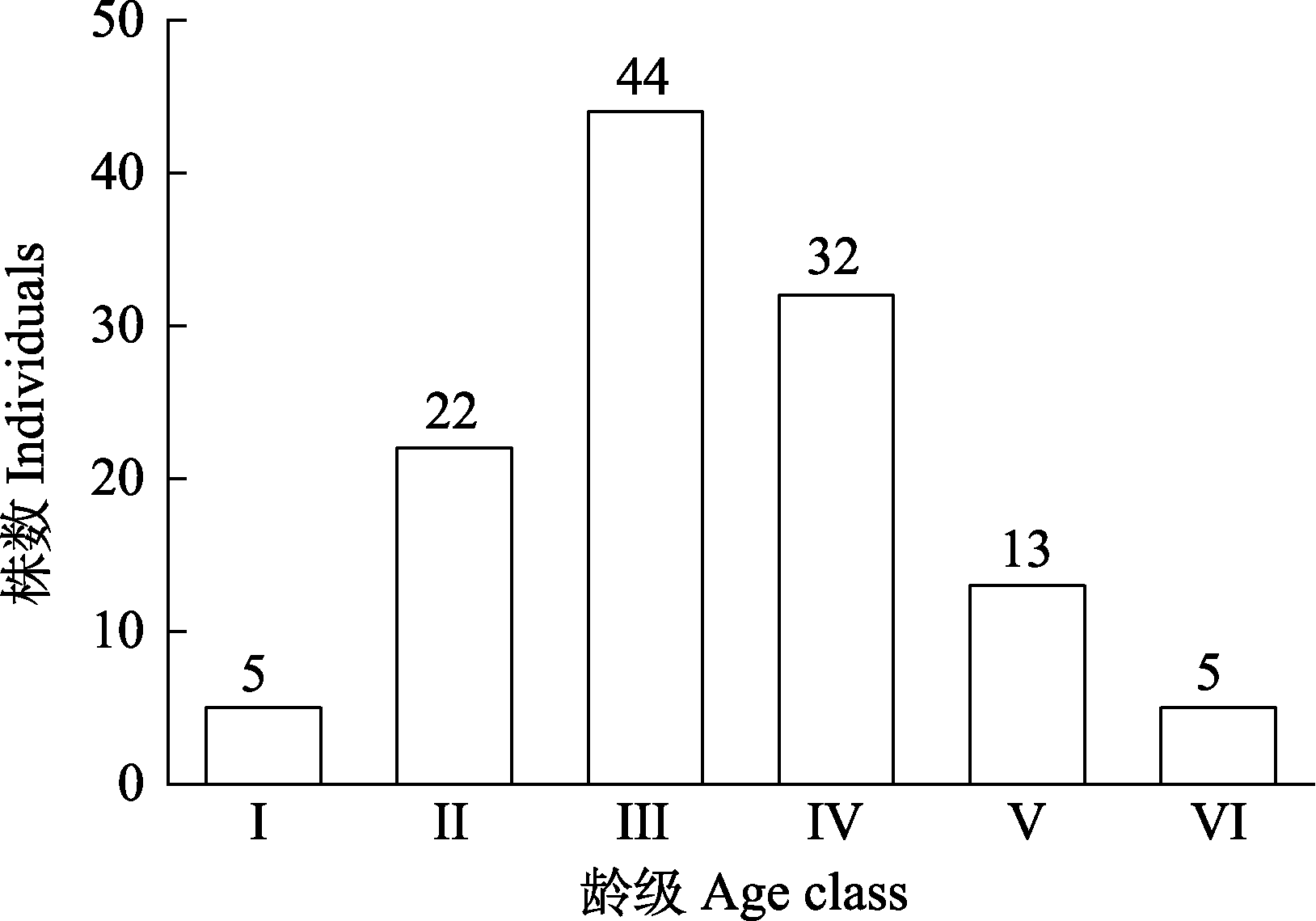
Fig. 1 Age structure of Parrotia subaequalis population. I, DBH < 2.5 cm; II, 2.5 cm ≤ DBH < 7.5 cm; III, 7.5 cm ≤ DBH < 12.5 cm; IV, 12.5 cm ≤ DBH < 17.5 cm; V, 17.5 cm ≤ DBH < 22.5 cm; VI, DBH ≥ 22.5 cm. DBH, diameter at breast height.
| 龄级 Age class | 存活数 No. of survival | Vx | Vpi | |
|---|---|---|---|---|
| I | 5 | -77.27 | 20.81 | 0.69 |
| II | 22 | -50.00 | ||
| III | 44 | 27.27 | ||
| IV | 32 | 59.38 | ||
| V | 13 | 61.54 | ||
| VI | 5 | 100.00 |
Table 2 Dynamic index of the age structure of Parrotia subaequalis
| 龄级 Age class | 存活数 No. of survival | Vx | Vpi | |
|---|---|---|---|---|
| I | 5 | -77.27 | 20.81 | 0.69 |
| II | 22 | -50.00 | ||
| III | 44 | 27.27 | ||
| IV | 32 | 59.38 | ||
| V | 13 | 61.54 | ||
| VI | 5 | 100.00 |
| 龄级 Age class | Ax | ax | lx | ln lx | dx | qx | Lx | Tx | ex | Sx | Kx |
|---|---|---|---|---|---|---|---|---|---|---|---|
| I | 5 | 40 | 1 000 | 6.908 | 225 | 0.225 | 887.500 | 2 525 | 2.525 | 0.775 | 0.255 |
| II | 22 | 31 | 775 | 6.653 | 225 | 0.290 | 662.500 | 1 638 | 2.114 | 0.710 | 0.343 |
| III | 44 | 22 | 550 | 6.310 | 200 | 0.364 | 450.000 | 975 | 1.773 | 0.636 | 0.452 |
| IV | 32 | 14 | 350 | 5.858 | 75 | 0.214 | 312.500 | 525 | 1.500 | 0.786 | 0.241 |
| V | 13 | 11 | 275 | 5.617 | 200 | 0.727 | 175.000 | 213 | 0.775 | 0.278 | 1.300 |
| VI | 5 | 3 | 75 | 4.317 | − | − | 37.500 | 38 | 0.507 | − | 4.317 |
Table 3 Static life table of Parrotia subaequalis population
| 龄级 Age class | Ax | ax | lx | ln lx | dx | qx | Lx | Tx | ex | Sx | Kx |
|---|---|---|---|---|---|---|---|---|---|---|---|
| I | 5 | 40 | 1 000 | 6.908 | 225 | 0.225 | 887.500 | 2 525 | 2.525 | 0.775 | 0.255 |
| II | 22 | 31 | 775 | 6.653 | 225 | 0.290 | 662.500 | 1 638 | 2.114 | 0.710 | 0.343 |
| III | 44 | 22 | 550 | 6.310 | 200 | 0.364 | 450.000 | 975 | 1.773 | 0.636 | 0.452 |
| IV | 32 | 14 | 350 | 5.858 | 75 | 0.214 | 312.500 | 525 | 1.500 | 0.786 | 0.241 |
| V | 13 | 11 | 275 | 5.617 | 200 | 0.727 | 175.000 | 213 | 0.775 | 0.278 | 1.300 |
| VI | 5 | 3 | 75 | 4.317 | − | − | 37.500 | 38 | 0.507 | − | 4.317 |
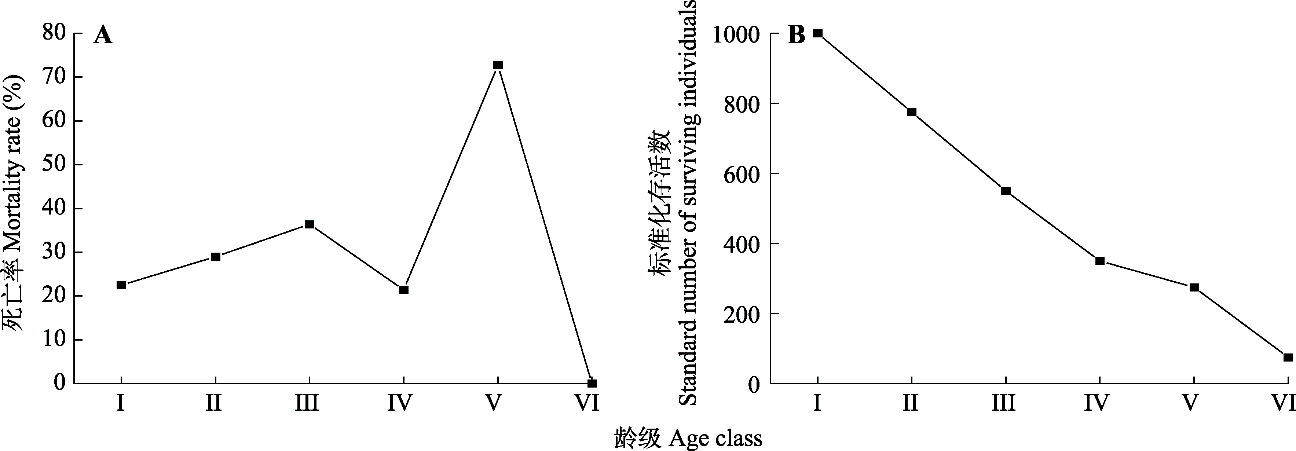
Fig. 2 Mortality rate curve (A) and survival curve (B) of Parrotia subaequalis population. The classification of age classes is consistent with that presented in Fig. 1.
| [1] | Chen XD (1998). A study on the method of quantitative analysis for plant population and community structural dynamics. Acta Ecologica Sinica, 18, 214-217. |
| [陈晓德 (1998). 植物种群与群落结构动态量化分析方法研究. 生态学报, 18, 214-217.] | |
| [2] | Condit R (1998). Tropical Forest Census Plots: Methods and Results from Barro Colorado Island, Panama and a Comparison with Other Plots. Springer, Berlin. |
| [3] | Deng MB, Jin YX, Sheng GY, Yang QS (1997). Observation on the growth of flower buds and flowering habit of Shaniodondron subaequale. Chinese Journal of Applied and Environmental Biology, 3, 226-229. |
| [邓懋彬, 金岳杏, 盛国英, 杨其生 (1997). 银缕梅花芽生长和开花习性的观察. 应用与环境生物学报, 3, 226-229.] | |
| [4] | Fang YM, Deng MB (1996). Wood anatomy of Shaniodendron subaequale (Hamamelidaceae) and its systematic implication. Journal of Plant Resources and Environment, 5(2), 50-54. |
| [方炎明, 邓懋彬 (1996). 银缕梅木材解剖特征及其系统学意义. 植物资源与环境, 5(2), 50-54.] | |
| [5] | Gong B, Xia YJ, Zhang GF, Lu Y, Sun G (2012). Population structure and spatial pattern of Parrotia subaequalis, a rare and endangered species endemic to China. Journal of Ecology and Rural Environment, 28, 638-646. |
| [龚滨, 夏洋洁, 张光富, 陆芸, 孙国 (2012). 中国特有珍稀濒危树种银缕梅种群结构和空间格局. 生态与农村环境学报, 28, 638-646.] | |
| [6] |
Hett JM, Loucks OL (1976). Age structure models of balsam fir and eastern hemlock. Journal of Ecology, 64, 1029-1044.
DOI URL |
| [7] | Hu GW (2013). Breeding technology and formula fertilization research of Parrotia subaequalis. Master degree dissertation, Zhejiang A & F University, Hangzhou. |
| [胡国伟 (2013). 银缕梅繁育技术及配方施肥研究. 硕士学位论文, 浙江农林大学, 杭州.] | |
| [8] | Huang SH, Fang YM, Peng Z, Yan JF, Fang SQ (2005). The niche study of shaniodendron subaequale population of Longchi Mountain. Journal of Central South Forestry University, 25(6), 80-83. |
| [黄绍辉, 方炎明, 彭冶, 颜建法, 方顺清 (2005). 江苏宜兴市龙池山银缕梅种群的生态位研究. 中南林学院学报, 25(6), 80-83.] | |
| [9] | Jiang H (1992). Population Ecology of Spruce. China Forestry Publishing House, Beijing. |
| [江洪 (1992). 云杉种群生态学. 中国林业出版社, 北京.] | |
| [10] | Lai FX, Ruan XD, Zhao K, Tai CR, Yang YF, Wu Y (2022). Study on endangered mechanism and breeding protection of Parrotia subaequalis. Journal of Anqing Normal University (Natural Science Edition), 28(4), 83-88. |
| [赖辅鑫, 阮向东, 赵凯, 台昌锐, 阳艳芳, 吴彦 (2022). 珍稀植物银缕梅濒危机理及繁育保护研究. 安庆师范大学学报(自然科学版), 28(4), 83-88.] | |
| [11] | Liu MZ, Zhu B, Yuan SQ, Zhou ZZ (2020). Pollen morphology of an endangered endemic species, Parrotia subaequalis. Acta Micropalaeontologica Sinica, 37(1), 99-104. |
| [刘明珍, 朱斌, 袁素强, 周忠泽 (2020). 我国特有珍稀濒危植物银缕梅(Parrotia subaequalis)的花粉形态研究. 微体古生物学报, 37(1), 99-104.] | |
| [12] | Liu XJ, Tang SJ, Yao G, Xiong YN (2008). Observation on the flowering process and flower morphology of Parrotia subaequalis. Jiangsu Agricultural Sciences, (6), 165-166. |
| [刘兴剑, 汤诗杰, 姚淦, 熊玉宁 (2008). 银缕梅开花过程与花形态观察. 江苏农业科学, (6), 165-166.] | |
| [13] |
Ma Y, Chen G, Grumbine RE, Dao Z, Sun W, Guo H (2013). Conserving plant species with extremely small populations (PSESP) in China. Biodiversity and Conservation, 22, 803-809.
DOI URL |
| [14] |
Ren H, Zhang QM, Lu HF, Liu HX, Guo QF, Wang J, Jian SG, Bao HO (2012). Wild plant species with extremely small populations require conservation and reintroduction in China. Ambio, 41, 913-917.
DOI PMID |
| [15] | Ren J, Zhang GF, Hu RK, Sun G, Yu LP (2012). Population structure and distribution pattern of Parrotia subaequalis from Longwangshan Nature Reserve, Zhejiang Province. Bulletin of Botanical Research, 32, 554-560. |
|
[任洁, 张光富, 胡瑞坤, 孙国, 俞立鹏 (2012). 浙江龙王山银缕梅种群结构和分布格局研究. 植物研究, 32, 554-560.]
DOI |
|
| [16] | Shang TJ, Xu QC, Tong PL, Ma TX, Yu ZL, Zhao MH, Wang YM, Jia TQ, Wu SJ, Xiang H (2025). Population structure and dynamic characteristics of wild Parrotia subaequalis in the Dabie Mountain Area. Journal of Henan Agricultural University, 59, 998-1005. |
| [尚铁军, 徐琦超, 仝蟠龙, 马天晓, 余泽龙, 赵梦幻, 王艳梅, 贾天琦, 吴胜军, 向辉 (2025). 大别山区野生银缕梅种群结构及动态特征. 河南农业大学学报, 59, 998-1005.] | |
| [17] | Shao XP (2011). Investigation on the current situation of community distribution and population protection of Anemone spicata. Anhui Agricultural Science Bulletin, 17(9), 48-49. |
| [邵小平 (2011). 银缕梅群落分布现状调查与种群保护. 安徽农学通报, 17(9), 48-49.] | |
| [18] |
Song YB, Xu L, Duan JP, Zhang WJ, Shentu XL, Li TX, Zang RG, Dong M (2020). Sex ratio and spatial pattern of Taxus fuana, a wild plant with extremely small populations in Tibet. Biodiversity Science, 28, 269-276.
DOI URL |
|
[宋垚彬, 徐力, 段俊鹏, 张卫军, 申屠晓露, 李天翔, 臧润国, 董鸣 (2020). 西藏极小种群野生植物密叶红豆杉种群的性比及雌雄空间格局. 生物多样性, 28, 269-276.]
DOI |
|
| [19] | Tan JR, Yuan WG, Li TT, Xu GL, Wu ZZ, Chen XM, Li WZ, Xu HC, Ku WP, Zhu JR, Wu CP (2022). Population structure and dynamic characteristics of an extremely small population plant Sinojackia microcarpa. Acta Ecologica Sinica, 42, 3678-3687. |
| [谭菊荣, 袁位高, 李婷婷, 许国良, 吴正柱, 陈小明, 李卫忠, 许惠春, 库伟鹏, 朱锦茹, 吴初平 (2022). 极小种群野生植物细果秤锤树种群结构与动态特征. 生态学报, 42, 3678-3687.] | |
| [20] | The Editorial Committee of Flora of Zhejiang (New Edition) (2021). Flora of Zhejiang (New Edition). Zhejiang Science and Technology Press, Hangzhou. |
| [浙江植物志(新编)编辑委员会 (2021). 浙江植物志(新编). 浙江科学技术出版社, 杭州.] | |
| [21] | The Editorial Committee of Vegetation Map of China, Chinese Academy of Sciences (2007). Vegetation of China and Its Geographic Pattern: Illustration of the Vegetation Map of the People’s Republic of China (1:1 000 000). Geological Publishing House Press, Beijing. |
| [中国科学院中国植被图编辑委员会 (2007). 中国植被及其地理格局: 中华人民共和国植被图(1:1 000 000)说明书. 地质出版社, 北京.] | |
| [22] | The Editorial Committee of Vegetation of China (1980). Vegetation of China. Science Press, Beijing. |
| [中国植被编辑委员会 (1980). 中国植被. 科学出版社, 北京.] | |
| [23] |
Volis S (2016). How to conserve threatened Chinese plant species with extremely small populations? Plant Diversity, 38, 45-52.
DOI PMID |
| [24] | Wang L, Zhao K, Ruan XD, Zhang C, Cao KB, Sun JJ (2018). Study on the population structure characteristics of the rare and endangered species Parrotia subaequalis—Taking Jinzhai County in Anhui Province as an example. Forest Resources Management, (3), 81-87. |
| [王林, 赵凯, 阮向东, 张超, 曹科斌, 孙晶晶 (2018). 珍稀濒危物种银缕梅种群结构特征研究——以安徽省金寨县为例. 林业资源管理, (3), 81-87.] | |
| [25] |
Wang YT, Liu XJ, Tang CF, Chen WY, Wang MJ, Xiang SZ, Liu M, Yang LS, Fu Q, Yan ZG, Meng HJ (2024). Community characteristics and population dynamics of Acer miaotaiense, an extremely small population species in Shennongjia, China. Chinese Journal of Plant Ecology, 48, 80-91.
DOI URL |
|
[王雨婷, 刘旭婧, 唐驰飞, 陈玮钰, 王美娟, 向松竹, 刘梅, 杨林森, 傅强, 晏召贵, 孟红杰 (2024). 神农架极小种群植物庙台槭群落特征及种群动态. 植物生态学报, 48, 80-91.]
DOI |
|
| [26] | Wildlife Protection and Nature Reserve Management Department of the State Forestry Administration (2013). Practice and Exploration of Wildlife Conservation for Extremely Small Population in Yunnan Province. Science Press, Kunming. |
| [国家林业局野生动植物保护与自然保护区管理司 (2013). 云南省极小种群野生植物保护实践与探索. 云南科技出版社, 昆明.] | |
| [27] | Wu XL, Zhou RH, Duan JA (1998). Preliminary studies on the chemical constituents in the stem bark of Shaniodendron subaequale (H. T. Chang) M. B. Deng, H. T. Wei et X. Q. Wang. Journal of Plant Resources and Environment, 7(4), 59-60. |
| [吴献礼, 周荣汉, 段金廒 (1998). 银缕梅茎皮的化学成分. 植物资源与环境, 7(4), 59-60.] | |
| [28] | Yan C, Wang ZS, An SQ, Chen SN, Wei N, Lu XM (2008). Differences in photosynthetic capacity among different diameter-classes of Parrotia subaequalis populations and their implications to regeneration limitation. Acta Ecologica Sinica, 28, 4153-4161. |
| [颜超, 王中生, 安树青, 陈姝凝, 魏娜, 陆霞梅 (2008). 濒危植物银缕梅(Parrotia subaequalis)不同径级个体的光合能力差异与更新限制. 生态学报, 28, 4153-4161.] | |
| [29] | Yang J, Cai L, Liu DT, Chen G, Gratzfeld J, Sun WB (2020). China’s conservation program on Plant Species with Extremely Small Populations (PSESP): progress and perspectives. Biological Conservation, 244, 108535. DOI: 10.1016/j.biocon.2020.108535. |
| [30] |
Yang J, Tao LD, Yang JR, Wu CF, Sun WB (2023). Integrated conservation of Acer yangbiense: a case study for conservation methods of plant species with extremely small populations. Plants, People, Planet, 5, 574-580.
DOI URL |
| [31] |
Yang WZ, Zhang SS, Wang WB, Kang HM, Ma N (2017). A sophisticated species conservation strategy for Nyssa yunnanensis, a species with extremely small populations in China. Biodiversity and Conservation, 26, 967-981.
DOI URL |
| [32] | Yang YF, Luo LK, Ding C, Yin MY, Zhai W, Zhao K (2024). Effects of gibberellin on seed germination and seedling growth of Parrotia subaequalis, a rare and endangered plant species. Chinese Journal of Ecology, 43, 2026-2032. |
| [阳艳芳, 罗来开, 丁聪, 尹明月, 翟伟, 赵凯 (2024). 赤霉素对珍稀濒危植物银缕梅种子萌发及幼苗生长的影响. 生态学杂志, 43, 2026-2032.] | |
| [33] |
Zang RG (2020). Research progress in wild plant with extremely small populations in China. Biodiversity Science, 28, 263-268.
DOI |
|
[臧润国 (2020). 中国极小种群野生植物保护研究进展. 生物多样性, 28, 263-268.]
DOI |
|
| [34] | Zhang GF, Yao R, Jiang YQ, Chen FC, Zhang WY (2016). Intraspecific and interspecific competition intensity of Parrotia subaequalis in different habitats from Wanfoshan Nature Reserve, Anhui Province. Chinese Journal of Ecology, 35, 1744-1750. |
| [张光富, 姚锐, 蒋悦茜, 陈福程, 张文燕 (2016). 安徽万佛山不同生境下银缕梅的种内与种间竞争强度. 生态学杂志, 35, 1744-1750.] | |
| [35] | Zhang LF, Fang YM (2018). Optimization and primer selection of SSR-PCR system of Parrotia subaequalis. Molecular Plant Breeding, 16, 5340-5346. |
| [张丽芳, 方炎明 (2018). 银缕梅SSR-PCR反应体系的优化及引物筛选. 分子植物育种, 16, 5340-5346.] | |
| [36] | Zhang LF, Wu YG, Feng J, Zhang Y, Hafsi A, Wu DH, Liu JL, Wei BL, Lv HF, Yu MJ (2024). Obstacles affecting seedling germination and reproductive success of the critically endangered species Abies beshanzuensis. Global Ecology and Conservation, 56, e03317. DOI: 10.1016/j.gecco.2024.eo3317. |
| [1] | . The influence of ephemeral rivers along the altitude gradient on the structure and distribution of plant communities [J]. Chin J Plant Ecol, 2026, 50(预发表): 0-. |
| [2] | Chen Ya-Song, Lan Zhi-Chun, Wang Yin-Liu, Jiang Xin-Yi, NIU Guo-Xiang. Effects of Nitrogen and Phosphorus Inputs on the Interspecific Competition of Dominant Plants in Poyang Lake [J]. Chin J Plant Ecol, 2026, 50(预发表): 1-. |
| [3] | CHEN Peng-Peng, WU Sheng-Li, ZHANG Yan, XIAO Jia-Qi, HUANG Lu-Rui, SHI Hui-Jie. Population structure and dynamics of Haloxylon ammodendron on parabolic dunes in Ebinur Lake watershed [J]. Chin J Plant Ecol, 2026, 50(4): 937-946. |
| [4] | CHEN Gang-Gang, ZHU Si-Jie, GUO Liang-Na, FU Fang-Wei, LIU Yu-Zhuo, LI Jiang-Rong. Aboveground and belowground nutrient allocation strategies for trees and shrubs at alpine treeline in Sygera Mountains of the southeastern Qingzang Plateau [J]. Chin J Plant Ecol, 2025, 49(9): 1515-1526. |
| [5] | ZHANG Lin, CHEN Hua-Yang, HUANG Zhen-Ying. Dataset of plant species composition and community characteristics of long-term observation plots in the Ordos sandy grassland from 2004 to 2010 [J]. Chin J Plant Ecol, 2025, 49(8): 1263-1270. |
| [6] | CHEN Long, GUO Ke, GOU Xiao-Hua, ZHAO Xiu-Hai, MA Hong-Ruo. Community components and characteristics of Juniperus przewalskii forests [J]. Chin J Plant Ecol, 2025, 49(6): 852-864. |
| [7] | JIA Yan-Yan, LIU Hua-Qing, XIE Xin-Ran, WANG Bo, ZHANG Wei, YANG Yun-Fei. Age structure and population dynamics of rare and endangered Fraxinus sogdiana, China [J]. Chin J Plant Ecol, 2025, 49(5): 760-772. |
| [8] | WANG Juan, ZHANG Deng-Shan, XIAO Yuan-Ming, PEI Quan-Bang, WANG Bo, FAN Bo, ZHOU Guo-Ying. Relationships between the characteristics of root exudate and environmental factors in the alpine steppe following long-term grazing exclusion [J]. Chin J Plant Ecol, 2025, 49(4): 596-609. |
| [9] | DU Hua-Dong, WANG Meng-Yu, NIE Wen-Jie, SUN Hao, CHE Xu-Xi, TANG Xun. Influence of photovoltaic arrays construction on plant community characteristics in subsidence areas in semi-arid coal mining area [J]. Chin J Plant Ecol, 2025, 49(11): 1778-1790. |
| [10] | HUANG Cheng-Ling, LI Rong-Han, QIN Hong-Ling, YANG Sheng-Xiong, TIAN Xiao-Ling, XIA Guo-Wei, CHEN Zheng-Ren, ZHOU Wei. Conservation genetics of Rhododendron liboense based on SNP molecular markers, a plant species with extremely small populations [J]. Chin J Plant Ecol, 2025, 49(10): 1677-1684. |
| [11] | YAO Bao-Hui, WANG Rong, TAN Zhao-Xian, ZHANG Yan, WANG Yi-Hong, WANG Su-Qin, ZHOU Hua-Kun, QU Jia-Peng. Effects of Eimeria spp. control of plateau pika on the plant community characteristics of alpine grassland [J]. Chin J Plant Ecol, 2025, 49(1): 199-210. |
| [12] | ZHANG Hui, ZHAO Yun-Peng, LIU Xiao-Chen, GUO Zeng-Peng, HU Guo-Rui, FENG Yan-Hao, MA Miao-Jun. Dynamics of soil seed bank and its role in plant community regeneration during alpine meadow degradation [J]. Chin J Plant Ecol, 2025, 49(1): 74-82. |
| [13] | DONG Shao-Qiong, HOU Dong-Jie, QU Xiao-Yun, GUO Ke. A plot-based dataset of plant communities on the Qaidam Basin, China [J]. Chin J Plant Ecol, 2024, 48(4): 534-540. |
| [14] | LIU Cong-Cong, HE Nian-Peng, LI Ying, ZHANG Jia-Hui, YAN Pu, WANG Ruo-Meng, WANG Rui-Li. Current and future trends of plant functional traits in macro-ecology [J]. Chin J Plant Ecol, 2024, 48(1): 21-40. |
| [15] | WANG Yu-Ting, LIU Xu-Jing, TANG Chi-Fei, CHEN Wei-Yu, WANG Mei-Juan, XIANG Song-Zhu, LIU Mei, YANG Lin-Sen, FU Qiang, YAN Zhao-Gui, MENG Hong-Jie. Community characteristics and population dynamics of Acer miaotaiense, an extremely small population species in Shennongjia, China [J]. Chin J Plant Ecol, 2024, 48(1): 80-91. |
| Viewed | ||||||
|
Full text |
|
|||||
|
Abstract |
|
|||||
Copyright © 2026 Chinese Journal of Plant Ecology
Tel: 010-62836134, 62836138, E-mail: apes@ibcas.ac.cn, cjpe@ibcas.ac.cn

