
Chin J Plant Ecol ›› 2016, Vol. 40 ›› Issue (3): 200-211.DOI: 10.17521/cjpe.2015.0161 cstr: 32100.14.cjpe.2015.0161
Special Issue: 生物多样性
• Research Articles • Previous Articles Next Articles
Jie HAN1, Ling-Xiao YING1, Gui-Xiang LI2, Ze-Hao SHEN1,*( )
)
Received:2015-05-07
Revised:2016-12-27
Online:2016-03-10
Published:2016-03-25
Contact:
Ze-Hao SHEN
Jie HAN, Ling-Xiao YING, Gui-Xiang LI, Ze-Hao SHEN. Spatial patterns of species diversity in the herb layer of early post-fire regeneration in mixed Pinus yunnanensis forests[J]. Chin J Plant Ecol, 2016, 40(3): 200-211.
Add to citation manager EndNote|Ris|BibTeX
URL: https://www.plant-ecology.com/EN/10.17521/cjpe.2015.0161
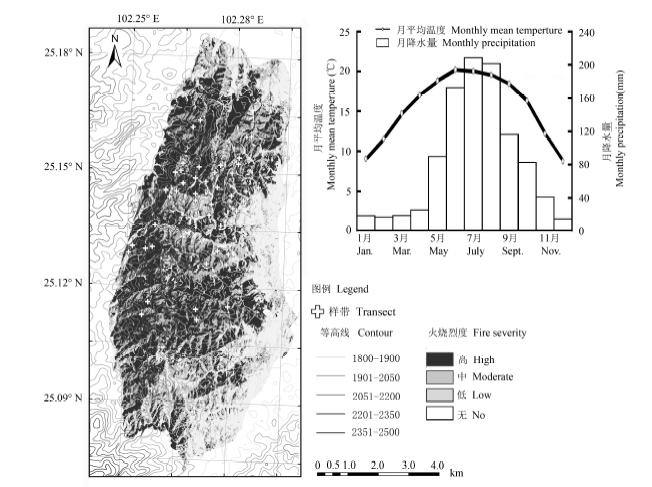
Fig. 1 The geographical location, climate, geomorphic feature of the burnt area (in 2013) and the distribution of sampling sites.
| 类型 Type | 变量 Variable | 定义及范围 Definition & value range |
|---|---|---|
| 火烧烈度 Fire severity | 火烧比例 Burn ratio | 0-1 |
| 火前植被 Pre-fire vegetation | ln(胸面积和) ln(Sum of basal area) | 样方中死树胸面积和的自然对数值 Natural logarithm of sum of basal area of dead trees in sample plot |
| 地形 Topography | 海拔 Elevation (m) | 1 928-2 331 m |
| 坡度 Slope gradient (°) | 5°-52° | |
| 坡向 Slope aspect (°) | 0°(N) -180°(S) | |
| 坡位 Slope position | 2-下坡位; 3-中坡位; 4-上坡位; 5-山顶 2-lower slope; 3-midslope; 4-upper slope; 5-top | |
| 坡形 Slope shape | 1-凹; 2-平; 3-凸 1-concave; 2-flat; 3-convex |
Table 1 Variables of post-fire vegetation and habitat investigations
| 类型 Type | 变量 Variable | 定义及范围 Definition & value range |
|---|---|---|
| 火烧烈度 Fire severity | 火烧比例 Burn ratio | 0-1 |
| 火前植被 Pre-fire vegetation | ln(胸面积和) ln(Sum of basal area) | 样方中死树胸面积和的自然对数值 Natural logarithm of sum of basal area of dead trees in sample plot |
| 地形 Topography | 海拔 Elevation (m) | 1 928-2 331 m |
| 坡度 Slope gradient (°) | 5°-52° | |
| 坡向 Slope aspect (°) | 0°(N) -180°(S) | |
| 坡位 Slope position | 2-下坡位; 3-中坡位; 4-上坡位; 5-山顶 2-lower slope; 3-midslope; 4-upper slope; 5-top | |
| 坡形 Slope shape | 1-凹; 2-平; 3-凸 1-concave; 2-flat; 3-convex |
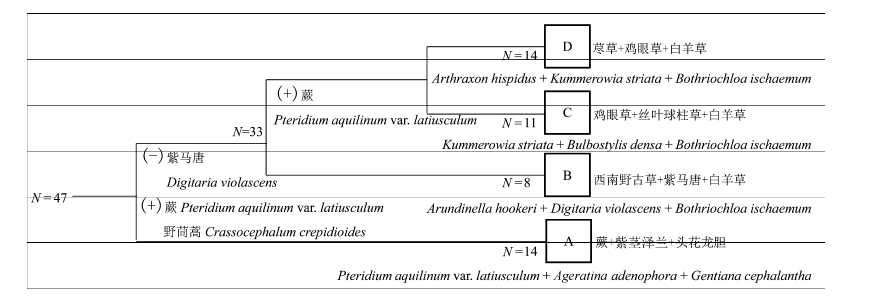
Fig. 2 The classification diagram of TWINSPAN for the herb layer of post-fire regenerated communities. N represents the number of transects. A, B, C, and D designate four types of post-fire regenerated herb communities. A, Pteridium aquilinum var. latiusculum + Ageratina adenophora + Gentiana cephalantha community; B, Arundinella hookeri + Digitaria violascens + Bothriochloa ischaemum community; C, Kummerowia striata + Bulbostylis densa + Bothriochloa ischaemum community; D, Arthraxon hispidus + Kummerowia striata + Bothriochloa ischaemum community. (+) means it is positive with classification; (-) means it is negetive with classification.
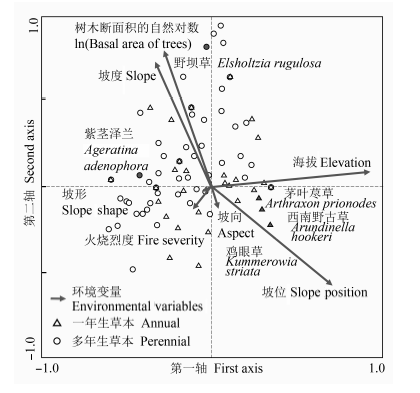
Fig. 3 The canonical correspondence analysis ordination pattern for the annual (∆) and perennial (○) plant species in the early post-fire regenerated communities.
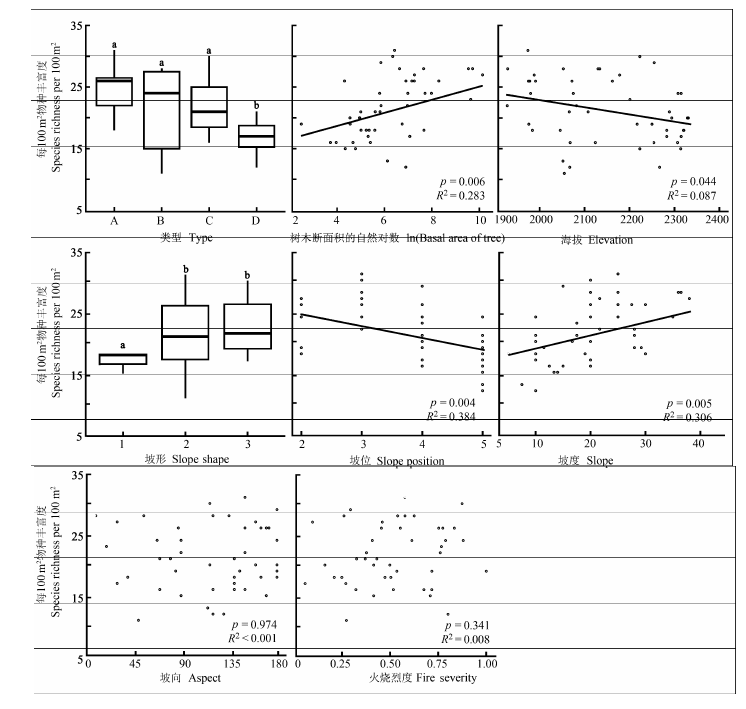
Fig. 4 The relationships between habitat factors and the species richness in herb layer of the transects of post-fire plant communities. The letters a and b above all box-plots refer to significantly different levels in t-test. A, B, C, and D designate four types of post-fire regenerated herb communities. A, Pteridium aquilinum var. latiusculum + Ageratina adenophora + Gentiana cephalantha community; B, Arundinella hookeri + Digitaria violascens + Bothriochloa ischaemum community; C, Kummerowia striata + Bulbostylis densa + Bothriochloa ischaemum community; D, Arthraxon hispidus + Kummerowia striata + Bothriochloa ischaemum community.
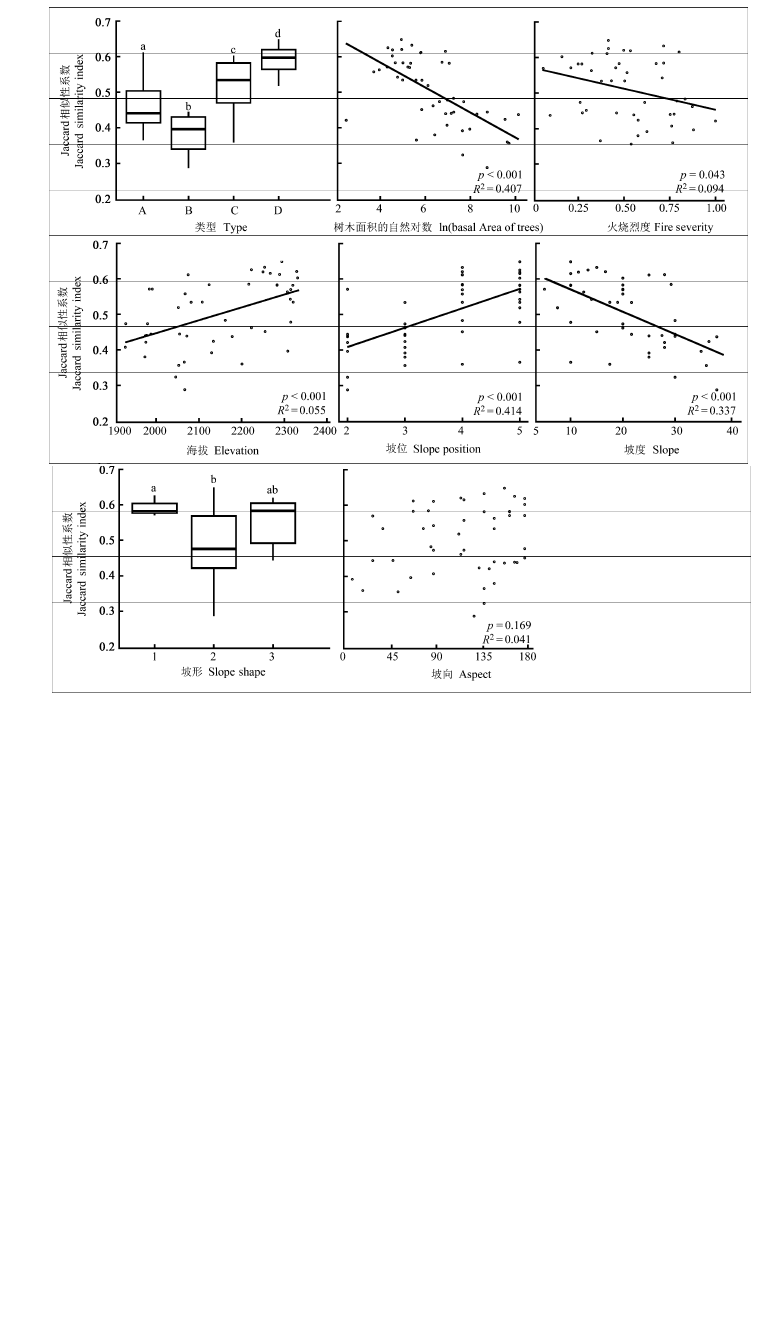
Fig. 5 The patterns of β-diversity in herb layer of post-fire plant communities. The letters a and b above all box-plots refer to significantly different levels in t-test. A, B, C, and D in the first graph panel designate four types of post-fire regenerated herb communities. A, Pteridium aquilinum var. latiusculum + Ageratina adenophora + Gentiana cephalantha community; B, Arundinella hookeri + Digitaria violascens + Bothriochloa ischaemum community; C, Kummerowia striata + Bulbostylis densa + Bothriochloa ischaemum community; D, Arthraxon hispidus + Kummerowia striata + Bothriochloa ischaemum community.
| 生境因子 Habitat factor | α多样性 α diversity | β多样性 β diversity | |||
|---|---|---|---|---|---|
| 样方尺度 Plot scale | 样带尺度 Transect scale | Jaccard系数 Jaccard index | Morisita-Horn系数 Morisita-Horn index | ||
| 海拔 Elevation | 3.8 | 12.0 | 16.8* | 1.9 | |
| 坡向 Aspect | 1.6 | 1.9 | 1.6 | 9.2 | |
| 坡形 Slope shape | 17.9* | 6.4 | 1.5 | 5.3 | |
| 坡位 Slope position | 54.7* | 30.6* | 20.7* | 13.4 | |
| 乔木胸面积对数 ln(sum of tree basal area) | 3.4 | 26.6* | 38.6* | 41.6* | |
| 坡度 Slope | 8.7* | 20.9* | 11.9* | 19.5* | |
| 火烧强度 Fire severity | 9.9* | 1.5 | 8.9* | 9.0 | |
| 调整的决定系数 Adjusted coefficient of determination | 0.172 | 0.645 | 0.678 | 0.638 | |
Table 2 Effects of habitat factors on the species diversity in herb layer of post-fire plant communities
| 生境因子 Habitat factor | α多样性 α diversity | β多样性 β diversity | |||
|---|---|---|---|---|---|
| 样方尺度 Plot scale | 样带尺度 Transect scale | Jaccard系数 Jaccard index | Morisita-Horn系数 Morisita-Horn index | ||
| 海拔 Elevation | 3.8 | 12.0 | 16.8* | 1.9 | |
| 坡向 Aspect | 1.6 | 1.9 | 1.6 | 9.2 | |
| 坡形 Slope shape | 17.9* | 6.4 | 1.5 | 5.3 | |
| 坡位 Slope position | 54.7* | 30.6* | 20.7* | 13.4 | |
| 乔木胸面积对数 ln(sum of tree basal area) | 3.4 | 26.6* | 38.6* | 41.6* | |
| 坡度 Slope | 8.7* | 20.9* | 11.9* | 19.5* | |
| 火烧强度 Fire severity | 9.9* | 1.5 | 8.9* | 9.0 | |
| 调整的决定系数 Adjusted coefficient of determination | 0.172 | 0.645 | 0.678 | 0.638 | |
| [1] | Abella SR, Covington WW (2006). Vegetation-environment relationships and ecological species groups of an Arizona Pinus ponderosa landscape, USA.Plant Ecology, 185, 255-268. |
| [2] | Ackerly D (2004). Functional strategies of chaparral shrubs in relation to seasonal water deficit and disturbance.Ecological Monographs, 74, 25-44. |
| [3] | Bond W, Keeley J (2005). Fire as a global ‘herbivore’: The ecology and evolution of flammable ecosystems.Trends in Ecology & Evolution, 20, 387-394. |
| [4] | Boneau CA (1960). The effects of violations of assumptions underlying the t test.Psychological Bulletin, 57, 49-64. |
| [5] | Bormann FH, Likens GE (2012). Pattern and Process in a Forested Ecosystem: Disturbance, Development and the Steady State Based on the Hubbard Brook Ecosystem Study. Springer Science & Business Media, New York. |
| [6] | Boucher D, Gauthier S, Noël J, Greene DF, Bergeron Y (2014). Salvage logging affects early post-fire tree composition in Canadian boreal forest.Forest Ecology and Management, 325,118-127. |
| [7] | Bowman DM, Balch JK, Artaxo P, Bond WJ, Carlson JM, Cochrane MA, D’Antonio CM, DeFries RS, Doyle JC, Harrison SP, Johnston FH, Keeley JE, Krawchuk MA, Kull CA, Marston JB, Moritz MA, Prentice IC, Roos CI, Scott AC, Swetnam TW, van der Werf GR, Pyne SJ (2009). Fire in the Earth system.Science, 324, 481-484. |
| [8] | Bowman DM, Balch JK, Artaxo P, Bond WJ, Cochrane MA, D’Antonio CM, DeFries R, Johnston FH, Keeley JE, Krawchuk MA, Kull CA, Mack M, Moritz MA, Pyne S, Roos CI, Scott AC, Sodhi NS, Swetnam TW (2011). The human dimension of fire regimes on Earth.Journal of Biogeography, 38, 2223-2236. |
| [9] | Broncano MJ, Retana J (2004). Topography and forest composition affecting the variability in fire severity and post-fire regeneration occurring after a large fire in the Mediterranean basin.International Journal of Wildland Fire, 13, 209-216. |
| [10] | Camac JS, Williams RJ, Wahren C, Morris WK, Morgan JW (2013). Post-fire regeneration in alpine heathland: Does fire severity matter?Austral Ecology, 38, 199-207. |
| [11] | Casady GM, van Leeuwen WJD, Marsh SE (2010). Evaluating post-wildfire vegetation regeneration as a response to multiple environmental determinants.Environmental Modeling & Assessment, 15, 295-307. |
| [12] | Crotteau JS, Morgan Varner J, Ritchie MW (2013). Post-fire regeneration across a fire severity gradient in the southern Cascades.Forest Ecology and Management, 287, 103-112. |
| [13] | Dai CR, Gu BW, Li JH (2011). The relationship between the severely affected forest fire season in Yunnan and the abnormal change of the Pacific Ocean surface temperature. Journal of Yunnan University (Natural Sciences), 33(S1), 188-191. (in Chinese with English abstract)[戴丛蕊, 顾本文, 李金槐 (2011). 云南林火重灾年与太平洋海温异常变化关系的研究. 云南大学学报(自然科学版), 33(S1), 188-191.] |
| [14] | Forrestel EJ, Donoghue MJ, Smith MD (2014). Convergent phylogenetic and functional responses to altered fire regimes in mesic savanna grasslands of North America and South Africa.New Phytologist, 203, 1000-1011. |
| [15] | Fox DM, Maselli F, Carrega P (2008). Using SPOT images and field sampling to map burn severity and vegetation factors affecting post forest fire erosion risk.Catena, 75, 326-335. |
| [16] | Guo Q (2001). Early post-fire succession in California chaparral: Changes in diversity, density, cover and biomass.Ecological Research, 16, 471-485. |
| [17] | Han J, Shen ZH, Ying LX, Chen A (2015). Early post-fire regeneration of a fire-prone subtropical Pinus mixed forest in Yunnan, southwest China: The effects of pre-fire vegetation, fire severity and topographic factors.Forest Ecology & Management, 356, 31-40. |
| [18] | Hill MO (1979). TWINSPAN—A FORTRAN Program for Arranging Multivariate Data in an Ordered Two-Way Table by Classification of the Individuals and Attributes. Cornell University Press, New York. |
| [19] | Hurtt GC, Pacala SW (1995). The consequences of recruitment limitation: reconciling chance, history and competitive differences between plants.Journal of Theoretical Biology, 176, 1-12. |
| [20] | Jaccard P (1912). The distribution of the flora in the alpine zone.New Phytologist, 11, 37-50. |
| [21] | Jin ZZ, Peng J (1998). Vegetation of Kunming. Yunnan Science and Technology Press, Kunming. (in Chinese)[金振洲, 彭鉴 (1988). 昆明植被. 云南科技出版社, 昆明.] |
| [22] | Keeley JE, Fotheringham CJ, Baer-Keeley M (2005). Factors affecting plant diversity during post-fire recovery and succession of Mediterranean-climate shrublands in California, USA.Diversity Distributions, 11, 525-537. |
| [23] | Kurkowski TA, Mann DH, Rupp TS, Verbyla DL (2008). Relative importance of different secondary successional pathways in an Alaskan boreal forest.Canadian Journal of Forest Research, 38, 1911-1923. |
| [24] | Lee J, Lee S, Lim J, Won M, Lee H (2014). Effects of heterogeneity of pre-fire forests and vegetation burn severity on short-term post-fire vegetation density and regeneration in Samcheok, Korea.Landscape and Ecological Engineering, 10, 215-228. |
| [25] | Liu CJ, Yang ZZ, Li Q, Lu ZX, Zhang W (2012). Impact of fire disturbance on Carabid beetles communities in forest of Pinus yunnanensis in Cangshan.Sichuan Journal of Zoology, 3, 387-392. (in Chinese with English abstract)[刘春菊, 杨自忠, 李巧, 卢志兴, 张威 (2012). 火干扰对苍山云南松林步甲群落的影响. 四川动物, 3, 387-392.] |
| [26] | Lobo J (2001). Spatial and environmental determinants of vascular plant species richness distribution in the Iberian Peninsula and Balearic Islands.Biological Journal of the Linnean Society, 73, 233-253. |
| [27] | Maia P, Keizer J, Vasques A, Abrantes N, Roxo L, Fernandes P, Ferreira A, Moreira F (2014). Post-fire plant diversity and abundance in pine and eucalypt stands in Portugal: Effects of biogeography, topography, forest type and post-fire management.Forest Ecology and Management, 334,154-162. |
| [28] | Maia P, Pausas JG, Vasques A, Keizer JJ (2012). Fire severity as a key factor in post-fire regeneration of Pinus pinaster (Ait.) in Central Portugal.Annals of Forest Science, 69, 489-498. |
| [29] | Mayer H, Swetnam TW (2000). Century scale climate forcing of fire regimes in the American Southwest.The Holocene, 10, 213-220. |
| [30] | Mouillot F, Ratte J, Joffre R, Mouillot D, Serge Rambal A (2005). Long-term forest dynamic after land abandonment in a fire prone Mediterranean landscape (central Corsica, France).Landscape Ecology, 20, 101-112. |
| [31] | Oliveira S, Pereira JMC, San-Miguel-Ayanz J, Lourenço L (2014). Exploring the spatial patterns of fire density in Southern Europe using Geographically Weighted Regression.Applied Geography, 51, 143-157. |
| [32] | Pausas JG (1994). Species richness patterns in the understory of Pyrenean Pinus sylvestris forest.Journal of Vegetation Science, 5, 517-524. |
| [33] | Roder A, Hill J, Duguy B, Alloza J, Vallejo R (2008). Using long time series of Landsat data to monitor fire events and post-fire dynamics and identify driving factors. A case study in the Ayora region (eastern Spain).Remote Sensing of Environment, 112, 259-273. |
| [34] | Roleček J, Tichý L, Zelený D, Chytrý M (2009). Modified TWINSPAN classification in which the hierarchy respects cluster heterogeneity.Journal of Vegetation Science, 20, 596-602. |
| [35] | Shen ZH, Fei SL, Feng JM, Liu YN, Liu ZL, Tang ZY, Wang XP, Wu XP, Zheng CY, Zhu B, Fang JY (2012). Geographical patterns of community-based tree species richness in Chinese mountain forests: The effects of contemporary climate and regional history.Ecography, 35, 1134-1146. |
| [36] | Shen ZH, Zhang XS, Jin YX (2000a). Spatial pattern analysis and topographical interpretation of species diversity in the forests of Dalaoling in the region of the Three Gorges.Acta Botanica Sinica, 42, 620-627. (in Chinese with English abstract)[沈泽昊, 张新时, 金义兴 (2000a). 三峡大老岭森林物种多样性的空间格局分析及其地形解释. 植物学报, 42, 620-627.] |
| [37] | Shen, ZH, Jin YX, Zhao ZE, Wu JQ, Huang HD (2000b). A study on the quantitative classification of forest communities of Dalaoling region at the Three Gorges.Journal of Wuhan Botanical Research, 18, 99-107. (in Chinese with English abstract)[沈泽昊, 金义兴, 赵子恩, 吴金清, 黄汉东 (2000b). 三峡大老岭地区森林群落的数量分类研究. 武汉植物学研究, 18, 99-107.] |
| [38] | Su WH, Shi Z, Zhou R, Zhao YJ, Zhang GF (2015). Thr role of fire in the Central Yunnan Plateau ecosystem, southwestern China.Forest Ecology and Management, 356, 22-30. |
| [39] | Swanson FJ, Kratz TK, Caine N (1988). Landform effects on ecosystem patterns and processes.BioScience, 38, 92-98. |
| [40] | Tang RR, Zhou RL (2007). Study on the fuel loading forecast models of Pinus yunnanensis.Shandong Forestry Science and Technology, 1, 1-4. (in Chinese with English abstract)[唐荣逸, 周汝良 (2007). 云南松可燃物载量预测模型研究. 山东林业科技, 1, 1-4.] |
| [41] | Vallejo VR, Alloza JA (2012). Post-fire management in the Mediterranean Basin.Israel Journal of Ecology and Evolution, 58, 251-264. |
| [42] | Walsh C, Mac Nally R (. |
| [43] | Wang QH, Shu LF, Li SY (2011). Study on spotting of Pinus yunnanensis forest during burning.Journal of Safety Science and Technology, 7, 49-53. (in Chinese with English abstract)[王秋华, 舒立福, 李世友 (2011). 云南松林燃烧过程中飞火的研究.中国安全生产科学技术, 7, 49-53.] |
| [44] | Wang S, Niu SK, Li D, Wang JH, Chen F, Sun W (2013). Vertical distribution of fuels in Pinus yunnanensis forest and related affecting factors. Chinese Journal of Applied Ecology, 24, 331-337. (in Chinese with English abstract)[王叁, 牛树奎, 李德, 王景华, 陈锋, 孙武 (2013). 云南松林可燃物的垂直分布及影响因子. 应用生态学报, 24, 331-337.] |
| [45] | Whigham DF (2004). Ecology of woodland herbs in temperate deciduous forests.Annual Review of Ecology, Evolution, and Systematics, 35, 583-621. |
| [46] | Wolda H (1981). Similarity indices, sample size and diversity.Oecologia, 50, 296-302. |
| [47] | Zhang YT, Duan X, Li JF (1994). Climatic regionalization of forest fires in the central Yunnan region.Journal of Southwest Forestry College, 3, 122-127. (in Chinese with English abstract)[张映堂, 段旭, 李俊峰 (1994). 滇中地区林火气候区划. 西南林学院学报, 3, 122-127.] |
| [1] | Yang Meihua, Zhang ZiJia, Qiao Dong, Feng Junna, Pang ZiJie, Qian Long, Liu Zhihui, Cai Nana, Hu Zhongmin, Yang Guojiao. A dataset of arbor community surveys and species diversity in Hainan tropical forests [J]. Chin J Plant Ecol, 2026, 50(预发表): 0-. |
| [2] | Qing He, Xudong Yuan, Boshen Ren, Zhiyang Feng, Mengzhen Lu, Qiaoling Lin, Qinghu Jiang, Linsen Yang, Huiliang Yu, Hui Yao, Jingyuan Yang, Feng Liu, Mingxi Jiang. Effects of Erigeron annuus invasion on plant community structure and diversity in subalpine peat wetlands [J]. Chin J Plant Ecol, 2026, 50(预发表): 0-. |
| [3] | CAI Rong-Rong, SHEN Li-Du, LIU Ya-Ge, FEI Wen-Li, DAI Guan-Hua. Dataset of plant species composition and community characteristics of the Changbai Mountain broadleaf Korean pine forest permanent plot from 2005 to 2010 [J]. Chin J Plant Ecol, 2025, 49(8): 1236-1245. |
| [4] | BAI Fan, WANG Yang. Dataset of plant species composition and community characteristics from a long-term observation plot of warm-temperate deciduous broadleaf forests in Dongling Mountain, Beijing from 2007 to 2015 [J]. Chin J Plant Ecol, 2025, 49(8): 1229-1235. |
| [5] | ZHAO Chang-Ming, XIONG Gao-Ming, SHEN Guo-Zhen, GE Jie-Lin, XU Wen-Ting, XU Kai, WU Yuan-Shuai, XIE Zong-Qiang. Dataset of plant species composition and community characteristics of mixed evergreen and deciduous broadleaf forest and subalpine coniferous forest of Shennongjia in 2010 [J]. Chin J Plant Ecol, 2025, 49(8): 1215-1228. |
| [6] | RAO Xing-Quan, CAI Xi-An, LIN Yong-Biao, LIU Su-Ping. Dataset of plant species composition and community characteristics of a long-term observation plot of Acacia mangium forest plantation at Heshan Station from 2005 to 2015 [J]. Chin J Plant Ecol, 2025, 49(8): 1246-1254. |
| [7] | XU Zhi-Xiong, QI Jin-Hua, YANG Guo-Ping, LU Zhi-Yun, YANG Xiao-Dong, FAN Ze-Xin. Dataset of plant species composition and community characteristics in a long-term observation plot of mid-mountain moist evergreen broadleaf forest at Ailaoshan Station from 2005 to 2010 [J]. Chin J Plant Ecol, 2025, 49(8): 1191-1204. |
| [8] | ZHOU Zhi-Qiong, DING Jian-Lin, LI Xiao-Ming, HE Qi-Hua. Dataset on plant species composition and community characteristics in a long-term observation plot of montane coniferous plantations in southwest China from 2005 to 2010 [J]. Chin J Plant Ecol, 2025, 49(8): 1255-1262. |
| [9] | LIU Shi-Zhong, ZHANG Qian-Mei, ZHANG De-Qiang, LIU Ju-Xiu, CHU Guo-Wei, LI Yue-Lin. Dataset of plant species composition and community characteristics in a long-term observation plot of monsoon evergreen broadleaf forest in Dinghushan from 1999 to 2015 [J]. Chin J Plant Ecol, 2025, 49(8): 1205-1214. |
| [10] | ZHANG Kun, YI Li-Qing, LIU Zhan-Jun, ZHANG Zhi-Jie, WANG Xu, LI Ming-Le, MIAO Bai-Ling, ZHANG Jing-Hui, LI Zhi-Yong, DONG Lei, LIANG Cun-Zhu. Characteristics and classification of Caragana tibetica community [J]. Chin J Plant Ecol, 2025, 49(6): 888-896. |
| [11] | HAN Peng-Bin, PEI Kang-Di, HE Bin, XIAO Shu-Li, TANG Cindy Q.. Community composition and characteristics of Tsuga dumosa forests in China [J]. Chin J Plant Ecol, 2025, 49(6): 840-851. |
| [12] | HE Bin, HAN Peng-Bin, TANG Cindy Q.. Community types and characteristics of Keteleeria davidiana forests in China [J]. Chin J Plant Ecol, 2025, 49(6): 833-839. |
| [13] | HAN Peng-Bin, HE Bin, LU Shu-Gang, TANG Cindy Q.. Community types and characteristics of Keteleeria pubescens forests in China [J]. Chin J Plant Ecol, 2025, 49(6): 825-832. |
| [14] | DU Yan, LIU Xin, ZHANG Han-Yue, MA Shao-Wei, BAO Wei-Kai. Community characteristics of Pinus densata Alliance in China [J]. Chin J Plant Ecol, 2025, 49(6): 816-824. |
| [15] | ZHENG Li-Yuan, XU Xi-Zhu, YIN Jia-Qi, SUN Xiao-Wen, WANG Yan. Niche and interspecific associations of Glycine soja community on abandoned farmland near a river in suburban [J]. Chin J Plant Ecol, 2025, 49(10): 1685-1697. |
| Viewed | ||||||
|
Full text |
|
|||||
|
Abstract |
|
|||||
Copyright © 2026 Chinese Journal of Plant Ecology
Tel: 010-62836134, 62836138, E-mail: apes@ibcas.ac.cn, cjpe@ibcas.ac.cn

