
Chinese Journal of Plant Ecology >
Global patterns and controls of variation in cellulose decomposition rates of plant litters
Received date: 2024-05-08
Accepted date: 2024-12-10
Online published: 2025-01-02
Supported by
National Key R&D Program of China(2023YFF1305500);National Natural Science Foundation of China(32022056);National Natural Science Foundation of China(32101509);National Natural Science Foundation of China(32171641)
Aims As one of the key components of litter, cellulose decomposition plays an important role in the carbon cycle of terrestrial ecosystems. The objective of this study was to investigate the global patterns of cellulose decomposition rates of plant litters and the associated influential factors.
Methods We compiled a dataset from existing studies that reported the litter cellulose decomposition constant (i.e., k value, a measure of the decomposition rate). Using the first-order exponential kinetic model, we calculated the k values for litter cellulose decomposition. Then, we explored the distribution patterns of k across climatic zones, ecosystem types and leaf morphological types, and determined the extent to which these patterns were influenced by climate, terrain, soil properties, and litter substrate quality.
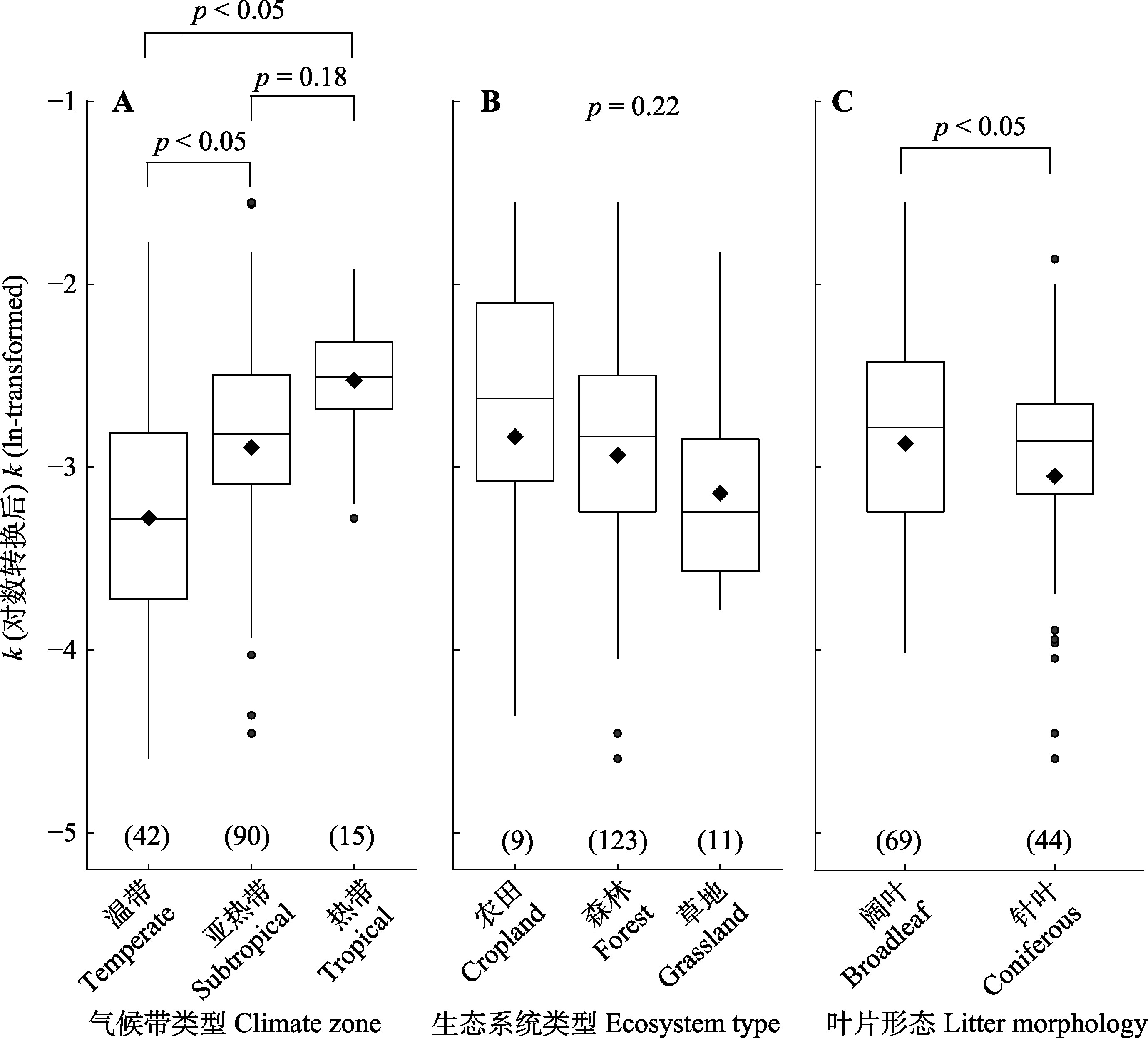
Important findings The decomposition rates of litter cellulose shifted pronouncedly with climatic zones and leaf morphological types, with climatic zone being highest in tropical (0.086), intermediate in subtropical (0.069) and lowest in temperate (0.048) regions, and with leaf morphology being higher in broadleaf than coniferous litters. Cellulose decomposition rates decreased with increase in initial carbon nitrogen ratio and lignin cellulose ratio, while increased with increasing mean annual temperature. These results suggest that litter substrate quality and climate play significant role for influencing litter cellulose decomposition. This study enhances our understanding of the litter cellulose decomposition, and helps to optimize plant litter turnover and ecosystem carbon cycle models.
Key words: cellulose; litter decomposition; climate; litter substrate quality
ZHOU Si-Qi , AI Ling , NI Xiang-Yin , WU Fu-Zhong , WU Qiu-Xia , ZHU Jing-Jing , ZHANG Xin-Ying . Global patterns and controls of variation in cellulose decomposition rates of plant litters[J]. Chinese Journal of Plant Ecology, 2025 , 49(3) : 393 -403 . DOI: 10.17521/cjpe.2024.0144
| [1] | Aber JD, Martin M (1999). Leaf chemistry, 1992-1993 (Accelerated Canopy Chemistry Program). [2024-09-05]. http://www.daac.ornl.gov. |
| [2] | Banerjee S, Kirkby CA, Schmutter D, Bissett A, Kirkegaard JA, Richardson AE (2016). Network analysis reveals functional redundancy and keystone taxa amongst bacterial and fungal communities during organic matter decomposition in an arable soil. Soil Biology & Biochemistry, 97, 188-198. |
| [3] | Barbe L, Jung V, Prinzing A, Bittebiere AK, Butenschoen O, Mony C (2017). Functionally dissimilar neighbors accelerate litter decomposition in two grass species. New Phytologist, 214, 1092-1102. |
| [4] | Berg B, McClaugherty C (2014). Plant Litter: Decomposition, Humus Formation, Carbon Sequestration. 3rd ed. Springer, Berlin. |
| [5] | Borsali AH, Lerch TZ, Besbes R, Gros R, Laffont-Schwob I, Boudenne JL, Ziarelli F, Pando A,Farnet Da Silva AM (2021). Coastal environments shape chemical and microbial properties of forest litters in the Circum-Mediterranean region. European Journal of Soil Science, 72, 1010-1025. |
| [6] | Bradford MA, Berg B, Maynard DS, Wieder WR, Wood SA (2016). Understanding the dominant controls on litter decomposition. Journal of Ecology, 104, 229-238. |
| [7] | Bradford MA, Veen GFC, Bonis A, Bradford EM, Classen AT, Cornelissen JHC, Crowther TW, de Long JR, Freschet GT, Kardol P, Manrubia-Freixa M, Maynard DS, Newman GS, Logtestijn RSP, Viketoft M, et al.(2017). A test of the hierarchical model of litter decomposition. Nature Ecology & Evolution, 1, 1836-1845. |
| [8] | Cai AD, Liang GP, Yang W, Zhu J, Han TF, Zhang WJ, Xu MG (2021). Patterns and driving factors of litter decomposition across Chinese terrestrial ecosystems. Journal of Cleaner Production, 278, 123964. DOI: 10.1016/j.jclepro.2020.123964. |
| [9] | Chen J, Elsgaard L, van Groenigen KJ, Olesen JE, Liang Z, Jiang Y, L?rke PE, Zhang YF, Luo YQ, Hungate BA, Sinsabaugh RL, J?rgensen U (2020). Soil carbon loss with warming: new evidence from carbon-degrading enzymes. Global Change Biology, 26, 1944-1952. |
| [10] | Chen YM, He RL, Deng CC, Liu Y, Yang WQ, Zhang J (2014). Litter cellulolytic enzyme activities in alpine timberline ecotone of western Sichuan. Chinese Journal of Plant Ecology, 38, 334-342. |
| [陈亚梅, 和润莲, 邓长春, 刘洋, 杨万勤, 张健 (2014). 川西高山林线交错带凋落物纤维素分解酶活性研究. 植物生态学报, 38, 334-342.] | |
| [11] | Cotrufo MF, Soong JL, Horton AJ, Campbell EE, Haddix M, Wall DH, Parton WJ (2015). Formation of soil organic matter via biochemical and physical pathways of litter mass loss. Nature Geoscience, 8, 776-779. |
| [12] | Dai YC, Yang ZL, Cui BK, Wu G, Yuan HS, Zhou LW, He SH, Ge ZW, Wu F, Wei YL, Yuan Y, Si J (2021). Diversity and systematics of the important macrofungi in Chinese forests. Mycosystema, 40, 770-805. |
| [戴玉成, 杨祝良, 崔宝凯, 吴刚, 袁海生, 周丽伟, 何双辉, 葛再伟, 吴芳, 魏玉莲, 员瑗, 司静 (2021). 中国森林大型真菌重要类群多样性和系统学研究. 菌物学报, 40, 770-805.] | |
| [13] | Dong HL, Zeng Q, Liu D, Sheng YZ, Liu XL, Liu Y, Hu JL, Li Y, Xia QY, Li RJ, Hu DF, Zhang DL, Zhang WH, Guo DY, Zhang XW (2024). Interactions between clay minerals and microbes: mechanisms and applications in environmental remediation. Earth Science Frontiers, 31, 467-485. |
| [董海良, 曾强, 刘邓, 盛益之, 刘晓磊, 刘源, 胡景龙, 李扬, 夏庆银, 李润洁, 胡大福, 张冬磊, 张文慧, 郭东毅, 张晓文 (2024). 黏土矿物-微生物相互作用机理以及在环境领域中的应用. 地学前缘, 31, 467-485.] | |
| [14] | Evdokimova EV, Gladkov GV, Kuzina NI, Ivanova EA, Kimeklis AK, Zverev AO, Kichko AA, Aksenova TS, Pinaev AG, Andronov EE (2020). The difference between cellulolytic ‘culturomes’ and microbiomes inhabiting two contrasting soil types. PLoS ONE, 15, e0242060. DOI: 10.1371/journal.pone.0242060. |
| [15] | Fanin N, Bertrand I (2016). Aboveground litter quality is a better predictor than belowground microbial communities when estimating carbon mineralization along a land-use gradient. Soil Biology & Biochemistry, 94, 48-60. |
| [16] | Fick SE, Hijmans RJ (2017). WorldClim 2: new 1-km spatial resolution climate surfaces for global land areas. International Journal of Climatology, 37, 4302-4315. |
| [17] | Ge XG, Xiao WF, Zeng LX, Huang ZL, Zhou BZ (2014). Effect of soil-litter layer enzyme activities on litter decomposition in Pinus massoniana plantation in Three Gorges Reservoir Area. Acta Ecologica Sinica, 34, 2228-2237. |
| [葛晓改, 肖文发, 曾立雄, 黄志霖, 周本智 (2014). 三峡库区马尾松林土壤-凋落物层酶活性对凋落物分解的影响. 生态学报, 34, 2228-2237.] | |
| [18] | He YL, Qi YC, Peng Q, Dong YS, Guo SF, Yan ZQ, Wang LQ, Li ZL (2017). Effects of external carbon on the key processes of carbon cycle in a terrestrial ecosystem and its microbial driving mechanism. Acta Ecologica Sinica, 37, 358-366. |
| [贺云龙, 齐玉春, 彭琴, 董云社, 郭树芳, 闫钟清, 王丽芹, 李兆林 (2017). 外源碳输入对陆地生态系统碳循环关键过程的影响及其微生物学驱动机制. 生态学报, 37, 358-366.] | |
| [19] | Hendricks JJ, Aber JD, Nadelhoffer KJ, Hallett RD (2000). Nitrogen controls on fine root substrate quality in temperate forest ecosystems. Ecosystems, 3, 57-69. |
| [20] | Hengl T, Mendes de Jesus J, Heuvelink GBM, Ruiperez Gonzalez M, Kilibarda M, Blagoti? A, Shangguan W, Wright MN, Geng XY, Bauer-Marschallinger B, Guevara MA, Vargas R, MacMillan RA, Batjes NH, Leenaars JGB, et al.(2017). SoilGrids250m: Global gridded soil information based on machine learning. PLoS ONE, 12, e0169748. DOI: 10.1371/journal.pone.0169748. |
| [21] | Hobbie SE (2015). Plant species effects on nutrient cycling: revisiting litter feedbacks. Trends in Ecology & Evolution, 30, 357-363. |
| [22] | Jiang YS, Sun YT, Zhang G, Luo CL (2023). Pattern and influencing factors of forest soil microbial communities in different climate types in China. Ecology and Environmental Sciences, 32, 1355-1364. |
| [姜懿珊, 孙迎韬, 张干, 罗春玲 (2023). 中国不同气候类型森林土壤微生物群落结构及其影响因素. 生态环境学报, 32, 1355-1364.] | |
| [23] | Joly FX, Scherer-Lorenzen M, H?ttenschwiler S (2023). Resolving the intricate role of climate in litter decomposition. Nature Ecology & Evolution, 7, 214-223. |
| [24] | Leitner S, Wanek W, Wild B, Haemmerle I, Kohl L, Keiblinger KM, Zechmeister-Boltenstern S, Richter A (2012). Influence of litter chemistry and stoichiometry on glucan depolymerization during decomposition of beech (Fagus sylvatica L.) litter. Soil Biology & Biochemistry, 50, 174-187. |
| [25] | Li H, Wu FZ, Yang WQ, Xu LY, Ni XY, He J, Tan B, Hu Y (2016). Effects of forest gaps on litter lignin and cellulose dynamics vary seasonally in an alpine forest. Forests, 7, 27. DOI:10.3390/f7020027. |
| [26] | Li Q, Zhang MH, Geng QH, Jin CS, Zhu JQ, Ruan HH, Xu X (2020). The roles of initial litter traits in regulating litter decomposition: a “common plot” experiment in a subtropical evergreen broadleaf forest. Plant and Soil, 452, 207-216. |
| [27] | Liu L, Chen H, Li DJ, Liang SC (2017). Changes of soil hydrolytic and oxidized enzyme activities under the process of vegetation restoration in a karst area, southwest China. Acta Scientiae Circumstantiae, 37, 3528-3534. |
| [刘璐, 陈浩, 李德军, 梁士楚 (2017). 喀斯特山区植被恢复过程中土壤水解酶和氧化酶活性的响应. 环境科学学报, 37, 3528-3534.] | |
| [28] | López-Mondéjar R, Zühlke D, Becher D, Riedel K, Baldrian P (2016). Cellulose and hemicellulose decomposition by forest soil bacteria proceeds by the action of structurally variable enzymatic systems. Scientific Reports, 6, 25279. DOI:10.1038/srep25279. |
| [29] | Ma ZL, Gao S, Yang WQ, Wu FZ (2015). Degradation characteristics of lignin and cellulose of foliar litter at different rainy stages in subtropical evergreen broadleaved forest. Chinese Journal of Ecology, 34, 122-129. |
| [马志良, 高顺, 杨万勤, 吴福忠 (2015). 亚热带常绿阔叶林区凋落叶木质素和纤维素在不同雨热季节的降解特征. 生态学杂志, 34, 122-129.] | |
| [30] | Mao HR, Cotrufo MF, Hart SC, Sullivan BW, Zhu XF, Zhang JC, Liang C, Zhu MQ (2024). Dual role of silt and clay in the formation and accrual of stabilized soil organic carbon. Soil Biology & Biochemistry, 192, 109390. DOI: 10.1016/j.soilbio.2024.109390. |
| [31] | Mo HD, Qiu JH, Yang C, Zang LM, Sakai E, Chen J (2020). Porous biochar/chitosan composites for high performance cellulase immobilization by glutaraldehyde. Enzyme and Microbial Technology, 138, 109561. DOI: 10.1016/j.enzmictec.2020.109561. |
| [32] | Olson JS (1963). Energy storage and the balance of producers and decomposers in ecological systems. Ecology, 44, 322-331. |
| [33] | Rowland AP, Roberts JD (1994). Lignin and cellulose fractionation in decomposition studies using acid-detergent fibre methods. Communications in Soil Science and Plant Analysis, 25, 269-277. |
| [34] | Ryan MG, Melillo JM, Ricca A (1990). A comparison of methods for determining proximate carbon fractions of forest litter. Canadian Journal of Forest Research, 20, 166-171. |
| [35] | Santiago LS (2007). Extending the leaf economics spectrum to decomposition: evidence from a tropical forest. Ecology, 88, 1126-1131. |
| [36] | Shangguan W, Dai Y, Duan Q, Liu B, Yuan H (2014). A global soil data set for earth system modeling. Journal of Advances in Modeling Earth Systems, 6, 249-263. |
| [37] | Song HT, Gao Y, Yang YM, Xiao WJ, Liu SH, Xia WC, Liu ZL, Yi L, Jiang ZB (2016). Synergistic effect of cellulase and xylanase during hydrolysis of natural lignocellulosic substrates. Bioresource Technology, 219, 710-715. |
| [38] | Tang S, Ma Q, Marsden KA, Chadwick DR, Luo Y, Kuzyakov Y, Wu LH, Jones DL (2023). Microbial community succession in soil is mainly driven by carbon and nitrogen contents rather than phosphorus and sulphur contents. Soil Biology & Biochemistry, 180, 109019. DOI: 10.1016/j.soilbio.2023.109019. |
| [39] | Tardy V, Spor A, Mathieu O, Lévèque J, Terrat S, Plassart P, Regnier T, Bardgett RD, van der Putten WH, Roggero PP, Seddaiu G, Bagella S, Lemanceau P, Ranjard L, Maron PA (2015). Shifts in microbial diversity through land use intensity as drivers of carbon mineralization in soil. Soil Biology & Biochemistry, 90, 204-213. |
| [40] | Vanderbilt KL, White CS, Hopkins O, Craig JA (2008). Aboveground decomposition in arid environments: results of a long-term study in central New Mexico. Journal of Arid Environments, 72, 696-709. |
| [41] | Veli?kovi? M, Wu R, Gao Y, Thairu MW, Veli?kovi? D, Munoz N, Clendinen CS, Bilbao A, Chu R, Lalli PM, Zemaitis K, Nicora C, Kyle JE, Orton D, Williams S, et al.(2024). Mapping microhabitats of lignocellulose decomposition by a microbial consortium. Nature Chemical Biology, 20, 1033-1043. |
| [42] | Wang WJ, Yang WQ, Tan B, Liu RL, Wu FZ (2013). Contributions of soil fauna to litter decomposition in subtropical evergreen broad-leaved forests in Sichuan basin. Ecology and Environmental Sciences, 22, 1488-1495. |
| [王文君, 杨万勤, 谭波, 刘瑞龙, 吴福忠 (2013). 四川盆地亚热带常绿阔叶林土壤动物对几种典型凋落物分解的影响. 生态环境学报, 22, 1488-1495.] | |
| [43] | Wei H, Guenet B, Vicca S, Nunan N, Asard H, AbdElgawad H, Shen WJ, Janssens IA (2014). High clay content accelerates the decomposition of fresh organic matter in artificial soils. Soil Biology & Biochemistry, 77, 100-108. |
| [44] | Weintraub SR, Wieder WR, Cleveland CC, Townsend AR (2013). Organic matter inputs shift soil enzyme activity and allocation patterns in a wet tropical forest. Biogeochemistry, 114, 313-326. |
| [45] | Wu JJ, Zhang Q, Zhang DD, Jia W, Chen J, Liu GH, Cheng XL (2022). The ratio of ligninase to cellulase increased with the reduction of plant detritus input in a coniferous forest in subtropical China. Applied Soil Ecology, 170, 104269. DOI: 10.1016/j.apsoil.2021.104269. |
| [46] | Yang K, Zhu JJ, Zhang WW, Zhang Q, Lu DL, Zhang YK, Zheng X, Xu S, Wang GG (2022). Litter decomposition and nutrient release from monospecific and mixed litters: comparisons of litter quality, fauna and decomposition site effects. Journal of Ecology, 110, 1673-1686. |
| [47] | Yue K, de Frenne P, Fornara DA, van Meerbeek K, Li W, Peng X, Ni XY, Peng Y, Wu FZ, Yang YS, Pe?uelas J (2021). Global patterns and drivers of rainfall partitioning by trees and shrubs. Global Change Biology, 27, 3350-3357. |
| [48] | Zechmeister-Boltenstern S, Keiblinger KM, Mooshammer M, Pe?uelas J, Richter A, Sardans J, Wanek W (2015). The application of ecological stoichiometry to plant-microbial- soil organic matter transformations. Ecological Monographs, 85, 133-155. |
| [49] | Zeng T, Hou M, Wang Y, Peng B, Tang BY, Zhao XR, Sui YY, Jiao XG (2024). Effects of different land use types on soil cellulase activity and fertility factors. Journal of Agricultural Science and Technology, 26, 193-200. |
| [曾婷, 侯萌, 王耀, 彭博, 汤博宇, 赵晓蕊, 隋跃宇, 焦晓光 (2024). 不同土地利用类型对土壤纤维素酶活性及肥力因子的影响. 中国农业科技导报, 26, 193-200.] | |
| [50] | Zhang HM, Zheng RP, Chen JW, Huang H (2010). Investigation on the determination of lignocellulosics components by NREL method. Chinese Journal of Analysis Laboratory, 29(11), 15-18. |
| [张红漫, 郑荣平, 陈敬文, 黄和 (2010). NREL法测定木质纤维素原料组分的含量. 分析试验室, 29(11), 15-18.] | |
| [51] | Zhang WW, Yang K, Lyu ZT, Zhu JJ (2019). Microbial groups and their functions control the decomposition of coniferous litter: a comparison with broadleaved tree litters. Soil Biology & Biochemistry, 133, 196-207. |
| [52] | Zhang XX, Wang BY, Liu ZW (2018). and Eucommia ulmoides Oliver. Acta Oecologica, 93, 7-13. |
| [53] | Zhao Q, Classen AT, Wang WW, Zhao XR, Mao B, Zeng DH (2017). Asymmetric effects of litter removal and litter addition on the structure and function of soil microbial communities in a managed pine forest. Plant and Soil, 414, 81-93. |
| [54] | Zhao Y, Shakeel U, Saif Ur Rehman M, Li HQ, Xu X, Xu J (2020). Lignin-carbohydrate complexes (LCCs) and its role in biorefinery. Journal of Cleaner Production, 253, 120076. DOI: 10.1016/j.jclepro.2020.120076. |
| [55] | Zheng HP, Yang TJ, Bao YZ, He PP, Yang KM, Mei XL, Wei Z, Xu YC, Shen QR, Banerjee S (2021). Network analysis and subsequent culturing reveal keystone taxa involved in microbial litter decomposition dynamics. Soil Biology & Biochemistry, 157, 108230. DOI: 10.1016/j.soilbio.2021.108230. |
| [56] | Zhou S, Chen L, Wang JY, He LY, Wang J, Ren CJ, Guo YX, Zhao FZ (2022). Stronger microbial decay of recalcitrant carbon in tropical forests than in subtropical and temperate forest ecosystems in China. Catena, 215, 106351. DOI: 10.1016/j.catena.2022.106351. |
/
| 〈 |
|
〉 |
Copyright © 2026 Chinese Journal of Plant Ecology
Tel: 010-62836134, 62836138, E-mail: apes@ibcas.ac.cn, cjpe@ibcas.ac.cn

