
Chinese Journal of Plant Ecology >
Dataset of plant species composition and community characteristics of mixed evergreen and deciduous broadleaf forest and subalpine coniferous forest of Shennongjia in 2010
Received date: 2024-09-30
Accepted date: 2025-01-27
Online published: 2025-02-06
Supported by
National Natural Science Foundation of China(32201323);National Natural Science Foundation of China(32271641)
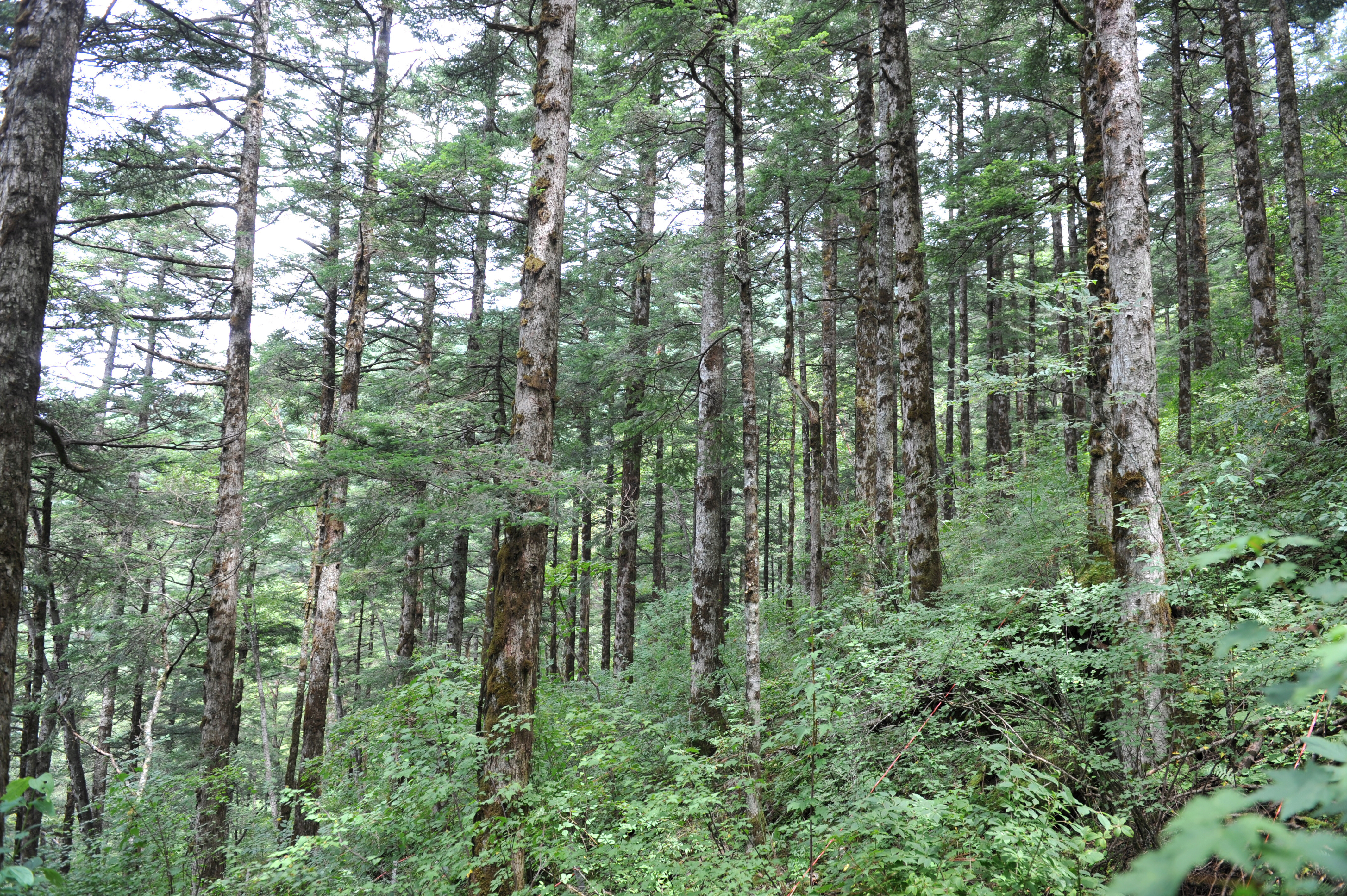
Plant species composition and community characteristics are the basis for the structure, function and dynamics of forest ecosystems, which determine forest ecosystem services such as productivity, carbon sequestration and biodiversity conservation. Plant species composition and community characteristics are important indicators for long-term positional observation of biological elements in terrestrial ecosystems by the Chinese Ecosystem Research Network (CERN) and the Chinese National Ecosystem Research Network (CNERN). Mixed evergreen and deciduous broadleaf forest is a zonal vegetation type in northern subtropical China, and respond sensitively to environmental change. Subalpine coniferous forest is a typical vegetation type in the upper part of the vertical belt spectrum of the Shennongjia mountainous area, preserving a large area of natural primary forests that are the only remaining ones in Central China, and it is an important ecological barrier in the Qinba mountainous area. Two 100 m × 100 m long-term monitoring sample plots of subalpine coniferous forest and mixed evergreen and deciduous broadleaf forest were set up in 2001 and in 2008, respectively, by the Shennongjia Forest Ecosystem Research Station (National Field Station for Forest Ecosystems in Shennongjia, also known as Shennongjia Biodiversity Research Station of Chinese Academy of Sciences). Plant community inventories were conducted in 2010 in accordance with CERN and CNERN monitoring specifications. Tree layer surveys were conducted in 100 sub-samples of 10 m × 10 m, and shrub and herb layer surveys were conducted in 13 sub-samples of 10 m × 10 m. In the tree layer, all woody plants with diameter at breast height (DBH) ≥ 1 cm were surveyed, and the indicators included plant species name, DBH, height, etc. In the shrub layer, woody plants with DBH < 1 cm were monitored, and the indicators included species name, abundance, average basal diameter, average height, and coverage, etc. In the herb layer, herbaceous plants were monitored, and the indicators included species name, abundance, average height, and coverage. Six data tables for this dataset were formed through statistical organization: data sheet on species composition of forest plant communities in the tree layer, data sheet on the species composition of the shrub layer of forest plant communities, data sheet on the species composition of the herbaceous layer of forest plant communities, data sheet on characterization of tree layer communities of forest plant communities, data sheet on characterization of shrub layer communities of forest plant communities, data sheet on characterization of herbaceous layer communities of forest plant communities. This dataset can provide background data for in-depth investigation into the impact of environmental changes on the community structure and productivity of subtropical forest ecosystems, as well as support the evaluation of ecosystem service functions, biodiversity conservation and ecological quality monitoring in the region.
Database/dataset profile
| Data title | Dataset of plant species composition and community characteristics of mixed evergreen and deciduous broadleaf forest and subalpine coniferous forest of Shennongjia in 2010 |
| Data authors | ZHAO Chang-Ming, XIONG Gao-Ming, SHEN Guo-Zhen, GE Jie-Lin, XU Wen-Ting, XU Kai, WU Yuan-Shuai, XIE Zong-Qiang |
| Data corresponding author | XIE Zong-Qiang (xie@ibcas.ac.cn) |
| Data time range | 2010 |
| Data geographical scope | National Field Station for Forest Ecosystems in Shennongjia (NFSFES) (also known as Shennongjia Biodiversity Research Station of Chinese Academy of Sciences) (110.05°-110.57° E, 31.32°- 31.60° N) |
| Data volume | 324.86 kb, 3 855 entries |
| Data format | .xlsx |
| Data links | https://www.plant-ecology.com/fileup/1005-264X/PDF/cjpe.2024.0340-D1.xlsx https://www.plantplus.cn/doi/10.12282/plantdata.1680 https://www.scidb.cn/doi/10.12282/plantdata.1680 |
| Database/dataset composition | This dataset consists of one file, including six sheets: forest plant community tree layer species composition; forest plant community shrub layer species composition; forest plant community herb layer species composition; forest plant community tree layer community characterization; forest plant community shrub layer community characterization; forest plant community herb layer community characterization |
ZHAO Chang-Ming , XIONG Gao-Ming , SHEN Guo-Zhen , GE Jie-Lin , XU Wen-Ting , XU Kai , WU Yuan-Shuai , XIE Zong-Qiang . Dataset of plant species composition and community characteristics of mixed evergreen and deciduous broadleaf forest and subalpine coniferous forest of Shennongjia in 2010[J]. Chinese Journal of Plant Ecology, 2025 , 49(8) : 1215 -1228 . DOI: 10.17521/cjpe.2024.0340
| [1] | Callahan JT (1984). Long-term ecological research. BioScience, 34, 363-367. |
| [2] | Chen YC, Lou J, Wu YH, Yu D, She J, Zhou P (2012). Carbon pool of subalpine dark coniferous// Proceedings of Conference on Environmental Pollution and Public Health (CEPPH 2012). Shanghai, China, 721-723. |
| [陈有超, 罗辑, 吴艳宏, 余东, 佘佳, 周鹏 (2012). 亚高山暗针叶林的碳汇作用. 2012年环境污染与大众健康学术会议论文集. 中国上海. 721-723.] | |
| [3] | Fu BJ, Liu SL (2002). Problems and trends of long-term ecological research. Chinese Journal of Applied Ecology, 13, 476-480. |
| [傅伯杰, 刘世梁 (2002). 长期生态研究中的若干重要问题及趋势. 应用生态学报, 13, 476-480.] | |
| [4] | Ge JL, Berg B, Xie ZQ (2019). Climatic seasonality is linked to the occurrence of the mixed evergreen and deciduous broad-leaved forests in China. Ecosphere, 10, e02862. DOI: 10.1002/ecs2.2862. |
| [5] | Ge JL, Xie ZQ (2017). Geographical and climatic gradients of evergreen versus deciduous broad-leaved tree species in subtropical China: implications for the definition of the mixed forest. Ecology and Evolution, 7, 3636-3644. |
| [6] | Jiang YX (1963). Community characteristics and classification principles of subalpine dark coniferous forests in western Sichuan. Acta Phytoecologica et Geobotanica Sinica, 1, 42-50. |
| [蒋有绪 (1963). 川西亚高山暗针叶林的群落特点及其分类原则. 植物生态学与地植物学丛刊, 1, 42-50.] | |
| [7] | Liao XH, Feng ZM, Gao X, Sun HL, Sun JL, Yu GR, Dai EF, Zhan CS, Ma ZQ, Yu XB, He HL, Yang YP, Liu RG, Dai JH, Liu C, Wang JL (2020). The development of field scientific observation and research stations (networks) and scientific data centers. Acta Geographica Sinica, 75, 2669-2683. |
| [廖小罕, 封志明, 高星, 孙鸿烈, 孙九林, 于贵瑞, 戴尔阜, 占车生, 马泽清, 于秀波, 何洪林, 杨雅萍, 刘荣高, 戴君虎, 刘闯, 王卷乐 (2020). 野外科学观测研究台站(网络)和科学数据中心建设发展. 地理学报, 75, 2669-2683.] | |
| [8] | Liu HJ, Sun C, Qi Y, He LH, Peng FL, Yu Y (2014). A brief review of progress of the eco-environmental research network in China and aboard. Environmental Monitoring in China, 30(5), 125-131. |
| [刘海江, 孙聪, 齐杨, 何立环, 彭福利, 于洋 (2014). 国内外生态环境观测研究台站网络发展概况. 中国环境监测, 30(5), 125-131.] | |
| [9] | Liu Q, Wu Y, He H (2001). Ecological problems of subalpine coniferous forest in the southwest of China. World Sci-tech R&D, 23(2), 63-69. |
| [刘庆, 吴彦, 何海 (2001). 中国西南亚高山针叶林的生态学问题. 世界科技研究与发展, 23(2), 63-69.] | |
| [10] | The Editorial Committee of Vegetation of China (1980). Vegetation of China. Science Press, Beijing. |
| [中国植被编辑委员会 (1980). 中国植被. 科学出版社, 北京.] | |
| [11] | Wu DX, Zhang L, Song CY, Zhang SM (2019). Protocols and Standard Biological Observations and Measurement in Terrestrial Ecosystems. China Environment Publishing Group, Beijing. |
| [吴冬秀, 张琳, 宋创业, 张淑敏 (2019). 陆地生态系统生物观测指标与规范. 中国环境出版集团, 北京.] | |
| [12] | Zhang XC, Ma C, Gu S, Yang J, Song BY, He XD, Gao YB (2009). Complexity of ecosystem dynamics. Acta Scientiarum Naturalium Universitatis Nankaiensis, 42(2), 99-104. |
| [张晓春, 马春, 古松, 杨劼, 宋炳煜, 何兴东, 高玉葆 (2009). 生态系统动态的复杂性分析. 南开大学学报(自然科学版), 42(2), 99-104.] | |
| [13] | Zhao SD (2001). International long-term ecological research network (ILTER)—Background, present situation and prospect. Acta Phytoecologica Sinica, 25, 510-512. |
| [赵士洞 (2001). 国际长期生态研究网络(ILTER)——背景、现状和前景. 植物生态学报, 25, 510-512.] |
/
| 〈 |
|
〉 |
Copyright © 2026 Chinese Journal of Plant Ecology
Tel: 010-62836134, 62836138, E-mail: apes@ibcas.ac.cn, cjpe@ibcas.ac.cn

