
Chinese Journal of Plant Ecology >
Classification of plant associations based on a 20 hm2 dynamics plot of evergreen broad- leaved forest in Mt. Tiantong, Zhejiang, China
Received date: 2017-10-19
Revised date: 2018-05-07
Online published: 2018-07-20
Supported by
Supported by the National Basic Research Priorities Program of the Ministry of Science and Technology of China(2015FY210200)
Aims Our objectives were to obtain typical plant association types in a 20 hm 2 forest dynamic monitoring plot in Mt. Tiantong, and provide methodological references for determining transitional types and identifying typical types in vegetation classification.
Methods We used two-way indicator species analysis (TWINSPAN) and detrended correspondence analysis (DCA) to remove transitional community and identify typical association types. DCA method was also used to analyze the relationship between the distributions of different plant associations and environmental variables.
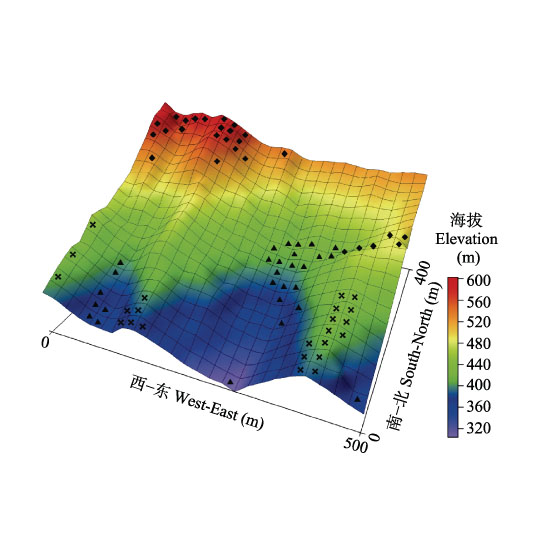
Important findings The results showed that the classification of typical plant associations was greatly improved by the removal of transitional communities. The forest was divided into three associations: 1) Viburnum erosum- Ternstroemia gymnanthera/Lithocarpus harlandii + Cyclobalanopsis sessilifolia Association, 2) Daphniphyllum oldhami-Lithocarpus glaber/Schima superba + Castanopsis carlesii Association, and 3) Illicium lanceolatum- Phoebe sheareri/Choerospondias axillaries + Machilus leptophylla Association. The results of DCA revealed the importance of environmental variables (elevation, convexity, slope, and aspect) on spatial distribution of plant associations. Elevation and convexity had significant effects on the distribution of associations, while slope and aspect had weak effects. The results confirmed the high accuracy of the association classification we used.
SUN Xiao-Wei, YANG Qing-Song, LIU He-Ming, WANG Xi-Hua . Classification of plant associations based on a 20 hm2 dynamics plot of evergreen broad- leaved forest in Mt. Tiantong, Zhejiang, China[J]. Chinese Journal of Plant Ecology, 2018 , 42(5) : 550 -561 . DOI: 10.17521/cjpe.2017.0263
| [1] | Braun-Blanquet J ( 1964). Pflanzensoziologie: Grundzüge der Vegetationskunde. Springer, Wien,New York. |
| [2] | Condit R ( 1998). Tropical Forest Census Plots: Methods and Results from Barro Colorado Island, Panama and Comparison with Other Plots. Springer,Berlin. |
| [3] | de Cáceres M, Jansen F ( 2016). Indicspecies: Relationship Between Species and Groups of Sites. |
| [4] | de Cáceres M, Legendre P ( 2009). Associations between species and groups of sites: Indices and statistical inference. Ecology, 90, 3566-3574. |
| [5] | de Cáceres M, Legendre P, Moretti M ( 2010). Improving indicator species analysis by combining groups of sites. Oikos, 119, 1674-1684. |
| [6] | Dufrêne M, Legendre P ( 1997). Species assemblages and indicator species: The need for a flexible asymmetrical approach. Ecological Monographs, 67, 345-366. |
| [7] | Fang JY, Wang XP, Shen ZH, Tang ZY, He JS, Yu D, Jiang Y, Wang ZH, Zheng CY, Zhu JL, Guo ZD ( 2009). Methods and protocols for plant community inventory. Biodiversity Science, 17, 533-548. |
| [7] | [ 方精云, 王襄平, 沈泽昊, 唐志尧, 贺金生, 于丹, 江源, 王志恒, 郑成洋, 朱江玲, 郭兆迪 ( 2009). 植物群落清查的主要内容、方法和技术规范. 生物多样性, 17, 533-548.] |
| [8] | Federal Geographic Data Committee, Vegetation Subcommittee ( FGDC-VS) ( 2008). The National Vegetation Classification Standard. Version 2. FGDC-STD-005-2008 (Version 2). Cited:2008-02. |
| [9] | Harms KE, Condit R, Hubbell SP, Foster RB ( 2001). Habitat associations of trees and shrubs in a 50-ha neotropical forest plot. Journal of Ecology, 89, 947-959. |
| [10] | Hill MO ( 1979). TWINSPAN-A FORTRAN Program for Arranging Multivariate Data in an Ordered Two-Way Table by Classification of the Individuals and Attributes. Cornell University, Ithaca, USA. |
| [11] | Huang FZ, Wang B, Ding T, Xiang WS, Li XK, Zhou AP ( 2014). Numerical classification of associations in a northern tropical karst seasonal rain forest and the relationships of these associations with environmental factors. Biodiversity Science, 22, 157-166. |
| [11] | [ 黄甫昭, 王斌, 丁涛, 向悟生, 李先琨, 周爱萍 ( 2014). 弄岗北热带喀斯特季节性雨林群系数量分类及与环境的关系. 生物多样性, 22, 157-166.] |
| [12] | Jennings MD, Faber-Langendoen D, Louckes OL, Peet RK, Roberts D ( 2009). Standards for associations and alliances of the U.S. National Vegetation Classification. Ecological Monographs, 79, 173-199. |
| [13] | Lai JS, Mi XC, Ren HB, Ma KP ( 2010). Numerical classification of associations in subtropical evergreen broad-leaved forest based on multivariate regression trees―A case study of 24 hm 2 Gutianshan forest plot in China . Chinese Journal of Plant Ecology, 34, 761-769. |
| [13] | [ 赖江山, 米湘成, 任海保, 马克平 ( 2010). 基于多元回归树的常绿阔叶林群丛数量分类——以古田山24公顷森林样地为例. 植物生态学报, 34, 761-769.] |
| [14] | Lepš J, Šmilauer P ( 2003). Multivariate Analysis of Ecological Data Using CANOCO. Cambridge University Press, Cambridge, UK. |
| [15] | Liu HM, Yang QS, Fang XF, Ma ZP, Shen GC, Zhang ZG, Wang ZH, Wang XH ( 2015). Influences on gap species richness in a subtropical evergreen broadleaved forest. Biodiversity Science, 23, 149-156. |
| [15] | [ 刘何铭, 杨庆松, 方晓峰, 马遵平, 沈国春, 张志国, 王樟华, 王希华 ( 2015). 亚热带常绿阔叶林林窗物种丰富度的影响因素. 生物多样性, 23, 149-156.] |
| [16] | Maechler M, Rousseeuw P, Struyf A, Hubert M, Hornik K ( 2017). Cluster: Cluster Analysis Basics and Extensions. |
| [17] | Mueller-Dombois D, Ellenberg H ( 1974). Aims and Methods of Vegetation Ecology. John Wiley,New York. |
| [18] | Nee S ( 2005). The neutral theory of biodiversity: Do the numbers add up? Functional Ecology, 19, 173-176. |
| [19] | Oksanen J, Blanchet FG, Friendly M, Kindt R, Legendre P, McGlinn D, Minchin PR, O’Hara RB, Simpson GL, Solymos P, Stevens MHH, Szoecs E, Wagner H ( 2017). Vegan: Ordination, Diversity and Dissimilarities. |
| [20] | Rousseeuw PJ ( 1987). Silhouettes: A graphical aid to the interpretation and validation of cluster analysis. Journal of Computational & Applied Mathematics, 20, 53-65. |
| [21] | Song YC ( 2011). Recognition and proposal on the vegetation classification system of China. Chinese Journal of Plant Ecology, 35, 882-892. |
| [21] | [ 宋永昌 ( 2011). 对中国植被分类系统的认知和建议. 植物生态学报, 35, 882-892.] |
| [22] | Song YC ( 2017). Vegetation Ecology.2nd edn. Higher Education Press, Beijing. |
| [22] | [ 宋永昌 ( 2017). 植被生态学. 第二版. 高等教育出版社, 北京.] |
| [23] | Song YC, Wang XH, Yan NR ( 2013). Evergreen Broad-Leaved Forest of China—Classification, Ecology, Conservation. Science Press, Beijing. |
| [23] | [ 宋永昌, 王希华, 阎恩荣 ( 2013). 中国常绿阔叶林——分类, 生态, 保育. 科学出版社, 北京.] |
| [24] | Song YC, Wang XR ( 1995). Vegetation and Flora of Tiantong National Forest Park, Zhejiang Province. Shanghai Science and Technology Literature Press, Shanghai. 1-16. |
| [24] | [ 宋永昌, 王祥荣 ( 1995). 浙江天童国家森林公园的植被与区系. 上海科学技术文献出版社, 上海. 1-16.] |
| [25] | Song YC, Yan NR, Song K ( 2015). Synthetic comparison of eight dynamics plots in evergreen broadleaf forests, China. Biodiversity Science, 23, 139-148. |
| [25] | [ 宋永昌, 阎恩荣, 宋坤 ( 2015). 中国常绿阔叶林8大动态监测样地植被的综合比较. 生物多样性, 23, 139-148.] |
| [26] | Song YC, Yan NR, Song K ( 2017). An update of the vegetation classification in China. Chinese Journal of Plant Ecology, 41, 269-278. |
| [26] | [ 宋永昌, 阎恩荣, 宋坤 ( 2017). 再议中国的植被分类系统. 植物生态学报, 41, 269-278.] |
| [27] | Su SH, Chang-Yang CH, Lu CL, Tsui CC, Lin TT, Lin CL, Chiou WL, Kuan LH, Chen ZS, Hsieh CF ( 2007). Fushan Subtropical Forest Dynamics Plot: Tree Species Characteristics and Distribution Patterns. Taiwan Forestry Research Institute, Taipei, China. |
| [28] | Valencia R, Foster RB, Villa G, Condit R, Svenning JC, Hernandez C, Romoleroux K, Losos E, Magard E, Balslev H ( 2004). Tree species distributions and local habitat variation in the Amazon: Large forest plot in eastern Ecuador. Journal of Ecology, 92, 214-229. |
| [29] | van der Maarel E, Franklin J ( 2013). Vegetation Ecology. 2nd edn. John Wiley & Sons, Chichester, UK. 28-103. |
| [30] | Westhoff V, van der Maarel E ( Translated by Zheng HY ) ( 1985). The Braun-Blanquet approach. In: Whittaker RH ed. Classification of Plant Communities. Science Press, Beijing. 223-322. |
| [30] | [ 郑慧莹 ( 译)( 1985). 植物群落分类. 科学出版社, 北京. 223-322.] |
| [31] | Whittaker RH ( Translated by Zhou JL, Li B, Jiang YX, Chen CD, Li SY, Zheng HY, Hu JQ)( 1985). Classification of Plant Communities. Science Press, Beijing. 18. |
| [31] | [ 周纪纶, 李博, 蒋有绪, 陈昌笃, 李世英, 郑慧莹, 胡加琪 ( 译)( 1985). 植物群落分类. 科学出版社, 北京. 18] |
| [32] | Wu ZY ( 1980). Vegetation of China. Science Press, Beijing. |
| [32] | [ 吴征镒 ( 1980). 中国植被. 科学出版社, 北京.] |
| [33] | Xie YB, Ma ZP, Yang QS, Fang XF, Zhang ZG, Yan ER, Wang XH ( 2012). Coexistence mechanisms of evergreen and deciduous trees based on topographic factors in Tiantong region, Zhejiang Province, eastern China. Biodiversity Science, 20, 159-167. |
| [33] | [ 谢玉彬, 马遵平, 杨庆松, 方晓峰, 张志国, 阎恩荣, 王希华 ( 2012). 基于地形因子的天童地区常绿树种和落叶树种共存机制研究. 生物多样性, 20, 159-167.] |
| [34] | Yamakura T, Kanzake M, Itoh A, Ohkubo T, Ogino K, Chai EOK, Lee HS, Ashton PS ( 1995). Topography of a large-scale research plot established within a tropical rain forest at Lambir, Sarawak. Tropics, 5, 41-56. |
| [35] | Yang QS, Ma ZP, Xie YB, Zhang ZG, Wang ZH, Liu HM, Li P, Zhang N, Wang DL, Yang HB, Fang XF, Yan ER, Wang XH ( 2011). Community structure and species composition of an evergreen broad-leaved forest in Tiantong’s 20 ha dynamics plot, Zhejiang Province, eastern China. Biodiversity Science, 19, 215-223. |
| [35] | [ 杨庆松, 马遵平, 谢玉彬, 张志国, 王樟华, 刘何铭, 李萍, 张娜, 王达力, 杨海波, 方晓峰, 阎恩荣, 王希华 ( 2011). 浙江天童20 ha常绿阔叶林动态监测样地的群落特征. 生物多样性, 19, 215-223.] |
| [36] | Zhang JT ( 2011). Quantitative Ecology. 2nd edn. Science Press,Beijing. 156-160. |
| [36] | [ 张金屯 ( 2011). 数量生态学. 第二版. 科学出版社, 北京. 156-160.] |
| [37] | Zhang ZG, Ma ZP, Liu HM, Zheng ZM, Fang XF, Wang XH ( 2013). Topographic distribution patterns of forest gap within an evergreen broad-leaved forest in Tiantong region of Zhejiang Province, Eastern China. Chinese Journal of Applied Ecology, 24, 621-625. |
| [37] | [ 张志国, 马遵平, 刘何铭, 郑泽梅, 方晓峰, 王希华 ( 2013). 天童常绿阔叶林林窗的地形分布格局. 应用生态学报, 24, 621-625.] |
/
| 〈 |
|
〉 |
Copyright © 2026 Chinese Journal of Plant Ecology
Tel: 010-62836134, 62836138, E-mail: apes@ibcas.ac.cn, cjpe@ibcas.ac.cn

