
Chinese Journal of Plant Ecology >
Effects of fine root decomposition on bacterial community structure of four dominated tree species in Mount Taishan, China
Received date: 2018-02-21
Revised date: 2018-10-31
Online published: 2019-04-04
Supported by
Supported by the National Natural Science Foundation of China(31500362);Supported by the National Natural Science Foundation of China(31570705);the Joint Special Project of Shandong Province(ZR2014CL005);the Funds of Shandong “Double Tops” Program(SYL2017XTTD03)
Aims Microorganisms play a crucial role in the litter decomposition process in terrestrial ecosystems. Understanding the independent and interactive relationship between fine root decomposition and bacteria community related to substrate characteristics can help to predict the consequences of changes on ecosystem function. Therefore, the aim of this study was to identify fine roots’ influences on rhizosphere microbial structure and diversity.
Methods The decomposition of root litters of four dominant tree species of Mount Taishan (Robinia pseudoacacia(RP), Quercus acutissima(QA), Pinus tabulaeformis(PT) and Pinus densiflora(PD)) was tested in a Yaoxiang Forest Farm. Using Illumina high-throughput sequencing of 16S rRNA genes, bacterial community composition was determined. Composition, diversity and relative abundance of bacteria were calculated for per fine root litter.
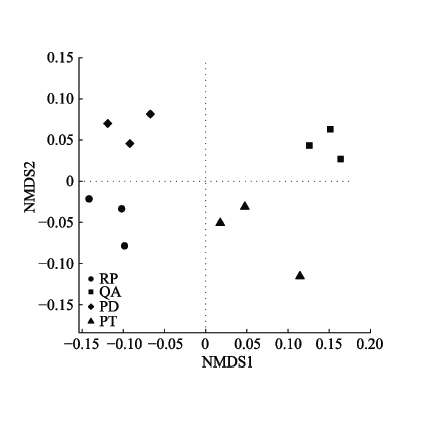
Important findings (1) Fine root litter decomposition differed significantly among different root types. There was no difference in decomposition rate between broad-leaved species and conifer species. In all species, fine roots of RP and QA were more strongly decomposed than that of PT and PD, and these differences were significant (RP > QA > PT > PD). (2) The number of observed species, operational taxonomic units, Ace index and phylogenetic diversity in broad-leaved species were significantly lower than that in coniferous species. Bacterial community structure differed significantly among four species for root decomposition. Initial carbon (C), lignin:nitrogen (N) and C:N in fine root had a great influence on the bacterial community structure. (3) At the phylum level, a total of 4 phyla were dominant (>5% across all species). Based on the average relative abundance, the most abundant phyla were Proteobacteria, Actinomyces, Bacteroidetes and Acidobacteria. Proteobacteria’s and Acidbacteria’s abundance were significantly different among the four species. Particularly, the Proteobacteria of broad-leaved species was significantly higher than that of coniferous species. At the class level, a wide range of classes dominated. Based on the average relative abundance, the most abundance classes were Alphaproteobacteria, Betaproteobacteria, Gammaproteobacteria, unidentified-Actinobacteria and Sphingobacteriia. Alphaproteobacteria and unidentified-Actinobacteria had significant differences among the four species. (4) Pearson correlation analysis showed that the relative abundance of dominant phylum and class was affected by the initial properties of root litter, especially the Proteobacteria and Alphaproteobacteria. In addition, there was a significant positive correlation between fine root decomposition rate and relative abundance of Proteobacteria and Alphaproteobacteria. Redundancy analysis (RDA) also demonstrated that the initial properties of fine root litter (initial N, P, C:N) had significant effects on the structures of bacterial community. These results can improve understanding the links between fine root litter decomposition and functional microbial communities.
Key words: decomposition; fine root; bacterial community; diversity
LU Ying, LI Kun, NI Rui-Qiang, LIANG Qiang, LI Chuan-Rong, ZHANG Cai-Hong . Effects of fine root decomposition on bacterial community structure of four dominated tree species in Mount Taishan, China[J]. Chinese Journal of Plant Ecology, 2018 , 42(12) : 1200 -1210 . DOI: 10.17521/cjpe.2018.0120
| [1] | Adam SW, Zacchaeus GC, Cindy ML ( 2013). Contrasting rRNA gene abundance patterns for aquatic fungi and bacteria in response to leaf-litter chemistry. Freshwater Science, 32, 663-672. |
| [2] | Barret M, Morrissey JP, O’Gara F ( 2011). Functional genomics analysis of plant growth-promoting rhizobacterial traits involved in rhizosphere competence. Biology and Fertility of Soils, 47, 729-743. |
| [3] | Chapman SK, Koch GW ( 2007). What type of diversity yields synergy during mixed litter decomposition in a natural forest ecosystem?Plant and Soil, 299, 153-162. |
| [4] | Chigineva NI, Aleksandrova AV, Tiunov AV ( 2009). The addition of labile carbon alters litter fungal communities and decreases litter decomposition rates. Applied Soil Ecology, 42, 264-270. |
| [5] | Co?teaux M, Bottner P, Berg B ( 1995). Litter decomposition, climate and litter quality. Tree, 10, 63-66. |
| [6] | Ding XJ, Jing RY, Huang YL, Chen BJ, Ma FY ( 2017). Bacterial structure and diversity in rhizosphere and non-?rhizosphere of Robinia pseudoacacia in the Yellow River Delta. Acta Pedologica Sinica, 54, 1293-1302. |
| [6] | [ 丁新景, 敬如岩, 黄雅丽, 陈博杰, 马风云 ( 2017). 黄河三角洲刺槐根际与非根际细菌结构及多样性. 土壤学报, 54, 1293-1302.] |
| [7] | Eichorst SA, Kuske CR, Schmidt TM ( 2011). Influence of plant polymers on the distribution and cultivation of bacteria in the phylum Acidobacteria. Applied and Environmental Microbiology, 77, 586-596. |
| [8] | Elser JJ, Acharya K, Kyle M ( 2003). Growth rate-stoichiometry couplings in diverse biota. Ecology Letters, 6, 936-943. |
| [9] | Fierer N, Bradford MA, Jackson RB ( 2007). Toward an ecological classification of soil bacteria. Ecology, 88, 1354-1364. |
| [10] | Gessner MO, Chauvet E, Dobson M ( 1999). A perspective on leaf litter breakdown in streams. Oikos, 85, 377-384. |
| [11] | Grier CC ( 1981). Biomass distribution and above- and below-?ground production in young and mature Abies amabilis zone ecosystems of the Washington Cascades. Canadian Journal of Forest Research, 11, 155-167. |
| [12] | Gui H, Purahong W, Hyde KD, Xu JC, Mortimer PE ( 2017). The arbuscular mycorrhizal fungus Funneliformis mosseae alters bacterial communities in subtropical forest soils during litter decomposition. Frontiers in Microbiology, 8, 1-11. |
| [13] | Hultman J, Waldrop MP, Mackelprang R, David MM, McFarland J, Blazewicz SJ, Harden J, Turetsky MR, McGuire AD, Shah MB, VerBerkmoes NC, Lee LH, Mavrommatis K, Jansson JK . ( 2015). Multi-omics of permafrost, active layer and thermokarst bog soil microbiomes. Nature, 521, 208-212. |
| [14] | Jones RT, Robeson MS, Lauber CL, Hamady M, Knight R, Fierer N ( 2009). A comprehensive survey of soil acidobacterial diversity using pyrosequencing and clone library analyses. The ISME Journal, 3, 442-453. |
| [15] | Kennedy AC ( 1999). Bacterial diversity in agroecosystems. Agriculture Ecosystems and Environment, 74(1-3), 65-76. |
| [16] | Kersters K, De Vos P, Gillis M, Swings J, Vandamme P, Stackebrandt E ( 2006). Introduction to the Proteobacteria. The Prokaryotes, 5(3), 4-37. |
| [17] | Luo YQ, Zhao XY, Wang T, Li YQ, Zuo XA, Ding JP ( 2017). Plant root decomposition and its responses to biotic and abiotic factors. Acta Prataculturae Sinica, 26(2), 197-207. |
| [17] | [ 罗永清, 赵学勇, 王涛, 李玉强, 左小安, 丁杰萍 ( 2017). 植物根系分解及其对生物和非生物因素的响应机理研究进展. 草业学报, 26(2), 197-207.] |
| [18] | Lydell C, Dowell L, Sikaroodi M, Gillevet P , Emerson ( 2004). A population survey of members of the phylum Bacteroidetes isolated from salt marsh sediments along the east coast of the United States. Microbial Ecology, 48, 263-273. |
| [19] | McLaren JR, Turkington R ( 2010). Plant functional group identity differentially affects leaf and root decomposition. Global Change Biology, 16, 3075-3084. |
| [20] | Meentemeyer V ( 1978). Macroclimate and lignin control of litter decomposition rates. Ecology, 59, 465-472. |
| [21] | Rong L, Li XW, Zhu TH, Zhang J, Yuan WY, Wang Q ( 2009). Varieties of soil microorganisms decomposing Betula luminifera fine roots and Hemarthria compressa roots. Acta Prataculturae Sinica, 18(4), 117-124. |
| [21] | [ 荣丽, 李贤伟, 朱天辉, 张健, 袁渭阳, 王巧 ( 2009). 光皮桦细根与扁穗牛鞭草草根分解的土壤微生物数量及优势类群. 草业学报, 18(4), 117-124.] |
| [22] | Sauvadet M, Chauvat M, Cluzeau D, Maron PA, Villenave C, Bertrand I ( 2016). The dynamics of soil micro-food web structure and functions vary according to litter quality. Soil Biology & Biochemistry, 95, 262-274. |
| [23] | Shen YF, Wang N, Cheng RM, Xiao WF, Yang S, Guo Y, Lei L, Zeng LX, Wang XR ( 2017). Characteristics of fine roots of Pinus massoniana in the Three Gorges Reservoir Area, China. Forests, 8(6), 1-13. |
| [24] | Soares RA, Roesch LFW, Zanatta G, De Oliveira Camargo FA, Passaglia LMP ( 2006). Occurrence and distribution of nitrogen fixing bacterial community associated with oat ( Avena sativa) assessed by molecular and microbiological techniques. Applied Soil Ecology, 33, 221-234. |
| [25] | Sun CL, Zhang G, Cheng RJ, Zhu LQ, Ding JB, Chang WS ( 2017). Microbial community structure and diversity of sheepfold atmosphere by 16S rRNA high-throughput sequencing. Acta Veterinaria et Zootechnica Sinica, 48, 1314-1322. |
| [25] | [ 孙翠丽, 张阁, 程汝佳, 朱良全, 丁家波, 常维山 ( 2017). 16S rRNA高通量测序方法检测羊圈空气微生物群落结构及多样性. 畜牧兽医学报, 48, 1314-1322.] |
| [26] | Sun H, Wang QX, Liu N, Li L, Zhang CG, Liu ZB, Zhang YY ( 2017). Effects of different leaf litters on the physicochemical properties and bacterial communities in Panax ginseng-growing soil. Applied Soil Ecology, 111, 17-24. |
| [27] | Taylor BR, Parkinson D, Parsons WFJ ( 1989). Nitrogen and lignin content as predictors of litter decay rates: A microcosm test. Ecology, 70, 97-104. |
| [28] | Tuomi M, Thum T, Jarvinen H, Fronzek S, Berg B, Harmon M, Trofymow JA, Sevanto S, Liski J ( 2009). Leaf litter decomposition—Estimates of global variability based on Yasso07 model. Ecological Modeling, 220, 3362-3371. |
| [29] | Urbanová M, ?najdr J, Baldrian P ( 2015). Composition of fungal and bacterial communities in forest litter and soil is largely determined by dominant trees. Soil Biology & Biochemistry, 84, 53-64. |
| [30] | Větrovsky T, Baldrian P ( 2015). An in-depth analysis of actinobacterial communities shows their high diversity in grassland soils along a gradient of mixed heavy metal contamination. Biology and Fertility of Soils, 51, 827-837. |
| [31] | Wardle DA, Bardgett RD, Klironomos JN, Set?l? H, van der Putten WH, Wall DH ( 2004). Ecological linkages between aboveground and belowground biota. Science, 304, 1629-1633. |
| [32] | Wymore AS, Salpas E, Casaburi G, Liu CM, Price LB, Hungate BA, McDowell WH, Marks JC ( 2018). Effects of plant species on stream bacterial communities via leachate from leaf litter. Hydrobiologia, 807, 131-144. |
| [33] | Zhang CH, Zhang LM, Liu XR, Xin XP, Li SG ( 2011). Root tissue and shoot litter decomposition of dominant species Stipa baicalensis in Hulun Buir meadow steppe of Inner Mongolia, China. Chinese Journal of Plant Ecology, 35, 1156-1166. |
| [33] | [ 张彩虹, 张雷明, 刘杏认, 辛晓平, 李胜功 ( 2011). 呼伦贝尔草甸草原优势种贝加尔针茅根系组织和地上部分凋落物的分解. 植物生态学报, 35, 1156-1166.] |
| [34] | Zhang MJ ( 2016). Effects of Forest Gap Disturbance on Microbial Biomass and Bacterial Community Structure in the Process of Foliar Litter Decomposition. Master degree dissertation, Sichuan Agricultural University, Chengdu. |
| [34] | [ 张明锦 ( 2016). 林窗干扰对凋落叶分解过程中微生物生物量和细菌群落结构的影响. 硕士论文, 四川农业大学, 成都.] |
| [35] | Zhang MJ, Zhang J, Ji TW, Liu H, Li X, Zhang Y, Yang WQ, Chen LH ( 2015). Influence of forest gap on bacterial community structure and diversity during litter decomposition. Ecology and Environment Sciences, 24, 1287-1294. |
| [35] | [ 张明锦, 张健, 纪托未, 刘华, 李勋, 张艳, 杨万勤, 陈良华 ( 2015). 林窗对凋落物分解过程中细菌群落结构和多样性的影响. 生态环境学报, 24, 1287-1294.] |
| [36] | Zhang YG, Cong J, Lu H, Yang CY, Yang YF, Zhou JZ, Li DQ ( 2014). An integrated study to analyze soil microbial community structure and metabolic potential in two forest types. PLOS ONE, 9, e93773. DOI: 10.1371/journal.pone.0093773. |
| [37] | Zhao BY, Xing P, Wu QL ( 2017). Microbes participated in macrophyte leaf litters decomposition in freshwater habitat. FEMS Microbiology Ecology, 93, fix108. DOI: 10.1093/ femsec/fix108. |
| [38] | Zhao YY, Wu FZ, Yang WQ, Tan B, He W ( 2016). Variations in bacterial communities during Foliar litter decomposition in the winter and growing seasons in an alpine forest of the eastern Tibetan Plateau. Canadian Journal of Microbiology, 62, 1-14. |
/
| 〈 |
|
〉 |
Copyright © 2026 Chinese Journal of Plant Ecology
Tel: 010-62836134, 62836138, E-mail: apes@ibcas.ac.cn, cjpe@ibcas.ac.cn

