
Chinese Journal of Plant Ecology >
Tracing technology of carbon isotope and its applications to studies of carbon cycling in terrestrial ecosystem
Received date: 2019-08-06
Accepted date: 2019-10-14
Online published: 2020-01-03
Supported by
National Natural Science Foundation of China(41430860);National Natural Science Foundation of China(41761134095);National Natural Science Foundation of China(41811540031);Natural Science Foundation of Hunan Province(2019JJ30028);Foundation Science Natural of the Groups Research Innovative of Hunan Province(2019JJ10003);Hunan Province Base for Scientific and Technological Innovation Cooperation(2018WK4012)
Recently developed in recent decades, the carbon isotope tracing technology is one of the most reliable methods, which has been widely used in the study of carbon (C) cycling in terrestrial ecosystems due to its high specificity and sensitivity. Here, the principle, analysis method and application process of C isotope tracing technology in C cycling in terrestrial ecosystem have been reviewed. Four different methods are currently being used in laboratory or field conditions, including natural abundance method, Free-Air Concentration Enrichment (FACE) technology coupling with 13C dilution method, pulse and continuous labeling with 13C enriched CO2, and labeling with 13C enriched substrates. Results of field experiments and lab incubation experiments employing carbon isotope tracing technology were combined in order to quantify the transformation and distribution of photosynthetic C in plant-soil system. Furthermore, these techniques also help to understand the contribution of plant photosynthetic C to soil organic matter, the stabilization of soil organic matter and its microbial mechanism, to illustrate the dynamic changes of soil organic carbon (SOC), evaluate the contribution of new and old organic C to soil C storage, and estimate the micromechanism of SOC input, conversion and the stabilization in terrestrial ecosystems. Carbon cycle is affected by climate, vegetation, human activities and other factors, and therefore it is imperative to further develop a sensitive, accurate, multiscale and multidirectional isotope tracing system by combining carbon isotopes with mass spectrometry, spectroscopy and molecular biological technology. We have summarized the coupled application of carbon isotope tracing technology and the insitu detection involving molecular and biological approaches, and discussed the existing issues of carbon isotope tracing technology.
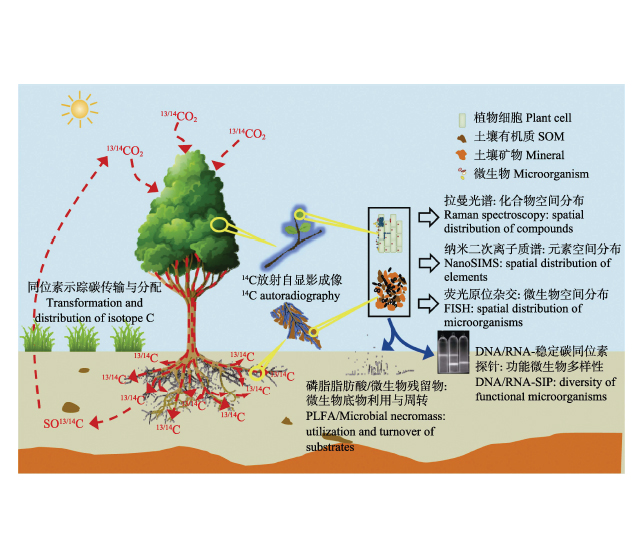
GE Ti-Da, WANG Dong-Dong, ZHU Zhen-Ke, WEI Liang, WEI Xiao-Meng, WU Jin-Shui . Tracing technology of carbon isotope and its applications to studies of carbon cycling in terrestrial ecosystem[J]. Chinese Journal of Plant Ecology, 2020 , 44(4) : 360 -372 . DOI: 10.17521/cjpe.2019.0208
| [1] | Apostel C, Dippold M, Kuzyakov Y (2015). Biochemistry of hexose and pentose transformations in soil analyzed by position-specific labeling and 13C-PLFA . Soil Biology & Biochemistry, 80, 199-208. |
| [2] | Arslan A, Zapata F, Kumarasinghe KS (1999). Carbon isotope discrimination as indicator of water-use efficiency of spring wheat as affected by salinity and gypsum addition. Communications in Soil Science and Plant Analysis, 30, 2681-2693. |
| [3] | Atere CT, Ge TD, Zhu ZK, Tong CL, Jones DL, Shibistova O, Guggenberger G, Wu JS (2017). Rice rhizodeposition and carbon stabilisation in paddy soil are regulated via drying- rewetting cycles and nitrogen fertilisation. Biology and Fertility Soils, 53, 407-417. |
| [4] | Bai E, Boutton TW, Liu F, Wu XB, Archer SR (2012). Spatial patterns of soil δ 13C reveal grassland-to-woodland successional processes . Organic Geochemistry, 42, 1512-1518. |
| [5] | Balesdent J, Mariotti A (1996). Measurement of soil organic matter turnover using 13C natural abundance//Boutton TW, Yamasaki SI. Mass Spectrometry of Soils. Marcel Dekker , New York. 83-111. |
| [6] | Bernoux M, Cerri CC, Neill C, de Moraes JFL (1998). The use of stable carbon isotopes for estimating soil organic matter turnover rates. Geoderma, 82, 43-58. |
| [7] | Berry D, Stecher B, Schintlmeister A, Reichert J, Brugiroux S, Wild B, Wanek W, Richter A, Rauch I, Decker T, Loy A, Wagner M (2013). Host-compound foraging by intestinal microbiota revealed by single-cell stable isotope probing. Proceedings of the National Academy of Sciences of the United States of America, 110, 4720-4725. |
| [8] | Blagodatskaya E, Yuyukina T, Blagodatsky S, Kuzyakov Y (2011a). Three-source-partitioning of microbial biomass and of CO2 efflux from soil to evaluate mechanisms of priming effects. Soil Biology & Biochemistry, 43, 778-786. |
| [9] | Blagodatskaya E, Yuyukina T, Blagodatsky S, Kuzyakov Y (2011b). Turnover of soil organic matter and of microbial biomass under C3-C4 vegetation change: consideration of 13C fractionation and preferential substrate utilization . Soil Biology & Biochemistry, 43, 159-166. |
| [10] | Blagodatskaya Е, Kuzyakov Y (2008). Mechanisms of real and apparent priming effects and their dependence on soil microbial biomass and community structure: critical review. Biology and Fertility of Soils, 45, 115-131. |
| [11] | Blaser M, Conrad R (2016). Stable carbon isotope fractionation as tracer of carbon cycling in anoxic soil ecosystems. Current Opinion in Biotechnology, 41, 122-129. |
| [12] | Bradford MA, Fierer N, Jackson RB, Maddox TR, Reynolds JF (2008). Nonlinear root-derived carbon sequestration across a gradient of nitrogen and phosphorous deposition in experimental mesocosms. Global Change Biology, 14, 1113-1124. |
| [13] | Canadell JG, Pitelka LF, Ingram JSI (1995). The effects of elevated [CO2] on plant-soil carbon below-ground: a summary and synthesis. Plant and Soil, 187, 391-400. |
| [14] | Cao YC, Sun GQ, Han Y, Sun DL, Wang X (2008). Determination of nitrogen, carbon and oxygen stable isotope ratios in N2O, CH4, and CO2 at natural abundance levels by mass spectrometer. Acta Pedologica Sinica, 45, 249-258. |
| [14] | [ 曹亚澄, 孙国庆, 韩勇, 孙德玲, 王曦 (2008). 大气浓度下N2O、CH4和CO2中氮、碳和氧稳定同位素比值的质谱测定. 土壤学报, 45, 249-258.] |
| [15] | Chen SP, Bai YF, Han XG (2002). Applications of stable carbon isotope techniques to ecological research. Acta Phytoecologica Sinica, 26, 549-560. |
| [15] | [ 陈世苹, 白永飞, 韩兴国 (2002). 稳定性碳同位素技术在生态学研究中的应用. 植物生态学报, 26, 549-560.] |
| [16] | Cheng WX (2009). Rhizosphere priming effect: its functional relationships with microbial turnover, evapotranspiration, and C-N budgets. Soil Biology & Biochemistry, 41, 1795-1801. |
| [17] | Conley MM, Kimball BA, Brooks TJ, Pinter Jr. PJ, Hunsaker DJ, Wall GW, Adam NR, LaMorte RL, Matthias AD, Thompson TL, Leavitt SW, Ottman MJ, Cousins AB, Triggs JM (2001). CO2 enrichment increases water-use efficiency in sorghum. New Phytologist, 151, 407-412. |
| [18] | Conrad R, Klose M, Claus P, Enrich-Prastb A (2010). Methanogenic pathway, 13C isotope fractionation, and archaeal community composition in the sediment of two clear- water lakes of Amazonia . Limnology and Oceanography, 55, 689-702. |
| [19] | Conrad R, Klose M, Yuan Q, Lu YH, Chidthaisong A (2012). Stable carbon isotope fractionation, carbon flux partitioning and priming effects in anoxic soils during methanogenic degradation of straw and soil organic matter. Soil Biology & Biochemistry, 49, 193-199. |
| [20] | Cotrufo MF, Soong JL, Horton AJ, Campbell EE, Haddix ML, Wall DH, Parton WJ (2015). Formation of soil organic matter via biochemical and physical pathways of litter mass loss. Nature Geoscience, 8, 776-779. |
| [21] | Cotrufo MF, Wallenstein MD, Boot CM, Denef K, Paul E (2013). The Microbial Efficiency-Matrix Stabilization (MEMS) framework integrates plant litter decomposition with soil organic matter stabilization: Do labile plant inputs form stable soil organic matter? Global Change Biology, 19, 988-995. |
| [22] | Crow SE, Sulzma EW, Rugh WD, Bowden RD, Lajtha K (2006). Isotopic analysis of respired CO2 during decomposition of separated soil organic matter pools. Soil Biology & Biochemistry, 38, 3279-3291. |
| [23] | Dekas AE, Poretsky RS, Orphan VJ (2009). Deep-sea archaea fix and share nitrogen in methane-consuming microbial consortia. Science, 326, 422-426. |
| [24] | Dorodnikov M, Kuzyakov Y, Fangmeier A, Wiesenberg GLB (2011). C and N in soil organic matter density fractions under elevated atmospheric CO2: turnover vs. stabilization. Soil Biology & Biochemistry, 43, 579-589. |
| [25] | Dumont MG, Radajewski SM, Miguez CB, McDonald IR, Murrell JC (2006). Identification of a complete methane monooxygenase operon from soil by combining stable isotope probing and metagenomic analysis. Environmental Microbiology, 8, 1240-1250. |
| [26] | Ebdon JS, Petrovic AM, Dawson TE (1998). Relationship between carbon isotope discrimination, water use efficiency, and evapotranspiration in Kentucky bluegrass. Crop Science, 38, 157-162. |
| [27] | Ehleringer J, Pearcy RW (1983). Variation in quantum yield for CO2 uptake among C3 and C4 plants. Plant Physiology, 73, 555-559. |
| [28] | Eiler JM, Clog M, Magyar P, Piasecki A, Sessions A, Stolper D, Deerberg M, Schlueter HJ, Schwieters J (2012). A high-resolution gas-source isotope ratio mass spectrometer. International Journal of Mass Spectrometry, 335, 45-56. |
| [29] | Epron D, Bahn M, Derrien D, Lattanzi FA, Pumpanen J, Gessler A, H?gberg P, Maillard P, Dannoura M, Gérant D, Buchmannet N (2012). Pulse-labelling trees to study carbon allocation dynamics: a review of methods, current knowledge and future prospects. Tree Physiology, 32, 776-798. |
| [30] | Fan FL, Yin C, Tang YJ, Li ZJ, Song AL, Wakelin SA, Zou J, Liang YC (2014). Probing potential microbial coupling of carbon and nitrogen cycling during decomposition of maize residue by 13C-DNA-SIP . Soil Biology & Biochemistry, 70, 12-21. |
| [31] | Fernandez I, Mahieu N, Cadisch G (2003). Carbon isotopic fractionation during decomposition of plant materials of different quality. Global Biogeochemical Cycles, 17, 1075. DOI: 10.1029/2001gb001834. |
| [32] | Garten Jr CT, Taylor Jr GE (1992). Foliar δ13C within a temperate deciduous forest: spatial, temporal, and species sources of variation. Oecologia, 90, 1-7. |
| [33] | Ge TD, Li BZ, Zhu ZK, Hu YJ, Yuan HZ, Dorodnikov M, Jones DL, Wu JS, Kuzyakov Y (2017). Rice rhizodeposition and its utilization by microbial groups depends on N fertilization. Biology and Fertility of Soils, 53, 37-48. |
| [34] | Ge Y, He JZ, Zheng YM, Zhang LM, Zhu YG (2006). Stable isotope probing and its applications in microbial ecology. Acta Ecologica Sinica, 26, 1574-1582. |
| [34] | [ 葛源, 贺纪正, 郑袁明, 张丽梅, 朱永官 (2006). 稳定性同位素探测技术在微生物生态学研究中的应用. 生态学报, 26, 1574-1582.] |
| [35] | Griepentrog M, Eglinton TI, Hagedorn F, Schmidt MWI, Wiesenberg GLB (2015). Interactive effects of elevated CO2 and nitrogen deposition on fatty acid molecular and isotope composition of above- and belowground tree biomass and forest soil fractions. Global Change Biology, 21, 473-486. |
| [36] | Guenet B, Camino-Serrano M, Ciais P, Tifafi M, Maignan F, Soong JL, Janssens IA (2018). Impact of priming on global soil carbon stocks. Global Change Biology, 24, 1873-1883. |
| [37] | Hagedorn F, Hiltbrunner D, Streit K, Ekblad A, Lindahl B, Miltner A, Frey B, Handa IT, H?ttenschwiler S (2013). Nine years of CO2 enrichment at the alpine treeline stimulates soil respiration but does not alter soil microbial communities. Soil Biology & Biochemistry, 57, 390-400. |
| [38] | Hagedorn F, Spinnler D, Siegwolf R (2003). Increased N deposition retards mineralization of old soil organic matter. Soil Biology & Biochemistry, 35, 1683-1692. |
| [39] | Hanson PJ, Edwards NT, Garten CT, Andrews JA (2000). Separating root and soil microbial contributions to soil respiration: a review of methods and observations. Biogeochemistry, 48, 115-146. |
| [40] | He Y (2016). Stectroscopy and Imaging Technology in Agriculture. Science Press, Beijing. |
| [40] | [ 何勇 (2016). 光谱及成像技术在农业中的应用. 科学出版社, 北京.] |
| [41] | Herrmann AM, Ritz K, Nunan N, Clode PL, Pett-Ridge J, Kilburn MR, Murphy DV, O’Donnell AG, Stockdale EA (2007). Nano-scale secondary ion mass spectrometry—A new analytical tool in biogeochemistry and soil ecology: a review article. Soil Biology & Biochemistry, 39, 1835-1850. |
| [42] | Hofmockel KS, Zak DR, Moran KK, Jastrow JD (2011). Changes in forest soil organic matter pools after a decade of elevated CO2 and O3. Soil Biology & Biochemistry, 43, 1518-1527. |
| [43] | Holz M, Zarebanadkouki M, Carminati A, Kuzyakov Y (2019). Visualization and quantification of root exudation using 14C imaging: challenges and uncertainties . Plant and Soil, 437, 473-485. |
| [44] | Holz M, Zarebanadkouki M, Kuzyakov Y, Pausch J, Carminati A (2018). Root hairs increase rhizosphere extension and carbon input to soil. Annals of Botany, 121, 61-69. |
| [45] | Hungate BA, Mau RL, Schwartz E, Caporaso JG, Dijkstra P, van Gestel N, Koch BJ, Liu CM, McHugh TA, Marks JC, Morrissey EM, Price LB (2015). Quantitative microbial ecology through stable isotope probing. Applied Environmental Microbiology, 81, 7570-7581. |
| [46] | Jin XX, Wang JK, Sun LJ, Wang S, Pei JB, An TT, Ding F, Gao XD, Xu YD (2017). Progress of carbon cycle in farmland and sequestration in soil aggregates revealed by stable 13C isotope . Soils, 49, 217-224. |
| [46] | [ 金鑫鑫, 汪景宽, 孙良杰, 王帅, 裴久渤, 安婷婷, 丁凡, 高晓丹, 徐英德 (2017). 稳定 13C同位素示踪技术在农田土壤碳循环和团聚体固碳研究中的应用进展 . 土壤, 49, 217-224.] |
| [47] | Kemmitt SJ, Lanyon CV, Waite IS, Wen Q, Addiscott TM, Bird NRA, O’Donnell AG, Brookes PC (2008). Mineralization of native soil organic matter is not regulated by the size, activity or composition of the soil microbial biomass—A new perspective. Soil Biology & Biochemistry, 40, 61-73. |
| [48] | Kiem R, Knicker H, K?rschens M, K?gel-Knabner I (2000). Refractory organic carbon in C-depleted arable soils, as studied by 13C NMR spectroscopy and carbohydrate analysis . Organic Geochemistry, 31, 655-668. |
| [49] | Kimura M, Murase J, Lu YH (2004). Carbon cycling in rice field ecosystems in the context of input, decomposition and translocation of organic materials and the fates of their end products (CO2 and CH4). Soil Biology & Biochemistry, 36, 1399-1416. |
| [50] | Kingston JD, Hill A, Marino BD (1994). Isotopic evidence for neogene hominid paleoenvironments in the Kenya rift valley. Science, 264, 955-959. |
| [51] | Ku?lien? G, Rasmussen J, Kuzyakov Y, Eriksen J (2014). Medium-term response of microbial community to rhizodeposits of white clover and ryegrass and tracing of active processes induced by 13C and 15N labelled exudates . Soil Biology & Biochemistry, 76, 22-33. |
| [52] | Kuzyakov Y (2005). Theoretical background for partitioning of root and rhizomicrobial respiration by δ13C of microbial biomass. European Journal of Soil Biology, 41, 1-9. |
| [53] | Kuzyakov Y (2006). Sources of CO2 efflux from soil and review of partitioning methods. Soil Biology & Biochemistry, 38, 425-448. |
| [54] | Kuzyakov Y (2010). Priming effects: interactions between living and dead organic matter. Soil Biology & Biochemistry, 42, 1363-1371. |
| [55] | Kuzyakov Y, Cheng WX (2001). Photosynthesis controls of rhizosphere respiration and organic matter decomposition. Soil Biology & Biochemistry, 33, 1915-1925. |
| [56] | Kuzyakov Y, Domanski G (2000). Carbon input by plants into the soil. Review. Journal of Plant Nutrition and Soil Science, 163, 421-431. |
| [57] | Kuzyakov Y, Gavrichkova O (2010). Time lag between photosynthesis and carbon dioxide efflux from soil: a review of mechanisms and controls. Global Change Biology, 16, 3386-3406. |
| [58] | Leavitt SW, Paul EA, Kimball BA, Hendrey GR, Mauney JR, Rauschkolb R, Rogers H, Lewin KF, Nagy J, Pinter Jr PJ, Johnson HB (1994). Carbon isotope dynamics of free-air CO2-enriched cotton and soils. Agricultural and Forest Meteorology, 70, 87-101. |
| [59] | Lechene CP, Luyten Y, McMahon G, Distel DL (2007). Quantitative imaging of nitrogen fixation by individual bacteria within animal cells. Science, 317, 1563-1566. |
| [60] | Li MQ, Canniffe DP, Jackson PJ, Davison PA, FitzGerald S, Dickman MJ, Burgess JG, Hunter CN, Huang WE (2012). Rapid resonance Raman microspectroscopy to probe carbon dioxide fixation by single cells in microbial communities. The ISME Journal, 6, 875-885. |
| [61] | Liang C, Schimel JP, Jastrow JD (2017). The importance of anabolism in microbial control over soil carbon storage. Nature Microbiology, 2, 17105. DOI: 10.1038/nmicrobiol.2017.105. |
| [62] | Liang JY, Zhou ZH, Huo CF, Shi Z, Cole JR, Huang L, Konstantinidis KT, Li XM, Liu B, Luo ZK, Penton CR, Schuur EAG, Tiedje JM, Wang YP, Wu LY, Xia JY, Zhou JZ, Luo YQ (2018). More replenishment than priming loss of soil organic carbon with additional carbon input. Nature Communications, 9, 3175. DOI: 10.1038/s41467-018-05667-7. |
| [63] | Lin GH (2013). Stable Isotope Ecology. Higher Education Press, Beijing. |
| [63] | [ 林光辉 (2013). 稳定同位素生态学. 高等教育出版社, 北京.] |
| [64] | Liu CB, Shen QP, Yang GY, Si XX, He P, Wang KM, Zhang HY, Liu ZH, Miao MM (2014). Determination of thermal decomposition products of glucose by thermal analysis combined with FTIR and GC-MS. Physical Testing and Chemical Analysis Part B: Chemical Analysis, 50, 1342-1347. |
| [64] | [ 刘春波, 申钦鹏, 杨光宇, 司晓喜, 何沛, 王昆淼, 张宏宇, 刘志华, 缪明明 (2014). 热分析-傅里叶变换红外光谱-气相色谱-质谱联用测定葡萄糖的热分解产物. 理化检验: 化学分册, 50, 1342-1347.] |
| [65] | Liu YL, Ge TD, Ye J, Liu SL, Shibistova O, Wang P, Wang JK, Li Y, Guggenberger G, Kuzyakov Y, Wu JS (2019a). Initial utilization of rhizodeposits with rice growth in paddy soils: rhizosphere and N fertilization effects. Geoderma, 338, 30-39. |
| [66] | Liu YL, Ge TD, Zhu ZK, Liu SL, Luo Y, Li Y, Wang P, Gavrichkova O, Xu XL, Wang JK, Wu JS, Guggenberger G, Kuzyakov Y (2019b). Carbon input and allocation by rice into paddy soils: a review. Soil Biology & Biochemistry, 133, 97-107. |
| [67] | Lu YH, Conrad R (2005). In situ stable isotope probing of methanogenic archaea in the rice rhizosphere. Science, 309, 1088-1090. |
| [68] | Lu YH, Watanabe A, Kimura M (2002a). Contribution of plant-derived carbon to soil microbial biomass dynamics in a paddy rice microcosm. Biology and Fertility of Soils, 36, 136-142. |
| [69] | Lu YH, Watanabe A, Kimura M (2002b). Input and distribution of photosynthesized carbon in a flooded rice soil. Global Biogeochemical Cycles, 16, 321-328. |
| [70] | Lu YH, Watanabe A, Kimura M (2003). Carbon dynamics of rhizodeposits, root- and shoot-residues in a rice soil. Soil Biology & Biochemistry, 35, 1223-1230. |
| [71] | McLeod AR, Long SP (1999). Free-air carbon dioxide enrichment (FACE) in global change research: a review. Advances in Ecological Research, 28, 1-56. |
| [72] | Morrissey EM, Mau RL, Schwartz E, McHugh TA, Dijkstra P, Koch BJ, Marks JC, Hungate BA (2017). Bacterial carbon use plasticity, phylogenetic diversity and the priming of soil organic matter. The ISME Journal, 11, 1890-1899. |
| [73] | Musat N, Musat F, Weber PK, Pett-Ridge J (2016). Tracking microbial interactions with NanoSIMS. Current Opinion in Biotechnology, 41, 114-121. |
| [74] | Neufeld JD, Chen Y, Dumont MG, Murrell JC (2008). Marine methylotrophs revealed by stable-isotope probing, multiple displacement amplification and metagenomics. Environmental Microbiology, 10, 1526-1535. |
| [75] | Paul D, Skrzypek G, Fórizs I (2007). Normalization of measured stable isotopic compositions to isotope reference scales—A review. Rapid Communications in Mass Spectrometry, 21, 3006-3014. |
| [76] | Pausch J, Kuzyakov Y (2011). Photoassimilate allocation and dynamics of hotspots in roots visualized by 14C phosphor imaging . Journal of Plant Nutrition and Soil Science, 174, 12-19. |
| [77] | Pendall E, Del Grosso S, King JY, LeCain DR, Milchunas DG, Morgan JA, Mosier AR, Ojima DS, Parton WA, Tans PP, White JWC (2003). Elevated atmospheric CO2 effects and soil water feedbacks on soil respiration components in a Colorado grassland. Global Biogeochemical Cycles, 17, 1046. |
| [78] | Pe?uelas J, Filella I, Terradas J (1999). Variability of plant nitrogen and water use in a 100-m transect of a subdesertic depression of the Ebro valley (Spain) characterized by leaf δ13C and δ15N. Acta Oecologica, 20, 119-123. |
| [79] | Perveen N, Barot S, Maire V, Cotrufo MF, Shahzad T, Blagodatskaya E, Stewart CE, Ding WX, Siddiq MR, Dimassi B, Mary B, Fontaine S (2019). Universality of priming effect: an analysis using thirty five soils with contrasted properties sampled from five continents. Soil Biology & Biochemistry, 134, 162-171. |
| [80] | Phillips DL, Gregg JW (2003). Source partitioning using stable isotopes: coping with too many sources. Oecologia, 136, 261-269. |
| [81] | Radajewski S, Ineson P, Parekh NR, Murrell JC (2000). Stable-isotope probing as a tool in microbial ecology. Nature, 403, 646-649. |
| [82] | Ren SJ, Yu GR (2011). Carbon isotope composition (δ13C) of C3 plants and water use efficiency in China. Chinese Journal of Plant Ecology, 35, 119-124. |
| [82] | [ 任书杰, 于贵瑞 (2011). 中国区域478种C3植物叶片碳稳定性同位素组成与水分利用效率. 植物生态学报, 35, 119-124.] |
| [83] | Rochette P, Flanagan LB, Gregorich EG (1999). Separating soil respiration into plant and soil components using analyses of the natural abundance of carbon-13. Soil Science Society of America Journal, 63, 1207-1213. |
| [84] | Rumpel C, Baumann K, Remusat L, Dignac MF, Barré P, Deldicque D, Glasser G, Lieberwirth I, Chabbi A (2015). Nanoscale evidence of contrasted processes for root-derived organic matter stabilization by mineral interactions depending on soil depth. Soil Biology & Biochemistry, 85, 82-88. |
| [85] | Ruyters S, Nicol GW, Prosser JI, Lievens B, Smolders E (2013). Activity of the ammonia oxidising bacteria is responsible for zinc tolerance development of the ammonia oxidising community in soil: a stable isotope probing study. Soil Biology & Biochemistry, 58, 244-247. |
| [86] | Six J, Carpentier A, van Kessel C, Merckx R, Harris D, Horwath WR, Lüscher A (2001). Impact of elevated CO2 on soil organic matter dynamics as related to changes in aggregate turnover and residue quality. Plant and Soil, 234, 27-36. |
| [87] | Tian QX, He HB, Cheng WX, Zhang XD (2014). Pulse-dynamic and monotonic decline patterns of soil respiration in long term laboratory microcosms. Soil Biology & Biochemistry, 68, 329-336. |
| [88] | Tieszen LL, Boutton TW (1989). Stable carbon isotopes in terrestrial ecosystem research//Rundel PW, Ehleringer JR, Nagy KA. Stable Isotopes in Ecological Research. Springer-Verlag, New York. 167-195. |
| [89] | Vidal A, Remusat L, Watteau F, Derenne S, Quenea K (2016). Incorporation of 13C labelled shoot residues in Lumbricus terrestris casts: a combination of transmission electron microscopy and nanoscale secondary ion mass spectrometry. Soil Biology & Biochemistry, 93, 8-16. |
| [90] | Wang J, Chapman SJ, Yao HY (2016). Incorporation of 13C-labelled rice rhizodeposition into soil microbial communities under different fertilizer applications . Applied Soil Ecology, 101, 11-19. |
| [91] | Webster EA, Chudek JA, Hopkins DW (1997). Fates of 13C from enriched glucose and glycine in an organic soil determined by solid-state NMR . Biology and Fertility of Soils, 25, 389-395. |
| [92] | Werth M, Kuzyakov Y (2010). 13C fractionation at the root-microorganisms-soil interface: a review and outlook for partitioning studies . Soil Biology & Biochemistry, 42, 1372-1384. |
| [93] | Whitman T, Lehmann J (2015). A dualisotope approach to allow conclusive partitioning between three sources. Nature Communications, 6, 8708. DOI: 10.1038/ncomms9708. |
| [94] | Wiesheu AC, Brejcha R, Mueller CW, K?gel-Knabner I, Elsner M, Niessner R, Ivleva NP (2018). Stable-isotope Raman microspectroscopy for the analysis of soil organic matter. Analytical and Bioanalytical Chemistry, 410, 923-931. |
| [95] | Williams MA, Myrold DD, Bottomley PJ (2006). Carbon flow from 13C-labeled straw and root residues into the phospholipid fatty acids of a soil microbial community under field conditions . Soil Biology & Biochemistry, 38, 759-768. |
| [96] | Xiao ML, Zang HD, Ge TD, Chen AL, Zhu ZK, Zhou P, Atere CT, Wu JS, Su YR, Kuzyakov Y (2019a). Effect of nitrogen fertilizer on rice photosynthate allocation and carbon input in paddy soil. European Journal of Soil Science, 70, 786-795. |
| [97] | Xiao ML, Zang HD, Liu SL, Ye RZ, Zhu ZK, Su YR, Wu JS, Ge TD (2019b). Nitrogen fertilization alters the distribution and fates of photosynthesized carbon in rice-soil systems: a 13C-CO2 pulse labeling study . Plant and Soil, 445, 101-112. |
| [98] | Yuan HZ, Li CY, Jian Y, Geng MM, Xu LW, Wang JR (2014). Stable isotope technique in the soil carbon cycling research of agricultural ecosystems. Journal of Isotopes, 27, 170-178. |
| [98] | [ 袁红朝, 李春勇, 简燕, 耿梅梅, 许丽卫, 王久荣 (2014). 稳定同位素分析技术在农田生态系统土壤碳循环中的应用. 同位素, 27, 170-178.] |
| [99] | Yuan HZ, Zhu ZK, Liu SL, Ge TD, Jing HZ, Li BZ, Liu Q, Lynn TM, Wu JS, Kuzyakov Y (2016). Microbial utilizetion of rice root exudates: 13C labeling and PLFA composition . Biology and Fertility of Soils, 52, 615-627. |
| [100] | Zang HD, Xiao ML, Wang YD, Ling N, Wu JS, Ge TD, Kuzyakov Y (2019). Allocation of assimilated carbon in paddies depending on rice age, chase period and N fertilization: experiment with 13CO2 labelling and literature synthesis . Plant and Soil, 445, 113-123. |
| [101] | Zhang L, Sun XY, Gao CD, Cao JX (2010). Applications of stable isotope ratio mass spectrometer in soil carbon cycle research. Analytical Instrumentation, 1, 18-23. |
| [101] | [ 张林, 孙向阳, 高程达, 曹吉鑫 (2010). 稳定同位素比例质谱仪在土壤碳循环研究中的应用. 分析仪器, 1, 18-23.] |
| [102] | Zhang R, Zhao Y, He HB, Zhang XD (2017). Investigation on effects of elevated atmospheric CO2 concentration on plant-soil system carbon cycling: based on stable isotopic technique. Chinese Journal of Applied Ecology, 28, 2379-2388. |
| [102] | [ 张蕊, 赵钰, 何红波, 张旭东 (2017). 基于稳定碳同位素技术研究大气CO2浓度升高对植物-土壤系统碳循环的影响. 应用生态学报, 28, 2379-2388.] |
| [103] | Zhang W, Liang C, Kao-Kniffin J, He HB, Xie HT, Zhang H, Zhang XD (2015). Differentiating the mineralization dynamics of the originally present and newly synthesized amino acids in soil amended with available carbon and nitrogen substrates. Soil Biology & Biochemistry, 85, 162-169. |
| [104] | Zhao ZW, Ge TD, Gunina A, Li YH, Zhu ZK, Peng PQ, Wu JS, Kuzyakov Y (2019). Carbon and nitrogen availability in paddy soil affects rice photosynthate allocation, microbial community composition, and priming: combining continuous 13C labeling with PLFA analysis . Plant and Soil, 445, 137-152. |
| [105] | Zhu ZK, Ge TD, Hu YJ, Zhou P, Wang TT, Shibistova O, Guggenberger G, Su YR, Wu JS (2017a). Fate of rice shoot and root residues, rhizodeposits, and microbial assimilated carbon in paddy soil-part 2: turnover and microbial utilization. Plant and Soil, 416, 243-257. |
| [106] | Zhu ZK, Ge TD, Liu SL, Hu YJ, Ye RZ, Xiao ML, Tong CL, Kuzyakov Y, Wu JS (2018a). Rice rhizodeposits affect organic matter priming in paddy soil: the role of N fertilization and plant growth for enzyme activities, CO2 and CH4 emissions. Soil Biology & Biochemistry, 116, 369-377. |
| [107] | Zhu ZK, Ge TD, Luo Y, Liu SL, Xu XL, Tong CL, Shibistova O, Guggenberger G, Wu JS (2018b). Microbial stoichiometric flexibility regulates rice straw mineralizetion and its priming effect in paddy soil. Soil Biology & Biochemistry, 121, 67-76. |
| [108] | Zhu ZK, Ge TD, Xiao ML, Yuan HZ, Wang TT, Liu SL, Atere CT, Wu JS, Kuzyakov Y (2017b). Belowground carbon allocation and dynamics under rice cultivation depends on soil organic matter content. Plant and Soil, 410, 247-258. |
| [109] | Zhu ZK, Shen BJ, Ge TD, Wang JR, Yuan HZ, Wu JS (2016). Biogeochemical processes underlying the input and turnover of crop assimilative carbon in farmland ecosystems. Acta Ecologica Sinica, 36, 5987-5997. |
| [109] | [ 祝贞科, 沈冰洁, 葛体达, 王久荣, 袁红朝, 吴金水 (2016). 农田作物同化碳输入与周转的生物地球化学过程. 生态学报, 36, 5987-5997.] |
| [110] | Zong C, Xu MX, Xu LJ, Wei T, Ma X, Zheng XS, Hu R, Ren B (2018). Surface-enhanced raman spectroscopy for bioanalysis: reliability and challenges. Chemical Reviews, 118, 4946-4980. |
/
| 〈 |
|
〉 |
Copyright © 2026 Chinese Journal of Plant Ecology
Tel: 010-62836134, 62836138, E-mail: apes@ibcas.ac.cn, cjpe@ibcas.ac.cn

