
Chinese Journal of Plant Ecology >
Extreme drought effects on nonstructural carbohydrates of dominant plant species in a meadow grassland
Online published: 2020-03-26
Supported by
National Natural Science Foundation of China(31971465);National Natural Science Foundation of China(41603080);Strategic Priority Research Program of Chinese Academy of Sciences(XDA23080401)
Aims Plant nonstructural carbohydrates (NSCs) produced by photosynthesis can reflect the responses of plants and/or ecosystem to environmental changes. Climate models recently predicted an increase in the frequency and duration of extreme drought (ED) events that could profoundly impact ecosystem structure and functions. Yet, less is understood about the response patterns of different plant species and functional groups to extreme drought.
Methods Here we studied the effects of extreme drought on the NSCs of dominant species belonging to different functional groups in grasslands. To achieve ED, we experimentally reduced precipitation amounts by 66% during four consecutive growing seasons in a meadow steppe in Hulunbeier, North China. The NSCs of six plants grouped into two functional groups (i.e., grass and non-grass) were examined.
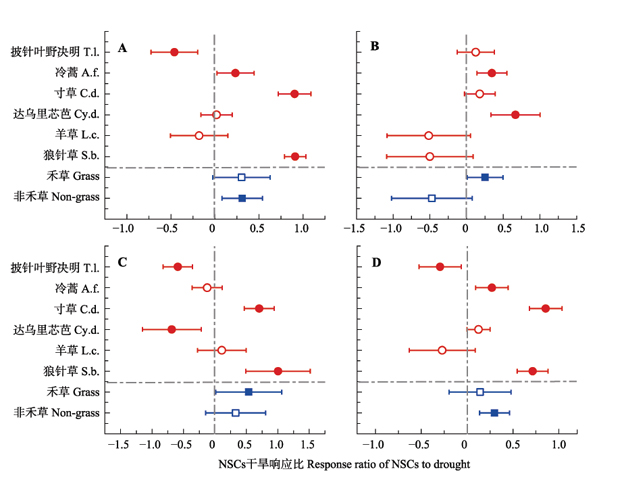
Important findings We found different species responded differently to drought, due to their differences in plant biological characteristics, photosynthetic characteristics and physiological ecology. This result implied that different species used different NSC-use strategies to cope with drought stress, resulting in different responses of their biomass to extreme drought. Extreme drought significantly increased the starch concentrations, and had no effect on the soluble sugar concentrations of the grass functional group. Contrarily, ED significantly increased the soluble sugar concentrations, and had no significant effects on the starch concentrations of the non-grass functional group. These results indicate that grasses moderately use and store photosynthate to cope with drought stress, hence their biomass was less sensitive. The biomass of the non-grasses was more sensitive perhaps because they maximally utilize soluble sugar for plant growth, defense and reproduction. Our results showed that different species or functional groups exhibit different NSC-use strategies to cope with drought stress. This study could provide scientific data for predicting future ecosystem responses to extreme drought.
SONG Lin, LUO Wen-Tao, MA Wang, HE Peng, LIANG Xiao-Sa, WANG Zheng-Wen . Extreme drought effects on nonstructural carbohydrates of dominant plant species in a meadow grassland[J]. Chinese Journal of Plant Ecology, 2020 , 44(6) : 669 -676 . DOI: 10.17521/cjpe.2019.0331
| [1] | Chen LP, Zhao NX, Zhang LH, Gao YB (2013). Responses of two dominant plant species to drought stress and defoliation in the Inner Mongolia Steppe of China. Plant Ecology, 214, 221-229. |
| [2] | Chen SP, Bai YF, Zhang LX, Han XG (2005). Comparing physiological responses of two dominant grass species to nitrogen addition in Xilin River Basin of China. Environmental and Experimental Botany, 53, 65-75. |
| [3] | Cherwin K, Knapp AK (2012). Unexpected patterns of sensitivity to drought in three semi-arid grasslands. Oecologia, 169, 845-852. |
| [4] | Dietze MC, Sala AN, Carbone MS, Czimczik CI, Mantooth JA, Richardson AD, Vargas R (2014). Nonstructural carbon in woody plants. Annual Review of Plant Biology, 65, 667-687. |
| [5] | Fan Y, Miguez-Macho G, Jobbágy EG, Jackson RB, Otero- Casal C (2017). Hydrologic regulation of plant rooting depth. Proceedings of the National Academy of Sciences of the United States of America, 114, 10572-10577. |
| [6] | Ford CW, Wilson JR (1981). Changes in levels of solutes during osmotic adjustment to water-stress in leaves of four tropical pasture species. Functional Plant Biology, 8, 77-91. |
| [7] | Graefe J, Sandmann M (2015). Shortwave radiation transfer through a plant canopy covered by single and double layers of plastic. Agricultural and Forest Meteorology, 201, 196-208. |
| [8] | Hartmann H, Trumbore S (2016). Understanding the roles of nonstructural carbohydrates in forest trees-from what we can measure to what we want to know. New Phytologist, 211, 386-403. |
| [9] | Hewitt BR (1958). Spectrophotometric determination of total carbohydrate. Nature, 182, 246-247. |
| [10] | Iannucci A, Russo M, Arena L, di Fonzo N, Martiniello P (2002). Water deficit effects on osmotic adjustment and solute accumulation in leaves of annual clovers. European Journal of Agronomy, 16, 111-122. |
| [11] | Jentsch A, Kreyling J, Boettcher-Treschkow J, Beierkuhnlein C (2009). Beyond gradual warming: extreme weather events alter flower phenology of European grassland and heath species. Global Change Biology, 15, 837-849. |
| [12] | Kang XM, Cui LJ, Hao YB, Li W, Cui XY, Wang YF (2015). Effects of extreme drought on the water balance of aLeymus chinensis steppe in Inner Mongolia, China. Chinese Journal of Applied and Environmental Biology, 21, 700-709. |
| [12] | [ 康晓明, 崔丽娟, 郝彦宾, 李伟, 崔骁勇, 王艳芬 (2015). 极端干旱对内蒙古羊草草原水分平衡的影响. 应用与环境生物学报, 21, 700-709.] |
| [13] | K?rner C (1999). Alpine Plant Life: Functional Plant Ecology of High Mountain Ecosystems. Springer Science & Business Media, Berlin. |
| [14] | Leloir L, Cardini C (1955). The biosynthesis of sucrose-correction. Journal of the American Chemical Society, 214, 157-165. |
| [15] | Li MH, Cherubini P, Dobbertin M, Arend M, Xiao WF, Rigling A (2013). Responses of leaf nitrogen and mobile carbohydrates in different Quercus species/provenances to moderate climate changes. Plant Biology, 15, 177-184. |
| [16] | Li MH, Xiao WF, Wang SG, Cheng GW, Cherubini P, Cai XH, Liu XL, Wang XD, Zhu WZ (2008). Mobile carbohydrates in Himalayan treeline trees I. Evidence for carbon gain limitation but not for growth limitation. Tree Physiology, 28, 1287-1296. |
| [17] | Loewe A, Einig W, Shi LB, Dizengremel P, Hampp R (2000). Mycorrhiza formation and elevated CO2 both increase the capacity for sucrose synthesis in source leaves of spruce and aspen. New Phytologist, 145, 565-574. |
| [18] | Luo WT, Zuo XA, Griffin-Nolan RJ, Xu C, Ma W, Song L, Helsen K, Lin YC, Cai JP, Yu Q, Wang ZW, Smith MD, Han XG, Knapp AK (2019). Long term experimental drought alters community plant trait variation, not trait means, across three semiarid grasslands. Plant and Soil, 442, 343-353. |
| [19] | Luo WT, Zuo XA, Ma W, Xu C, Li A, Yu Q, Knapp AK, Tognetti R, Dijkstra FA, Li MH, Han GD, Wang ZW, Han XG (2018). Differential responses of canopy nutrients to experimental drought along a natural aridity gradient. Ecology, 99, 2230-2239. |
| [20] | McDowell N, Pockman WT, Allen CD, Breshears DD, Cobb N, Kolb T, Plaut J, Sperry J, West A, Williams DG, Yepez EA (2008). Mechanisms of plant survival and mortality during drought: Why do some plants survive while others succumb to drought? New Phytologist, 178, 719-739. |
| [21] | McInerny GJ, Etienne RS (2012). Pitch the niche-taking responsibility for the concepts we use in ecology and species distribution modelling. Journal of Biogeography, 39, 2112-2118. |
| [22] | Pan QM, Han XG, Bai YF, Yang JC (2002). Advances in physiology and ecology studies on stored non-structure carbohydrates in plants. Chinese Bulletin of Botany, 19, 30-38. |
| [22] | [ 潘庆民, 韩兴国, 白永飞, 杨景成 (2002). 植物非结构性贮藏碳水化合物的生理生态学研究进展. 植物学通报, 19, 30-38.] |
| [23] | Peng WJ, Wang XM (2016). Concept and connotation development of niche and its ecological orientation. Chinese Journal of Applied Ecology, 27, 327-334. |
| [23] | [ 彭文俊, 王晓鸣 (2016). 生态位概念和内涵的发展及其在生态学中的定位. 应用生态学报, 27, 327-334.] |
| [24] | Slette IJ, Post AK, Awad M, Even T, Punzalan A, Williams S, Smith MD, Knapp AK (2019). How ecologists define drought, and why we should do better. Global Change Biology, 25, 3193-3200. |
| [25] | Smith MD (2011). An ecological perspective on extreme climatic events: a synthetic definition and framework to guide future research. Journal of Ecology, 99, 656-663. |
| [26] | Sparks JP, Black RA (1999). Regulation of water loss in populations of Populus trichocarpa: the role of stomatal control in preventing xylem cavitation. Tree Physiology, 19, 453-459. |
| [27] | Sushandoyo D, Magnusson T (2014). Strategic niche management from a business perspective: taking cleaner vehicle technologies from prototype to series production. Journal of Cleaner Production, 74, 17-26. |
| [28] | Wang CT, Long RJ, Ding LM (2004). The effects of differences in functional group diversity and composition on plant community productivity in four types of alpine meadow communities. Chinese Biodiversity, 12, 403-409. |
| [28] | [ 王长庭, 龙瑞军, 丁路明 (2004). 高寒草甸不同草地类型功能群多样性及组成对植物群落生产力的影响. 生物多样性, 12, 403-409.] |
| [29] | Wang X, Luo WT, Yu Q, Yan CF, Xu ZW, Li MH, Jiang Y (2014). Effects of nutrient addition on nitrogen, phosphorus and non-structural carbohydrates concentrations in leaves of dominant plant species in a semiarid steppe. Chinese Journal of Ecology, 33, 1795-1802. |
| [29] | [ 王雪, 雒文涛, 庾强, 闫彩凤, 徐柱文, 李迈和, 姜勇 (2014). 半干旱典型草原养分添加对优势物种叶片氮磷及非结构性碳水化合物含量的影响. 生态学杂志, 33, 1795-1802.] |
| [30] | Wang XY, Wang SL, Tang Y, Zhou WM, Zhou L, Zhong QL, Dai LM, Yu DP (2019). Characteristics of non-structural carbohydrate reserves of three dominant tree species in broadleaved Korean pine forest in Changbai Mountain, China. Chinese Journal of Applied Ecology, 30, 1608-1614. |
| [30] | [ 王晓雨, 王守乐, 唐杨, 周旺明, 周莉, 仲庆林, 代力民, 于大炮 (2019). 长白山阔叶红松林3个主要树种的非结构性碳储存特征. 应用生态学报, 30, 1608-1614.] |
| [31] | Wang YL, Xu ZZ, Zhou GS (2004). Changes in biomass allocation and gas exchange characteristics ofLeymus chinensis in response to soil water stress. Acta Phytoecologica Sinica, 28, 803-809. |
| [31] | [ 王云龙, 许振柱, 周广胜 (2004). 水分胁迫对羊草光合产物分配及其气体交换特征的影响. 植物生态学报, 28, 803-809.] |
| [32] | Zhang B, Zhu JJ, Liu HM, Pan QM (2014). Effects of extreme rainfall and drought events on grassland ecosystems. Chinese Journal of Plant Ecology, 38, 1008-1018. |
| [32] | [ 张彬, 朱建军, 刘华民, 潘庆民 (2014). 极端降水和极端干旱事件对草原生态系统的影响. 植物生态学报, 38, 1008-1018.] |
| [33] | Zhao GF, Xu L, Zhang LJ (2003). Environmental adaptation in plant population in the process of molecular evolution. Acta Botanica Boreali-Occidentalia Sinica, 23, 1084-1090. |
| [33] | [ 赵桂仿, 徐莉, 张林静 (2003). 植物种群分子进化中对生境的适应. 西北植物学报, 23, 1084-1090.] |
| [34] | Zheng YP, Wang HX, Lou X, Yang QP, Xu M (2014). Changes of non-structural carbohydrates and its impact factors in trees: a review. Chinese Journal of Applied Ecology, 25, 1188-1196. |
| [34] | [ 郑云普, 王贺新, 娄鑫, 杨庆朋, 徐明 (2014). 木本植物非结构性碳水化合物变化及其影响因子研究进展. 应用生态学报, 25, 1188-1196.] |
| [35] | Zhou M, Wang J, Bai WM, Zhang YS, Zhang WH (2019). The response of root traits to precipitation change of herbaceous species in temperate steppes. Functional Ecology, 33, 2030-2041. |
| [36] | Zhou SR, Zhang DY (2006). Neutral theory in community ecology. Journal of Plant Ecology (Chinese Veision), 30, 868-877. |
| [36] | [ 周淑荣, 张大勇 (2006). 群落生态学的中性理论. 植物生态学报, 30, 868-877.] |
| [37] | Zi HB, Ade LJ, Liu M, Hu L, Chen Y, Yang YF, Wang CT (2016). Difference of community characteristics and niche of dominant species in different grassland types of alpine meadow. Chinese Journal of Applied and Environmental Biology, 22, 546-554. |
| [37] | [ 字洪标, 阿的鲁骥, 刘敏, 胡雷, 陈焱, 杨有芳, 王长庭 (2016). 高寒草甸不同类型草地群落特征及优势种植物生态位差异. 应用与环境生物学报, 22, 546-554.] |
/
| 〈 |
|
〉 |
Copyright © 2026 Chinese Journal of Plant Ecology
Tel: 010-62836134, 62836138, E-mail: apes@ibcas.ac.cn, cjpe@ibcas.ac.cn

